anaheim-gazette 1929-05-16
Scanned page
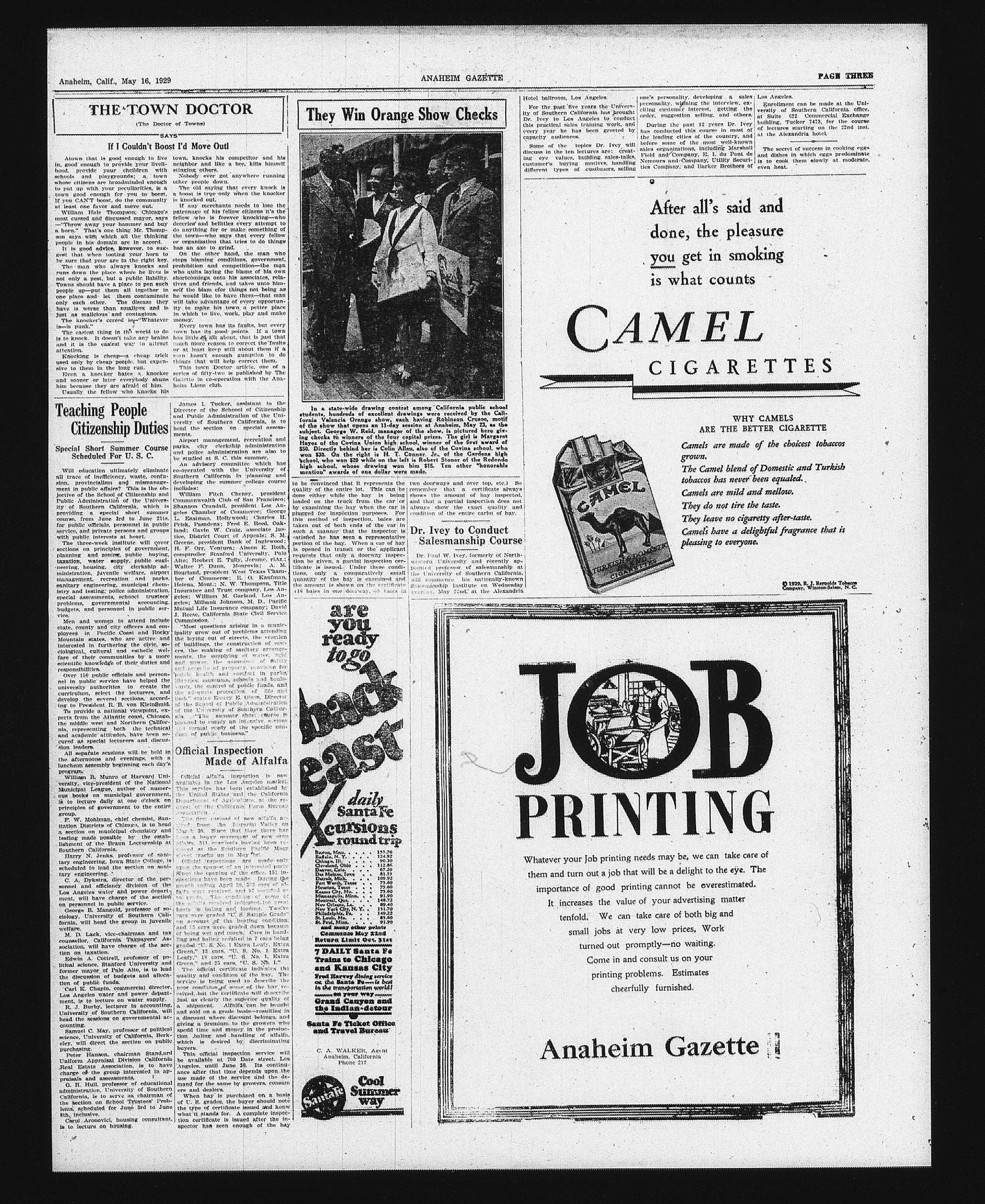
Searchable text
THE TOWN DOCTOR
(The Doctor of Towns)
SAYS
If I Couldn't Boost I'd Move Outl
Atown that is good enough to live in, good enough to provide your livelihood, provide your children with schools and playgrounds; a town whose citizens are broadminded enough to put up with your peculiarities, is a town good enough for you to boost. If you CAN'T boost, do the community at least one favor and move out.
William Hale Thompson; Chicago's most cussed and discussed mayor, says—"Throw away your hammer and buy a horn." That's one thing Mr. Thompson says with which all the thinking people in his domain are in accord.
It is good advice. However, to suggest that when tooting your horn to be sure that your are in the right key.
The man who always knocks and runs down the place where he lives is not only a pest, but a public liability. Towns should have a place to pen such people up—put them all together in one place and let them contaminate only each other. The disease they have is worse than smallpox and is just as malicious and contagious.
The knocker's creed is "Whatever is—is punk."
The easiest thing in the world to do is to knock. It doesn't take any brains and it is the easiest way to attract attention.
Knocking is cheap—a cheap trick used only by cheap people, but expensive to them in the long run.
Even a knocker hates a knocker and sooner or later everybody shuns him because they are afraid of him.
Usually the fellow who knocks his town, knocks his competitor and his neighbor and like a bee, kills himself stinging others.
Nobody ever got anywhere running other people down.
The old saying that every knock is a boost is true only when the knocker is knocked out.
If any merchants needs to lose the patronage of his fellow citizens it's the fellow who is forever knocking—who decries and belittles every attempt to do anything for or make something of the town—who says that every fellow or organization that tries to do things has an axe to grind.
On the other hand, the man who stops blaming conditions, government, prohibition and competition—the man who quits laying the blame of his own shortcomings onto his associates, relatives and friends, and takes unto himself the blame for things not being as he would like to have them—that man will take advantage of every opportunity to make his town a petter place in which to live, work, play and make money.
Every town has its faults, but every town has its good points. If a town has little or nil about, that is just that much more reason to correct the faults or at least keep still about them if a man hasn't enough gumption to do things that will help correct them.
This town Doctor article, one of a series of fifty-two is published by The Gazette in co-operation with the Anaheim Lions club.
Teaching People Citizenship Duties
Special Short Summer Course
James L. Tucker, assistant to the Director of the School of Citizenship and Public Administration of the University of Southern California, is to head the section on special assessments.
Airport management, recreation and parks, city clerkship administration
Knocking is cheap—a cheap trick used only by cheap people, but expensive to them in the long run.
Even a knocker hates a knocker and sooner or later everybody shuns him because they are afraid of him.
Usually the fellow who knocks his
Teaching People Citizenship Duties
Special Short Summer Course Scheduled For U. S. C.
Will education ultimately eliminate all trace of inefficiency, waste, confusion, provincialism and mismanagement in public affairs? This is the objective of the School of Citizenship and Public Administration of the University of Southern California, which is providing a special short summer course, from June 3rd to June 21st, for public officials, personnel in public service, and private persons and groups with public interests at heart.
The three-week institute will cover sections on principles of government, planning and zoning, public buying, taxation, water supply, public engineering, housing, city clerkship administration, juvenile welfare, airport management, recreation and parks, sanitary engineering, municipal chemistry and testing; police administration, special assessments, school trustees' problems, governmental accounting, budgets, and personnel in public service.
Men and women to attend include state, county and city officers and employees in Pacific Coast and Rocky Mountain states, who are active and interested in furthering the civic, sociological, cultural and esthetic welfare of their communities by a more scientific knowledge of their duties and responsibilities.
Over 150 public officials and personnel in public service have helped the university authorities to create the curriculum, select the lecturers, and develop the several sections, according to President R. B. von KleinSmid.
To provide a national viewpoint, experts from the Atlantic coast, Chicago, the middle west and Northern California, representing both the technical and academic attitudes, have been secured as special lecturers and discussion leaders.
All separate sessions will be held in the afternoons and evenings, with a luncheon assembly beginning each day's program.
William B. Munro of Harvard University, vice-president of the National Municipal League, author of numerous books on municipal government, is to lecture daily at one o'clock on principles of government to the entire group.
F. W. Mohlman, chief chemist, Sanitation Districts of Chicago, is to head a section on municipal chemistry and testing made possible by the establishment of the Braun Lectureship at Southern California.
James L. Tucker, assistant to the Director of the School of Citizenship and Public Administration of the University of Southern California, is to head the section on special assessments.
Airport management, recreation and parks, city clerkship administration and police administration are also to be studied at S. C. this summer.
An advisory committee which has co-operated with the University of Southern California in planning and developing the summer college course includes:
William Fitch Cheney, president Commonwealth Club of San Francisco; Shannon Crandall, president Los Angeles Chamber of Commerce; George L. Eastman, Hollywood; Charles H. Prisk, Pasadena; Fred E. Reed, Oakland; Gavin W. Craig, associate Justice; District Court of Appeals; S. M. Greene, president Bank of Inglewood; H. F. Orr, Ventura; Almon E. Roth, comptroller Stanford University; Palo Alto; Reobert E. Tully; Jerome, alz.; Walter F. Dunn, Monrovia; A. M. Bourland, president West Texas Chamber of Commerce; R. O. Kaufman, Helena, Mont.; N. W. Thompson, Title Insurance and Trust company, Los Angeles; William M. Garland, Los Angeles; Milbank Johnson, M. D., Pacific Mutual Life Insurance company; David J. Reese, California State Civil Service Commission.
"Most questions arising in a municipality grow out of problems attending the laying out of streets, the erection of buildings, the construction of sewers, the making of sanitary arrangements, the supplying of water, light and power, the assurance of safety and security of property, provision for public health and comfort in parks, libraries museums schools and boulevards, the control of public funds, and the adequate protection of life and limb," states Emory E. Olson. Director of the School of Public Administration of the University of Southern California.
"The summer short course is planned to supply an intensive serious and formal study of the specific conduct of public business."
Official Inspection Made of Alfalfa
Official alfalfa inspection is now available in the Los Angeles market. This service has been established by the United States and the California Department of Agriculture, at the request of the California Farm Bureau Association.
The first earlof new alfalfa arrived from the Imperial Valley on March 30. Since that time there has been a heavy movement of new crop alfalfa. 116 cowboys having been received at the Southern Pacific Macy
the afternoons and evenings, with a luncheon assembly beginning each day's program.
William B. Munro of Harvard University, vice-president of the National Municipal League, author of numerous books on municipal government, is to lecture daily at one o'clock on principles of government to the entire group.
F. W. Mohlman, chief chemist, Sanitation Districts of Chicago, is to head a section on municipal chemistry and testing made possible by the establishment of the Braun Lectureship at Southern California.
Harry N. Jenks, professor of sanitary engineering, Iowa State College, is scheduled to lead the section on sanitary engineering.
C. A. Dykstra, director of the personnel and efficiency division of the Los Angeles water and power department, will have charge of the section on personnel in public service.
George B. Mangold, professor of sociology, University of Southern California, will head the group in juvenile welfare.
M. D. Lack, vice-chairman and tax counsellor, California Taxpayers' Association, will have charge of the section on taxation.
Edwin A. Cottrell, professor of political science, Stanford University and former mayor of Palo Alto, is to lead the discussion of budgets and allocation of public funds.
Carl K. Chapin, commercial director, Los Angeles water and power department, is to lecture on water supply.
R. J. Burby, lecturer in accounting, University of Southern California, will head the sessions on governmental accounting.
Samuel C. May, professor of political science, University of California, Berkeley, will direct the section on public purchasing.
Peter Hanson, chairman Standard Uniform Appraisal Division California Real Estate Association, is to have charge of the group interested in appraisals and assessments.
O. R. Hull, professor of educational administration, University of Southern California, is to serve as chairman of the section on School Trustees' Problems, scheduled for June 3rd to June 8th, inclusive.
Carol Aronovici, housing consultant, is to lecture on housing.
Official alfalfa inspection is now available in the Los Angeles market. This service has been established by the United States and the California Department of Agriculture, at the request of the California Farm Bureau Association.
The first carload of new alfalfa arrived from the Imperial Valley on March 30. Since that time there has been a heavy movement of new crop alfalfa; 311 acres having been received at the Southern Pacific Macy street track up to May 1st.
Official inspections are made only upon the request of an interested party. Since the opening of the office, 151 inspections have been made. During the month ending April 30, 353 cars of alfalfa were received, and 97 certified to grade. The condition of some of the alfalfa received indicated too great haze in bailing and loading. Twelve cars were graded "U.S. Sample Grade" on account of the heating condition, and 13 cars were graded down because of being wet and tough. Care in handling and baling resulted in 7 cars being graded "U.S. No. 1 Extra Leafy, Extra Green," 13 cars, "U.S. No. 1 Extra Leafy," 18 cars, "U.S. No. 1 Extra Green," and 25 cars, "U.S. No. 1."
The official certificate indicates the quality and condition of the hay. The service is being used to describe the poor condition of some of the hay received, but the certificate will describe just as clearly the superior quality of a shipment. Alfalfa can be bought and sold on a grade basis—resulting in a discount where discount belongs, and giving a premium to the growers who spend time and money in the production, baling and handling of alfalfa, which is desired by discriminating buyers.
This official inspection service will be available at 700 Date street, Los Angeles, until June 30. Its continuance after that time depends upon the use made of the service and the demand for the same by growers, consumers and dealers.
When hay is purchased on a basis of U.S. grades, the buyer should note the type of certificate issued and know what it stands for. A complete inspection certificate is issued after the inspector has seen enough of the hay
They Win Orange Show Checks
In a state-wide drawing contest among California public school students, hundreds of excellent drawings were received by the California Valencia Orange show, each having Robinson Crusoe, motif of the show that opens an 11-day session at Anaheim, May 23, as the subject. George W. Reid, manager of the show, is pictured here giving checks to winners of the four capital prizes. The girl is Margaret Hayes of the Covina Union high school, winner of the first award of $50. Directly behind her is Colin Allen, also of the Covina school, who
In a state-wide drawing contest among California public school students, hundreds of excellent drawings were received by the California Valencia Orange show, each having Robinson Crusoe motif of the show that opens an 11-day session at Anaheim, May 23, as the subject. George W. Reid, manager of the show, is pictured here giving checks to winners of the four capital prizes. The girl is Margaret Hayes of the Covina Union high school, winner of the first award of $50. Directly behind her is Colin Allen, also of the Covina school, who won $30. On the right is H. T. Conner, Jr., of the Gardena high school, who won $20 while on the left is Robert Stoner of the Redondo high school, whose drawing won him $15. Ten other "honorable mention" awards of one dollar were made.
to be convinced that it represents the quality of the entire lot. This can be done either while the hay is being loaded on the truck from the car or by examining the hay when the car is plugged for inspection purposes. For this method of inspection, bales are taken out of both ends of the car in such a manner that the inspector is satisfied he has seen a representative portion of the hay. When a car of hay is opened in transit or the applicant requests that only a doorway inspection be given, a partial inspection certificate is issued. Under these conditions, only a comparatively small quantity of the hay is examined and the amount is shown on the certificate (16 bales in one doorway, 60 bales in two doorways and over top, etc.) So remember that a certificate always shows the amount of hay inspected, and that a partial inspection does not always show the exact quality and condition of the entire carlot of hay.
Dr. Ivey to Conduct Salesmanship Course
Dr. Paul W. Ivey, formerly of Northwestern University and recently appointed professor of salesmanship at the University of Southern California, will commence his nationally-known Salesmanship Institute on Wednesday evening, May 22nd, at the Alexandria.
are you ready to go back east
daily Santa Fe cursions round trip
daily Santa Fe
cursions
round trip
Boston, Mass. 157.76
Buffalo, N.Y. 124.92
Chicago, Ill. 90.30
Cleveland, Ohio 112.86
Danver, Colo. 67.20
Des Moines, Iowa 81.55
Detroit, Mich. 109.92
Fort Worth, Texas 75.60
Houston, Texas 75.60
Kansas City, Mo. 75.60
Minneapolis, Minn. 91.90
Mesquail, Qua. 148.72
New Orleans, La. 89.40
New York City, N.Y. 151.70
Philadelphia, Pa. 149.22
St Louis, Mo. 85.60
St Paul, Minn. 91.90
and many other points
Commence May 22nd
Return Limit Oct. 31st
7 DAILT Santa Fe
Trains to Chicago
and Kansas City
Fred Harvey dining service
on the Santa Fe is best
in the transportation world!
on your way
Grand Canyon and
the Indian-detour
Santa Fe Ticket Office
and Travel Bureau
C. A. WALKELt, Agent
Anaheim, California
Phone 217
SantaFe
Cool Summer way
PRINTI
Whatever your Job printing needs may be, w
them and turn out a job that will be a deligh
importance of good printing cannot be
It increases the value of your advert
tenfold. We can take care of bot
small jobs at very low prices,
turned out promptly—no wait
Come in and consult us on y
printing problems. Estima
cheerfully furnished.
Anaheim Ga
After all’s said and done, the pleasure you get in smoking is what counts
CAMEL CIGARETTES
WHY CAMELS ARE THE BETTER CIGARETTE
Camels are made of the choicest tobaccos
WHY CAMELS ARE THE BETTER CIGARETTE
Camels are made of the choicest tobaccos grown.
The Camel blend of Domestic and Turkish tobaccos has never been equaled.
Camels are mild and mellow.
They do not tire the taste.
They leave no cigarette after-taste.
Camels have a delightful fragrance that is pleasing to everyone.
© 1929, R. J. Reynolds Tobacco Company, Winston-Salem, N. C.
printing needs may be, we can take care of
that will be a delight to the eye. The
printing cannot be overestimated.
value of your advertising matter
can take care of both big and
at very low prices, Work
promptly—no waiting.
and consult us on your
problems. Estimates
meerfully furnished.
Heim Gazette