anaheim-gazette 1929-05-02
Scanned page
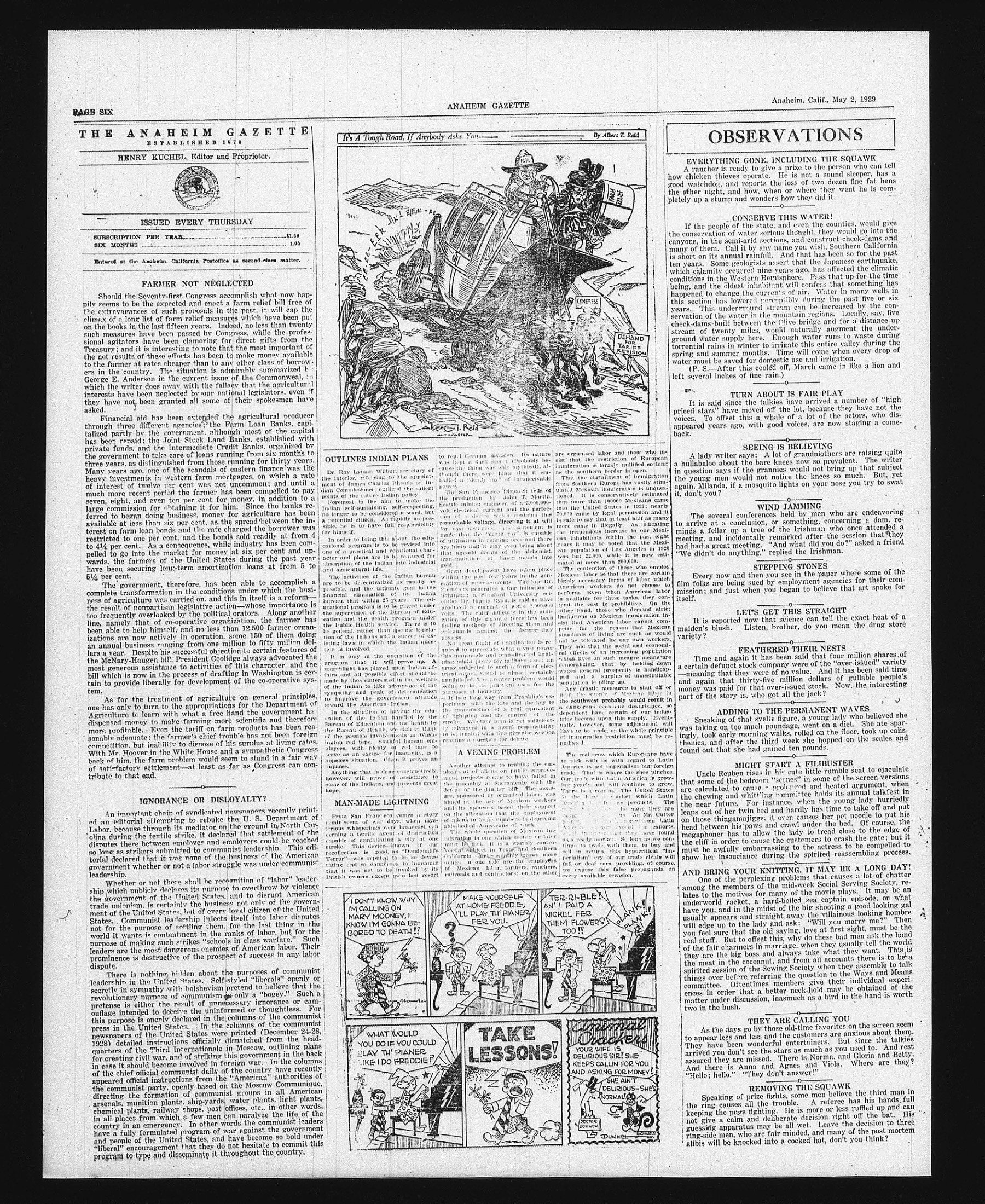
Searchable text
THE ANAHEIM GAZETTE
ESTABLISHED 1870
HENRY KUCHEL, Editor and Proprietor.
ISSUED EVERY THURSDAY
SUBSCRIPTION PER YEAR.....$1.50
SIX MONTHS.....1.00
Entured at the Anaheim, California Postoffice as second-class matter.
FARMER NOT NEGLECTED
Should the Seventy-first Congress accomplish what now happily seems to be the expected and enact a farm relief bill free of the extravagances of such proposals in the past, it will cap the climax of a long list of farm relief measures which have been put on the books in the last fifteen years. Indeed, no less than twenty such measures have been passed by Congress, while the professional agitators have been clamoring for direct gifts from the Treasury; and it is interesting to note that the most important of the net results of these efforts has been to make money available to the farmer at rates cheaper than to any other class of borrowers in the country. The situation is admirably summarized by George E. Anderson in the current issue of the Commonweal, in which the writer does away with the fallacy that the agricultural interests have been neglected by our national legislators, even if they have not been granted all some of their spokesmen have asked.
Financial aid has been extended the agricultural producer through three different agencies: the Farm Loan Banks, capitalized partly by the government, although most of the capital has been repaid; the Joint Stock Land Banks, established with private funds, and the Intermediate Credit Banks, organized by
the net results of these efforts has been to make money available to the farmer at rates cheaper than to any other class of borrowers in the country. The situation is admirably summarized by George E. Anderson in the current issue of the Commonweal, in which the writer does away with the fallacy that the agricultural interests have been neglected by our national legislators, even if they have not been granted all some of their spokesmen have asked.
Financial aid has been extended the agricultural producer through three different agencies; the Farm Loan Banks, capitalized partly by the government, although most of the capital has been repaid; the Joint Stock Land Banks, established with private funds, and the Intermediate Credit Banks, organized by the government to take care of loans running from six months to three years, as distinguished from those running for thirty years. Many years ago, one of the scandals of eastern finance was the heavy investments in western farm mortgages, on which a rate of interest of twelve per cent was not uncommon; and until a much more recent period the farmer has been compelled to pay seven, eight, and even ten per cent for money, in addition to a large commission for obtaining it for him. Since the banks referred to began doing business, money for agriculture has been available at less than six per cent, as the spread between the interest on farm loan bonds and the rate charged the borrower was restricted to one per cent, and the bonds sold readily at from 4 to 4¼ per cent. As a consequence, while industry has been compelled to go into the market for money at six per cent and upwards, the farmers of the United States during the past year have been securing long-term amortization loans at from 5 to 5¼ per cent.
The government, therefore, has been able to accomplish a complete transformation in the conditions under which the business of agriculture was carried on, and this in itself is a reform—the result of nonpartisan legislative action—whose importance is too frequently overlooked by the political orators. Along another line, namely that of co-operative organization, the farmer has been able to help himself, and no less than 12,500 farmer organizations are now actively in operation, some 150 of them doing an annual business ranging from one million to fifty million dollars a year. Despite his successful objection to certain features of the McNary-Haugen bill, President Coolidge always advocated the most generous assistance to activities of this character, and the bill which is now in the process of drafting in Washington is certain to provide liberally for development of the co-operative system.
As for the treatment of agriculture on general principles, one has only to turn to the appropriations for the Department of Agriculture to learn with what a free hand the government has dispensed money to make farming more scientific and therefore more profitable. Even the tariff on farm products has been reasonably adequate; the farmer's chief trouble has not been foreign competition, but inability to disnose of his surplus at living rates. With Mr. Hoover in the White House and a sympathetic Congress back of him, the farm problem would seem to stand in a fair way of satisfactory settlement—at least as far as Congress can contribute to that end.
IGNORANCE OR DISLOYALTY?
An important chain of syndicated newspapers recently printed an editorial attempting to rebuke the U. S. Department of Labor, because through its mediator on the ground in North Carolina during the textile strike, it declared that settlement of the disputes there between emplovers and emplovers could be reached upon as strikers submitted to communist leadership. This edi-
IGNORANCE OR DISLOYALTY?
An important chain of syndicated newspapers recently printed an editorial attempting to rebuke the U.S. Department of Labor, because through its mediator on the ground in North Carolina during the textile strike, it declared that settlement of the disputes there between emplovers and employers could be reached so long as strikers submitted to communist leadership. This editorial declared that it was none of the business of the American government whether or not a labor struggle was under communist leadership.
Whether or not there shall be recognition of "labor" leadership which publicly declares its purpose to overthrow by violence the government of the United States, and to disrupt American trade unionism, is certainly the business not only of the government of the United States, but of every loyal citizen of the United States. Communist leadership injects itself into labor disputes not for the purpose of softling them, for the last thing in the world it wants is contentment in the ranks of labor, but for the purpose of making such strikes "schools in class warfare." Such leaders are the most dangerous enemies of American labor. Their prominence is destructive of the prospect of success in any labor dispute.
There is nothing hidden about the purposes of communist leadership in the United States. Self-styled "liberals" openly or secretly in sympathy with bolshevism pretend to believe that the revolutionary purpose of communism is only a "bogey." Such a pretense is either the result of unnecessary ignorance or camouflage intended to deceive the uninformed or thoughtless. For this purpose is openly declared in the columns of the communist press in the United States. In the columns of the communist newspapers of the United States were printed (December 24-28, 1928) detailed instructions officially dispatched from the headquarters of the Third Internationale in Moscow, outlining plans for creating civil war, and of striking this government in the back in case it should become involved in foreign war. In the columns of the chief official communist daily of the country have recently appeared official instructions from the "American" authorities of the communist party, openly based on the Moscow Communique, directing the formation of communist groups in all American arsenals, munition plants, ship-yards, water plants, light plants, chemical plants, railway shops, post offices, etc., in other words, in all places from which a few men can paralyze the life of the country in an emergency. In other words the communist leaders have a fully formulated program of war against the government and people of the United States, and have become so bold under "liberal" encouragement that they do not hesitate to commit this program to type and disseminate it throughout the country.
ANAHEIM GAZETTE
It's A Tough Road, If Anybody Asks You
By Albert T. Reid
SPECIAL SESSION
CONGRESS
DEMAND FOR TARIFF REVISION
It priced voices appear back.
OUTLINES INDIAN PLANS
Dr. Ray Lyman Wilbur, secretary of the Interior, referring to the appointment of James Charles Pheads as Indian Commissioner, outlined the salient points of the future Indian policy.
Foremost is the aim to make the Indian self-sustaining, self-respecting, no longer to be considered a ward, but a potential citizen. As rapidly as possible, he is to have full responsibility for himself.
In order to bring this about, the educational program is to be revised into one of practical and vocational character and plans are to be featured for absorption of the Indian into industrial and agricultural life.
The activities of the Indian bureau are to be de-centralized as rapidly as possible, and the ultimate goal is the financial elimination of the Indian bureau, that within 25 years. The educational program is to be placed under the supervision of the Bureau of Education and the health program under the Public Health service. There is to be general, rather than specific legislation of the Indians and a survey of existing laws in which the Indian question is involved.
It is only in the operation of the program that it will prove up. A searchlight has played upon Indian affairs and all possible effort should be made by those interested in the welfare of the Indian to take advantage of the sympathy and peak of determination to improve the government attitude toward the American Indian.
In the situation of having the education of the Indian handled by the Bureau of Education and the health by the Bureau of Health, we ought to think of the possible involvement in Washington red tape. Slashful bureau employees, with plenty of red tape to serve as an excuse for inactivity, is a hopeless situation. Often it proves an impasse.
Anything that is done constructively, however, will prove of assistance to some of the Indians, and presents great hope.
MAN-MADE LIGHTNING
From San Francisco comes a story reminiscent of war days, when mysterious whisperings were broadcast concerning a terrible agent of destruction capable of unnibbling a city at one stroke. This device—known if not repel German invasion. Its nature was kept a dark secret (Probably because the thing was only my idea), although there were hints that it embodied a "death ray" of inconceivable power.
The San Francisco Dispatch tells of the production by John T. Martin. Seattle mining engineer, of a 2,000,000-volt electrical current and the perfection of a device which contains this remarkable voltage, directing it at will for vast distances. The statement is made that the "death ray" is capable of utilization in retiring ores and there are hints that it may even bring about that age-old dream of the alchemist, transmutation of laser metals into gold.
Great development have taken place within the post few years in the generation of super-currents. The late Dr. Steinmeyer generated a fair initiation of lightning; a Stanford University scientist, Dr. Harris Ryan, is said to have produced a current of some 2,000,000 volts. The chief difficulty in the utilization of this gigantic force has been finding methods of directing them and safeguards against the danger they possess.
No great flight of imagination is required to appreciate what a vast power this man-made and man-directed lightning might prove for military use: an army subjected to such a form of electrical attack would be almost certainly annihilated. The greater problem would be to be its practical uses for the purposes of industry.
It is a long way from Franklin's experiment with the kite and the key to the manufacture of a real equivalent of lightning and the control of the smoke. Whether man is yet sufficiently advanced in a moral responsibility to be trusted with this gigantic weapon remains a question for debate.
A VEXING PROBLEM
Another attempt to prohibit the employment of all men on public improvement projects seems to have failed in the assembly at Sacramento with the defeat of the dulley bill. The measure, sponsored by organized labor, was aimed at the use of Mexican workers and its sponsors based their support on the allegation that the employment of all men in large numbers is depriving able-bodied Americans of work.
The whole question of Mexican immigration is one which sooner or later must be met. It is a wary controversial subject in Texas and Southern are organized labor and those who insist that the restriction of European immigration is largely nullified so long as the southern border is open.
That the curtailment of immigration from Southern Europe has vastly stimulated Mexican immigration is unquestioned. It is conservatively estimated that more than 100,000 Mexicans came into the United States in 1927; nearly 70,000 came by legal permission and it is safe to say that at least half as many more came in illegally. As indicating the tremendous increase in our Mexican inhabitants within the past eight years it may be noted that the Mexican population of Los Angeles in 1920 was but 22,000, while it is now estimated at more than 200,000.
The contention of those who employ Mexican labor is that there are certain highly necessary forms of labor which American workers do not choose to perform. Even when American labor is available for these tasks, they contend the cost is prohibitive. On other hand, those who demand strict limitations on Mexican immigration insist that American labor cannot compete for the reason that Mexican standards of living are such as would not be tolerated by our own workers. They add that the social and economical effects of an increasing population which lives on such meagre means are demoralizing, that by holding down wages general prosperity is handicapped and a surplus of unassimilable population is piling up.
Any drastic measures to shut off or limit the supply of Mexico labor in the southwest probably would result in a dangerous economic disturbance, so dependent have certain of our industries become upon this supply. Eventually, however, some adjustment will have to be made, or the whole principle of immigration restriction must be repudiated.
The real crow which Europeans have to pick with us with regard to Latin America is not imperialism but foreign trade. That is where the shoe pinches. Our trade with Latin America is growing yearly and will continue to grow. There is a reason. The United States is here at market which Latin America has its products. The more they are being exported from Latin America, our exports list they have found us a ready market. So long as we continue to trade with them, to buy and organize labor and those who insist that the restriction of European immigration is largely nullified so long as the southern border is open.
That the curtailment of immigration from Southern Europe has vastly stimulated Mexican immigration is unquestioned. It is conservatively estimated that more than 100,000 Mexicans came into the United States in 1927; nearly 70,000 came by legal permission and it is safe to say that at least half as many more came in illegally. As indicating the tremendous increase in our Mexican inhabitants within the past eight years it may be noted that the Mexican population of Los Angeles in 1920 was but 22,000, while it is now estimated at more than 200,000.
The contention of those who employ Mexican labor is that there are certain highly necessary forms of labor which lives on such meagre means are demoralizing, that by holding down wages general prosperity is handicapped and a surplus of unassimilable population is piling up.
Any drastic measures to shut off or limit the supply of Mexico labor in the southwest probably would result in a dangerous economic disturbance, so dependent have certain of our industries become upon this supply. Eventually, however, some adjustment will have to be made, or the whole principle of immigration restriction must be repudiated.
The real crow which Europeans have to pick with us with regard to Latin America is not imperialism but foreign trade. That is where the shoe pinches. Our trade with Latin America is growing yearly and will continue to grow. There is a reason. The United States is here at market which Latin America has its products. The more they are being exported from Latin America, our exports list they have found us a ready market. So long as we continue to trade with them, to buy and organize labor and those who insist that the restriction of European immigration is largely nullified so long as the southern border is open.
That the curtailment of immigration from Southern Europe has vastly stimulated Mexican immigration is unquestioned. It is conservatively estimated that more than 100,000 Mexicans came into the United States in 1927; nearly 70,000 came by legal permission and it is safe to say that at least half as many more came in illegally. As indicating the tremendous increase in our Mexican inhabitants within the past eight years it may be noted that the Mexican population of Los Angeles in 1920 was but 22,000, while it is now estimated at more than 200,000.
The contention of those who employ Mexican labor is that there are certain highly necessary forms of labor which lives on such meagre means are demoralizing, that by holding down wages general prosperity is handicapped and a surplus of unassimilable population is piling up.
Any drastic measures to shut off or limit the supply of Mexico labor in the southwest probably would result in a dangerous economic disturbance, so dependent have certain of our industries become upon this supply. Eventually, however, some adjustment will have to be made, or the whole principle of immigration restriction must be repudiated.
The real crow which Europeans have to pick with us with regard to Latin America is not imperialism but foreign trade. That is where the shoe pinches. Our trade with Latin America is growing yearly and will continue to grow. There is a reason. The United States is here at market which Latin America has its products. The more they are being exported from Latin America, our exports list they have found us a ready market. So long as we continue to trade with them, to buy and organize labor and those who insist that the restriction of European immigration is largely nullified so long as the southern border is open.
That the curtailment of immigration from Southern Europe has vastly stimulated Mexican immigration is unquestioned. It is conservatively estimated that more than 100,000 Mexicans came into the United States in 1927; nearly 70,000 came by legal permission and it is safe to say that at least half as many more came in illegally. As indicating the tremendous increase in our Mexican inhabitants within the past eight years it may be noted that the Mexican population of Los Angeles in 1920 was but 22,000, while it is now estimated at more than 200,000.
The contention of those who employ Mexican labor is that there are certain highly necessary forms of labor which lives on such meagre means are demoralizing, that by holding down wages general prosperity is handicapped and a surplus of unassimilable population is piling up.
Any drastic measures to shut off or limit the supply of Mexico labor in the southwest probably would result in a dangerous economic disturbance, so dependent have certain of our industries become upon this supply. Eventually, however, some adjustment will have to be made, or the whole principle of immigration restriction must be repudiated.
The real crow which Europeans have to pick with us with regard to Latin America is not imperialism but foreign trade. That is where the shoe pinches. Our trade with Latin America is growing yearly and will continue to grow. There is a reason. The United States is here at market which Latin America has its products. The more they are being exported from Latin America, our exports list they have found us a ready market. So long as we continue to trade with them, to buy and organize labor and those who insist that the restriction of European immigration is largely nullified so long as the southern border is open.
That the curtailment of immigration from Southern Europe has vastly stimulated Mexican immigration is unquestioned. It is conservatively estimated that more than 100,000 Mexicans came into the United States in 1927; nearly 70,000 came by legal permission and it is safe to say that at least half as many more came in illegally. As indicating the tremendous increase in our Mexican inhabitants within the past eight years it may be noted that the Mexican population of Los Angeles in 1920 was but 22,000, while it is now estimated at more than 200,000.
The contention of those who employ Mexican labor is that there are certain highly necessary forms of labor which lives on such meagre means are demoralizing, that by holding down wages general prosperity is handicapped and a surplus of unassimilable population is piling up.
Any drastic measures to shut off or limit the supply of Mexico labor in the southwest probably would result in a dangerous economic disturbance, so dependent have certain of our industries become upon this supply. Eventually, however, some adjustment will have to be made, or the whole principle of immigration restriction must be repudiated.
The real crow which Europeans have to pick with us with regard to Latin America is not imperialism but foreign trade. That is where the shoe pinches. Our trade with Latin America is growing yearly and will continue to grow. There is a reason. The United States is here at market which Latin America has its products. The more they are being exported from Latin America, our exports list they have found us a ready market. So long as we continue to trade with them, to buy and organize labor and those who insist that the restriction of European immigration is largely nullified so long as the southern border is open.
That the curtailment of immigration from Southern Europe has vastly stimulated Mexican immigration is unquestioned. It is conservatively estimated that more than 100,000 Mexicans came into the United States in 1927; nearly 70,000 came by legal permission and it is safe to say that at least half as many more came in illegally. As indicating the tremendous increase in our Mexican inhabitants within the past eight years it may be noted that the Mexican population of Los Angeles in 1920 was but 22,000, while it is now estimated at more than 200,000.
The contention of those who employ Mexican labor is that there are certain highly necessary forms of labor which lives on such meagre means are demoralizing, that by holding down wages general prosperity is handicapped and a surplus of unassimilable population is piling up.
Any drastic measures to shut off or limit the supply of Mexico labor in the southwest probably would result in a dangerous economic disturbance, so dependent have certain of our industries become upon this supply. Eventually, however, some adjustment will have to be made, or the whole principle of immigration restriction must be repudiated.
The real crow which Europeans have to pick with us with regard to Latin America is not imperialism but foreign trade. That is where the shoe pinches. Our trade with Latin America is growing yearly and will continue to grow. There is a reason. The United States is here at market which Latin America has its products. The more they are being exported from Latin America, our exports list they have found us a ready market. So long as we continue to trade with them, to buy and organize labor and those who insist that the restriction of European immigration is largely nullified so long as the southern border is open.
That the curtailment of immigration from Southern Europe has vastly stimulated Mexican immigration is unquestioned. It is conservatively estimated that more than 100,000 Mexicans came into the United States in 1927; nearly 70,000 came by legal permission and it is safe to say that at least half as many more came in illegally. As indicating the tremendous increase in our Mexican inhabitants within the past eight years it may be noted that the Mexican population of Los Angeles in 1920 was but 22,000, while it is now estimated at more than 200,
MAN-MADE LIGHTNING
From San Francisco comes a story reminiscent of war days, when mysterious whisperings were broadcast concerning a terrific agent of destruction capable of annihilating a city at one stroke. This device—known if our recollection is good, as "Dundonah's Terror"—was reputed to be so devastating and so dangerous to humanity that it was not to be invoked by its British owners except as a last resort.
Another attempt to prohibit the employment of aliens on public improvement projects seems to have failed in the assembly at Sacramento with the defeat of the ducky bill. The measure, sponsored by organized labor, was aimed at the use of Mexican workers and its sponsors based their support on the allegation that the employment of aliens in large numbers is depriving able-bodied Americans of work.
The whole question of Mexican immigration is one which sooner or later must be mistaken. It is a warmly contemptuous subject in Texas and Southern California and monthly grows more acute, a one ride are the employers of Mexican labor, farmers, rancher, railroads and contractors; on the other pick with us with regard to Latin America is not imperialism but foreign trade. That is where the shoe pinches. Our trade with Latin America is growing yearly and will continue to grow. There is a reason. The United States is the largest market which Latin America exports. When imports fail they have found us a租ely market. So long as we continue to trade with them, to buy and sell in return, this hypocritical "imperialism" cry of our trade rivals will fall on deaf ears, providing, of course, we expose this false propaganda on every available occasion.
I DON'T KNOW WHY I'M CALLING ON MARY MOONEY, I KNOW I'M GONNA BE BORED TO DEATH!!
MAKE YOURSELF AT HOME FREDDIE, ILL PLAY TH' PIANER FER YOU.
TER-RI-BLE! AN' I PAID A NICKEL FER THEM FLOWERS TOO!!
WHAT WOULD YOU DO IF YOU COULD PLAY TH' PIANER LIKE I DO FREDDIE?
TAKE LESSONS!
Journal Clockwise
YOUR WIFE IS DELIRIOUS SIR! SHE KEEPS CALLIN' FOR YOU AND ASKING FOR MONEY!
SHE AIN'T DELIRIOUS-SHE'S NORMAL!
DOCTOR BOW WOW!
DUNKEL
OBSERVATIONS
EVERYTHING GONE, INCLUDING THE SQUAWK
A rancher is ready to give a prize to the person who can tell how chicken thieves operate. He is not a sound sleeper, has a good watchdog, and reports the loss of two dozen fine fat hens the other night, and how, when or where they went he is completely up a stump and wonders how they did it.
CONSERVE THIS WATER!
If the people of the state, and even the counties, would give the conservation of water serious thought, they would go into the canyons, in the semi-arid sections, and construct check-dams and many of them. Call it by any name you wish, Southern California is short on its annual rainfall. And that has been so for the past ten years. Some geologists assert that the Japanese earthquake, which calamity occurred nine years ago, has affected the climatic conditions in the Western Hemisphere. Pass that up for the time being, and the oldest inhabitant will confess that something has happened to change the currents of air. Water in many wells in this section has lowered perceptibly during the past five or six years. This underground stream can be increased by the conservation of the water in the mountain regions. Locally, say, five check-dams-built between the Olive bridge and for a distance up stream of twenty miles, would naturally augment the underground water supply here. Enough water runs to waste during torrential rains in winter to irrigate this entire valley during the spring and summer months. Time will come when every drop of water must be saved for domestic use and irrigation.
(P. S.—After this cooled off, March came in like a lion and left several inches of fine rain.)
TURN ABOUT IS FAIR PLAY
It is said since the talkies have arrived a number of "high priced stars" have moved off the lot, because they have not the voices. To offset this a whale of a lot of the actors, who disappeared years ago, with good voices, are now staging a comeback.
SEEING IS BELIEVING
TURN ABOUT IS FAIR PLAY
It is said since the talkies have arrived a number of "high priced stars" have moved off the lot, because they have not the voices. To offset this a whale of a lot of the actors, who disappeared years ago, with good voices, are now staging a comeback.
SEEING IS BELIEVING
A lady writer says: A lot of grandmothers are raising quite a hullabaloo about the bare knees now so prevalent. The writer in question says if the grannies would not bring up that subject the young men would not notice the knees so much. But, yet again, Milanda, if a mosquito lights on your nose you try to swat it, don't you?
WIND JAMMING
The several conferences held by men who are endeavoring to arrive at a conclusion, or something, concerning a dam, reminds a fellar up a tree of the Irishman who once attended a meeting, and incidentally remarked after the session that they had had a great meeting. "And what did you do?" asked a friend "We didn't do anything," replied the Irishman.
STEPPING STONES
Every now and then you see in the paper where some of the film folks are being sued by employment agencies for their commission; and just when you began to believe that art spoke for itself.
LET'S GET THIS STRAIGHT
It is reported now that science can tell the exact heat of a maiden's blush. Listen, brother, do you mean the drug store variety?
FEATHERED THEIR NESTS
Time and again it has been said that four million shares of a certain defunct stock company were of the "over issued" variety —meaning that they were of no value. And it has been said time and again that thirty-five million dollars of gullable people's money was paid for that over-issued stock. Now, the interesting part of the story is, who got all the jack?
ADDING TO THE PERMANENT WAVES
Speaking of that svelte figure, a young lady who believed she was taking on too much poundage, went on a diet. She ate sparingly, took early morning walks, rolled on the floor, took up calisthenics, and after the third week she hopped on the scales and found out that she had gained ten pounds.
MIGHT START A FILIBUSTER
Uncle Reuben rises in his cute little rumble seat to ejaculate that some of the bedroom "scenes" in some of the screen versions are calculated to cause a prolonged and heated argument, when the chewing and whitening committee holds its annual talkfest in the near future. For instance, when the young lady hurriedly leaps out of her twin bed and hardly has time to take off and put on those thingamajiggs, it even causes her pet poodle to put his head between his paws and crawl under the bed. Of course, the megaphoner has to allow the lady to tread close to the edge of the cliff in order to cause the customers to crash the gate; but it must be awfully embarrassing to the actress to be compelled to
MIGHT START A FILIBUSTER
Uncle Reuben rises in his cute little rumble seat to ejaculate that some of the bedroom "scenes" in some of the screen versions are calculated to cause a prolonged and heated argument, when the chewing and whitting committee holds its annual talkfest in the near future. For instance, when the young lady hurriedly leaps out of her twin bed and hardly has time to take off and put on those thingamajiggs, it even causes her pet poodle to put his head between his paws and crawl under the bed. Of course, the megaphoner has to allow the lady to tread close to the edge of the cliff in order to cause the customers to crash the gate; but it must be awfully embarrassing to the actress to be compelled to show her insouciance during the spirited reassembling process.
AND BRING YOUR KNITTING. IT MAY BE A LONG DAY!
One of the perplexing problems that causes a lot of chatter among the members of the mid-week Social Serving Society, relates to the motives for many of the movie plays. It may be an underworld racket, a hard-boiled sea captain episode, or what have you, and in the midst of the big shooting a good looking gal usually appears and straight away the villainous looking hombre will edge up to the lady and ask: "Will you marry me?" Then you feel sure that the old saying, love at first sight, must be the real stuff. But to offset this, why do these bad men ask the hand of the fair charmers in marriage, when they usually tell the world they are the big boss and always take what they want. This is the meat in the cocoonnut, and from all accounts there is to be a spirited session of the Sewing Society when they assemble to talk things over before referring the question to the Ways and Means committee. Often times members give their individual experiences in order that a better neck-hold may be obtained of the matter under discussion, inasmuch as a bird in the hand is worth two in the bush.
THEY ARE CALLING YOU
As the days go by those old-time favorites on the screen seem to appear less and less and the customers are anxious about them. They have been wonderful entertainers. But since the talkies arrived you don't see the stars as much as you used to. And rest assured they are missed. There is Norma, and Gloria and Betty. And there is Anna and Agnes and Viola. Where are they? "Hello; hello." "They don't answer!"
REMOVING THE SQUAWK
Speaking of prize fights, some men believe the third man in the ring causes all the trouble. A referee has his hands full keeping the pugs fighting. He is more or less ruffled up and can not give a calm and deliberate decision right off the bat. His guessing apparatus may be all wet. Leave the decision to three ring-side men, who are fair minded, and many of the post mortem alibis will be knocked into a cocked hat, don't you think?