anaheim-gazette 1929-04-25
Scanned page
Searchable text
THE TOWN DOCTOR
(The Doctor of Towns)
SAYS
They spend much time and money trying to attract new business when they are not getting all there is to get out of the business they already have.
There is, in the advertising business, what is called the "Golden Triangle" of every mercantile establishment. It is that space in front of the store where people who pass can see the store entrance and the windows. It is the vital point in every retail business; for no merchant can sell his wares (excluding mail order and telephone orders) unless the people come into the store. The advertising to reach the area so named is what is called "Point of Purchase" advertising. Its purpose is to stop the passerby, which is the one big reason for show windows and window displays. Through this medium the merchant attempts to attract attention, then create a desire to enter the store. American people buy by eye—what the eye doesn't see the heart doesn't fancy.
Towns are exactly like stores in this general respect. If a town got all of the business from the traffic it already has, it is ten to one that it would never have to spend any money for additional business. But as long as there are towns, and the people in them remain human, they will probably continue to go out after more customers when they have not got all there is to be had from the traffic they already have.
Let us take automobile traffic as one angle of revenue or business for a town. Every strange automobile that passes through your city is worth a goodly sum—much more than most people think—but you must stop the car and get the passengers out of it, if you are going to get their business. Twenty per cent of those people who tour by motor car are in the market for or can be sold a new location. Every motorist can be made to be the cause for more motorists coming to your town. An analysis of this means of town income shows many surprising facts, chief of which is first that very few towns recognize the business that can be had from it.
One morning a few years ago I left Chicago very early for points east. To save time and avoid traffic I took a back road, but much to my chagrin I encountered a freight train whose engineer evidently had no place to go and was in no hurry to get there. The half hour that I was delayed I have never regretted, for while waiting there I saw that which to me was, is and always will be a picture in life of wonderful significance.
Just inside the fence from where I sat parked lay a calf of less than six months of age, lazily dozing in the morning sunshine. The morning was warm and the files were more than numerous. Around the calf were many goslings, one of which was some five feet or more away, lazily sunning himself with eyes half open, but occasionally rousing sufficiently to pick off a fly that came unsuspectingly close enough. Another little fellow had settled himself directly adjacent to and up against that which soon would be someone's veal steak, and was fast asleep. Had the calf moved, one little duck would have been no more. Two other little downy ones with much vim and quacking endurance were chasing their fool legs off trying to run down, overtake and devour elusive insects that were far too clever for them—BUT—there was another little duck standing at that portion of the reclining calf anatomy where swish of tail and toe of head failed to disturb him, picking hundreds of files off the calf's back—in other words, taking advantage of an opportunity.
To me the calf was a highway, the files were motorists, and the goslings were towns, each in a true-to-form stage of wakefulness, activity and resourcefulness.
Your town is one of those ducks.
Copyright, 1929, A. D. Stone. Reproduction prohibited in whole or in part.
This Town Doctor article is published by the Gazette in co-operation with the Lions Club.
Another Menace To the Grower
Texas Root Rot Causing the Growers Much Concern
In the case of Texas Root Rot, we have a scourge that has not yielded to any curtural or curative practices in spite of the fact that thousands of dollars are spent annually by leaders in plant disease work in a study of this disease. During the last 40 years several curtural practices have been suggested that afford hope, but little control has resulted from their use. The leading suggestion at present is not to plant susceptible crops on infested land. If we are going to be held to this method, the spread of the disease will gradually prevent us from growing cotton, alfalfa, most vegetables and deciduous fruits on our best lands. Texas Root Rot has been known to plant disease experts as a very serious disease to cotton, alfalfa and many other plants for over 40 years. Within recent years the damage to the cotton crop of Texas alone has been conservatively estimated at over 600-800 bales in one season. The disease is known to exist in Texas, Oklahoma, Arkansas, New Mexico, Arizona and Northern Mexico, including Daja California, and is also found along the narrow alluvial strip in southeastern California along the Colorado river. The most important development in recent years showing that this disease will spread into California's best lands has been the discovery last year of a small area of authentic Texas Root Rot on the grounds of the Federal Date Garden at Indio. This one isolated spot means much to us, for it shows definitely what we may expect over a large part of California if no control of the spread of this disease is afforded by quarantine regulations.
At present we know rather definitely that this disease is caused by a soil fungus known as Phymatotrichum Omnivorum. It is rather interesting that after all these 40 years we are still uncertain as to the complete life history of this rather obscure parasite, able to live only on living plant material in moist soil. While the life history studies are being completed by the eminent scientists, it seems that it might be advisable for he waiting regulatory forces to resort to quarantine from regions known to have the disease should be watched carefully for signs of wilting plants. The following list of plants susceptible to Texas Root Rot is given to furnish an idea of the danger to our agriculture.
Susceptible fruit and nut trees, vines and shrubs include: Grape, persimmon, gooseberry, fig, apple, peach, pear raspberry, walnut, chestnut, pistache, Jujube. Ornamental trees and shrubs include: Maple, pine, ash, privet, poplar, willow, some oaks and elms, rose, spirea. Important farm and garden crops attacked include: Beet, spinach, lettuce, salsify, sweet potato, cabbage and related plants, beans, cowpeas, alfalfa, clover, cotton, okra, eggplant, tomato, carrot, parsley, hemp and many others.
Weeds susceptible to root rot are numerous but the following can be listed as most important: Cocklehurt ragweed, lamb's quarter, wild lettuce, sow thistle, morning glory, mustard, sweet clover, malva and its relatives.
Among the plants that can be considered immune to Texas Root Rot are practically all members of the grass family, including grains, sorghums, forage grasses, etc.; palms, yuccas, cacti, flowering bulbs, cannas, etc.; pecans, melons, squashes and related plants, onions, asparagus and strawberries.
If, as it seems best at present, quarantine regulations to control the spread of Texas Root Rot be issued just what should be included in the regulations? The movement of soil-growing plants, manure, plant refuse, etc., from infected territory should be restricted or prohibited until it is definitely shown that the disease cannot be spread in that way. It is apparent that ordinary travel from infected regions to disease free regions does not spread the disease. There is some definite way the disease spreads from region to region and it is this method of spread that should be stopped by quarantine. Until we know just how the disease is scattered it is better to cover all possible sources than to let the disease break through some unguarded opening. Let us lock the door before any more horses are stolen.
Water Company Directors Meet
The regular meeting of the Board of Directors of the Anahela Union Water company was held Monday with Directors Annin Brunworth, Mil-
Water Company Directors Meet
The regular meeting of the Board of Directors of the Anahela Union Water company was held Monday, with Directors Annin, Brunworth, Miller, Thamer and Tuffree present at roll call. Directors Hale and Hansen absent. In the absence of President Hale, Vice-President Tuffree took the chair.
Minutes of the last regular meeting were read and approved.
Superintendent's report was read and upon motion by Thamer, seconded by Miller, was accepted and ordered filed.
Upon motion warrants were ordered drawn in the following amounts:
Standard Oil Co., $147.88; R. W. Sparling, $10.68; Pay Roll account, $6.000;
California Corrugated Culvert Co., $56.81; J. C. Lamb, tax collector, $3.032.26; Southern Counties Gas Co., $2.04; Pacific Telephone Co., "P." $52.20; Pacific Telephone Co., "F." $8.90; Pacific Telephone Co., "A." $22.60; Snow Manufacturing Co., $171.20.
Superintendent Wallop reported that Crowther No. 6 well was perforated, that the derrick was being constructed preparatory to installing the pump.
Attorney Head reported on the motion of the attorneys representing the S. A. R. D. Co. et al to dismiss suit filed by the Moreno Mutual Irrigation company against the S. A. R. D. Co. et al, in the Riverside county superior court.
Oil production reports for the month of March were read and upon motion accepted and ordered filed.
Upon motion by Annin, seconded by Miller, President, or Vice-President and secretary instructed to sign the A. T. & S. F. Railway company license.
ANAHEIM GAZETTE
for the installation of a 36-inch pipe line under the railway tracks on the South Branch Ditch, Fullerton. The warrant for $5 to be issued the railway company for license fee.
Upon motion by Thamer, seconded by Annin, vice-president and secretary instructed to sign map of a portion of the Rivas and Y. Y. de Cota Allotment, as submitted by Engineer McBride.
Upon motion by Director Thamer, seconded by Director Annin, the following resolution was unanimously adopted:
"RESOLVED: That this corporation lease to W. H. Bell of Taft, California, the premises described in the lease now before the Board of Directors for a term of twenty-five (25) years from the 9th day of April, 1929,
and so long thereafter as oil, gas, asphaltum, or other hydrocarbon substances are produced in paying quantities thereof, upon the terms and conditions expressed in said lease, now before the Board of Directors and approved by it;
"AND BE IT FURTHER RESOLVED: That the president, or vice-president, and secretary of this corporation be, and they are hereby authorized and empowered to execute said lease in the name of this corporation, and to affix the seal of this corporation thereto, and to do and perform such other acts and deeds as may be necessary for the purpose of carrying this resolution into effect."
It may be true, as Shakespeare said, that all the world is a stage, but you can't get by with stage money.
Water Measurement Explained Over KFI
Beginning each day at 12 p.m., and continuing ten minutes talks of interest to farmers growers and producers will be given during the week beginning April 29 under the auspices of the Agricultural Extension Service co-operating with radio station KFI, as follows:
April 29—"Water Measurement" W. M. Cory, assistant farm advisor, Orange county.
April 30—"Propagation of Native Shrubs and Flowers," G. A. Turnbull.
May 1—"Control of Jack Rabbitts by Community Drives,55 Loren S. Neville deputy horticultural commissioner, Los Angeles county.
May 2—"The Value of Our Moun-
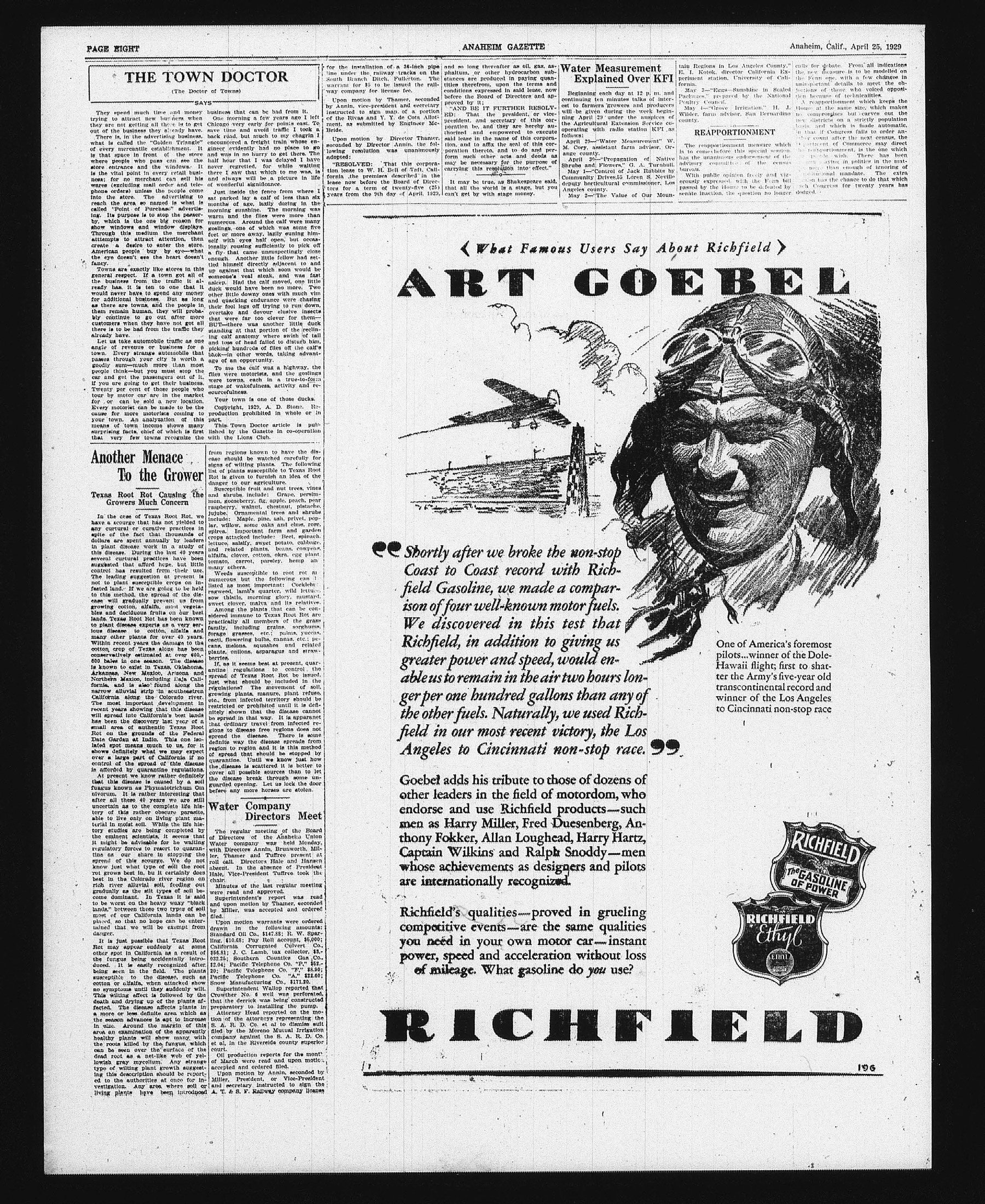
What Famous Users Say About ART GOE
Shortly after we broke the non-stop Coast to Coast record with Richfield Gasoline, we made a comparison of four well-known motor fuels. We discovered in this test that Richfield, in addition to giving us greater power and speed, would enable us to remain in the air two hours longer per one hundred gallons than any of the other fuels. Naturally, we used Richfield in our most recent victory, the Los Angeles to Cincinnati non-stop race.
Goebel adds his tribute to those of dozens of other leaders in the field of motordom, who endorse and use Richfield products—such men as Harry Miller, Fred Duesenberg, Anthony Fokker, Allan Loughead, Harry Hartz,
Goebel adds his tribute to those of dozens of other leaders in the field of motordom, who endorse and use Richfield products—such men as Harry Miller, Fred Duesenberg, Anthony Fokker, Allan Loughead, Harry Hartz, Captain Wilkins and Ralph Snoddy—men whose achievements as designers and pilots are internationally recognized.
Richfield's qualities—proved in grueling competitive events—are the same qualities you need in your own motor car—instant power, speed and acceleration without loss of mileage. What gasoline do you use?
RICHFIELD
Measurement and Over KFI
May at 12 p.m. and minutes talks of interservers and producers
the week beginer the auspices of extension Service college station KFI as
Measurement" W. farm advisor, Organization of Native
Residents," G. A. Turnbull,
of Jack Rabbits by
55 Loren S. Neville
commissioner, Los
value of Our Mountain Regions in Los Angeles County."
E. I. Kotok, director California Experiment station, University of California.
May 3—"Eggs—Sunshine in Sealed Packages," prepared by the National Poultry Council.
May 4—"Grove Irrigation," H. J. Wilder, farm advisor, San Bernardino county.
REAPPORTIONMENT
The reapportionment measure which is to come before this special session has the unanimous endorsement of the advisory committee of the census bureau.
With public opinion freely and vigorously expressed with the Fann bill passed by the House to be defeated by senate inaction, the question no longer calls for debate. From all indications the new measure is to be modelled on the Fann one, with a few changes in unimportant details to meet the objections of those who voiced opposition because of technicalities.
A reapportionment which keeps the House at the same size, which makes no compromises but carves out the new districts on a strictly population basis and which is made automatic, in that if Congress fails to order another count after the next census, the Department of Commerce may direct the reapportionment, is the one which people wish. There has been much playing in politics in the matter more than enough of ignoring institutional mandate. The extra season has the chance to do that which each Congress for twenty years has dodged.
One of America's foremost pilots...winner of the Dole-Hawaii flight; first to shatter the Army's five-year old transcontinental record and winner of the Los Angeles to Cincinnati non-stop race
RICHFIELD
The GASOLINE OF POWER
RICHFIELD
Ethyl
ETHYL
FIELD
196