anaheim-gazette 1929-04-25
Scanned page
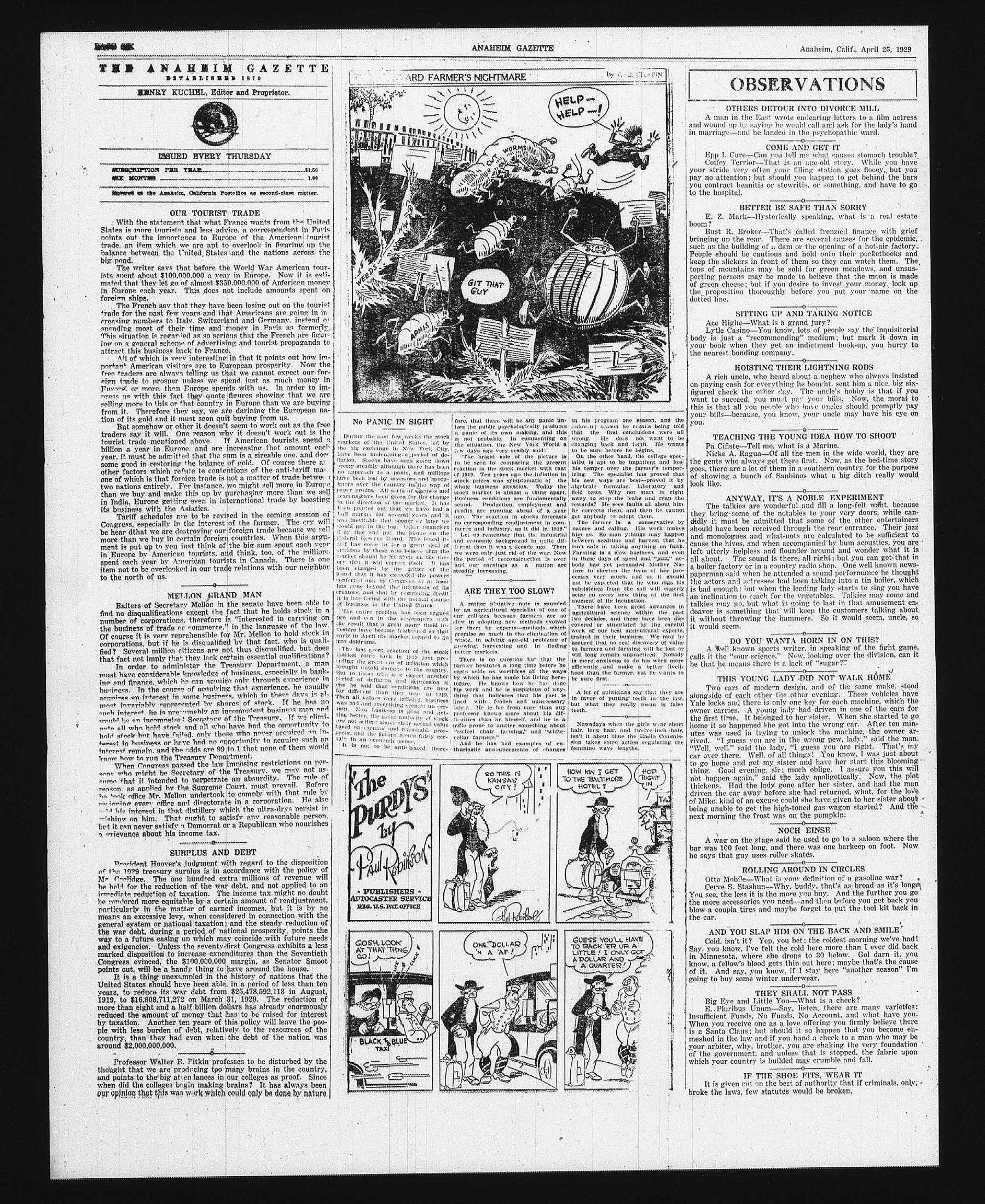
Searchable text
THE ANAHEIM GAZETTE
ESTABLISHED 1870
HENRY KUCHEL, Editor and Proprietor.
ISSUED EVERY THURSDAY
SUBSCRIPTION PER YEAR.....$1.50
OCT MONTH.....1.00
Entered at the Anaheim, California Postoffice as second-class matter.
OUR TOURIST TRADE
With the statement that what France wants from the United States is more tourists and less advice, a correspondent in Paris points out the importance to Europe of the American tourist trade, an item which we are apt to overlook in figuring up the balance between the United States and the nations across the big pond.
The writer says that before the World War American tourists spent about $100,000,000 a year in Europe. Now it is estimated that they let go of almost $350,000,000 of American money in Europe each year. This does not include amounts spent on foreign ships.
The French say that they have been losing out on the tourist trade for the past few years and that Americans are going in increasing numbers to Italy, Switzerland and Germany, instead of spending most of their time and money in Paris as formerly. This situation is regarded as so serious that the French are figuring on a general scheme of advertising and tourist propaganda to attract this business back to France.
All of which is very interesting in that it points out how important American visitors are to European prosperity. Now the free traders are always telling us that we cannot expect our foreign trade to prosper unless we spend just as much money in Europe or more than Europe spends with us. In order to impress us with this fact they quote figures showing that we are selling more to this or that country in Europe than we are buying from it. Therefore they say, we are darining the European nation of its gold and it must soon quit buying from us.
But somehow or other it doesn't seem to work out as the free traders say it will. One reason why it doesn't work out is the tourist trade mentioned above. If American tourists spend a billion a year in Europe and are increasing that amount each
All of which is very interesting in that it points out how important American visitors are to European prosperity. Now the free traders are always telling us that we cannot expect our foreign trade to prosper unless we spend just as much money in Europe, or more than Europe spends with us. In order to impress us with this fact they quote figures showing that we are selling more to this or that country in Europe than we are buying from it. Therefore they say, we are darining the European nation of its gold and it must soon quit buying from us.
But somehow or other it doesn't seem to work out as the free traders say it will. One reason why it doesn't work out is the tourist trade mentioned above. If American tourists spend a billion a year in Europe, and are increasing that amount each year, it must be admitted that the sum is a sizeable one, and does some good in restoring the balance of gold. Of course there are other factors which refute te contentions of the anti-tariff man one of which is that foreign trade is not a matter of trade between two nations entirely. For instance, we might sell more in Europe than we buy and make this up by purchasing more than we sell in India, Europe getting even in international trade by boosting its business with the Asiatics.
Tariff schedules are to be revised in the coming session of Congress, especially in the interest of the farmer. The cry will be hear dthat we are destroying our foreign trade because we sell more than we buy in certain foreign countries. When this argument is put up to you just think of the big sum spent each year in Europe by American tourists, and think, too, of the millions spent each year by American tourists in Canada. There is one item not to be overlooked in our trade relations with our neighbor to the north of us.
MELLON GRAND MAN
Baiters of Secretary Mellon in the senate have been able to find no disqualifications except the fact that he holds stock in a number of corporations, therefore is "interested in carrying on the business of trade or commerce," in the language of the law. Of course it is very reprehensible for Mr. Mellon to hold stock in corporations, but if he is disqualified by that fact, who is qualified? Several million citizens are not thus disqualified, but does that fact not imply that they lack certain essential qualifications?
In order to administer the Treasury Department, a man must have considerable knowledge of business, especially in banking and finance, which he can acquire only through experience in business. In the course of acquiring that experience, he usually acquires an interest in some business, which in these days is almost invariably represented by shares of stock. If he has no such interest, he is presumably an incompetent business man and would be an incompetent Secretary of the Treasury. If we eliminate all who hold stock and all who have had the opportunity to hold stock but have failed, only those who never acquired an interest in business or have had no opportunity to acquire such an interest remain, and the odds are 99 to 1 that none of them would know how to run the Treasury Department.
When Congress passed the law imposing restrictions on persons who might be Secretary of the Treasury, we may not assume that it intended to perpetrate an absurdity. The rule of reason, as applied by the Supreme Court, must prevail. Before he took office Mr. Mellon undertook to comply with that rule by resigning every office and directorate in a corporation. He also sold his interest in that distillery which the ultra-drys persist in wishing on him. That ought to satisfy any reasonable person, but it can never satisfy a Democrat or a Republican who nourishes a grievance about his income tax.
When Congress passed the law imposing restrictions on persons who might be Secretary of the Treasury, we may not assume that it intended to perpetrate an absurdity. The rule of reason, as applied by the Supreme Court, must prevail. Before he took office Mr. Mellon undertook to comply with that rule by requiring every office and directorate in a corporation. He also held his interest in that distillery which the ultra-drys persist in wishing on him. That ought to satisfy any reasonable person, but it can never satisfy a Democrat or a Republican who nourishes a grievance about his income tax.
SURPLUS AND DEBT
President Hoover's judgment with regard to the disposition of the 1929 treasury surplus is in accordance with the policy of Mr. Coolidge. The one hundred extra millions of revenue will be held for the reduction of the war debt, and not applied to an immediate reduction of taxation. The income tax might no doubt be rendered more equitable by a certain amount of readjustment, particularly in the matter of earned incomes, but it is by no means an excessive levy, when considered in connection with the general system or national taxation; and the steady reduction of the war debt, during a period of national prosperity, points the way to a future easing up which may coincide with future needs and exigencies. Unless the seventy-first Congress exhibits a less marked disposition to increase expenditures than the Seventieth Congress evinced, the $100,000,000 margin, as Senator Smoot points out, will be a handy thing to have around the house.
It is a thing unexampled in the history of nations that the United States should have been able, in a period of less than ten years, to reduce its war debt from $25,478,592,113 in August, 1919, to $16,808,711,272 on March 31, 1929. The reduction of more than eight and a half billion dollars has already enormously reduced the amount of money that has to be raised for interest by taxation. Another ten years of this policy will leave the people with less burden of debt, relatively to the resources of the country, than they had even when the debt of the nation was around $2,000,000,000.
Professor Walter B. Pitkin professes to be disturbed by the thought that we are producing too many brains in the country, and points to the big attendances in our colleges as proof. Since when did the colleges begin making brains? It has always been our opinion that this was work which could only be done by nature
ARD FARMER'S NIGHTMARE
by A. S. CHAPIN
HELP — HELP —!
CUT WORMS
WEEDS
GIT THAT GUY
ADNIS
No PANIC IN SIGHT
During the past few weeks the stock markets of the United States led by the big exchange in New York City fore, that there will be any panic unless the public psychologically produces a panic of its own making, and this is not probable. In commenting on the situation, the New York World a in his program one season, and the following season he recalls being told that the first conclusions were all wrong. He does not want to be changing back and forth. He wants
No PANIC IN SIGHT
During the past few weeks the stock markets of the United States led by the big exchange in New York City have been undergoing a period of depletion. Stocks have been going down pretty steadily although there has been no approach to a panic, and millions have been lost by investors and speculators over the country in the way of paper profits. All parts of societies and reasons have been given for the change in the direction of the market. It has been pointed out that we have had a bull market for several years and it was inevitable that sooner or later we would get to the top. Other financiers deny this and put the blame on the Federal Reserve Board. The board itself has come in for a great deal of criticism by those who believe that the market should be let alone on the theory that it will correct itself. It has been charged by the critics of the board that it has exceeded the powers conferred upon by Congress or at least has gone beyond the intentions of its creators, and that by restricting credit it is interfering with the normal course of business in the United States.
The entire problem has been argued pro and con in the newspapers with the result that a great many timid investors have become frightened so that early in April the market seemed to go into doldrums.
The last great reaction of the stock market came back in 1919 just preceding the great ten of inflation which brought untold damage to the country. But to those who now expect another period of deflation and depression it can be said that conditions are now far different than they were in 1919. Then all values were inflated, business was bad and everything seemed uncertain. Now business is good and getting better, the great majority of stock are not selling above their actual value based on earning and reasonable prospects, and the future seems fairly certain in an economic sense.
It is not to be anticipated, therefore, that there will be any panic unless the public psychologically produces a panic of its own making, and this is not probable. In commenting on the situation, the New York World a few days ago very sensibly said:
"The bright side of the picture is to be seen by comparing the present reaction in the stock market with that of 1919. Ten years ago the inflation in stock prices was symptomatic of the whole business situation. Today the stock market is almost a thing apart. Business conditions are fundamentally sound. Production, employment and profits are running ahead of a year ago. The reaction in stocks forecasts no corresponding readjustment in commerce and industry, as it did in 1919."
Let us remember that the industrial and economic background in quite different than it was a decade ago. Then we were only just rid of the war. Now the period of reconstruction is over and our earnings as a nation are steadily increasing.
ARE THEY TOO SLOW?
A rather plaintive note is sounded by an agricultural specialist of one of our colleges because farmers are so slow in adopting new methods evolved for them by experts—methods which promise so much in the elimination of waste, in solving age-old problems of growing, harvesting and in finding better markets.
There is no question but that the farmer hesitates a long time before he casts aside as worthless all the ways by which he has made his living herefore. He knows how he has done his work and he is suspicious of anything that indicates that his past is lined with foolish and unnecessary labor. He is far from sure than any professor knows more about his difficulties than he himself, and he is a trifle prone to mutter something about "swivel chair farming," and "white-collar farmers."
And he has hid examples of enthusiastic announcements of changes in his program one season, and the following season he recalls being told that the first conclusions were all wrong. He does not want to be changing back and forth. He wants to be sure before he begins.
On the other hand, the college specialist is apt to be impatient and lose his temper over the farmer's temporizing. The specialist has proved that his new ways are best—proved it by algebraic formulae, laboratory and field tests. Why not start in right away to stop the leaks and reap the rewards? He sees faults all about him he corrects them, and then he cannot get anybody to adopt them.
The farmer is a conservative by nature and calling. His work makes him so. So man ythings may happen between seedtime and harvest that he isn't safe in taking anything on faith. Farming is a slow business, and even in these days of speed and "Jazz," nobody has yet persuaded Mother Nature to shorten the term of her processes very much, and so it should not be expected that he who digs his subsistence from the soil will eagerly seize on every new thing at the first moment of its incubation.
There have been great advances in agricultural science within the past two decades, and these have been discovered or stimulated by the careful work of our best agricultural experts trained in their business. We may be assured that no real discovery of value to farmers and farming will be lost or will long remain unpracticed. Nobody is more anxious to do his work more efficiently, and make a better livelihood than the farmer, but he wants to be sure first.
A lot of politicians say that they are in favor of putting teeth in the law, but what they really mean is false teeth.
Nowadays when the girls wear short hair, long hair, and twelve-inch hair, isn't it about time the Radio Commission takes some action regulating the feminine wave length.
The Purdys by
Paul Robinson
PUBLISHERS - AUTOCASTER SERVICE
REG. U.S. PAT. OFFICE
GO THIS IS KANSAS CITY!
HOW KIN I GET TO THE BALTIMORE HOTEL?
HOP RIGHT IN
GOSH, LOOK AT THAT THING GO!
CLICK
CLICK
ONE DOLLAR IN A AF!
GUESS YOU'LL HAVE TO BACK 'ER UP A LITTLE! I ONLY GOT A DOLLAR AND A QUARTER!
BLACK & BLUE TAXI
OBSERVATIONS
OTHERS DETOUR INTO DIVORCE MILL
A man in the East wrote endearing letters to a film actress and wound up by saying he would call and ask for the lady's hand in marriage—and he landed in the psychopathic ward.
COME AND GET IT
Epp I. Cure—Can you tell me what causes stomach trouble?
Coffey Terrior—That is an age-old story. While you have your stride very often your filling station goes flooey, but you pay no attention; but should you happen to get behind the bars you contract beanitis or stewritis, or something, and have to go to the hospital.
BETTER BE SAFE THAN SORRY
E. Z. Mark—Hysterically speaking, what is a real estate boom?
Bust R. Broker—That's called frenzied finance with grief bringing up the rear. There are several causes for the epidemic, such as the building of a dam or the opening of a hot-air factory. People should be cautious and hold onto their pocketbooks and keep the slickers in front of them so they can watch them. The tops of mountains may be sold for green meadows, and unsuspecting persons may be made to believe that the moon is made of green cheese; but if you desire to invest your money, look up the proposition thoroughly before you put your name on the dotted line.
SITTING UP AND TAKING NOTICE
Ace Highe—What is a grand jury?
Lytle Casino—You know, lots of people say the inquisitorial body is just a "recommending" medium; but mark it down in your book when they get an indictment hook-up, you hurry to the nearest bonding company.
HOISTING THEIR LIGHTNING RODS
A rich uncle, who heard about a nephew who always insisted on paying cash for everything he bought, sent him a nice, big six-figured check the other day. The uncle's hobby is that if you want to succeed, you must pay your bills. Now, the moral to this is that all you people who have uncles should promptly pay your bills—because, you know, your uncle may have his eye on you.
TEACHING THE YOUNG IDEA HOW TO SHOOT
Pa Cifiste—Tell me, what is a Marine.
HOISTING THEIR LIGHTNING RODS
A rich uncle, who heard about a nephew who always insisted on paying cash for everything he bought, sent him a nice, big six-figured check the other day. The uncle's hobby is that if you want to succeed, you must pay your bills. Now, the moral to this is that all you people who have uncles should promptly pay your bills—because, you know, your uncle may have his eye on you.
TEACHING THE YOUNG IDEA HOW TO SHOOT
Pa Cifiste—Tell me, what is a Marine.
Nicke A. Ragua—Of all the men in the wide world, they are the gents who always get there first. Now, as the bed-time story goes, there are a lot of them in a southern country for the purpose of showing a bunch of Sanbinos what a big ditch really would look like.
ANYWAY, IT'S A NOBLE EXPERIMENT
The talkies are wonderful and fill a long-felt want, because they bring some of the notables to your very doors, while candidly it must be admitted that some of the other entertainers should have been received through the rear entrance. Their jazz and monologues and what-nots are calculated to be sufficient to cause the hives, and when accompanied by bum acoustics, you are left utterly helpless and flounder around and wonder what it is all about. The sound is there, all right; but you can get that in a boiler factory or in a country radio shop. One well known news-paperman said when he attended a sound performance he thought the actors and actresses had been talking into a tin boiler, which is bad enough; but when the leading lady starts to sing you have an inclination to reach for the vegetables. Talkies may come and talkies may go, but what is going to last in that amusement endeavor is something that will keep the customers talking about it without throwing the hammers. So it would seem, uncle, so it would seem.
DO YOU WANTA HORN IN ON THIS?
A well known sports writer, in speaking of the fight game, calls it the "sour science." Now, looking over the division, can it be that he means there is a lack of "sugar?"
THIS YOUNG LADY DID NOT WALK HOME
Two cars of modern design, and of the same make, stood alongside of each other the other evening. These vehicles have Yale locks and there is only one key for each machine, which the owner carries. A young lady had driven in one of the cars for the first time. It belonged to her sister. When she started to go home it so happened she got into the wrong car. After ten minutes was used in trying to unlock the machine, the owner arrived. "I guess you are in the wrong pew, lady," said the man. "Well, well," said the lady. "I guess you are right. That's my car over there. Well, of all things! You know, I was just about to go home and get my sister and have her start this blooming thing. Good evening, sir; much oblige. I assure you this will not happen again," said the lady apologetically. Now, the plot thickens. Had the lady gone after her sister, and had the man driven the car away before she had returned, what, for the love of Mike, kind of an excuse could she have given to her sister about being unable to get the high-toned gas wagon started? And the next morning the frost was on the pumpkin:
NOCH EINSE
A wag on the stage said he used to go to a saloon where the bar was 100 feet long, and there was one barkeep on foot. Now
NOCH EINSE
A wag on the stage said he used to go to a saloon where the bar was 100 feet long, and there was one barkeep on foot. Now he says that guy uses roller skates.
ROLLING AROUND IN CIRCLES
Otto Mobile—What is your definition of a gasoline war?
Cerve S. Stashun—Why, buddy, that's as broad as it's long. You see, the less it is the more you buy. And the further you go the more accessories you need—and then before you get back you blow a coupla tires and maybe forget to put the tool kit back in the car.
AND YOU SLAP HIM ON THE BACK AND SMILE
Cold, isn't it? Yep, you bet; the coldest morning we've had!
Say, you know, I've felt the cold here more than I ever did back in Minnesota, where she drops to 30 below. Gol darn it, you know, a fellow's blood gets thin out here; maybe that's the cause of it. And say, you know, if I stay here "another season" I'm going to buy some winter underwear.
THEY SHALL NOT PASS
Big Eye and Little You—What is a check?
E. Pluribus Unum—Say, listen, there are many varieties: Insufficient Funds, No Funds, No Account, and what have you. When you receive one as a love offering you firmly believe there is a Santa Claus; but should it so happen that you become enmeshed in the law and if you hand a check to a man who may be your arbiter, why, brother, you are shaking the very foundation of the government, and unless that is stopped, the fabric upon which your country is builted may crumble and fall.
IF THE SHOE FITS, WEAR IT
It is given cut on the best of authority that if criminals, only; broke the laws, few statutes would be broken.