anaheim-gazette 1929-03-14
Scanned page
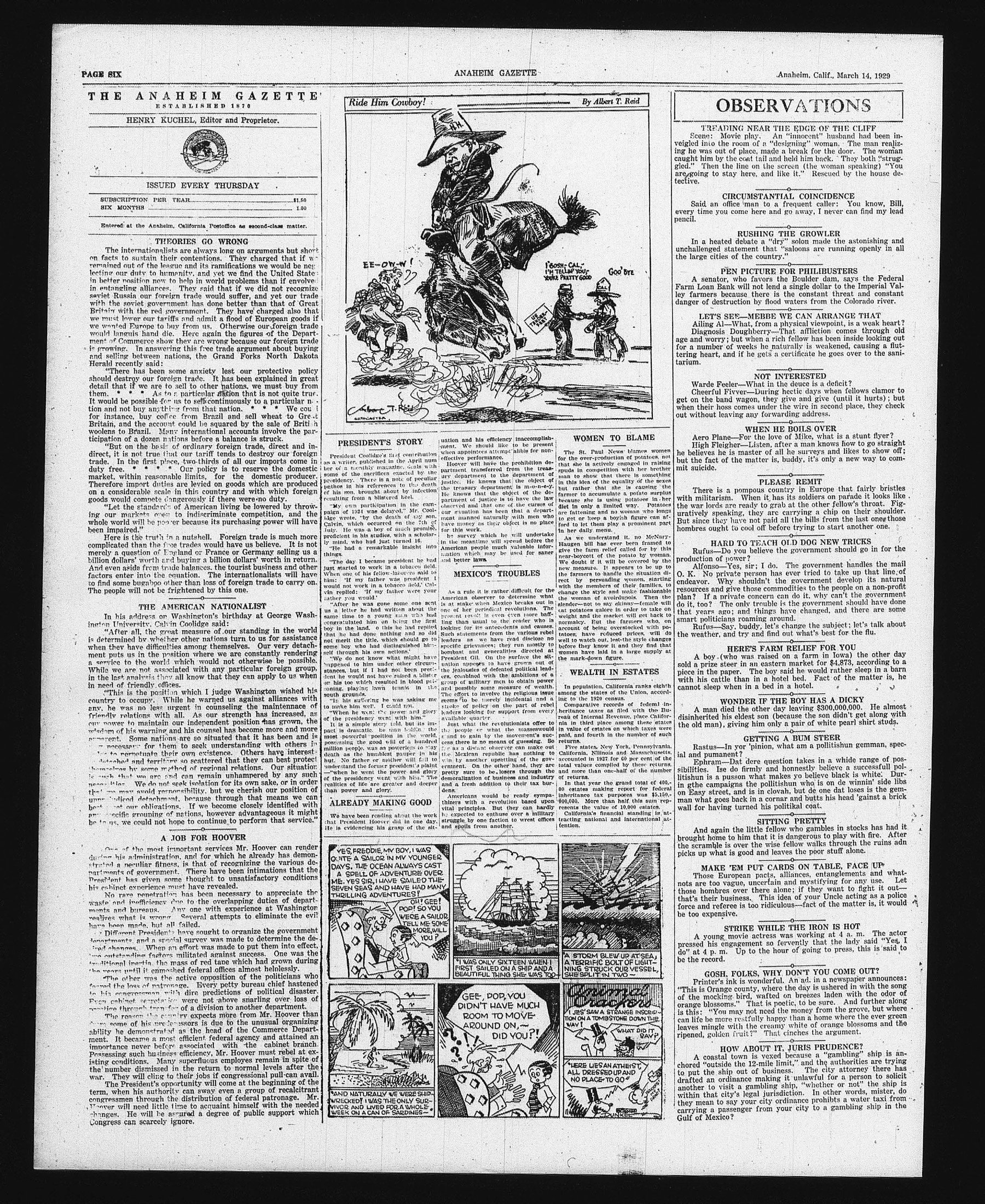
Searchable text
THE ANAHEIM GAZETTE
ESTABLISHED 1870
HENRY KUCHEL, Editor and Proprietor.
ISSUED EVERY THURSDAY
SUBSCRIPTION PER YEAR.....$1.50
SIX MONTHS.....1.00
Entered at the Anaheim, California Postoffice as second-class matter.
THEORIES GO WRONG
The internationalists are always long on arguments but short on facts to sustain their contentions. They charged that if we remained out of the league and its ramifications we would be neglecting our duty to humanity, and yet we find the United States in better position now to help in world problems than if involved in entangling alliances. They said that if we did not recognize soviet Russia our foreign trade would suffer, and yet our trade with the soviet government has done better than that of Great Britain with the red government. They have charged also that we must lower our tariffs and admit a flood of European goods if we wanted Europe to buy from us. Otherwise our foreign trade would languis hand die. Here again the figures of the Department of Commerce show they are wrong because our foreign trade is growing. In answering this free trade argument about buying and selling between nations, the Grand Forks North Dakota Herald recently said:
“There has been some anxiety lest our protective policy should destroy our foreign trade. It has been explained in great detail that if we are to sell to other nations, we must buy from them. * * * As to a particular nation that is not quite true. It would be possible for us to sell continuously to a particular nation and not buy anything from that nation. * * * We could for instance, buy coffee from Brazil and sell wheat to Great Britain, and the account could be squared by the sale of British woolens to Brazil. Many international accounts involve the participation of a dozen nations before a balance is struck.
“But on the basis of ordinary foreign trade, direct and in-
There has been some anxiety lest our protective policy should destroy our foreign trade. It has been explained in great detail that if we are to sell to other nations, we must buy from them. As to a particular nation that is not quite true. It would be possible for us to self continuously to a particular nation and not buy anything from that nation. We could for instance, buy coffee from Brazil and sell wheat to Great Britain, and the account could be squared by the sale of British woolens to Brazil. Many international accounts involve the participation of a dozen nations before a balance is struck.
But on the basis of ordinary foreign trade, direct and indirect, it is not true that our tariff tends to destroy our foreign trade. In the first place, two-thirds of all our imports come in duty free. Our policy is to reserve the domestic market, within reasonable limits, for the domestic producer. Therefore import duties are levied on goods which are produced on a considerable scale in this country and with which foreign goods would compete dangerously if there were no duty.
Let the standards of American living be lowered by throwing our markets open to indiscriminate competition, and the whole world will be poorer because its purchasing power will have been impaired."
Here is the truth in a nutshell. Foreign trade is much more complicated than the free trades would have us believe. It is not merely a question of England or France or Germany selling us a billion dollars' worth and buying a billion dollars' worth in return. And even aside from trade balances, the tourist business and other factors enter into the equation. The internationalists will have to find some bugaboo other than loss of foreign trade to carry on. The people will not be frightened by this one.
THE AMERICAN NATIONALIST
In his address on Washington's birthday at George Washington University, Calvin Coolidge said:
"After all, the great measure of our standing in the world is determined by whether other nations turn to us for assistance when they have difficulties among themselves. Our very detachment puts us in the position where we are constantly rendering a service to the world which would not otherwise be possible. While we are not associated with any particular foreign group, in the last analysis they all know that they can apply to us when in need of friendly offices.
This is the position which I judge Washington wished his country to occupy. While he warned us against alliances with any, he was no less urgent in counseling the maintenance of friendly relations with all. As our strength has increased, as our power to maintain our independent position has grown, the wisdom of his warning and his counsel has become more and more apparent. Some nations are so situated that it has been and is necessary for them to seek understanding with others in order to perpetuate their own existence. Others have interests detached and territory so scattered that they can best protect themselves by some method of regional relations. Our situation is such that we are end can remain unhampered by any such necessities. We do not seek isolation for its own sake, or in order that we may avoid responsibility, but we cherish our position of unprecedented detachment, because through that means we can best meet our obligations. If we become closely identified with any specific grouping of nations, however advantageous it might be to us, we could not hope to continue to perform that service."
A JOB FOR HOOVER
One of the most important services Mr. Hoover can render
A JOB FOR HOOVER
One of the most important services Mr. Hoover can render during his administration, and for which he already has demonstrated a peculiar fitness, is that of recognizing the various departments of government. There have been intimations that the President has given some thought to unsatisfactory conditions his cabinet experience must have revealed.
No rare penetration has been necessary to appreciate the waste and inefficiency due to the overlapping duties of departments and bureaus. Any one with experience at Washington realizes what is wrong. Several attempts to eliminate the evil have been made, but all failed.
Different Presidents have sought to organize the government departments, and a special survey was made to determine the desired changes. When an effort was made to put them into effect, outstanding factors militated against success. One was the traditional inertia; the mass of red tane which had grown during the years until it enmeshed federal offices almost helplessly.
The other was the active opposition of the politicians who feared the loss of patronage. Every petty bureau chief hastened to his congressman with dire predictions of political disaster. Even cabinet secretaries were not above snarlling over loss of practice through transfer of a division to another department.
The reason the country expects more from Mr. Hoover than from some of his predecessors is due to the unusual organizing ability he demonstrated as the head of the Commerce Department. It became a most efficient federal agency and attained an importance never before associated with the cabinet branch. Possessing such business efficiency, Mr. Hoover must rebel at existing conditions. Many superfluous employees remain in spite of the number dismissed in the return to normal levels after the war. They will cling to their jobs if congressional pull-can avail.
The President's opportunity will come at the beginning of the term, when his authority can sway even a group of recalcitrant congressmen through the distribution of federal patronage. Mr. Hoover will need little time to acquaint himself with the needed changes. He will be assured a degree of public support which Congress can scarcely ignore.
Ride Him Cowboy! By Albert T. Reid
EE-OW-W!
I'GOSH-CAL,
I'M TELLING YOU,
YOU'RE PRETTY GOOD
GOO' BYE
PRESIDENT'S STORY
WOMEN TO BLAME
PRESIDENT'S STORY
President Coolidge's first contribution as a writer, published in the April number of a monthly magazine. Goals with some of the sacrifices exacted by the presidency. There is a note of peculiar pathos in his references to the death of his son, brought about by infection resulting from a blistered heel.
"My own participation in the campaign of 1924 was delayed." Mr. Coolidge wrote, "by the death of my son, Calvin, which occurred on the 7th of July. He was a boy of much promise, proficient in his studies, with a scholarly mind, who had just turned 16."
"He had a remarkable insight into things."
"The day I became president he had just started to work in a tobacco field. When one of his fellow laborers said to him: 'If my father was president I would not work in a tobacco field,' Calvin replied: 'If my father were your father you would.'"
"After he was gone some one sent us a letter he had written about the same time to a young man who had congratulated him on being the first boy in the land. o this he had replied that he had done nothing and so did not merit the title, which should go to some boy who had distinguished himself through his own actions."
"We do not know what might have happened to him under other circumstances, but if I had not been president he would not have raised a blister on his toe which resulted in blood poisoning, playing lawn tennis in the south grounds."
"In his suffering he was asking me to make him well. I could not."
"When he went to the power and glory of the presidency went with him."
It is a simple story told, but its impact is dramatic. He man holding the most powerful position in the world, possessing the good will of a hundred million people, was as powerless to stay death as the humblest pauper in his hut. No father or mother will fail to understand the former president's plaint—when he went the power and glory of the presidency went with him. The realities of life are greater and deeper than power and glory.
ALREADY MAKING GOOD
We have been reading about the work that President Hoover did in one day. He is evidencing his grasp of the sit-
uation and his efficiency in accomplishment. We should like to be present when appointees attempt albis for non-effective performance.
Hoover will have the prohibition department transferred from the treasury department to the department of justice. He knows that the object of the treasury department is m-o-n-e-y. He knows that the object of the department of justice is to have the law observed and that one of the curses of our situation has been that a department manned naturally with men who have money as their object is no place for this work.
he survey which he will undertake in the meantime will spread before the American people much valuable information which may be used for saner and better laws.
MEXICO'S TROUBLES
As a rule it is rather difficult for the American observer to determine what is at stake when Mexico breaks out in one of her periodical revolutions. The present revolt is even even more buffling than usual to the reader who is looking for its antecedents and causes. Such statements from the various rebel leaders as we have read disclose no specific grievances; they run mostly to bombust and generalities directed at President Gil. On the surface the situation appears to have grown out of the jealousies of defeated political leaders, combined with the ambitions of a group of military men to obtain power and possibly some measure of wealth. The effort to involve the religious issue seems to be merely incidental and a stroke of policy on the part of rebel leaders looking for support from every available quarter.
Just what the revolutionists offer to the people or what the masses would tend to gain by the movement's success there is no means of guessing. So far as a distant observer can make out the Mexican republic has nothing to win by another upsetting of the government. On the other hand, they are pretty sure to be losers through the demoralization of business and industry and a fresh addition to their tax burdens.
Americans would be ready sympathizers with a revolution based upon vital principles. But they can hardly be expected to enthuse over a military struggle by one faction to wrest offices and spoils from another.
WOMEN TO BLAME
The St. Paul News blames women for the over-production of potatoes, not that she is actively engaged in raising spuds in competition with her brother man to show that there is something in this idea of the equality of the sexes but rather that she is causing the farmer to accumulate a potato surplus because she is using potatoes in her diet in only a limited way. Potatoes are fattening and no woman who longs to get or keep a boyish figure can afford to let them play a prominent part in her daily menu.
As we understand it, no McNary-Haugen bill has ever been framed to give the farm relief called for by this near-boycott of the potato by woman. We doubt if it will be covered by the new measure. It appears to be up to the farmers to handle the situation direct by persuading women, starting with members of their families, to change the style and make fashionable the woman of avoidrdpois. Then the slender—not to say skimny—female will eat potatoes galore in order to take weight and the market will get back to normalcy. But the farmers who, on account of being overstocked with potatoes, have reduced prices, will do well to watch out, lest the style changes before they know it and they find that women have laid in a large supply at the mark-down figure.
WEALTH IN ESTATES
In population, California ranks eighth among the states of the Union, according to the 1920 census.
Comparative records of federal inheritance taxes as filed with the Bureau of Internal Revenue, place California in third place among these states in value of estates on which taxes were paid, and fourth in the number of such returns.
Five states, New York, Pennsylvania, California, Nillinois and Massachusetts, accounted in 1927 for 60 per cent of the total values compiled by these returns, and more than one-half of the number of returns.
In that year the grand total of 400,000 estates making report for federal inheritance tax purposes was $5,150,-900,000. More than half this sum represents the value of 10,000 estates.
California's financial standing is attracting national and international attention.
ALREADY MAKING GOOD
We have been reading about the work that President Hoover did in one day. He is evidencing his grasp of the sit-down.
YES, FREDDIE, MY BOY, I WAS OUTE A SAILOR IN MY YOUNGER DAYS. THE OCEAN ALWAYS CAST A SPELL OF ADVENTURE OVER ME. YES SIR, I HAVE SAILED THE SEVEN SEAS AND HAVE MANY THRILLING ADVENTURES!
OH! GEE! POP! SO YOU WERE A SAILOR TELL ME SOME MORE, WILL YOU?
I WAS ONLY SIXTEEN WHEN I FIRST SAILED ON A SHIP AND A BEAUTIFUL THING SHE WAS TOO
A STORM BLEW UP AT SEA, A TERRIFIC BOLT OF LIGHT-NING STRUCK OUR VESSEL, SHE SPLIT IN TWO
AND NATURALLY WE WERE SHIP-WRECKED! I WAS THE ONLY SURVIVOR AND LIVED FOR A WHOLE WEEK ON A CAN OF SARDINES-
GEE, POP, YOU DIDN'T HAVE MUCH ROOM TO MOVE AROUND ON, DID YOU?!
I JES'SAW A STRANGE INSCRIDION ON A TOMBSTONE DOWN THE WAY!
WHAT DID IT SAY?
HERE LIES AN ATHEIST, ALL DRESSED UP AND NO PLACE TO GO!
OBSERVATIONS
TREADING NEAR THE EDGE OF THE CLIFF
Scene: Movie play. An "innocent" husband had been inveigled into the room of a "designing" woman. The man realizing he was out of place, made a break for the door. The woman caught him by the coat tail and held him back. They both "struggled." Then the line on the screen (the woman speaking) "You are going to stay here, and like it." Rescued by the house detective.
CIRCUMSTANTIAL COINCIDENCE
Said an office man to a frequent caller: You know, Bill, every time you come here and go away, I never can find my lead pencil.
RUSHING THE GROWLER
In a heated debate a "dry" solon made the astonishing and unchallenged statement that "saloons are running openly in all the large cities of the country."
PEN PICTURE FOR PHILIBUSTERS
A senator, who favors the Boulder dam, says the Federal Farm Loan Bank will not lend a single dollar to the Imperial Valley farmers because there is the constant threat and constant danger of destruction by flood waters from the Colorado river.
LET'S SEE—MEBBE WE CAN ARRANGE THAT
Ailing Al—What, from a physical viewpoint, is a weak heart?
Diagnosis Doughberry—That affliction comes through old age and worry; but when a rich fellow has been inside looking out for a number of weeks he naturally is weakened, causing a fluttering heart, and if he gets a certificate he goes over to the sanitarium.
NOT INTERESTED
Warde Feeler—What in the deuce is a deficit?
Cheerful Fivver—During hectic days when fellows clamor to get on the band wagon, they give and give (until it hurts); but when their hoss comes under the wire in second place, they check out without leaving any forwarding address.
WHEN HE BOILS OVER
Aero Plane—For the love of Mike, what is a stunt flyer?
High Fleigher—Listen, after a man knows how to go straight
NOT INTERESTED
Warde Feeler—What in the deuce is a deficit?
Cheerful Fivver—During hectic days when fellows clamor to get on the band wagon, they give and give (until it hurts); but when their hoss comes under the wire in second place, they check out without leaving any forwarding address.
WHEN HE BOILS OVER
Aero Plane—For the love of Mike, what is a stunt flyer?
High Fleigher—Listen, after a man knows how to go straight he believes he is master of all he surveys and likes to show off; but the fact of the matter is, buddy, it's only a new way to commit suicide.
PLEASE REMIT
There is a pompous country in Europe that fairly bristles with militarism. When it has its soldiers on parade it looks like the war lords are ready to grab at the other fellow's throat. Figuratively speaking, they are carrying a chip on their shoulder. But since they have not paid all the bills from the last one those hombres ought to cool off before trying to start another one.
HARD TO TEACH OLD DOG NEW TRICKS
Rufus—Do you believe the government should go in for the production of power?
Alfonso—Yes, sir; I do. The government handles the mail O.K. No private person has ever tried to take up that line of endeavor. Why shouldn't the government develop its natural resources and give those commodities to the people on a non-profit plan? If a private concern can do it, why can't the government do it, too? The only trouble is the government should have done that years ago; and things have changed, and there are some smart politicians roaming around.
Rufus—Say, buddy, let's change the subject; let's talk about the weather, and try and find out what's best for the flu.
HERE'S FARM RELIEF FOR YOU
A boy (who was raised on a farm in Iowa) the other day sold a prize steer in an eastern market for $4,873, according to a piece in the paper. The boy said he would rather sleep in a barn with his cattle than in a hotel bed. Fact of the matter is, he cannot sleep when in a bed in a hotel.
WONDER IF THE BOY HAS A DICKY
A man died the other day leaving $300,000,000. He almost disinherited his eldest son (because the son didn't get along with the old man), giving him only a pair of white pearl shirt studs.
GETTING A BUM STEER
Rastus—In yor 'pinion, what am a polititish gemman, special and pumanent?
Ephram—Dat dere question takes in a whide range of possibilities. Ise do firmly and honnestly believe a successfull politishun is a pusson what makes yo believe black is white. During gthe campaigns the politishun who is on de winnin' side libs on Easy street, and is in clovah, but de one dat loses is the gemman what goes back in a cornar and butts his head 'gainst a brick wall for having turned his politikal coat.
SITTING PRETTY
And again the little fellow who gambles in stocks has had it brought home to him that it is dangerous to play with fire. After the scramble is over the wise fellow walks through the ruins adn
Ephram—Dat dere question takes in a whide range of possibilities. Ise do firmly and honnestly believe a successful politishun is a pusson what makes yo believe black is white. Durin gthe campaigns the politishun who is on de winnin' side libs on Easy street, and is in clovah, but de one dat loses is the gemman what goes back in a cornar and butts his head 'gainst a brick wall for having turned his politikal coat.
SITTING PRETTY
And again the little fellow who gambles in stocks has had it brought home to him that it is dangerous to play with fire. After the scramble is over the wise fellow walks through the ruins adn picks up what is good and leaves the poor stuff alone.
MAKE 'EM PUT CARDS ON TABLE, FACE UP
Those European pacts, alliances, entanglements and what-nots are too vague, uncertain and mystifying for any use. Let those hombres over there alone; if they want to fight it out—that's their business. This idea of your Uncle acting as a police force and referee is too ridiculous—fact of the matter is, it would be too expensive.
STRIKE WHILE THE IRON IS HOT
A young movie actress was working at 4 a.m. The actor pressed his engagement so fervently that the lady said "Yes, I do" at 4 p.m. Up to the hour of going to press, this is said to be the record.
GOSH, FOLKS, WHY DON'T YOU COME OUT?
Printer's ink is wonderful. An ad. in a newspaper announces: "This is Orange county, where the day is ushered in with the song of the mocking bird, wafted on breezes laden with the odor of orange blossoms." That is poetic, to be sure. And further along is this: "You may not need the money from the grove, but where can life be more restfully happy than a home where the ever green leaves mingle with the creamy white of orange blossoms and the ripened, golden fruit?" That cinches the argument.
HOW ABOUT IT, JURIS PRUDENCE?
A coastal town is vexed because a "gambling" ship is anchored "outside the 12-mile limit," and the authorities are trying to put the ship out of business. The city attorney there has drafted an ordinance making it unlawful for a person to solicit another to visit a gambling ship, "whether or not" the ship is within that city's legal jurisdiction. In other words, mister, do they mean to say your city ordinance prohibits a water taxi from carrying a passenger from your city to a gambling ship in the Gulf of Mexico?