anaheim-gazette 1929-02-21
Scanned page
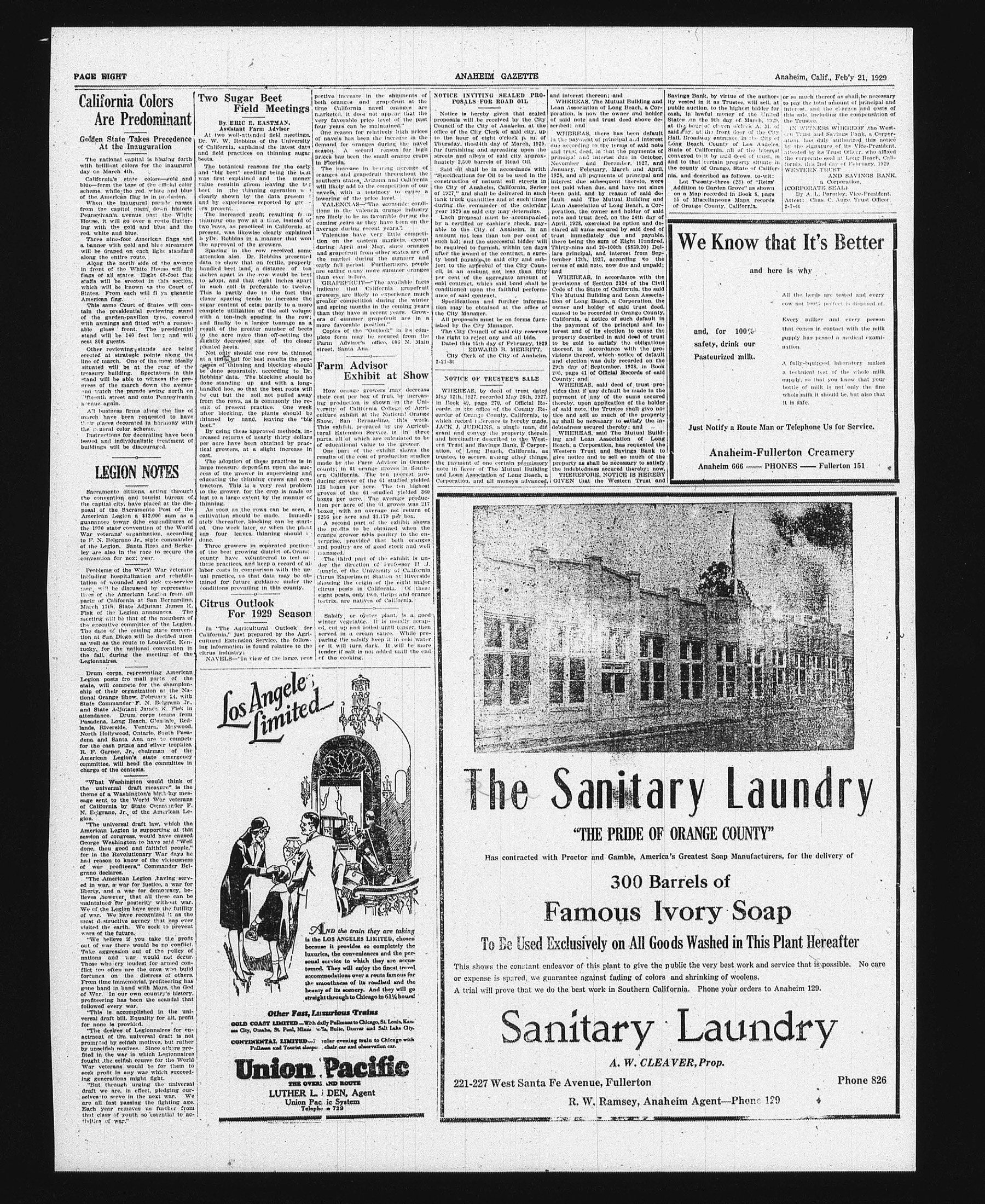
Searchable text
California Colors Are Predominant
Golden State Takes Precedence At the Inauguration
The national capital is blazing forth with brilliant colors for the inaugural day on March 4th.
California's state colors—gold and blue—form the base of the official color scheme, while the red, white and blue of the American flag is in profusion.
When the inaugural parade passes from the capitol plaza down historic Pennsylvania avenue past the White House, it will go over a route fluttering with the gold and blue and the red, white and blue.
Three nine-foot American flags and a banner with gold and blue streamers will be draped on each light standard along the entire route.
Along the north side of the avenue in front of the White House will fly flags of all states. Eight 60-foot flag staffs will be erected in this section, which will be known as the Court of States. From each will flay gigantic American flag.
This same Court of States will contain the presidential reviewing stand of the garden-pavilion type, covered with awnings and fitted with a removable glass front. The presidential stand will be 140 feet long and will seat 800 guests.
Other reviewing stands are being erected at strategic points along the line of march. One of the most ideally situated will be at the rear of the treasury building. Spectators in this stand will be able to witness the progress of the march down the avenue and watch the parade swing north on Fifteenth street and onto Pennsylvania Avenue again.
All business firms along the line of march have been requested to have their places decorated in harmony with the general color scheme.
Instructions for decorating have been issued and individualistic treatment of buildings will be discouraged.
Two Sugar Beet Field Meetings
By ERIC E. EASTMAN,
Assistant Farm Advisor
At two well-attended field meetings, Dr. W. W. Robbins of the University of California, explained the latest data and field practices on thinning sugar beets.
The botanical reasons for the early and "big beet" seedling being the best was first explained and the money value result given leaving the beet in the thinning operation was clearly shown by the data present and by experiences reported by growers present.
The increased profit resulting from thinning one row at a time, instead of two rows, as practiced in California at present, was likewise clearly explained by Dr. Robbins in a manner that won the approval of the growers.
Spacing in the row received some attention also. Dr. Robbins presented data to show that on fertile, properly handled beet land, a distance of ten inches apart in the row would be best to adopt, and that eight inches apart in such soil is preferable to twelve. This is partly due to the fact that closer spacing tends to increase the sugar content of eets; partly to a more complete utilization of the soil volume with a ten-inch spacing in the row; and finally to a larger tonnage as a result of the greater number of beets to the acre more than off-setting the slightly decreased size of the closer planted beets.
Not only should one row be thinned at a time but for best results the processes of thinning and blocking should be done separately, according to Dr. Robbins' data. The blocking should be done standing up and with a long-handled hoe, so that the beet roots will be cut but the soil not pulled away from the rows, as is commonly the result of present practice. One week after blocking, the plants should be thinned by hand, leaving the "big beet."
By using these approved methods, increased returns of nearly thirty dollars per acre have been obtained by practical growers at a slight increase inpective increase both oranges and time California marketed. It does very favorable price four years can be expected.
One reason for many navels has been demand for orange season. A second price has been thinned in Florida.
The increase in oranges and grape southern states will likely add to navels, with a lowering of the prices in the valencias have been on the cast during April and grape fruit from the market during early fall period, are eating many ripe than ever before.
GRAVEFRUIT indicate that growers are likely greater competitive and spring months than they have in others of summer more favorable prices.
Copies of the plate form may Farm Advisor's street, Santa Ana.
Farm Advice Exhibit
How orange grapes their cost per box ing production is versity of California culture exhibit at Show, San Benito. This exhibit provides natural Extension Service parts, all of which of educational va
LEGION NOTES
Sacramento citizens, acting through the convention and tourist bureau of the capital city, have placed at the disposal of the Sacramento Post of the American Legion a $12,000 sum as a guanntee toward the expenditures of the 1930 state convention of the World War veterans' organization, according to F. N. Belgrano Jr., state commander of the Legion. Santa Rosa and Berkeley are also in the race to secure the convention for next year.
Problems of the World War veteran including hospitalization and rehabilitation of wounded and sick ex-service men, will be discussed by representatives of the American Legion from all parts of California at San Bernardino, March 17th. State Adjutant James K. Fisk of the Legion announces. The meeting will be that of the members of the executive committee of the Legion. The date of the coming state convention at San Diego will be decided upon as well as the route to Louisville, Kentucky, for the national convention in the fall, during the meeting of the Legionnares.
Drum corps, representing American Legion posts fro mall parts of the state, will compete for the championship of their organization at the National Orange Show, February 24, with State Commander F. N. Belgrano Jr., and State Adjutant James K. Fisk in attendance. Drum corps teams from Pasadena, Long Beach, Glendale, Redlands, Riverside, Ventura, Maywood, North Hollywood, Ontario, South Pasadena and Santa Ana are to compete for the cash prize and silver trophies. R. F. Garner, Jr., chairman of the American Legion's state emergency committee, will head the committee in charge of the contests.
"What Washington would think of the universal draft measure" is the theme of a Washington's birthday message sent to the World War veterans of California by State Commander F. N. Belgrano Jr., of the American Legion.
"The universal draft law, which the American Legion is supporting at this session of congress, would have caused George Washington to have said 'Well done, thou good and faithful people,'"
Citrus Outlook For 1929 Season
In "The Agricultural Outlook for California," just prepared by the Agricultural Extension Service, the following information is found relative to the citrus industry:
NAVELS—"In view of the large proximate should one row be trimmed at a time but for beat results the processes of thinning and blocking should be done separately, according to Dr. Robbins' data. The blocking should be done standing up and with a long-handled hoe, so that the beet roots will be cut but the soil not pulled away from the rows, as is commonly the result of present practice. One week after blocking, the plants should be thinned by hand, leaving the "big beet."
By using these approved methods, increased returns of nearly thirty dollars per acre have been obtained by practical growers, at a slight increase in cost.
The adoption of these practices is in large measure dependent upon the success of the grower in supervising and educating the thinning crowds and contractors. This is a very real problem to the grower, for the crop is made or lost to a large extent by the manner of thinning.
As soon as the rows can be seen, a cultivation should be made. Immediately thereafter, blocking can be started. One week later, or when the plant has four leaves, thinning should be done.
Three growers in separated portions of the best growing district of Orange county have volunteered to test out these practices, and keep a record of all labor costs in comparison with the usual practice, so that data may be obtained for future guidance under the conditions prevailing in this county.
Los Angeles Limited
"What Washington would think of the universal draft measure" is the theme of a Washington's birthday message sent to the World War veterans of California by State Commander F. N. Eglgrano, Jr., of the American Legion.
"The universal draft law, which the American Legion is supporting at this session of congress, would have caused George Washington to have said "Well done, thou good and faithful people," for in the Revolutionary War days he had reason to know of the viciousness of war profiteers," Commander Belgrano declares.
"The American Legion having served in war, at war for justice, a war for liberty, and a war for democracy, believes however, that all these can be maintained for posterity without war. We of the Legion have seen the futility of war. We have recognized it as the most destructive agency that has ever visited the earth. We seek to prevent wars of the future.
"We believe if you take the profit out of war there would be no conflict. Take aggression out of the policy of nations and war would not occur. Those who cry loudest for armed conflict too often are the ones who build fortunes on the distress of others. From time immemorial, profiteering has gone hand in hand with Mars, the God of War. In our own country's history, profiteering has been the scandal that followed every war.
"This is accomplished in the universal draft bill. Equality for all, profit for none is provided."
"The desires of Legionnalires for enactment of the universal draft is not prompted by selfish motives, but rather by unselfish motives. Since others profited in the war in which Legionnalires fought, the selfish course for the World War veterans would be for them to seek profit in any war which succeeding generations might fight.
But through urging the universal draft we are, in effect, pledging ourselves to serve in the next war. We are all fast passing the fighting age. Each year removes us further from that class of youth so essential to activities of war."
ANAHEIM GAZETTE
pective increase in the shipments of both oranges and grapefruit at the time California navel oranges are marketed, it does not appear that the very favorable price level of the past four years can be maintained."
One reason for relatively high prices of navels has been the increase in the demand for oranges during the navel season. A second reason for high prices has been the small orange crops in Florida.
The increase in bearing acreage of oranges and grapefruit throughout the southern states, Arizona and California will likely add to the competition of our navels, with a tendency to cause a lowering of the price level.
VALENCIAS—"The economic conditions in the valencia orange industry are likely to be as favorable during the coming years as they have been on the average during recent years."
Valencias have very little competition on the eastern markets, except during April and May, since oranges and grapefruit from other states are off the market during the summer and early fall period. Furthermore, people are eating many more summer oranges than ever before.
GRAPEFRUIT—"The available facts indicate that California grapefruit growers are likely to experience much greater competition during the winter and spring months in the coming years than they have in recent years. Growers of summer grapefruit are in a more favorable position."
Copies of the "Outlook" in its complete form may be secured from the Farm Advisor's office, 606 N. Main street, Santa Ana.
Farm Advisor Exhibit at Show
How orange growers may decrease their cost per box of fruit by increasing production is shown in the University of California College of Agriculture exhibit at the National Orange Show, San Bernardino, this week. This exhibit, prepared by the Agricultural Extension Service, is in three parts, all of which are calculated to be of educational value to the grower.
NOTICE INVITING SEALED PROPOSALS FOR ROAD OIL
Notice is hereby given that sealed proposals will be received by the City Council of the City of Anaheim, at the office of the City Clerk of said city, up to the hour of eight o'clock p.m. of Thursday, the 4th day of March, 1929, for furnishing and spreading upon the streets and alleys of said city approximately 2,500 barrels of Road Oil.
Said oil shall be in accordance with "Specifications for Oil to be used in the construction of natural soil streets in the City of Anaheim, California, Series of 1927," and shall be delivered in such tank truck quantities and at such times during the remainder of the calendar year 1929 as said city may determine.
Each proposal must be accompanied by a certified or cashier's check, payable to the City of Anaheim, in an amount not less than ten per cent of such bid; and the successful binder will be required to furnish, within ten days after the award of the contract, a surety bond payable to said city and subject to the approval of the City Council, in an amount not less than fifty per cent of the aggregate amount of said contract, which said bond shall be conditioned upon the faithful performance of said contract.
Specifications and further information may be obtained at the office of the City Manager.
All proposals must be on forms furnished by the City Manager.
The City Council of said city reserves the right to reject any and all bids.
Dated this 15th day of February, 1929 EDWARD B. MERRITT,
City Clerk of the City of Anaheim.
2-21-3t
NOTICE OF TRUSTEE'S SALE
WHEREAS, by deed of trust dated May 12th, 1927, recorded May 26th, 1927, in Book 49, page 270, of Official Records, in the office of the County Recorder of Orange County, California, to which record reference is hereby made.
JACK J. JUDKINS, a single man, did grant and convey the property therein and hereafter described to the Western Trust and Savings Bank, a Corporation,
and interest thereon; and
WHEREAS, there has been default in the payment of principal and interest due according to the terms of said note and trust deed, in that the payments of principal and interest due in October, November and December, 1927, and January, February, March and April, 1928, and all payments of principal and interest due subsequent thereto, were not paid when due, and have not since been paid, and by reason of said default said The Mutual Building and Loan Association of Long Beach, a Corporation, the owner and holder of said note and trust deed, on the 24th day of April, 1928, exercised its option and declared all sums secured by said deed of trust immediately due and payable, there being the sum of Eight Hundred, Thirty-nine and 20-100th ($$39.20) Dollars principal, and interest from September 12th, 1927, according to the terms of said note, now due and unpaid;
WHEREAS, in accordance with the provisions of Section 2294 of the Civil Code of the State of California, the said The Mutual Building and Loan Association of Long Beach, a Corporation, the owner and holder of said trust deed, caused to be recorded in Orange County, California, a notice of such default in the payment of the principal and interest and its election to cause the property described in said deed of trust to be sold to satisfy the obligations thereof, in accordance with the provisions thereof, which notice of default and election was duly recorded on the 28th day of September, 1928, in Book 205, page 41 Of Official Records of said County; and
WHEREAS, said deed of trust provides that if any default be made in the payment of any of the sums secured thereby upon application of the holder of said note, the Trustee shall give notice and sell so much of the property as shall be necessary to satisfy the indebtedness secured thereby; and
WHEREAS, said The Mutual Building and Loan Association of Long Beach, a Corporation, has requested
Farm Advisor Exhibit at Show
How orange growers may decrease their cost per box of fruit by increasing production is shown in the University of California College of Agriculture exhibit at the National Orange Show, San Bernardino, this week. This exhibit, prepared by the Agricultural Extension Service, is in three parts, all of which are calculated to be of educational value to the grower.
One part of the exhibit shows the results of the cost of production studies made by the Farm Advisor in Orange county, in 61 orange groves in Southern California. The ten poorest producing groves of the 61 studied yielded 138 boxes per acre. The ten highest groves of the 61 studied yielded 360 boxes per acre. The average production per acre of the 61 groves was 217 boxes, with an average net return of $256 per acre and $1,179 per box.
A second part of the exhibit shows the profits to be obtained when the orange grower adds poultry to the enterprise, provided that both oranges and poultry are of good stock and well managed.
The third part of the exhibit is under the direction of Professor H. J. Guayle, of the University of California Citrus Experiment Station at Riverside showing the origin of the eight major citrus pests in California. Of these eight pests, only two, thrips and orange tortrix, are natives of California.
Salisfly, or oyster plant, is a good winter vegetable. It is usually scraped, cut up and boiled until tender, then served in a cream sauce. While preparing the salisfy keep it in cold water or it will turn dark. It will be more tender if salt is not added until the end of the cooking.
NOTICE OF TRUSTEE'S SALE
WHEREAS, by deed of trust dated May 12th, 1927, recorded May 26th, 1927, in Book 49, page 270, of Official Records, in the office of the County Recorder of Orange County, California, to which record reference is hereby made. JACK J. JUDKINS, a single man, did grant and convey the property therein and hereinafter described to the Western Trust and Savings Bank, a Corporation, of Long Beach, California, as trustee, to secure, among other things, the payment of one certain promissory note in favor of The Mutual Building and Loan Association of Long Beach, a Corporation, and all moneys advanced.
WHEREAS, said The Mutual Building and Loan Association of Long Beach, a Corporation, has requested the Western Trust and Savings Bank to give notice and sell so much of the property as shall be necessary to satisfy the indebtedness secured thereby; and
THEREFORE, NOTICE IS HEERBY GIVEN that the Western Trust and
AND the train they are taking is the LOS ANGELES LIMITED, chosen because it provides so completely the luxuries, the conveniences and the personal service to which they are accustomed. They will enjoy the finest travel accommodations over a route famous for the smoothness of its roadbed and the beauty of its scenery. And they will go straight through to Chicago in 61¼ hours.
Fast, Luxurious Trains
ED—With daily Pullmans to Chicago, St. Louis, Kansas, Minneapolis, Suite, Denver and Salt Lake City.
UNITED—Regular evening train to Chicago with tourist sleepers, chair car and observation car.
Union Pacific
THE OVERLAND ROUTE
HER L. DEN, Agent
Union Pacific System
Telephone 729
The Sanitary
“THE PRIDE OF ORAL
Has contracted with Proctor and Gamble, America’s Great
300 Barrels
Famous Ivory
To Be Used Exclusively on All Goods W
This shows the constant endeavor of this plant to give the public the or expense is spared, we guarantee against fading of colors and shr
A trial will prove that we do the best work in Southern California.
Sanitary L
A. W. CLEAVER,
221-227 West Santa Fe Avenue, Fullerton
R. W. Ramsey, Anaheim A
Anaheim, Calif., Feb'y 21, 1929
Savings Bank, by virtue of the authority vested in it as Trustee, will sell at public auction, to the highest bidder for cash, in lawful money of the United States on the 9th day of March, 1929, at the hour of eleven o'clock A.M. of said day, at the front door of the City Hall, Broadway entrance, in the City of Long Beach, County of Los Angeles, State of California, all of the interest conveyed to it by said deed of trust, in and to that certain property situated in the county of Orange, State of California, and described as follows, to-wit:
Lot Twenty-three (23) of "Relief" Addition to Garden Grove" as shown on a Map recorded in Book 8, page 15 of Miscellaneous Maps, records of Orange County, California.
IN WITNESS WHEREOF the Weston Trust and Savings Bank, a Corporation, has duly authorized this notice by the signature of its Vice-President, attested by its Trust Officer, who affixed the corporate seal at Long Beach, California, this 2nd day of February, 1929.
WESTERN TRUST
AND SAVINGS BANK,
a Corporation.
(CORPORATE SEAL)
By A. L. Parinley, Vice-President.
Attest: Chas C. Auge, Trust Officer.
2-7-4t
We Know that It's Better
and here is why
All the herds are tested and every cow not 100% perfect is disposed of.
Every milker and every person that comes in contact with the milk supply has passed a medical examination.
A fully-equipped laboratory makes a technical test of the whole milk supply so that you know that your bottle of milk is not only the fine whole milk it should be, but also that it is safe.
Just Notify a Route Man or Telephone Us for Service.
Notice of default recorded on the 1928, in Book Records of said ed of trust pro- it be made in the one sums secured on of the holder tree shall give no- of the property to satisfy the in-eby; and the Mutual Build-ation of Long Savings Bank to so much of the necessary to satisfy thereby; now, CE IS HEREBY eastern Trust and
Pasteurized milk.
A fully-equipped laboratory makes a technical test of the whole milk supply, so that you know that your bottle of milk is not only the fine whole milk it should be, but also that it is safe.
Just Notify a Route Man or Telephone Us for Service.
Anaheim-Fullerton Creamery
Anaheim 666 — PHONES — Fullerton 151
Military Laundry
RIDE OF ORANGE COUNTY"
Military Laundry
BRIDE OF ORANGE COUNTY"
Amble, America's Greatest Soap Manufacturers, for the delivery of
300 Barrels of
Ivory Soap
All Goods Washed in This Plant Hereafter
to give the public the very best work and service that is possible. No care
dling of colors and shrinking of woolens.
Southern California. Phone your orders to Anaheim 129.
Military Laundry
W. W. CLEAVER, Prop.
Fullerton
Phone 826
Densey, Anaheim Agent—Phone 129