anaheim-gazette 1929-02-14
Scanned page
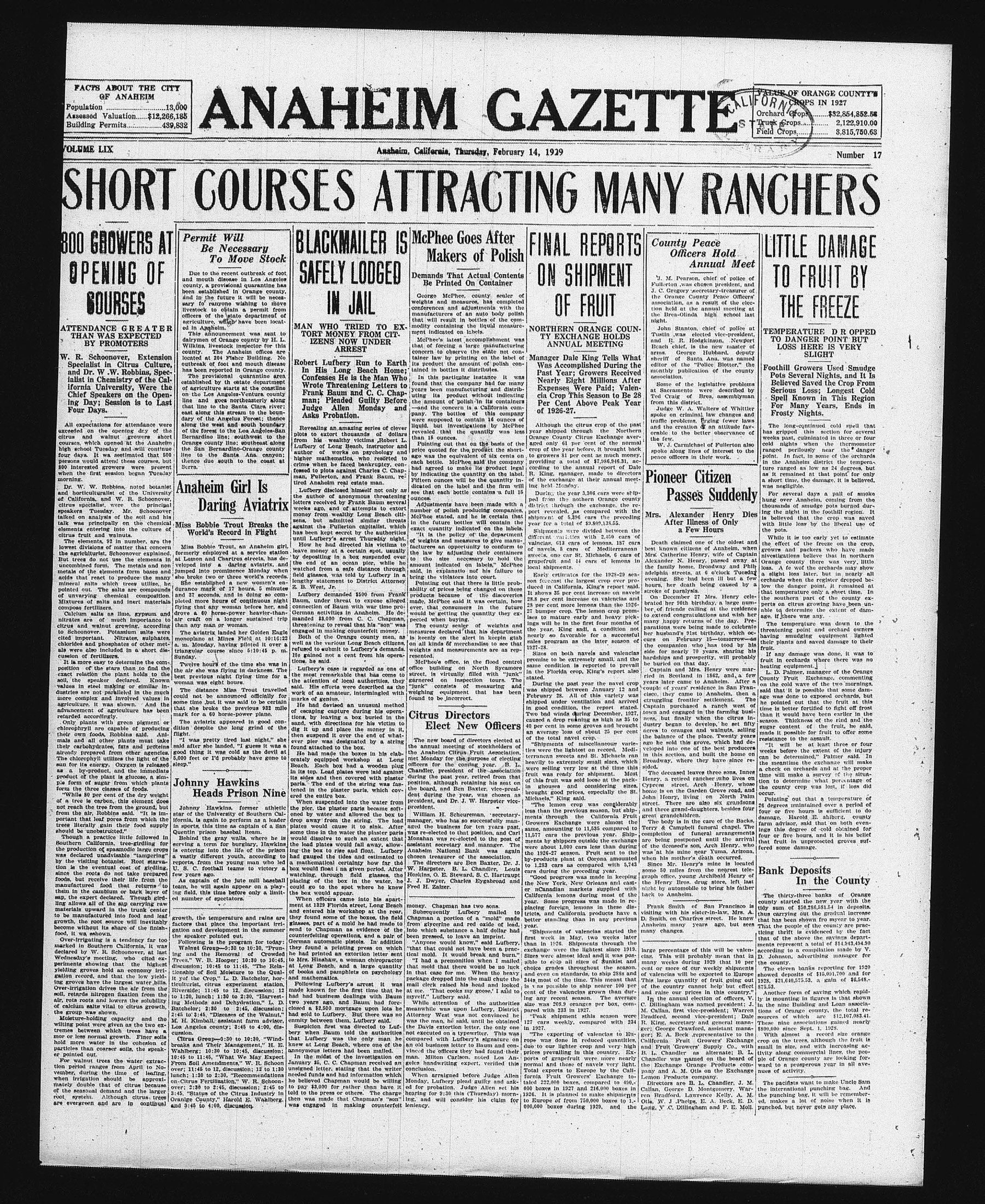
Searchable text
FACTS ABOUT THE CITY OF ANAHEIM
Population ...13,000
Assessed Valuation...$12,266,185
Building Permits...439,832
VOLUME LIX
SHORT COURSES
800 GROWERS AT OPENING OF COURSES
ATTENDANCE GREATER THAN WAS EXPECTED BY PROMOTERS
W. R. Schoonover, Extension Specialist in Citrus Culture, and Dr. W. W. Robbins, Specialist in Chemistry of the California University, Were the Chief Speakers on the Opening Day; Session is to Last Four Days.
All expectations for attendance were exceeded on the opening day of the citrus and walnut growers short courses, which opened at the Anaheim high school Tuesday and will continue.
Permit Will
Be Necessary
To Move Stock
Due to the recent outbreak of foot and mouth disease in Los Angeles county, a provisional quarantine has been established in Orange county, and in the future it will be necessary for anyone wishing to move livestock to obtain a permit from officers of the state department of agriculture, which have been located in Anaheim.
This announcement was sent to dairymen of Orange county by H. L. Wilkins, livestock inspector for this county. The Anaheim offices are located at 204 Fisher Building. No outbreak of foot and mouth disease has been reported in Orange county.
The provisional quarantine area established by the estate department of agriculture starts at the coastline on the Los Angeles-Ventura county line and goes northeasterly along that line to the Santa Clara river; east along this stream to the boundary of the Angelus Forest; thence along the west and south boundary of the forest to the Los Angeles-San Bernardino line; southwest to the Orange county line; southeast along the San Bernardino-Orange county
All expectations for attendance were exceeded on the opening day of the citrus and walnut growers short courses, which opened at the Anaheim high school Tuesday and will continue four days. It was estimated that 500 persons would attend these courses, but 800 interested growers were present when the first session began Tuesday morning.
Dr. W. W. Robbins, noted botanist and horticulturalist of the University of California, and W. R. Schoonover, citrus specialist, were the principal speakers Tuesday. Mr. Schoonover talked on analysis of the soil and his talk was principally on the chemical elements entering into the culture of citrus fruit and walnuts.
The elements, 92 in number, are the lowest divisions of matter that concern the agriculturist. Schoonover explained. But trees do not use the elements in uncombined form. The metals and non-metals of the elements form bases and acids that react to produce the many mineral salts which trees utilize, he pointed out. The salts are compounds of unvarying chemical composition. Mixtures of salts and inert materials compose fertilizers.
Calcium salts as lime, gypsum and nitrates are of much importance to citrus and walnut growing, according to Schoonover. Potassium salts were cited important. Nitrates, sulphates, chlorides and phosphates of other metals were also included in a short discussion of fertilizers.
It is more easy to determine the composition of the stars than to find the exact relation the plant holds to the soil, the speaker declared. Known values in steel making or similar industries are not paralleled in the much more complex and involved values in agriculture, it was shown. And the advancement of agriculture has been retarded accordingly.
Only plants with green pigment or chlorophyll are capable of producing their own foods, Robbins said. Animals and all other plants must take their carbohydrates, fats and proteins already prepared from other agencies. The chlorophyll utilizes the light of the sun for its energy. Oxygen is released as a by-product, and the immediate product of the plant is glucose, a simple form of sugar from which plants form the three classes of foods.
"While $80 per cent of the dry weight of a tree is carbon, this element does not reach the tree from the ground, but from the air, Robbins said. "It is important that leaf pores from which the trees literally gain their food supply should be unobstructed."
Though a practice little followed in Southern California, tree-girdling for the production of spasmodic large crops located at 204 Fisher Building. No outbreak of foot and mouth disease has been reported in Orange county.
The provisional quarantine area established by th estate department of agriculture starts at the coastline on the Los Angeles-Ventura county line and goes northeasterly along that line to the Santa Clara river; east along this stream to the boundary of the Angelus Forest; thence along the west and south boundary of the forest to the Los Angeles-San Bernardino line; southwest to the Orange county line; southeast along the San Bernardino-Orange county line to the Santa Ana canyon; thence due south to the coast at Serra.
Anaheim Girl Is Daring Aviatrix
Miss Bobbie Trout Breaks the World's Record in Flight
Miss Bobbie Trout, an Anaheim girl, formerly employed at a service station at Lemon and Chartres streets, has developed into a daring aviatrix, and jumped into prominence Monday when she broke two or three world's records.
She established a new women's endurance mark of 17 hours. 5 minutes and 37 seconds, and in doing so completed more hours of continuous night flying that any woman before her, and drove a 60 horse-power heavier-than-air craft on a longer sustained trip than any man or woman.
The aviatrix landed her Golden Eagle monoplane at Mines Field at 10:10:22 a.m. Monday, having piloted it over a triangular course since 5:10:45 p.m. Sunday.
Twelve hours of the time she was in the air she was flying in darkness. The best previous night flying time for a woman was eight hours.
The distance Miss Trout travelled could not be announced officially for some time, but it was said to be certain that she broke the previous 932 mile mark for a 60 horse-power plane.
The aviatrix appeared in good condition despite the long grind of the flight.
"I was pretty tired last night," she said after she landed. "I guess it was a good thing it was cold as the devil at 5,000 feet or I'd probably have gone to sleep."
Johnny Hawkins Heads Prison Nine
Johnny Hawkins, former athletic star of the University of Southern California, is again to perform as a leader in sports, this time as captain of a San Quentin prison baseal team.
Behind the gray walls, where he is serving a term for burglary, Hawkins is entering into the life of the prison.
Robert Lufbery Run In His Long Beach Confesses He is thus Wrote Threatening Frank Baum and Cman; Pleaded Gu Judge Allen Mo Asks Probation.
Lufbery disclosed himself the author of anonymous letters received by Frank weeks ago, and of attempt money from wealthy Lorenz zens, but admitted slim against the Fullerton cap has been kept secret by the until Lufbery's arrest Th.
How he had directed him leave money at a certain by depositing in a box sundec end of an ocean pla watched from a safe dist field glasses, was told by lengthy statement to Dist Z.B.West Jr.
Lufbery demanded $500 Baum, under threat to connection of Baum with German activities in Anahmand $3,000 from C., threatening to reveal that engaged in making counter Both of the Orange co well as the various Long B refused to submit to Lufbery He gained not a cent froctions, he said.
Lufbery's case is regarded the most remarkable that at attention of local auth said. His efforts were desi work of an amateur, inter marks of genius.
He had devised an unusu of escaping capture durations, by leaving a box b sand, with directions for dig it up and place th then suspend it over th ever pier was designated found attached to the box.
He had made the boxes orately equipped workshop Beach. Each box had a in its top. Lead plates were its sides and then covered parls. The end of the strtened in the plaster parls, ered the entire box.
When suspended into ther pier, the plaster parls ened by water and allowed drop away from the strinner plates would cause it to some time in the water th he would dissolve to such and lead plates would fall ing the box rise and flo
The chlorophyll utilizes the light of the sun for its energy. Oxygen is released by a by-product, and the immediate product of the plant is glucose, a simple form of sugar from which plants form the three classes of foods.
"While 80 per cent of the dry weight of a tree is carbon, this element does not reach the tree from the ground, but from the air, Robbins said. "It is important that leaf pores from which the trees literally gain their food supply should be unobstructed."
Though a practice little followed in Southern California, tree-girdling for the production of spasmodic large crops was declared unadvisable "tampering" by the visiting botanist. Root starvation is the eventual cost of girdling, since the roots do not take prepared foods, but receive their life from the manufactured food that returns to them in the cambium or bark layer of sap, the expert declared. Though girdling allows all of the sap carrying raw materials upward in the trunk center to be manufactured into food and leaf growth, the root source will inevitably become without its share of the finish-food, it was ashown.
Over-irrigation is a tendency far too marked in Southern California, it was declared by W. R. Schoonover, at last Wednesday's meeting, who cited experiments showing that the highest yielding groves hold an economy irrigation record, and that the low yielding groves have the largest water bills. Over-irrigation drives the air from the soil, retards nitrogen fixation from the air, rots roots and lowers the solubility of calcium salts vital to citrus growth, the group was shown.
Moisture-holding capacity and the wilting point were given as the two extremes between which trees have a mor or less normal growth. Finer soils hold more water in the cohesion of particles than coarser soils, the speaker pointed out.
For walnut trees the water extraction period ranges from April to November, during the time of leafing, when irrigation should be approximately double that of citrus because of the seasonal demand and the larger root system. Although citrus trees are evergreen and are in continual growth, the temperature and rains are factors that place the important irrigation and development in the summer the speaker pointed out.
Following is the program for today:
Walnut Group—9:30 to 10:30; Pruning and Removal of Crowded Trees," W. B. Hooper; 10:30 to 10:45; discussion; 10:45 to 11:45; "The Relationship of Soil Moisture to the Quality of the Crop," L. D. Batchelor, horticulturist, citrus experiment station, Riverside; 11:45 to 12; discussion; 12 to 1:30; lunch; 1:30 to 2:30; "Harvesting Methods and Dehydration," L. D. Batchelor; 2:30 to 2:45; discussion; 2:45 to 3:45; "Diseases of the Walnut," M. H. Klimball, assistant farm advisor, Los Angeles county; 3:45 to 4:00; discussion.
Citrus Group—9:30 to 10:30; "Windbreaks and Their Management," H. E. Wahliger; 10:30 to 10:45; discussion; 10:45 to 11:45; "What We May Expect From Soil Amendmentments," W. R. Schoonover; 11:45 to 12; discussion; 12 to 1:30 lunch; 1:30 to 2:30; "Recommendations on Citrus Fertilization," W. R. Schoonover; 2:30 to 2:45; discussion; 2:45 to 3:45; "Status of the Citrus Industry in Oranige County," Harold E. Wahlberg, and 3:45 to 4:00; discussion.
Johnny Hawkins Heads Prison Nine
Johnny Hawkins, former athletic star of the University of Southern California, is again to perform as a leader in sports, this time as captain of a San Quentin prison baseball team.
Behind the gray walls, where he is serving a term for burglary, Hawkins is entering into the life of the prison a vastly different youth, according to reports, from the young man who led U. S. C. football teams to victory a few years ago.
As captain of the jute mill baseball team, he will again appear on a playing field, this time before only a limited number of spectators.
growth, the temperature and rains are factors that place the important irrigation and development in the summer the speaker pointed out.
Following is the program for today:
Walnut Group—9:30 to 10:30; Pruning and Removal of Crowded Trees," W. B. Hooper; 10:30 to 10:45; discussion; 10:45 to 11:45; "The Relationship of Soil Moisture to the Quality of the Crop," L. D. Batchelor, horticulturist, citrus experiment station, Riverside; 11:45 to 12; discussion; 12 to 1:30 lunch; 1:30 to 2:30; "Harvesting Methods and Dehydration," L. D. Batchelor; 2:30 to 2:45; discussion; 2:45 to 3:45; "Diseases of the Walnut," M. H. Klimball, assistant farm advisor, Los Angeles county; 3:45 to 4:00; discussion.
Lufbery's arrest made known for the first time had bad business dealings two years ago, and Baum closed a $2,500 mortgage upon sold to Lufbery. But the enmity between them, Lufbery Suspicion first was directed by Baum told that Lufbery was the one knew at Long Beach, where anonymous letters had been in the midst of the invoices January 25, C. C. Chapman unsigned letter stating that needed funds and had informed he believed Chapman would pay $3,000 for rather than told to the press or others. Then was made that Chapman was engaged in making
AHEIM GAZETT
Ansbaim, California, Thursday, February 14, 1929
SES ATTRACTING MANY
BLACKMAILER IS SAFELY LODGED IN JAIL
MAN WHO TRIED TO EXTORT MONEY FROM CITIZENS NOW UNDER ARREST
Robert Lufbery Run to Earth In His Long Beach Home; Confesses He is the Man Who Wrote Threatening Letters to Frank Baum and C. C. Chapman; Pleaded Guilty Before Judge Allen Monday and Asks Probation.
Rovealing an amazing series of clever plots to extort thousands of dollars from his wealthy victims, Robert L. Lufbery of Long Beach, instructor and McPhee Goes After Makers of Polish
Demands That Actual Contents Be Printed On Container
George McPhee, county sealer of weights and measures, has completed conferences and adjustments with the manufacturers of an auto body polish that will result in bottles of the commodity containing the liquid measurement indicated on labels.
McPhee's latest accomplishment was that of forcing a large manufacturing concern to observe the state net container law by printing on the label of its product the amount of polish contained in bottles it distributes.
In this particular instance it was found that the company had for many years been manufacturing and distributing its product without indicating the amount of polish in its containers—and the concern is a California company. The bottles of this company were supposed to contain 16 ounces of liquid, but investigations by McPhee revealed that the quantity was less than 15 ounces.
Pointing out that on the basis of the price quoted for the product the short-cropped text is clearly visible.
FINAL REPORTS ON SHIPMENT OF FRUIT
NORTHERN ORANGE COUNTY EXCHANGE HOLDS ANNUAL MEETING
Manager Dale King Tells What Was Accomplished During the Past Year; Growers Received Nearly Eight Millions After Expenses Were Paid; Valencia Crop This Season to Be 28 Per Cent Above Peak Year of 1926-27.
Although the citrus crop of the past year shipped through the Northern Orange County Citrus Exchange averaged only 61 per cent of the normal crop of the year before it brought back County Office A
J. M. Pearson Fullerton was called J. C. Gregory gave the Orange County association, as a tion held at the Brea-Olinda night.
John Stanton Tustin was eld and R. R. Ho Beach chief, is arms. George sheriff of San editor of the monthly public association.
Some of the at Sacramento Ted Craig of from this district Judge W. A. spoke on crimin traffice problems, and the creation orable to the b the few.
W. J. Carmich
Robert Lufbery Run to Earth In His Long Beach Home; Confesses He is the Man Who Wrote Threatening Letters to Frank Baum and C. C. Chapman; Pleaded Guilty Before Judge Allen Monday and Asks Probation.
Revealing an amazing series of clever plots to extort thousands of dollars from his wealthy victims, Robert L. Lufbery of Long Beach, instructor and author of works on psychology and higher mathematics, who resorted to crime when he faced bankruptcy, confessed to plots against Charles C. Chapman, Fullerton, and Frank Baum, retired Anheim real estate man.
Lufbery disclosed himself not only as the author of anonymous threatening letters received by Frank Baum several weeks ago, and of attempts to extort money from wealthy Long Beach citizens, but admitted similar threats against the Fullerton capitalist, which has been kept secret by the authorities until Lufbery's arrest Thursday night.
How he had directed his victim to leave money at a certain spot, usually by depositing in a box suspended over the end of an ocean pier, while he watched from a safe distance through field glasses, was told by Lufbery in a lengthy statement to District Attorney Z. B. West, Jr.
Lufbery demanded $500 from Frank Baum, under threat to expose alleged connection of Baum with war time German activities in Anaheim. He demanded $3,000 from C. C. Chapman, threatening to reveal that his "son" was engaged in making counterfeit money.
Both of the Orange county men, as well as the various Long Beach citizens, refused to submit to Lufbery's demands. He gained not a cent from his operations, he said.
Lufbery's case is regarded as one of the most remarkable that has come to the attention of local authorities, they said. His efforts were described as the work of an amateur, intermingled with marks of genius.
He had devised an unusual method of escaping capture during his operations, by leaving a box buried in the sand, with directions for his victim to dig it up and place the money in it, then suspend it over the end of whatever pler was designated by a string found attached to the box.
He had made the boxes in his elaborately equipped workshop at Long Beach. Each box had a wooden plug in its top. Lead plates were laid against its sides and then covered with plaster paris. The end of the string was fastened in the plaster paris, which covered the entire box.
When suspended into the water from the pler, the plaster paris became softened by water and allowed the box to drop away from the string. The lead plates would cause it to sink. After some time in the water the plaster paris would dissolve to such an extent that the load plates would fall away, allowing the box to rise and float.
Lufbery disclosed himself not only as the author of anonymous threatening letters received by Frank Baum several weeks ago, and of attempts to extort money from wealthy Long Beach citizens, but admitted similar threats against the Fullerton capitalist, which has been kept secret by the authorities until Lufbery's arrest Thursday night.
How he had directed his victim to leave money at a certain spot, usually by depositing in a box suspended over the end of an ocean pier, while he watched from a safe distance through field glasses, was told by Lufbery in a lengthy statement to District Attorney Z. B. West, Jr.
Lufbery demanded $500 from Frank Baum, under threat to expose alleged connection of Baum with war time German activities in Anaheim. He demanded $3,000 from C. C. Chapman, threatening to reveal that his "son" was engaged in making counterfeit money.
Both of the Orange county men, as well as the various Long Beach citizens, refused to submit to Lufbery's demands. He gained not a cent from his operations, he said.
Lufbery's case is regarded as one of the most remarkable that has come to the attention of local authorities, they said. His efforts were described as the work of an amateur, intermingled with marks of genius.
He had devised an unusual method of escaping capture during his operations, by leaving a box buried in the sand, with directions for his victim to dig it up and place the money in it, then suspend it over the end of what ever pler was designated by a string found attached to the box.
He had made the boxes in his elaborately equipped workshop at Long Beach. Each box had a wooden plug in its top. Lead plates were laid against its sides and then covered with plaster paris. The end of the string was fastened in the plaster paris, which covered the entire box.
When suspended into the water from the pler, the plaster paris became softened by water and allowed the box to drop away from the string. The lead plates would cause it to sink. After some time in the water the plaster paris would dissolve to such an extent that the load plates would fall away, allowing the box to rise and float.
Lufbery disclosed himself not only as the author of anonymous threatening letters received by Frank Baum several weeks ago, and of attempts to extort money from wealthy Long Beach citizens, but admitted similar threats against the Fullerton capitalist, which has been kept secret by the authorities until Lufbery's arrest Thursday night.
How he had directed his victim to leave money at a certain spot, usually by depositing in a box suspended over the end of an ocean pier, while he watched from a safe distance through field glasses, was told by Lufbery in a lengthy statement to District Attorney Z. B. West, Jr.
Lufbery demanded $500 from Frank Baum, under threat to expose alleged connection of Baum with war time German activities in Anaheim. He demanded $3,000 from C. C. Chapman, threatening to reveal that his "son" was engaged in making counterfeit money.
Both of the Orange county men, as well as the various Long Beach citizens, refused to submit to Lufbery's demands. He gained not a cent from his operations, he said.
Lufbery's case is regarded as one of the most remarkable that has come to the attention of local authorities, they said. His efforts were described as the work of an amateur, intermingled with marks of genius.
He had devised an unusual method of escaping capture during his operations, by leaving a box buried in the sand, with directions for his victim to dig it up and place the money in it, then suspend it over the end of what ever pler was designated by a string found attached to the box.
He had made the boxes in his elaborately equipped workshop at Long Beach. Each box had a wooden plug in its top. Lead plates were laid against its sides and then covered with plaster paris. The end of the string was fastened in the plaster paris, which covered the entire box.
When suspended into the water from the pler, the plaster paris became softened by water and allowed the box to drop away from the string. The lead plates would cause it to sink. After some time in the water the plaster paris would dissolve to such an extent that the load plates would fall away, allowing the box to rise and float.
Lufbery disclosed himself not only as the author of anonymous threatening letters received by Frank Baum several weeks ago, and of attempts to extort money from wealthy Long Beach citizens, but admitted similar threats against the Fullerton capitalist, which has been kept secret by the authorities until Lufbery's arrest Thursday night.
How he had directed his victim to leave money at a certain spot, usually by depositing in a box suspended over the end of an ocean pier, while he watched from a safe distance through field glasses, was told by Lufbery in a lengthy statement to District Attorney Z. B. West, Jr.
Lufbery demanded $500 from Frank Baum, under threat to expose alleged connection of Baum with war time German activities in Anaheim. He demanded $3,000 from C. C. Chapman, threatening to reveal that his "son" was engaged in making counterfeit money.
Both of the Orange county men, as well as the various Long Beach citizens, refused to submit to Lufbery's demands. He gained not a cent from his operations, he said.
Lufbery's case is regarded as one of the most remarkable that has come to the attention of local authorities, they said. His efforts were described as the work of an amateur, intermingled with marks of genius.
He had devised an unusual method of escaping capture during his operations, by leaving a box buried in the sand, with directions for his victim to dig it up and place the money in it, then suspend it over the end of what ever pler was designated by a string found attached to the box.
He had made the boxes in his elaborately equipped workshop at Long Beach. Each box had a wooden plug in its top. Lead plates were laid against its sides and then covered with plaster paris. The end of the string was fastened in the plaster paris, which covered the entire box.
When suspended into the water from the pler, the plaster paris became softened by water and allowed the box to drop away from the string. The lead plates would cause it to sink. After some time in the water the plaster paris would dissolve to such an extent that the load plates would fall away, allowing the box to rise and float.
Lufbery disclosed himself not only as the author of anonymous threatening letters received by Frank Baum several weeks ago, and of attempts to extort money from wealthy Long Beach citizens, but admitted similar threats against the Fullerton capitalist, which has been kept secret by the authorities until Lufbery's arrest Thursday night.
How he had directed his victim to leave money at a certain spot, usually by depositing in a box suspended over the end of an ocean pier, while he watched from a safe distance through field glasses, was told by Lufbery in a lengthy statement to District Attorney Z. B. West, Jr.
Lufbery demanded $500 from Frank Baum, under threat to expose alleged connection of Baum with war time German activities in Anaheim. He demanded $3,000 from C. C. Chapman, threatening to reveal that his "son" was engaged in making counterfeit money.
Both of the Orange county men, as well as the various Long Beach citizens, refused to submit to Lufbery's demands. He gained not a cent from his operations, he said.
Lufbery's case is regarded as one of the most remarkable that has come to the attention of local authorities, they said. His efforts were described as the work of an amateur, intermingled with marks of genius.
He had devised an unusual method of escaping capture during his operations, by leaving a box buried in the sand, with directions for his victim to dig it up and place the money in it, then suspend it over the end of what ever pler was designated by a string found attached to the box.
He had made the boxes in his elaborately equipped workshop at Long Beach. Each box had a wooden plug in its top. Lead plates were laid against its sides and then covered with plaster paris. The end of the string was fastened in the plaster paris, which covered the entire box.
When suspended into the water from the pler, the plaster paris became softened by water and allowed the box to drop away from the string. The lead plates would cause it to sink. After some time in the waterthe plaster paris would dissolve to such an extent thatthe load plates would fall awayallowingtheboxtoriseandfloat.Lufberymadeithainsthelabelofitsproductoftheamountofpolishcontainedinbottlesitwilldistinguishbetweentheexactquantityindicatedonthelabels.“Itisthepolicyofthedepartmentofweightsandmeasurestogivemanufacturersan opportunitytoconsformethelawbyadjustingthecontainertoholdmigrants81percentasmuchmoney.providingatotalof$7,986,946,31accordingtotheannualreportDaleR.King.manager,madetodirectorsoftheexchangeatthetheannualmeetingheldMonday.Duringtheyear3,306carswereshippedfromthenotherOrangeCountysDistrictthroughtheexchange,thereportrevealed.ascomparedwiththeshipmentof5,396carstheprecedingyearforatotalof$9,809,13855.Shipmentsweredividedbetweenthedifferentvarietieswith2,450carsofvalencias,613carsoflemons,187carsofnavels,5carsofMediterraneansweets,一cerainSt.Michaels6carsofgrapefruitand14carsoflemonsinlocalshipments.Earlyestimatesforthe1928-29seasonforecastthelargestcropeverproducedinCalifornia.King’sreportsaidItshows65percentincreaseontavelsances28.8percentincreaseontavelsances28.percentilemorelamentsthanthe1926-27bumpercrop.Thelemoncroppromisesmatureearlyandheavypicklingswillbeinfirstfourmonthsoftheyear.Kingsadi,aconditionnotnearlysofavorableforasuccessfulsalesprogramasthelaterseasonof1927-28.Sizesoncothenavelsancswillberegulatedtotheresmall,andthe sameconditionisreportedprevailintheFloridacrop.King’sreportalsostated.DuringthepastyearthenavelcropwasshippedbetweenJanuary12andFebruary28.Allofthisvarietywishedshippedunderventilationandarrivedingoodcondition,thereportstated.TwobadwindsduringDecember,1927causedadroprunningashighas35to40percentincinemoregrovesandbroughtanaveragelossofabout25percentofthetotalnavelcrop.“Shipmentsofmiscellaneousvarielethelightestonrecord.Mediterranean sweetsandSt.Michaelsranheydusband’s91stcursionsbeyondfebruaryonFebruarycompiledwellbeingpostedattachedtothebox.CaptainandMrriedinScotlandyearlaterchosetwocurrenglingsreceivedeightgivenvelopedintooneoinclinishsection,andBroadwaywhereided.ThedeceasedleaveHenry,aretiredraiserCypressstreet.AhomeisontheGarageJohn Henry,LivingstreetThereareandthreegrand-daughtersequentialgrendchildrenThebodyisintheTerry&Campbellcompletionoffunbeingpostedofficiallyofthedeceased’sson
orately equipped workshop at Long Beach. Each box had a wooden plug in its top. Lead plates were laid against its sides and then covered with plaster paris. The end of the string was fastened in the plaster paris, which covered the entire box.
When suspended into the water from the pier, the plaster paris became softened by water and allowed the box to drop away from the string. The lead plates would cause it to sink. After some time in the water the plaster paris would dissolve to such an extent that the load plates would fall away, allowing the box to rise and float. Lufbery had gauged the tides and estimated to a mathematical certainty how far the box would float if given period. After watching, through field glasses, the placing of the box in the water, he could go to the spot where he knew the box would appear.
When officers came into his apartment at 1329 Florida street, Long Beach and entered his workshop at the rear, they found some of the boxes, the field glasses, part of a mold he had made to send to Chapman as evidence of the counterfeiting operations, and a pair of German automatic pistols. In addition they found a printing press on which he had printed an extortion letter sent to Mrs. Hinshaw, a woman chiropractor at Long Beach, and a large quantity of books and pamphlets on psychology and mathematics.
Following Lufbery's arrest it was made known for the first time that he had had business dealings with Baum two years ago, and Baum had foreclosed a $2,500 mortgage upon lots he had sold to Lufbery. But there was no enmity between them, Lufbery said.
Suspicion first was directed to Lufbery when Baum told the authorities that Lufbery was the only man he knew at Long Beach, where one of the anonymous letters had been mailed.
In the midst of the investigation on January 26, C.C. Chapman received an unsigned letter, stating that the writer needed funds and had information which he believed Chapman would be willing to pay $3,000 for rather than have it sold to the press or others. The charge then was made that Chapman's "son" was engaged in making counterfeit money. Chapman has two sons.
Subsequently Lufbery mailed to Chapman a portion of a "mold" made from glycerine and red oxide of lead, into which substance a half dollar had been pressed, to leave an imprint.
"Anyone would know," said Lufbery, "that that could not have been a practical mold. It would break and burn."
"I had a premonition when I mailed that mold that there would be no luck in that case for me. When the heavy package dropped into the mail chute the mail clerk raised his head and looked at me." That cooks my goose," I said to myself," Lufbery said.
While attention of the authorities meanwhile was upon Lufbery, District Attorney West was not convinced he was the man, he said, until he obtained the Davis extortion letter, the only one not executed on a typewriter. This was compared with Lufbery's signature on an old business letter to Baum and convinced the officers they had found their man. Milton Carlson, noted Los Angeles handwriting expert, verified this conclusion.
When arraigned before Judge Allen Monday, Lufbery plead guilty and asked for probation. Judge Allen set his hearing for 9:30 this (Thursday) morning, and will consider his claim for leniency.
William H. Scheureman, secretary-manager, who has so successfully managed the business for ten years past, was re-elected to that position, and Carl Monahan was re-elected to the post of assistant secretary and manager. The Anaheim National Bank was again chosen treasurer of the association.
The directors are Ben Baxter, Dr. J.W. Harpster, B.L. Chandler, Louis Hoskins, O.E. Steward, S.C. Hartraupt J.J. Dwyer, Charles Eygabroad and Fred H.Zalzer.
"The lemon crop was considerably less than the previous season, but shipments through the California Fruit Growers' Exchange were almost the same, amounting to 11,535 compared to 11,577 cars the previous year. Shipments by shippers outside the exchange were about 1,000 cars less than during the 1926-27 season. Fruit sent to the by-products plant at Corona amounted to 1,283 cars as compared with 5,743 cars during the preceding year.
"Good progress was made in keeping the New York, New Orleans and easter nCanadian markets supplied with California lemons during most of the year. Some progress was made in replacing foreign lemons in these districts, and California products have a better standing than in any previous year."
"Shipments of valencias started the first week in May, two weeks later than in 1926. Shipments through the exchange were the lightest since 1919. Sizes were almost ideal and it was possible to ship all sizes of Sunkist and choice grades throughout the season, and even on standards, to ship 288s and 344s most of the time. This meant that it was possible to ship nearer 100 percent of the valencias grown than during any recent season. The average size was 208.9 oranges per box, compared with 233 in 1927.
"Peak shipment sthls season were 127 cars weekly, compared with 234 in 1927.
"The exporting of valencias to Europe was done in reduced quantities due to our lighter crop and very high prices prevailing in this country. Exports of grapefruit were more nearly normal and those of navels very light. Total exports to Europe by the California Fruit Growers' Exchange totaled 222,000 boxes, compared to 490,000 boxes in 1927 and 216,000 boxes in 1926. It is planned to make shipments to Europe of from 750,000 boxes to 1,000,000 boxes during 1929, and the large percentage of clas. This will provide many weeks during cent or more of our valencias will be. This large quantity of the country cars and raise our price.
In annual election C.Dilingham was M.Callan, first vice Bradford, second v.R.King, secretary; George Crawfer; E.A.Beck,r.California Fruit and Fruit Growers; B.L.Chandler and Chandler was named the Exchange Orangel and A.M.OtLemon Products coDirectors are B.Callan, George D.Ren Bradford,Law Olis.W.J.Phelps,Lung,V.C.Dillingham
VALUE OF ORANGE COUNTY
CROPS IN 1927
Orchard Crops.....$32,854,852.5$
Truck Crops.....2,122,910.00
Field Crops.....3,815,750.63
Number 17
MANY RANCHERS
County Peace Officers Hold Annual Meet
J. M. Pearson, chief of police of Fullerton, was chosen president, and J. C. Gregory secretary-treasurer of the Orange County Peace Officers' association, as a result of the election held at the annual meeting at the Brea-Olinda high school last night.
John Stanton, chief of police at Tustin, was elected vice-president, and R. R. Hodgkinson, Newport Beach chief, is the new master of arms. George Hubbard, deputy sheriff of Santa Ana, was named editor of the "Police Blotter," the monthly publication of the county association.
Some of the legislative problems at Sacramento were described by Ted Craig of Brea, assemblyman from this district.
Judge W. A. Walters of Whittier spoke on criminal law changes and traffic problems, urging fewer laws and the creation of an attitude favorable to the better observance of the few.
W. J. Carmichael of Fullerton also
LITTLE DAMAGE TO FRUIT BY THE FREEZE
TEMPERATURE D.R. OPPED TO DANGER POINT BUT LOSS HERE IS VERY SLIGHT
Foothill Growers Used Smudge Pots Several Nights, and It Is Believed Saved the Crop From Serious Loss; Longest Cold Spell Known in This Region For Many Years, Ends in Frosty Nights.
The long-continued cold spell that has gripped this section for several weeks past, culminated in three or four cold nights when the thermometer ranged positively near the lower limit.
Pioneer Citizen Passes Suddenly
Mrs. Alexander Henry Dies After Illness of Only a Few Hours
Death claimed one of the oldest and best known citizens of Anaheim, when Mrs. Catherine Henry, wife of Captain Alexander N. Henry, passed away at the family home, Broadway and Philadelphia streets, at 6 o'clock Tuesday evening. She had been ill but a few hours, her death being caused by a stroke of paralysis.
On December 27 Mrs. Henry celebrated her 90th birthday, a large number of friends calling at the residence to extend congratulations and wish her many happy returns of the day. Preparations were being made to celebrate her husband's 91st birthday, which occurs on February 15—tomorrow—as the companion who has tood by his side for nearly 70 years, sharing his hardships and prosperity, will probably be buried on that day.
Captain and Mrs. Henry were married in Scotland in 1862, and a few years later came to Anaheim. After a couple of years' residence in San Francisco, they came to Anaheim, then a struggling frontier settlement. The Captain purchased a ranch west of town and engaged in the farming business, but finally when the citrus industry began to develop, he set fifty acres to oranges and walnuts, selling the balance of the place. Twenty years ago he sold this grove, which had developed into one of the best producers in this section, and built the home on Broadway, where they have since resided.
The deceased leaves three sons, Innes Henry, a retired rancher who lives on Cypress street, Arch Henry, whose home is on the Garden Grove road, and John Henry, living on North Palm street. There are also six grandsons and three grand-daughters, besides four great grandchildren.
The body is in the care of the Backs, Terry & Campbell funeral chapel. The completion of funeral arrangements are being postponed until the arrival of the deceased's son, Arch Henry, who
Foothill Growers Used Smudge Pots Several Nights, and It Is Believed Saved the Crop From Serious Loss; Longest Cold Spell Known in This Region For Many Years, Ends in Frosty Nights.
The long-continued cold spell that has gripped this section for several weeks past, culminated in three or four cold nights when the thermometer ranged perilously near the danger point. In fact, in some of the orchards in the Anaheim district the temperature ranged as low as 24 degrees, but as it remained at that point for only a short time, the damage, it is believed, was negligible.
For several days a pall of smoke hung over Anaheim, coming from the thousands of smudge pots burned during the night in the foothill region. It is believed that the crop was saved with little loss by the liberal use of the pots.
While it is too early yet to estimate the effect of the freeze on the crop, growers and packers who have made investigations believe that in northern Orange county there was very little loss. A fe wof the orchards may show a slight loss later, but in nearly all orchards when the register dropped below the danger point, it remained at that temperature only a short time. In the southern part of the county experts on citrus growing have been unable to determine the extent of damage, if there was any.
The temperature was down to the threatening point and orchard owners having smudging equipment lightened their plants and saved damage to their fruit.
If any damage was done, it was to fruit in orchards where there was no heating equipment.
L. D. Palmer, manager of the Orange County Fruit Exchange, commenting on the cold wave of the two mornings, said that it is possible that some damage was done to exposed orchards, but he pointed out that the fruit at this time is better fortified to fight off frost than it would have been earlier in the season. Thickness of the rind and the sugar content of the fruit, he said, made it possible for fruit to offer some resistance to the assault.
"It will be at least three or four weeks before the extent of the injury can be determined," Palmer said. In the meantime the exchange will make a check on orchards and at the proper time will make a survey of the situation to determine what percentage of the county crop was lost, if loss did occur.
Pointing out that a temperature of 26 degrees maintained over a period of four or five hours is sufficient to do damage, Harold E. alberg, county farm advisor, said that on both evenings this degree of cold obtained for four or five hours, and it is his belief that fruit in unprotected groves suffered some damage.
Bank Deposits
In the County
The thirty-three banks of Orange county started the new year with the tidy sum of $50,286,581.54 in deposits, thus carrying out the gradual increase that has been shown fro myear to year. That the people of the county are practicing thrift is evidenced by the fact that of the above the savings departments represent a total of $14,943,494.90 according to a compilation made by V. D. Johnson, advertising manager for the county.
The eleven banks reporting for 1920 showed deposits of $15,091,700 and for 1928, $21,640,575.53, a gain of $6,548,-875.53.
Another form of saving which rapidly is mounting in figures is that shown in the nine Building and Loan associations of Orange county, the total resources of which are $12,107,083.41. These nine associations gained nearly $800,000 since Sept. 1, 1928.
With almost a record size orange crop on the trees, although the fruit is small in size, and with increasing activity along commercial lines, the people of Orange county are looking forward to a prosperous year in all avenues of activity.
The pacifists want to make Uncle Sam the international punching bag. And the punching bag, it will be remembered, makes a lot of noise when it is punched, but never gets any place.