anaheim-gazette 1929-01-10
Scanned page
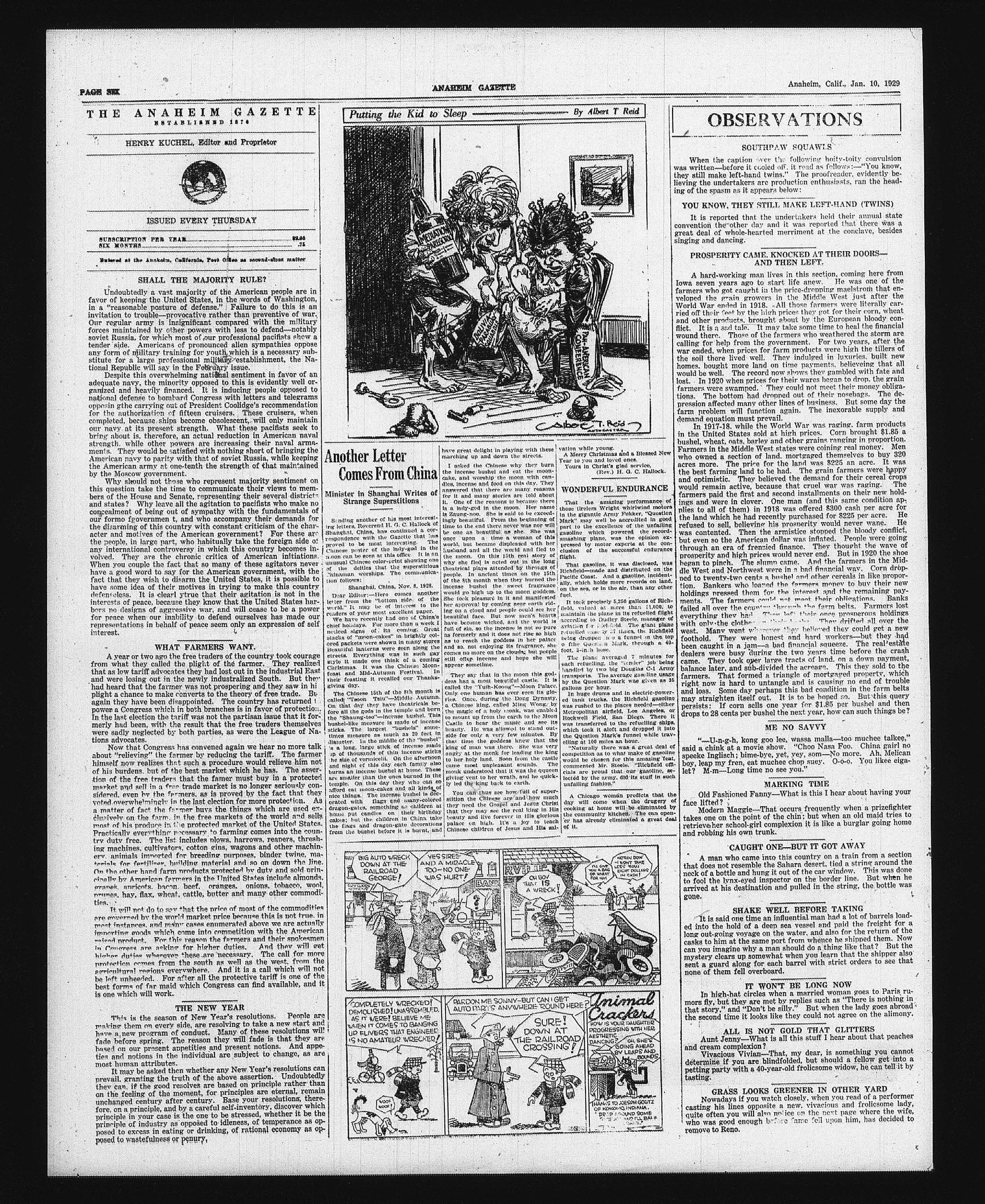
Searchable text
THE ANAHEIM GAZETTE
ESTABLISHED 1870
HENRY KUCHEL, Editor and Proprietor
ISSUED EVERY THURSDAY
SUBSCRIPTION PER YEAR.....$2.00
SIX MONTHS.....75
Buried at the Annapolis, California, Post Office as second-class matter
SHALL THE MAJORITY RULE?
Undoubtedly a vast majority of the American people are in favor of keeping the United States, in the words of Washington, in a "reasonable posture of defense." Failure to do this is an invitation to trouble—provocative rather than preventive of war. Our regular army is insignificant compared with the military forces maintained by other powers with less to defend—notably soviet Russia, for which most of our professional pacifists show a tender side. Americans of pronounced alien sympathies oppose any form of military training for youth which is a necessary substitute for a large professional military establishment, the National Republic will say in the February issue.
Despite this overwhelming national sentiment in favor of an adequate navy, the minority opposed to this is evidently well organized and heavily financed. It is inducing people opposed to national defense to bombard Congress with letters and telegrams opposing gthe carrying out of President Coolidge's recommendation for the authorization of fifteen cruisers. These cruisers, when completed, because ships become obsolescent, will only maintain our navy at its present strength. What these pacifists seek to bring about is, therefore, an actual reduction in American naval strength, while other powers are increasing their naval arma-
Despite this overwhelming national sentiment in favor of an adequate navy, the minority opposed to this is evidently well organized and heavily financed. It is inducing people opposed to national defense to bombard Congress with letters and telegrams opposing the carrying out of President Coolidge's recommendation for the authorization of fifteen cruisers. These cruisers, when completed, because ships become obsolescent, will only maintain our navy at its present strength. What these pacifists seek to bring about is, therefore, an actual reduction in American naval strength, while other powers are increasing their naval armaments. They would be satisfied with nothing short of bringing the American navy to parity with that of soviet Russia, while keeping the American army at one-tenth the strength of that maintained by the Moscow government.
Why should not those who represent majority sentiment on this question take the time to communicate their views to members of the House and Senate, representing their several districts and states? Why leave all the agitation to pacifists who make no concealment of being out of sympathy with the fundamentals of our formo fgovernmen t, and who accompany their demands for the disarming of this country with constant criticism of the character and motives of the American government? For these are the people, in large part, who habitually take the foreign side of any international controversy in which this country becomes involved. They are the chronic critics of American initiations. When you couple the fact that so many of these agitators never have a good word to say for the American government, with the fact that they wish to disarm the United States, it is possible to have some idea of their motives in trying to make this country defenseless. It is clearl ytrue that their agitation is not in the interests of peace, because they know that the United States harbors no designs of aggressive war, and will cease to be a power for peace when our inability to defend ourselves has made our representations in behalf of peace seem only an expression of self interest.
WHAT FARMERS WANT.
A year or two ago the free traders of the country took courage from what they called the plight of the farmer. They realized that as low tariff advocates they had lost out in the industrial East and were losing out in the newly industrialized South. But they had heard that the farmer was not prospering and they saw in his plight a chance to make converts to the theory of free trade. But again they have been disappointed. The country has returned to power a Congress which in both branches is in favor of protection. In the last election the tariff was not the partisan issue that it formerly had been, with the result that the free traders themselves were sadly neglected by both parties, as were the League of Nations advocates.
Now Congress has convened again we hear no more talk about "relieving" the farmer by reducing the tariff. The farmer himself now realizes that such a procedure would relieve him not of his burdens, but of the best market which he has. The assertion of the free traders that the farmer must buy in a protected market and sell in a free trade market is no longer seriously considered, even by the farmers, as is proved by the fact that they voted overwhelmingly in the last election for more protection. As a matter of fact the farmer buys the things which are used exclusively on the farm, in the free markets of the world and sells most of his produce in the protected market of the United States. Practically everything necessary to farming comes into the country duty free. The list includes plows, harrows, reapers, threshing machines, cultivators, cotton gins, wagons and other machin-
himself now realizes that such a procedure would relieve him not of his burdens, but of the best market which he has. The assertion of the free traders that the farmer must buy in a protected market and sell in a free trade market is no longer seriously considered, even by the farmers, as is proved by the fact that they voted overwhelmingly in the last election for more protection. As a matter of fact the farmer buys the things which are used exclusively on the farm, in the free markets of the world and sells most of his produce in the protected market of the United States. Practically everything necessary to farming comes into the country duty free. The list includes ollows, harrows, reapers, threshing machines, cultivators, cotton gins, wagons and other machinery animals imported for breeding purposes, binder twine, materials for fertilizer, building material and so on down the line. On the other hand farm products protected by duty and sold principally by American farmers in the United States include almonds, granes, amricots, bacon, beef, oranges, onions, tobacco, wool, prunes, hay, flax, wheat, cattle, butter and many other commodities.
It will not do to say that the price of most of the commodities are governed by the world market price because this is not true. In most instances, and many cases enumerated above we are actually importing goods which come into competition with the American raised product. For this reason the farmers and their spokesmen in Congress are asking for higher duties. And they will get higher duties wherever these are necessary. The call for more protection comes from the south as well as the west, from the agricultural regions everywhere. And it is a call which will not be left unheeded. For after all the protective tariff is one of the best forms of far maid which Congress can find available, and it is one which will work.
THE NEW YEAR
This is the season of New Year's resolutions. People are making them on every side, are resolving to take a new start and have a new program of conduct. Many of these resolutions will fade before spring. The reason they will fade is that they are based on our present appetites and present notions. And appeties and notions in the individual are subject to change, as are most human attributes.
It may be asked then whether any New Year's resolutions can prevail, granting the truth of the above assertion. Undoubtedly they can, if the good resolves are based on principle rather than on the feeling of the moment, for principles are eternal, remain unchanged century after century. Base your resolutions, therefore, on a principle, and by a careful self-inventory, discover which principle in your case is the one to be stressed, whether it be the principle of industry as opposed to idleness, of temperance as opposed to excess in eating or drinking, of rational economy as opposed to wastefulness or penury.
ANAHEIM GAZETTE
Putting the Kid to Sleep By Albert T Reid
MEDICATION WARS CORRUPTION
COLLIVIA PAPERQUILLE
PAN-AMERICAN CONFERENCE
Albert T. Reid
Another Letter Comes From China
Minister in Shanghai Writes of Strange Superstitions
Sending another of his most interesting letters, Reverend H. G. C. Hallock of Shanghai, China, has continued a correspondence with the Gazette that has proved to be most interesting. The Chinese poster of the lady-god in the moon can be seen at this office. It is an unusual Chinese color-print showing one of the delights that the superstitious Chinaman worships. The communication follows:
Shanghai, China, Nov. 8, 1928.
Dear Editor: Here comes another letter from the "bottom side of the world." It may be of interest to the readers of your most excellent paper.
We have recently had one of China's chief holidays. For more than a week I noticed signs of its coming. Great stacks of "moon-cakes" in brightly colored packets were shown in many stores. Beautiful lanterns were seen along the streets. Everything was in such gay style it made one think of a coming Christmas. It was the Chinese Moon-feast and Mid-Autumn Festival. In their feasting it recalled our Thanksgiving day.
The Chinese 15th of the 8th month is called "Tsoon Tsai"—Middle Autumn. On that day they have theatricals before all the gods in the temple and burn the "Shuang-teo"—incense bushel. This bushel-like measure is made of incense sticks. The largest "bushels" sometimes measure as much as 20 feet in diameter. In the middle of the "bushel" is a long, large stick of incense made up of thousands of thin incense sticks the size of vermicilli. On the afternoon and night of this day each family also burns an incense bushel at home. These are smaller than the ones burned in the temple. On this day they who can so afford eat moon-cakes and all kinds of nice things. The incense bushel is decorated with flags and many-colored dragon-games, something as children at home put candles on their birthday cakes; but the children in China take the flags and dragon-gate decorations from the bushel before it is burnt, and have great delight in playing with these marching up and down the streets.
I asked the Chinese why they burn the incense bushel and eat the mooncake, and worship the moon with candles, incense and food on this day. They answered that there are many reasons for it and many stories are told about it. One of the reasons is because there is a lady-god in the moon. Her name is Zaung-noo. She is said to be exceedingly beautiful. From the beginning of time to the end there never was nor will be one as beautiful as she. She was once upon a time a woman of this world, but became displeased with her husband and all the world and fled to the moon. On this 15th real story of why she fled is acted out in the long theoretical plays attended by throngs of people. In ancient times on the 15th of the 8th month when they burned the incense bushel the sweet fragrance would go high up to the moon goddess. She took pleasure in it and manifested her approval by coming near earth riding on a cloud and people could see her beautiful face. But now men's hearts have become wicked, and the world is full of sin, so the incense is not so pure as formerly and it does not rise so high as to reach the goddess in her palace and so, not enjoying its fragrance, she comes no more on the clouds; but people still offers incense and hope she will appear sometime.
They say that in the moon this goddess has a most beautiful castle. It is called the "Yuhl-Koong"—Moon Palace. Only one human has ever seen its glories. Once, during the Dong Dynasty, a Chinese king, called Ming Wong, by the magic of a holy monk, was enabled to mount up from the earth to the Moon Castle to hear the music and see its beauty. He was allowed to stand outside for only a very few minutes. By that time the goddess knew that the king of man was there. She was very angry at the monk for leading the king to her holy land. Soon from the castle came most unpleasant sounds. The monk understood that it was the queen giving vent to her wrath, and he quickly led the king back to earth.
You can thus see how full of superstition the Chinese are and how much they need the Gospel and Jesus Christ that they may see the real king in His beauty and live forever in His glorious palace on high. It's a joy to teach Chinese children of Jesus and His salvation while young.
A Merry Christmas and a Blessed New Year to you and loved ones.
Yours in Christ's glad service.
(Rev.) H. G. C. Hallock.
WONDERFUL ENDURANCE
That the amazing performance of those tireless Wright whirlwind motors in the gigantic Army Folkker, "Question Mark" may well be accredited in good part to the excellence of the unfailing gasoline which powered the record-smashing plane, was the opinion expressed by motor experte at the conclusion of the successful endurance flight.
That gasoline, it was disclosed, was Richfield—made and distributed on the Pacific Coast. And a gasoline, incidentally, which holds more records on land, on the sea, or in the air, than any other fuel.
It took precisely 5,250 gallons of Richfield, valued at more than $1,000, to maintain the plane in its refuelled flight according to Dudley Steele, manager of aviation for Richfield. The giant plane refuelled easily 37 times, the Richfield being dropped into a funnel in the top o'fthe Question Mark, through a 40-foot, 3-inch hose.
The plane averaged 7 minutes for each refuelling, the "gender" job being handled by two big Douglas C-1 Army transports. The average gasoline usage by the Question Mark was given as 35 gallons per hour.
In huge drums and in electric-powered tank trucks, the Richfield gasoline was rushed to the places needed—either Metropolitan airfield, Los Angeles, or Rockwell Field, San Diego. There it was transferred to the refuelling ships, which took it aloft and dropped it into the Question Mark's funnel while travelling at 100 miles an hour.
"Naturally there was a great deal of competition as to what make of gasoline would be chosen for this amazing feat," commented Mr. Steele. "Richfield officials are proud that our gasoline, selected by the army, did its stuff in such unfailing fashion."
A Chicago woman predicts that the day will come when the drugery of cooking at home will be eliminated by the community kitchen. The can opener has already eliminated a great deal of it.
the size of vermicellil. On the afternoon and night of this day each family also burns an incense bushel at home. These are smaller than the ones burned in the temple. On this day they who can so afford eat moon-cakes and all kinds of nice things. The incense bushel is decorated with flags and many-colored dragon-gates, something as children at home put candles on their birthday cakes; but the children in China take the flags and dragon-gate decorations from the bushel before it is burnt, and to her holy land. Soon from the castle came most unpleasant sounds. The monk understood that it was the queen giving vent to her wrath, and he quickly led the king back to earth.
You can thus see how full of superstition the Chinese are and how much they need the Gospel and Jesus Christ that they may see the real king in His beauty and live forever in His glorious palace on high. It's a joy to teach Chinese children of Jesus and His sal-
A Chicago woman predicts that the day will come when the drugery of cooking at home will be eliminated by the community kitchen. The can opener has already eliminated a great deal of it.
BIG AUTO WRECK DOWN AT THE RAILROAD GEORGE!
YES SIREE AND A MIRACLE TOO-NO ONE WAS HURT!
BANK
OH BOY THAT IS A WRECK!
I'll give you a bag or wheat for him
COMPLETELY WRECKED! DEMOLISHED! UNASSEMBLED, AS IT WERE! BELIEVE ME WHEN IT COMES TO BANGING UP FLUVERS THAT ENGINEER IS NO AMATEUR WRECKER!
PARDON ME SONNY-BUT CAN I GET AUTO PARTS ANYWHERE ROUND HERE?
SURE! DOWN AT THE RAILROAD CROSSING!
Animal Crackers
HOW IS YOUR DAUGHTER PROGRESSING WITH HER AESTHETIC DANCING?
OH, SHE'S GOING AHEAD BY LEAPS AND BOUNDS!
THANKS TO JOESPH GOETZ OF KOKOMO INDIA.
DRIP Around Some Trees And Fill Baif Floor!
OBSERVATIONS
SOUTHPAW SQUAWLS
When the caption over the following hoity-toity convulsion was written—before it cooled off, it read as follows: "You know, they still make left-hand twins." The proofreader, evidently believing the undertakers are production enthusiasts, ran the heading of the spasm as it appears below:
YOU KNOW, THEY STILL MAKE LEFT-HAND (TWINS)
It is reported that the undertakers held their annual state convention the other day and it was reported that there was a great deal of whole-hearted merriment at the conclave, besides singing and dancing.
PROSPERITY CAME. KNOCKED AT THEIR DOORS—and THEN LEFT.
A hard-working man lives in this section, coming here from Iowa seven years ago to start life anew. He was one of the farmers who got caught in the price-dropping maelstrom that enveloped the grain growers in the Middle West just after the World War ended in 1918. All those farmers were literally carried off their feet by the high prices they got for their corn, wheat and other products, brought about by the European bloody conflict. It is a sad tale. It may take some time to heal the financial wound there. Those of the farmers who weathered the storm are calling for help from the government. For two years, after the war ended, when prices for farm products were high the tillers of the soil there lived well. They indulged in luxuries, built new homes, bought more land on time payments, believing that all would be well. The record now shows they gambled with fate and lost. In 1920 when prices for their wares began to drop, the grain farmers were swamped. They could not meet their money obligations. The bottom had dropped out of their nosebags. The depression affected many other lines of business. But some day the farm problem will function again. The inexorable supply and demand equation must prevail.
In 1917-18, while the World War was raging, farm products in the United States sold at high prices. Corn brought $1.85 a bushel, wheat, oats, barley and other grains ranging in proportion. Farmers in the Middle West states were coining real money. Men
the soil there lived well. They indulged in luxuries, built new homes, bought more land on time payments, believing that all would be well. The record now shows they gambled with fate and lost. In 1920 when prices for their wares began to drop, the grain farmers were swamped. They could not meet their money obligations. The bottom had dropped out of their nosebags. The depression affected many other lines of business. But some day the farm problem will function again. The inexorable supply and demand equation must prevail.
In 1917-18, while the World War was raging, farm products in the United States sold at high prices. Corn brought $1.85 a bushel, wheat, oats, barley and other grains ranging in proportion. Farmers in the Middle West states were coining real money. Men who owned a section of land, mortgaged themselves to buy 320 acres more. The price for the land was $225 an acre. It was the best farming land to be had. The grain farmers were happy and optimistic. They believed the demand for their cereal crops would remain active, because that cruel war was raging. The farmers paid the first and second installments on their new holdings and were in clover. One man (and this same condition applies to all of them) in 1918 was offered $300 cash per acre for the land which he had recently purchased for $225 per acre. He refused to sell, believing his prosperity would never wane. He was contented. Then the armistice stopped the bloody conflict, but even so the American dollar was inflated. People were going through an era of frenzied finance. They thought the wave of prosperity and high prices would never end. But in 1920 the shoe began to pinch. The slump came. And the farmers in the Middle West and Northwest were in a bad financial way. Corn dropped to twenty-two cents a bushel and other cereals in like proportion. Bankers who loaned the farmers money to buy their new holdings pressed them for the interest and the remaining payments. The farmers could not meet their obligations. Banks failed all over the country through the farm belts. Farmers lost everything they had. They left their once prosperous holdings with only the clothes they drifted all over the west. Many went whenever they believed they could get a new foothold. They were honest and hard workers—but they had been caught in a jam—a bad financial squeeze. The real estate dealers were busy during the two years time before the crash came. They took over large tracts of land, on a down payment, balance later, and sub-divided the acreage. This they sold to the farmers. That formed a triangle of mortgaged property, which right now is hard to untangle and is causing no end of trouble and loss. Some day perhaps this bad condition in the farm belts may straighten itself out. It is to be hoped so. But this query persists: If corn sells one year for $1.85 per bushel and then drops to 28 cents per bushel the next year, how can such things be?
ME NO SAVVY
“U-n-g-h, kong goo lee, wassa malla—too muchee talkee,” said a chink at a movie show. “Choo Nasa Foo. China gairl no speeke Inglisch; bime-bye, yet, yey, som—No more. Ah, Melican boy, leap my fren, eat muchee chop suey. O-o-o. You likee eigalet? M-m—Long time no see you.”
MARKING TIME
Old Fashioned Fanny—What is this I hear about having your face lifted?
Modern Maggie—That occurs frequently when a prizefighter takes one on the point of the chin; but when an old maid tries to retrieve her school-girl complexion it is like a burglar going home and robbing his own trunk.
CAUGHT ONE—BUT IT GOT AWAY
MARKING TIME
Old Fashioned Fanny—What is this I hear about having your face lifted?
Modern Maggie—That occurs frequently when a prizefighter takes one on the point of the chin; but when an old maid tries to retrieve her school-girl complexion it is like a burglar going home and robbing his own trunk.
CAUGHT ONE—BUT IT GOT AWAY
A man who came into this country on a train from a section that does not resemble the Sahara desert, tied a string around the neck of a bottle and hung it out of the car window. This was done to fool the lynx-eyed inspector on the border line. But when he arrived at his destination and pulled in the string, the bottle was gone.
SHAKE WELL BEFORE TAKING
It is said one time an influential man had a lot of barrels loaded into the hold of a deep sea vessel and paid the freight for a long out-going voyage on the water, and also for the return of the casks to him at the same port from whence he shipped them. Now can you imagine why a man should do a thing like that? But the mystery clears up somewhat when you learn that the shipper also sent a guard along for each barrel with strict orders to see that none of them fell overboard.
IT WON'T BE LONG NOW
In high-hat circles when a married woman goes to Paris rumors fly, but they are met by replies such as "There is nothing in that story," and "Don't be silly." But when the lady goes abroad the second time it looks like they could not agree on the alimony.
ALL IS NOT GOLD THAT GLITTERS
Aunt Jenny—What is all this stuff I hear about that peaches and cream complexion?
Vivacious Vivian—That, my dear, is something you cannot determine if you are blindfolded, but should a fellow get into a petting party with a 40-year-old frolicsome widow, he can tell it by tasting.
GRASS LOOKS GREENER IN OTHER YARD
Nowadays if you watch closely, when you read of a performer casting his lines opposite a new, vivacious and frolicsome lady, quite often you will also notice on the next page where the wife, who was good enough before fame fell upon him, has decided to remove to Reno.