anaheim-gazette 1928-11-22
Scanned page
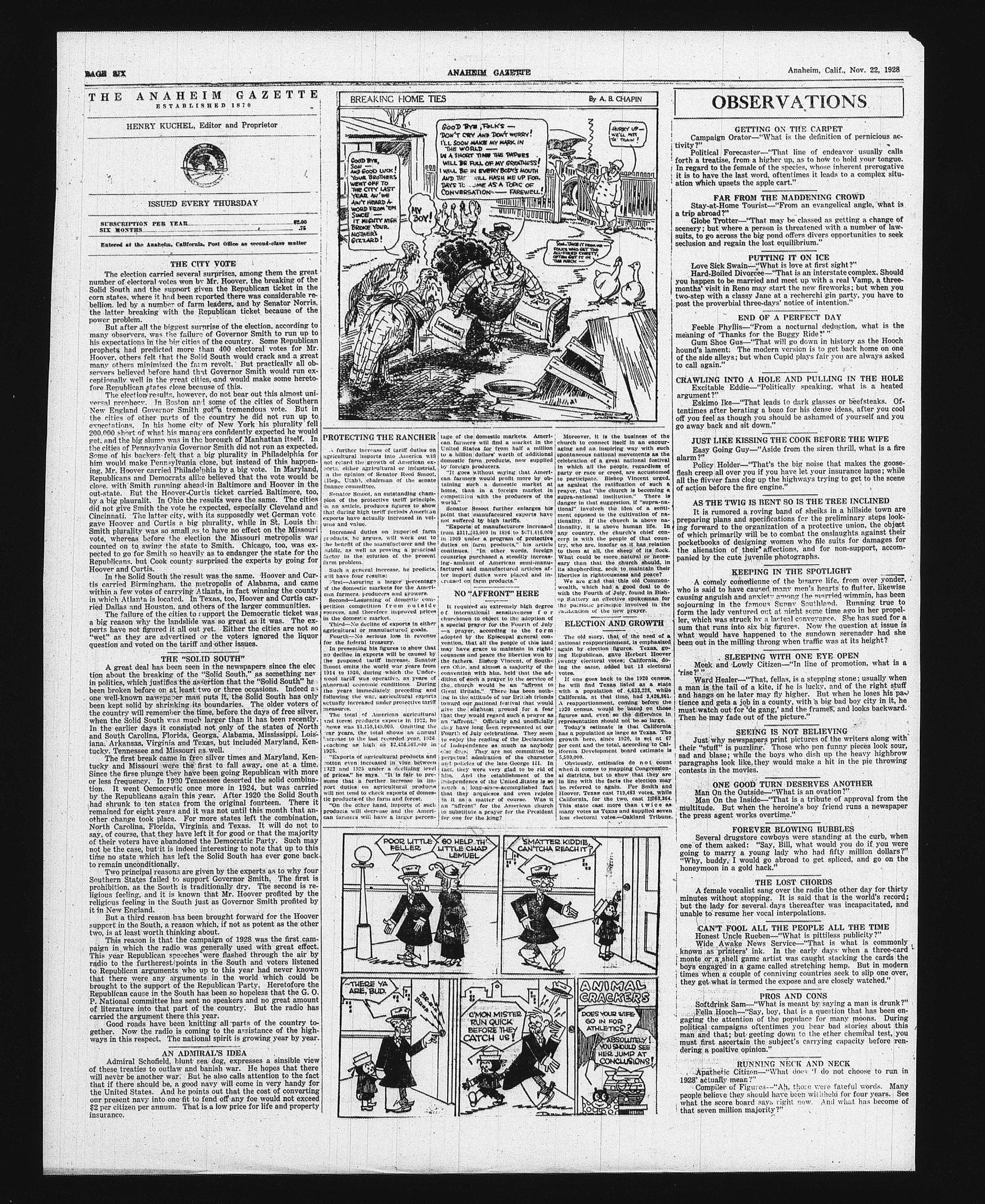
Searchable text
THE ANAHEIM GAZETTE
ESTABLISHED 1870
HENRY KUCHEL, Editor and Proprietor
ISSUED EVERY THURSDAY
SUBSCRIPTION PER YEAR $2.00
SIX MONTHS .75
Entered at the Anaheim, California, Post Office as second-class matter
THE CITY VOTE
The election carried several surprises, among them the great number of electoral votes won by Mr. Hoover, the breaking of the Solid South and the support given the Republican ticket in the corn states, where it had been reported there was considerable rebellion, led by a number of farm leaders, and by Senator Norris, the latter breaking with the Republican ticket because of the power problem.
But after all the biggest surprise of the election, according to many observers, was the failure of Governor Smith to run up to his expectations in the big cities of the country. Some Republican prophets had predicted more than 400 electoral votes for Mr. Hoover, others felt that the Solid South would crack and a great many others minimized the farm revolt. But practically all observers believed before hand that Governor Smith would run exceptionally well in the great cities, and would make some heretofore Republican states close because of this.
The election results, however, do not bear out this almost universal prophecy. In Boston and some of the cities of Southern New England Governor Smith got a tremendous vote. But in the cities of other parts of the country he did not run up to expectations. In his home city of New York his plurality fell 200,000 short of what his managers confidently expected he would get, and the big slump was in the borough of Manhattan itself. In the cities of Pennsylvania Governor Smith did not run as expected.
Hoover, others felt that the Solid South would crack and a great many others minimized the farm revolt. But practically all observers believed before hand that Governor Smith would run exceptionally well in the great cities, and would make some heretofore Republican states close because of this.
The election results, however, do not bear out this almost universal prophecy. In Boston and some of the cities of Southern New England Governor Smith got a tremendous vote. But in the cities of other parts of the country he did not run up to expectations. In his home city of New York his plurality fell 200,000 short of what his managers confidently expected he would get, and the big slump was in the borough of Manhattan itself. In the cities of Pennsylvania Governor Smith did not run as expected. Some of his backers felt that a big plurality in Philadelphia for him would make Pennsylvania close, but instead of this happening, Mr. Hoover carried Philadelphia by a big vote. In Maryland, Republicans and Democrats alike believed that the vote would be close, with Smith running ahead in Baltimore and Hoover in the out-state. But the Hoover-Curtis ticket carried Baltimore, too, by a big pluralit. In Ohio the results were the same. The cities did not give Smith the vote he expected, especially Cleveland and Cincinnati. The latter city, with its supposedly wet German vote gave Hoover and Curtis a big plurality, while in St. Louis the Smith plurality was so small as to have no effect on the Missouri vote, whereas before the election the Missouri metropolis was counted on to swing the state to Smith. Chicago, too, was expected to go for Smith so heavily as to endanger the state for the Republicans, but Cook county surprised the experts by going for Hoover and Curtis.
In the Solid South the result was the same. Hoover and Curtis carried Birmingham, the metropolis of Alabama, and came within a few votes of carrying Atlanta, in fact winning the county in which Atlanta is located. In Texas, too, Hoover and Curtis carried Dallas and Houston, and others of the larger communities.
The failure of the cities to support the Democratic ticket was a big reason why the landslide was so great as it was. The experts have not figured it all out yet. Either the cities are not so "wet" as they are advertised or the voters ignored the liquor question and voted on the tariff and other issues.
THE "SOLID SOUTH"
A great deal has been seen in the newspapers since the election about the breaking of the "Solid South," as something new in politics, which justifies the assertion that the "Solid South" has been broken before on at least two or three occasions. Indeed as one well-known newspaper man puts it, the Solid South has only been kept solid by shrinking its boundaries. The older voters of the country will remember the time, before the days of free silver, when the Solid South was much larger than it has been recently. In the earlier days it consisted not only of the states of North and South Carolina, Florida, Georgia, Alabama, Mississippi, Louisiana, Arkansas, Virginia and Texas, but included Maryland, Kentucky, Tennessee and Missouri as well.
The first break came in free silver times and Maryland, Kentucky and Missouri were the first to fall away, one at a time. Since the firse plunge they have been going Republican with more or less frequency. In 1920 Tennessee deserted the solid combination. It went Oemocratic once more in 1924, but was carried by the Republicans again this year. After 1920 the Solid South had shrunk to ten states from the original fourteen. There it remained for eight years and it was not until this month that another change took place. For more states left the combination, North Carolina, Florida, Virginia and Texas. It will do not to say, of course, that they have left it for good or that the majority of their voters have abandoned the Democratic Party. Such may not be the case, but it is indeed interesting to note that up to this...
The first break came in free silver times and Maryland, Kentucky and Missouri were the first to fall away, one at a time. Since the first plunge they have been going Republican with more or less frequency. In 1920 Tennessee deserted the solid combination. It went Democratic once more in 1924, but was carried by the Republicans again this year. After 1920 the Solid South had shrunk to ten states from the original fourteen. There it remained for eight years and it was not until this month that another change took place. For more states left the combination, North Carolina, Florida, Virginia and Texas. It will do not to say, of course, that they have left it for good or that the majority of their voters have abandoned the Democratic Party. Such may not be the case, but it is indeed interesting to note that up to this time no state which has left the Solid South has ever gone back to remain unconditionally.
Two principal reasons are given by the experts as to why four Southern States failed to support Governor Smith. The first is prohibition, as the South is traditionally dry. The second is religious feeling, and it is known that Mr. Hoover profited by the religious feeling in the South just as Governor Smith profited by it in New England.
But a third reason has been brought forward for the Hoover support in the South, a reason which, if not as potent as the other two, is at least worth thinking about.
This reason is that the campaign of 1928 was the first campaign in which the radio was generally used with great effect. This year Republican speeches were flashed through the air by radio to the furtherest points in the South and voters listened to Republican arguments who up to this year had never known that there were any arguments in the world which could be brought to the support of the Republican Party. Heretofore the Republican cause in the South has been so hopeless that the G. O. P. National committee has sent no speakers and no great amount of literature into that part of the country. But the radio has carried the argument there this year.
Good roads have been knitting all parts of the country together. Now the radio is coming to the assistance of the highways in this respect. The national spirit is growing year by year.
AN ADMIRAL'S IDEA
Admiral Schofield, blunt sea dog, expresses a sensible view of these treaties to outlaw and banish war. He hopes that there will never be another war. But he also calls attention to the fact that if there should be, a good navy will come in very handy for the United States. And he points out that the cost of converting our present navy into one fit to fend off any foe would not exceed $2 per citizen per annum. That is a low price for life and property insurance.
BREAKING HOME TIES
By A. B. CHAPIN
GOOD BYE, SON — AND GOOD LUCK! YOUR BROTHERS WENT OFF TO THE CITY LAST YEAR. A'VE ANN'T HEARD A WORD FROM 'EM SINCE — IT MIGHT NICH BRONZE YOUR MOTHER'S GIZZARD!
GOOD BYE, FOLK'S — DON'T CRY AND DON'T WORRY! ILL SOON MAKE MY MARK IN THE WORLD — IN A SHORT TIME THE PAPERS WILL BE FULL OF MY GREATNESS! I WILL BE IN EVERY BODY'S MOUTH AND THEN WILL HASH ME UP FOR DAYS TO COME AS A TOPIC OF CONVERSATION — FAREWELL!
MY BOY!
SOUL TAKE IT FROM ME — FOLKS WHO GET TOO ALL-TIRED CHRIETY, OFTEN GET IT IN THE PICK —
PROTECTING THE RANCHER
stage of the domestic markets. American farmers will find a market in the United States for from half a million.
Moreover, it is the business of the church to connect itself in an encouraging and an inspiring way with such
PROTECTING THE RANCHER
A further increase of tariff duties on agricultural imports into America will not retard the growth of American exports, either agriculturally or industrial, in the opinion of Senator Reed Smoot (Rep., Utah), chairman of the senate finance committee.
Senator Smoot, an outstanding champion of the protective tariff principle, in an article, produces figures to show that during high tariff periods American exports have actually increased in volume and value.
Increased duties on imported farm products, he argues, will work out to the benefit of the manufacturer and the public, as well as proving a principal factor in the solution of the present farm problem.
Such a general increase, he predicts, will have four results:
First—Assuring a larger percentage of the domestic markets for the American farmers, producers and growers.
Second—Lessening of domestic competition from outside sources, and therefore improved prices in the domestic market.
Third—No decline of exports in either agricultural or manufactured goods.
Fourth—No serious loss in revenue for the federal treasury.
In presenting his figures to show that no decline in exports will be caused by the proposed tariff increase, Senator Smoot omits the world war years from 1914 to 1920, during which the Underwood tariff was operative, as years of abnormal economic conditions.
During the years immediately preceding and following the war, agricultural exports actually increased under protective tariff measures.
The total of American agricultural and forest products exports in 1912, he shows is $1,158,149,000. Onitting the war years, the total shows an annual increase to the last recorded year, 1926, reaching as high as $2,436,567,000 in 1925.
"Exports of agricultural products and cotton even increased in vine between 1922 and 1925 under a declining level of prices," he says. "It is fair to presume that a further increase in import duties on agricultural products will not tend to check exports of domestic products of the farm and forest."
"On the other hand, imports of such products will decrease and the American farmers will have a larger percentage of the domestic markets. American farmers will find a market in the United States for from half a million to a billion dollars' worth of additional domestic farm products, now supplied by foreign producers.
"It goes without saying that American farmers would profit more by obtaining such a domestic market at home, than in a foreign market in competition with the producers of the world."
Senator Smoot further enlarges his point that manufactured exports have not suffered by high tariffs.
"Exports of manufacturers increased from $311,243,000 in 1896 to $671,416,000 in 1909 under a program of protective duties on farm products," his article continues. "In other words, foreign countries purchased a steadily increasing amount of American semi-manufactured and manufactured articles after import duties were placed and increased on farm products."
NO "AFFRONT" HERE
It required an extremely high degree of international sensitivity for churchmen to object to the adoption of a special prayer for the Fourth of July—a prayer, according to the form adopted by the Episcopal general convention, that all the people of this land may have grace to maintain in rightousness and peace the liberties won by the fathers. Bishop Vincent, of Southern Ohio, and almost a majority of the convention with him, held that the addition of such a prayer to the service of the church would be an "affront to Great Britain." There has been nothing in the attitude of our British friends toward our national festival that would give the slightest ground for a fear that they would regard such a prayer as an "affront." Officially and unofficially they have long been represented at our Fourth of July celebrations. They seem to enjoy the reading of the Declaration of Independence as much as anybody else does. They are not committed to perpetual admiration of the character and policies of the late George III. In fact, they were very glad to be rid of him. And the establishment of the independence of the United States is so much a long-since-accomplished fact that they acquiesce and even rejoice in it as a matter of course. Was it an "affront" for the American church to substitute a prayer for the President for one for the king?
Moreover, it is the business of the church to connect itself in an encouraging and an inspiring way with such spontaneous national movements as the celebration of a great national festival in which all the people, regardless of party or race or creed, are accustomed to participate. Bishop Vincent urged, against the ratification of such a prayer, that "the church is becoming a supra-national institution." There is danger in that suggestion, if "supra-national" involves the idea of a sentiment opposed to the cultivation of nationality. If the church is above nationality, it is above human life. In any country, the church's chief concern is with the people of that country, who are, insofar as it has relation to them at all, the sheep of its flock. What could be more natural or necessary than that the church should, in its shepherding, seek to maintain their liberties in righteousness and peace?
We are glad that this old Commonwealth, which had a good deal to do with the Fourth of July, found in Bishop Satterry an effective spokesman for the patriotic principle involved in the validation of the new prayer.
ELECTION AND GROWTH
The old story, that of the need of a national reapportionment, is emphasized again by election figures. Texas, going Republican, gave Herbert Hoover twenty electoral votes; California, doing the same, added but 13 electoral votes.
If one goes back to the 1920 census, he will find Texas listed as a state with a population of 4,633,228, while California, at that time, had 3,426,861. A reapportionment, coming before the 1930 census, would be based on those figures and, even so, the difference in representation should not be so large.
Today's estimate is that California has a population as large as Texas. The growth here, since 1920, is set at 67 per cent and the total, according to California Development board estimate is 5,500,000.
Obviously, estimates do not count when it comes to mapping Congressional districts, but to show that they are in line with the facts the election may be referred to again. For Smith and Hoover, Texas cast 719,483 votes, while California, for the two, cast 1765,364. This state cast more than twice as many votes as Texas and supplied seven less electoral votes—Oakland Tribune.
"Exports of agricultural products and cotton even increased in vile between 1922 and 1925 under a declining level of prices," he says. "It is fair to presume that a further increase in import duties on agricultural products will not tend to check exports of domestic products of the farm and forest.
On the other hand, imports of such products will decrease and the American farmers will have a larger percen-
perpetual admiration of the character and policies of the late George III. In fact, they were very glad to be rid of him. And the establishment of the independence of the United States is so much a long-since-accomplished fact that they acquiesce and even rejoice in it as a matter of course. Was it an 'affront' for the American church to substitute a prayer for the President for one for the king?
POOR LITTLE PELLER
GO HELP THE LITTLE CHAD LEMUEL
SMATTER KIDDIE, CAN'T CHA REACH IT?
THERE YA ARE, BUD.
G'MON MISTER RUN QUICK BEFORE THEY CATCH US!
ANIMAL CRACKERS
DOES YOUR WIFE GO IN FOR ATHLETICS?
ABSOLUTELY! YOU SHOULD SEE HER JUMP AT CONCLUSIONS!"
OBSERVATIONS
GETTING ON THE CARPET
Campaign Orator—"What is the definition of pernicious activity?"
Political Forecaster—"That line of endeavor usually calls forth a treatise, from a higher up, as to how to hold your tongue. In regard to the female of the species, whose inherent prerogative it is to have the last word, oftentimes it leads to a complex situation which upsets the apple cart."
FAR FROM THE MADDENING CROWD
Stay-at-Home Tourist—"From an evangelical angle, what is a trip abroad?"
Globe Trotter—"That may be classed as getting a change of scenery; but where a person is threatened with a number of lawsuits, to go across the big pond offers divers opportunities to seek seclusion and regain the lost equilibrium."
PUTTING IT ON ICE
Love Sick Swain—"What is love at first sight?"
Hard-Boiled Divorcee—"That is an interstate complex. Should you happen to be married and meet up with a real Vamp, a three-months' visit in Reno may start the new fireworks; but when you two-step with a classy Jane at a recherchi gin party, you have to post the proverbial three-days' notice of intention."
END OF A PERFECT DAY
Feeble Phyllis—"From a nocturnal deduction, what is the meaning of 'Thanks for the Buggy Ride?'"
Gum Shoe Gus—"That will go down in history as the Hooch hound's lament: The modern version is to get back home on one of the side alleys; but when Cupid plays fair you are always asked to call again."
CRAWLING INTO A HOLE AND PULLING IN THE HOLE
Excitable Eddie—"Politically speaking, what is a heated argument?"
Eskimo Ike—"That leads to dark glasses or beefsteaks. Of-tentimes after berating a bozo for his dense ideas, after you cool off you feel as though you should be ashamed of yourself and you go away back and sit down."
JUST LIKE KISSING THE COOK BEFORE THE WIFE
CRAWLING INTO A HOLE AND PULLING IN THE HOLE
Excitable Eddie—"Politically speaking, what is a heated argument?"
Eskimo Ike—"That leads to dark glasses or beefsteaks. Of tentimes after berating a bozo for his dense ideas, after you cool off you feel as though you should be ashamed of yourself and you go away back and sit down."
JUST LIKE KISSING THE COOK BEFORE THE WIFE
Easy Going Guy—"Aside from the siren thrill, what is a fire alarm?"
Policy Holder—"That's the big noise that makes the goose-flesh creep all over you if you have let your insurance lapse; while all the flivver fans clog up the highways trying to get to the scene of action before the fire engine."
AS THE TWIG IS BENT SO IS THE TREE INCLINED
It is rumored a roving band of sheiks in a hillside town are preparing plans and specifications for the preliminary steps looking forward to the organization of a protective union, the object of which primarily will be to combat the onslaughts against their pocketbooks of designing women who file suits for damages for the alienation of their affections, and for non-support, accompanied by the cute juvenile photographs.
KEEPING IN THE SPOTLIGHT
A comely comedienne of the bizarre life, from over yonder, who is said to have caused many men's hearts to flutter, likewise causing anguish and anxiety among the married wimmin, has been sojourning in the famous Sunny Southland. Running true to form the lady ventured out at night some time ago in her propeller, which was struck by a lacteal conveyance. She has sued for a sum that runs into six big figures. Now the question at issue is what would have happened to the sundown serenader had she been out in the milling throng when traffic was at its height?
SLEEPING WITH ONE EYE OPEN
Meek and Lowly Citizen—"In line of promotion, what is a 'rise?'"
Ward Healer—"That, fellas, is a stepping stone; usually when a man is the tail of a kite, if he is lucky, and of the right stuff and hangs on he later may fly higher. But when he loses his patience and gets a job in a county, with a big bad boy city in it, he must watch out for 'de gang,' and the frames, and looks backward. Then he may fade out of the picture."
SEEING IS NOT BELIEVING
Just why newspapers print pictures of the writers along with their "stuff" is puzzling. Those who pen funny pieces look sour, sad and blase; while the boys who dish up the heavy highbrow paragraphs look like they would make a hit in the pie throwing contests in the movies.
ONE GOOD TURN DESERVES ANOTHER
Man On the Outside—"What is an ovation?"
Man On the Inside—"That is a tribute of approval from the multitude. But when the heroine's boy friend runs a newspaper the press agent works overtime."
FOREVER BLOWING BUBBLES
Several drugstore cowboys were standing at the curb, when one of them asked: "Say, Bill, what would you do if you were
ONE GOOD TURN DESERVES ANOTHER
Man On the Outside—"What is an ovation?"
Man On the Inside—"That is a tribute of approval from the multitude. But when the heroine's boy friend runs a newspaper the press agent works overtime."
FOREVER BLOWING BUBBLES
Several drugstore cowboys were standing at the curb, when one of them asked: "Say, Bill, what would you do if you were going to marry a young lady who had fifty million dollars?" "Why, buddy, I would go abroad to get spliced, and go on the honeymoon in a gold hack."
THE LOST CHORDS
A female vocalist sang over the radio the other day for thirty minutes without stopping. It is said that is the world's record; but the lady for several days thereafter was incapacitated, and unable to resume her vocal interpolations.
CAN'T FOOL ALL THE PEOPLE ALL THE TIME
Honest Uncle Rueben—"What is pittiless publicity?"
Wide Awake News Service—"That is what is commonly known as printers' ink. In the early days when a three-card monte or a shell game artist was caught stacking the cards the boys engaged in a game called stretching hemp. But in modern times when a couple of conniving countries seek to slip one over, they get what is termed the expose and are closely watched."
PROS AND CONS
Softdrink Sam—"What is meant by saying a man is drunk?"
Fella Hooch—"Say, boy, that is a question that has been engaging the attention of the populace for many moons. During political campaigns oftentimes you hear bad stories about this man and that; but geeting down to the ether chemical test, you must first ascertain the subject's carrying capacity before rendering a positive opinion."
RUNNING NECK AND NECK
Apathetic Citizen—"What does I do not choose to run in 1928' actually mean?"
Compiler of Figures—"Ah, those were fateful words. Many people believe they should have been withheld for four years. See what the score board says right now. And what has become of that seven million majority?"