anaheim-gazette 1928-11-08
Scanned page
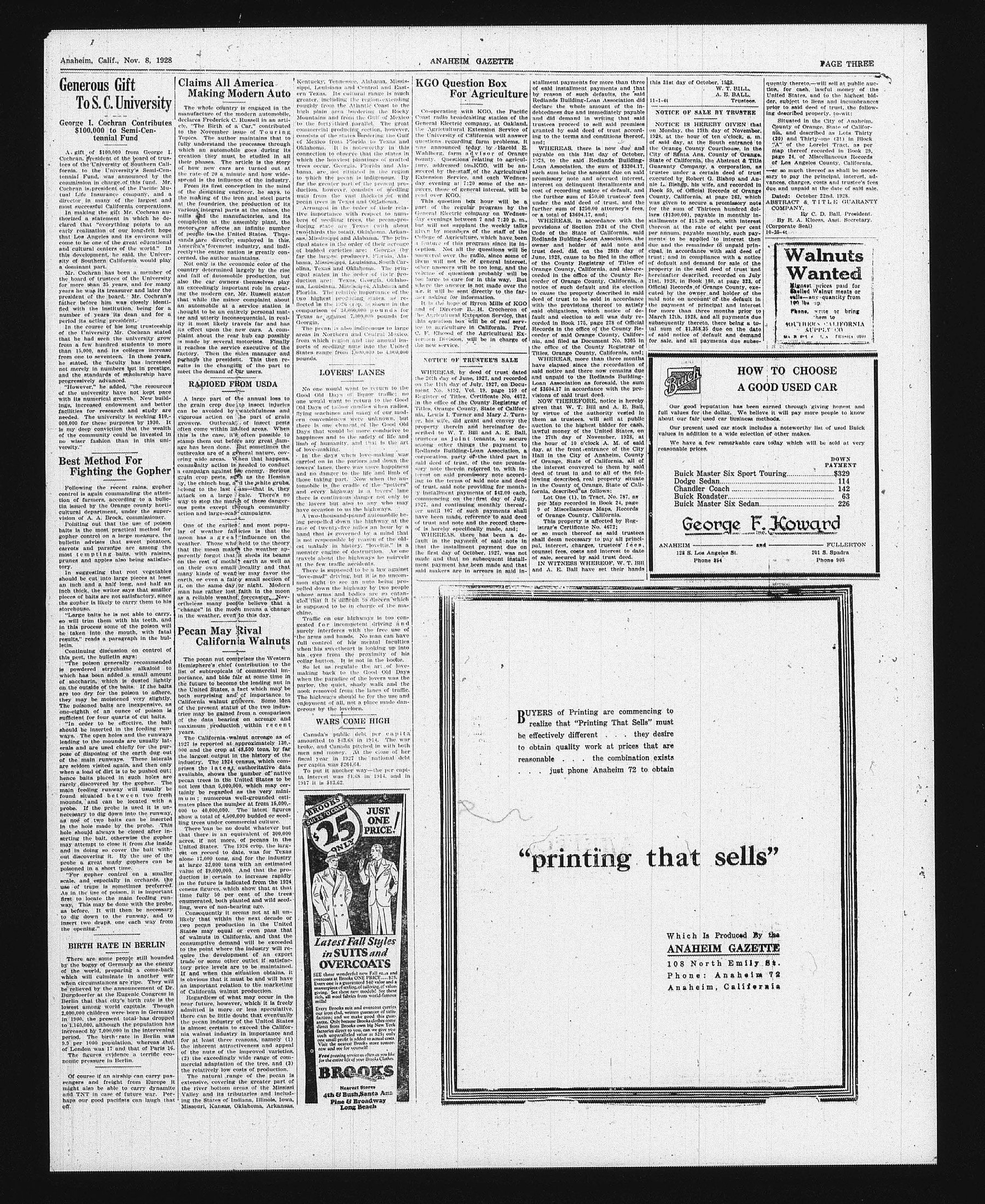
Searchable text
Generous Gift To S.C. University
George I. Cochran Contributes $100,000 to Semi-Centennial Fund
A gift of $100,000 from George I. Cochran, president of the board of trustees of the University of Southern California, to the University's Semi-Centennial Fund, was announced by the commission in charge of this fund. Mr. Cochran is president of the Pacific Mutual Life Insurance company, and a director in many of the largest and most successful California corporations.
In making the gift Mr. Cochran authorized a statement in which he declared that "everything points to an early realization of our long-felt hope that Los Angeles and its environs will come to be one of the great educational and cultural centers of the world." In this development, he said, the University of Southern California would play a dominant part.
Mr. Cochran has been a member of the board of trustees of the University for more than 35 years, and for many years he was its treasurer and later the president of the board. Mr. Cochran's father before him was closely identified with the institution, being for a number of years its dean and for a period its acting president.
In the course of his long trusteeship of the University Mr. Cochran stated that he had seen the university grow from a few hundred students to more than 15,000, and its colleges increase from one to seventeen. In these years, he stated, the faculty has increased not merely in numbers but in prestige, and the standards of scholarship have progressively advanced.
"However," he added, "the resources of the university have not kept pace with its numerical growth. New buildings, increased endowment and better facilities for research and study are needed. The university is seeking $10,000,000 for these purposes by 1930. It is my deep conviction that the wealth of the community could be invested in no wiser fashion than in this university."
Claims All America Making Modern Auto
The whole country is engaged in the manufacture of the modern automobile, declares Frederick C. Russell in an article, "The Birth of a Car," contributed to the November issue of Touring Topics. The author maintains that to fully understand the processes through which an automobile goes during its creation they must be studied in all their phases. The article is the story of how new cars are turned out at the rate of 20 a minute and how widespread is the influence of the industry.
From its first conception in the mind of the designing engineer, he says, to the making of the iron and steel parts at the foundries, the production of its various integral parts at the mines, the mills and the manufactories, and its completion at the assembly plant, the motor car affects an infinite number of people in the United States. Thousands are directly employed in this, America's foremost industry, and indirectly the entire nation is greatly concerned, the author maintains.
Not only is the economic color of the country determined largely by the rise and fall of automobile production, but also the car owners themselves play an exceedingly important role in creating the modern car. Mr. Russell states that while the minor complaint about an automobile at a service station is thought to be an entirely personal matter and utterly inconsequential, in reality it most likely travels far and has its effect upon the new cars. A complaint about the rear hub cap possibly is made by several motorists. Finally it reaches the service executive of the factory. Then the sales manager and perhaps the president. This then results in the changing of the part to meet the demand of car users.
RADIOED FROM USDA
A large part of the annual loss to the grain crop due to insect injuries can be avoided by watchfulness and vigorous action on the part of grain growers. Outbreaks of insect posts often come within limited areas. When this is case, it's often possible to stamp them out before any great damage has been done. But sometimes the Kentucky, Tennessee, Alabama, Mississippi, Louisiana and Central Texas. Its cultural greater, including the relatively high plain area bordering Mountains and from there to the forty-third parallel commercial producing area consists of the states bordered Mexico from Florida to Oklahoma. It is noteworthy connection to observe that which the heaviest plants trees occur, Georgia, Florida bama, are not situated to which the pecan is far farther part of this duction, however, consists nuts from vast thie pecan trees in Texas and Arranged in the order importance with reberbers of seedling trees, ducing state are Texas two thirds total), Oklahoma Mississippi and Alabama central states in the order production are: Texas Georgia Louisiana Mississippi Florida. The relative importance two highest producing affected in the 1926 crop comparison of 34,000,000 Texas as against 7,000,000 Georgia.
The pecan is also indicative areas in Northern and Central from which region and ports of seedling nuts in States range from 1,000,000 pounds.
LOVERS' LAKE
No one would want to Good Old Days of Iowa one would want to return Old Days of Iowa candles flying machines and manned conveniences were there is one element of Days that would be more happiness and to the safelib of humanity, and t
Best Method For Fighting the Gopher
Following the recent rains, gopher control is again commanding the attention of farmers, according to a bulletin issued by the Orange county horticultural department, under the supervision of A. A. Brock, commissioner.
Pointing out that the use of poison baits is the most practical method for gopher control on a large measure, the bulletin advises that sweet potatoes, carrots and parsnips are among the most tempting baits, with raisins, prunes and apples also being satisfactory.
In suggesting that root vegetables should be cut into large pieces at least an inch and a half long, and half an inch thick, the writer says that smaller pieces of baits are not satisfactory, since the gopher is likely to carry them to his storehouse.
"Large baits he is not able to carry, so will trim them with his teeth, and in this process some of the poison will be taken into the mouth, with fatal results," reads a paragraph in the bulletin.
Continuing discussion on control of this pest, the bulletin says:
"The poison generally recommended is powdered strychnine alkaloid to which has been added a small amount of saccharin, which is dusted lightly on the outside of the baits. If the baits are too dry for the poison to adhere they may be moistened very slightly. The poisoned baits are inexpensive, as one-eighth of an ounce of poison is sufficient for four quarts of cut baits."
"In order to be effective, the bait should be inserted in the feeding runways. The open holes and the runways leading to the mounds are usually laterals and are used chiefly for the purpose of disposing of the earth dug out of the main runways. These laterals are seldom visited again, and then only when a load of dirt is to be pushed out; hence baits placed in such holes are rarely discovered by the gopher. The main feeding runway will usually be found situated between two fresh mounds, and can be located with a probe. If the probe is used it is unnecessary to dig down into the runway, as noe of two baits can be inserted in the hole made by the probe. This hole should always be closed after inserting the bait, otherwise the gopher may attempt to close it from the inside and in doing so cover the bait with from one to seventeen. In these years, he stated, the faculty have increased not merely in numbers but in prestige, and the standards of scholarship have progressively advanced.
"However," he added, "the resources of the university have not kept pace with its numerical growth. New buildings, increased endowment and better facilities for research and study are needed. The university is seeking $10,-000,000 for these purposes by 1930. It is my deep conviction that the wealth of the community could be invested in no wiser fashion than in this university."
RADIOED FROM USDA
A large part of the annual loss to the grain crop due to insect injuries can be avoided by watchfulness and vigorous action on the part of grain growers. Outbreaks of insect pests often come within limited areas. When this is the case, it's often possible to stamp them out before any great damage has been done. But sometimes the outbreaks are of a general nature, covering wide areas. When that happens, community action is needed to conduct a campaign against the enemy. Serious grain crop pests, such as the Hessian fly, the chinch bug, and the white grubs, belong to the last class—that is, they attack on a large scale. There's no way to stop the march of these dangerous pests except through community action and large-scale campaigns.
One of the earliest and most popular of weather fallicies is that the moon has a great influence on the weather. Those who held to the theory that the moon makes the weather apparently forget that it sheds its beans on the rest of mother's earth as well as on their own small locality and that many kinds of weather may favor the earth, or even a fairly small section of it. On the same day or night. Modern man has rather lost faith in the moon as a reliable weather forecaster. Nevertheless many people believe that a "change" in the moon means a change in the weather, even to this day.
Pecan May Rival California Walnuts
The pecan nut comprises the Western Hemisphere's chief contribution to the list of subtropicals of commercial importance, and bide fair at some time in the future to become the leading nut in the United States, a fact which may be both surprising and of importance to California walnut growers. Some idea of the present status of the two industries may be gained from a comparison of the data bearing on acreage and maximum production within recent years.
The California walnut acreage as of 1927 is reported at approximately 130,-000 and the crop at 48,500 tons, by far the largest output in the history of the industry. The 1924ensus, which comprises the latest authoritative data available, shows the number of native pecan trees in the United States to be not less than 5,000,000, which may certainly be regarded as the very minimum; numerous well-grounded estimates place the number at from 15,000-000 to 40,000,000. The latest figures show a total of 4,500,000 budded or seedling trees under commercial culture.
There can be no doubt whatever but that there is an equivalent of 300,000 acres, if not more, of pecans in the United States. The 1926 crop, the largest image from one to seventeen. In these years, he stated, the resources of the university have not kept pace with its numerical growth. New buildings, increased endowment and vigorous action on the part of grain growers. Outbreaks of insect pests often come within limited areas. When this is the case, it's often possible to stamp them out before any great damage has been done. But sometimes the outbreaks are of a general nature, covering wide areas. When that happens, community action is needed to conduct a campaign against the enemy. Serious grain crop pests, such as the Hessian fly, the chinch bug, and the white grubs, belong to the last class—that is, they attack on a large scale. There’s no way to stop the march of these dangerous pests except through community action and large-scal campaign.
A two-thousand-pound propelled down the race of twenty-five miles hand that is governed by is not responsible by real malady in history. The monster engine of destruction travels about the highway at the few traffic accidents.
There is supposed to be "love-mad" driving, but I am slight down the highway whose arms and bodies give that it is difficult to be supposed to be in charge.
Traffic on our highways gested for incompetence surely interferes with thieves and hands. No full control of his me when his sweetheart is leaking his eyes from his collar button. It is not so let us regulate making back to the G when the paradise of the parlor, the quiet, shady nook removed from the Highways should be enjoyment of all, not a pleasure by the lovelorn.
WARS COME
Canada's public debt amounted to $13.68 in broke, and Canada pitches men and money. At this fiscal year in 1927 there was $264.64.
To put it another way ta interest was $1.68 in 1917 it is $13.62.
of the main runways. These laterals are seldom visited again, and then only when a load of dirt is to be pushed out; hence baits placed in such holes are rarely discovered by the gopher. The main feeding runway will usually be found situated between two fresh mounds, and can be located with a probe. If the probe is used it is unnecessary to dig down into the runway, as noe of two baits can be inserted in the hole made by the probe. This hole should always be closed after inserting the bait, otherwise the gopher may attempt to close it from the inside and in doing so cover the bait without discovering it. By the use of the probe a great many gophers can be poisoned in a short time.
"For gopher control on a smaller scale, and especially in orchards, the use of traps is sometimes preferred. As in the use of poison, it is important first to locate the main feeding runway. This may be done with the probe, as before. It will then be necessary to dig down to the runway, and to insert two draps, one each way from the opening."
BIRTH RATE IN BERLIN
There are some people still hounded by the bogey of Germany as the enemy of the world, preparing a come-back which will culminate in another wrt when circumstances are ripe. They will be relieved by the announcement of Dr. Burgdoerfer at the Eugenic Congress in Berlin that city's birth rate is the lowest among world capitals. Though 2,000,000 children were born in Germany in 1900, the present total has dropped to 1,160,000, although the population has increased by 7,000,000 in the intervening period. The birth rate in Berlin was 9.9 per 1000 population, whereas that of London was 17 and that of Paris 16.
The figures evidence a terrific economic pressure in Berlin.
Of course if an airship can carry passengers and freight from Europe it might also be able to carry dynamite and TNT in case of future war. Perhaps our good pacifists can laugh that off.
The natural range of the pecan is extensive, covering the greater part of the river bottom areas of the Mississippi Valley and its tributaries and including the States of Indiana, Illinois, Iowa, Missouri, Kansas, Oklahoma, Arkansas,
Kentucky, Tennessee, Alabama, Mississippi, Louisiana and Central and Eastern Texas. Its cultural range is much greater, including the region-extending roughly from the Atlantic Coast to the high plain area bordering the Rocky Mountains and from the Gulf of Mexico to the forty-third parallel. The great commercial producing section, however, consists of the states bordering the Gulf of Mexico from Florida to Texas and Oklahoma. It is noteworthy in this connection to observe that the states in which the heaviest plantings of grafted trees occur, Georgia, Florida and Alabama, are not situated in the region to which the pecan is indigenous. By far the greater part of the present production, however, consists of seedling nuts from the vast thickets of wild pecan trees in Texas and Oklahoma.
Arranged in the order of their relative importance with respect to numbers of seedling trees, the pecan-producing state are Texas (with about two-thirds the total), Oklahoma, Arkansas, Mississippi and Alabama. The principal states in the order of their production are: Texas, Georgia, Oklahoma, Louisiana, Mississippi, Alabama and Florida. The relative importance of the two highest producing states, as reflected in the 1926 crop, is shown in the comparison of 34,000,000 pounds for Texas as against 7,000,000 pounds for Georgia.
The pecan is also indigenous to large areas in Northern and Central Mexico, from which region and the annual imports of seedling nuts into the United States range from 1,000,000 to 4,000,000 pounds.
LOVERS' LANES
No one would want to return to the Good Old Days of liquor traffic; no one would want to return to the Good Old Days of tallow candles when radios, flying machines and many of our modern conveniences were unknown, but there is one element of the Good Old Days that would be more conducive to happiness and to the safety of life and limb of humanity, and that is the art of love-making.
KGO Question Box For Agriculture
Co-operating with KGO, the Pacific Coast radio broadcasting station of the General Electric company, at Oakland, the Agricultural Extension Service of the University of California will answer questions regarding farm problems. It was announced today by Harold E. Wahlberg, farm advisor of Orange county. Questions relating to agriculture, addressed to KGO, will be answered by the staff of the Agricultural Extension Service, and each Wednesday evening at 7:20 some of the answers, those of general interest, will be read over KGO.
This question box hour will be a part of the regular program by the General Electric company on Wednesday evenings between 7 and 7:30 p.m., but will not supplant the weekly talks given by members of the staff of the College of Agriculture, which have been a feature of this program since its inception. Not all the questions will be answered over the radio, since some of them will not be of general interest, other answers will be too long, and the volume of questions probably will be too large to care for in this way. But where the answer is not made over the air, it will be sent directly to the farmer asking for information.
It is the hope of Byron Mills of KGO and of Director B. H. Crocheron of the Agricultural Extension Service, that this question box will be of real service to agriculture in California. Prof. C. F. Elwood of the Agricultural Extension Division, will be in charge of the new service.
NOTICE OF TRUSTEE'S SALE
WHEREAS, by deed of trust dated the 29th day of June, 1927, and recorded on the 11th day of July, 1927, on Document No. $8192, Vol. 19, page 159 of Register of Titles, Certificate No. 4672, in the office of the County Registrar of Titles, Orange County, State of California, Lewis I. Turner and Mary J. Turner, his wife, did grant and convey the property therein and hereinafter described to W. T. Bill and A. E. Ball, trustees as joint tenants, to secure among other things the payment to installment payments for more than three of said installment payments and that by reason of such defaults, the said Redlands Building-Loan Association declare the whole amount of the indebtedness due and immediately payable and did demand in writing that said trustees proceed to sell said premises granted by said deed of trust according to the terms and conditions thereof,
WHEREAS, there is now due and payable on this 31st day of October, 1928, to the said Redlands Building-Loan Association, the sum of $3304.17 such sum being the amount due on said promissory note and accrued interest, interest on delinquent installments and cost of recording notice of default, and further sum of $0.00 trustees' fees under the said deed of trust, and the further sum of $250.00 attorney's fees or a total of $3604.17;
WHEREAS, in accordance with the provisions of Section 2934 of the Civil Code of the State of California, said Redlands Building-Loan Association, the owner and holder of said note and trust deed, did on the 28th day of June, 1928, cause to be filed in the office of the County Registrar of Titles of Orange County, California, and also recorded in the office of the County Recorder of Orange County, California, a notice of such default and its election to cause the property described in said deed of trust to be sold in accordance with the provisions thereof to satisfy said obligations which notice of default and election to sell was duly recorded In Book 175, page 278 of Official Records in the office of the County Recorder of said Orange County, California,and filed as Document No. 9305 in the office of the County Registrar of Titles, Orange County, California;and;
WHEREAS, more than three months have elapsed since the recordation of said notice and there now remains due and unpaid to the Redlands Building-Loan Association as foresaid,the sum of $3604.17 in accordance with the provisions of said trust deed.
NOW THEREFORE, notice is hereby given that W. T. Bill and A. E. Ballby virtue of the authority vested in them as trusteeswill sell at public auction to the highest bidder for cash,Lawful money of the United States.on the 27th day of November,1928.atthe hourof10 o'clockA.M.ofsaiddayatthefront entranceoftheCity
LOVERS’ LANES
No one would want to return to the Good Old Days of liquor traffic; no one would want to return to the Good Old Days of tallow candles when radios, flying machines and many of our modern conveniences were unknown, but there is one element of the Good Old Days that would be more conducive to happiness and to the safety of life and limb of humanity, and that is the art of love-making.
In the days when love-making was carried on in the parlors and down the lowers’ lanes, there was more happiness and no danger to the life and limb of those taking part. Now when the automobile is the cradle of the “petters” and every highway is a lovers’ lane there is continuous danger not only to the lovers but also to any who may have occasion to us the highways.
A two-thousand-pound automobile being propelled down the highway at the rate of twenty-five miles an hour by a hand that is governed by a mind that is not responsible by reason of the oldest malady in history, “lovetis.” is a monster engine of destruction. As one travels about the highways he murrels at the few traffic accidents.
There is supposed to be a law against "love-mad" driving, but it is no uncommon sight to see an auto being propelled down the highway by two people whose arms and bodies are so entangled that it is difficult to discern which is supposed to be in charge of the machine.
Traffic on our highways is too congested for incompetent driving and surely interferes with the free use of the arms and hands. No man can have full control of his mental faculties when his sweetheart is looking up into his eyes from the proximity of his collar button. It is not in the bootee.
So let us regulate the art of love-making back to the Good Old Days when the paradise of the lovers was the parlor, the quiet, shady walk and the nook removed from the lanes of traffic. The highways should be for the use and enjoyment of all, not a place made dangerous by the lovelorn.
WARS COME HIGH
Canada’s public debt per capita amounted to $43.68 in 1914. The war broke, and Canada pitched in with both men and money. At the close of her fiscal year in 1927 the national debt per capita was $264.64.
To put it another way—the per capita interest was $1.68 in 1914, and in 1917 it is $13.62.
NOTICE OF TRUSTEE’S SALE
WHEREAS, by deed of trust dated the 20th day of June, 1927, and recorded on the 11th day of July, 1927, on Document No. 8192, Vol. 19, page 159 of Register of Titles, Certificate No. 4672, in the office of the County Registrar of Titles, Orange County, State of California, Lewis I. Turner and Mary J. Turner, his wife, did grant and convey the property therein and hereinafter described to W. T. Bill and A. E. Ball, trustees as joint tenants, to secure among other things the payment to Redlands Building-Loan Association, a corporation, party of the third part in said deed of trust, of the one promissory note therein referred to, with interest on said promissory note according to the terms of said note and deed of trust, said note providing for monthly installment payments of $42.00 each, commencing on the first day of July, 1927, and continuing monthly thereafter until 107 of such payments shall have been made, reference to said deed of trust and note and the record thereof is hereby specifically made, and;
WHEREAS, there has been a default in the payment of said note in that the installment payment due on the first day of October, 1927, was not made and that no subsequent installment payment has been made and that said makers are in arrears in said in-
BUYERS of Printing are commencing to realize that "Printing That Sells" must be effectively different... they desire to obtain quality work at prices that are reasonable... the combination exists... just phone Anaheim 72 to obtain
BROOKS SUITES & COATS
$25 ONLY
JUST ONE PRICE!
Latest Fall Styles in SUITS and OVERCOATS
SEE these wonderful new Fall suits and overcoats at Brooks ONE PRICE... $25. Every one is a guaranteed $40 value and a masterpiece of styling, of tailoring, of value-giving. See these new models! See these rich, all wool fabrics from world-famous mills!
Every Brooks suit and overcoat carries our iron clad, written guarantee of satisfaction; and we make good this guarantee. Only because Brooks clothes come direct from Brooks own big New York factories direct to you, can we give you such unparalleled value at $25; only one small profit is added to actual costs. Visit the nearest Brooks store tomorrow and see for yourself!
Free pressing service as often as you like for the entire life of your Brooks Clothes.
BROOKS
Nearest Stores
4th & Bush,Santa Ana
Pine & Broadway
Long Beach
this 31st day of October, 1928.
W. T. BILL.
A. E. BALL.
Trustees.
NOTICE OF SALE BY TRUSTEE
NOTICE IS HEREBY GIVEN that on Monday, the 19th day of November, 1928, at the hour of ten o'clock, a m. of said day, at the South entrance to the Orange County Courthouse, in the City of Santa Ana, County of Orange, State of California, the Abstract & Title Guaranty Company, a corporation, as trustee under a certain deed of trust executed by Robert G. Bishop and Annie L. Bishop, his wife, and recorded in Book 59, of Official Records of Orange County, California, at page 262, which was given to secure a promissory note for the sum of Thirteen hundred dollars ($1300.00), payable in monthly installments of $15.20 each, with interest thereon at the rate of eight per cent per annum, payable monthly, such payments to be applied to interest then due and the remainder to unpaid principal, in accordance with said deed of trust; and in compliance with a notice of default and demand for sale of the property in the said deed of trust and hereinafter described, recorded on July 21st, 1928, in Book 180, at page 323, of Official Records of Orange County, executed by the owner and holder of the said note on account of the default in the payment of principal and interest for more than three months prior to March 12th, 1928, and all payments due subsequently thereto, there being a total sum of $1,358.35 due on the date of said notice of default and demand for sale, and all payments due subsequently thereto, will sell at public auction, for cash, lawful money of the United States, and to the highest bidder, subject to liens and incumbrances prior to said deed of trust, the following described property, to-wit:
Situated in the City of Anaheim, County of Orange, State of California, and described as Lots Thirty (30) and Thirty-one (31) in Block "A" of the Lorelei Tract, as per map thereof recorded in Book 29, page 24, of Miscellaneous Records of Los Angeles County, California,
—or so much thereof as shall be necessary to pay the principal, interest, advances, charges, costs and trustee's fees due and unpaid at the date of said sale.
Dated: October 22nd, 1928.
ABSTRACT & TITLE GUARANTY COMPANY.
By C. D. Ball, President.
By R. A. Kloess, Asst. Secretary.
(Corporate Seal)
10-25-4t
Walnuts Wanted
Highest prices paid for Sold Walnut meats or cakes—any quantity from 100 lbs up.
Phone: write or bring them to SOUTHERN CALIFORNIA SUPPLY CO.
HOW TO CHOOSE A GOOD USED CAR
Our good reputation has been earned through giving honest and full values for the dollar. We believe it will pay more people to know about our fair used car business methods.
Our present used car stock includes a noteworthy list of used Buick values in addition to a wide selection of other makes.
We have a few remarkable cars today which will be sold at very reasonable prices.
HOW TO CHOOSE
A GOOD USED CAR
Our good reputation has been earned through giving honest and full values for the dollar. We believe it will pay more people to know about our fair used car business methods.
Our present used car stock includes a noteworthy list of used Buick values in addition to a wide selection of other makes.
We have a few remarkable cars today which will be sold at very reasonable prices.
DOWN
PAYMENT
Buick Master Six Sport Touring.....$329
Dodge Sedan.....114
Chandler Coach.....142
Buick Roadster.....63
Buick Master Six Sedan.....226
George F. Koward
ANAHEIM and FULLERTON
128 S. Los Angeles St.
Phone 854
201 S. Spadra
Phone 905
combination exists
m 72 to obtain
g that sells"
Which Is Produced By the
ANAHEIM GAZETTE
108 North Emily St.
Phone: Anaheim 72
Anaheim, California