anaheim-gazette 1928-10-11
Scanned page
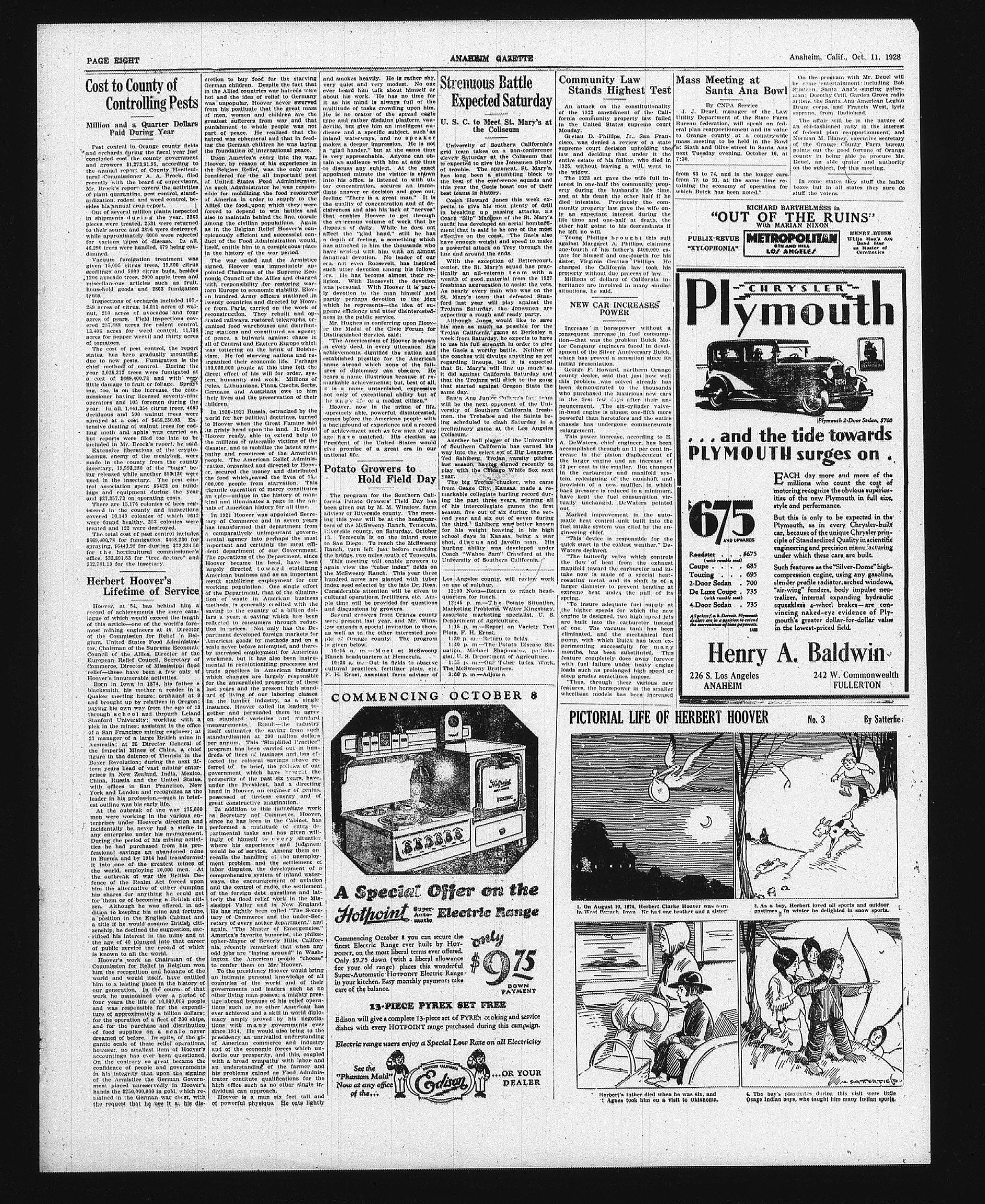
Searchable text
Cost to County of Controlling Pests
Million and a Quarter Dollars Paid During Year
Pest control in Orange county fields and orchards during the fiscal year just concluded cost the county government and growers $1,273,91.95, according to the annual report of County Horticultural Commissioner A. A. Prock, filed recently with the board of supervisors, Mr. Brock's report covers the activities of plant quarantine, pest control, standardization, rodent and weed control, besides his annual crop report.
Out of several million plants inspected in shipments during the year, 3363 pieces were treated, 2531 were returned to their source and 3896 were destroyed, while approximately 6000 were rejected for various types of disease. In all, 46,290 trees were handled, 679 being condemned.
Vacuum fumigation treatment was given 15,095 citrus trees, 19,800 citrus seedlings and 5000 citrus buds, besides 1206 avocado trees, 2000 apple trees and miscellaneous articles such as fruit, household goods and 2863 fumigation tents.
Inspections of orchards included 107-289 acres of citrus, 14,011 acres of walnut, 210 acres of avocados and four acres of pears. Field inspections covered 257,388 acres for rodent control, 13,408 acres for weed control, 11,738 acres for pepper weevil and thirty acres of tomatoes.
The cost of pest control, the report states, has been gradually mounting due to new pests. Fumigation is the chief method of control. During the year 2,028,312 trees were fumigated at a cost of $669,400.78 and with very little damage to fruit or foliage. Spraying, too, is on the increase, the commissioner having licensed seventy-nine operators and 105 foremen during the year. In all, 1,441,354 citrus trees, 4683 deciduous and 500 walnut trees were sprayed at a cost of $458,230.03. Extensive dusting of walnut trees for coding moth and aphids was carried on but reports were filed too late to be included in Mr. Brock's report, he said.
Upon America's entry into the war, Hoover, by reason of his experience in the Belgian Relief, was the only man considered for the all important post of United States Food Administrator. As such Administrator he was responsible for mobilizing the food resources of America in order to supply to the Allies the food upon which they were forced to depend to win battles and also to maintain behind the line, morale among the civilian populations. Again as in the Belgian Relief Hoover's conspicuously efficient and successful conduct of the Food Administration would itself entitle him to a conspicuous place in the history of the war period.
The war ended and the Armistice signed, Hoover was immediately appointed Chairman of the Supreme Economic Council of the Allies and charged with responsibility for restoring warorn Europe to economic stability. Eleven hundred Army officers stationed in twenty countries and directed by Hoover from Paris, carried on the work of reconstruction. They rebuilt and operated railways, restored telegraphs, organized food warehouses and distributing stations and constituted an agency of peace, a bulwark against chaos in all of Central and Eastern Europe which was tottering on the brink of Bolshevism. He fed starving nations and reorganized their economic life. Perhaps 100,000,000 people at this time felt the direct effect of his will for order, system, humanity and work. Millions of Poles, Lithuanians, Finnas Czechs, Serbs, Germans and Austrians owe to him their lives and the preservation of their children.
In 1920-1921 Russia, ostracized by the world for her political doctrines, turned to Hoover when the Great Famine laid its grisly hand upon the land. It found Hoover ready, able to extend help to the millions of miserable victims of the disaster, and to mobilize the latent symbiont to buy food for the starving German children. Despite the fact that in the Allied countries war hatred were hot and the idea of relief to Germany was unpopular, Hoover never swerved from his postulate that the great mass of men, women and children are the greatest sufferers from war and that punishment to whole people was not part of peace. He realized that the hatred was ephemeral and that in feeding the German children he was laying the foundation of international peace.
Upon America's entry into the war, Hoover, by reason of his experience in the Belgian Relief, was the only man considered for the all important post of United States Food Administrator. As such Administrator he was responsible for mobilizing the food resources of America in order to supply to the Allies the food upon which they were forced to depend to win battles and also to maintain behind the line, morale among the civilian populations. Again as in the Belgian Relief Hoover's conspicuously efficient and successful conduct of the Food Administration would itself entitle him to a conspicuous place in the history of the war period.
The war ended and the Armistice signed, Hoover was immediately appointed Chairman of the Supreme Economic Council of the Allies and charged with responsibility for restoring warorn Europe to economic stability. Eleven hundred Army officers stationed in twenty countries and directed by Hoover from Paris, carried on the work of reconstruction. They rebuilt and operated railways, restored telegraphs, organized food warehouses and constituted an agency of peace, a bulwark against chaos in all of Central and Eastern Europe which was tottering on the brink of Bolshevism. He fed starving nations and reorganized their economic life. Perhaps 100,000,000 people at this time felt the direct effect of his will for order, system, humanity and work. Millions of Poles, Lithuanians, Finnas Czechs, Serbs, Germans and Austrians owe to him their lives and the preservation of their children.
In 1920-1921 Russia, ostracized by the world for her political doctrines, turned to Hoover when the Great Famine laid its grisly hand upon the land. It found Hoover ready, able to extend help to the millions of miserable victims of the disaster, and to mobilize the latent symbiont to buy food for the starving German children. Despite the fact that in the Allied countries war hatred were hot and the idea of relief to Germany was unpopular, Hoover never swerved from his postulate that the great mass of men, women and children are the greatest sufferers from war and that punishment to whole people was not part of peace. He realized that the hatred was ephemeral and that in feeding the German children he was laying the foundation of international peace.
Upon America's entry into the war, Hoover, by reason of his experience in the Belgian Relief, was the only man considered for the all important post of United States Food Administrator. As such Administrator he was responsible for mobilizing the food resources of America in order to supply to the Allies the food upon which they were forced to depend to win battles and also to maintain behind the line, morale among the civilian populations. Again as in the Belgian Relief Hoover's conspicuously efficient and successful conduct of the Food Administration would itself entitle him to a conspicuous place in the history of the war period.
The war ended and the Armistice signed, Hoover was immediately appointed Chairman of the Supreme Economic Council of the Allies and charged with responsibility for restoring warorn Europe to economic stability. Eleven hundred Army officers stationed in twenty countries and directed by Hoover from Paris, carried on the work of reconstruction. They rebuilt and operated railways, restored telegraphs, organized food warehouses and constituted an agency of peace, a bulwark against chaos in all of Central and Eastern Europe which was tottering on the brink of Bolshevism. He fed starving nations and reorganized their economic life. Perhaps 100,000,000 people at this time felt the direct effect of his will for order, system, humanity and work. Millions of Poles, Lithuanians, Finnas Czechs, Serbs, Germans and Austrians owe to him their lives and the preservation of their children.
In 1920-1921 Russia, ostracized by the world for her political doctrines,turned to Hoover when the Great Famine laid its grisly hand upon the land. It found Hoover ready,able to extend help to the millions of miserable victims of the disaster,and to mobilize the latent symbiont to buy food for the starving German children. Despite the fact that in The Allied countries war hatred were hot and the idea of relief to Germany was unpopular,Hoover never swerved from his postulate that the great mass of men, women和children arethe greatest sufferersfromwarandthatpunishmenttowholepeoplewasnotpartofpeace.Ho realizarethathathedrorwasephemeralandthatinfeedtingtheGermanchildrenhewaslayingthefoundationininternationalpeace.
Upon America's entry intothewar,Hoover,bylearnstainntan audience,todiscussanyappointinedminuteintotheoffice,intheterconcentrateddiateanswerorfeeling"Therearethequalityofcoolsiselivenessandaethent enablesHoremewmiserdisposofdailysaffectthe"glialdepthoffeelshasattachedtohaveworkedwithfanaticaldevotionsnotevensuchutterdevicesHehasbeiligion.Withyouwaspersonal.Blydevotiontotopart perhapswhichherepreseofficiencyninthepublicMr.HughesinertheMedalofDistinguishedSociety"TheAmericansineverydeed,bachievementsdestablishedpropnameabroadwururesofdiplomacybearsa nameimarkableachieveitisanameonlyofexistencetheshapelikeHoovernowsupremelyablecomesbeforethatabackgroundofachievementagehaimPresidentofthegivepromiseso
Herbert Hoover's Lifetime of Service
Hoover, at 54, has behind him a record of achievements the mere catalogue of which would exceed the length of this article—one of the world's foremost mining engineers at 40. Director of the Commission for Relief in Belgium, United States Food Administrator, Chairman of the Supreme Economic Council of the Allies, Director of the European Relief Council, Secretary of Commerce, Director of Mississippi flood relief—these have been a few only of Hoover's innumerable activities.
Born in Iowa in 1874, his father a blacksmith, his mother a reader in a Quaker meeting house; orphaned at 9 and brought up by relatives in Oregon; paying his own way from the age of 13 through school and through Leland Stanford University; working with a plank in the mines; assistant in the office of a San Francisco mining engineer; at 23 manager of a large British mine in Australia; at 25 Director General of the Imperial Mines of China, a chief figure in the defence of Tientsin in the Boxer Revolution; during the next fifteen years head of vast mining enterprises in New Zealand, India, Mexico, China, Russia and the United States, with offices in San Francisco, New York and London and recognized as the leader in his profession—such in briefest outline was his early life.
At the outbreak of the war 175,000 men were working in the various enterprises under Hoover's direction and incidentally he never had a strike in any enterprise under his management. During the period of his mining activities he had purchased from his pro-
In 1920-1921 Russia, ostracized by the world for her political doctrines, turned to Hoover when the Great Famine laid its grisly hand upon the land. It found Hoover ready, able to extend help to the millions of miserable victims of the disaster, and to mobilize the latent sympathy and resources of the American people. The American Relief Administration, organized and directed by Hoover, secured the money and distributed the food which saved the lives of 15,000,000 people from starvation. This gigantic operation of mercy constitutes an epic—unique in the history of mankind and illuminates a page in the annals of American history for all time.
In 1921 Hoover was appointed Secretary of Commerce and in seven years has transformed that department from a comparatively unimportant governmental agency into perhaps the most important and certainly the most efficient department of our Government. The operations of the Department since Hoover became its head, have been largely directed toward stabilizing American business and as an important result stabilizing employment for our working population. One single effort of the Department, that of the elimination of waste in American business methods, is generally credited with the saving to the country of a billion dollars a year, a saving which has been reflected to consumers through reduction in prices. Not only has the Department developed foreign markets for American goods by methods and on a scale never before attempted, and thereby increased employment for American workmen, but it has also been instrumental in revolutionizing processes and trade practices in American industry which changes are largely responsible for the unparalleled prosperity of these last years and the present high standard of living of our laboring classes.
In the lumber industry, as a single instance, Hoover called its leaders together and persuaded them to agree on standard varieties and standard measurements. Result—the industry itself estimates the saving from such standardization at 200 million dollars per annum. This "Simplified Practice" program has been carried out in hundreds of lines of businesses and has effected the colossal savings above referred to. In brief, the policies of our government which have brought the prosperity of the past six years, have, under the President, had a directing hand in Hoover, an engineer of genius, possessed of tireless energy and of great constructive imagination.
In addition to this immediate work as Secretary afof Commerce. Hoover, since he has been in the Cabinet, has performed a multitude of extra departmental tasks and has given willingly himself to every situation where his experience and judgment would be of service. Among them on
At the outbreak of the war 175,000 men were working in the various enterprises under Hoover's direction and incidentally he never had a strike in any enterprise under his management. During the period of his mining activities he had purchased from his professional savings an abandoned mine in Burma and by 1914 had transformed it into one of the greatest mines of the world, employing 20,000 men. At the outbreak of war the British Defence of the Realm Act forced upon him the alternative of either dumping his shares for anything he could get for them or of becoming a British citizen. Although he was offered, in addition to keeping his mine and fortune, a position in the English Cabinet and a title if he would assume British citizenship, he declined the suggestion, sacrificed his interest in the mine and at the age of 40 plunged into that career of public service the record of which is known to all the world.
Hoover's work as Chairman of the Commission for Relief in Belgium won him the recognition and homage of the world and would itself have entitled him to a leading place in the history of our generation. In the course of that work he maintained over a period of four years the life of 10,000,000 people and was responsible for the expenditure of approximately a billion dollars; for the operation of a fleet of 200 ships, and for the purchase and distribution of food supplies on a scale never dreamed of before. In spite of the gigantic scale of these relief operations, however, no smallest item of Hoover's accountings has ever been questioned. On the contrary so great became the confidence of people and governments in his integrity that upon the signing of the Armistice the German Government placed unreservedly in Hoover's hands the $250,000,000 in gold, which remained in the German war chest, with the request that he use it at his dis-
In addition to this immediate work as Secretary of Commerce, Hoover, since he has been in the Cabinet, has performed a multitude of extra departmental tasks and has given willingly of himself to every situation where his experience and judgment would be of service. Among them on recalls the handling of the unemployment problem and the settlement of labor disputes, the development of a comprehensive system of inland waterways, the encouragement of aviation and the control of radio, the settlement of the foreign debt questions and latterly the flood relief work in the Mississippi Valley and in New England. He has rightly been called "The Secretary of Commerce and the under-Secretary of every another department," and again, "The Master of Emergencies." America's favorite humorist, the philosopher-Mayor of Beverly Hills, California, recently remarked that when any odd jobs are "laying around" in Washington the American people "choose" to confer them on Mr. Hoover.
To the presidency Hoover would bring an intimate personal knowledge of all countries of the world and of their governments and leaders such as no other living man posses; a mighty prestige abroad because of his relief operations such as no other American has ever achieved and a skill in world diplomacy amply proved by his negotiations with many governments ever since 1914. He would also bring to the presidency an unrivalled understanding of American commerce and industry and of the economic forces which underlie our prosperity, and this, coupled with a broad sympathy with labor and an understanding of the farmer and his problems gained as Food Administrator constitute qualifications for the high office such as no other single individual can approach.
Hoover is a man six feet tall and of powerful physique. He cuts lightly
Starving fact that there were Germany swerved great mass are the that was not that the in feed-ras laying peace. The war, prevalence in important post administrator, is response resources only to the they were battles and morale Again overer's con- scious would, place armisticeimately apper- tion Ecoco charged warility. Elevation in by Hoov- work of and op-ographs, ordi- distribution agency chaos in cope which of Bolshheus and re- Perhaps the felt the order, sys- filings of schools, Serbs, be to him of their and smokes heavily. He is rather shy, very quiet and very modest. No one ever heard him talk about himself or his work. He has no time for it as his mind is always full of the multitude of tasks crowding upon him. He is no orator of the spread eagle type and rather disdains platform vaudeville, but give him an intelligent audience and a specific subject, such as inland waterways, and no speaker makes a deeper impression. He is not a "glad hand," but at the same time is very approachable. Anyone can obtain an audience with him at any time to discuss any subject. At the exact appointed minute the visitor is shown into his office, is listened to with utter concentration, secures an immediate answer or decision and goes out feeling "There is a great man." It is the quality of concentration and deci-siveness and also his lack of "nerves" that enables Hoover to get through the enormous volume of work that he disposes of daily. While he does not affect the "glad hand," still he has a depth of feeling, a something which has attached to him the thousands who have worked with him with an almost fanatical devotion. No leader of our era, not even Roosevelt, has inspired such utter devotion among his followers. He has become almost their religion. With Roosevelt the devotion was personal. With Hoover it is partly devotion to the man himself and partly perhaps devotion to the idea which he represents—the idea of supreme efficiency and utter disinterestedness in the public service.
Mr. Hughes in conferring upon Hoo- verr the Medal of the Civic Forum for Distinguished Service, said:
"The Americanism of Hoover is shown in every deed, in every utterance. His achievements dignified the nation and established prestige for the American name abroad which none of the failures of diplomacy can obscure. He bears a name illustrious because of remarkable achievements; but, best of all, it is a name untarnished, expressive not only of exceptional ability but of the shape like or a modest citizen."
Hoover, now in the prime of life, supremely able, powerful, disinterested, comes before the American people with a background of experience and a record of achievement such as few men of any age have matched. His election as President of the United States would give promise of a great era in our
Strenuous Battle Expected Saturday
U. S. C. to Meet St. Mary's at the Coliseum
University of Southern California's grid team takes on a non-conference eleven Saturday at the Coliseum that is expected to give the Jonesmen plenty of trouble. The opponent, St. Mary's, has long been a stumbling block to the best of the conference squads and this year the Gaels boast one of their best teams in history.
Coach Howard Jones this week expects to give his men plenty of drill in breaking up passing attacks, as Coach "Slip" Madigan of the St. Mary's outfit has developed an aerial bombardment that is said to be one of the most effective on the coast. The Gaels also have enough weight and speed to make a powerful attack on Troy through the line and around the ends.
With the exception of Bettencourt, center, the St. Mary's squad has practically an all-veteran team with a wealth of good material from the 1927 freshman aggregation to assist the vets. As nearly every man who was on the St. Mary's team that defeated Stanford last year will play against the Trojans Saturday, the Jonesmen are expecting a rough and ready party.
Although Jones would like to save his men as much as possible for the Trojan California game at Berkeley a week from Saturday, he expects to have to use his full strength in order to give the Gaels a worthy battle. Neither of the coaches will divulge anything as yet regarding lineups, but it is expected that St. Mary's will line up much as did against California Saturday and that the Trojans will stick to the gang that started against Oregon State the same day.
Santa Ana Junior College's fast team will be the next opponent of the University of Southern California freshmen, the Trobabes and the Saints being scheduled to clash Saturday in a preliminary game at the Los Angeles Coliseum.
Another ball player of the University of Southern California has earned his
Community Law Stands Highest Test
An attack on the constitutionality of the 1923 amendment of the California community property law failed in the United States supreme court Monday.
Gretan D. Phillips, Jr., San Francisco, was denied a review of state supreme court decision upholding the law and deciding that under it the entire estate of his father, who died in 1925, without leaving a will, went to the widow.
The 1923 act gave the wife full interest in one-half the community property during the husband's life time, and at his death the other half if he died intestate. Previously the community property law gave the wife only an expectant interest during the life time and one-half at death, the other half going to his descendants if he left no will.
Young Phillips brought this suit against Margaret A. Phillips, claiming one-fourth of his father's $400,000 estate for himself and one-fourth for his sister, Virginia Grattian Phillips. He charged the California law took his property without due process of law.
Millions of dollars of California inheritance involved in many similar situations, he said.
NEW CAR INCREASES POWER
Increase in horsepower without a consequent increase in fuel consumption—that was the problem Buick Motor Company engineers faced in development of the Silver Anniversary Buick, which has proved a sensation since its initial presentation.
George F. Howard, northern Orange county dealer, said that just how well this problem was solved already has been demonstrated to the thousands who purchased the luxurious new cars in the first few days after their announcement. The six-cylinder valve-in-head engine is almost one-fifth more powerful than heretofore and the entire chassis has undergone commensurate enlargement.
This power increase, according to E. A. DeWaters, chief engineer, has been accomplished through an 11 percent increase
Potato Growers to Hold Field Day
The program for the Southern California Potato Growers' Field Day has been given out by M. M. Winslow, farm advisor of Riverside county. The meeting this year will be at the headquarters of the McSweeny Ranch, Temecula, Riverside county, on Saturday, October 13. Temecula is on the inland route to San Diego. To reach the McSweeny Ranch, turn left just before reaching the bridge, two miles south of Temecula.
This meeting will enable growers to again view the "tuber index" fields on the McSweeny Ranch. This year three hundred acres are planted with tuber index seed selected by the late Dr. Rosa. Considerable attention will be given to cultural operations, fertilizers, etc. Ample time will be provided for questions and discussions by growers.
Several growers from Orange county were present last year, and Mr. Winslow extends a special invitation to them, as well as to the other interested people of Orange county. The program is given below.
10:15 a.m.—Meet at McSweeny Ranch headquarters at Hemecula.
10:30 a.m.—Out in fields to observe cultural practices, fertilizer plots, etc.
F. H. Ernst, assistant farm advisor of Los Angeles county, will review work on use of sulphur.
12:00 Noon—Return to ranch headquarters for lunch.
12:45 p.m.—The Potato Situation, Marketing Problems, Walter Kingbury, associate marketing specialist, U. S. Department of Agriculture.
1:15 p.m.—Report on Variety Test Plots, F. H. Ernst.
1:30 p.m.—Return to fields.
1:40 p.m.—The Potato Disease Situation, Michael Shapirovalor, pathologist, U. S. Department of Agriculture.
1:55 p.m.—Our Tuber Index Work, The McSweeny Brothers.
3:00 p.m.—Adjourn.
COMMENCING OCTOBER 8
PICTORIAL LIFE OF HER
A Special Offer on the Hotpoint Super-Automatic Electric Range
Commencing October 8 you can secure the finest Electric Range ever built by Hotpoint, on the most liberal terms ever offered. Only $9.75 down (with a liberal allowance for your old range) places this wonderful Super-Automatic Hotpoint Electric Range in your kitchen. Easy monthly payments take care of the balance.
13-PIECE PYREX SET FREE
Edison will give a complete 13-piece set of PYREX cooking and service dishes with every HOTPOINT range purchased during this campaign.
Electric range users enjoy a Special Low Rate on all Electricity
See the "Phantom Maid" Now at any office of the... OR YOUR DEALER
Anaheim, Calif., Oct. 11, 1928
Mass Meeting at Santa Ana Bowl
By CNPA Service
J. J. Deuel, manager of the Law Utility Department of the State Farm Bureau federation, will speak on federal plan reapportionment and its value to Orange county at a countrywide mass meeting to be held in the Bowl at Sixth and Olive street in Santa Ana next Tuesday evening, October 16, at 7:30.
From 63 to 74, and in the longer cars from 78 to 91, at the same time retaining the economy of operation for which Buick has been noted."
On the program with Mr. Deuel will be some entertainment including Bob Stinson, Santa Ana's singing policeman; Dorothy Crill, Garden Grove radio artist; the Santa Ana American Legion Drum corps, and Francis West, lyric soprano, from Radioland.
The affair will be in the nature of an old-fashioned rally in the interest of federal plan reapportionment, and Norman M. Blaney, executive secretary of the Orange County Farm bureau points out the good fortune of Orange county in being able to procure Mr. Deuel, an able orator and authority on the subject, for this meeting.
In some states they stuff the ballot boxes but in all states they sure do stuff the voters.
RICHARD BARTHELMESS in "OUT OF THE RUINS"
With MARIAN NIXON
PUBLIX-REVUE
"XYLOPHONIA"
METROPOLITAN
6TH AND HILL
LOS ANGELES
HENRY BUSSE
White Man's Ace Band Star as Master of Ceremonies
Chrysler Plymouth
Plymouth 2-Door Sedan, $700
and the tide towards
and the tide towards
PLYMOUTH surges on.
675
AND UPWARDS
Readster . . . $675
(with rumble seat)
Coupe . . . 685
Touring . . . 695
2-Door Sedan . 700
De Luxe Coupe . 735
(with rumble seat)
4-Door Sedan . 735
All prizes f.o.b. Detroit. Plymouth dealers are in a position to extend the convenience of time payments.
Each day more and more of the millions who count the cost of motoring recognize the obvious superiorities of the new Plymouth in full size, style and performance.
But this is only to be expected in the Plymouth, as in every Chrysler-built car, because of the unique Chrysler principle of Standardized Quality in scientific engineering and precision manufacturing under which these cars are built.
Such features as the "Silver-Dome" high-compression engine, using any gasoline, slender profile radiator, arched windows, "air-wing" fenders, body impulse neutralizer, internal expanding hydraulic squeakless 4-wheel brakes—are convincing naked-eye evidence of Plymouth's greater dollar-for-dollar value in the lowest-priced field.
Henry A. Baldwin
226 S. Los Angeles
ANAHEIM
242 W. Commonwealth
FULLERTON
LIFE OF HERBERT HOOVER
No. 3 By Satterfield
0, 1874. Herbert Clarke Hoover was born in a town. He had one brother and a sister.
2. As a boy, Herbert loved all sports and outdoor pastimes. In winter he delighted in snow sports.
It's father died when he was six, and it took him on a visit to Oklahoma.
4. The boy's playmates during this visit were little Osage Indian boys, who taught him many Indian sports.