anaheim-gazette 1928-10-11
Scanned page
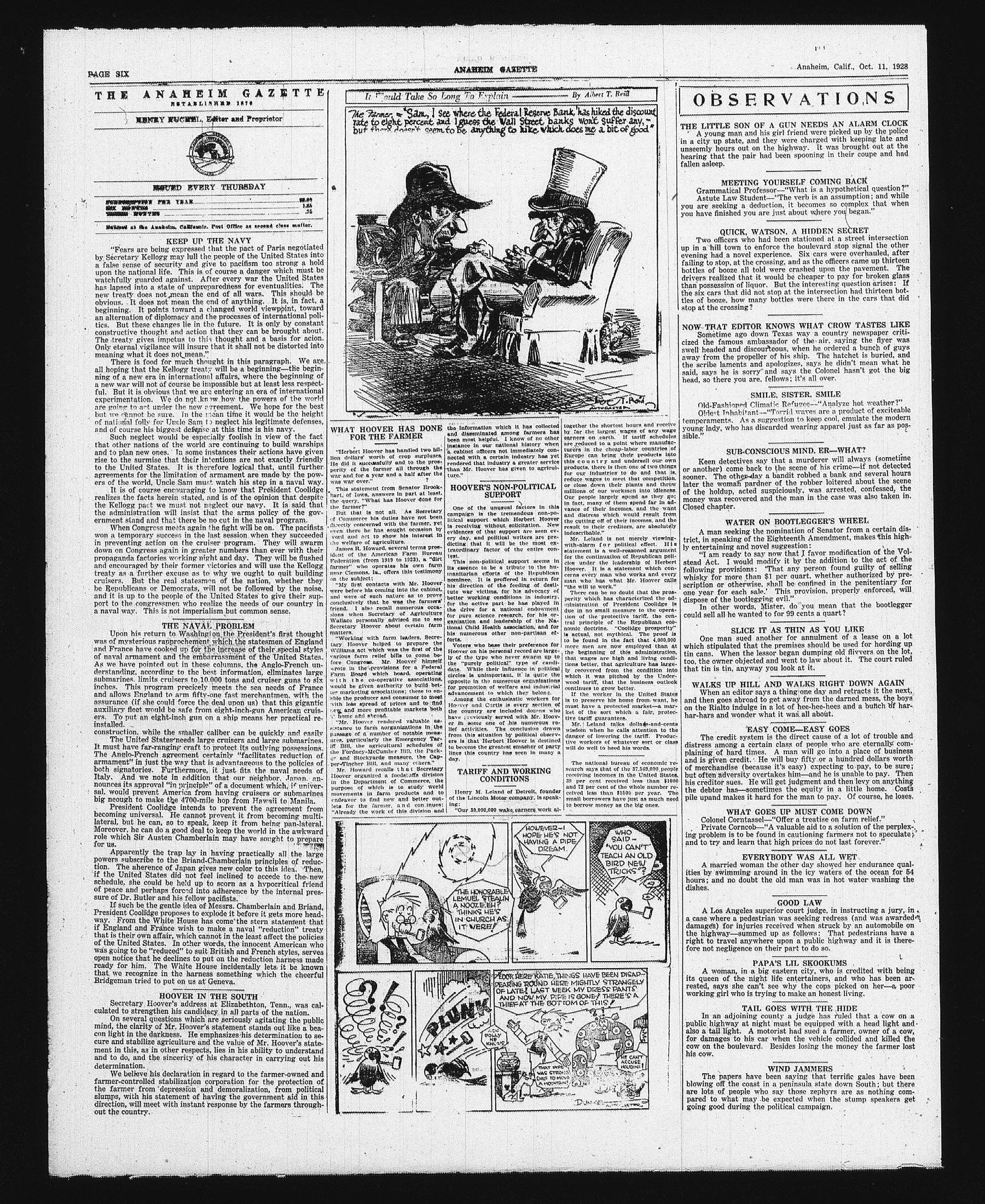
Searchable text
THE ANAHEIM GAZETTE
ESTABLISHED 1870
HENRY RUCHHL, Editor and Proprietor
ISSUED EVERY THURSDAY
SUBSCRIPTION PER YEAR.....$2.00
SIX MONTHS.....1.25
NINE MONTHS......75
Published at the Anaheim, Californian. Post Office as second class matter.
KEEP UP THE NAVY
"Fears are being expressed that the pact of Paris negotiated by Secretary Kellogg may lull the people of the United States into a false sense of security and give to pacifism too strong a hold upon the national life. This is of course a danger which must be watchfully guarded against. After every war the United States has lapsed into a state of unpreparedness for eventualities. The new treaty does not mean the end of all wars. This should be obvious. It does not mean the end of anything. It is, in fact, a beginning. It points toward a changed world viewpoint, toward an alternation of diplomacy and the processes of international politics. But these changes lie in the future. It is only by constant constructive thought and action that they can be brought about. The treaty gives impetus to this thought and a basis for action. Only eternal vigilance will insure that it shall not be distorted into meaning what it does not mean."
There is food for much thought in this paragraph. We are all hoping that the Kellogg treaty will be a beginning—the beginning of a new era in international affairs, where the beginning of a new war will not of course be impossible but at least less respectful. But it is obvious that we are entering an era of international experimentation. We do not know how the powers of the world are going to act under the new agreement. We hope for the best but we cannot be sure. In the meantime it would be the height of national folly for Uncle Sam to neglect his legitimate defenses, and of course his biggest defense at this time is his navy.
Such neglect would be especially foolish in view of the fact that other nations of the world are continuing to build warships
There is food for much thought in this paragraph. We are all hoping that the Kellogg treaty will be a beginning—the beginning of a new era in international affairs, where the beginning of a new war will not of course be impossible but at least less respectful. But it is obvious that we are entering an era of international experimentation. We do not know how the powers of the world are going to act under the new agreement. We hope for the best but we cannot be sure. In the mean time it would be the height of national folly for Uncle Sam to neglect his legitimate defenses, and of course his biggest defense at this time is his navy.
Such neglect would be especially foolish in view of the fact that other nations of the world are continuing to build warships and to plan new ones. In some instances their actions have given rise to the surmise that their intentions are not exactly friendly to the United States. It is therefore logical that, until further agreements for the limitation of armament are made by the powers of the world, Uncle Sam must watch his step in a naval way.
It is of course encouraging to know that President Coolidge realizes the facts herein stated, and is of the opinion that despite the Kellogg pact we must not neglect our navy. It is said that the administration will insist that the arms policy of the government stand and that there be no cut in the naval program.
When Congress meets again the fight will be on. The pacifists won a temporary success in the last session when they succeeded in preventing action on the cruiser program. They will swarm down on Congress again in greater numbers than ever with their propaganda factories working night and day. They will be flushed and encouraged by their former victories and will use the Kellogg treaty as a further excuse as to why we ought to quit building cruisers. But the real statesmen of the nation, whether they be Republicans or Democrats, will not be followed by the noise, and it is up to the people of the United States to give their support to the congressmen who realize the needs of our country in a naval way. This is not imperialism but common sense.
THE NAVAL PROBLEM
Upon his return to Washington the President's first thought was of mysterious rapprochement which the statesmen of England and France have cooked up for the increase of their special styles of naval armament and the embarrassment of the United States. As we have pointed out in these columns, the Anglo-French understanding, according to the best information, eliminates large submarines. Limits cruisers to 10,000 tons and cruiser guns to six inches. This program precisely meets the sea needs of France and allows England to arm fifty-one fast merchantmen, with the assurance (if she could force the deal upon us) that this gigantic auxiliary fleet would be safe from eight-inch-gun American cruisers. To put an eight-inch gun on a ship means her practical reinstalled construction, while the smaller caliber can be quickly and easily.
The United States needs large cruisers and large submarines. It must have far-ranging craft to protect its outliving possessions. The Anglo-French agreement certainly "facilitates reduction of armament" in just the way that is advantageous to the policies of both signatories. Furthermore, it just fits the naval needs of Italy. And we note in addition that our neighbor, Japan, announces its approval "in principle" of a document which, if universal, would prevent America from having cruisers or submarines big enough to make the 4700-mile hop from Hawaii to Manila.
President Coolidge intends to prevent the agreement from becoming universal. He cannot prevent it from becoming multilateral, but he can, so to speak, keep it from being pan-lateral. Moreover, he can do a good deal to keep the world in the awkward role which Sir Austen Chamberlain may have sought to prepare for us.
The Anglo-French agreement certainly facilitates reduction of armament in just the way that is advantageous to the policies of both signatories. Furthermore, it just fits the naval needs of Italy. And we note in addition that our neighbor, Japan, announces its approval "in principle" of a document which, if universal, would prevent America from having cruisers or submarines big enough to make the 4700-mile hop from Hawaii to Manila.
President Coolidge intends to prevent the agreement from becoming universal. He cannot prevent it from becoming multilateral, but he can, so to speak, keep it from being pan-lateral. Moreover, he can do a good deal to keep the world in the awkward role which Sir Austen Chamberlain may have sought to prepare for us.
Apparently the trap lay in having practically all the large powers subscribe to the Briand-Chamberlain principles of reduction. The adherence of Japan gives new color to this idea. Then, if the United States did not feel inclined to accede to the new schedule, she could be held up to scorn as a hypocritical friend of peace and perhaps forced into adherence by the internal pressure of Dr. Butler and his fellow pacifists.
If such be the gentle idea of Messrs. Chamberlain and Briand, President Coolidge proposes to explode it before it gets more headway. From the White House has come the stern statement that if England and France wish to make a naval "reduction" treaty that is their own affair, which cannot in the least affect the policies of the United States. In other words, the innocent American who was going to be "reduced" to suit British and French styles, serves open notice that he declines to put on the reduction harness made ready for him. The White House incidentally lets it be known that we recognize in the harness something which the cheerful Bridgeman tried to put on us at Geneva.
HOOVER IN THE SOUTH
Secretary Hoover's address at Elizabethton, Tenn., was calculated to strengthen his candidacy in all parts of the nation.
On several questions which are seriously agitating the public mind, the clarity of Mr. Hoover's statement stands out like a beacon light in the darkness. He emphasizes his determination to secure and stabilize agriculture and the value of Mr. Hoover's statement in this, as in other respects, lies in his ability to understand and to do, and the sincerity of his character in carrying out his determination.
We believe his declaration in regard to the farmer-owned and farmer-controlled stabilization corporation for the protection of the farmer from depression and demoralization, from political slumps, with his statement of having the government aid in this direction, will meet with instant response by the farmers throughout the country.
ANAHEIM GAZETTE
It Would Take So Long To Explain — By Albert T. Reid
The Farmer, "Sam," I see where the Federal Reserve Bank has hiked the discount rate to eight percent and I guess the Wall Street banks won't suffer any, but there doesn't seem to be anything to like which does me a bit of good."
WHAT HOOVER HAS DONE FOR THE FARMER
the information which it has collected and disseminated among farmers has been most helpful. I know of no other instance in our national history when together the shortest hours and receive by far the largest wages of any wage earners on earth. If tariff schedules are reduced to a point where manufactures in the cheap-labor countries of
WHAT HOOVER HAS DONE FOR THE FARMER
"Herbert Hoover has handled two billion dollars' worth of crop surpluses. He did it successfully and to the prosperity of the farmer all through the war and for a year and a half after the war over."
This statement from Senator Brookhart, of Iowa, answers in part at least, the query, "What has Hoover done for the farmer?"
But that is not all. As Secretary of Commerce his duties have not been directly concerned with the farmer, yet even there he has sought occasion by word and act to show his interest in the welfare of agriculture.
James R. Howard, several terms president of the American Farm Bureau Federation (from 1919 to 1923), a "dirt farmer" who operates his own farm near Clemons, Ia., offers this testimony on the subject:
"My first contacts with Mr. Hoover were before his coming into the cabinet, and were of such nature as to prove conclusively that he was the farmers' friend. I also recall numerous occasions when Secretary of Agriculture Wallace personally advised me to see Secretary Hoover about certain farm matters.
"Working with farm leaders, Secretary Hoover helped to prepare the Williams act which was the first of the various farm relief bills to come before Congress. Mr. Hoover himself wrote in the provisions for a Federal Farm Board which board, operating with the co-operative associations, would be given authority to build better marketing associations; these to enable the producer and consumer to meet with less spread of prices and to find new and more profitable markets both home and abroad.
Mr. Hoover rendered valuable assistance to farm nongroupings in the passage of a number of notable measures, particularly the Emergency Tariff Bill, the agricultural schedules of the Fordney-McCumber Bill, the Packer and Stockyards measure, the Capper-Uncher Bill, and many others."
Mr. Howard recalls that Secretary Hoover organized a foodstuffs division in the Department of Commerce, the purpose of which is to study world movements in farm products and to endeavor to find new and better outlets for the farmer, and continues: "Already the work of this division and the information which it has collected and disseminated among farmers has been most helpful. I know of no other instance in our national history when a cabinet officers not immediately connected with a certain industry has yet rendered that industry a greater service than Mr. Hoover has given to agriculture."
HOOVER'S NON-POLITICAL SURPORT
One of the unusual factors in this campaign is the tremendous non-political support which Herbert Hoover is receiving without solicitation. New evidences of that support are seen every day, and political writers are predicting that it will be the most extraordinary factor of the entire contest.
This non-political support seems in its essence to be a tribute to the humanitarian efforts of the Republican nominee. It is proffered in return for his direction of the feeding of destitute war victims, for his advocacy of better working conditions in industry, for the active part he has played in the drive for a national endowment for pure science research, for his organization and leadership of the National Child Health association, and for his numerous other non-partisan efforts.
Voters who base their preference for Hoover on his personal record are largely of the type who never swarm up to the "purely political" type of candidate. While their influence in political circles is unimportant, it is quite opposite in the numerous organizations for promotion of welfare and industrial advancement to which they belong.
Among the enthusiastic workers for Hoover and Curtis is every section of the country are included dozens who have previously served with Mr. Hoover in some one of his numerous relief activities. The conclusion drawn from this situation by political observers is that Herbert Hoover is destined to become the greatest smasher of party lines this country has seen in many a day.
TARIFF AND WORKING CONDITIONS
Henry M. Leland of Detroit, founder of the Lincoln Motor company, is speaking: "Our 30,000,000 wake earners work al-together the shortest hours and receive by far the largest wages of any wage earners on earth. If tariff schedules are reduced to a point where manufacturers in the cheap-labor countries of Europe can bring their products into this country and undersell our own products, there is then one of two things for our industries to do and that is, reduce wages to meet that competition, or close down their plants and throw millions of our workmen into idleness. Our people largely spend as they go; in fact, many of them spend far in advance of their incomes, and the want and distress which would result from the cutting off of their incomes, and the result to their creditors, are absolutely indescribable."
Mr. Leland is not merely viewing-with-alarm for political effect. His statement is a well-reasoned argument for the continuation of Republican policies under the leadership of Herbert Hoover. It is a statement which concerns every man who works and every man who has what Mr. Hoover calls "the will to work."
There can be no doubt that the prosperity which has characterized the administration of President Coolidge is due in no small measure to the operation of the protective tariff, the central principle of the Republican economic doctrine. "Coolidge prosperity" is actual, not mythical. The proof is to be found in the fact that 4,000,000 more men are now employed than at the beginning of this administration, that wages are high and living conditions better, that agriculture has largely recovered from the condition into which it was pitched by the Underwood tariff, that the business outlook continues to grow better.
If the worker in the United States is to preserve his home from want, he must have a protected market—a market of the sort which a fair, protective tariff guarantees.
Mr. Leland talks dollars-and-cents wisdom when he calls attention to the danger of lowering the tariff. Produce workers of whatever sort or class will do well to heed his words.
The national bureau of economic research says that of the 37,569,000 people receiving incomes in the United States, 39 per cent received less than $1000 and 72 per cent of the whole number received less than $1500 per year. The small borrowers have just as much need to borrow money as the big ones.
Mr. Howard recalls that Secretary Hoover organized a foodstuffs division in the Department of Commerce, the purpose of which is to study world movements in farm products and to endeavor to find new and better outlets for the farmer, and continues: "Already the work of this division and
TARIFF AND WORKING CONDITIONS
Henry M. Leland of Detroit, founder of the Lincoln Motor company, is speaking:
"Our 30,000,000 wake earners work al-
HOWEVER—I HOPE HE'S NOT HAVING A PIPE DREAM.
THE HONORABLE LEMUEL STEALIN A NOOZE.EH? THINKS HE'S IN CHURCH AS IT WERE!
WHO SAID—"YOU CAN'T TEACH AN OLD BIRD NEW TRICKS"?
LOOK HERE KATIE, THINGS HAVE BEEN DISAPPEARING ROUND HERE MIGHTLY STRANGELY OF LATE! LAST WEEK MY DRESS PANTS AND NOW MY PIPE IS GONE! THERE'S A THief AT THE BOTTOM OF THIS!
ASK POLLY HE KNOWS!
THAT PIPE WAS STRONG ENUF TO MOVE A MOUNTAIN!
DUNKEL
OBSERVATIONS
THE LITTLE SON OF A GUN NEEDS AN ALARM CLOCK
A young man and his girl friend were picked up by the police in a city up state, and they were charged with keeping late and unseemly hours out on the highway. It was brought out at the hearing that the pair had been spooning in their coupe and had fallen asleep.
MEETING YOURSELF COMING BACK
Grammatical Professor—"What is a hypothetical question?"
Astute Law Student—"The verb is an assumption; and while you are seeking a deduction, it becomes so complex that when you have finished you are just about where you began."
QUICK, WATSON, A HIDDEN SECRET
Two officers who had been stationed at a street intersection up in a hill town to enforce the boulevard stop signal the other evening had a novel experience. Six cars were overhauled, after failing to stop, at the crossing, and as the officers came up thirteen bottles of booze all told were crashed upon the pavement. The drivers realized that it would be cheaper to pay for broken glass than possession of liquor. But the interesting question arises: If the six cars that did not stop at the intersection had thirteen bottles of booze, how many bottles were there in the cars that did stop at the crossing?
NOW-THAT EDITOR KNOWS WHAT CROW TASTES LIKE
Sometimes ago down Texas way a country newspaper criticized the famous ambassador of the air, saying the flyer was swell headed and discourteous, when he ordered a bunch of guys away from the propeller of his ship. The hatchet is buried, and the scribe laments and apologizes, says he didn't mean what he said, says he is sorry and says the Colonel hasn't got the big head, so there you are, fellows; it's all over.
SMILE, SISTER, SMILE
Old-Fashioned Climatic Refugee—"Analyze hot weather?"
Oldest Inhabitant—"Torrid waves are a product of exciteable temperaments. As a suggestion to keep cool, emulate the modern young lady, who has discarded wearing apparel just as far as possible."
SMILE, SISTER, SMILE
Old-Fashioned Climatic Refugee—"Analyze hot weather?"
Oldest Inhabitant—"Torrid waves are a product of exciteable temperaments. As a suggestion to keep cool, emulate the modern young lady, who has discarded wearing apparel just as far as possible."
SUB-CONSCIOUS MIND, ER—WHAT?
Keen detectives say that a murderer will always (sometime or another) come back to the scene of his crime—if not detected sooner. The other day a bandit robbed a bank and several hours later the woman pardner of the robber loitered about the scene of the holdup, acted suspiciously, was arrested, confessed, the money was recovered and the man in the case was also taken in. Closed chapter.
WATER ON BOOTLEGGER'S WHEEL
A man seeking the nomination of Senator from a certain district, in speaking of the Eighteenth Amendment, makes this highly entertaining and novel suggestion:
"I am ready to say now that I favor modification of the Volstead Act. I would modify it by the addition to the act of the following provisions: 'That any person found guilty of selling whisky for more than $1 per quart, whether authorized by prescription or otherwise, shall be confined in the penitentiary for one year for each sale.' This provision, properly enforced, will dispose of the bootlegging evil."
In other words, Mister, do you mean that the bootlegger could sell all he wanted to for 99 cents a quart?
SLICE IT AS THIN AS YOU LIKE
One man sued another for annulment of a lease on a lot which stipulated that the premises should be used for hording up tin cans. When the lessor began dumping old flivvers on the lot, too, the owner objected and went to law about it. The court ruled that tin is tin, anyway you look at it.
WALKS UP HILL AND WALKS RIGHT DOWN AGAIN
When an editor says a thing one day and retracts it the next, and then goes abroad to get away from the darned mess, the boys on the Rialto indulge in a lot of hee-hee-hees and a bunch of har-hars and wonder what it was all about.
EASY COME—EASY GOES
The credit system is the direct cause of a lot of trouble and distress among a certain class of people who are eternally complaining of hard times. A man will go into a place of business and is given credit. He will buy fifty or a hundred dollars worth of merchandise (because it's easy) expecting to pay, to be sure; but often adversity overtakes him—and he is unable to pay. Then his creditor sues. He will get judgment and then levy on anything the debtor has—sometimes the equity in a little home. Costs pile up makes it hard for the man to pay. Of course, he loses.
WHAT GOES UP MUST COME DOWN
Colonel Corntassel—"Offer a treatise on farm relief."
Private Corncob—"A valuable aid to a solution of the perplexing problem is to be found in cautioning farmers not to speculate; and to try and learn that high prices do not last forever."
WHAT GOES UP MUST COME DOWN
Colonel Corntassel—"Offer a treatise on farm relief."
Private Corncob—"A valuable aid to a solution of the perplexing problem is to be found in cautioning farmers not to speculate; and to try and learn that high prices do not last forever."
EVERYBODY WAS ALL WET
A married woman the other day showed her endurance qualities by swimming around in the icy waters of the ocean for 54 hours; and no doubt the old man was in hot water washing the dishes.
GOOD LAW
A Los Angeles superior court judge, in instructing a jury, in a case where a pedestrian was seeking redress (and was awarded damages) for injuries received when struck by an automobile on the highway—summed up as follows: That pedestrians have a right to travel anywhere upon a public highway and it is therefore not negligence on their part to do so.
PAPA'S LIL SKOOKUMS
A woman, in a big eastern city, who is credited with being its queen of the night life entertainers, and who has been arrested, says she can't see why the cops picked on her—a poor working girl who is trying to make an honest living.
TAIL GOES WITH THE HIDE
In an adjoining county a judge has ruled that a cow on a public highway at night must be equipped with a head light and also a tail light. A motorist had sued a farmer, owner of a cow, for damages to his car when the vehicle collided and killed the cow on the boulevard. Besides losing the money the farmer lost his cow.
WIND JAMMERS
The papers have been saying that terrific gales have been blowing off the coast in a peninsula state down South; but there are lots of people who say those zephyrs are as nothing compared to what may be expected when the stump speakers get going good during the political campaign.