anaheim-gazette 1928-10-04
Scanned page
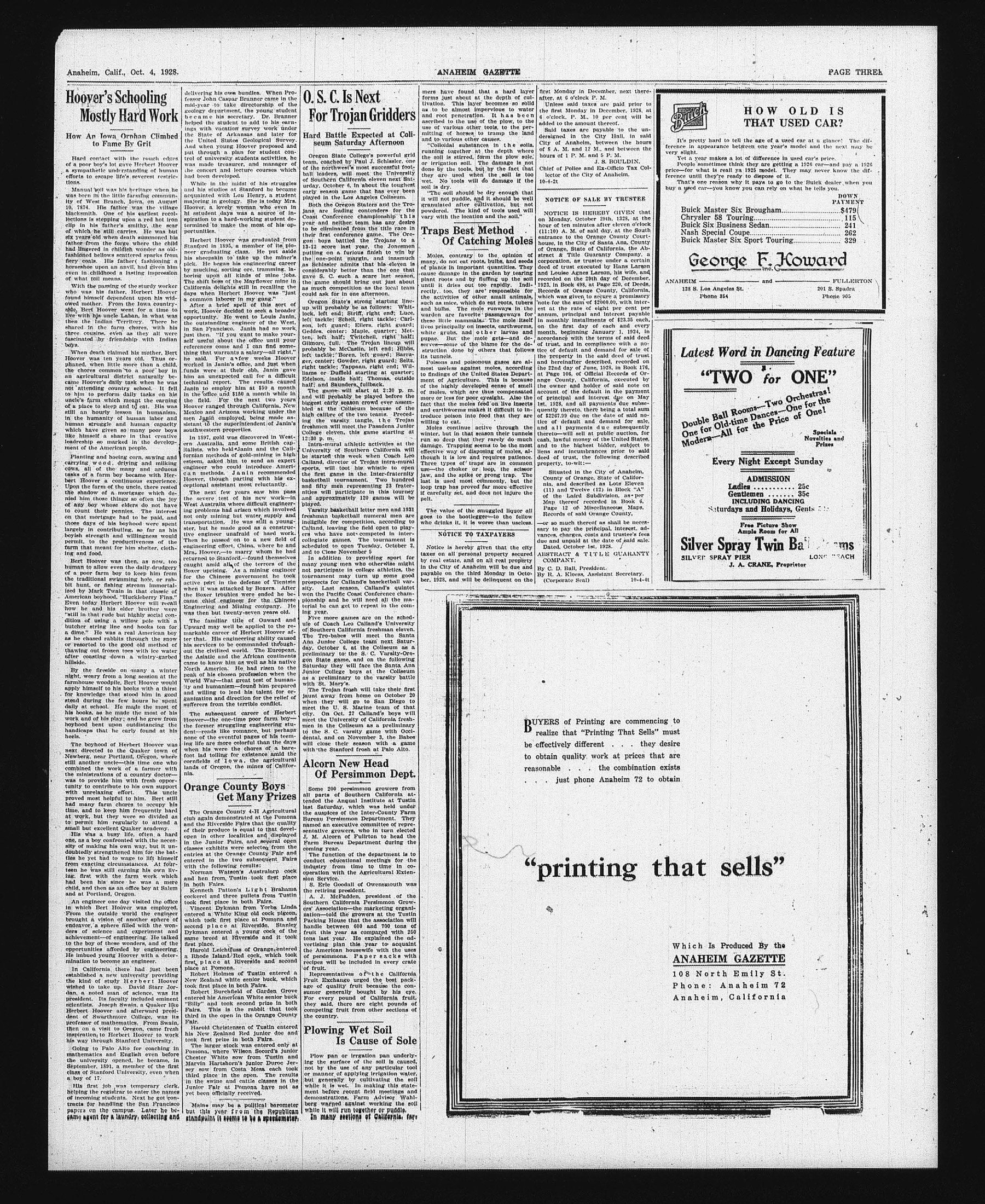
Searchable text
Hoover’s Schooling Mostly Hard Work
How An Iowa Orphan Climbed to Fame By Grit
Hard contact with the rough edges of a poor boy’s lot gave Herbert Hoover a sympathetic understanding of human efforts to escape life's severest restrictions.
Manual toll was his heritage when he was born in the little farming community of West Branch, Iowa, on August 10, 1874. His father was the village blacksmith. One of his earliest recollections is stepping upon a red hot iron clip in his father’s smithy, the scar of which he still carries. He was but six years old when death summoned his father from the forge where the child had lingered in childish wonder as old-fashioned bellows scattered sparks from fiery coals. His father (fashioning a horsehoe upon an anvil, had given him even in childhood a lasting impression of what toll means.
With the passing of the sturdy worker who was his father, Herbert Hoover found himself dependent upon his widowed mother. From the Iowa countryside, Bert Hoover went for a time to live with his uncle Laban, in what was then the Indian Territory. There he shared in the farm chores, with his three cousins, even as they all were fascinated by friendship with Indian boys.
When death claimed his mother, Bert Hoover was ten years old. Thus orphaned, when little more than a child, the chores common to a poor boy in an agricultural district naturally became Hoover’s daily task when he was not attending country school. It fell to him to perform daily tasks on his uncle’s farm which meant the earning of a place to sleep and to eat. His was still an hourly lesson in humanism, in the humanity of human labor and human struggle and human capacity which have given so many poor boys like himself a share in that creative leadership so marked in the development of the American people.
delivering his own bundles. When Professor John Caspar Branner came in the mid-year to take directorship of the geology department, the young student became his secretary. Dr. Branner helped the student to add to his earnings with vacation survey work under the State of Arkansas and later for the United States Geological Survey. And when young Hoover proposed and put through a plan for student control of university students activities, he was made treasurer, and manager of the concert and lecture courses which had been developed.
While in the midst of his struggles and his studies at Stanford he became acquainted with Lou Henry, a student majoring in geology. She is today Mrs. Hoover, a lovely woman who even in hi student days was a source of inspiration to a hard-working student determined to make the most of his opportunities.
Herbert Hoover was graduated from Stanford in 1895, a member of its pioneer graduating class. He put aside his sheepskin to take up the miner’s pick. He began his engineering career by mucking, sorting ore, tramming, laboring upon all kinds of mine jobs. The shift boss of the Mayflower mine in California delights still in recalling the days when Herbert Hoover was “just a common laborer in my gang.”
After a brief spell of this sort of work, Hoover decided to seek a broader opportunity. He went to Louis Janin, the outstanding engineer of the West, in San Francisco. Janin had no work just then. "If you want to make yourself useful about the office until your references come and I can find something that warrants a salary—all right," he said. For a few weeks Hoover worked in Janin’s office, and just when funds were at their ebb, Janin gave him an unexpected call for a difficult technical report. The results caused Janin to employ him at $50 a month in the office and $150 a month while in the field. For the next two years Hoover ranged through California, New Mexico and Arizona working under the men Janin employed, being made assistant to the superintendent of Janin’s southwestern properties.
In 1897, gold was discovered in Western Australia, and some British capitalists, who held Janin and the Cali-
O. S. C. Is New For Trojan
Hard Battle Experience Saturday
Oregon State College team, coached by Paul of the northwest’s most ball leaders, will meet of Southern California Saturday, October 6. In early season game that played in the Los Angeles Both the Oregon State Jans are leading Coast Conference charm year and neither team to be eliminated from their first conference game 13-12 score last year putting on a furious one-point margin as Schlissler admits considerably better than gave S. C. such a scarcity the game should bring as much competition as could ask for in one afternoon.
Oregon State’s strong up will probably be as lock, left end; Striff, left tackle; Schell, right son; guard; Eller Geddes, center; Maple ten, left half; Twitch Glimore, full. The Tr probably be McCaslin, left tackle; Boren, left ger; center; Gowder, right tackle; Tappann, lams or Duffield start Edelson, inside half; half; and Saunders, full.
The game will start and will probably be biggest early season cried at the Coliseum high calibre of the two playing the varsity tango freshmen will meet the College eleven, this go
Hoover was ten years old. Thus orphaned, when little more than a child, the chores common to a poor boy in an agricultural district naturally became Hoover's daily task when he was not attending country school. It fell to him to perform daily tasks on his uncle's farm which meant the earning of a place to sleep and to eat. His was still an hourly lesson in humanism, in the humanity of human labor and human struggle and human capacity which have given so many poor boys like himself a share in that creative leadership so marked in the development of the American people.
Planting and hoeing corn, sawing and carrying wood, drying and milking cows, all of the many and arduous tasks of a farm boy became with Herbert Hoover a continuous experience. Upon the farm of the uncle, there rested the shadow of a mortgage which denied him those things so often the joy of any boy whose elders do not have to count their pennies. The interest on that mortgage had to be paid, and those days of his boyhood were spent largely in contributing, so far as his boyish strength and willingness would permit, to the productiveness of the farm that meant for him shelter, clothing and food.
Bert Hoover was then, as now, too human to allow even the daily drudgery of a poor farm boy to keep him from the traditional swimming hole, or rabbit hunt, or fishing stream immortalized by Mark Twain in that classle of American boyhood. "Huckleberry Finn." Even today Herbert Hoover will recall how he and his elder brother were "still in that rude but highly social condition of using a willow pole with a butterer string line and books ten for a dime." He was a real American boy as he chased rabbits through the snow or resorted to the good old method of thawing out frozen toes with ice water after coasting down a wintry-garbed hillside.
By the fireside on many a winter night, weary from a long session at the farmhouse woodpile, Bert Hoover would apply himself to his books with a thirst for knowledge that stood him in good stead during the few hours he spent daily at school. He made most of his books, as he made the most of his work and of his play; and he grew from boyhood bent upon outdistancing the handicaps that he early found at his heels.
The boyhood of Herbert Hoover was next directed to the Quaker town of Newberg, near Portland, Oregon, where still another uncle—this time one who combined the work of a farmer with the ministrations of a country doctor—was to provide him with fresh opportunity to contribute to his own support with unrelaxing effort. This uncle proved most helpful to him. Bert still had many farm chores to occupy his time, and to keep him frequently hard at work, but they were so divided as to permit him regularly to attend a small but excellent Quaker academy.
His was a busy life, often a hard one, as a boy confronted with the necessity of making his own way, but it unphantened, when little more than a child, the chores common to a poor boy in an agricultural district naturally became Hoover's daily task when he was not attending country school. It fell to him to perform daily tasks on his uncle's farm which meant the earning of a place to sleep and to eat. His was still an hourly lesson in humanism, in the humanity of human labor and human struggle and human capacity which have given so many poor boys like himself a share in that creative leadership so marked in the development of the American people.
Planting and hoeing corn, sawing and carrying wood, drying and milking cows, all of the many and arduuous tasks of a farm boy became with Herbert Hoover a continuous experience. Upon the farm of the uncle, there rested the shadow of a mortgage which denied him those things so often the joy of any boy whose elders do not have to count their pennies. The interest on that mortgage had to be paid, and those days of his boyhood were spent largely in contributing, so far as his boyish strength and willingness would permit, to the productiveness of the farm that meant for him shelter, clothing and food.
Bert Hoover was then, as now, too human to allow even the daily drudgery of a poor farm boy to keep him from the traditional swimming hole, or rabbit hunt, or fishing stream immortalized by Mark Twain in that classle of American boyhood. "Huckleberry Finn." Even today Herbert Hoover will recall how he and his elder brother were "still in that rude but highly social condition of using a willow pole with a butterer string line and books ten for a dime." He was a real American boy as he chased rabbits through the snow or resorted to the good old method of thawing out frozen toes with ice water after coasting down a wintry-garbed hillside.
By the fireside on many a winter night, weary from a long session at the farmhouse woodpile, Bert Hoover would apply himself to his books with a thirst for knowledge that stood him in good stead during the few hours he spent daily at school. He made most of his books, as he made the most of his work and of his play; and he grew from boyhood bent upon outdistancing the handicaps that he early found at his heels.
The boyhood of Herbert Hoover was next directed to the Quaker town of Newberg, near Portland, Oregon, where still another uncle—this time one who combined the work of a farmer with the ministrations of a country doctor—was to provide him with fresh opportunity to contribute to his own support with unrelaxing effort. This uncle proved most helpful to him. Bert still had many farm chores to occupy his time, and to keep him frequently hard at work, but they were so divided as to permit him regularly to attend a small but excellent Quaker academy.
His was a busy life, often a hard one, as a boy confronted with the necessity of making his own way, but it unphantened, when little more than a child, the chores common to a poor boy in an agricultural district naturally became Hoover's daily task when he was not attending country school. It fell to him to perform daily tasks on his uncle's farm which meant the earning of a place to sleep and to eat. His was still an hourly lesson in humanism, in the humanity of human labor and human struggle and human capacity which have given so many poor boys like himself a share in that creative leadership so marked in the development of the American people.
Planting and hoeing corn, sawing and carrying wood, drying and milking cows, all of the many and arduuous tasks of a farm boy became with Herbert Hoover a continuous experience. Upon the farm of the uncle, there rested the shadow of a mortgage which denied him those things so often the joy of any boy whose elders do not have to count their pennies. The interest on that mortgage had to be paid, and those days of his boyhood were spent largely in contributing, so far as his boyish strength and willingness would permit, to the productiveness of the farm that meant for him shelter, clothing and food.
Bert Hoover was then, as now, too human to allow even the daily drudgery of a poor farm boy to keep him from the traditional swimming hole, or rabbit hunt, or fishing stream immortalized by Mark Twain in that classle of American boyhood. "Huckleberry Finn." Even today Herbert Hoover will recall how he and his elder brother were "still in that rude but highly social condition of using a willow pole with a butterer string line and books ten for a dime." He was a real American boy as he chased rabbits through the snow or resorted to the good old method of thawing out frozen toes with ice water after coasting down a wintry-garbed hillside.
By the fireside on many a winter night, weary from a long session at the farmhouse woodpile, Bert Hoover would apply himself to his books with a thirst for knowledge that stood him in good stead during the few hours he spent daily at school. He made most of his books, as he made the most of his work and of his play; and he grew from boyhood bent upon outdistancing the handicaps that he early found at his heels.
The boyhood of Herbert Hoover was next directed to the Quaker town of Newberg, near Portland, Oregon, where still another uncle—this time one who combined the work of a farmer with the ministrations of a country doctor—was to provide him with fresh opportunity to contribute to his own support with unrelaxing effort. This uncle proved most helpful to him. Bert still had many farm chores to occupy his time, and to keep him frequently hard at work, but they were so divided as to permit him regularly to attend a small but excellent Quaker academy.
His was a busy life, often a hard one, as a boy confronted with the necessity of making his own way, but it unphantened, when little more than a child, the chores common to a poor boy in an agricultural district naturally became Hoover's daily task when he was not attending country school. It fell to him to perform daily tasks on his uncle's farm which meant the earning of a place to sleep and to eat. His was still an hourly lesson in humanism, in the humanity of human labor and human struggle and human capacity which have given so many poor boys like himself a share in that creative leadership so marked in the development of the American people.
Planting and hoeing corn, sawing and carrying wood, drying and milking cows, all of the many and arduuous tasks of a farm boy became with Herbert Hoover a continuous experience. Upon the farm of the uncle, there rested the shadow of a mortgage which denied him those things so often the joy of any boy whose elders do not have to count their pennies. The interest on that mortgage had to be paid, and those days of his boyhood were spent largely in contributing, so far as his boyish strength and willingness would permit, to the productiveness of the farm that meant for him shelter, clothing and food.
Bert Hoover was then, as now, too human to allow even the daily drudgery of a poor farm boy to keep him from the traditional swimming hole, or rabbit hunt, or fishing stream immortalized by Mark Twain in that classle of American boyhood. "Huckleberry Finn." Even today Herbert Hoover will recall how he and his elder brother were "still in that rude but highly social condition of using a willow pole with a butterer string line and books ten for a dime." He was a real American boy as he chased rabbits through the snow or resorted to the good old method of thawing out frozen toes with ice water after coasting down a wintry-garbed hillside.
By the fireside on many a winter night, weary from a long session at the farmhouse woodpile, Bert Hoover would apply himself to his books with a thirst for knowledge that stood him in good stead during the few hours he spent daily at school. He made most of his books, as he made the most of his work and of his play; and he grew from boyhood bent upon outdistancing the handicaps that he early found at his heels.
The boyhood of Herbert Hoover was next directed to the Quaker town of Newberg, near Portland, Oregon, where still another uncle—this time one who combined the work of a farmer with the ministrations of a country doctor—was to provide him with fresh opportunity to contribute to his own support with unrelaxing effort. This uncle proved most helpful to him. Bert still had many farm chores to occupy his time, and to keep him frequently hard at work, but they were so divided as to permit him regularly to attend a small but excellent Quaker academy.
His was a busy life, often a hard one, as a boy confronted with the necessity of making his own way, but it unphantened, when little more than a child, the chores common to a poor boy in an agricultural district naturally became Hoover's daily task when he was not attending country school. It fell to him to perform daily tasks on his uncle's farm which meant the earning of a place to sleep and to eat. His was still an hourly lesson in humanism, in the humanity of human labor and human struggle and human capacity which have given so many poor boys like himself a share in that creative leadership so marked in the development of the American people.
Planting and hoeing corn,sawing and carrying wood,drying and milking cows , all of the many and arduuous tasks of a farm boy became with Herbert Hoover after that. His engineering ability caused his services to be commanded throughout the civilized world. The European,the Asiatie and African continents came to know him as well as his native North America. He had risen to the peak of his chosen profession when the World War—that great test of humanity and humanism—found him prepared and willing to lend his talent for organization and direction for the relief of sufferers from the terrible conflict.
The subsequent career of Herbert Hoover—the one-time poor farm boy—the former struggling engineering student—reads like romance, but perhaps none of the eventful pages of his teeming life are more colorful than the days when he werethe choresofa bare-foot lad tolling for existence amidthe cornfieldsof Iowa,the agricultural landsof Oregon,the minesof California.
Orange County Boys Get Many Prizes
The Orange County 4-H Agricultural club again demonstrated at the Pomona and Riverside Fairs that quality of their produce is equal to that developed in other localities and displayed in the Junior Fairs,and several open classes exhibits were selected fromthe left tackle,boreen center,center right tackle,Trappanadam high calibreofthe two,freshmenwill participateand approximately120p.m.Intra-mural athleticUniversityofSouthernbe started this weekwithCallan director,trofforesswintermasterswill turnprospectsforCallandamscity.Last season,CoyoteWinfordChapelshipandhewillrememberthetrialyear.Fivemore gamesareruleofCoachLeoCallanofSouthernCaliforniaatTheTro-babeswillmanyyoumenwhomnotparticipateincollegetournamentmayturnprospectsforCallandamscity.Last season,CoyoteWinfordChapelshipandhewillrememberthetrialyear.Fivemore gamesareruleofCoachLeoCallanofSouthernCaliforniaatTheTro-babeswillmanyyoumenwhomnotparticipateincollegetournamentmayturnprospectsforCallandamscity.Last season,CoyoteWinfordChapelshipandhewillrememberthetrialyear.Fivemore gamesareruleofCoachLeoCallanofSouthernCaliforniaatTheTro-babeswillmanyyoumenwhomnotparticipateincollegetournamentmayturnprospectsforCallandamscity.Last season,CoyoteWinfordChapelshipandhewillrememberthetrialyear.Fivemore gamesareruleofCoachLeoCallanofSouthernCaliforniaatTheTro-babeswillmanyyoumenwhomnotparticipateincollegetournamentmayturnprospectsforCallandamscity.Last season,CoyoteWinfordChapelshipandhewillrememberthetrialyear.Fivemore gamesareruleofCoachLeoCallanofSouthernCaliforniaatTheTro-babeswillmanyyoumenwhomnotparticipateincollegetournamentmayturnprospectsforCallandamscity.Last season,CoyoteWinfordChapelshipandhewillrememberthetrialyear.Fivemore gamesareruleofCoachLeoCallanofSouthernCaliforniaatTheTro-babeswillmanyyoumenwhomnotparticipateincollegetournamentmayturnprospectsforCallandamscity.Last season,CoyoteWinfordChapelshipandhewillrememberthetrialyear.Fivemore gamesareruleofCoachLeoCallanofSouthernCaliforniaatTheTro-babeswillmanyyoumenwhomnotparticipateincollegetournamentmayturnprospectsforCallandamscity.Last season,CoyoteWinfordChapelshipandhewillrememberthetrialyear.Fivemore gamesareruleofCoachLeoCallanofSouthernCaliforniaatTheTro-babeswillmanyyoumenwhomnotparticipateincollegetournamentmayturnprospectsforCallandamscity.Last season,CoyoteWinfordChapelshipandhewillrememberthetrialyear.Fivemore gamesareruleofCoachLeoCallanofSouthernCaliforniaatTheTro-babeswillmanyyoumenwhomnotparticipateincollegetournamentmayturnprospectsforCallandamscity.Last season,CoyoteWinfordChapelshipandhewillrememberthetrialyear.Fivemore gamesareruleofCoachLeoCallanofSouthernCaliforniaatTheTro-babeswillmanyyoumenwhomnotparticipateincollegetournamentmayturnprospectsforCallandamscity.Last season,CoyoteWinfordChapelshipandhewillrememberthetrialyear.Fivemore gamesareruleofCoachLeoCallanofSouthernCaliforniaatTheTro-babeswillmanyyoumenwhomnotparticipateincollegetournamentmayturnprospectsforCallandamscity.Last season,CoyoteWinfordChapelshipandhewillrememberthetrialyear.Fivemore gamesareruleofCoachLeoCallanofSouthernCaliforniaatTheTro-babeswillmanyyoumenwhomnotparticipateincollegetournamentmayturnprospectsforCallandamscity.Last season,CoyoteWinfordChapelshipandhewillrememberthetrialyear.F五more gamesareruleofCoachLeoCallanofSouthernCaliforniaatTheTro-babeswillmanyyoumenwhomnotparticipateincollegetournamentmayturnprospectsforCallandamscity.Last season,CoyoteWinfordChapelshipandhewillrememberthetrialyear.F五more gamesareruleofCoachLeoCallanofSouthernCaliforniaatTheTro-babeswillmanyyoumenwhomnotparticipateincollegetournamentmayturnprospectsforCallandamscity.Last season,CoyoteWinfordChapelshipandhewillrememberthetrialyear.F五more gamesareruleofCoachLeoCallanofSouthernCaliforniaatTheTro-babeswillmanyyoumenwhomnotparticipateincollegetournament mayturnprospectsforCallandamscity.Last season,CoyoteWinfordChapelshipandhewillrememberthetrialyear.F五more gamesareruleofCoachLeoCallanofSouthernCaliforniaatTheTro-babeswillmanyyoumenwhomnotparticipateincollegetournament mayturnprospectsforCallandamscity.Last season,CoyoteWinfordChapelshipandhewillrememberthetrialyear.F五more gamesareruleofCoachLeoCallanofSouthernCaliforniaatTheTro-babeswillmanyyoumenwhomnotparticipateincollegetournament mayturnprospectsforCallandamscity.Last season,CoyoteWinfordChapelshipandhewillrememberthetrialyear.F五more gamesareruleofCoachLeoCallanofSouthernCaliforniaatTheTro-babeswillmanyyoumenwhomnotparticipateincollegetournament mayturnprospectsfforCallandamscity.Last season,CoyoteWinfordChapelshipandhewillrememberthetrialyear.F五more gamesareruleofCoachLeoCallanofSouthernCaliforniaatTheTro-babeswillmany你 men whom not participate in college tournaments will turn pro spective foe tionals foe call an S.C.varsity game g o o o o o o o o o o o o o o o o o o o o o o o o o o o o o o o o o o o o o o o o o o o o o o o o o o o o o o o o o o o o o o o o o o o o o o o o o o o o o o o o o o o o o o o o o o o o o
Newberg, near Portland, Oregon, where still another uncle—this time one who combined the work of a farmer with the ministrations of a country doctor—was to provide him with fresh opportunity to contribute to his own support with unrelaxing effort. This uncle proved most helpful to him. Bert still had many farm chores to occupy his time, and to keep him frequently hard at work, but they were so divided as to permit him regularly to attend a small but excellent Quaker academy.
His was a busy life, often a hard one, as a boy confronted with the necessity of making his own way, but it undoubtedly strengthened him for the battles he yet had to wage to lift himself from exacting circumstances. At fourteen he was still earning his own living, first with the farm work which had been his since he was a mere child, and then as an office boy at Salem and at Portland, Oregon.
An engineer one day visited the office in which Bert Hoover was employed. From the outside world the engineer brought a vision of another sphere of endeavor, a sphere filled with the wonders of science and experiment and achievement—of engineering. He talked to the boy of these wonders, and of the opportunities afforded by engineering. He imbued young Hoover with a determination to become an engineer.
In California there had just been established a new university providing the kind of study Herbert Hoover wished to take up. David Starr Jordan, a noted man of science, was its president. Its faculty included eminent scientists. Joseph Swain, a Quaker like Herbert Hoover and afterward president of Swarthmore College, was its professor of mathematics. From Swain, then on a visit to Oregon, came fresh inspiration to Herbert Hoover to work his way through Stanford University.
Going to Palo Alto for coaching in mathematics and English even before the university opened, he became, in September, 1891, a member of the first class of Stanford University, even when a boy of 17.
His first job was temporary clerk, helping the registrar to enter the names of incoming students. Next he got contracts for handling the San Francisco papers on the campus. Later he became agent for a laundry, collecting and
Orange County Boys Get Many Prizes
The Orange County 4-H Agricultural club again demonstrated at the Pomona and the Riverside Fairs that the quality of their produce is equal to that developed in other localities and displayed in the Junior Fairs, and several open classes exhibits were selected from the entries at the Orange County Fair and entered in the two subsequent Fairs with the following results:
Norman Watson's Australorp cock and hen from Tustin took first place in both Fairs.
Kenneth Patton's Light Brahama cockerel and three pullets from Tustin took first place in both Fairs.
Vincent Dykman from Yorba Linda entered a White King old cock pigeon, which took first place at Pomona and second place at Riverside. Stanley Dykman entered a young cock of the same breed at Riverside and it took first place.
Harold Leichtfuss of Orange entered a Rhode Island/Red cock, which took first place at Riverside and second place at Pomona.
Robert Holmes of Tustin entered a New Zealand white senior buck, which took first place in both Fairs.
Robert Burchfield of Garden Grove entered his American White senior buck "Billy" and took second prize in both Fairs. This is the rabbit that took third in the open in the Orange County Fair.
Harold Christensen of Tustin entered his New Zealand Red junior doe and took first prize in both Fairs.
The larger stock was entered only at Pomona, where Wilson Secord's junior Chester White sow from Tustin and Marvin Hartshorn's junior Duroc Jersey sow from Costa Mesa each took third place in the open. The results in the swine and cattle classes in the Junior Fair at Pomona have not as yet been officially received.
Maine may be a political barometer but this year from the Republican standpoint it seems to be a speedometer.
O.S.C. Is Next For Trojan Gridders
Hard Battle Expected at Coliseum Saturday Afternoon
Oregon State College's powerful grid team, coached by Paul J. Schissler, one of the northwest's most successful football leaders, will meet the University of Southern California eleven next Saturday, October 6, in about the toughest early season game that has ever been played in the Los Angeles Coliseum.
Both the Oregon Staters and the Trojans are leading contenders for the Coast Conference championship this year and neither team has any desire to be eliminated from the title race in their first conference game. The Oregon boys battled the Trojans to a 13-12 score last year, the Jonesmen putting on a furious finish to win by the one-point margin, and inasmuch as Schissler admits that his eleven is considerably better than the one that gave S.C. such a scare last season, the game should bring out just about as much competition as the local team could ask for in one afternoon.
Oregon State's strong starting lineup will probably be as follows: Whitlock, left end; Striff, right end; Luce, left tackle; Schell, right tackle; Carlson, left guard; Ellers, right guard; Geddes, center; Maple, quarter; Metten, left half; Twitchell, right half; Gilmore, full. The Trojan lineup will probably be McCaslin, left end; Hilbs, left tackle; Boren, left guard; Barrager, center; Gowder, right guard; Seltz, right tackle; Tappanan, right end; Williams or Duffield starting at quarter; Edelson, inside half; Thomas, outside half; and Saunders, fullback.
The game will start at 2:30 p.m. and will probably be played before the biggest early season crowd ever assembled at the Coliseum because of the high calibre of the two teams. Preceding the varsity tangle, the Trojan freshmen will meet the Pasadena Junior College eleven, this game starting at 12:30 p.m.
Intra-mural athletic activities at the University of Southern California will mera have found that a hard layer forms just about at the depth of cultivation. This layer becomes so solid as to be almost impervious to water and root penetration. It has been ascribed to the use of the plow, to the use of various other tools, to the permitting of horses to tramp the land and to various other causes.
"Colloidal substances in the soils, running together at the depth where the soil is stirred, form the plow sole, or irrigation soil. The damage is not done by the tools, but by the fact that they are used when the soil is too wet. No tools will do damage if the soil is dry."
"The soil should be dry enough that it will not puddle, and it should be well granulated after cultivation, but not powdered. The kind of tools used will vary with the location and the soil."
Traps Best Method Of Catching Moles
Moles, contrary to the opinion of many, do not eat roots, bulbs, and seeds of plants in important quantities. They cause damage in the garden by tearing plant roots and by flushing up the soil until it dries out too rapidly. Indirectly, too, they are responsible for the activities of other small animals, such as mice, which do eat roots, tubers and bulbs. The mole runways in the warden are favorite passageways for these little mammals. The mole itself lives principally on insects, earthworms, white grubs, and other larvae and pupae. But the mole gets—and serves—some of the blame for the destruction done by others that follows its tunnels.
Poisons and poisonous gases are almost useless against moles, according to findings of the United States Department of Agriculture. This is because of the highly developed sense of smell of moles, which are thus compensated more or less for poor eyesight. Also the fact that the moles feed on live insects and earthworms makes it difficult to introduce poison into food that they are willing to eat.
Moles continue active through the winter, but in that season their tunnels run so deep that they rarely do much damage. Trapping seems to be the most first Monday in December, next thereafter, at 6 o'clock P.M.
Unless said taxes are paid prior to the first Monday in December, at 6 o'clock P.M., 10 per cent will be added to the amount thereof.
Said taxes are payable to the undersigned in the City Hall, in said City of Anaheim, between the hours of 8 A.M. and 12 M., and between the hours of 1 P.M. and 5 P.M.
J.S.BOULDIN.
Chief of Police and Ex-Officio Tax Collector of the City of Anaheim.
10-4-2t
NOTICE OF SALE BY TRUSTEE
NOTICE IS HEREBY GIVEN that on Monday, October 29th, 1328, at the hour of ten minutes after eleven o'clock (11:10) A.M. of said day, at the South entrance to the Orange County Courthouse, in the City of Santa Ana, County of Orange, State of California, the Abstract & Title Guaranty Company, a corporation, as trustee under a certain deed of trust executed by Hans Larson and Louise Agnes Larson, his wife, and recorded on the 29th day of December, 1923. In Book 498, at Page 220 of Deeds Records of Orange County, California, which was given to secure a promissory note for the sum of $2000.00 with interest at the rate of eight per cent per annum, principal and interest payable in monthly installments of $23.35 each, on the first day of each and every month, beginning January 1, 1924, in accordance with the terms of said deed of trust, and in compliance with a notice of default and demand for sale of the property in the said deed of trust and hereinafter described, recorded on the 22nd day of June, 1928, in Book 176. At Page 106, of Official Records of Orange County, California, executed by the owner and holder of said note on account of the default in the payment of principal and interest due on May 1st, 1928, and all payments due subsequently thereto; there being a total sum of $2267.99 due on the date of said notice of default and demand for sale, and all payments due subsequently thereto—will sell at public auction, for cash, lawful money of the United States, and to the highest bidder, subject to
left tackle; Boren, left guard; Barranger, center; Gowder, right guard; Seltz, right tackle; Tappan, right end; Williams or Duffield starting at quarter; Edelson, inside half; Thomas, outside half; Saunders, fullback.
The game will start at 2:30 p.m. and will probably be played before the biggest early season crowd ever assembled at the Coliseum because of the high calibre of the two teams. Preceding the varsity tangle, the Trojan freshmen will meet the Pasadena Junior College eleven, this game starting at 12:30 p.m.
Intra-mural athletic activities at the University of Southern California will be started this week when Coach Leo Calland, director of Trojan intra-mural sports, will toot his whistle to open the first game in the Inter-fraternity basketball tournament. Two hundred and fifty men representing 23 fraternities will participate in this tourney and approximately 120 games will be played.
Varsity basketball letter men and 1931 freshman basketball numeral men are ineligible for competition, according to Calland, leaving the field open to players who have not competed in inter-collegiate games. The tournament is scheduled to open Tuesday, October 2, and to Close November 5.
In addition to providing sport for many young men who otherwise might not participate in college athletics, the tournament may turn up some good prospects for Calland's baseketball varsity. Last season, Calland's quintet won the Pacific Coast Conference championship and he will need all the material he can get to repeat in the coming year.
Five more games are on the schedule of Coach Leo Calland's University of Southern California freshman eleven. The Tro-babes will meet the Santa Ana Junior College team next Saturday, October 6, at the Coliseum as a preliminary to the S.C. Varsity-Oregon State game, and on the following Saturday they will face the Santa Ana Junior College boys at the Coliseum as a preliminary to the varsity battle with St. Mary's.
The Trojan frosh will take their first jaunt away from home on October 20 when they will go to San Diego to meet the U.S. Marine team of that city. On Oct. 27 Calland's boys will meet the University of California freshmen in the Coliseum as a preliminary to the S.C. varsity game with Occidental, and on November 3, the Babes will close their season with a game with the Stanford frosh at Palo Alto.
Alcorn New Head Of Persimmon Dept.
Some 200 persimmon growers from all parts of Southern California attended the Angual Institute at Tustin last Saturday, which was held under the auspices of the Inter-County Farm Bureau Persimmon Department. They named an executive committee of representative growers, who in turn elected J.M. Alcorn of Fullrton to head the Farm Bureau Department during the coming year.
Poilsons and poisonous gases are almost useless against moles, according to findings of the United States Department of Agriculture. This is because of the highly developed sense of smell of moles, which are thus compensated more or less for poor eyesight. Also fact that the moles feed on live insects and earthworms makes it difficult to introduce poison into food that they are willing to eat.
Moles continue active through the winter, but in that season their tunnels run so deep that they rarely do much damage. Trapping seems to be the most effective way of disposing of moles, although it is low and requires patience. Three types of traps are in common use—the choker or loop, the scissor jaw, and the spike or prong trap. The last is used most commonly, but the loop trap has proved far more effective if carefully set, and does not injure the pelt.
The value of the smuggled liquor all goes to the bootleger—to the fellow who drinks it, it is worse than useless.
NOTICE TO TAXPAYERS
Notice is hereby given that the city taxes on all personal property secured by real estate, and on all real property in the City of Anaheim will be due and payable on the third Monday in October, 1928, and will be delinquent on the property in the said deed of trust and hereinafter described, recorded on the 22nd day of June, 1928, in Book 176, at Page 106, of Official Records of Orange County, California, executed by the owner and holder of said note on account of the default in the payment of principal and interest due on May 1st, 1928, and all payments due subsequently thereto, there being a total sum of $2267.99 due on the date of said notice of default and demand for sale, and all payments due subsequently thereto—will sell at public auction, for cash, lawful money of the United States, and to the highest bidder, subject to liens and incumbences prior to said deed of trust, the following described property, to-wit:
Situated in the City of Anaheim, County of Orange, State of California, and described as Lots Eleven (11) and Twelve (12) in Block "A" of the Laird Subdivision, as per Map thereof recorded in Book 6, Page 12 of Miscellaneous Maps, Records of said Orange County.
Or so much thereof as shall be necessary to pay the principal, interest, advances, charges, costs and trustee's fees due and unpaid at the date of said sale. Dated, October 1st, 1928.
ABSTRACT & TITLE GUARANTY COMPANY.
By C.D.Ball, President.
By R.A.Kloess, Assistant Secretary.
(Corporate Seal)
BUYERS OF PRINTING ARE COMMENCING TO REALIZE THAT “PRINTING THAT SELLS” MUST BE EFFECTIVELY DIFFERENT . . . they desire to obtain quality work at prices that are reasonable . . . the combination exists just phone Anaheim 72 to obtain
Alcorn New Head Of Persimmon Dept.
Some 200 persimmon growers from all parts of Southern California attended the Angual Institute at Tustin last Saturday, which was held under the auspices of the Inter-County Farm Bureau Persimmon Department. They named an executive committee of representative growers, who in turn elected J. M. Alcorn of Fullirton to head the Farm Bureau Department during the coming year.
The function of the department is to conduct educational meetings for the industry from time to time in cooperation with the Agricultural Extension Service.
S. Erle Goodall of Owensmouth was the retiring president.
A. J. McFadden, president of the Southern California Persimmon Growers' Association—the marketing organization—told the growers at the Tustin Packing House that the association will handle between 600 and 700 tons of fruit this year as compared with 250 tons last year. He explained the advertising plan this year to acquaint the American housewife with the uses of persimmons. Paper sacks with recipes will be included in every crate of fruit.
Representatives of the California Fruit Exchange urged the best package of quality fruit because the consumer generally bought by his eye. For every pound of California fruit, they said, there are eight pounds of competing fruit from other sections of the country.
Plowing Wet Soil Is Cause of Sole
Plow pan or irrigation pan underlying the surface of the soil is caused, not by the use of any particular tool or manner of applying irrigation water, but generally by cultivating the soil while it is wet. In making this statement before recent field meetings and demonstrations, Farm Advisor Wahlberg warned against working the soil while it will run together or puddle.
HOW OLD IS THAT USED CAR?
It's pretty hard to tell the age of a used car at a glance! The difference in appearance between one year's model and the next may be very slight.
Yet a year makes a lot of difference in used car's price.
People sometimes think they are getting a 1926 car—and pay a 1926 price—for what is real ya 1925 model. They may never know the difference until they're ready to dispose of it.
That's one reason why it pays to go to the Buick dealer when you buy a used car—you know you can rely on what he tells you.
DOWN PAYMENT
Buick Master Six Brougham.....$479
Chrysler 58 Touring.....115
Buick Six Business Sedan.....241
Nash Special Coupe.....262
Buick Master Six Sport Touring.....329
George F. Howard
Inc.
ANAHEIM and FULLERTON
128 S. Los Angeles St.
Phone 854
201 S. Spadra
Phone 905
Latest Word in Dancing Feature
"TWO for ONE"
Double Ball Rooms—Two Orchestras!
One for Old-time Dances—One for the Modera—All for the Price of One!
Specials
Novelties and Prizes
"TWO for ONE"
Double Ball Rooms—Two Orchestras!
One for Old-time Dances—One for the Modera—All for the Price of One!
Specials
Novelties and
Prizes
Every Night Except Sunday
ADMISSION
Ladies ... 25¢
Gentlemen ... 35¢
INCLUDING DANCING
Saturdays and Holidays, Gents 7:10
Free Picture Show
Ample Room for All
Silver Spray Twin Ball Rooms
SILVER SPRAY PIER LONG BEACH
J. A. CRANE, Proprietor
Which Is Produced By the
ANAHEIM GAZETTE
108 North Emily St.
Phone: Anaheim 72
Anaheim, California