anaheim-gazette 1928-09-27
Scanned page
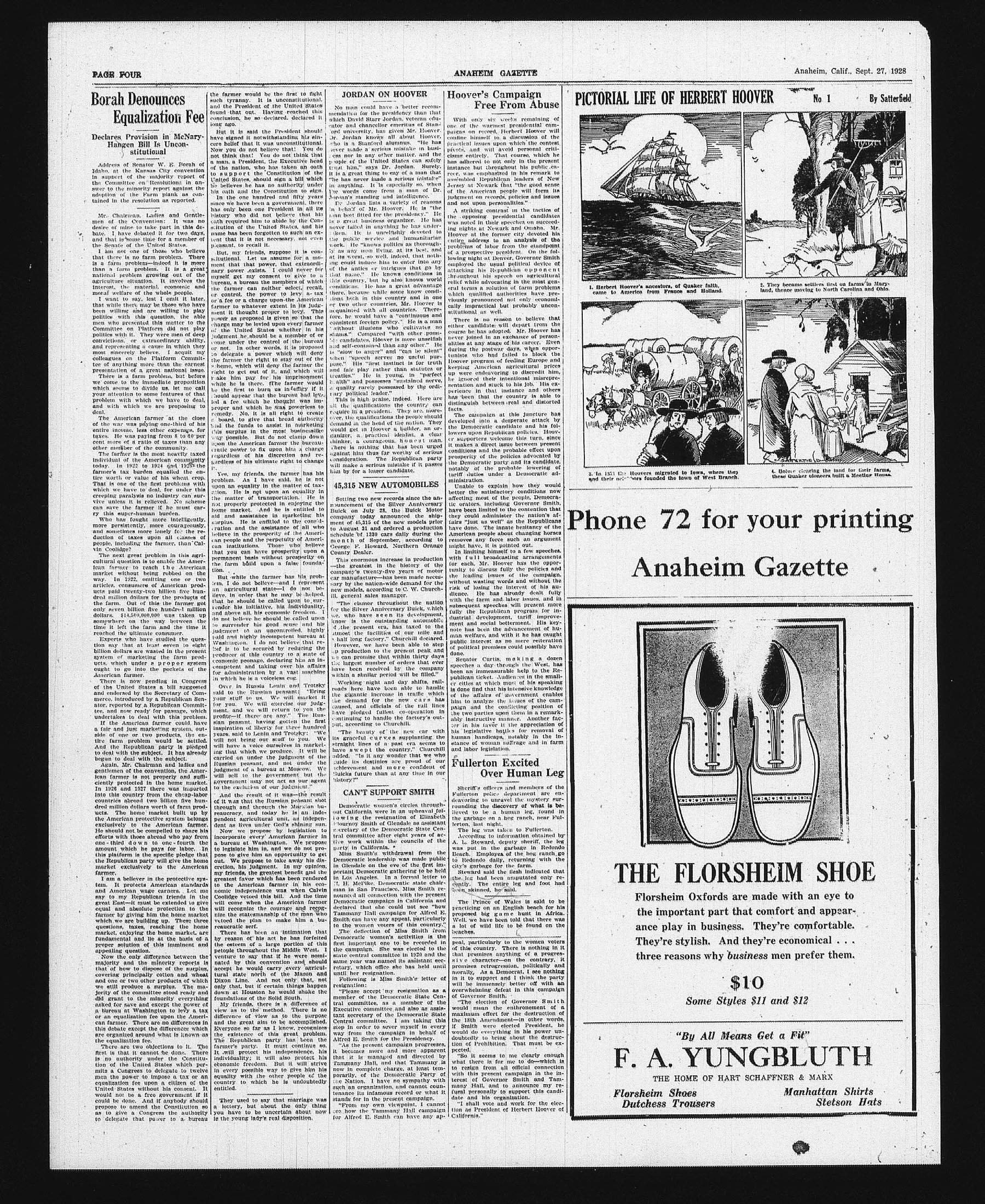
Searchable text
Borah Denounces Equalization Fee
Declares Provision in McNary-Hangen Bill Is Unconstitutional
Address of Senator W. E. Borah of Idaho, at the Kansas City convention in support of the majority report of the Committee on Resolutions in answer to the minority report against the adoption of the Farm plank as contained in the resolution as reported.
Mr. Chairman, Ladies and Gentlemen of the Convention: It was no desire of mine to take part in this debate. I have debated it for two days, and that is some time for a member of the Senate of the United States.
I am not one of those who believe that there is no farm problem. There is a farm problem—indeed it is more than a farm problem. It is a great national problem growing out of the agriculture situation. It involves the interest, the material, economic and moral welfare of the whole people.
I want to say, lest I omit it later, that while there may be those who have been willing and are willing to play politics with this question, the able men who presented this matter to the Committee on Platform did not play politics with it. They were men of deep convictions, or extraordinary ability, and representing a cause in which they most sincerely believe. I acquit my colleagues on the Platform Committee of anything more than the earnest presentation of a great national issue.
There is a farm problem, but before we come to the immediate proposition which seems to divide us, let me call your attention to some features of that problem with which we have to deal, and with which we are proposing to deal.
The American farmer at the close of the war was plying one-third of his entire income, less other expenses, for taxes. He was paying from 8 to 10 per cent more of a ratio of taxes than any other member of the community.
the farmer would be the first to fight such tyranny. It is unconstitutional, and the President of the United States found that out. Having reached this conclusion, he so declared, declared it long ago.
But it is said the President should have signed it notwithstanding his sincere belief that it was unconstitutional. Now you do not believe that! You do not think that! You do not think that a man, a President, the Executive head of the nation, who has taken an oath to support the Constitution of the United States, should sign a bill which he believes he has no authority under his oath and the Constitution to sign.
In the one hundred and fifty years since we have been a government, there has only been one President in all its history who did not believe that his cath required him to abide by the Constitution of the United States, and his name has been forgotten to such an extent that it is not necessary, not even pleasant, to recall it.
But, my friends, suppose it is constitutional. Let us assume for a moment that power, that extraordinary power exists. I could never for myself get my consent to give to a bureau, a bureau the members of which the farmer can neither select, recall, or control, the power to levy a tax or a fee or a charge upon the American farmer to whatever extent in its judgment it thought proper to levy. This power as proposed is given so that the charge may be levied upon every farmer of the United States whether in his judgment he should be a member of or come under the control of the bureau or not. In other words, it is proposed to delegate a power which will deny the farmer the right to stay out of the scheme, which will deny the farmer the right to get out of it, and which will make him pay for his imprisonment while he is there. The farmer would be the first to burn us in effigy if it should appear that the bureau had levied a fee which he thought was improper and which he was powerless to remedy. No, it is all right to create a board, to give that broad authority and the funds to assist in marketing this surplus in the most businesslike way possible. But do not clamp down upon the American farmer the bureaucatic power to fix upon him a charge...
The American farmer at the close of the war was plying one-third of his entire income, less other expenses, for taxes. He was paying from 8 to 40 per cent more of a ratio of taxes than any other member of the community.
The farmer is the most heavily taxed individual of the American community today. In 1922 to 1924 and 1925 the farmer's tax burden equalled the entire worth or value of his wheat crop. That is one of the first problems with which we have to deal, for under this creeping paralysis no industry can survive unless it is relieved. No scheme can save the farmer if he must carry this super-human burden.
Who has fought more intelligently, more persistently, more courageously, and sometimes more lonely for the reduction of taxes upon all classes of people, including the farmer, than Calvin Coolidge?
The next great problem in this agricultural question is to enable the American farmer to reach the American market without being robbed on the way. In 1922, omitting one or two articles, consumers of American products paid twenty-two billion five hundred million dollars for the products of the farm. Out of this the farmer got only seven billion five hundred million dollars. $14,500,000,000 was taken up somewhere on the way between the time it left the farm and the time it reached the ultimate consumer.
Experts who have studied the question say that at least seven to eight billion dollars are wasted in the present system of marketing the farm products, which under a proper system ought to go into the pockets of the American farmer.
There is now pending in Congress of the United States a bill suggested and endorsed by the Secretary of Commerce, introduced by a Republican Senator, reported by a Republican Committee, and now ready for passage, which undertakes to deal with this problem.
If the American farmer could have a fair and just marketing system, outside of one or two products, the entire farm problem would be settled. And the Republican party is pledged to deal with the subject. It has already begun to deal with the subject.
Again, Mr. Chairman and ladies and gentlemen of the convention, the American farmer is not properly and sufficiently protected in the home market. In 1926 and 1927 there was imported into this country from the cheap-labor countries abroad two billion five hundred million dollars worth of farm products. The home market built up by the American protective system belongs exclusively to the American farmer. He should not be compelled to share his efforts with those abroad who pay from one third down to one fourth the amount which he pays for labor. In
To delegate a power which will deny the farmer the right to stay out of the scheme, which will deny the farmer the right to get out of it, and which will make him pay for his imprisonment while he is there. The farmer would be the first to burn us infiltrify if it should appear that the bureau had leaved a fee which he thought was improper and which he was powerless to remedy. No. It is all right to create a board, to give that broad authority and the funds to assist in marketing this surplus in the most businesslike way possible. But do not clamp down upon the American farmer the bureaucratic power to fix upon him a charge regardless of his discretion and regardless of his ultimate right to change it.
Yes, my friends, the farmer has his problem. As I have said, he is not upon an equality in the matter of taxation. He is not upon an equality in the matter of transportation. He is not properly protected in enjoying the home market. And he is entitled to aid and assistance in marketing his surplus. He is entitled to the consideration and the assistance of all who believe in the prosperity of the American people and the perpetuity of American institutions. Those who believe that you can have prosperity upon a permanent basis without prosperity on the farm build upon a false foundation.
But while the farmer has his problem, I do not believe—and I represent an agricultural state—I do not believe, in order that he may be helped, that he should be called upon to surrender his initiative, his individuality, and above all, his economic freedom. I do not believe he should be called upon to surrender his good sense and his judgment to an uncontrolled, highly paid and highly incompetent bureauat Washington. I do not believe that relief is to be secured by reducing the producer of this country to a state of economic peonage, declaring him an incompetent and taking over his affairs for administration by a vast machine in which he is a volceless coog.
Over in Russia Lenin and Trotsky said to the Russian peasant: "Bring your stuff to us. We will market it for you. We will exercise our judgment, and we will return to you the profits—if there are any." The Russian peasant, having gotten the first inspiration of liberty for three hundred years, said to Lenin and Trotsky: "We will not bring out stuff to you. We will have a voice ourselves in marketing that which we produce. It will be carried on under the Judgment of the Russian peasant, and not under the Judgment of a bureauat Moscow. We will sell to the government but the government may not act as our agent to the exclusion of our judgment."
And the result of it was—the result of it was that the Russian peasant shot through and through the Marxian bureaucracy, and today he is an independent agricultural unit, as independent as lives under God's shining sun.
Now we propose by legislation to incorporate every American farmer in a bureau at Washington. We propose to legislate him in, and we do not pro-
Again, Mr. Chairman and ladies and gentlemen of the convention, the American farmer is not properly and sufficiently protected in the home market. In 1926 and 1927 there was imported into this country from the cheap-labor countries abroad two billion five hundred million dollars worth of farm products. The home market built up by the American protective system belongs exclusively to the American farmer. He should not be compelled to share his efforts with those abroad who pay from one-third down to one-fourth the amount which he pays for labor. In this platform is the specific pledge that the Republican party will give the home market exclusively to the American farmer.
I am a believer in the protective system. It protects American standards and American wage earners. Let me say to my Republican friends in the great East—it must be extended to give equal and absolute protection to the farmer by giving him the home market which we are building up. These three questions, taxes, reaching the home market, enjoying the home market, are fundamental and lie at the basis of a proper solution of this imminent and appealing question.
Now the only difference between the majority and the minority reports is that of how to dispose of the surplus, covering principally cotton and wheat and one or two other products of which we still produce a surplus. The majority of the committee stood ready and did grant to the minority everything asked for save and except the power of a bureau at Washington to levy a tax or an equalization fee upon the American farmer. There are no differences in this debate except the difference which are organized around what is known as the equalization fee.
There are two objections to it. The first is that it cannot be done. There is no authority under the Constitution of the United States which permits a Congress to delegate to twelve men the power to impose a tax or an equalization fee upon a citizen of the United States without his consent. It would not be a free government if it could be done. And if anybody should propose to amend the Constitution so as to give a Congress the authority to delegate that power to a bureau carried on under the judgment of the Russian peasant shot through and through the Marxian bureauracy, and today he is an independent agricultural unit, as independent as lives under God's shining sun.
Now we propose by legislation to incorporate every American farmer in a bureau at Washington. We propose to legislate him in, and we do not propose to give him an opportunity to get out. We propose to take away his discretion, his judgment. In my opinion, my friends, the greatest benefit and the greatest favor which has been rendered to the American farmer in his economic independence was when Calvin Coolidge vetoed this bill. And the time will come when the American farmer will recognize the courage and recognize the statesmanship of the man who vetoed the plan to make him a bureauracist serf.
There has been an intimation that by reason of his act he has forfeited the esteem of a large portion of this petroleum throughout the Middle West. I venture to say that if he were nominated by this convention and should accept he would carry every agricultural state north of the Mason and Dixon Line. And not only that, but if certain things happen down at Houston he would shake the foundations of the Solid South.
My friends, there is a difference of view as to the method. There is no difference of view as to the purpose and the great aim to be accomplished. Everyone so far as I know recognizes the existence of this great problem. The Republican party has been the farmer's party. It must continue so. It will protect his independence, his individuality; it will also protect his economic freedom. But it will strive in every possible way to give him his equality with the other people of the country to which he is undoubtedly entitled.
They used to say that marriage was a lottery, but about the only thing you have to be uncertain about now is the young lady's real disposition.
CAN'T
Democratic out California losing th
Hournoy Sm
secretary of
tral commit
five work w
party in Ca
Miss Smith
Democratic in Glendale
important Dem
in Los Angle
T. H. McIlhill
man in San
nounced all
Democratic declared th
Tammany L
Smith can h
to the wom
The defied Democratic first imperilthe campaign state central same year w
taken by her rea
Following resignation:
"Please add a member of tral commi
Executive cotant secretary Central comstep in order way from t
Alfred E. Sny
"As the pr
it becomes th it is Tammany L now in comporarily, off
the Nation,
such an orgatenance its stands for in
From my see how th for Alfred E. Sny
ANAHEIM GAZETTE
JORDAN ON HOOVER
No man could have a better recommendation for the presidency than that which David Starr Jordan, veteran educator and chancellor emeritus of Stanford university, has given Mr. Hoover. Dr. Jordan knows all about Hoover, who is a Stanford alumnus. "He has never made a serious mistake in business nor in any other matter, and the people of the United States can safely trust him," says Dr. Jordan. Surely, it is a great thing to eay of a man that "he has never made a serious mistake" in anything. It is especially so when the words come from a man of Dr. Jordan's standing and intelligence.
Dr. Jordan lists a variety of reasons in behalf of Mr. Hoover. He is "the man best fitted for the presidency." He is a great business organizer. He has never failed in anything he has undertaken. He is unselfishly devoted to the public service and humanitarian work. He "knows politics as thoroughly as any man living, at its best, and at its worst, so well, indeed, that nothing could induce him to enter into any of the anties or intrigues that go by that name." He knows conditions in this country, but he also knows world conditions. He has a great advantage there, because while some know conditions both in this country and in one or two other countries, Mr. Hoover is acquainted with all countries. Therefore, he would have a "continuous and consistent foreign policy." He is a man "without illusions who cultivates no shame." Compared "with other possible candidates," Hoover is more unselfish and self-contained than any other." He is "slow to anger" and "can be silent" when "speech serves no useful purpose." His "first instinct is for truth and fair play rather than statutes or treaties." He is young, in "perfect health" and possesses "sustained nerve, a quality rarely possessed by the ordinary political leader."
This is high praise, indeed. Here are all the qualifications the country can require in a president. They are, moreover, the qualifications the people should demand in the head of the nation. They would get in Hoover a builder, an organizer, a practical idealist, a clear thinker, a courageous, honest man. There is nothing that has been urged
Hoover's Campaign Free From Abuse
With only six weeks remaining of one of the warmest presidential campaigns on record, Herbert Hoover will confine himself to a discussion of the practical issues upon which the contest pivots, and will avoid personal criticisms entirely. That course, which he has adhered to not only in the present instance but throughout his public career, was emphasized in his remark to assembled Republican leaders of New Jersey at Newark that "the good sense of the American people will form its judgment on records, policies and issues and not upon personalities."
A striking contrast in the tactics of the opposing presidential candidates was noted in their speeches on succeeding nights at Newark and Omaha. Mr. Hoover at the former city devoted his entire address to an analysis of the problems of labor from the standpoint of a prospective president. On the following night at Denver, Governor Smith employed the usual political device of attacking his Republican opponent throughout his speech on agricultural relief while advocating in the most general terms a solution of farm problems which qualified authorities have previously pronounced not only economically impractical but probably unconstitutional as well.
There is no reason to believe that either candidate will depart from the course he has adopted. Mr. Hoover has never joined in an exchange of personalities at any stage of his career. Even during the postwar days, when opportunists who had failed to block the Hoover program of feeding Europe and keeping American agricultural prices up were endeavoring to discredit him, he ignored their intentional misrepresentation and stuck to his job. His experience in that instance and others has been that the country is able to distinguish between real and distorted facts.
The campaign at this juncture has developed into a desperate attack by the Democratic candidate and his followers upon Republican policies. Hoover supporters welcome this turn, since it makes a direct issue between present
when "speech serves no useful purpose." His "first instinct is for truth and fair play rather than statutes or treaties." He is young, in "perfect health" and possesses "sustained nerve, a quality rarely possessed by the ordinary political leader."
This is high praise, indeed. Here are all the qualifications the country can require in a president. They are moreover, the qualifications the people should demand in the head of the nation. They would get in Hoover a builder, an organizer, a practical idealist, a clear thinker, a courageous, honest man. There is nothing that has been urged against him thus far worthy of serious consideration. The Republican party will make a serious mistake if it passes him by for a lesser candidate.
45,315 NEW AUTOMOBILES
Setting two new records since the announcement of the Silver Anniversary Bulck on July 28, the Bulck Motor company today announced the shipment of 45,315 of the new models prior to August 31 and ordered a production schedule of 1330 cars daily during the month of September, according to George F. Howard, Northern Orange County Dealer.
This enormous increase in production—the greatest in the history of the company's twenty-five years of motor car manufacture—has been made necessary by the nation-wide demand for the new models, according to C. W. Churchill, general sales manager.
"The clamor throughout the nation for the Silver Anniversary Bulck, which we have seen its development, know is the outstanding automobile of the present era, has taxed to the utmost the facilities of our mile and half long factory." Churchill declared. However, we have been able to step up production to the present peak and we can promise that within thirty days the largest number of orders that ever have been received by the company within a similar period will be filled.
Working night and day shifts, railroads here have been able to handle the gigantic increase in traffic which the demand for the new cars has caused, and officials of the rail lines have pledged fullest co-operation in continuing to handle the factory's output, according to Churchill.
"The beauty of the new car with its graceful curves supplanting the straight lines of a past era seems to have swept the country," Churchill added. "Is it any wonder that we guide its destinies are proud of our achievement and more confident of Bulcks future than at any time in our history?"
CAN'T SUPPORT SMITH
Democratic women's circles throughout California were in an uphaval following the resignation of Elizabeth Bourney Smith of Glendale as assistant secretary of the Democratic State Central committee after eight years of active work within the councils of the party in California.*
The campaign at this juncture has developed into a desperate attack by the Democratic candidate and his followers upon Republican policies. Hoover supporters welcome this turn, since it makes a direct issue between present conditions and the probable effect upon prosperity of the policies advocated by the Democratic party and its candidate, notably of the probable lowering of tariff duties under a Democratic administration.
Unable to explain how they would better the satisfactory conditions now affecting most of the people, Democratic orators, including Governor Smith, have been limited to the contention that they could administer the nation's affairs "just as well" as the Republicans have done. The innate hesitancy of the American people about changing horses removes any force such an argument might have, it is pointed out.
In limiting himself to a few speeches, with full broadcasting arrangements for each, Mr. Hoover has the opportunity to discuss fully the policies and the leading issues of the campaign, without wasting words and without the risk of losing the interest of his audience. He has already dealt fully with the farm and labor issues, and in subsequent speeches will present more fully the Republican program for industrial development, tariff improvement and social betterment. His keynote has been the advancement of human welfare, and with it he has caught public interest as no mere reiteration of political promises could possibly have done.
Senator Curtis, making a dozen speeches a day through the West, has been an immeasurable help to the Republican ticket. Audiences in the smaller cities at which most of his speaking is done find that his intensive knowledge of the affairs of government enables him to analyze the issues of the campaign and the conflicting position of the two parties upon them in a remarkably instructive manner. Another factor in his favor is the appreciation of his legislative battles for removal of human handicaps, notably in the instance of woman suffrage and in farm and labor legislation.
Fullerton Excited Over Human Leg
Sheriff's officers and members of the Fullerton police department are endeavoring to unravel the mystery surrounding the discovery of what is believed to be a human leg, found in the garbage on a hog ranch, near Fullerton, last night.
The leg was taken to Fullerton.
According to information obtained by A. L. Steward, deputy sheriff, the leg was put in the garbage in Redondo
CANT SUPPORT SMITH
Democratic women's circles throughout California were in an upheaval following the resignation of Elizabeth Bourry Smith of Glendale as assistant secretary of the Democratic State Central committee after eight years of active work within the councils of the party in California.
Miss Smith's withdrawal from the Democratic leadership was made public in Glendale on the eve of the first important Democratic gathering to be held in Los Angeles. In a formal letter to H. H. McPike, Democratic state chairman in San Francisco, Miss Smith re-announced all connection with the present Democratic campaign in California and declared that she could not see "how Tammany Hall campaign for Alfred E. Smith can have any appeal, particularly to the women voters of this country."
The defection of Miss Smith from Democratic women's activities is the first important one to be recorded in the campaign. She was elected to the state central committee in 1920 and the same year was named its assistant secretary, which office she has held until until her resignation.
Following is Miss Smith's letter of resignation:
"Please accept my resignation as a member of the Democratic State Central committee, as a member of the Executive committee and also as assistant secretary of the Democratic State Central committee. I am taking this step in order to sever myself in every way from the campaign in behalf of Alfred E. Smith for the Presidency.
As the present campaign progresses, it becomes more and more apparent that it is managed and directed by Tammany Hall, and that Tammany is now in complete charge, at least temporarily, of the Democratic Party of the Nation. I have no sympathy with such an organization, and cannot countenance its infamous record or what it stands for in the present campaign.
From my own viewpoint, I cannot see how the Tammany Hall campaign for Alfred E. Smith can have any ap-
Fullerton Excited Over Human Leg
Sheriff's officers and members of the Fullerton police department are endeavoring to unravel the mystery surrounding the discovery of what is believed to be a human leg, found in the garbage on a hog ranch, near Fullerton, last night.
The leg was taken to Fullerton.
According to information obtained by A. L. Steward, deputy sheriff, the leg was put in the garbage in Redondo Beach. Employees of the hog ranch go to Redondo daily, returning with the city's garbage for the farm.
Steward said the flesh indicated that the leg had been amputated only recently. The entire leg and foot had been skinned, he said.
The Prince of Wales is said to be practicing on an English beach for his proposed big game hunt in Africa. Well, we have been told that there was a lot of wild life to be found on the beaches.
particularly to the women voters of this country. There is nothing in it that promises anything of a progressive character—on the contrary, it promises retrogression, politically and morally. As a Democrat, I see nothing in it to support and I think the party will be immensely better off with an overwhelming defeat in this campaign of Governor Smith.
"The election of Governor Smith would mean the enthrancement of a maximum effort for the destruction of the 18th Amendment—in other words, if Smith were elected President, he would do everything in his power undoubtedly to bring about the destruction of Prohibition. That must be expected.
"So it seems to me clearly enough what there is for me to do—which is to resign from all official connection with this present campaign in the interest of Governor Smith and Tammany Hall, and to announce my refusal personally to support this candidate and his organization.
"I shall vote and work for the election as President of Herbert Hoover of California."
Anaheim, Calif., Sept. 27, 1928
AL LIFE OF HERBERT HOOVER
No. 1 By Satterfield
Hoover's ancestors, of Quaker faith,
America from France and Holland.
2. They became settlers first on farms in Maryland, then moving to North Carolina and Ohio.
The Hoovers migrated to Iowa, where they
members founded the town of West Branch.
4. Before clearing the land for their farms,
these Quaker pioneers built a Meeting House.
ne 72 for your printing
Anaheim Gazette
THE FLORSHEIM SHOE
Florsheim Oxford are made with an eye to the important part that comfort and appearance play in business. They're comfortable. They're stylish. And they're economical . . . three reasons why business men prefer them.
$10
Some Styles $11 and $12
"By All Means Get a Fit"
F. A. YUNGBLUTH
THE HOME OF HART SCHAFFNER & MARX
Florsheim Shoes
Dutchess Trousers
Manhattan Shirts
Stetson Hats