anaheim-gazette 1928-08-23
Scanned page
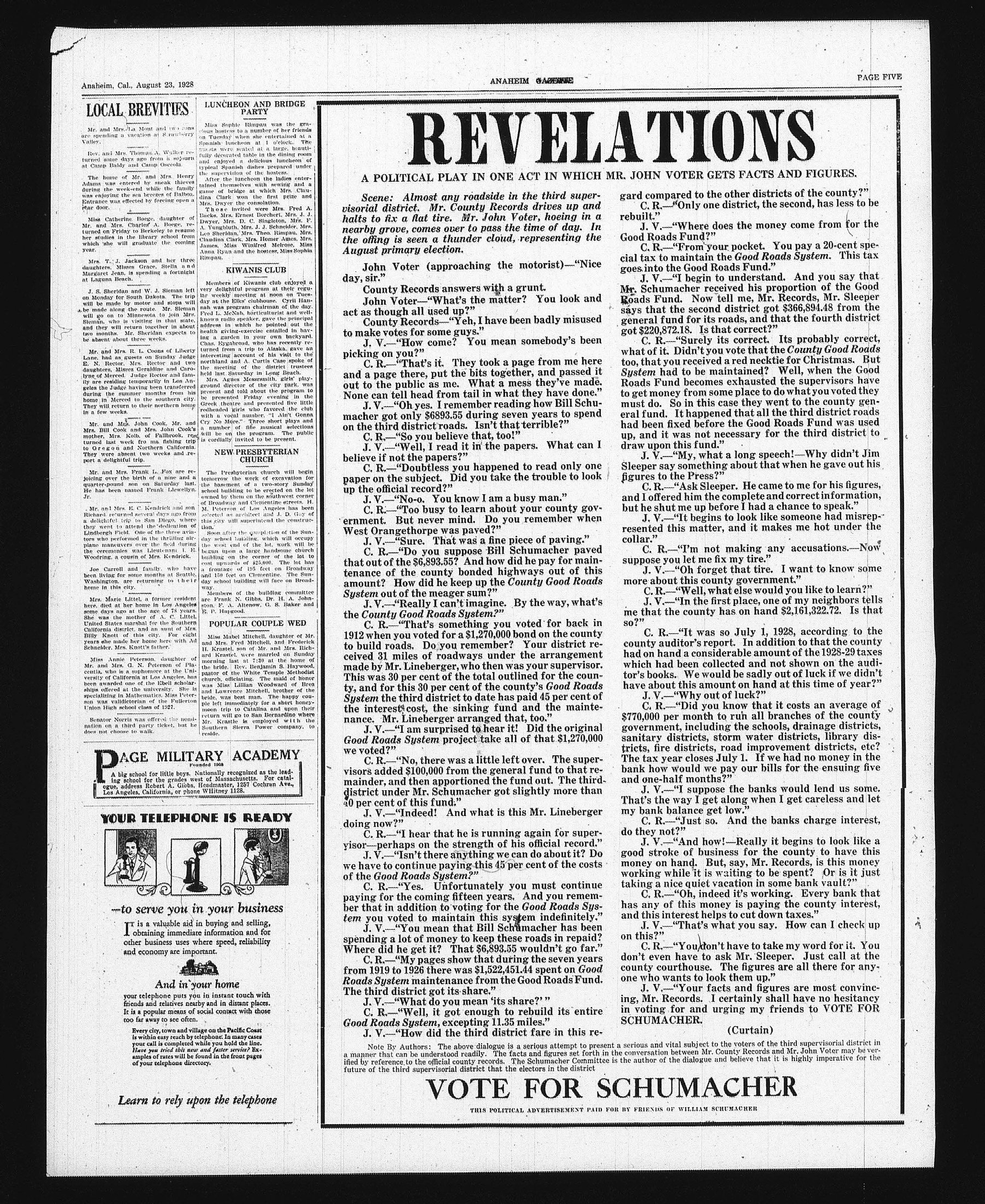
Searchable text
LOCAL BREVITIES
Mr. and Mrs. La Mont and two sons are spending a vacation at Strawberry Valley.
Rev. and Mrs. Thomas A. Walker returned some days ago from a sojourn at Camp Baldy and Camp Osceola.
The home of Mr. and Mrs. Henry Adams was entered by sneak thieves during the week-end while the family was enjoying the sea breezes of Balboa. Entrance was effected by forcing open a rear door.
Miss Catherine Boege, daughter of Mr. and Mrs. Charles A. Boege, returned on Friday to Berkeley to resume her studies in the library school from which she will graduate the coming year.
Mrs. T., J. Jackson and her three daughters, Misses Grace, Stella and Margaret Jean, is spending a fortnight at Laguna Beach.
J. S. Sheridan and W. J. Sieman left on Monday for South Dakota. The trip will be made by motor and stops will be made along the route. Mr. Sieman will go on to Minnesota to Join Mrs. Sieman, who is visiting in that state, and they will return together in about two months. Mr. Sheridan expects to be absent about three weeks.
Mr. and Mrs. R. L. Coons of Liberty Lane, had as guests on Sunday Judge E. N. Rector, Mrs. Rector and two daughters, Misses Geraldine and Carolynne of Merced. Judge Rector and family are residing temporarily in Los Angeles the Judge having been transferred during the summer months from his home in Merced to the southern city. They will return to their northern home in a few weeks.
Mr. and Mrs. John Cook, Mr. and Mrs. Bill Cook and Mrs. John Cook's mother, Mrs. Kolb, of Fallbrook, returned last week fro ma fishing trip to Oregon and Northern California.
LUNCHEON AND BRIDGE PARTY
Miss Sophie Rimpau was the gracious hostess to a number of her friends on Tuesday when she entertained at a Spanish luncheon at 1 o'clock. The guests were seated at a large, beautifully decorated table in the dining room and enjoyed a delicious luncheon of typical Spanish dishes prepared under the supervision of the hostess.
After the luncheon the ladies entertained themselves with sewing and a game of bridge at which Mrs. Claudina Clark won the first prize and Mrs. Dwyer the consolation.
Those invited were Mrs. Fred A. Backs, Mrs. Ernest Borchert, Mrs. J. J. Dwyer, Mrs. D. C. Singleton, Mrs. F. A. Yungbluth, Mrs. J. J. Schneider, Mrs. Leo Sheridan, Mrs. Theo Rimpau, Mrs. Claudina Clark, Mrs. Homer Ames, Mrs. James, Miss Winifred Melrose, Miss Anna Ryan and the hostess, Miss Sophia Rimpau.
KIWANIS CLUB
Members of Kiwanis club enjoyed a very delightful program at their regular weekly meeting at noon on Tuesday at the Elks' clubhouse. Cyril Hannah was program chairman of the day. Fred L. McNab, horticulturist and well-known radio speaker, gave the principal address in which he pointed out the health giving-exercise entailed in having a garden in your own backyard. Chas, Eygabroad, who has recently returned from a trip to Alaska, gave an interesting account of his visit to the northland and A. Curtis Case spoke of the meeting of the district trustees held last Saturday in Long Beach.
Mrs. Agnes Messrsmith, girls' playground director of the city park, was present and told about the program to be presented Friday evening in the Greek theatre and presented five little redheaded girls who favored the club with a vocal number, "I Ain't Gonna Cry No More." Three short plays and a number of fine musical selections will be on the program. The public is cordially invited to be present.
Lane, had as guests on Sunday Judge E. N. Rector, Mrs. Rector and two daughters, Misses Geraldine and Carolyn of Merced. Judge Rector and family are residing temporarily in Los Angeles the Judge having been transferred during the summer months from his home in Merced to the southern city. They will return to their northern home in a few weeks.
Mr. and Mrs. John Cook, Mr. and Mrs. Bill Cook and Mrs. John Cook's mother, Mrs. Kolb, of Fallbrook, returned last week fro ma fishing trip to Oregon and Northern California. They were absent two weeks and report a delightful trip.
Mr. and Mrs. Frank L. Fox are rejoicing over the birth of a nine and a quarter-pound son on Saturday last. He has been named Frank Llewellyn Jr.
Mr. and Mrs. E. C. Kendrick and son Richard returned several days ago from a delightful trip to San Diego, where they went to attend the dedication of Lindbergh Field. One of the three aviators who performed in the thrilling airplane maneuvers over the field during the ceremonies was Lieutenant I. E. Woodring, a cousin of Mrs. Kendrick.
Joe Carroll and family, who have been living for some months at Seattle, Washington, are returning to their home in this city.
Mrs. Marie Littel, a former resident here, died at her home in Los Angeles some days ago at the age of 78 years. She was the mother of A. C. Littel, United States marshal for the Southern California district, and an aunt of Mrs. Billy Knott of this city. For eight years she made her home here with Ad Schneider, Mrs. Knott's father.
Miss Annie Peterson, daughter of Mr. and Mrs. G. N. Peterson of Placentia, who is a sophomore at the University of California at Los Angeles, has been awarded one of the Ebell scholarships offered at the university. She is specializing in Mathematics. Miss Peterson was validictorian of the Fullerton Union High school class of 1927.
Senator Norris was offered the nomination on a third party ticket, but he does not choose to walk.
NEW PRESBYTERIAN CHURCH
The Presbyterian church will begin tomorrow the work of excavation for the basement of a two-story Sunday school building to be erected on the lot owned by them on the southwest corner of Broadway and Clementine streets. H. M. Peterson of Los Angeles has been selected as architect and J. D. Gray of this city will superintend the construction.
Soon after the completion of the Sunday school building, which will occupy the west end of the lot, work will be begun upon a large handsome church building on the corner of the lot to cost upwards of $25,000. The lot has a frontage of 195 feet on Broadway and 150 feet on Clementine. The Sunday school building will face on Broadway.
Members of the building committee are Frank N. Gibbs, Dr. H. A. Johnston, F. A. Altenow, G. S. Baker and E. P. Hapgood.
POPULAR COUPLE WED
Miss Mabel Mitchell, daughter of Mr. and Mrs. Fred Mitchell, and Frederick H. Krastel, son of Mr. and Mrs. Richard Krastel, were married on Sunday morning last at 7:30 at the home of the bride. Rev. Benjamin S. Haywood, pastor of the White Temple Methodist church, officiating. The maid of honor was Miss Lillian Woodward of Brea and Lawrence Mitchell, brother of the bride, was best man. The happy couple left immediately for a short honey-moon trip to Catalina and upon their return will go to San Bernardino where Mr. Krastle is employed with the Southern Sierra Power company, to reside.
PAGE MILITARY ACADEMY
Founded 1008
A big school for little boys. Nationally recognized as the leading school for the grades west of Massachusetts. For catalogue, address Robert A. Giobs, Headmaster, 1257 Cochran Ave., Los Angeles, California, or phone WHitney 1128.
YOUR TELEPHONE IS READY
A big school for little boys. Nationally recognized as the leading school for the grades west of Massachusetts. For catalogue, address Robert A. Giobs, Headmaster, 1257 Cochran Ave., Los Angeles, California, or phone WHitney 1128.
YOUR TELEPHONE IS READY
—to serve you in your business
It is a valuable aid in buying and selling, obtaining immediate information and for other business uses where speed, reliability and economy are important.
And in your home
your telephone puts you in instant touch with friends and relatives nearby and in distant places.
It is a popular means of social contact with those too far away to see often.
Every city, town and village on the Pacific Coast is within easy reach by telephone. In many cases your call is completed while you hold the line. Have you tried this new and faster service? Examples of rates will be found in the front pages of your telephone directory.
Learn to rely upon the telephone
REVELATION
A POLITICAL PLAY IN ONE ACT IN WHICH MR. JOHN VOTER
Scene: Almost any roadside in the third supervisorial district. Mr. County Records drives up and halts to fix a flat tire. Mr. John Voter, hoeing in a nearby grove, comes over to pass the time of day. In the offing is seen a thunder cloud, representing the August primary election.
John Voter (approaching the motorist)—“Nice day, sir.”
County Records answers with a grunt.
John Voter—“What’s the matter? You look and act as though all used up?”
County Records—“Yeh, I have been badly misused to make votes for some guys.”
J. V.—“How come? You mean somebody’s been picking on you?”
C. R.—“That’s it. They took a page from me here and a page there, put the bits together, and passed it out to the public as me. What a mess they’ve made. None can tell head from tail in what they have done.”
J. V.—“Oh yes. I remember reading how Bill Schumacher got only $6893.55 during seven years to spend on the third district roads. Isn’t that terrible?”
C. R.—“So you believe that, too!”
J. V.—“Well, I read it in the papers. What can I gard compared to C. R.—“Only rebuilt.”
J. V.—“Whe Good Roads Fund.
C. R.—“Fromcial tax to maint goes into the Go.
J. V.—“I be Mr. Schumacher Roads Fund. N says that the se general fund for got $220,872.18.
C. R.—“Sun what of it. Didn’t too, that you rec System had to b Roads Fund because to get money fro must do. So in eral fund. It ha had been fixed b up, and it was n draw upon this f
C. R.—“That’s it. They took a page from me here and a page there, put the bits together, and passed it out to the public as me. What a mess they’ve made. None can tell head from tail in what they have done.”
J. V.—“Oh yes. I remember reading how Bill Schumacher got only $6893.55 during seven years to spend on the third district roads. Isn’t that terrible?”
C. R.—“So you believe that, too!”
J. V.—“Well, I read it in the papers. What can I believe if not the papers?”
C. R.—“Doubtless you happened to read only one paper on the subject. Did you take the trouble to look up the official record?”
J. V.—“No-o. You know I am a busy man.”
C. R.—“Too busy to learn about your county government. But never mind. Do you remember when West Orangethorpe was paved?”
J. V.—“Sure. That was a fine piece of paving.”
C. R.—“Do you suppose Bill Schumacher paved that out of the $6,893.55? And how did he pay for maintenance of the county bonded highways out of this amount? How did he keep up the County Good Roads System out of the meager sum?”
J. V.—“Really I can’t imagine. By the way, what’s the County Good Roads System?”
C. R.—“That’s something you voted for back in 1912 when you voted for a $1,270,000 bond on the county to build roads. Do you remember? Your district received 31 miles of roadways under the arrangement made by Mr. Lineberger, who then was your supervisor. This was 30 per cent of the total outlined for the county, and for this 30 per cent of the county’s Good Roads System the third district to date has paid 45 per cent of the interest cost, the sinking fund and the maintenance. Mr. Lineberger arranged that, too.”
J. V.—“I am surprised to hear it! Did the original Good Roads System project take all of that $1,270,000 we voted?”
C. R.—“No, there was a little left over. The supervisors added $100,000 from the general fund to that remainder, and then apportioned the fund out. The third district under Mr. Schumacher got slightly more than 40 per cent of this fund.”
J. V.—“Indeed! And what is this Mr. Lineberger doing now?”
C. R.—“I hear that he is running again for supervisor—perhaps on the strength of his official record.”
C. R.—“No, there was a little left over. The supervisors added $100,000 from the general fund to that remainder, and then apportioned the fund out. The third district under Mr. Schumacher got slightly more than 40 per cent of this fund.”
J. V.—“Indeed! And what is this Mr. Lineberger doing now?”
C. R.—“I hear that he is running again for supervisor—perhaps on the strength of his official record.”
J. V.—“Isn’t there anything we can do about it? Do we have to continue paying this 45 per cent of the costs of the Good Roads System?”
C. R.—“Yes. Unfortunately you must continue paying for the coming fifteen years. And you remember that in addition to voting for the Good Roads System you voted to maintain this system indefinitely.”
J. V.—“You mean that Bill Schumacher has been spending a lot of money to keep these roads in repaid? Where did he get it? That $6,893.55 wouldn’t go far.”
C. R.—“My pages show that during the seven years from 1919 to 1926 there was $1,522,451.44 spent on Good Roads System maintenance from the Good Roads Fund. The third district got its share.”
J. V.—“What do you mean ‘its share’?”
C. R.—“Well, it got enough to rebuild its entire Good Roads System, excepting 11.35 miles.”
J. V.—“How did the third district fare in this re-
Note By Authors: The above dialogue is a serious attempt to present a serious and vital subjecia manner that can be understood readily. The facts and figures set forth in the conversation betweenified by reference to the official county records. The Schumacher Committee is the author of the dialect future of the third supervisorial district that the electors in the district
VOTE FOR SCHUMACHER
THIS POLITICAL ADVERTISEMENT PAID FOR BY FRIENDS OF WILLIAMS
R. JOHN VOTER GETS FACTS AND FIGURES.
gard compared to the other districts of the county?"
C. R.—"Only one district, the second, has less to be rebuilt."
J. V.—"Where does the money come from for the Good Roads Fund?"
C. R.—"From your pocket. You pay a 20-cent special tax to maintain the Good Roads System. This tax goes into the Good Roads Fund."
J. V.—"I begin to understand. And you say that Mr. Schumacher received his proportion of the Good Roads Fund. Now tell me, Mr. Records, Mr. Sleeper says that the second district got $366,894.48 from the general fund for its roads, and that the fourth district got $220,872.18. Is that correct?"
C. R.—"Surely its correct. Its probably correct, what of it. Didn't you vote that the County Good Roads too, that you received a red necktie for Christmas. But System had to be maintained? Well, when the Good Roads Fund becomes exhausted the supervisors have to get money from some place to do what you voted they must do. So in this case they went to the county general fund. It happened that all the third district roads had been fixed before the Good Roads Fund was used up, and it was not necessary for the third district to draw upon this fund."
too, that you received a red necktie for Christmas. But System had to be maintained? Well, when the Good Roads Fund becomes exhausted the supervisors have to get money from some place to do what you voted they must do. So in this case they went to the county general fund. It happened that all the third district roads had been fixed before the Good Roads Fund was used up, and it was not necessary for the third district to draw upon this fund."
J. V.—"My, what a long speech!—Why didn’t Jim Sleeper say something about that when he gave out his figures to the Press?"
C. R.—"Ask Sleeper. He came to me for his figures, and I offered him the complete and correct information, but he shut me up before I had a chance to speak."
J. V.—"It begins to look like someone had misrepresented this matter, and it makes me hot under the collar."
C. R.—"I’m not making any accusations.—Now suppose you let me fix my tire."
J. V.—"Oh forget that tire. I want to know some more about this county government."
C. R.—"Well, what else would you like to learn?"
J. V.—"In the first place, one of my neighbors tells me that the county has on hand $2,161,322.72. Is that so?"
C. R.—"It was so July 1, 1928, according to the county auditor’s report. In addition to that the county had on hand a considerable amount of the 1928-29 taxes which had been collected and not shown on the auditor’s books. We would be sadly out of luck if we didn’t have about this amount on hand at this time of year?"
J. V.—"Why out of luck?"
C. R.—"Did you know that it costs an average of $770,000 per month to run all branches of the county government, including the schools, drainage districts, sanitary districts, storm water districts, library districts, fire districts, road improvement districts, etc? The tax year closes July 1. If we had no money in the bank how would we pay our bills for the ensuing five and one-half months?"
J. V.—"I suppose the banks would lend us some. That’s the way I get along when I get careless and let my bank balance get low."
C. R.—"Just so. And the banks charge interest, do they not?"
J. V.—"And how!—Really it begins to look like a
The tax year closes July 1. If we had no money in the bank how would we pay our bills for the ensuing five and one-half months?"
J. V.—"I suppose the banks would lend us some. That's the way I get along when I get careless and let my bank balance get low."
C. R.—"Just so. And the banks charge interest, do they not?"
J. V.—"And how!—Really it begins to look like a good stroke of business for the county to have this money on hand. But, say, Mr. Records, is this money working while it is waiting to be spent? Or is it just taking a nice quiet vacation in some bank vault?"
C. R.—"Oh, indeed it's working. Every bank that has any of this money is paying the county interest, and this interest helps to cut down taxes."
J. V.—"That's what you say. How can I check up on this?"
C. R.—"You don't have to take my word for it. You don't even have to ask Mr. Sleeper. Just call at the county courthouse. The figures are all there for anyone who wants to look them up."
J. V.—"Your facts and figures are most convincing, Mr. Records. I certainly shall have no hesitancy in voting for and urging my friends to VOTE FOR SCHUMACHER.
(Curtain)
A serious and vital subject to the voters of the third supervisorial district in the conversation between Mr. County Records and Mr. John Voter may be verthe author of the dialogue and believe that it is highly imperative for the
SCHUMACHER
BY FRIENDS OF WILLIAM SCHUMACHER