anaheim-gazette 1928-08-16
Scanned page
Searchable text
THE ANAHEIM GAZETTE
ESTABLISHED 1870
HENRY KUCHEL, Editor and Proprietor
ISSUED EVERY THURSDAY
SUBSCRIPTION PER YEAR.....$2.00
SIX MONTHS.....1.25
THREE MONTHS......75
Entered at the Anaheim, California. Post Office as second class matter.
ROMANS HIGHWAY BUILDERS
Everyone is interested in highways in these days of motor traffic, but comparatively few of us perhaps know the history of highway development from the earliest times, and realize that before the modern automobile era, the ancient Romans were the greatest highway builders in the history of the world. There is an interesting account of highways ancient and modern in the current issue of the National Republic. It was written by Congressman Clarence J. McLeod of Michigan, and in addition to the history of the highway it tells something of the possibilities of the future on the western continent. In writing of the revived interest in highway building in Latin-America, Mr. McLeod says:
"Interest in good roads in Latin-America is being manifested in many ways. Guatemala already has a good system of roads which make it easy to cross that country from north to south Guatemala. By the way, is a country of 48,000 square miles and a population of 2,200,000, or forty-five people to the square mile, while other Pan-American countries, still almost entirely without roads, are fairly uniformly populated at from six to fourteen per square mile.
"A federal highway program was inaugurated in Mexico in 1925, with funds provided by tobacco taxes and gasoline tax, which in a few years will complete a highway from Laredo." Tex., to the Guatemala border.
"You will observe by looking at a map that the rivers of South America—that is, the principal highways today—have a general east-west direction. The products of the interior that
"A federal highway program was inaugurated in Mexico in 1925, with funds provided by tobacco taxes and gasoline tax, which in a few years will complete a highway from Laredo, Tex., to the Guatemala border.
"You will observe by looking at a map that the rivers of South America—that is, the principal highways today—have a general east-west direction. The products of the interior that are within easy reach of their arteries of commerce can float down to the seaports and the coast, but the wide, fertile areas between the navigable streams are completely lost to civilization. The proposed course of the Pan-American highway takes it directly across all these avenues of trade and travel, and will make what may be termed an "inner belt line" for South America.
"It is estimated that such a highway would open up immediate market for 15,000,000 automobiles and trucks, due to the following facts:
"It will open to rapid transportation, local and for export, commercial products over 200,000 farms and plantations now served only by cow trails.
"It will open vacant lands to millions of agriculturists, who will produce coffee, cocoa, fruits, grains, live stock and other commercial products.
"It will open up thousands of small rubber plantations and solve the problem of reaching the wild-rubber forests along the Amazon River and its tributaries, where hundreds of millions of matured wild rubber trees in full bearing now exist, only partly worked, thus opening up to our markets this source of rubber supply, reputed to be the greatest in the world.
"It will furnish transportation to 2,000 miles of country, watered by tributaries of the Amazon, and containing ancient channels of partly proven placer gold fields, denosits of precious stones, quartz ledges of amazing commercial values, all at present inaccessible."
"The vast mileage of commercial timbers along the route are all marketable. Competent authorities report that there are approximately 5,000,000,000 long-life railroad crosssties in standing timber within the forests of one of the countries the highway will cross, and that easy shipment would thus be afforded to a nearby port. Commercial timbers for furniture, cabinet work, and interior house furnishing are unequalled in the world in billions of feet."
OUR HOME MARKET
Arthur Brisbane, the noted writer, said recently: "Germans complain that they cannot compete with American automobile makers and their small manufacturers are forced to the wall. All their manufacturers are small compared to ours. It is not lack of skill but lack of a huge selling market."
This is undoubtedly true and as Mr. Brisbane points out "We can sing, 'We've got the men, we've got the market, we've got the money, too'—and 24,000,000 automobiles running to prove it." The American automobile makers have the edge on their European competitors and the reason they have the edge is that they enjoy the tremendous American market. With this to take the great percentage of their output they can get out into the world market and do better than hold their own. The experience of our automobile manufacturers and their German competitors again emphasizes the importance of the home market and of holding it for the American producer.
The free traders tell us that we cannot sell abroad if we
This is undoubtedly true and as Mr. Brisbane points out "We can sing, 'We've got the men, we've got the market, we've got the money, too'—and 24,000,000 automobiles running to prove it." The American automobile makers have the edge on their European competitors and the reason they have the edge is that they enjoy the tremendous American market. With this to take the great percentage of their output they can get out into the world market and do better than hold their own. The experience of our automobile manufacturers and their German competitors again emphasizes the importance of the home market and of holding it for the American producer.
The free traders tell us that we cannot sell abroad if we protect our home market because Europe will not have the money to buy from us. This has been disproved by the records during the past ten years. Many other items go into making up the balance of trade, including the expenditures of our tourists in Europe, the sending of money by American workers to relatives abroad and so on. Then again the fact that international trade is a complicated process and not a direct bargaining between two nations, must be taken into consideration.
But even aside fro mall of that, it would still be necessary to protect the home market. Because the American market is the biggest and best in the world, absorbing more than four-fifths of our produce. What would be the sense of surrendering to foreign competitors a market taking eighty-five per cent of our produce for a theoretical opportunity to increase a doubtful market abroad?
As a matter of fact, opening the home market to unrestricted competition would not help but would ruin our chances for foreign trade. European and Asiatic labor is much cheaper than our own. The only reason we can compete in the world markets is the tremendous production we have due to our demand in the home market. The lesson of the automobile given above thoroughly demonstrates this. We sell abroad because our tremendous production enables us to compete despite our higher standard of living. But if we throw open the home market to cheap foreign competition we destroy the goose that lays the golden egg and we will lose out both at home and abroad. There is no disputing the facts.
The figures show us that tour protective tariff does not destroy our foreign trade and our common sense should teach us that if we destroy the home market by permitting cheap competition from abroad we will be in no shape to compete in the markets of the world. To do this our factories must be running at high tide and they cannot so run if the home market is taken away from them.
We cannot help our industries by turning over to Europe and Asia the greatest market in the world.
ANAHEIM GAZETTE
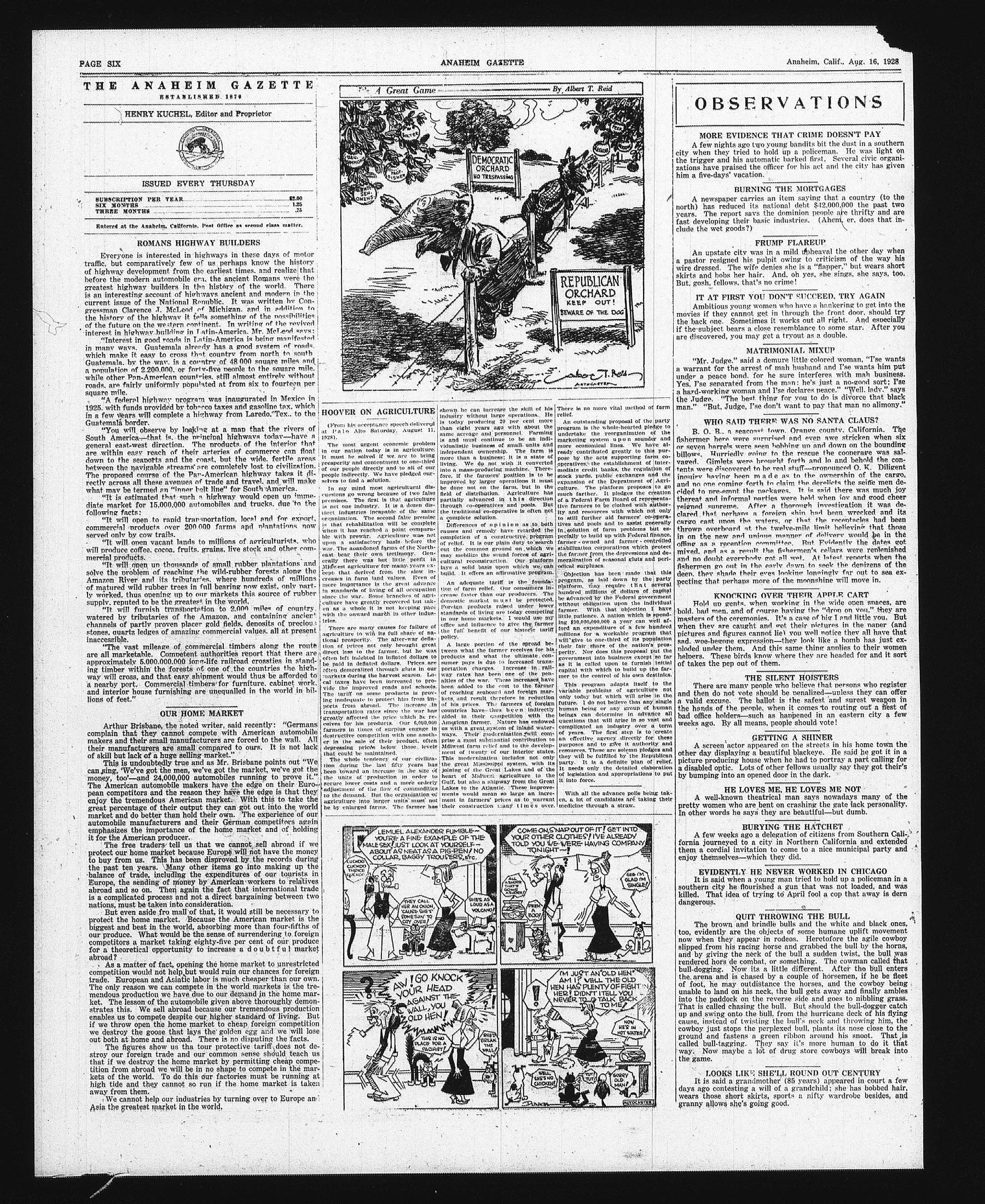
A Great Game By Albert T. Reid
DEMOCRATIC ORCHARD NO TRESPASSING
REPUBLICAN ORCHARD KEEP OUT! BEWARE OF THE DOG
HOOVER ON AGRICULTURE
(From his acceptance speech delivered at Palo Alto Saturday, August 11, 1928).
The most urgent economic problem shown he can increase the skill of his industry without large operations. He is today producing 20 per cent more than eight years ago with about the same acreage and personnel. Farming is and must continue to be an individualistic business of small units and there is no more vital method of farm relief.
An outstanding proposal of the party program is the whole-hearted pledge to undertake the reorganization of the marketing system upon sounder and more economical lines. We have al-
HOOVER ON AGRICULTURE
(From his acceptance speech delivered at Palo Alto Saturday, August 11, 1928).
The most urgent economic problem in our nation today is in agriculture. It must be solved if we are to bring prosperity and contentment to one-third of our people directly and to all of our people indirectly. We have pledged ourselves to find a solution.
In my mind most agricultural discussions go wrong because of two false premises. The first is that agriculture is not one industry. It is a dozen distinct industries incapable of the same organization. The second false premise is that rehabilitation will be complete when it has reached a point comparable with prewar. Agriculture was not upon a satisfactory basis before the war. The abandoned farms of the Northeast bear their own testimony. Generally there was but little profit in Midwest agriculture for many years except that derived from the slow increases in farm land values. Even of more importance is the great advance in standards of living of all occupation since the war. Some branches of agriculture have greatly recovered but taken as a whole it is not keeping pace with the onward march in other industries.
There are many causes for failure of agriculture to win its full share of national prosperity. The after-war deflation of prices not only brought great direct loss to the farmer, but he was often left indebted in inflated dollars to be paid in deflated dollars. Prices are often demoralized through gluts in our markets during the harvest season. Local taxes have been increased to provide the improved roads and schools. The tariff on some products is proving inadequate to protect him from imports from abroad. The increase in transportation rates since the war has greatly affected the price which he receives for his products. Our 6,000,000 farmers in times of surplus engage in destructive competition with one another in the sale of their product, often depressing prices below those levels that could be maintained.
The whole tendency of our civilization during the last fifty years has been toward an increase in the size of the units of production in order to secure lower costs and a more orderly adjustment of the flow of commodities to the demand. But the organization of agriculture into larger units must not be enlarged farms. The farmer has shown he can increase the skill of his industry without large operations. He is today producing 20 per cent more than eight years ago with about the same acreage and personnel. Farming is and must continue to be an individualistic business of small units and independent ownership. The farm is more than a business; it is a state of living. We do not wish it converted into a mass-producing machine. Therefore, if the farmers' position is to be improved by larger operations it must be done not on the farm, but in the field of distribution. Agriculture has partially advanced in this direction through co-operatives and pools. But the traditional co-operative is often not a complete solution.
Differences of opinion as to both causes and remedy have retarded the completion of a constructive program of relief. It is our plain duty to search out the common ground on which we may mobilize the sound forces of agricultural reconstruction. Our platform lays a solid basis upon which we can build. It offers an affirmative program.
An adequate tariff is the foundation of farm relief. Our consumers increase faster than our producers. The domestic market must be protected. Foreign products raised under lower standards of living are today competing in our home markets. I would use my office and influence to give the farmer the full benefit of our historic tariff policy.
A large portion of the spread between what the farmer receives for his products and what the ultimate consumer pays is due to increased transportation charges. Increase in railway rates has been one of the penalties of the war. These increases have been added to the cost to the farmer of reaching seaboard and foreign markets, and result therefore in reduction of his prices. The farmers of foreign countries have thus been indirectly added in their competition with the American farmer. Nature has endowed us with a great system of inland waterways. Their modernization will comprise a most substantial contribution to Midwest farm relief and to the development of twenty of our interior states.
This modernization includes not only the great Mississippi system, with its joining of the Great Lakes and of the heart of Midwest agriculture to the Gulf, but also a shipway from the Great Lakes to the Atlantic. These improvements would mean so large an increment in farmers' prices as to warrant their construction many times over.
There is no more vital method of farm relief.
An outstanding proposal of the party program is the whole-hearted pledge to undertake the reorganization of the marketing system upon sounder and more economical lines. We have already contributed greatly to this purpose by the acts supporting farm cooperatives, the establishment of intermediate credit banks, the regulation of stock yards, public exchanges and the expansion of the Department of Agriculture. The platform proposes to go much farther. It pledges the creation of a Federal Farm Board of representative farmers to be clothed with authority and resources with which not only to still further aid farmers' co-operatives and pools and assist generally in solution of farm problems but especially to build up with Federal finance, farmer-owned and farmer-controlled stabilization corporations which protect the farmer from the depressions and demoralization of seasonal gluts and periodical surpluses.
Objection has been made that this program, as laid down by the party platform, may require that several hundred millions of dollars of capital be advanced by the Federal government without obligation upon the individual farmer. With that objection I have little patience. A nation which is spending $30,000,000,000 a year can well afford an expenditure of a few hundred millions for a workable program that will give to one-third of its population their fair share of the nation's prosperity. Nor does this proposal put the government into business except so far as it is called upon to furnish initial capital with which to build up the farmer to the control of his own destinies.
This program adapts itself to the variable problems of agriculture not only today but which will arise in the future. I do not believe that any single human being or any group of human beings can determine in advance all questions that will arise in so vast and complicated an industry over a term of years. The first step is to create an effective agency directly for these purposes and to give it authority and resources. These are solemn pledges and they will be fulfilled by the Republican party. It is a definite plan of relief. It needs only the detailed elaboration of legislation and appropriations to put it into force.
With all the advance polls being taken, a lot of candidates are taking their medicine through a straw.
The whole tendency of our civilization during the last fifty years has been toward an increase in the size of the units of production in order to secure lower costs and a more orderly adjustment of the flow of commodities to the demand. But the organization of agriculture into larger units must not be by enlarged farms. The farmer has
This modernization includes not only joining of the Great Lakes and of the heart of Midwest agriculture to the Gulf, but also a shipway from the Great Lakes to the Atlantic. These improvements would mean so large an increment in farmers' prices as to warrant their construction many times over.
With all the advance polls being taken, a lot of candidates are taking their medicine through a straw.
LEMUEL ALEXANDER FUMBLE—YOU'RE A FINE EXAMPLE OF THE MALE SEX! JUST LOOK AT YOURSELF—ABOUT AS NEAT AS A PIG-PEN/NO COLLAR, BAGGY TROUSERS, etc.
THEY CALL HER AN ONION, CAUSE SHE'S SOMETHIN' TO CRY OVER!
SHE'S AS LOUD AS A VOLCANO!
COME ON, SNAP OUT OF IT! GET INTO YOUR OTHER CLOTHES! I'VE ALREADY TOLD YOU WE WERE HAVING COMPANY TONIGHT—!
ALL A SHORER THAT'S GOING AT NIGHT!
PREW A BOO!
AM! GO KNOCK YOUR HEAD AGAINST THE WALL, YOU OLD HEN!
THIS IS NO PLACE FOR A PACIFIET!
SHE'D BREAK THE WALL!
I'M JUST AN 'OLD HEN' AM I? WELL THE OLD HEN HAS PLENTY OF FIGHT IN HER! DIDN'T ITELL YOU NEVER TO TAKE BACK TO ME!
NOW HE'S IN HOT WATER!
WELL, SHE'S NO CHICKEN!
Sorry Old Man!
AUTOCASTER
OBSERVATIONS
MORE EVIDENCE THAT CRIME DOESN'T PAY
A few nights ago two young bandits bit the dust in a southern city when they tried to hold up a policeman. He was light on the trigger and his automatic barked first. Several civic organizations have praised the officer for his act and the city has given him a five-days' vacation.
BURNING THE MORTGAGES
A newspaper carries an item saying that a country (to the north) has reduced its national debt $42,000,000 the past two years. The report says the dominion people are thrifty and are fast developing their basic industries. (Ahemi er, does that include the wet goods?)
FRUMP FLAREUP
An upstate city was in a mild upheaval the other day when a pastor resigned his pulpit owing to criticism of the way his wire dressed. The wife denies she is a "flapper," but wears short skirts and hobs her hair. And, oh yes, she sings, she says, too. But, gosh, fellows, that's no crime!
IT AT FIRST YOU DON'T SUCCEED, TRY AGAIN
Ambitious young women who have a hankering to get into the movies if they cannot get in through the front door, should try the back one. Sometimes it works out all right. And especially if the subject bears a close resemblance to some star. After you are discovered, you may get a tryout as a double.
MATRIMONIAL MIXUP
"Mr. Judge." said a demure little colored woman, "I se wants a warrant for the arrest of mah husband and I se wants him put under a peace bond. For he sure interferes with mah business. Yes, I se senarated from the man: he's just a no-good sort; I se a hard-working woman and I se declares peace." "Well, lady." says the Judge. "The best thing for you to do is divorce that black man." "But, Judge, I se don't want to pay that man no alimony."
WHO SAID THERE WAS NO SANTA CLAUS?
B. O. B., a seacoast town, Orange county, California. The fishermen here were surprised and even awe stricken when six or seven barrels were seen bobbing up and down on the bounding
"Mr. Judge." said a demure little colored woman, "Ise wants a warrant for the arrest of mah husband and Ise wants him put under a peace bond. for he sure interferes with mah business. Yes, Ise separated from the man; he's just a no-good sort; Ise a hard-working woman and Ise declares peace." "Well, lady." says the Judge. "The best thing for you to do is divorce that black man." "But, Judge, Ise don't want to pay that man no alimony."
WHO SAID THERE WAS NO SANTA CLAUS?
B. O. B., a seacoast town, Orange county, California. The fishermen here were surprised and even awe stricken when six or seven barrels were seen bobbing up and down on the bounding billows. Hurriedly going to the rescue the coonerage was salvaged. Gimlets were brought forth and lo and behold the contents were discovered to be real stuff—pronounced O. K. Dillgent inquiry having been made as to the ownership of the cargo, and no one coming forth to claim the derelicts the seine men decided to pre-emnt the packages. It is said there was much joy thereat and informal parties were held when iov and good cheer reigned supreme. After a thorough investigation it was declared that perhaps a foreign ship had been wrecked and its cargo cast upon the waters, or that the recentacles had been thrown overboard at the twelve-mile limit believine that those in on the new and unique manner of delivery would be in the offing as a reception committee. But Evidently the dates got mixed, and as a result the fishermen's cellars were replenished and no doubt everybody got all wet. At latest reports when the fishermen go out in the early dawn to seek the denizens of the dean, they shade their eyes looking lonely far out to sea expecting that perhaps more of the moonshine will move in.
KNOCKING OVER THEIR APPLE CART
Hold up gents, when working in the wide open snaces, are bold. bad men, and of course having the "dron on you," they are masters of the ceremonies. It's a case of big I and little you. But when they are caught and get their pictures in the paper (and pictures and figures cannot lie) you well notice they all have that sad, woe-begone expression—they look like a bomb has just exploded under them. And this same thing applies to their women helpers. These birds know where they are headed for and it sort of takes the pep out of them.
THE SILENT HOISTERS
There are many people who believe that persons who register and then do not vote should be penalized—unless they can offer a valid excuse. The ballot is the safest and surest weapon in the hands of the people, when it comes to routing out a nest of bad office holders—such as happened in an eastern city a few weeks ago. By all means, people should vote!
GETTING A SHINER
A screen actor appeared on the streets in his home town the other day displaying a beautiful blackeye. He said he got it in a picture producing house when he had to portray a part calling for a disabled optic. Lots of other fellows usually say they got their's by bumping into an opened door in the dark.
HE LOVES ME, HE LOVES ME NOT
A well-known theatrical man says nowadays many of the pretty women who are bent on crashing the gate lack personality. In other words he says they are beautiful—but dumb.
BURYING THE HATCHET
A few weeks ago a delegation of citizens from Southern California journeyed to a city in Northern California and extended them a cordial invitation to come to a nice municipal party and
HE LOVES ME, HE LOVES ME NOT
A well-known theatrical man says nowadays many of the pretty women who are bent on crashing the gate lack personality. In other words he says they are beautiful—but dumb.
BURYING THE HATCHET
A few weeks ago a delegation of citizens from Southern California journeyed to a city in Northern California and extended them a cordial invitation to come to a nice municipal party and enjoy themselves—which they did.
EVIDENTLY HE NEVER WORKED IN CHICAGO
It is said when a young man tried to hold up a policeman in a southern city he flourished a gun that was not loaded, and was killed. That idea of trying to April fool a cop that away is dern dangerous.
QUIT THROWING THE BULL
The brown and brindle bulls and the white and black ones, too, evidently are the objects of some humane uplift movement now when they appear in rodeos. Heretofore the agile cowboy slipped from his racing horse and grabbed the bull by the horns, and by giving the neck of the bull a sudden twist, the bull was rendered hors de combat, or something. The cowman called that bull-dogging. Now its a little different. After the bull enters the arena and is chased by a couple of horsemen, if he be fleet of foot, he may outdistance the horses, and the cowboy being unable to land on his neck, the bull gets away and finally ambles into the paddock on the reverse side and goes to nibbling grass. That is called chasing the bull. But should the bull-dogger catch up and swing onto the bull, from the hurricane deck of his flying cause, instead of twisting the bull's neck and throwing him, the cowboy just stops the perplexed bull, plants its nose close to the ground and fastens a green ribbon around his snoot. That is called bull-tagging. They say it's more human to do it that way. Now maybe a lot of drug store cowboys will break into the game.
LOOKS LIKE SHE'LL ROUND OUT CENTURY
It is said a grandmother (85 years) appeared in court a few days ago contesting a will of a grandchild; she has bobbed hair, wears those short skirts, sports a nifty wardrobe besides, and granny allows she's going good.