anaheim-gazette 1928-08-02
Scanned page
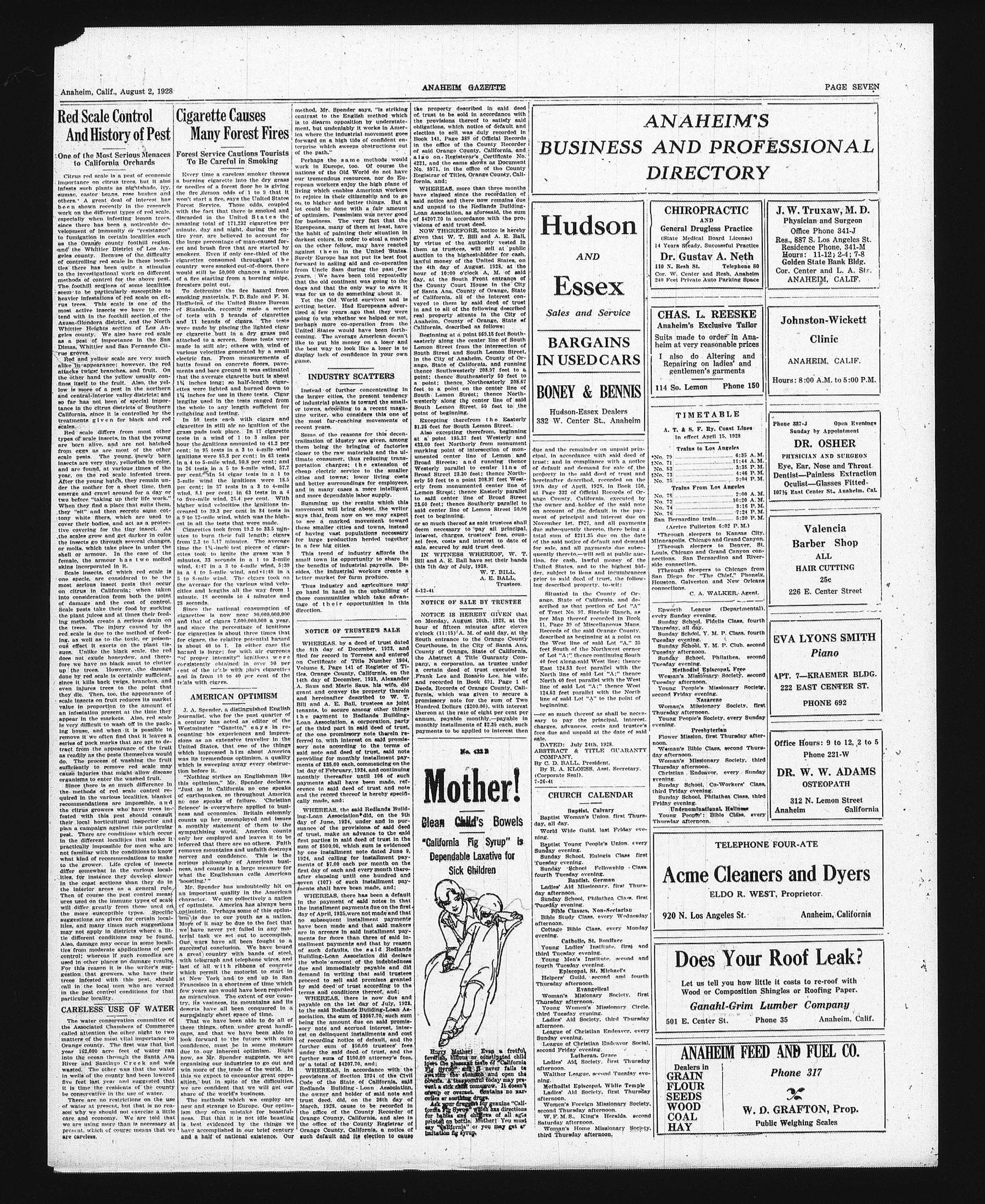
Searchable text
Red Scale Control And History of Pest
One of the Most Serious Menaces to California Orchards
Citrus red scale is a pest of economic importance on citrus trees, but it also infests such plants as nightshade, ivy, sumac, castor beans, rose bushes and others. A great deal of interest has been shown recently in the research work on the different types of red scale, especially when infesting lemon trees, since there has been a noticeable development of immunity or "resistance" to fumigation in certain localities such as the Orange county foothill region, and the Whittier District of Los Angeles county. Because of the difficulty of controlling red scale in these localities there has been quite a stimulus to the investigational work on different methods of control for the above pest. The foothill sections of some localities seem to be particularly susceptible to heavier infestations of red scale on citrus trees. This scale is one of the most active insects we have to contend with in the foothill section of the Azusa-Glondora district, and the North Whittier Heights section of Los Angeles county. We also have red scale as a pest of importance in the San Dimas, Whittier and San Fernando Citrus groves.
Red and yellow scale are very much alike in appearance; however, the red attacks twigs; branches, and fruit. On the other hand the yellow usually confines itself to the fruit. Also, the yellow is more of a pest in the northern and central-interior valley districts; and so far has not been of special importance in the citrus districts of Southern California, since it is controlled by the treatments given for black and red scales.
Red scale differs from most other types of scale insects, in that the young are born alive, and are not hatched
Cigarette Causes Many Forest Fires
Forest Service Cautions Tourists To Be Careful in Smoking
Every time a careless smoker throws a burning cigarette into the dry grass or needles of a forest floor he is giving the fire demon odds of 1 to 9 that it won't start a fire, says the United States Forest Service. Those odds, coupled with the fact that there is smoked and discarded in the United States the amazing total of 171,232 cigarettes per minute, day and night, during the entire year, are believed to account for the large percentage of man-caused forest and brush fires that are started by smokers. Even if only one-third of the cigarettes consumed throughout the country were smoked out-of-doors, there would still be 50,000 chances a minute of a fire starting from a burning snipe, foresters point out.
To determine the fire hazard from smoking materials, P. D. Sale and F. M. Hoffheims, of the United States Bureau of Standards, recently made a series of tests with 9 brands of cigarettes and 11 brands of cigars. The tests were made by placing the lighted cigar or cigarette butt in a dry grass pad attached to a screen. Some tests were made in still air; others with wind of various velocities generated by a small electric fan. From measurements of butts found on concrete floors, pavements and bare ground it was estimated that the average cigarette butt is about 1¼ inches long; so half-length cigarettes were lighted and burned down to 1¼ inches for use in these tests. Cigar lengths used in the tests ranged from the whole to any length sufficient for relighting and testing.
In 50 tests each with cigars and cigarettes in still air no ignition of the grass pads took place. In 17 cigarette tests in a wind of 1 to 3 miles per hour the ignitions amounted to 41.2 per method. Mr. Spender says contrast to the English he is to disarm opposition to it, but undeniably it will locate where the industrial men forward on a high tide of enterprise which sweeps off of the path."
Perhaps the same man work in Europe, too. Nations of the Old World our tremendous resources ropean workers enjoy their living which enables America to rejoice in their citizens on to higher and better lot could be done with all of optimism. Pessimism wives for business. The very Europeans, many of them the habit of painting their darkest colors, in order to on the other fellow, may against them in the U Surely Europe has not put forward in asking aid and from Uncle Sam during years. We have been told that the old continent was dogs and that the only way was for us to do something.
Yet the Old World sucks better. Had Eurias tamed a few years ago going to win whether we perhaps more co-operate United States would have coming. The average American like to put his money on the best way to look like display lack of confidence game.
INDUSTRY SCALE
Instead of further control the larger cities, the pre-eminent industrial plants is town er towns, according to a zine writer, who considers the most far-reaching recent years.
Some of the reasons for tractionization of industry are them being the bringing
Red and yellow scale are very much alike in appearance; however, the red attacks twigs; branches, and fruit. On the other hand the yellow usually confines itself to the fruit. Also, the yellow is more of a pest in the northern and central-interior valley districts; and so far has not been of special importance in the citrus districts of Southern California, since it is controlled by the treatments given for black and red scales.
Red scale differs from most other types of scale insects, in that the young are born alive, and are not hatched from eggs as are most of the other scale pests. The young, newly born insects are very tiny, yellowish in color, and are found, at various times of the year, on the red scale infested trees. After the young hatch, they remain under the mother for a short time, then emerge and crawl around for a day or two before "taking up their life work." When they find a place that suits them, they "slit" and then secrete some cottony white fibers, which are used to cover their bodies, and act as a protective covering for the tiny insect. As the scales grow and get darker in color the insects go through several changes, or molts, which take place in under the shell or armour. In the case of the female, the armour has two molted skins incorporated in it.
Scale insects, of which red scale is one specie, are considered to be the most serious insect pests that occur on citrus in California; when taken into consideration from both the point of damage and the cost of control. Scale pests take their food by sucking the plant juices and at times their feeding methods create a serious drain on the trees. The injury caused by the red scale is due to the method of feeding, as well as to the toxic, or poisonous effect it exerts on the plant tissues. Unlike the black scale, the red does not exude honeydew, and therefore we have no black smut to clutter up the trees. However, the damage done by red scale is certainly sufficient, since it kills back twigs, branches, and even injures trees to the point that they die. Then, too, the appearance of scale insects on fruit reduces its market value in proportion to the amount of an infestation present at the time they appear in the markets. Also, red scale is very difficult to wash off in the packing house, and when it is possible to remove it we often find that it leaves a series of pock marks that are apt to detract from the appearance of the fruit as readily as the pests themselves would do. The process of washing the fruit sufficiently to remove red scale may cause injuries that might allow disease organisms to enter the washed fruit.
Since there is so much difference in the methods of red scale control required in the various localities, blanket recommendations are impossible, and the citrus growers who have trees infested with this pest should consult their local horticultural inspector and plan a campaign against this particular pest. There are conditions which occur in the different localities that make it practically impossible for men who are
AMERICAN OPTIMISM
J. A. Spender, a distinguished English journalist, who for the past quarter of a century has acted as editor of the Westminster "Gazette," says in recounting his experiences and impressions as an extensive traveller in the United States, that one of the things which impressed him about America was its tremendous optimism, a quality which is sweeping away every obstruction before it.
"Nothing strikes an Englishman like this optimism," Mr. Spender declares. "Just as in California no one speaks of earthquakes, so throughout America no one speaks of failure. 'Christian Science' is everywhere applied to business and economics. Britain solemnly counts up her unemployed and issues a monthly statement of them to the sympathizing world. America counts only her employed and leaves it to be inferred that there are no others. Faith removes mountains and unfaith destroys electric fan. From measurements of butts found on concrete floors, pavements and bare ground it was estimated that the average cigarette butt is about 1¼ inches long; so half-length cigarettes were lighted and burned down to 1¼ inches for use in these tests. Cigar lengths used in the tests ranged from the whole to any length sufficient for rellighting and testing.
In 50 tests each with cigars and cigarettes in still air no ignition of the grass pads took place. In 17 cigarette tests in a wind of 1 to 3 miles per hour the ignitions amounted to 41.2 per cent; in 95 tests in a 3 to 4-mile-wind ignitions were 85.3 per cent; in 63 tests in a 4 to 5-mile wind, 50.8 per cent; and in 26 tests in a 5 to 8-mile wind, 57.7 per cent. In 54 cigar tests in a 1 to 3-mile wind the ignitions were 18.5 per cent; in 37 tests in a 3 to 4-mile wind, 8.1 per cent; in 63 tests in a 4 to five-mile wind, 25.4 per cent. With higher wind velocities the ignitions increased to 39.3 per cent in 84 tests in a 9 to 12-mile wind, which was the highest in all the tests that were made.
Cigarettes took from 19.2 to 33.5 minutes to burn their full length; cigars from 2.3 to 5.17 minutes. The average time the 1¼-inch test pieces of cigarettes took to ignite the grass was 9 minutes, 33 seconds in a 1 to 3-mile wind, 4:47 in a 3 to 4-mile wind, 5:39 in a 4 to 5-mile wind, and 4:48 in a 5 to 8-mile wind. The cigars took on the average for the various wind velocities and lengths all the way from 1 minute, 18 seconds to 4 minutes and 28 seconds.
Since national consumption of cigarettes is now near 90,000,000,000 and that of cigars 7,000,000,000 a year, and since the percentage of ignitions for cigarettes is about three times that for cigars, the relative potential hazard is about 40 to 1. In either case the hazard is large; for with air currents "of proper intensity" ignitions were consistently obtained in over 90 percent of the trials with plain cigarettes and in from 10 to 40 per cent of the trials with cigars.
AMERICAN OPTIMISM
WHEREAS, by a deed,the 8th day of December filled for record in Torrance on Certificate of Title Volume 8, Page 141 of Fiction Orange County, Called 14th day of December, A. Saus and Marie Saus grant and convey the property hereinafter described Bill and A. E. Ball, trust tenants, to secure among them the payment to Redla Loan Association,a copy ofthe third partin briefs ofered towith interest oresory note accordingto tsa said note and deed ofthe providing for monthly immeasures of $35.00 each.com last day of February,1924.monthly thereafter until payments shall have been encredto taid deed of fandthe record thereof is cally made,and:
WHEREAS,the said Fing-Loan Association*daily day of June,1924.unsuance ofthe provisionsof trust,make an advail first parties in said deed sum of $500.00which su
Since there is so much difference in the methods of red scale control required in the various localities, blanket recommendations are impossible, and the citrus growers who have trees infested with this pest should consult their local horticultural inspector and plan a campaign against this particular pest. There are conditions which occur in the different localities that make it practically impossible for men who are not familiar with the conditions to know what kind of recommendations to make to the grower. Life cycles of insects differ somewhat in the various localities, for instance they develop slower in the coast sections than they do in the interior areas as a general rule. Then of course the pest control measures used on the immune types of scale will differ greatly from those used on the more susceptible types. Specific suggestions are given for certain localities, and many times such suggestions may not apply in districts where a little different conditions may be found. Also, damage may occur in some localities from moderate applications of pest control; whereas if such remedies are used in other places no damage results. For this reason it is the writer's suggestion that growers, who have their trees infested with this pest, should call in the local men who are versed in the pest control conditions for that particular locality.
CARELESS USE OF WATER
The water conservation committee of the Associated Chambers of Commerce called attention the other night to two matters of the most vital importance to Orange county. The first was that last year 162,000 acre feet of water ran into the ocean through the Santa Ana River and Santiago Creek and wasted. The other was that the water in wells of the county had been lowered five feet last year and suggested that it is time the residents of the county be conservative in the use of water.
There are no restrictions on the use of water at present, but that is no reason why we should not exercise a little care and economy. We are told that we are using more than is necessary at present, which of course means that we are careless.
That we have been able to do all these things, often under great handicaps, and that we have been able to look forward to the future with calm confidence, must be in some measure due to our inherent optimism. Right now, as Mr. Spender suggests, we are organizing our industries to go out and win more of the trade of the world. In this we expect to encounter great opposition, but in spite of the difficulties, we are confident that we will get our share of the world's business.
The methods which we employ are new and strange to Europe. Our optimism they often mistake for boastfulness. But that it is not idle boasting is best evidenced by the things we have accomplished in our brief century and a half of national existence. Our was its tremendous optimism, a quality which is sweeping away every obstruction before it.
"Nothing strikes an Englishman like this optimism," Mr. Spender declares. "Just as in California no one speaks of earthquakes, so throughout America no one speaks of failure." 'Christian Science' is everywhere applied to business and economics. Britain solemnly counts up her unemployed and issues a monthly statement of them to the sympathizing world. America counts only her employed and leaves it to be inferred that there are no others. Faith removes mountains and unfaith destroys nerves and confidence. This is the serious philosophy of American business, and counts in a large measure for what the Englishman calls American "boosting."
Mr. Spender has undoubtedly hit on an important quality in the American character. We are collectively a nation of optimists. America has always been optimistic. Perhaps some of this optimism is due to our youth as a nation. More of it may be due to the fact that we have never yet failed in any material task we set out to accomplish. Our wars have all been fought to a successful conclusion. We have bound a great country with bands of steel, with telegraph and telephone wires, and last all with ribbons of concrete which permit the motorist to start in at New York and to end up in San Francisco in a shortness of time which few years ago would have been regarded as miraculous. The extent of our country, its vastness, its mountains and its deserts have all been conquered in a surprisingly short space of time.
That we have been able to do all these things, often under great handicaps, and that we have been able to look forward to the future with calm confidence, must be in some measure due to our inherent optimism. Right now, as Mr. Spender suggests, we are organizing our industries to go out and win more of the trade of the world. In this we expect to encounter great opposition, but in spite of the difficulties, we are confident that we will get our share of the world's business.
The methods which we employ are new and strange to Europe. Our optimism they often mistake for boastfulness. But that it is not idle boasting is best evidenced by the things we have accomplished in our brief century and a half of national existence. Our was its tremendous optimism, a quality which is sweeping away every obstruction before it.
"Nothing strikes an Englishman like this optimism," Mr. Spender declares. "Just as in California no one speaks of earthquakes, so throughout America no one speaks of failure." 'Christian Science' is everywhere applied to business and economics. Britain solemnly counts up her unemployed and issues a monthly statement of them to the sympathizing world. America counts only her employed and leaves it to be inferred that there are no others. Faith removes mountains and unfaith destroys nerves and confidence. This is the serious philosophy of American business, and counts in a large measure for what the Englishman calls American "boosting."
Mr. Spender has undoubtedly hit on an important quality in the American character. We are collectively a nation of optimists. America has always been optimistic. Perhaps some of this optimism is due to our youth as a nation. More of it may be due to the fact that we have never yet failed in any material task we set out to accomplish. Our wars have all been fought to a successful conclusion. We have bound a great country with bands of steel, with telegraph and telephone wires, and last all with ribbons of concrete which permit the motorist to start in at New York and to end up in San Francisco in a shortness of time which few years ago would have been regarded as miraculous. The extent of our country, its vastness, its mountains and its deserts have all been conquered in a surprisingly short space of time.
That we have been able to do all these things, often under great handicaps, and that we have been able to look forward to the future with calm confidence, must be in some measure due to our inherent optimism. Right now, as Mr. Spender suggests, we are organizing our industries to go out and win more of the trade of the world. In this we expect to encounter great opposition, but in spite of the difficulties, we are confident that we will get our share of the world's business.
The methods which we employ are new and strange to Europe. Our optimism they often mistake for boastfulness. But that it is not idle boasting is best evidenced by the things we have accomplished in our brief century and a half of national existence. Our was its tremendous optimism, a quality which is sweeping away every obstruction before it.
"Nothing strikes an Englishman like this optimism," Mr. Spender declares. "Just as in California no one speaks of earthquakes, so throughout America no one speaks of failure." 'Christian Science' is everywhere applied to business and economics. Britain solemnly counts up her unemployed and issues a monthly statement of them to the sympathizing world. America counts only her unemployed and leaves it to be inferred that there are no others. Faith removes mountains and unfaith destroys nerves and confidence. This is the serious philosophy of American business, and counts in a large measure for what the Englishman calls American "boosting."
Mr. Spender has undoubtedly hit on an important quality in the American character. We are collectively a nation of optimists. America has always been optimistic. Perhaps some of this optimism is due to our youth as a nation. More of it may be due to the fact that we have never yet failed in any material task we set out to accomplish. Our wars have all been fought to a successful conclusion. We have bound a great country with bands of steel, with telegraph and telephone wires, and last all with ribbons of concrete which permit the motorist to start in at New York and to end up in San Francisco in a shortness of time which few years ago would have been regarded as miraculous. The extent of our country, its vastness, its mountains and its deserts have all been conquered in a surprisingly short space of time.
That we have been able to do all these things, often under great handicaps, and that we have been able to look forward to the future with calm confidence, must be in some measure due to our inherent optimism. Right now, as Mr. Spender suggests, we are organizing our industries to go out and win more of the trade of the world. In this we expect to encounter great opposition, but in spite of the difficulties, we are confident that we will get our share of the world's business.
The methods which we employ are new and strange to Europe. Our optimism they often mistake for boastfulness. But that it is not idle boasting is best evidenced by the things we have accomplished in our brief century and a half of national existence. Our was its tremendous optimism, a quality which is sweeping away every obstruction before it.
"Nothing strikes an Englishman like this optimism," Mr. Spender declares. "Just as in California no one speaks of earthquakes, so throughout America no one speaks of failure." 'Christian Science' is everywhere applied to business and economics. Britain solemnly counts up her unemployed and issues a monthly statement of them to the sympathizing world. America counts only her unemployed and leaves it to be inferred that there are no others. Faith removes mountains and unfaith destroys nerves and confidence. This is the serious philosophy of American business, and counts in a large measure for what the Englishman calls American "boosting."
Mr. Spender has undoubtedly hit on an important quality in the American character. We are collectively a nation of optimists. America has always been optimistic. Perhaps some of this optimism is due to our youth as a nation. More of it may be due to the fact that we have never yet failed in any material task we set out to accomplish. Our wars have all been fought to a successful conclusion. We have bound a great country with bands of steel, with telegraph and telephone wires, and last all with ribbons of concrete which permit the motorist to start in at New York and to end up in San Francisco in a shortness of time which few years ago would have been regarded as miraculous. The extent of our country, its vastness, its mountains and its deserts have all been conquered in a surprisingly short space of time.
That we have been able to do all these things, often under great handicaps, and that we have been able to look forward to the future with calm confidence, must be in some measure due to our inherent optimism. Right now, as Mr. Spender suggests, we are organizing our industries to go out and win more of the trade of the world. In this we expect to encounter great opposition, but in spite of the difficulties, we are confident that we will get our share of the world's business.
The methods which we employ are new and strange to Europe. Our optimism they often mistake for boastfulness. But that it is not idle boasting is best evidenced by the things we have accomplished in our brief century and a half of national existence. Our was its tremendous optimism, a quality which is sweeping away every obstruction before it.
"Nothing strikes an Englishman like this optimism," Mr. Spender declares. "Just as in California no one speaks of earthquakes, so throughout America no one speaks of failure." 'Christian Science' is everywhere applied to business and economics. Britain solemnly counts up her unemployed and issues a monthly statement of them to the sympathizing world. America counts only her unemployed and leaves it to be inferred that there are no others. Faith removes mountains and unfaith destroys nerves and confidence. This is the serious philosophy of American business, and counts in a large measure for what the Englishman calls American "boosting."
Mr. Spender has undoubtedly hit on an important quality in the American character. We are collectively a nation of optimists. America has always been optimistic. Perhaps some of this optimism is due to our youth as a nation. More of it may be due to the fact that we have never yet failed in any material task we set out to accomplish. Our wars have all been fought to a successful conclusion. We have bound a great country with bands of steel, with telegraph and telephone wires, and last all with ribbons of concrete which permit the motorist to start in at New York and to end up in San Francisco in a shortness of time which few years ago would have been regarded as miraculous. The extent of our country, its vastness, its mountains和 its deserts have all been conquered in a surprisingly short space of time.
That we have been able to do all these things, often under great handicaps, and that we have been able to look forward to the future with calm confidence, must be in some measure due to our inherent optimism. Right now, as Mr. Spender suggests, we are organizing our industries to go out and win more of the trade of the world. In this we expect to encounter great opposition, but in spite of the difficulties, we are confident that we will get our share of the world's business.
The methods which we employ are new and strange to Europe. Our optimism they often mistake for boastfulness. But that it is not idle boasting is best evidenced by the things we have accomplished in our brief century and a half of national existence. Our was its tremendous optimism, a quality which is sweeping away every obstruction before it.
"Nothing strikes an Englishman like this optimism," Mr. Spender declares. "Just as in California no one speaks of earthquakes, so throughout America no one speaks of failure." 'Christian Science' is everywhere applied to business and economics. Britain solemnly counts up her unemployed and issues a monthly statement of them to the sympathizing world. America counts only her unemployed和 leaves it to be inferred that there are no others. Faith removes mountains和 unfaith destroys nerves和 confidence. This is the serious philosophy of American business, and counts in a large measure for what the Englishman calls American "boosting."
Mr. Spender has undoubtedly hit on an important quality in the American character. We are collectively a nation of optimists. America has always been optimistic.Perhaps some of this optimism is due to our youth as a nation.Moreofitmaybe duetofailureanddemandinwritingthatisproceedtolsealproofsbysaldedproofsbytradiedproofsbytradiedproofsbytradiedproofsbytradiedproofsbytradiedproofsbytradiedproofsbytradiedproofsbytradiedproofsbytradiedproofsbytradiedproofsbytradiedproofsbytradiedproofsbytradiedproofsbytradiedproofsbytradiedproofsbytradiedproofsbytradiedproofsbytradiedproofsbytradiedproofsbytradiedproofsbytradiedproofsbytradiedproofsbytradiedproofsbytradiedproofsbytradiedproofsbytradiedproofsbytradiedproofsbytradiedproofsbytradiedproofsbytradiedproofsbytradiedproofsbytradiedproofsbytradiedproofsbytradiedproofsbytradiedproofsbytradiedproofsbytradiedproofsbytradiedproofsbytradiedproofsbytradiedproofsbytradiedproofsbytradied proofsbytradied proofsbytradied proofsbytradied proofsbytradied proofsbytradied proofsbytradied proofsbytradied proofsbytradied proofsbytradied proofsbytradired proofsbytradired proofsbytrradired proofsbytrradired proofsbytrradired proofsbytrradired proofsbytrradired proofsbytrradired proofsbytrradired proofsbytrradired proofsbytrradired proofsbytrradired proofsbytrradired proofsbytrradired proofsbytrradired proofsbytrradired proofsbytrradired proofsbytrradired proofsobyttravelled proofsbypracticalproblemssyrelievableproblemssyrelievableproblemssyrelievableproblemssyrelievableproblemssyrelievableproblemssyrelievableproblemssyrelievableproblemssyrelievableproblemssyrelievableproblemssyrelievableproblemssyrelievableproblemssyrelievableproblemssyrelievableproblemssyrelievableproblemssyrelievableproblemssyrelievableproblemssyrelievableproblemssyrelievableproblemssyrelievableproblemssyrelievableproblemssyrelievableproblemssyrelievableproblemssyrelievableproblemssyrelievableproblemssyrelievableproblemssyrelievableproblemssyrelievableproblemssyrelievableproblemssyrelievableproblemssyrelievableproblemssyrelievableproblemssyrelievableproblemssyrelievableproblemssyrelievableproblemssyrelievableproblemssyrelievableproblemssyrelievableproblemssyrelievableproblemssyrelievableproblemssyrelievableproblemssyrelievableproblemssyrelievableproblemssyrelievableproblemssyrelievableproblemssyrelievableproblemssyrelievableproblemssyrelievableproblemssyrelievableproblemssyrelievableproblemssyrelievableproblemssyrelievableproblemssyrelievableproblemssyrelievableproblemssyrelievableproblemssyrelievableproblemssyrelievableproblemssyrelievableproblemssyrelievableproblemssyrelievableproblemssyrelievableproblemssyrelievableproblemssyrelievableproblemssyrelievableproblemssyrelievableproblemssyrelievableproblemssyrelievableproblemssyrelievableproblemssyrelievableproblemssyrelievableproblemssyrelievableproblemssyrelievableproblemsyyrelevablesyyrelevablesyyrelevablesyyrelevablesyyrelevablesyyrelevablesyyrelevablesyyrelevablesyyrelevablesyyrelevablesyyrelevablesyyrelevablesyyrelevablesyyrelevablesyyrelevablesyyrelevablesyyrelevablesyyrelevablesyyrelevablesyyrelevablesyyrelevablesyyrelevablesyyrelevablesyyrelevablesyyrelevablesyyrelevablesyyrelevablesyyrelevablesyyrelevablesyyrelevablesyyrelevablesyyrelevablesyyrelevablesyyrelevablesyyrelevablesyyrelevablesyyrelevablesyyrelevablesyyrelevablesYYYrelevantsproblemsYYYrelevantsproblemsYYYrelevantsproblemsYYYrelevantsproblemsYYYrelevantsproblemsYYYrelevantsproblemsYYYrelevantsproblemsYYYrelevantsproblemsYYYrelevantsproblemsYYYrelevantsproblemsYYYrelevantsproblemsYYYrelevantsproblemsYYYrelevantsproblemsYYYrelevantsproblemsYYYrelevantsproblemsYYYrelevantsproblemsYYYrelevantsproblemsYYYrelevantsproblemsYYYrelevantsproblemsYYYrelevantsproblemsYYYrelevantsproblemsYYYrelevantsproblemsYYYrelevantsproblemsYYYrelevantsproblemsYYYrelevantspropositionsYYYrelevantspropositionsYYYrelevantspropositionsYYYrelevantspropositionsYYYrelevantspropositionsYYYrelevantspropositionsYYYrelevantspropositionsYYYrelevantspropositionsYYYrelevantspropositionsYYYrelevantspropositionsYYYrelevantspropositionsYYYrelevantspropositionsYYYrelevantspropositionsYYYrelevantspropositionsYYYrelevantspropositionsYYYrelevantspropositionsYYYrelevantspropositionsYYYrelevantspropositionsYYYrelevantspropositionsYYYrelevantspropositionsYYYrelevantspropositionsYYY.relevantspropositionsYYYrelevantspropositionsYYYrelevantspropositionsYYYrelevantspropositionsYYYrelevantspropositionsYYYrelevantspropositionsYYYrelevantspropositionsYYYrelevantspropositionsYYYrelevantspropositionsYYYrelevantspropositionsYYYrelevantspropositionsYYYrelevantspropositionsYYYrelevantspropositionsYYYrelevantspropositionsYYY.relevantspropositionsYYY.relevantspropositionsYYY.relevantspropositionsYYY.relevantspropositionsYYY.relevantspropositionsYYY.relevantspropositionsYYY.relevantspropositionsYYY.relevantspropositionsYYY.relevantspropositionsYYY.representations???????????????????????????????????????????????????????????????????????????????????????????????????????????????????????????????????????????????????????????????
WHEREAS,these papers were made from paper or plastic materials such as wood or metal,and they were printed on high-quality paper or plastic materials such as wood or metal,and they were printed on high-quality paper or plastic materials such as wood or metal,and they were printed on high-quality paper or plastic materials such as wood or metal,and they were printed on high-quality paper or plastic materials such as wood or metal,and they were printed on high-quality paper or plastic materials such as wood or metal,and they were printed on high-quality paper or plastic materials such as wood or metal,and they were printed on high-quality paper or plastic materials such as wood or metal,and they were printed on high-quality paper or plastic materials such as wood or metal,and they were printed on high-quality paper or plastic materials such as wood or metal,and they were printed on high-quality paper or plastic materials such as wood or metal,and they were printed on high-quality paper or plastic materials such as wood or metal,and they were printed on high-quality paper or plastic materials such as wood or metal,and they were printed on high-quality paper or plastic materials such as wood or metal,and they were printed on high-quality paper or plastic materials such as wood or metal,and they were printed on high-quality paper or plastic materials such as wood or metal,and they were printed on high-quality paper or plastic materials such as wood or metal,and they were printed on high-quality paper or plastic materials such as wood or metal,and they were printed on high-quality paper or plastic materials such as wood or metal,and they were printed on high-quality paper or plastic materials such as wood or metal,and they were printed on high-quality paper or plastic materials such as wood or metal,and they were printed on high-quality paper or plastic materials such as wood or metal,and they were printed on high-quality paper or plastic materials such as wood or metal,and they were printed on high-quality paper or plastic materials such as wood or metal,and they were printed on high-quality paper or plastic materials such as wood or metal,and they were printed on high-quality paper or plastic materials such as wood or metal,and they were printed on high-quality paper or plastic materials such as wood or metal,and they were printed on high-quality paper or plastic materials such as wood or metal,and they were printed on high-quality paper or plastic materials such as wood或金属,andtheywereprintedonhighqualitypaperorplasticmaterialsofnatureandeffectivenessfortheirindependencefromtheirownabilityandefficiencyfortheirindependencefromtheirownabilityandefficiencyfortheirindependencefromtheirownabilityandefficiencyfortheirindependencefromtheirownabilityandefficiencyfortheirindependencefromtheirownabilityandefficiencyfortheirindependencefromtheirownabilityandefficiencyfortheirindependencefromtheirownabilityandefficiencyfortheirindependencefromtheirownabilityandefficiencyfortheirindependencefromtheirownabilityandefficiencyfortheirindependencefromtheirownabilityandefficiencyfortheirindependencefromtheirownabilityandefficiencyfortheirindependencefromtheirownabilityandefficiencyfortheirindependencefromtheirownabilityandefficiencyfortheirindependencefromtheirownabilityandefficiencyfortheirindependencefromtheirownabilityandefficiencyfortheirindependencefromtheirownabilityandefficiencyfortheirindependencefromtheirownabilityandefficiencyfortheirindependentfromtheirownabilityandefficiencyfortheirindependentfromtheirownabilityandefficiencyfortheirindependentfromtheirownabilityandefficiencyfortheirindependentfromtheirownabilityandefficiencyfortheirindependentfromtheirownabilityandefficiencyfortheirindependentfromtheirownabilityandefficiencyfortheirindependentfromtheirownabilityandefficiencyfortheirindependentfromtheirownabilityandefficiencyfortheirindependentfromtheirownabilityandefficiencyfortheirindependentfromtheirownabilityandefficiencyfortheirindependentfromtheirownabilityandefficiencyfortheirindependentfromtheirownabilityandefficiencyfortheirindependentfromtheirownabilityandefficiencyfortheirsituationalimportanceoftheproductofaforeigncompanyasanimportantobjectofaforeigncompanyasanimportantobjectofaforeigncompanyasanimportantobjectofaforeigncompanyasanimportantobjectofaforeigncompanyasanimportantobjectofaforeigncompanyasanimportantobjectofaforeigncompanyasanimportantobjectofaforeigncompanyasanimportantobjectofaforeigncompanyasanimportantobjectofaforeigncompanyasanimportantobjectofaforeigncompanyasanimportantobjectofaforeigncompanyasanimportantobjectofaforeigncompanyasanimportantobjectofaforeigncompanyasanimportantobjectofaforeigncompanyasanimportantobjectofaforeigncompanyasanimportantobjectofaforeigncompanyasanimportantobjectofaforeigncompanyasanimportantobjectofaforeigncompanyasanimportantobjectofaforeigncompanyasanimportantobjectofaforeigncompanyasanimportantobjectofaforeigncompanyasanimportantobjectofaforeigncompanyasanimportantobjectofaforeigncompanyasanimportantobjectofaforeigncompanyasanimportantobjectofaforeigncompanyasanimportantobjectofaforeigncompanyasanimportantobjectofaforeigncompanyasanimportantobjectofaforeigncompanyasanimportantobjectofaforeigncompanyasanimportantobjectof
method, Mr. Spender says, "is striking contrast to the English method which is to disarm opposition by understatement, but undeniably it works in America where the industrial movement goes forward on a high tide of confident enterprise which sweeps obstructions out of the path."
Perhaps the same methods would work in Europe, too. Of course the nations of the Old World do not have our tremendous resources, nor do European workers enjoy the high plane of living which enables American workers to rejoice in their citizenship and to go on to higher and better things. But a lot could be done with a fair amount of optimism. Pessimism was never good for business. The very fact that the Europeans, many of them at least, have the habit of painting their situation in darkest colors, in order to steal a march on the other fellow, may have reacted against them in the United States. Surely Europe has not put its best foot forward in asking aid and co-operation from Uncle Sam during the past few years. We have been told repeatedly that the old continent was going to the dogs and that the only way to save it was for us to do something about it.
Yet the Old World survives and is getting better. Had Europeans advertised a few years ago that they were going to win whether we helped or not, perhaps more co-operation from the United States would have been forthcoming. The average American doesn't like to put his money on a loser and the best way to look like a loser is to display lack of confidence in your own game.
INDUSTRY SCATTERS
Instead of further concentrating in the larger cities, the present tendency of industrial plants is toward the smaller towns, according to a recent magazine writer, who considers this one of the most far-reaching movements of recent years.
Some of the reasons for this decentralization of industry are given, among them being the bringing of factories
the property described in said deed of trust to be sold in accordance with the provisions thereof to satisfy said obligations, which notice of default and election to sell was duly recorded in Book 141, Page 389 of Official Records in the office of the County Recorder of said Orange County, California, and also on Registerar's Certificate No. 4221, and the same shows as Document No. 8971, in the office of the County Registrar of Titles, Orange County, California, and;
WHEREAS, more than three months have elapsed since the recordation of said notice and there now remains due and unpaid to the Redlands Building-Loan Association, as aforesaid, the sum of $4207.70 in accordance with the provisions of said trust deed.
NOW THEREFORE, notice is hereby given that W. T. Bill and A. E. Ball, by virtue of the authority vested in them as trustees, will sell at public auction to the highest bidder for cash, lawful money of the United States, on the 4th day of August, 1928, at the hour of 10:00 o'clock A.M. of said day, at the South Front entrance of the County Court House in the City of Santa Ana, County of Orange, State of California, all of the interest conveyed to them by said deed of trust in and to all of the following described real property situate in the City of Anaheim, County of Orange, State of California, described as follows:
Beginning at a point $869.15 feet South-easterly along the center line of South Lemon Street from the intersection of South Street and South Lemon Street, in the City of Anaheim, County of Orange, State of California, and running thence Southwesterly 208.97 feet to a point; thence Southeasterly 50 feet to a point; thence Northeasterly 208.67 feet to a point on the center line of South Lemon Street; thence North-westerly along the center line of said South Lemon Street 50 feet to the point of beginning.
Excepting therefrom the Easterly 31.25 feet for South Lemon Street.
Also excepting therefrom, beginning at a point 185.37 feet Westerly and 433.00 feet Northerly from monument marking of intersection of mon...
INDUSTRY SCATTERS
Instead of further concentrating in the larger cities, the present tendency of industrial plants is toward the smaller towns, according to a recent magazine writer, who considers this one of the most far-reaching movements of recent years.
Some of the reasons for this decentralization of industry are given, among them being the bringing of factories closer to the raw materials and the ultimate consumer, thus reducing transportation charges; the extension of cheap electric service to the smaller cities and towns; lower living costs and better surroundings for employees, and in many cases a more intelligent and more dependable labor supply.
Summing up the results which this movement will bring about, the writer says that, from now on we may expect to see a marked movement toward these smaller cities and towns, instead of having vast populations necessary for large production herded together in a few big cities.
This trend of industry affords the small town its opportunity to share in the benefits of industrial payrolls. Besides, the industrial workers create a better market for farm produce.
Thus industry and agriculture may go hand in hand in the upbuilding of those communities which take advantage of their opportunities in this direction.
NOTICE OF TRUSTEE'S SALE
WHEREAS, by a deed of trust dated the 8th day of December, 1923, and filed for record in Torrens and entered on Certificate of Title Number 1904, Volume 8, Page 141 of Register of Titles, Orange County, California, on the 14th day of December, 1923, Alexander A. Saus and Mario Saus, his wife, did grant and convey the property therein and hereinafter described to W. T. Bill and A. E. Ball, trustees as joint tenants, to secure among other things the payment to Redlands Building-Loan Association, a corporation, party of the third part in said deed of trust, of the one promissory note therein referred to, with interest on said promissory note according to the terms of said note and deed of trust, said note providing for monthly installment payments of $35.00 each, commencing on the 1st day of February, 1924, and continuing monthly thereafter until 106 of such payments shall have been made, reference to said deed of trust and note and the record thereof is hereby specifically made, and:
WHEREAS, the said Redlands Building-Loan Association did, on the 9th day of June, 1924, under and in pursuance of the provisions of said deed of trust, make an advance to the said first parties in said deed of trust in the sum of $500.00, which sum is evidenced upon date June 8
Mother!
Clean Child's Bowels "California Fig Syrup" is IN USEDCARS BONEY & BENNIS Hudson-Essex Dealers 332 W. Center St., Anaheim due and the remainder on unpaid principal. In accordance with said deed of trust; and in compliance with a notice of default and demand for sale of the property in the said deed of trust and hereinafter described, recorded on the 19th day of April, 1928, in Book 150, at Page 332 of Official Records of Orange County, California, executed by the owner and holder of the said note on account of the default in the payment of principal and interest due on November 1st, 1927, and all payments due subsequently thereto, there being a total sum of $211.35 due on the date of the said notice of default and demand for sale, and all payments due subsequently thereto—will sell at public auction, for cash, lawful money of the United States, and to the highest bidder, subject to liens and incumbrances prior to said deed of trust, the following described property, to-wit:
Situated in the County of Orange, State of California, and described as that portion of Lot "A" of Tract No. 97, Sinclair Ranch, as per Map thereof recorded in Book 11. Page 39 of Miscellaneous Mans. Records of the said Orange County, described as beginning at a point on the West line of said Lot "A," 35 feet South of the Northwest corner of Lot "A"; thence continuing South 40 feet along said West line; thence East 124.53 feet parallel with the North line of said Lot "A"; thence North 40 feet parallel with the West line of said Lot "A"; thence West 124.53 feet parallel with the North line of said Lot "A" to the point of beginning.
—or so much thereof as shall be necessary to pay the principal. Interest charges, advances, costs and trustee's fees due and unpaid at the date of said sale.
DATED: July 24th, 1928. ABSTRACT & TITLE GUARANTY COMPANY. By C. D. BALL, President. By R. A. KLOESS. Asst. Secretary. (Corporate Seal). 7-26-4t
CHURCH CALENDAR
Baptist, Calvary
Baptist Woman's Union, first Thursday, all day.
World Wide Guild, last Friday evening.
Baptist Young People's Union every Sunday evening.
Mother!
Clean Child's Bowels
"California Fig Syrup" is Dependable Laxative for Sick Children
WHEREAS, the said Redlands Building-Loan Association did on the 9th day of June, 1924, under and in pursuance of the provisions of said deed of trust, make an advance to the said first parties in said deed of trust in the sum of $500.00, which sum is evidenced by one installment note dated June 9, 1924, and calling for installment payments of $7.00 each per month on the first day of each and every month thereafter elapsing until one hundred and seven (107) of such installment payments shall have been made, and;
WHEREAS, there has been a default in the payment of said notes in that the installment payments due on the first day of April, 1925, were not made and that no subsequent installment payments have been made and that said makers are in arrears in said installment payments for more than three of said installment payments and that by reason of such defaults, the said Redlands Building-Loan Association did declare the whole amount of the indebtedness due and immediately payable and did demand in writing that said trustees proceed to sell said premises granted by said deed of trust according to the terms and conditions thereof, and;
WHEREAS, there is now due and payable on the 1st day of July, 1928, to the said Redlands Building-Loan Association, the sum of $3957.70, such sum being the amount due on said promissory note and accrued interest, interest on delinquent installments and cost of recording notice of default, and the further sum of $50.00 trustees' fees under the said deed of trust, and the further sum of $100.00 attorney's fees, or a total of $4207.70, and;
WHEREAS, in accordance with the provisions of Section 2924 of the Civil Code of the State of California, said Redlands Building-Loan Association, the owner and holder of said note and trust deed, did, on the 26th day of March, 1928, cause to be recorded in the office of the County Recorder of Orange County, California, and also in the office of the County Registrar of Orange County, California, a notice of such default and its election to cause
Harry Mother! Even a fretful feverish, billious or constipated child loves the pleasant taste of "California Fig Syrup," and it never falls to system the stomach and open the bowels. A惩毒ful today may prevent a sick child tomorrow. It doesn't grow or overheat. Contains no carcoles or soothing drugs.
Ask your dragonfly for genuine "California Fig Syrup" which has directions for habilies and children of all ages printed on bottle. Mother! You must say "California" or you may get an imitation fig syrup.
COMPANY.
By C. D. BALL, President.
By R. A. KLOESS, Asst. Secretary.
(Corporate Seal).
7-26-41
CHURCH CALENDAR
Baptist, Calvary
Baptist Woman's Union, first Thursday day, all day.
World Wide Guild, last Friday evening.
Baptist Young People's Union, every Sunday evening.
Sunday School, Eulogia Class first Tuesday evening.
Sunday - School Fellowship - Class fourth Tuesday evening.
Baptist, German
Ladies' Aid Missionary, first Thursday afternoon.
Sunday School, Philathea Class, first Tuesday evening.
Bible Classes, Non-Sectarian
Bible Study Class, every Wednesday afternoon.
Cottage Bible Class, every Monday evening.
Catholic, St. Roniface
Young Ladies' Institute, first and third Tuesday evening.
Young Men's Institute, second and fourth Tuesday evening.
Episcopal, St. Michael's
Helpers' Guild, second and fourth Thursday afternoon.
Evangeline
Woman's Missionary Society, first Thursday afternoon.
Young Women's Missionary Circle, third Tuesday evening.
Ladies' Aid Society, third Thursday afternoon.
League of Christian Endeavor, every Sunday evening.
League of Christian Endeavor Social, second Friday evening.
Lutheran, Grace
Ladies' Aid Society, first Thursday afternoon.
Walther League, second Tuesday evening.
Methodist Episcopal White Temple
Ladies' Aid Society, first Thursday afternoon.
Women's Foreign Missionary Society, second Thursday afternoon.
W.F.M.S., King's Heralds, second Saturday afternoon.
Woman's Home Missionary Society, third Thursday afternoon.
ANAHEIM'S
ESS AND PROFESSIONAL
DIRECTORY
CHIROPRACTIC
AND
General Drugless Practice
(State Medical Board License)
14 Years Steady, Successful Practice
Dr. Gustav A. Neth
110 N. Resh St. Telephone 80
Cor. W. Center and Resh, Anaheim
240 Feet Private Auto Parking Space
J. W. Truxaw, M. D.
Physician and Surgeon
Office Phone 341-J
Res., 887 S. Los Angeles St.
Residence Phone, 341-M
Hours: 11-12; 2-4; 7-8
Golden State Bank Bldg.
Cor. Center and L. A. Ste.
ANAHEIM, CALIF.
CHAS. L. REESKE
Anaheim's Exclusive Tailor
Suits made to order in Anaheim at very reasonable prices
I also do Altering and
Repairing on ladies' and
gentlemen's garments
114 So. Lemon Phone 150
Johnston-Wickett
Clinic
ANAHEIM, CALIF.
Hours: 8:00 A.M. to 5:00 P.M.
TIMETABLE
A. T. & S. F. Ry. Coast Lines
In effect April 15, 1928
Phone 837-J Open Evenings
Sunday by Appointment
DR. OSHER
I also do Altering and Repairing on ladies' and gentlemen's garments
114 So. Lemon Phone 150
TIMETABLE
A. T. & S. F. Ry. Coast Lines
In effect April 15, 1928
Trains to Los Angeles
*No. 79 ... 6:35 A.M.
$No. 71 ... 11:44 A.M.
No. 53 ... 3:35 P.M.
$No. 73 ... 4:46 P.M.
No. 75 ... 9:04 P.M.
Trains From Los Angeles
No. 78 ... 2:00 A.M.
No. 72 ... 10:20 A.M.
No. 74 ... 3:16 P.M.
No. 76 ... 7:24 P.M.
San Bernardino train ... 5:20 P.M.
(Arrive Fullerton 6:02 P.M.)
*Through sleepers to Kansas City, Minneapolis, Chicago and Grand Canyon.
*Through sleepers to Denver, St. Louis, Chicago and Grand Canyon connections, San Bernardino and River-side connection.
*Through sleepers to Chicago from San Diego for "The Chief," Phoneix, Houston, Galveston and New Orleans connections.
C. A. WALKER, Agent.
Epworth League (Departmental), every Sunday evening.
Sunday School, Fidella Class, fourth Thursday, all day.
Sunday School, Y. M. P. Class, fourth Tuesday evening.
Sunday School, Y. M. P. Club, second Tuesday afternoon.
Sunday School, Philathea, second Tuesday evening.
Methodist Episcopal Free
Woman's Missionary Society, second Tuesday afternoon.
Young People's Missionary Society, second Friday evening.
Nazarene
Woman's Missionary Society, first Thursday afternoon.
Young People's Society, every Sunday evening.
Presbyterian
Flower Mission, first Thursday afternoon.
Woman's Bible Class, second Thursday afternoon.
Woman's Missionary Society, third Thursday afternoon.
Christian Endeavor, every Sunday evening.
Sunday School, Co-Workers' Class, third Friday evening.
Sunday School, Philathea Class, third Friday evening.
Undenominational Helms
Young People': Bible Class, every Thursday afternoon.
ANAHEIM, CALIF.
Hours: 8:00 A.M. to 5:00 P.M.
Phone 387-J Open Evenings
Sunday by Appointment
DR. OSHER
PHYSICIAN AND SURGEON
Eye, Ear, Nose and Throat
Dentist—Painless Extraction
Oculist—Glasses Fitted
107½ East Center St., Anaheim, Cal.
Valencia
Barber Shop
ALL
HAIR CUTTING
25c
226 E. Center Street
EVA LYONS SMITH
Piano
APT. 7—KRAEMER BLDG.
222 EAST CENTER ST.
PHONE 692
Office Hours: 9 to 12, 2 to 5
Phone 221-W
DR. W. W. ADAMS
OSTEOPATH
312 N. Lemon Street
Anaheim California
Woman's Missionary Society, third Thursday afternoon.
Christian Endeavor, every Sunday evening.
Sunday School, Co-Workers' Class, third Friday evening.
Sunday School, Philathea Class, third Friday evening.
Undenominational Helios Young People's Bible Class, every Thursday afternoon.
TELEPHONE FOUR-ATE
Acme Cleaners and Dyers
ELDO R. WEST, Proprietor.
920 N. Los Angeles St. Anaheim, California
Does Your Roof Leak?
Let us tell you how little it costs to re-roof with Wood or Composition Shingles or Roofing Paper.
Ganahl-Grim Lumber Company
501 E. Center St. Phone 35 Anaheim, Calif.
ANAHEIM FEED AND FUEL CO.
Dealers in
GRAIN
FLOUR
SEEDS
WOOD
COAL
HAY
Phone 317
W. D. GRAFTON, Prop.
Public Weighing Scales