anaheim-gazette 1928-06-14
Scanned page
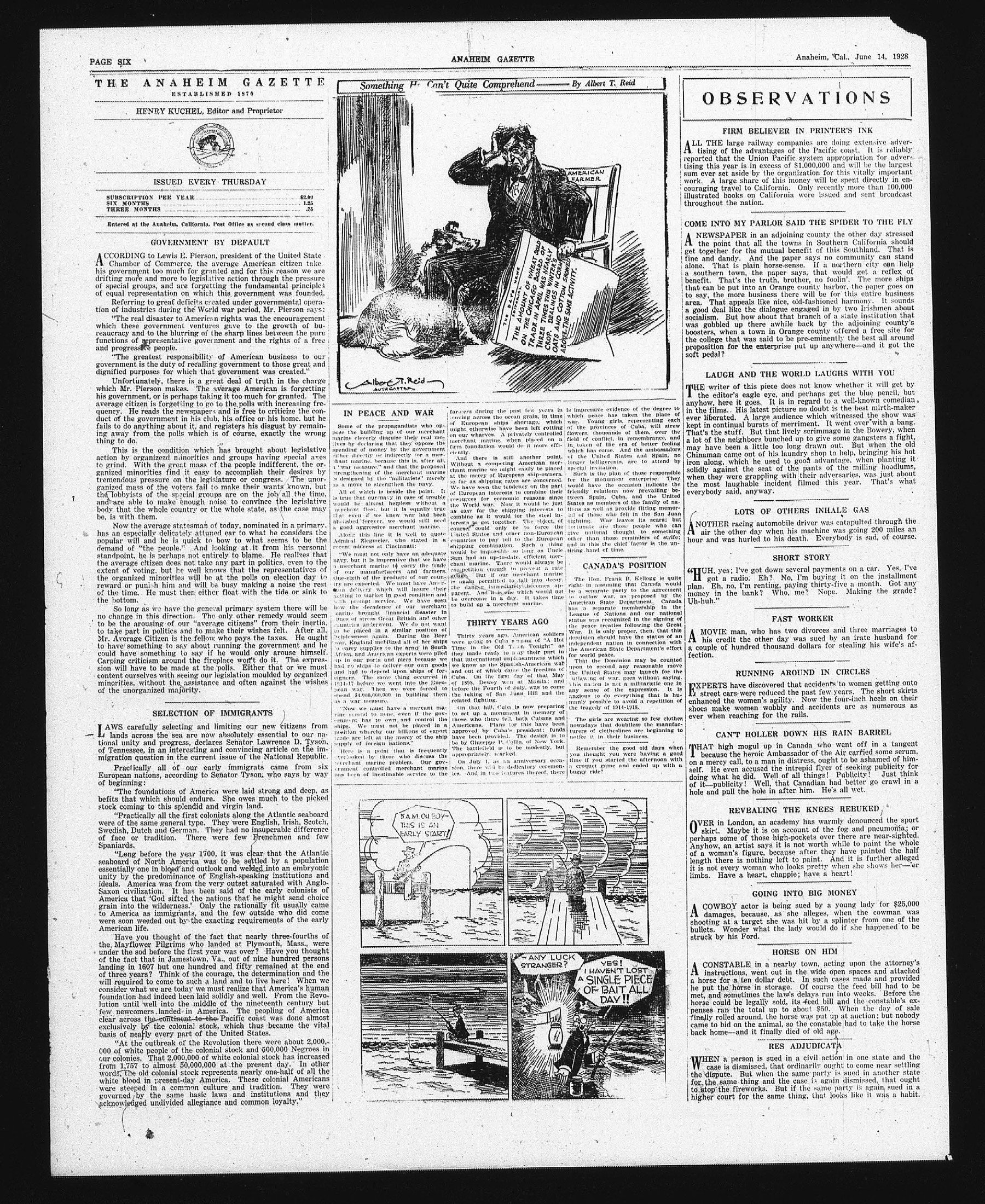
Searchable text
THE ANAHEIM GAZETTE
ESTABLISHED 1870
HENRY KUCHEL, Editor and Proprietor
ISSUED EVERY THURSDAY
SUBSCRIPTION PER YEAR $2.00
SIX MONTHS 1.25
THREE MONTHS .75
Entered at the Anaheim, California, Post Office as second class matter.
GOVERNMENT BY DEFAULT
ACCORDING to Lewis E. Pierson, president of the United State Chamber of Commerce, the average American citizen takes his government too much for granted and for this reason we are drifting more and more to legislative action through the pressure of special groups, and are forgetting the fundamental principles of equal representation on which this government was founded.
Referring to great deficits created under governmental operation of industries during the World war period, Mr. Pierson says:
"The real disaster to American rights was the encouragement which these government ventures gave to the growth of bureaucracy and to the blurring of the sharp lines between the pure functions of representative government and the rights of a free and progressive people.
"The greatest responsibility of American business to our government is the duty of recalling government to those great and dignified purposes for which that government was created."
Unfortunately, there is a great deal of truth in the charge which Mr. Pierson makes. The average American is forgetting his government, or is perhaps taking it too much for granted. The average citizen is forgetting to go to the polls with increasing frequency. He reads the newspapers and is free to criticize the conduct of the government in his club, his office or his home, but he fails to do anything about it, and registers his disgust by remaining away from the polls which is of course, exactly the wrong thing to do.
"The greatest responsibility of American business to our government is the duty of recalling government to those great and dignified purposes for which that government was created."
Unfortunately, there is a great deal of truth in the charge which Mr. Pierson makes. The average American is forgetting his government, or is perhaps taking it too much for granted. The average citizen is forgetting to go to the polls with increasing frequency. He reads the newspapers and is free to criticize the conduct of the government in his club, his office or his home, but he fails to do anything about it, and registers his disgust by remaining away from the polls which is of course, exactly the wrong thing to do.
This is the condition which has brought about legislative action by organized minorities and groups having special axes to grind. With the great mass of the people indifferent, the organized minorities find it easy to accomplish their desires by tremendous pressure on the legislature or congress. The unorganized mass of the voters fail to make their wants known, but the lobbyists of the special groups are on the job all the time, and are able to make enough noise to convince the legislative body that the whole country or the whole state, as the case may be, is with them.
Now the average statesman of today, nominated in a primary, has an especially delicately attuned ear to what he considers the popular will and he is quick to bow to what seems to be the demand of "the people." And looking at it from his personal standpoint, he is perhaps not entirely to blame. He realizes that the average citizen does not take any part in politics, even to the extent of voting, but he well knows that the representatives of the organized minorities will be at the polls on election day to reward or punish him and will be busy making a noise the rest of the time. He must then either float with the tide or sink to the bottom.
So long as we have the general primary system there will be no change in this direction. The only other remedy would seem to be the arousing of our "average citizens" from their inertia, to take part in politics and to make their wishes felt. After all, Mr. Average Citizen is the fellow who pays the taxes. He ought to have something to say about running the government and he could have something to say if he would only arouse himself. Carping criticism around the fireplace won't do it. The expression will have to be made at the polls. Either that or we must content ourselves with seeing our legislation moulded by organized minorities, without the assistance and often against the wishes of the unorganized majority.
SELECTION OF IMMIGRANTS
LAWS carefully selecting and limiting our new citizens from lands across the sea are now absolutely essential to our national unity and progress, declares Senator Lawrence D. Tyson, of Tennessee, in an interesting and convincing article on the immigration question in the current issue of the National Republic.
Practically all of our early immigrants came from six European nations, according to Senator Tyson, who says by way of beginning:
"The foundations of America were laid strong and deep, as befits that which should endure. She owes much to the picked stock coming to this splendid and virgin land.
"Practically all the first colonists along the Atlantic seaboard were of the same general type. They were English, Irish, Scotch, Swedish, Dutch and German. They had no insuperable difference of face or tradition. There were few Frenchmen and few Spaniards."
Practically all of our early immigrants came from six European nations, according to Senator Tyson, who says by way of beginning:
"The foundations of America were laid strong and deep, as befits that which should endure. She owes much to the picked stock coming to this splendid and virgin land.
"Practically all the first colonists along the Atlantic seaboard were of the same general type. They were English, Irish, Scotch, Swedish, Dutch and German. They had no insuperable difference of face or tradition. There were few Frenchmen and few Spaniards.
"Long before the year 1700, it was clear that the Atlantic seaboard of North America was to be settled by a population essentially one in blood and outlook and welded into an embryonic unity by the predominance of English-speaking institutions and ideals. America was from the very outset saturated with Anglo-Saxon civilization. It has been said of the early colonists of America that 'God sifted the nations that he might send choice grain into the wilderness.' Only the rationally fit usually came to America as immigrants, and the few outside who did come were soon weeded out by the exacting requirements of the early American life.
Have you thought of the fact that nearly three-fourths of the Mayflower Pilgrims who landed at Plymouth, Mass., were under the sod before the first year was over? Have you thought of the fact that in Jamestown, Va., out of nine hundred persons landing in 1607 but one hundred and fifty remained at the end of three years? Think of the courage, the determination and the will required to come to such a land and to live here! When we consider what we are today we must realize that America's human foundation had indeed been laid solidly and well. From the Revolution until well into the middle of the nineteenth century but few newcomers landed in America. The peopling of America clear across the continent to the Pacific coast was done almost exclusively by the colonial stock, which thus became the vital basis of nearly every part of the United States.
"At the outbreak of the Revolution there were about 2,000,-000 of white people of the colonial stock and 500,000 Negroes in our colonies. That 2,000,000 of white colonial stock has increased from 1,757 to almost 50,000,000 at the present day. In other words, the old colonial stock represents nearly one-half of all the white blood in present-day America. These colonial Americans were steeped in a common culture and tradition. They were governed by the same basic laws and institutions and they acknowledged undivided allegiance and common loyalty."
Something He Can't Quite Comprehend — By Albert T. Reid
IN PEACE AND WAR
Some of the propagandists who oppose the building up of our merchant marine cleverly disguise their real motives by declaring that they oppose the unpleasantness of money by the government farmers during the past few years in moving across the ocean grain, in time of European ships shortage, which might otherwise have been left rotting on our wharves. A privately controlled merchant marine, when placed on a firm foundation would do it more efficiently is impressive evidence of the degree to which peace has taken the place of war. Young girls, representing each of the provinces of Cuba, will strew flowers, thousands of them, over the field of conflict, in remembrance, and in token of the era of better feeling.
IN PEACE AND WAR
Some of the propagandists who oppose the building up of our merchant marine cleverly disguise their real motives by declaring that they oppose the spending of money by the government either directly or indirectly for a merchant marine, because this is, after all, a "war measure," and that the proposed strengthening of the merchant marine is designed by the "militarists" merely as a move to strengthen the navy.
All of which is beside the point. It is true that our navy in case of trouble would be almost helpless without a merchant fleet, but it is equally true that even if we knew war had been abolished forever, we would still need a good aggressive merchant marine.
Among this line it is well to quote Admiral Ziegmeier, who stated in a recent address at Cincinnati:
"We must not only have an adequate navy, but it is imperative that we have a merchant marine to carry the trade of our manufacturers and farmers. One-sixth of the products of our country are exported. We must have American delivery which will insure their setting to market in good condition and with prompt service. We have seen how the decadence of our merchant marine brought financial disaster in times of stress Great Britain and other countries underwent. We do not want to be placed in a similar position of helplessness again. During the Boer war, England mobilized all of her ships to carry supplies to the army in South Africa, and American exports were piled up in our ports and piers because we had no ships to deliver our own goods and had to depend upon ships of foreigners. The same thing occurred in 1914-17 before we went into the European war. Then we were forced to spend $4,000,000,000 in building them as a war measure.
Now we must have a merchant marine second to none, even if the government has to own and control the ships. We must not be placed in a position whereby our billions of export trade are left at the mercy of the ship supply of foreign nations."
Here is a point that is frequently overlooked by those who discuss the merchant marine problem. Our government controlled merchant marine has been inefficient service to the farmers during the past few years in moving across the ocean grain, in time of European ships shortage, which might otherwise have been left rotting on our wharves. A privately controlled merchant marine, when placed on a firm foundation would do it more efficiently.
And there is still another point. Without a competing American merchant marine we might easily be placed at the mercy of European ship owners. So far as shipping rates are concerned, we have seen the tendency on the part of European interests to combine their resources for economic reasons since the World war. Now it would be just as easy for the shipping interests to combine as it would for the steel interests to get together. The object, of course, could only be to force the United States and other non-European countries to pay toll to the European shipping combination. Such a thing would be impossible so long as Uncle Sam had an up-to-date, efficient merchant marine. But if our merchant marine is again permitted to fall into decay, the danger immediately becomes apparent. And it is one which would not be overcome in a day. It takes time to build up a merchant marine.
THIRTY YEARS AGO
Thirty years ago, American soldiers were going to Cuba sizing up of "A Hot Time in the Old Town Tonight" as they made ready to pay their part in that international unpleasantness which we know as the Spanish-American war and out of which came the freedom of Cuba. On the first day of May 1898, Dewey won at Manila; and before the Fourth of July, was to come the taking of San Juan Hill and the related fighting.
On that July, Cuba is now preparing to set up a monument in memory of those who there fell, both Cubans and Americans. Plans for this have been approved by Cuba's president; funds have been provided. The design is to be by Gluseppe P. Colla, of New York. The battlefield is to be modestly, but appropriately marked.
On July 1, as an anniversary occasion, there will be dedicatory ceremonies. And in two features thereof, there is impressive evidence of the degree to which peace has taken the place of war. Young girls, representing each of the provinces of Cuba, will strew flowers, thousands of them, over the field of conflict, in remembrance, and in token of the era of better feeling which has come. And the ambassadors of the United States and Spain, no longer belligerents, are to attend by special invitation.
Such is the plan of those responsible for the monument enterprise. They would have the occasion indicate the friendly relations now prevailing between Spain, Cuba, and the United States as members of the family of nations as well as provide fitting memorials of those who fell in the San Juan fighting. War leaves its scars; but torturate are those people who can give national thought to something other than those reminders of strife; and in this the chief factor is the uniring hand of time.
CANADA'S POSITION
The Hon. Frank B. Kellogg is quite right in assuming that Canada would be a separate party to the agreement to outlaw war, as proposed by the American State Department. Canada has a separate membership in the League of Nations and our national status was recognized in the signing of the peace treaties following the Great War. It is only proper, then, that this dominion should have the status of an independent nation in connection with the American State Department's effort for world peace.
That the Dominion may be counted upon to second any reasonable move the United States may launch for the outlawing of war, goes without saying. This nation is not a militaristic one in any sense of the expression. It is anxious to do everything that is humanly possible to avoid a repetition of the tragedy of 1914-1918.
The girls are wearing so few clothes nowadays that doubtless the manufacturers of clotheslines are beginning to notice it in their business.
Remember the good old days when you thought you were having a good time if you started the afternoon with a croquet game and ended up with a buggy ride?
from six days by way
and deep, as
the picked
the seaboard
fish, Scotch,
the difference
and few
the Atlantic
population
embryonic
indutions and
with Anglocolonists of
send choice
usually came
so did come
of the early
-fourths of
Mass., were
you thought
fired persons
at the end
ion and the
When we
America's human
in the Revocentury but
of America
alone almost
e the vital
about 2,000,-Negroes in
has increased.
In other
if of all the
Americans
They were
and they
ty."
On July 1, as an anniversary occasion, there will be dedicatory ceremonies. And in two features thereof, there
SA M. OU4 BOYTHIS IS AN
EARLY START!
ANY LUCK
STRANGER?
YES!
I HAVEN'T LOST
A SINGLE PIECE
OF BAIT ALL
DAY!!
OBSERVATIONS
FIRM BELIEVER IN PRINTER'S INK
ALL THE large railway companies are doing extensive advertising of the advantages of the Pacific coast. It is reliably reported that the Union Pacific system appropriation for advertising this year is in excess of $1,000,000 and will be the largest sum ever set aside by the organization for this vitally important work. A large share of this money will be spent directly in encouraging travel to California. Only recently more than 100,000 illustrated books on California were issued and sent broadcast throughout the nation.
COME INTO MY PARLOR SAID THE SPIDER TO THE FLY
A NEWSPAPER in an adjoining county the other day stressed the point that all the towns in Southern California should get together for the mutual benefit of this Southland. That is fine and dandy. And the paper says no community can stand alone. That is plain horse-sense. If a northern city can help a southern town, the paper says, that would get a reflex of benefit. That's the truth, brother, no foolin'. The more ships that can be put into an Orange county harbor, the paper goes on to say, the more business there will be for this entire business area. That appeals like nice, old-fashioned harmony. It sounds a good deal like the dialogue engaged in by two Irishmen about socialism. But how about that branch of a state institution that was gobbled up there awhile back by the adjoining county's boosters, when a town in Orange county offered a free site for the college that was said to be pre-eminently the best all around proposition for the enterprise put up anywhere—and it got the soft pedal?
LAUGH AND THE WORLD LAUGHS WITH YOU
The writer of this piece does not know whether it will get by the editor's eagle eye, and perhaps get the blue pencil, but anyhow, here it goes. It is in regard to a well-known comedian in the films. His latest picture no doubt is the best mirth-maker ever liberated. A large audience which witnessed the show was kept in continual bursts of merriment. It went over with a bang. That's the stuff. But that lively scrimmage in the Bowery, when a lot of the neighbors bunched up to give some gangsters a fight, may have been a little too long drawn out. But when the old
LAUGH AND THE WORLD LAUGHS WITH YOU
THE writer of this piece does not know whether it will get by the editor's eagle eye, and perhaps get the blue pencil, but anyhow, here it goes. It is in regard to a well-known comedian in the films. His latest picture no doubt is the best mirth-maker ever liberated. A large audience which witnessed the show was kept in continual bursts of merriment. It went over with a bang. That's the stuff. But that lively scrimmage in the Bowery, when a lot of the neighbors bunched up to give some gangsters a fight, may have been a little too long drawn out. But when the old Chinaman came out of his laundry shop to help, bringing his hot iron along, which he used to good advantage, when planting it solidly against the seat of the pants of the milling hoodlums, when they were grappling with their adversaries, was just about the most laughable incident filmed this year. That's what everybody said, anyway.
LOTS OF OTHERS INHALE GAS
NOTHER racing automobile driver was catapulted through the air the other day when his machine was going 200 miles an hour and was hurled to his death. Everybody is sad, of course.
SHORT STORY
"HUH, yes; I've got down several payments on a car. Yes, I've got a radio. Eh? No, I'm buying it on the installment plan. Eh, no, I'm renting, paying thirty-five a month. Got any money in the bank? Who, me? Nope. Making the grade? Uh-huh."
FAST WORKER
A MOVIE man, who has two divorces and three marriages to his credit the other day was sued by an irate husband for a couple of hundred thousand dollars for stealing his wife's affection.
RUNNING AROUND IN CIRCLES
EXPERTS have discovered that accidents to women getting onto street cars were reduced the past few years. The short skirts enhanced the women's agility. Now the four-inch heels on their shoes make women wobbly and accidents are as numerous as ever when reaching for the rails.
CAN'T HOLLER DOWN HIS RAIN BARREL
THAT high mogul up in Canada who went off in a tangent because the heroic Ambassador of the Air carried some serum, on a mercy call, to a man in distress, ought to be ashamed of himself. He even accused the intrepid flyer of seeking publicity for doing what he did. Well of all things! Publicity! Just think of it—publicity! Well, that Canadian had better go crawl in a hole and pull the hole in after him. He's all wet.
REVEALING THE KNEES REBUKED
OVER in London, an academy has warmly denounced the sport skirt. Maybe it is on account of the fog and pneumonia; or perhaps some of those high-pockets over there are near-sighted. Anyhow, an artist says it is not worth while to paint the whole
REVEALING THE KNEES REBUKED
OVER in London, an academy has warmly denounced the sport skirt. Maybe it is on account of the fog and pneumonia; or perhaps some of those high-pockets over there are near-sighted. Anyhow, an artist says it is not worth while to paint the whole of a woman's figure, because after they have painted the half length there is nothing left to paint. And it is further alleged it is not every woman who looks pretty when she shows her—er limbs. Have a heart, chappie; have a heart!
GOING INTO BIG MONEY
A COWBOY actor is being sued by a young lady for $25,000 damages, because, as she alleges, when the cowman was shooting at a target she was hit by a splinter from one of the bullets. Wonder what the lady would do if she happened to be struck by his Ford.
HORSE ON HIM
A CONSTABLE in a nearby town, acting upon the attorney's instructions, went out in the wide open spaces and attached a horse for a ten dollar debt. In such cases made and provided he put the horse in storage. Of course the feed bill had to be met, and sometimes the law's delays run into weeks. Before the horse could be legally sold, its feed bill and the constable's expenses ran the total up to about $50. When the day of sale finally rolled around, the horse was put up at auction; but nobody came to bid on the animal, so the constable had to take the horse back home—and it finally died of old age.
RES ADJUDICATA
WHEN a person is sued in a civil action in one state and the case is dismissed, that ordinarily ought to come near settling the dispute. But when the same party is sued in another state for the same thing and the case is again dismissed, that ought to stop the fireworks. But if the same party is again sued in a higher court for the same thing, that looks like it was a habit.