anaheim-gazette 1928-05-10
Scanned page
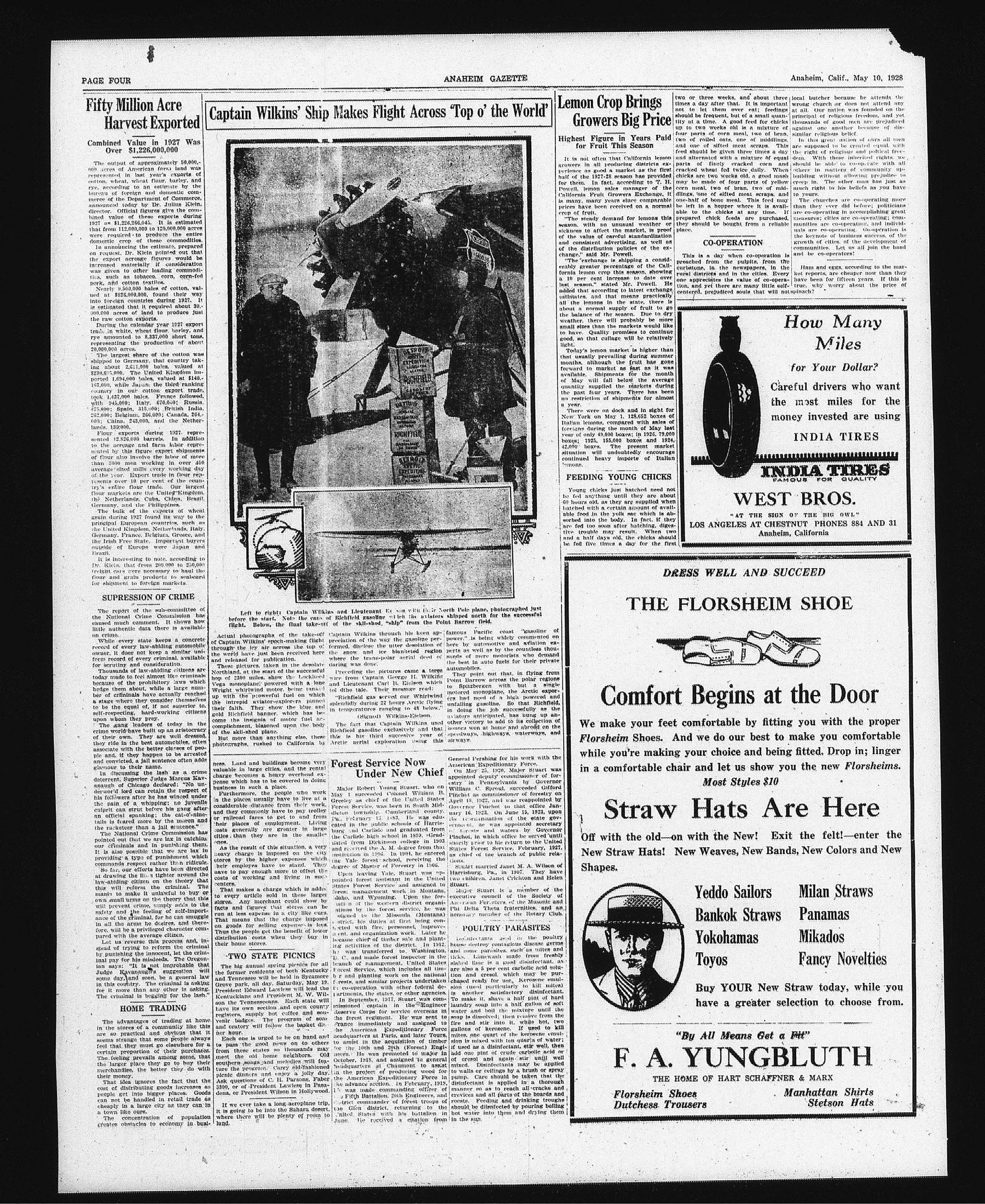
Searchable text
Fifty Million Acre Harvest Exported
Combined Value in 1927 Was Over $1,226,000,000
The output of approximately 50,000,000 acres of American farmland was represented in last year's exports of cotton, wheat, wheat flour, barley, and rye, according to an estimate by the bureau of foreign and domestic commerce of the Department of Commerce, announced today by Dr. Julius Klein, director. Official figures give the combined value of these exports during 1927 as $1,226,266,045. It is estimated that from 112,000,000 to 120,000,000 acres were required to produce the entire domestic crop of these commodities.
In announcing the estimate, prepared on request, Dr. Klein pointed out that the export acreage figures would be increased materially if consideration was given to other leading commodities, such as tobacco, corn, corn-fed pork, and cotton textiles.
Nearly 9,500,000 bales of cotton, valued at $826,000,000, found their way into foreign countries during 1927. It is estimated that it required about 30,000,000 acres of land to produce just the raw cotton exports.
During the calendar year 1927 export trade in white, wheat flour, barley, and rye amounted to 8,337,000 short tons, representing the production of about 20,000,000 acres.
The largest share of the cotton was shipped to Germany, that country taking about 2,611,000 bales, valued at $230,635,000. The United Kingdom imported 1,694,000 bales, valued at $140,-167,000; while Japan; the third-ranking country in our cotton export trade took 1,437,000 bales. France followed with 945,000; Italy, 670,050; Russia. 475,000; Spain, 315,000; British India. 262,000; Belgium, 266,000; Canada, 264,000; China, 243,000; and the Netherlands, 137,000.
Flour exports during 1927 represented 12,826,000 barrels. In addition to the acreage and farm labor repre-
The largest share of the cotton was shipped to Germany, that country taking about 2,611,000 bales, valued at $230,625,000. The United Kingdom imported 1,694,000 bales, valued at $140,-167,000, while Japan; the third-ranking country in our cotton export trade, took 1,437,000 bales. France followed with 945,000; Italy, 670,050; Russia, 475,000; Spain, 315,000; British India, 262,000; Belgium, 266,000; Canada, 264,-000; China, 243,000, and the Netherlands, 132,000.
Flour exports during 1927 represented 12,826,000 barrels. In addition to the average and farm labor represented by this figure export shipments of flour also involve the labor of more than 3000 men working in over 450 average sized mills every working day of the year. Export trade in flour represents over 10 per cent of the country's entire flour trade. Our largest flour markets are the United Kingdom, the Netherlands, Cuba, China, Brazil, Germany, and the Philippines.
The bulk of the exports of wheat grain during 1927 found its way to the principal European countries, such as the United Kingdom, Netherlands, Italy, Germany, France, Belgium, Greece, and the Irish Free State. Important buyers outside of Europe were Japan and Brazil.
It is interesting to note, according to Dr. Klein, that from 200,000 to 250,000 freight cars were necessary to haul the flour and grain products to seaboard for shipment to foreign markets.
SUPPRESSION OF CRIME
The report of the sub-committee of the National Crime Commission has caused much comment. It shows how little authentic data there is available on crime.
While every state keeps a concrete record of every law-abiding automobile owner, it does not keep a similar uniform record of every criminal, available for scrutiny and consideration.
Thousands of law-abiding citizens are today made to feel almost like criminals because of the prohibitory laws which hedge them about, while a large number of criminals have actually reached a stage where they consider themselves to be the equal of, if not superior to, self-respecting, hard-working citizens upon whom they prey.
The gang leaders of today in the crime world have built up an aristocracy of their own. They are well dressed, they ride in the best automobiles, often associate with the better classes of people and, if they happen to be arrested and convicted, a jail sentence often adds glamour to their name.
In discussing the lash as a crime deterrent, Superior Judge Marcus Kavanaugh of Chicago declared: "No underworld lord can retain the respect of his followers after he has winced under the pain of a whipping; no juvenile culprit can strut before his gang after an official spanking; the cat-o-nine-tails is feared more by the moron and the racketeer than a jail sentence."
The National Crime Commission has pointed out that we are lax in catching our criminals and in punishing them.
Actual photographs of the take-off of Captain Wilkins' epoch-making flight through the ley air across the top of the world have just been received here and released for publication.
These pictures taken in the desolate Northland, at the start of the successful hop of 2300 miles, show the Lockheed Vega monoplane powered with a long Wright whirlwind motor being tensed up with the powerful fuel on which the intrepid aviator-explorers panned their faith. They show the blue and gold Richfield banner, which has become the insignia of motor fuel accomplishment, blazoned upon the body of the skil-shod plane.
But more than anything else, these photographs, rushed to California by nature. Land and buildings become very valuable in large cities, and the rental charge becomes a heavy overhead expense which has to be covered in doing business in such a place.
Furthermore, the people who work in the places usually have to live at a considerable distance from their work, and they commonly have to pay trolley or railroad fares to get to and from their places of employment. Living costs generally are greater in large cities than they are in the smaller ones.
As the result of this situation, a very
In discussing the lash as a crime deterrent, Superior Judge Marcus Kavanaugh of Chicago declared: "No underworld'lord can retain the respect of his followers after he has winced under the pain of a whipping; no juvenile culprit can strut before his gang after an official spanking; the cat-o-nine-tails is feared more by the moron and the racketeer than a jail sentence."
The National Crime Commission has pointed out that we are lax in catching our criminals and in punishing them. It is also possible that we are lax in providing a type of punishment which commands respect rather than ridicule.
So far, our efforts have been directed at drawing the lines tighter around the law-abiding citizen on the theory that this will reform the criminal. The man to make it unlawful to buy or own small arms on the theory that this will prevent crime, simply adds to the safety and the feeling of self-importance of the criminal, for he can smuggle in all the arms he desires, and therefore, will be a privileged character compared with the average citizen.
Let us reverse this process and, instead of trying to reform the criminal by punishing the innocent, let the criminal pay for his misdeeds. The Oregonian says: "It is not improbable that Judge Kavanaugh's suggestion will some day, and soon, be a general law in this country. The criminal is asking for it more than any other is asking. The criminal is begging for the lash."
HOME TRADING
The advantages of trading at home in the stores of a community like this are so practical and obvious that it seems strange that some people always feel that they must go elsewhere for a certain proportion of their purchases. The feeling prevails among some, that the larger place they go to buy their merchandise, the better they do with their money.
That idea ignores the fact that the cost of distributing goods increases as people get into bigger places. Goods cannot be handled in retail trade as cheaply in a large city as they can in a town like ours.
The concentration of population creates obstacles to economy in business. Land and buildings become very valuable in large cities, and the rental charge becomes a heavy overhead expense which has to be covered in doing business in such a place.
Furthermore, the people who work in the places usually have to live at a considerable distance from their work, and they commonly have to pay trolley or railroad fares to get to and from their places of employment. Living costs generally are greater in large cities than they are in the smaller ones.
As the result of this situation, a very heavy charge is imposed on the city stores by the higher expenses which their employees have to stand. They have to pay enough more to offset the costs of working and living in success centers.
That makes a charge which is added to every article sold in these larger stores. Any merchant could show by facts and figures that stores can be run at less expense in a city like ours. That means that the charge imposed on goods for selling expense is less. Thus the people get the benefit of lower distribution costs when they buy in their home stores.
TWO STATE PICNICS
The big annual spring picnics for all the former residents of both Kentucky and Tennessee will be held in Sycamore Grove park, all day. Saturday, May 19. President Edward Lawless will lead the Kentuckians and President M. W. Wilson the Tennesseeans. Each state will have its own section and open county registers, supply hot coffee and souvenir badges. The program of some oratory will follow the basket dinner hour.
Each one is urged to be on hand and to pass the good news on to others from these states so thousands may meet the old home neighbors. Old southern songs and melodies will feature the program. Carry old-fashioned picnic dinners and enjoy a jolly day. Ask questions of C. H. Parsons, Faber 3300, or of President Lawless in Pasadena, or President Wilson in Hollywood.
If we ever take a long aeroplane trip, it is going to be into the Sahara desert, where there will be plenty of room to land.
ANAHEIM GAZETTE
Lemon Crop Brings Growers Big Price
Highest Figure in Years Paid for Fruit This Season
It is not often that California lemon growers in all producing districts experience as good a market as the first half of the 1927-28 season has provided for them. In fact, according to T. H. Powell, lemon sales manager of the California Fruit Growers Exchange, it is many, many years since comparable prices have been received on a normal crop of fruit.
"The steady demand for lemons this season, with no unusual weather or sickness to affect the market, is proof of the value of careful standardization and consistent advertising, as well as of the distribution policies of the exchange," said Mr. Powell.
"The exchange is shipping a considerably greater percentage of the California lemon crop this season, showing a 10 per cent increase to date over last season," stated Mr. Powell. He added that according to latest exchange estimates, and that means practically all the lemons in the state, there is about a normal supply of fruit to go the balance of the season. Due to dry weather, there will probably be more small sizes than the markets would like to have. Quality promises to continue good, so that cullage will be relatively light.
Today's lemon market is higher than that usually prevailing during summer months, although the fruit has gone forward to market as fast as it was available. Shipments for the month of May will fall below the average quantity supplied the markets during the past four years. There has been no restriction of shipments for almost a year.
There were on dock and in sight for New York on May 1, 128,652 boxes of Italian lemons, compared with sales of foreigns during the month of May last year of only 49,000 boxes; in 1926, 79,000 boxes; 1925, 155,000 boxes and 1924, 42,000 boxes. The present market
Captain Wilkins and Lieutenant Erson with their North Pole plane, photographed just before the cans of Richfield gasoline which the aviators shipped north for the successful final take-off of the ski-shod, "ship" from the Point Barrow field.
The take-off making flight was the top of received here on. The desolate successful Lockheed with a lone being tanked on which pilots pinned the blue and which has been motor fuel accustomed to the body else, these California by Captain Wilkins through his keen appreciation of the way the gasoline performed, disclose the utter desolation of the snow and ice blaniteted region where the trans-polar aerial deed of daring was done.
Preceding the pictures came a terse wire from Captain George H. Wilkins and Lieutenant Carl B. Eielson which told the tale. Their message read:
"Richfield gas served our Whirlwind splendidly during 22 hours Arctic flying in temperatures ranging to 48 below."
(Signed) Wilkins-Eielson.
The fact that Captain Wilkins used Richfield gas exclusively and that this is his third successive year of Arctic aerial exploration using famous Pacific coast "gasoline of power," is being widely commented on here by automotive and aviation experts as well as by the countless thousands of mere motorists who demand the best in auto fuels for their private automobiles.
They point out that, in flying from Point Barrow across the polar regions to Spitzbergen with but a single-motored monoplane, the Arctic explorers had need of a high powered and unfailing gasoline. So that Richfield, in doing the job successfully as the aviators anticipated, has hung up another victory to add to its collection of honors won at home and abroad on the speedways, highways, waterways, and airways.
Forest Service Now Under New Chief
Major Robert Young Stuart, who on May 1 succeeded Colonel William B. Greeley as chief of the United States Forest Service, was born in South Middleton township, Cumberland county, Pa., February 15, 1883. He was educated in the public schools of Harrisburg and Carlisle and graduated from the Carlisle high school in 1899. Graduated from Dickinson college in 1903 and received the A.M. degree from that General Pershing for his work with the American Expeditionary Force.
On May 25, 1920, Major Stuart was appointed deputy commissioner of forestry in Pennsylvania by Governor William C. Sprout, succeeded Gifford Pinchot as commissioner of forestry on April 18, 1922, and was reappointed by Governor Pinchot to that office January 16, 1923. On June 15, 1923, upon the reorganization of the state government, he was appointed secretary of forests and waters by Governor Pinchot, in which office he served until shortly prior to his return to the United States Forest Service, February, 1927.
FEEDING YOUNG CHICKS
Young chicks just hatched need not be fed anything until they are about 60 hours old, as they are supplied when hatched with a certain amount of available food in the yolk sac which is absorbed into the body. In fact, if they are fed too soon after hatching, digestive trouble may result. When two and a half days old, the chicks should be fed five times a day for the first Comfort
We make your feet comfortable Florsheim Shoes. And while you're making you in a comfortable chair Straw Off with the old—on w
Forest Service Now Under New Chief
Major Robert Young Stuart, who on May 1 succeeded Colonel William B. Greeley as chief of the United States Forest Service, was born in South Middleton township, Cumberland county, Pa., February 15, 1883. He was educated in the public schools of Harrisburg and Carlisle and graduated from the Carlisle high school in 1899. Graduated from Dickinson college in 1903 and received the A.M. degree from that institution in 1904. In 1904, he entered the Yale forest school, receiving the degree of Master of Forestry in 1906.
Upon leaving Yale, Stuart was appointed forest assistant in the United States Forest Service and assigned to forest management work in Montana, Idaho, and Wyoming. Upon the formation of the western district organizations by the forest service, he was assigned to the Missoula (Montana) district, his duties at first being connected with fire, personnel, improvement, and organization work. Later he became chief of timber sale and planting activities of the district. In 1912, he was transferred to Washington, D.C., and made forest inspector in the branch of management, United States Forest Service, which includes all timber and planting work on the national forests, and similar projects undertaken in cooperation with other federal departments, the states, or other agencies.
In September, 1917, Stuart was commissioned captain in the Engineer Reserve Corps for service overseas in the forest regiment. He was sent to France immediately and assigned to the American Expeditionary Force headquarters at Paris, and later Tours, to assist in the acquisition of timber for the 10th and 20th (Forest) Engineers. He was promoted to major in October, 1918, and assigned to general headquarters at Chaumont to assist in the project of producing wood for the American Expeditionary Force in the advance section. In February, 1919, he was made commanding officer of Fifth Battalion, 20th Engineers, and district commander of forest troops of Tao Glen district, returning to the United States with his battalion in June. He received a citation from General Pershing for his work with the American Expeditionary Force.
On May 25, 1920, Major Stuart was appointed deputy commissioner of forestry in Pennsylvania by Governor William C. Sproul, succeeded Gifford Pinchot as commissioner of forestry on April 18, 1922, and was reappointed by Governor Pinchot to that office January 16, 1923. On June 15, 1923, upon the reorganization of the state government, he was appointed secretary of forests and waters by Governor Pinchot, in which office he served until shortly prior to his return to the United States Forest Service, February 1927, as chief of the branch of public relations.
Stuart married Janet M. A. Wilson of Harrisburg, Pa., in 1907. They have two children, Janet Crichton and Helen Stuart.
Major Stuart is a member of the executive council of the Society of American Foresters, of the Masonic and Phi Delta Theta fraternities, and an honorary member of the Rotary Club.
POULTRY PARASITES
Doinfectants used in the poultry house destroy contagious disease germs and some parasites, such as mites and ticks. Limewash made from freshly slaked lime is a good disinfectant, as are also a 5 per cent carbolic acid solution and cresol, which may be purchased ready for use. Kerosene emulsion (used particularly to kill mites) is another satisfactory disinfectant. To make it, shave a half pint of hard laundry soap into a half gallon of soft water and boil the mixture until the soap is dissolved; then remove from the fire and stir into it, while hot, two gallons of kerosene. If used to kill mites, one quart of the kerosene emulsion is mixed with ten quarts of water; if used as a disinfectant, stir well, then add one pint of crude carbolic acid or of cresol and again stir until well mixed. Disinfectants may be applied to walls or ceilings by a brush or spray pump. Care should be taken that the disinfectant is applied in a thorough manner so as to reach all cracks and crevices and all parts of the boards and roosts. Feeding and drinking troughs should be disinfected by pouring boiling hot water into them and drying them in the sun.
Anaheim, Calif., May 10, 1928
Top Brings Big Price
In Years Paid This Season
At California lemon producing districts ex-market as the first season has provided according to T. H. the manager of the Powers Exchange. It is since comparable received on a normal and for lemons this unusual weather or the market, is proofful standardization artising, as well as policies of the ex-owell.
Shipping a consid-antage of the Cali-licia season, showing ease to date over Mr. Powell. He to latest exchange means practically the state, there is plenty of fruit to go season. Due to dry probably be more markets would like promises to continue we will be relatively market is higher than during summer the fruit has gone as fast as it was for the month below the average the markets during seasons. There has been equipments for almost clock and in sight for 1,128,652 boxes of prepared with sales of month of May last boxes; in 1926,79,000 100 boxes and 1924, the present market two or three weeks, and about three times a day after that. It is important not to let them over eat; feedings should be frequent, but of a small quantity at a time. A good feed for chicks up to two weeks old is a mixture of four parts of corn meal, two of bran, two of rolled oats, one of middlings, and one of sifted meat scraps. This feed should be given three times a day and alternated with a mixture of equal parts of finely cracked corn and cracked wheat fed twice daily. When chicks are two weeks old, a good mash may be made of four parts of yellow corn meal, two of bran, two of middlings, one of sifted meat scraps, and one-half of bone meal. This feed may be left in a hopper where it is available to the chicks at any time. If prepared chick feeds are purchased, they should be bought from a reliable place.
CO-OPERATION
This is a day when co-operation is preached from the pulpits, from the curbstone, in the newspapers, in the rural districts and in the cities. Every one appreciates the value of co-operation, and yet there are many little self-centered, prejudiced souls that will not spinach?
Ham and eggs, according to the market reports, are cheaper now than they have been for fifteen years. If this is true, why worry about the price of spinach?
for Your Dollar?
Careful drivers who want the most miles for the money invested are using
INDIA TIRES
INDIA TIRES
FAMOUS FOR QUALITY
WEST BROS.
"AT THE SIGN OF THE BIG Owl"
LOS ANGELES AT CHESTNUT PHONES 884 AND 31
Anaheim, California
DRESS WELL AND SUCCEED
THE FLORSHEIM SHOE
Comfort Begins at the Door
Make your feet comfortable by fitting you with the proper
Shoes. And we do our best to make you comfortable
you're making your choice and being fitted. Drop in; linger
comfortable chair and let us show you the new Florsheims.
Most Styles $10
Straw Hats Are Here
In the old—on with the New! Exit the felt!—enter the
comfortable chair and let us show you the new Florsheims.
Most Styles $10
Straw Hats Are Here
with the old—on with the New! Exit the felt!—enter the
straw Hats! New Weaves, New Bands, New Colors and New
Yeddo Sailors Milan Straws
Bankok Straws Panamas
Yokohamas Mikados
Toyos Fancy Novelties
Buy YOUR New Straw today, while you
have a greater selection to choose from.
"By All Means Get a Fit"
F. A. YUNGBLUTH
THE HOME OF HART SCHAFFNER & MARX
Florsheim Shoes Manhattan Shirts
Outchess Trousers Stetson Hats