anaheim-gazette 1928-04-26
Scanned page
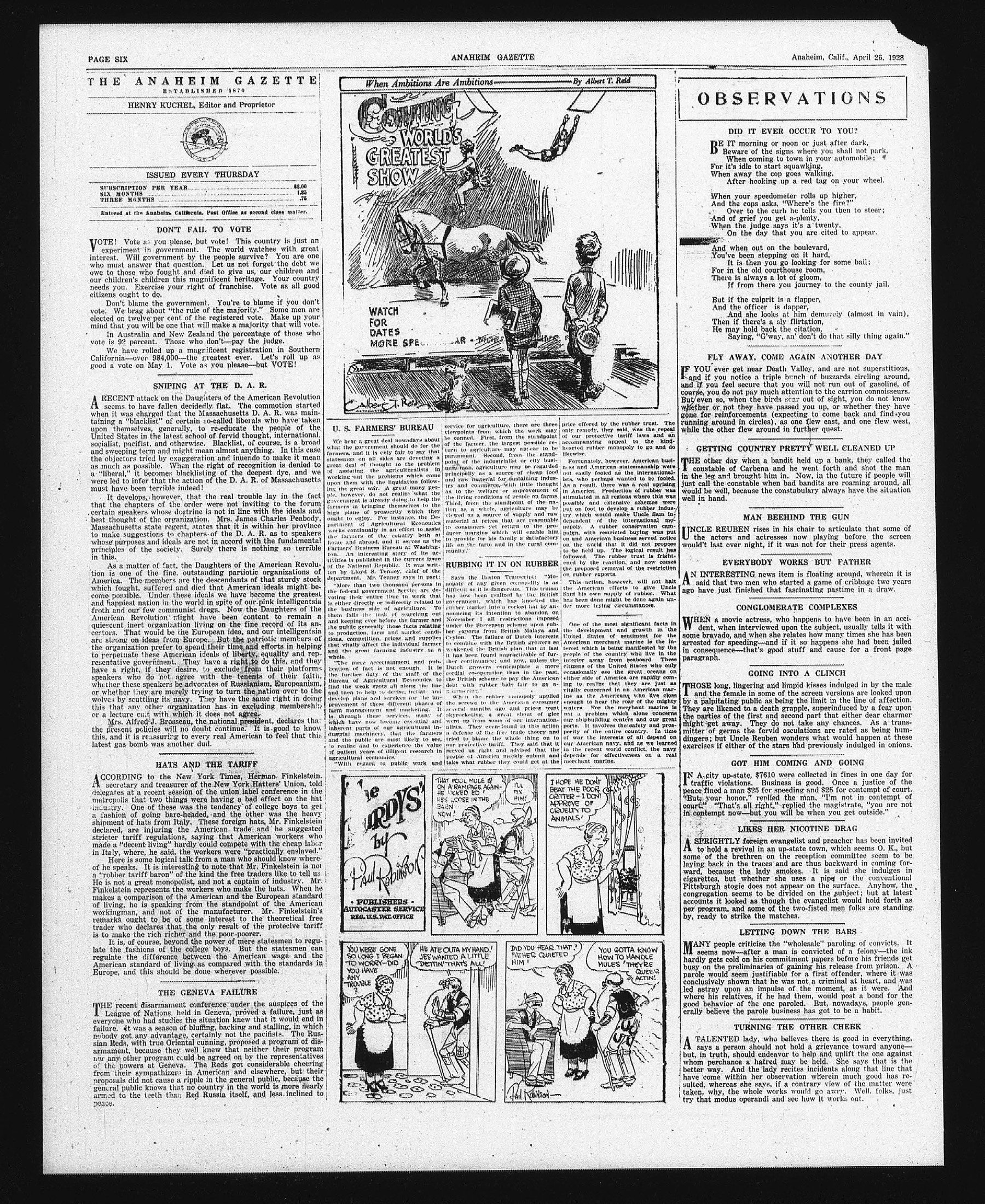
Searchable text
THE ANAHEIM GAZETTE
ESTABLISHED 1870
HENRY KUCHEL, Editor and Proprietor
ISSUED EVERY THURSDAY
SUBSCRIPTION PER YEAR.....$2.00
SIX MONTHS.....1.25
THREE MONTHS......75
Entored at the Anaheim, California, Post Office as second class matter.
DON'T FAIL TO VOTE
VOTE! Vote as you please, but vote! This country is just an experiment in government. The world watches with great interest. Will government by the people survive? You are one who must answer that question. Let us not forget the debt we owe to those who fought and died to give us, our children and our children's children this magnificent heritage. Your country needs you. Exercise your right of franchise. Vote as all good citizens ought to do.
Don't blame the government. You're to blame if you don't vote. We brag about "the rule of the majority." Some men are elected on twelve per cent of the registered vote. Make up your mind that you will be one that will make a majority that will vote.
In Australia and New Zealand the percentage of those who vote is 92 percent. Those who don't—pay the judge.
We have rolled up a magnificent registration in Southern California—over 984,000—the greatest ever. Let's roll up as good a vote on May 1. Vote as you please—but VOTE!
SNIPING AT THE D. A. R.
A RECENT attack on the Daughters of the American Revolution seems to have fallen decidedly flat. The commotion started when it was charged that the Massachusetts D. A. R. was maintaining a "blacklist" of certain so-called liberals who have taken upon themselves, generally, to re-educate the people of the United States in the latest school of fervid thought, international, socialist, pacifist, and otherwise. Blacklist, of course, is a broad
SNIPING AT THE D. A. R.
A RECENT attack on the Daughters of the American Revolution seems to have fallen decidedly flat. The commotion started when it was charged that the Massachusetts D. A. R. was maintaining a "blacklist" of certain so-called liberals who have taken upon themselves, generally, to re-educate the people of the United States in the latest school of fervid thought, international, socialist, pacifist, and otherwise. Blacklist, of course, is a broad and sweeping term and might mean almost anything. In this case the objectors tried by exaggeration and inuendo to make it mean as much as possible. When the right of recognition is denied to a "liberal," it becomes blacklisting of the deepest dye, and we were led to infer that the action of the D. A. R. of Massachusetts must have been terrible indeed!
It develops, however, that the real trouble lay in the fact that the chapters of the order were not inviting to the forum certain speakers whose doctrine is not in line with the ideals and best thought of the organization. Mrs. James Charles Peabody, Massachusetts state regent, states that it is within her province to make suggestions to chapters of the D. A. R. as to speakers whose purposes and ideals are not in accord with the fundamental principles of the society. Surely there is nothing so terrible in this.
As a matter of fact, the Daughters of the American Revolution is one of the fine, outstanding partiotic organizations of America. The members are the descendants of that sturdy stock which fought, suffered and died that American ideals might become possible. Under these ideals we have become the greatest and happiest nation in the world in spite of our pink intelligentsia froth and our few communist dregs. Now the Daughters of the American Revolution might have been content to remain a quiescent inert organization living on the fine record of its ancestors. That would be the European idea, and our intelligentsia are strong on ideas from Europe. But the patriotic members of the organization prefer to spend their time and efforts in helping to perpetuate these American ideals of liberty, equality and representative government. They have a right to do this, and they have a right, if they desire, to exclude from their platforms speakers who do not agree with the tenents of their faith, whether these speakers be advocates of Russianism, Europeanism, or whether they are merely trying to turn the nation over to the wolves by scuttling its navy. They have the same right in doing this that any other organization has in excluding membership or a lecture cult with which it does not agree.
Mrs. Alfred J. Brosseau, the national president, declares that the present policies will no doubt continue. It is good to know this, and it is reassuring to every real American to feel that this latest gas bomb was another dud.
HATS AND THE TARIFF
ACCORDING to the New York Times, Herman Finkelstein, secretary and treasurer of the New York Hatters' Union, told delegates at a recent session of the union label conference in the metropolis that two things were having a bad effect on the hat industry. One of these was the tendency of college boys to get a fashion of going bare-headed, and the other was the heavy shipment of hats from Italy. These foreign hats, Mr. Finkelstein declared, are injuring the American trade and he suggested stricter tariff regulations, saying that American workers who made a "decent living" hardly could compete with the cheap labor
HATS AND THE TARIFF
ACCORDING to the New York Times, Herman Finkelstein, secretary and treasurer of the New York Hatters' Union, told delegates at a recent session of the union label conference in the metropolis that two things were having a bad effect on the hat industry. One of these was the tendency of college boys to get a fashion of going bare-headed, and the other was the heavy shipment of hats from Italy. These foreign hats, Mr. Finkelstein declared, are injuring the American trade and he suggested stricter tariff regulations, saying that American workers who made a "decent living" hardly could compete with the cheap labor in Italy, where, he said, the workers were "practically enslaved."
Here is some logical talk from a man who should know where-of he speaks. It is interesting to note that Mr. Finkelstein is not a "robber tariff baron" of the kind the free traders like to tell us. He is not a great monopolist, and not a captain of industry. Mr. Finkelstein represents the workers who make the hats. When he makes a comparison of the American and the European standard of living, he is speaking from the standpoint of the American workingman, and not of the manufacturer. Mr. Finkelstein's remarks ought to be of some interest to the theoretical free trader who declares that the only result of the protecive tariff is to make the rich richer and the poor poorer.
It is, of course, beyond the power of mere statesmen to regulate the fashions of the college boys. But the statesmen can regulate the difference between the American wage and the American standard of living as compared with the standards in Europe, and this should be done wherever possible.
THE GENEVA FAILURE
The recent disarmament conference under the auspices of the League of Nations, held in Geneva, proved a failure, just as everyone who had studies the situation knew that it would end in failure. It was a season of bluffing, backing and stalling, in which nobody got any advantage, certainly not the pacifists. The Russian Reds, with true Oriental cunning, proposed a program of disarmament, because they well knew that neither their program nor any other program could be agreed on by the representatives of the powers at Geneva. The Reds got considerable cheering from their sympathizers in American and elsewhere, but their proposals did not cause a ripple in the general public, because the general public knows that no country in the world is more nearly armed to the teeth than Red Russia itself, and less inclined to peace.
When Ambitions Are Ambitions By Albert T. Reid
COMING WORLD'S GREATEST SHOW
WATCH FOR DATES MORE SPECIAL
U. S. FARMERS' BUREAU
We hear a great deal nowadays about what the government should do for the service for agriculture, there are three viewpoints from which the work may be conned. First, from the standpoint of the farmer, the largest possible return to agriculture may appear to be price offered by the rubber trust. The only remedy, they said, was the repeal of our protective tariff laws and an accompanying appeal to the kind-hearted rubber monopoly to go and do
U. S. FARMERS' BUREAU
We hear a great deal nowadays about what the government should do for the farmers, and it is only fair to say that statesmen on all sides are devoting a great deal of thought to the problem of assisting the agriculturalists in working out the problems which came upon them with the liquidation following the great war. A great many people, however, do not realize what the government is already doing to help the farmers in bringing themselves to the high plane of prosperity which they ought to enjoy. For instance, the Department of Agricultural Economics works continually in an effort to assist the farmers of the country both at home and abroad, and it serves as the Farmers' Business Bureau at Washington. An interesting story of its activities is published in the current issue of the National Republic. It was written by Lloyd S. Tenney, chief of the department. Mr. Tenney says in part:
"More than two thousand persons in the federal government service are devoting their entire time to work that is either directly or indirectly related to the business side of agriculture. To them falls the task of searching out and keeping ever before the farmer and the public generally those facts relating to production, farm and market conditions, competition, prices and supplies that vitally affect the individual farmer and the great farming industry as a whole.
"The mere ascertainment and publication of fact is not enough. It is further duty of the staff of the Bureau of Agricultural Economics to find the weak spots all along the line and then to help to devise, initiate and develop plans and services for the improvement of these different phases of farm management and marketing. It is through these services, many of which have now become essential and inherent parts of our agricultural industrial machinery, that the farmers and the public are most likely to see, to realize and to experience the value of patient years of diligent research in agricultural economics."
With regard to public work and service for agriculture, there are three viewpoints from which the work may be conned. First, from the standpoint of the farmer, the largest possible return to agriculture may appear to be paramount. Second, from the standpoint of the industrialist or city business man, agriculture may be regarded principally as a source of cheap food and raw material for sustaining industry and commerce, with little thought as to the welfare or improvement of the living conditions of people on farms. Third, from the standpoint of the nation as a whole, agriculture may be viewed as a source of supply and raw material at prices that are reasonable to consumers yet return to the producer margins which will enable him to provide for his family a satisfactory life on the farm and in the rural community."
RUBBING IT IN ON RUBBER
Says the Boston Transcript: "Monopoly of any given commodity is as difficult as it is dangerous. This trivial has now been realized by the British government, which has knocked the rubber market into a cocked hat by announcing its intention to abandon on November 1 all restrictions imposed under the Stevenson scheme upon rubber exports from British Malaya and Ceylon. The failure of Dutch interests to combine with the British growers so weakened the British plan that at last it has been found impracticable of further continuance; and now, unless the Dutch growers contemplate a more cordial co-operation than in the past, the British scheme to pay the American debt with rubber bids fair to go against."
When the rubber monopoly applied the serews to the American consumer several months ago and prices went skyrocketing, a great shout of glee went up from some of our internationalists. They even found in this action a defense of the free trade theory and tried to blame the whole thing on to our protective tariff. They said that it served us right and advised that the people of America weekly submit and take what rubber they could get at the price offered by the rubber trust. The only remedy, they said, was the repeal of our protective tariff laws and an accompanying appeal to the kind-hearted rubber monopoly to go and do likewise.
Fortunately, however, American business and American statemanship were not easily fooled as the internationalists, who perhaps wanted to be fooled. As a result, there was a real uprising in America. Production of rubber was stimulated in all regions where this was possible and extensive schemes were put on foot to develop a rubber industry which would make Uncle Sam independent of the international monopoly. A rubber conservation campaign, with restricted buying was put on and American business served notice on the world that it did not propose to be held up. The logical result has followed. The rubber trust is frightened by the reaction, and now comes the proposed removal of the restriction on rubber exports.
This action, however, will not halt the American efforts to give Uncle Sant's own supply of rubber. What has been done might be done again under more trying circumstances.
One of the most significant facts in the development and growth in the United States of sentiment for the American merchant marine is the interest which is being manifested by the people of the country who live in the interior away from seaboard. These citizens of the United States who only occasionally see the great oceans on either side of America are rapidly coming to realize that they are just as vitally concerned in an American marine as the Americans who live close enough to hear the roar of the mighty waters. For the merchant marine is not a problem which alone concerns our shipbuilding centers and our great ports. It involves the safety and prosperity of the entire country. In time of war the interests of all depend on our American navy, and as we learned in the recent world conflict, the navy depends for effectiveness on a real merchant marine.
The Murders by Paul Robinson
PUBLISHERS - AUTOCASTER SERVICE
REG. U.S. PAT. OFFICE
THAT POOL MULE IS ON A RAMPIAGE AGAIN-HE LOCKED ED'HES LOOSE IN THE BARN NOW!
I'll fix him!
I HOPE HE DON'T BEAT THE POOR CRITTER-I DON'T APPROVE OF CRUELTY TO ANIMALS!
YOU WERE GONE SO LONG I BEGAN TO WORRY-DID YOU HAVE ANY TROUBLE?
HE ATE OUTA MY HAND! JES'S WANTED A LITTLE DETTIN' THAT'S ALL!
DID YOU HEAR THAT? FATHER QUIETED HIM!
YOU GOTTA KNOW HOW TO HANDLE MULES 'THEY'RE QUEEN ACTIN!
Paul Robinson
OBSERVATIONS
DID IT EVER OCCUR TO YOU?
BE IT morning or noon or just after dark,
Beware of the signs where you shall not park,
When coming to town in your automobile;
For it's idle to start squawking,
When away the cop goes walking,
After hooking up a red tag on your wheel.
When your speedometer rolls up higher,
And the cops asks, "Where's the fire?"
Over to the curb he tells you then to steer;
And of grief you get a-plenty,
When the judge says it's a twenty,
On the day that you are cited to appear.
And when out on the boulevard,
You've been stepping on it hard,
It is then you go looking for some bail;
For in the old courthouse room,
There is always a lot of gloom,
If from there you journey to the county jail.
But if the culprit is a flapper,
And the officer is dapper,
And she looks at him demurcibly (almost in vain),
Then if there's a sly flirtation,
He may hold back the citation,
Saying, "G'way, an' don't do that silly thing again."
FLY AWAY, COME AGAIN ANOTHER DAY
IF YOU ever get near Death Valley, and are not superstitious,
and if you notice a triple bunch of buzzards circling around,
and if you feel secure that you will not run out of gasoline, of course, you do not pay much attention to the carrion connoisseurs.
But even so, when the birds scar out of sight, you do not know whether or not they have passed you up, or whether they have gone for reinforcements (expecting to come back and find you running around in circles), as one flew east, and one flew west, while the other flew around in further quest.
FLY AWAY, COME AGAIN ANOTHER DAY
IF YOU ever get near Death Valley, and are not superstitious,
and if you notice a triple bunch of buzzards circling around,
and if you feel secure that you will not run out of gasoline, of course, you do not pay much attention to the carrion connoisseurs.
But even so, when the birds scar out of sight, you do not know whether or not they have passed you up, or whether they have gone for reinforcements (expecting to come back and find you running around in circles), as one flew east, and one flew west, while the other flew around in further quest.
GETTING COUNTRY PRETTY WELL CLEANED UP
THE other day when a bandit held up a bank, they called the constable of Carbena and he went forth and shot the man in the leg and brought him in. Now, in the future if people will just call the constable when bad bandits are roaming around, all would be well, because the constabulary always have the situation well in hand.
MAN BEEHIND THE GUN
UNCLE REUBEN rises in his chair to articulate that some of the actors and actresses now playing before the screen wouldn't last over night, if it was not for their press agents.
EVERYBODY WORKS BUT FATHER
AN INTERESTING news item is floating around, wherein it is said that two men who started a game of cribbage two years ago have just finished that fascinating pastime in a draw.
CONGLOMERATE COMPLEXES
WHEN a movie actress, who happens to have been in an accident, when interviewed upon the subject, usually tells it with some bravado, and when she relates how many times she has been arrested for speeding—and if it so happens she had been jailed in consequence—that's good stuff and cause for a front page paragraph.
GOING INTO A CLINCH
THOSE long, lingering and limpid kisses indulged in by the male and the female in some of the screen versions are looked upon by a palpitating public as being the limit in the line of affection. They are likened to a death grapple, superinduced by a fear upon the parties of the first and second part that either dear charmer might get away. They do not take any chances. As a transmitter of germs the fervid osculations are rated as being humdinger; but Uncle Reuben wonders what would happen at these exercises if either of the stars had previously indulged in onions.
GOT HIM COMING AND GOING
IN A city up-state, $7610 were collected in fines in one day for traffic violations. Business is good. Once a justice of the peace fined a man $25 for speeding and $25 for contempt of court. "But your honor," replied the man, "I'm not in contempt of court." "That's all right," replied the magistrate, "you are not in contempt now—but you will be when you get outside."
LIKES HER NICOTINE DRAG
AS PRIGHTLY foreign evangelist and preacher has been invited to hold a revival in an up-state town, which seems O.K., but
GOT HIM COMING AND GOING
IN A city up-state, $7610 were collected in fines in one day for traffic violations. Business is good. Once a justice of the peace fined a man $25 for speeding and $25 for contempt of court. "But, your honor," replied the man, "I'm not in contempt of court." "That's all right," replied the magistrate, "you are not in contempt now—but you will be when you get outside."
LIKES HER NICOTINE DRAG
ASPRIGHTLY foreign evangelist and preacher has been invited to hold a revival in an up-state town, which seems O. K., but some of the brethren on the reception committee seem to be laying back in the traces and are thus backward in coming forward, because the lady smokes. It is said she indulges in cigarettes, but whether she uses a pipe or the conventional Pittsburgh stogie does not appear on the surface. Anyhow, the congregation seems to be divided on the subject; but at latest accounts it looked as though the evangelist would hold forth as per program, and some of the two-fisted men folks are standing by, ready to strike the matches.
LETTING DOWN THE BARS
MANY people criticise the "wholesale" paroling of convicts. It seems now—after a man is convicted of a felony—the ink hardly gets cold on his commitment papers before his friends get busy on the preliminaries of gaining his release from prison. A parole would seem justifiable for a first offender, where it was conclusively shown that he was not a criminal at heart, and was led astray upon an impulse of the moment, as it were. And where his relatives, if he had them, would post a bond for the good behavior of the one paroled. But, nowadays, people generally believe the parole business has got to be a habit.
TURNING THE OTHER CHEEK
TALEENTED lady, who believes there is good in everything, says a person should not hold a grievance toward anyone—but, in truth, should endeavor to help and uplift the one against whom perchance a hatred may be held. She says that is the better way. And the lady recites incidents along that line that have come within her observation wherein much good has resulted, whereas she says, if a contrary view of the matter were taken, why, the whole works would go awry. Well, folks, just try that modus operandi and see how it works out.