anaheim-gazette 1928-04-26
Scanned page
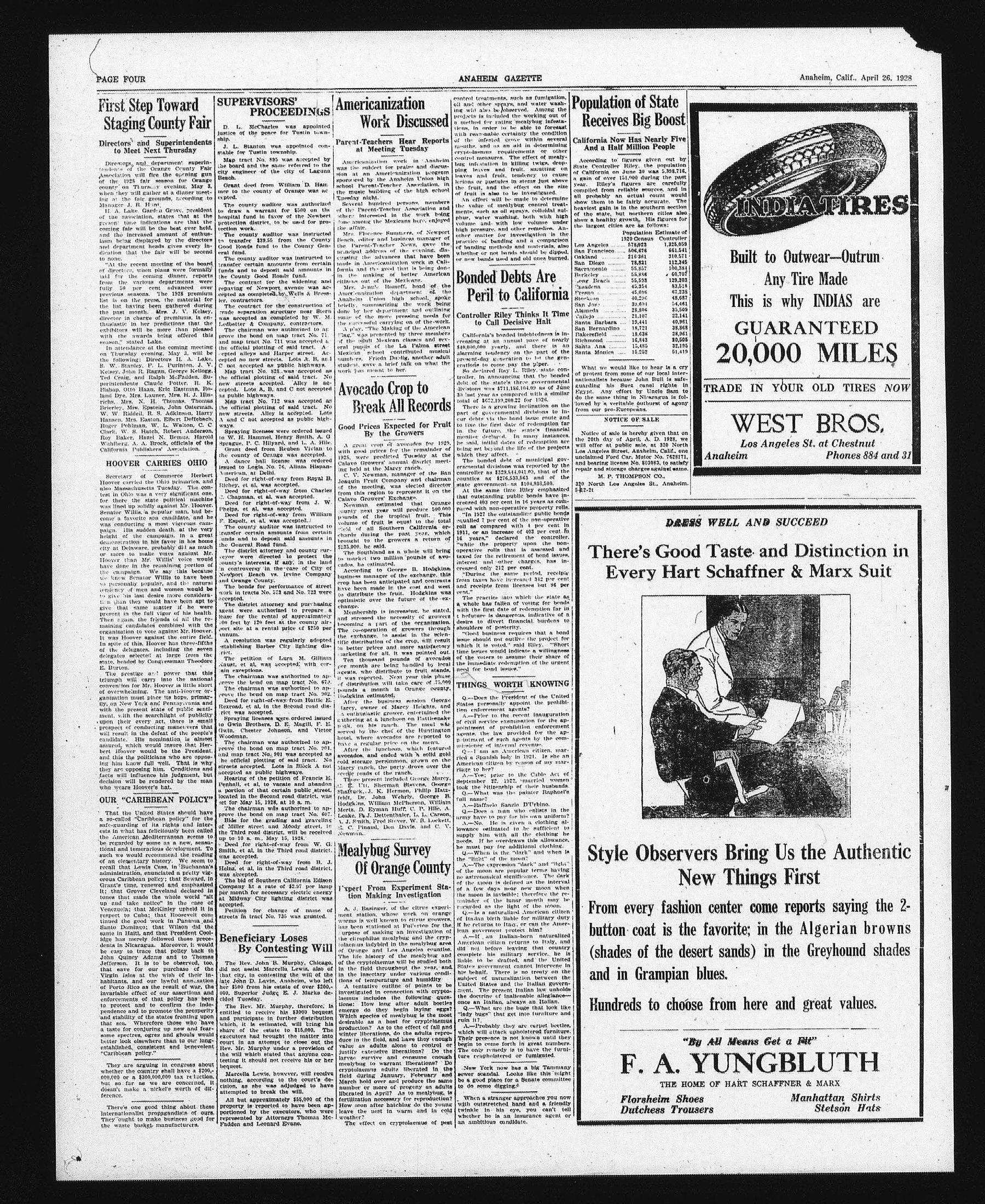
Searchable text
First Step Toward Staging County Fair
Directors and Superintendents to Meet Next Thursday
Directors, and department superintendents of the Orange County Fair Association will fire the opening gun of the 1928 fair season for Orange county on Thursday evening, May 3, when they will gather at a dinner meeting at the fair grounds, according to Manager J. R. Hunt.
H. A. Lake Garden Grove, president of the association, states that at the present time indications are that the coming fair will be the best ever held, and the increased amount of enthusiasm being displayed by the directors and department heads gives every indication that the fair will be second to none.
"At the recent meeting of the board of directors, when plans were formally laid for the coming dinner, reports from the various departments were fully 50 per cent advanced over previous seasons. The 1928 premium list is on the press, the material for the list having been gathered during the past month. Mrs. J. V. Kelsey, director in charge of premiums, is enthusiastic in her predictions that the exhibitors will be more than pleased with the awards being offered this season," stated Lake.
In attendance at the coming meeting on Thursday evening, May 3, will be the following: Directors H. A. Lake S. W. Stanley, F. L. Purinton, J. V. Kelsey, John R. Ragan, George Kellogg, Ted Craig, and Ralph McFadden. Superintendents Claudie Potter, R. K. Bishop, Otto Haan, Eric Eastman, Roland Dye, Mrs. Launer, Mrs. H. J. Hinrichs, Mrs. N. H. Thomas, Thomas Brierley, Mrs. Epatein, John Osterman, W. W. Riddeil, R. S. Adkinson, Harry Hansen, Mrs. Easton, Elbert Deffebach, Roger Pohlman, W. L. Waiton, C. C Clark, W. S. Hatch, Robert Anderson, Roy Baker, Hazel N. Bernus, Harold Wahlberg, A. A. Brock, officials of the California Association.
SUPERVISORS' PROCEEDINGS
D. L. McCharles was appointed justice of the peace for Tustin township.
J. L. Stanton was appointed constable for Tustin township.
Map tract No. 895 was accepted by the board and the same referred to the city engineer of the city of Laguna Beach.
Grant deed from William D. Hammer to the county of Orange was accepted.
The county auditor was authorized to draw a warrant for $500 on the hospital fund in favor of the Newbert protection district, to be used for protection work.
The county auditor was instructed to transfer $39.55 from the County Good Roads fund to the County General fund.
The county auditor was instructed to transfer certain amounts from certain funds and to deposit said amounts in the County Good Roads fund.
The contract for the widening and repaving of Newport avenue was accepted as completed by Wells & Bressler, contractors.
The contract for the construction of trade separation structure near Stern was accepted as completed by W. M. Ledbetter & Company, contractors.
The chairman was authorized to approve the bond on map tract No. 71 and map tract No. 711 was accepted as the official plotting of said tract. Accepted alleys and Harper street. Accepted no new streets. Lots A, B, and C not accepted as public highways.
Map tract No. 828 was accepted as the official plotting of said tract. No new streets accepted. Alley is accepted. Lots A, B, and C not accepted as public highways.
Map tract No. 712 was accepted as the official plotting of said tract. No new streets. Alley is accepted. Lots A and C not accepted as public highways.
Spraying licenses were ordered issued to W. Hammel, Henry Smith, A. G. Sprague, P. C. Hilyard, and L. A. Hile.
Grant deed from Reuben Visiancio
HOOVER CARRIES OHIO
Secretary of Commerce Herbert Hoover carried the Ohio primaries, and also Massachusetts Tuesday. The contest in Ohio was a very significant one, for there the state political machine was lined up solidly against Mr. Hoover. Senator Willis, a popular man, had become a favorite son candidate, and he was conducting a most vigorous campaign. His sudden death at the very height of the campaign, in a great demonstration in his favor in his home city at Delaware, probably did as much or more to make votes against Mr. Hoover than Mr. Willis' voice would have done in the remaining portion of the campaign. We say this because we knew Senator Willis to have been so personally popular, and the natural tendency of men and women would be to give his last desire more consideration than they would have been apt to give that same matter if he were present in the full vigor of his health. Then again, the friends of all the remaining candidates combined with the organization to vote against Mr. Hoover. It was Hoover against the entire field. In spite of this, Hoover has three-fifths of the delegates, including the seven delegates selected at large from the state, headed by Congressman Theodore E. Burton.
The prestige and power that this triumph will carry into the national convention for Mr. Hoover is little short of overwhelming. The anti-Hoover organization must place its hope, primarily, on New York and Pennsylvania and with the present state of public sentiment, with the searchlight of publicity upon their every act, there is small prospect of conducting maneuvers that will result in the defeat of the people's candidate. His nomination is almost assured, which would insure that Herbert Hoover would be the President, and this the politicians who are opposing him know full well. That is why they are opposing him. Conditions and facts will influence his judgment, but decision will be rendered by the man who wears Hoover's hat.
OUR "CARIBBEAN POLICY"
That the United States should have a no-called "Caribbean policy" for the safe-guarding of its rights and interests in what has felicitously been called the American Mediterranean seems to be regarded by some as a new, sensational and temerarious development. To
OUR "CARIBBEAN POLICY"
That the United States should have a so-called "Caribbean policy" for the safe-guarding of its rights and interests in what has felicitously been called the American Mediterranean seems to be regarded by some as a new, sensational and temerarious development. To such we would recommend the reading of an elementary history. We seem to recall that Lewis Cass, in Buchanan's administration, enunciated a pretty vigorous Caribbean policy; that Seward, in Grant's time, renewed and emphasized it; that Grover Cleveland declared in tones that made the whole world "sit up and take notice" in the case of Venezuela; that McKinley upheld it in respect to Cuba; that Roosevelt continued the good work in Panama and Santo Domingo; that Wilson did the same in Haiti, and that President Coolidge has merely followed those precedents in Nicaragua. Moreover, it would be easy to trace that policy back to John Quincy Adams and to Thomas Jefferson. It is to be observed, too, that save for our purchase of the Virgin Isles at the wish of their inhabitants, and our lawful annexation of Porto Rico as the result of war, the invariable effect of our assertions and enforcements of that policy has been to protect and to confirm the independence and to promote the prosperity and stability of the states fronting upon that sea. Wherefore those who have a taste for conjuring up new and fearsome spectres, ogres and ghouls would better look elsewhere than to our long-established, consistent and benevolent "Caribbean policy."
They are arguing in congress about whether the country shall have a $200,000,000 or a $300,000,000 tax reduction, but so far as we are concerned, it doesn't make a nickel's worth of difference.
There's one good thing about these internationalist propagandists of ours. They ought to make business good for the waste basket manufacturers.
Hearing of the petition of Francis E. Penhall, et al., to vacate and abandon a portion of that certain public street, located in the Second road district, was set for May 15, 1928, at 10 a.m.
The chairman was authorized to approve the bond on map tract No. 607.
Bids for the grading and graveling of Miller street and Moody street, in the Third road district, will be received up to 10 a.m., May 15, 1928.
Deed for right-of-way from W. G. Smith, et al., in the Third road district, was accepted.
Deed for right-of-way from B. J. Heinz, et al., in the Third road district, was accepted.
The bid of Southern California Edison Company hit a rate of $2.97 per lamp per month for necessary electric energy at Midway City lighting district was accepted.
Petition for change of name of streets in tract No. 735 was granted.
Beneficiary Loses By Contesting Will
The Rev. John B. Murphy, Chicago, did not assist Marcella Lewis, also of that city, in contesting the will of the late John D. Lavin, Anaheim, who left her $500 from his estate of over $200,000. Superior Judge E. J. Marks decided Tuesday.
The Rev. Mr. Murphy, therefore, is entitled to receive his $3000 bequest and participate in further distribution which, it is estimated, will bring his share of the estate to $15,000. The executors had brought the matter into court in an attempt to close out the Rev. Mr. Murphy under a provision of the will which stated that anyone contesting it should not receive his or her bequest.
Marcella Lewis, however, will receive nothing according to the court's decision, as she was adjudged to have attempted to break the will.
All but approximately $55,000 of the property is reported to have been apportioned by the executors, who were represented by Attorneys Thomas McFadden and Leonard Evans.
ANAHEIM GAZETTE
Americanization Work Discussed
Parent-Teachers Hear Reports at Meeting Tuesday
Americanization work in Anaheim was the subject for praise and discussion at an Americanization program sponsored by the Anaheim Union high school Parent-Teacher Association, in the music building of the high school Tuesday night.
Several hundred persons, members of the Parent-Teacher Association and others interested in the work being done among the Mexicans here, enjoyed the affair.
Mrs. Florence Summers, of Newport Beach, editor and business manager of the Parent-Teacher News, gave the principal address of the evening, discussing the advances that have been made in Americanization work in California and the goal that is being done in the making of better American citizens out of the Mexicans.
Mr. Jennie Romoff, head of the Americanization department of the Anaheim Union high school, spoke briefly, summarizing the work being done by her department and outlining some of the more pressing needs for the successful carrying on of the work.
A play, "The Making of the American Flag," was presented by three members of the adult Mexican classes and several pupils of the La Palma street Mexican school contributed musical numbers. Frieda Dulig, another adult student, gave a brief talk on what the work has meant to her.
Avocado Crop to Break All Records
Good Prices Expected for Fruit By the Growers
A great crop of avocados for 1928.
Population of State Receives Big Boost
California Now Has Nearly Five And a Half Million People
According to figures given out by State Controller Riley, the population of California on June 30 was 5,398,716, a gain of over 151,000 during the past year. Riley's figures are carefully compiled from reliable sources, and in all probably an actual count would show them to be fairly accurate. The heaviest gain is in the southern section of the state, but northern cities also show a healthy growth. His figures for the largest cities are as follows:
Population Estimate of 1920 Census Controller
Los Angeles 578,023 1,325,059
San Francisco 606,676 661,541
Oakland 216,361 310,571
San Diego 78,831 112,345
Sacramento 55,857 100,384
Berkeley 55,886 60,707
Long Beach 55,593 129,203
Tasadena 45,354 83,518
Fresno 45,086 67,238
Stockton 40,296 48,687
San Jose 39,604 54,461
Alameda 28,806 35,509
Vallejo 21,107 22,141
Santa Barbara 19,441 40,961
San Bernardino 18,721 38,868
Bakersfield 18,638 28,961
Richmond 18,643 20,605
Santa Ana 15,485 32,195
Santa Monica 15,252 51,419
What we would like to hear is a cry of protest from some of our local internationalists because John Bull is safeguarding his Suez canal rights in Egypt. Any effort by Uncle Sam to do the same thing in Nicaragua is followed by a veritable outburst of agony from our pro-Europeans.
NOTICE OF SALE
Notice of sale is hereby given on the 20th day of April. A.D. 1928, we will offer at public sale, at 320 North
Avocado Crop to Break All Records
Good Prices Expected for Fruit By the Growers
A great crop of avocados for 1928 with good prices for the remainder of 1928, were predicted Tuesday at the Calavoy Growers' annual district meeting held at the Marcy ranch.
C. V. Newman, manager of the San Joaquin Fruit Company and chairman of the meeting, was elected director from this region to represent it on the Calavoy Growers' Exchange.
Newman estimated that Orange county next year will produce 500,000 pounds of the tropical fruit. This volume of fruit is equal to the total yield of all Southern California orchards during the past year, which brought to the growers a return of $235,000, he said.
The Southland as a whole will bring to market two million pounds of avocados, he estimated.
According to George B. Hodgkins, business manager of the exchange, this crop has been anticipated and contracts have been made in the east and west to distribute the fruit. Hodgkins was optimistic over the future of the exchange.
Membership is increasing, he stated, and stressed the necessity of growers becoming a part of the organization. The co-operation of growers through the exchange, to assist in the scientific distribution of the crop, will result in better prices and more satisfactory marketing for all. It was pointed out.
Ten thousand pounds of avocados per month are being handled by local agents, who distribute to fruit stands, it was reported. Next year this phase of distribution will take care of 75,000 pounds a month in Orange county, Hodgkins estimated.
After the business session George Larcey, owner of Marcy Heights, and an enthusiastic grower, entertained the gathering at a luncheon on Hattienake mack, on his ranch. The meal was served by the chef of the Huntington hotel, where avocados are reported to have a regular price on the menu.
After the luncheon, which featured avocados, and ended with a solid gold cold storage persimmon, grown on the Marcy ranch, the party drove over the scenic roads of the ranch.
Those present included George Murcy, C. E. Utt, Sherman Stevens, George Shaftuck, J. K. Hermon, Philip Hatzfeldt, Dr. John Wehrly, George B. Hodgkins, William McPherson, William Mertz, D. Eyman Huff, C. P. Hile, A. Leake, P.J. Dettenthaler, L. L. Carson, A. J. Smith, Fred Stever, W. B. Lockett, E. C. Pinaud, Don Davle, and C. V. Newman.
So declared Ruy L. Riley, state controller, in announcing that the bond debt of the state's three governmental divisions was $711,186,104.09 as of June 30 last year as compared with a similar total of $672,193,200.22 for 1926.
There is a growing inclination on the part of governmental divisions to incur debts via the bond issue route and to fixe the first date of redemption far in the future; the state's financial monitor declared. In many instances, he said, initial dates of redemption are being set beyond the life of the projects which they affect.
The bonded debt of municipal governmental divisions was reported by the controller as $329,844,041.00, that of the counties as $276,533,563 and of the state government-as $104,808,500.
At the same time Riley emphasized that outstanding public bonds have increased 403 per cent in 16 years as compared with non-operative property rolls.
"In 1927 the outstanding public bonds equalled 7 per cent of the non-operative roll as compared with 4 per cent in 1911, or an increase of 403 per cent in 16 years," declared the controller.
"While the property upon the non-operative rolls that is assessed and taxed for the retirement of bond issues, interest and other charges has increased only 212 per cent."
During the same period, receipts from taxes have increased 342 per cent and receipts from licenses but 96 per cent.
The practice into which the state as a whole has fallen for voting for bonds with the first date of redemption far in its future is dangerous, indicative of a desire to divert financial burdens to shoulders of posterity.
"Good business requires that a bond issue should not outline the project for which it is voted," said Riley.
"Short time issues would indicate a willingness of the voters to assume their share of the immediate redemption of the urgent need for bond issues."
THINGS WORTH KNOWING
Q.-Does the President of the United States personally appoint the prohibition enforcement agents?
A.-Prior to the recent inauguration of civil service examination for the appointment of prohibition enforcement agents, the law provided for the appointment of such agents by the commissioner of internal revenue.
Q.-I am an American citizen, married a Spanish lady in 1921. Is she an American citizen by reason of my marriage to her?
A.-Yes; prior to the Cable Act of September 22, 1922, married women took the citizenship of their husbands.
Q.-What was the painter Raphael's full name?
A.-Raffaelo Sanzio D'Urbino.
Q.-Does a man who enlistes in the army have to pay for his own uniform?
A.-No. He is given a clothing allowance estimated to be sufficient to supply him with all the clothing he needs. If he overdraws this allowance, he must pay for additional clothing.
Mealybug Survey Of Orange County
Expert From Experiment Station Making Investigation
A. J. Basinger, of the citrus experiment station, whose work on orange worms is well known to citrus growers, has been stationed at Fullerton for the purpose of making an investigation of the citrophilus mealybug and the cryptolaemus ladybird in the mealybug area of Orange and Los Angeles counties. The life history of the mealybug and of the cryptolaemus will be studied both in the field throughout the year, and in the insectary under various conditions of temperature and humidity.
A tentative outline of points to be investigated in connection with cryptolaemus includes the following questions: How long after adult beetles emerge do they begin laying eggs? Which species of mealybug is the most desirable as a host for cryptolaemus production? As to the effect of fall and winter liberations, do the adults reproduce in the field, and have they enough value as adults alone to control or justify extensive liberations? Do the larvae survive and consume enough mealybug to warrant liberations? Do cryptolaemus adults liberated in the field during January, February and March hold over and produce the same number or more of progeny as adults liberated in April? As to mealybug, is fertilization necessary for reproduction? How soon after hatching do the young leave the nest in warm and in cold weather?
The effect on cryptolaemus of pest
From every fashion button coat is the (shades of the desert and in Grampian Hundreds to choose...
Anaheim, Calif., April 26, 1928
India tires
Built to Outwear—Outrun
Any Tire Made
This is why INDIAS are
GUARANTEED
20,000 MILES
TRADE IN YOUR OLD TIRES NOW
WEST BROS.
Los Angeles St. at Chestnut
20,000 MILES
TRADE IN YOUR OLD TIRES NOW
WEST BROS.
Los Angeles St. at Chestnut
Anaheim
Phones 884 and 31
DRESS WELL AND SUCCEED
Here's Good Taste and Distinction in
every Hart Schaffner & Marx Suit
le Observers Bring Us the Authentic
New Things First
every fashion center come reports saying the 2on coat is the favorite; in the Algerian browns
les of the desert sands) in the Greyhound shades
in Grampian blues.
reds to choose from here and great values.
"By All Means Get a Fit"
F. A. YUNGBLUTH
THE HOME OF HART SCHAFFNER & MARX
Florsheim Shoes
Dutchess Trousers
Manhattan Shirts
Stetson Hats