anaheim-gazette 1928-04-12
Scanned page
Searchable text
THE ANAHEIM GAZETTE
ESTABLISHED 1870
HENRY KUCHEL, Editor and Proprietor
ISSUED EVERY THURSDAY
SUBSCRIPTION PER YEAR $2.00
SIX MONTHS 1.35
THREE MONTHS .75
Entered at the Anaheim, California, Post Office on second class matter.
EUROPE AGAINST AMERICA
So SHREWD and conservative an economist as Mr. W. T. Layton, editor of the London Economist, is now telling Britain and the other European nations that they must cut out their tariffs against one another and combine in a general protective tariff against the United States. Mr. Layton tells Europe, in effect, that if it does not do that, it will have to play second fiddle to the United States forever. He points out that while in the past fifteen years the foreign trade of the United States has increased 40 per cent, the European countries have produced two per cent less and sold fifteen per cent less in the same period. Presumably the war has had a good deal to do with that, but the fact remains that, relatively to that of the United States, the commerce of Europe is growing "smaller by degrees and beautifully less." The cause, as the European economists believe, is the free trade which prevails between the American states and their opration together as an economic unit. The logic for Europe is to do the same thing.
An interesting theory, but the trouble is to tell how Europe is going to do it. The United States consists, in reality, of one people. The European nations are composed of very different people with very diverse interests. Great Britain, with practical free trade, is in a better position to take part in such a customs union than any other country, but Great Britain is as much dependent upon American imports as any other European nation. And her commercial policies are profoundly suspected by all the continental countries. She has the greatest of colonial empires to draw upon. To make things equal, would the European customs
prevails between the American states and their opration at together as an economic unit. The logic for Europe is to do the same thing.
An interesting theory, but the trouble is to tell how Europe is going to do it. The United States consists, in reality, of one people. The European nations are composed of very different people with very diverse interests. Great Britain, with practical free trade, is in a better position to take part in such a customs union than any other country, but Great Britain is as much dependent upon American imports as any other European nation. And her commercial policies are profoundly suspected by all the continental countries. She has the greatest of colonial empires to draw upon. To make things equal, would the European customs union admit the British dominions to full membership in their organization? And what, in that case, would become of the dominions' own protective tariffs, to adherence to which they seem to be very much inclined? Would it be practicable for the European Zollverein to have free trade with the South American countries while putting up a tariff barrier against the United States? And what about the very different living conditions which prevail in the various European countries?
The people of the United States will worry very little about a European customs union against them, for two reasons. First, such a union is impracticable. Second, it would even if put into effect have no seriously damaging effect upon life and production in the United States. How this discussion would delight the ghost of our great protectionist economist, Henry C. Carey, who advocated the absolute prohibition of all commercial imports!
NEW NAVAL PROPOSAL
Now that reduction of armaments seems to be one of the leading topics of the day, Great Britain has sent to the French, the Japanese, and our own government some concrete proposals for reducing further the navies of the world. The British government is said to hope that such proposals as it suggests can be put into effect before the time for the replacement of capital ships comes about under the Washington agreement. The proposals made by the British government are in substance as follows:
First: The reduction of the size of any battleship to be built in the future from 35,000 to 30,000 tons or under.
Second: Reduction of the size of guns of battleships from sixteen inches to thirteen and a half inches.
Third: The extension of the life of existing capital ships from twenty years, under the present agreement, to twenty-six years.
All of which sounds fair enough but—the British government has just completed two new 35,000-ton battleships, the Nelson and the Rodney, both carrying sixteen-inch guns. Under the circumstances, and with these two great capital fighting ships, Great Britain is of course willing to gain superiority by compromise—that is, she is willing that the other nations agree not to build any ships as big as the Nelson and the Rodney, and not to use guns as big as those on the two new battleships. And of course, gaining this superiority, she is willing also to continue this superiority for six years longer by putting off the agreed replacement date for six years. Nothing could be fairer than this—for John Bull at least.
Undoubtedly, some of our internationalists will make a great deal of ado about this European "concession." But it is doubtful whether the American naval experts and the American government will be any more enamored over it than they were over the European "limitation" proposals at Geneva a few months ago.
With the new Nelson and the new Rodney, Great Britain now has the temporary "edge" over the United States. She would naturally therefore be willing to agree on reduction in accordance with her own terms. But it should occur to us that back in 1927
gains as big as those on the two new battleships. And of course,
gaining this superiority, she is willing also to continue this
superiority for six years longer by putting off the agreed replacement date for six years. Nothing could be fairer than this—for John Bull at least.
Undoubtedly, some of our internationalists will make a great deal of ado about this European "concession." But it is doubtful whether the American naval experts and the American government will be any more enamored over it than they were over the European "limitation" proposals at Geneva a few months ago.
With the new Nelson and the new Rodney, Great Britain now has the temporary "edge" over the United States. She would naturally therefore be willing to agree on reduction in accordance with her own terms. But it should occur to us that back in 1922 when the United States proposed naval reduction, it was Uncle Sam and not Europe who held the edge. It was then in the interest of the European nations to reduce, and against the so-called "selfish" interests of Uncle Sam to do likewise. America, however, forfeited a decided naval advantage in order to accomplish something for disarmament and world peace. We dismantled some real warships and gave up our potential superiority.
Now the shoe is on the other foot. Great Britain has the superiority and is willing to limit naval armaments—but she wants to hold her advantage and not give it up as we did in the interest of disarmament.
Of course the United States expects no war with Great Britain and wants no trouble with Great Britain or any other nations. But we do believe we should be in position to enforce our rights as a free nation on the high seas in case our commerce is ever interfered with.
We would suggest therefore to our internationalist friends that they persuade the British admiralty in the interest of world disarmament to dismantle the Nelson and the Rodney so that we will be back to par again as we were after 1922 before we do any more limiting. Let them try it and see how far they get.
AN INSTITUTION TO SAVE
If IT is good policy to protect the manufacturer, the farmer, the laboring man, why is it not equally good policy to protect the merchant marine? How do we gain by shutting the foreigner out of our home market, and then employing him to transport what we buy or sell abroad? If Congress will give the shipping situation the same courageous consideration it has given other industries in time of emergency, the answer will be at hand. But action is required, or the Stars and Stripes will again disappear from the high seas to the everlasting shame of a people that prides itself on doing big things in a big way.
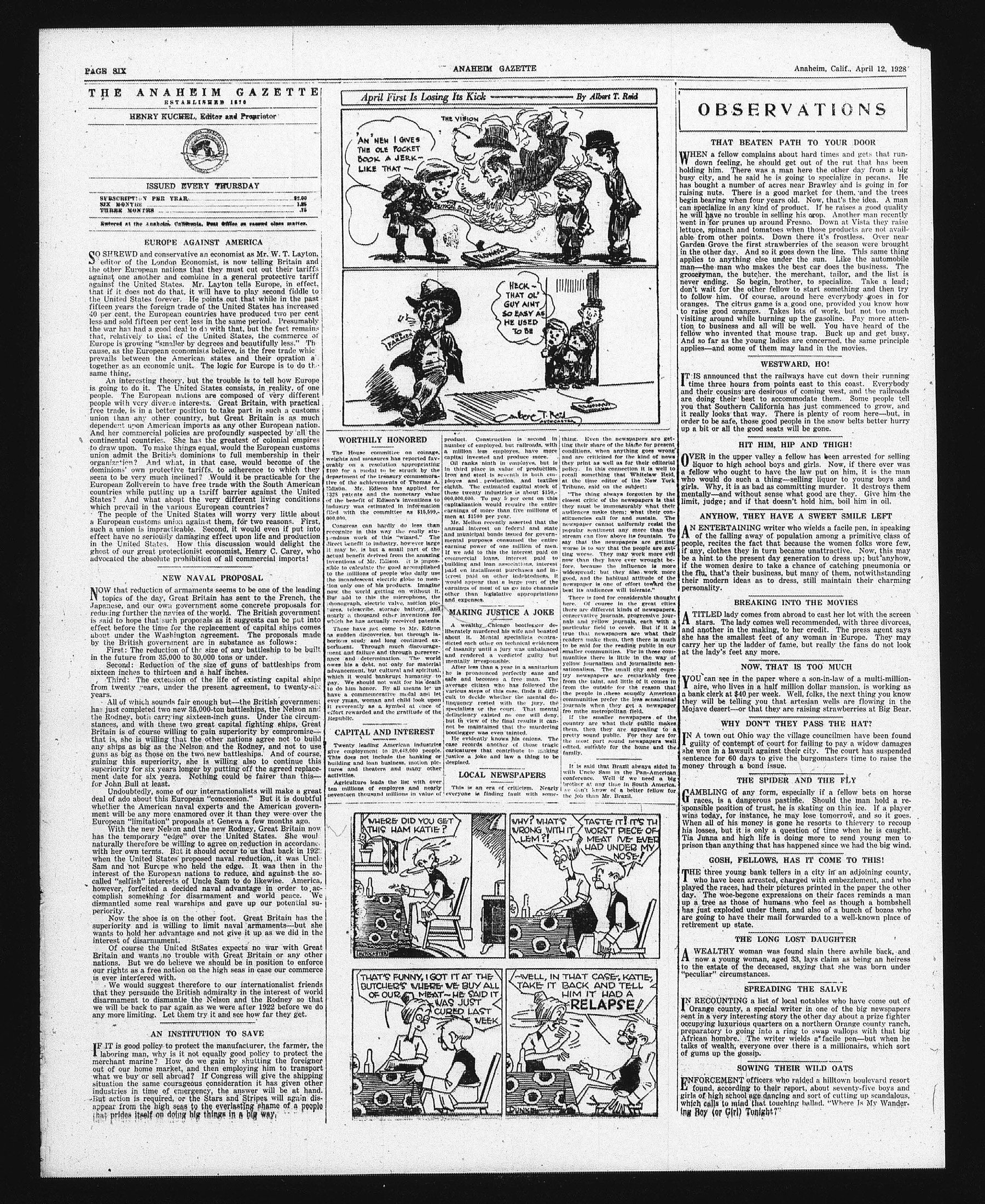
APRIL FIRST IS LOSING ITS KICK BY ALBERT T. REID
THE VISION
'AN NEW GIVES THE OLE POCKET BOOK A JERK LIKE THAT'
HECK - THAT OL' GUY AINT SO EASY AS HE USED TO BE
WORTHILY HONORED
product. Construction is second in number of employed, but railroads, with thing. Even the newspapers are getting their share of the blame for present
WORTHILY HONORED
The House committee on coinage, weights and measures has reported favorably on a resolution appropriating $100 for a medal to be struck by the department of the treasury commemorative of the achievements of Thomas A. Edison. Mr. Edison has applied for 1328 patents and the monetary value of the benefit of Edison's inventions to industry was estimated in information filed with the committee as $15,599,-000,000.
Congress can hardly do less than recognize in this way the really stupendous work of this "wizard." The direct benefit to industry, however large it may be, is but a small part of the actual benefit derived from the amazing inventions of Mr. Edison. It is impossible to calculate the good accomplished to the millions of people who daily use the incandescent electric globe to mention only one of his products. Imagine now the world getting on without it. But add to this the microphone, the phonograph, electric valve, motion pictures, telescribe, storage battery, and nearly a thousand other inventions for which he has actually received patents.
These have not come to Mr. Edison as sudden discoveries, but through laborious study and long continued experiment. Through much discouragement and failure and through perseverance and determination. The world owes his a debt, not only for material advancement, but cultural and spiritual, which it would bankrupt humanity to pay. We should not wait for his death to do him honor. By all means let us have a commemorative medal and let ever yman, woman and child look upon it reverently as a symbol at once of effort rewarded and the gratitude of the Republic.
CAPITAL AND INTEREST
Twenty leading American industries give employment to 20,448,000 people. This does not include the banking or building and loan business, motion pictures and theaters and many other activities.
Agriculture leads the list with over ten millions of employees and nearly seventeen thousand millions in value of product. Construction is second in number of employed, but railroads, with a million less employees, have more capital invested and produce more.
Oil ranks ninth in employees, but is in third place in value of production. Iron and steel is seventh in both employees and production, and textiles eighth. The estimated capital stock of these twenty industries is about $150,000,000,000. To pay 5 per cent on this capitalization would require the entire earnings of more than five millions of men at $1500 per year.
Mr. Mellon recently asserted that the annual interest on federal and state municipal bonds issued for governmental purposes consumed the entire earning power of one million of men. If we add to this the interest paid on commercial loans, interest paid to building and loan associations, interest paid on installment purchases and interest paid on other indebtedness, it would appear that a large part of the earnings of most of us go into channels other than legislative appropriations and expenses.
MAKING JUSTICE A JOKE
A wealthy Chicago bootlegger deliberately murdered his wife and boasted about it. Mental specialists contradicted each other on technical evidences of insanity until a jury was unbalanced and rendered a verdict of guilty but mentally irresponsable.
After less than a year in a sanitarium he is pronounced perfectly sane and safe and becomes a free man. The average citizen who has followed the various steps of this case finds it difficult to decide whether the mental delinquency rested with the jury, the specialists or the court. That mental deficiency existed no one will deny, but in view of the final results it cannot be maintained that the murdering bootlegger was even tainted.
He evidently knows his onions. The case records another of those tragic caricatures that contribute to making justice a joke and law a thing to be despised.
LOCAL NEWSPAPERS
This is an era of criticism. Nearly everyone is finding fault with something. Even the newspapers are getting their share of the blame for present conditions, when anything goes wrong and are criticized for the kind of news they print as well as for their editorial policy. In this connection it is well to recall something that Whitelaw Reid, at the time editor of the New York Tribune, said on the subject:
"The thing always forgotten by the closest critic of the newspapers is that they must be immeasurably what their audiences make them; what their constituencies call for and sustain. The newspaper cannot uniformly resist the popular sentiment any more than the stream can flow above its fountain. To say that the newspapers are getting worse is to say that the people are getting worse. They may work more evil now than they have ever wrought before, because the influence is more widespread; but they also work more good, and the habitual attitude of the newspaper is one of effort toward the best its audiences will tolerate."
There is food for considerable thought here. Of course in the great cities there are different kinds of newspapers, conservative journals, yellow journals, each with a particular field to cover. But if it is true that newspapers are what their readers make them, then there is much to be said for the reading public in our smaller communities. For in these communities there is little in the way of yellow journalism and journalistic sensationalism. The small city and country newspapers are remarkably free from the taint, and little of it comes in from the outside for the reason that the people in these soundly American communities prefer the less sensational journals when they get a newspaper fro mthe metropolitan field.
If the smaller newspapers of the country are what their public makes them, then they are appealing to a pretty sound public. For they are for the most part sound newspapers well edited, suitable for the home and the family.
It is said that Brazil always sided in with Uncle Sam in the Pan-American conference. Well if we need a big brother at any time in South America, we don't know of a better fellow for the job than Mr. Brazil.
This does not include the banking or building and loan business, motion pictures and theaters and many other activities.
Agriculture leads the list with over ten millions of employees and nearly seventeen thousand millions in value of
LOCAL NEWSPAPERS
This is an era of criticism. Nearly everyone is finding fault with some-
WHERE DID YOU GET THIS HAM KATIE?
WHY? WHAT'S WRONG WITH IT LEM?!
TASTE IT! IT'S TH WORST PIECE OF MEAT IVE EVER HAD UNDER MY NOSE!
THAT'S FUNNY, I GOT IT AT THE BUTCHER'S WHERE WE BUY ALL OF OUR MEAT~HE SAID IT WAS JUST CURED LAST WEEK
~VELL, IN THAT CASE, KATIE, TAKE IT BACK AND TELL HIM IT HAD A RELAPSE!
OBSERVATIONS
THAT BEATEN PATH TO YOUR DOOR
WHEN a fellow complains about hard times and gets that run-down feeling, he should get out of the rut that has been holding him. There was a man here the other day from a big busy city, and he said he is going to specialize in pecans. He has bought a number of acres near Brawley and is going in for raising nuts. There is a good market for them, and the trees begin bearing when four years old. Now, that's the idea. A man can specialize in any kind of product. If he raises a good quality he will have no trouble in selling his crop. Another man recently went in for prunes up around Fresno. Down at Vista they raise lettuce, spinach and tomatoes when those products are not available from other points. Down there it's frostless. Over near Garden Grove the first strawberries of the season were brought in the other day. And so it goes down the line. This same thing applies to anything else under the sun. Like the automobile man—the man who makes the best car does the business. The groceryman, the butcher, the merchant, tailor, and the list is never ending. So begin, brother, to specialize. Take a lead; don't wait for the other fellow to start something and then try to follow him. Of course, around here everybody goes in for oranges. The citrus game is a good one, provided you know how to raise good oranges. Takes lots of work, but not too much visiting around while burning up the gasoline. Pay more attention to business and all will be well. You have heard of the fellow who invented that mouse trap. Buck up and get busy. And so far as the young ladies are concerned, the same principle applies—and some of them may land in the movies.
WESTWARD, HO!
IT IS announced that the railways have cut down their running time three hours from points east to this coast. Everybody and their cousins are desirous of coming west, and the railroads are doing their best to accommodate them. Some people tell you that Southern California has just commenced to grow, and it really looks that way. There is plenty of room here—but, in order to be safe, those good people in the snow belts better hurry up a bit or all the good seats will be gone.
HIT HIM, HIP AND THIGH!
WESTWARD, HO!
IT IS announced that the railways have cut down their running time three hours from points east to this coast. Everybody and their cousins are desirous of coming west, and the railroads are doing their best to accommodate them. Some people tell you that Southern California has just commenced to grow, and it really looks that way. There is plenty of room here—but, in order to be safe, those good people in the snow belts better hurry up a bit or all the good seats will be gone.
HIT HIM, HIP AND THIGH!
OVER in the upper valley a fellow has been arrested for selling liquor to high school boys and girls. Now, if there ever was a fellow who ought to have the law put on him, it is the man who would do such a thing—selling liquor to young boys and girls. Why, it is as bad as committing murder. It destroys them mentally—and without sense what good are they. Give him the limit, judge; and if that doesn't hold him, boil him in oil.
ANYHOW, THEY HAVE A SWEET SMILE LEFT
AN ENTERTAINING writer who wields a facile pen, in speaking of the falling away of population among a primitive class of people, recites the fact that because the women folks wore few, if any, clothes they in turn became unattractive. Now, this may be a hint to the present day generation to dress up; but anyhow, if the women desire to take a chance of catching pneumonia or the flu, that's their business, but many of them, notwithstanding their modern ideas as to dress, still maintain their charming personality.
BREAKING INTO THE MOVIES
A TITLED lady comes from abroad to cast her lot with the screen stars. The lady comes well recommended, with three divorces, and another in the making, to her credit. The press agent says she has the smallest feet of any woman in Europe. They may carry her up the ladder of fame, but really the fans do not look at the lady's feet any more.
NOW, THAT IS TOO MUCH
YOU can see in the paper where a son-in-law of a multi-millionaire, who lives in a half million dollar mansion, is working as a bank clerk at $40 per week. Well, folks, the next thing you know they will be telling you that artesian wells are flowing in the Mojave desert—or that they are raising strawberries at Big Bear.
WHY DON'T THEY PASS THE HAT?
In a town out Ohio way the village councilmen have been found guilty of contempt of court for failing to pay a widow damages she won in a lawsuit against their city. The court has suspended sentence for 60 days to give the burgomasters time to raise the money through a bond issue.
THE SPIDER AND THE FLY
GAMBLING of any form, especially if a fellow bets on horse races, is a dangerous pastime. Should the man hold a responsible position of trust, he is skating on thin ice. If a player wins today, for instance, he may lose tomorrow, and so it goes. When all of his money is gone he resorts to thievery to recoup his losses, but it is only a question of time when he is caught. Tia Juana and high life is doing more to send young men to prison than anything that has happened since we had the big wind.
THE SPIDER AND THE FLY
GAMBLING of any form, especially if a fellow bets on horse races, is a dangerous pastime. Should the man hold a responsible position of trust, he is skating on thin ice. If a player wins today, for instance, he may lose tomorrow, and so it goes. When all of his money is gone he resorts to thievery to recoup his losses, but it is only a question of time when he is caught. Tia Juana and high life is doing more to send young men to prison than anything that has happened since we had the big wind.
GOSH, FELLOWS, HAS IT COME TO THIS!
THE three young bank tellers in a city in an adjoining county, who have been arrested, charged with embezzlement, and who played the races, had their pictures printed in the paper the other day. The woe-begone expressions on their faces remind a man up a tree as those of humans who feel as though a bombshell has just exploded under them, and also of a bunch of bozos who are going to have their mail forwarded to a well-known place of retirement up state.
THE LONG LOST DAUGHTER
A WEALTHY woman was found slain there awhile back, and now a young woman, aged 33, lays claim as being an heiress to the estate of the deceased, saying that she was born under "peculiar" circumstances.
SPREADING THE SALVE
IN RECOUNTING a list of local notables who have come out of Orange county, a special writer in one of the big newspapers sent in a very interesting story the other day about a prize fighter occupying luxurious quarters on a northern Orange county ranch, preparatory to going into a ring to swap wallops with that big African hombre. The writer wields a facile pen—but when he talks of wealth, everyone over there is a millionairs, which sort of gums up the gossip.
SOWING THEIR WILD OATS
ENFORCEMENT officers who raided a hilltown boulevard resort found, according to their report, about seventy-five boys and girls of high school age dancing and sort of cutting up scandalous, which calls to mind that touching ballad, "Where Is My Wander-ing Boy (or Girl) Tonight?"