anaheim-gazette 1928-03-22
Scanned page
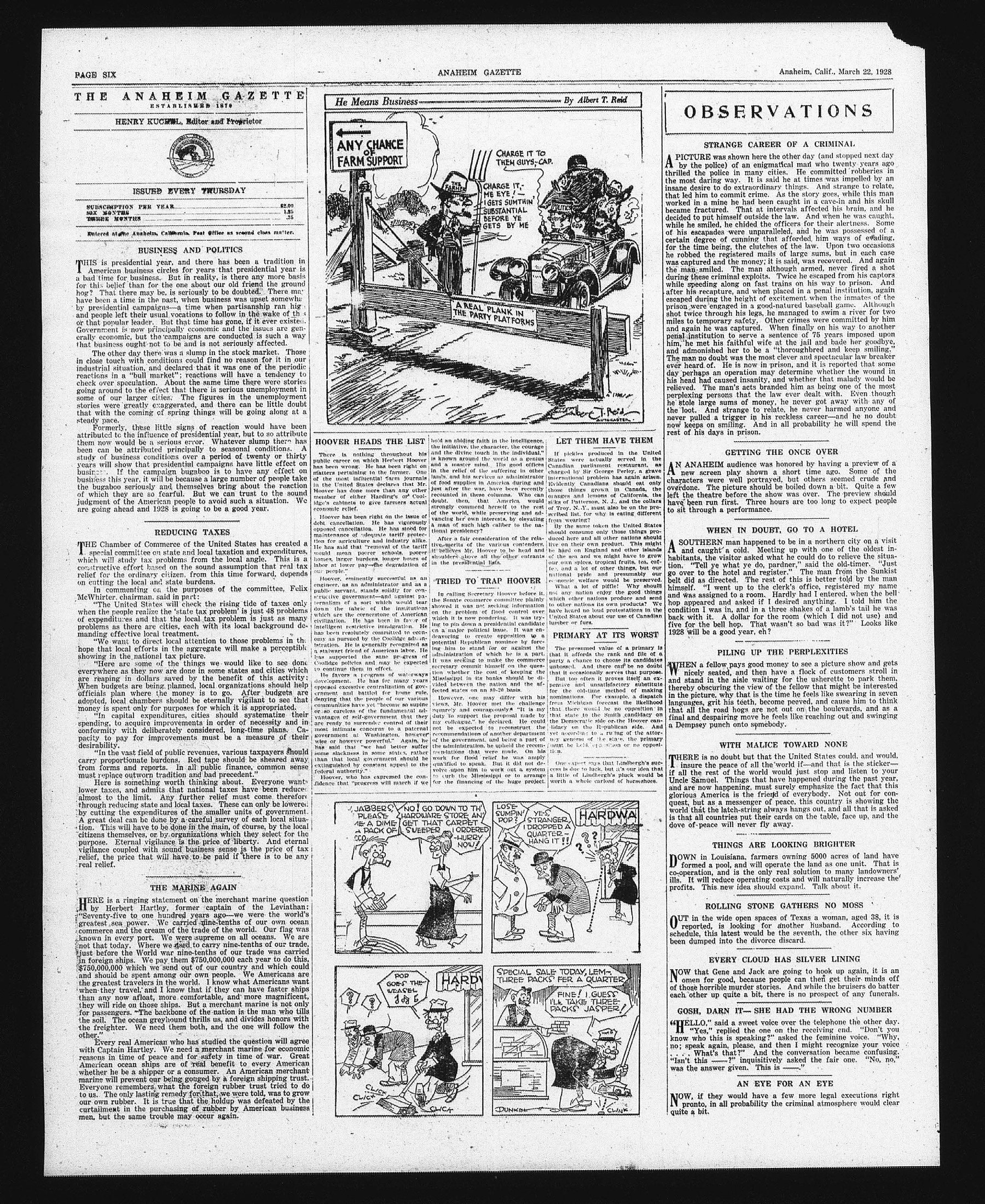
Searchable text
THE ANAHEIM GAZETTE
ESTABLISHED 1870
HENRY KUCHL, Editor and Proprietor
ISSUED EVERY THURSDAY
SUBSCRIPTION PER YEAR.....$2.00
SIX MONTHS.....1.25
THREE MONTHS......75
Entered at the Anaheim, California Post Office as second class matter.
BUSINESS AND POLITICS
THIS is presidential year, and there has been a tradition in American business circles for years that presidential year is a bad time for business. But in reality, is there any more basis for this belief than for the one about our old friend the ground hog? That there may be, is seriously to be doubted. There may have been a time in the past, when business was upset somewhat by presidential campaigns—a time when partisanship ran high and people left their usual vocations to follow in the wake of this or that popular leader. But that time has gone, if it ever existed. Government is now principally economic and the issues are generally economic, but the campaigns are conducted is such a way that business ought not to be and is not seriously affected.
The other day there was a slump in the stock market. Those in close touch with conditions could find no reason for it in our industrial situation, and declared that it was one of the periodic reactions in a "bull market"; reactions will have a tendency to check over speculation. About the same time there were stories going around to the effect that there is serious unemployment in some of our larger cities: The figures in the unemployment stories were greatly exaggerated, and there can be little doubt that with the coming of spring things will be going along at a steady pace.
Formerly, these little signs of reaction would have been attributed to the influence of presidential year, but to so attribute them now would be a serious error. Whatever slump there has been can be attributed principally to seasonal conditions.
REDUCING TAXES
THE Chamber of Commerce of the United States has created a special committee on state and local taxation and expenditures, which will study tax problems from the local angle. This is a constructive effort based on the sound assumption that real tax relief for the ordinary citizen, from this time forward, depends on cutting the local and state burdens.
In commenting on the purposes of the committee, Felix McWhirter, chairman, said in part:
"The United States will check the rising tide of taxes only when the people realize the 'state tax problem' is just 48 problems of expenditures and that the local tax problem is just as many problems as there are cities, each with its local background demanding effective local treatment.
"We want to direct local attention to those problems in the hope that local efforts in the aggregate will make a perceptible showing in the national tax picture.
"Here are some of the things we would like to see done everywhere as they now are done in some states and cities which are reaping in dollars saved by the benefit of this activity: When budgets are being planned, local organizations should help officials plan where the money is to go. After budgets are adopted, local chambers should be eternally vigilant to see that money is spent only for purposes for which it is appropriated.
"In capital expenditures, cities should systematize their spending, to acquire improvements in order of necessity and in conformity with deliberately considered, long-time plans. Capacity to pay for improvements must be a measure of their desirability.
"In the vast field of public revenues, various taxpayers should carry proportionate burdens. Red tape should be sheared away from forms and reports. In all public finance, common sense must replace outworn tradition and bad precedent."
Here is something worth thinking about. Everyone wants lower taxes, and admits that national taxes have been reduced almost to the limit. Any further relief must come therefore through reducing state and local taxes. These can only be lowered by cutting the expenditures of the smaller units of government. A great deal can be done by a careful survey of each local situation. This will have to be done in the main, of course, by the local citizens themselves, or by organizations which they select for the purpose. Eternal vigilance is the price of liberty. And eternal vigilance coupled with sound business sense is the price of tax
Here is something worth thinking about. Everyone wants lower taxes, and admits that national taxes have been reduced almost to the limit. Any further relief must come therefore through reducing state and local taxes. These can only be lowered by cutting the expenditures of the smaller units of government. A great deal can be done by a careful survey of each local situation. This will have to be done in the main, of course, by the local citizens themselves, or by organizations which they select for the purpose. Eternal vigilance is the price of liberty. And eternal vigilance coupled with sound business sense is the price of tax relief, the price that will have to be paid if there is to be any real relief.
THE MARINE AGAIN
HERE is a ringing statement on the merchant marine question by Herbert Hartley, former captain of the Leviathan: "Seventy-five to one hundred years ago—we were the world's greatest sea power. We carried nine-tenths of our own ocean commerce and the cream of the trade of the world. Our flag was known in every port. We were supreme on all oceans. We are not that today. Where we used to carry nine-tenths of our trade, just before the World war nine-tenths of our trade was carried in foreign ships. We pay them $750,000,000 each year to do this, $750,000,000 which we send out of our country and which could and should be spent among our own people. We Americans are the greatest travelers in the world. I know what Americans want when they travel; and I know that if they can have faster ships than any now afloat, more comfortable, and more magnificent, they will ride on those ships. But a merchant marine is not only for passengers. The backbone of the nation is the man who tills the soil. The ocean greyhound thrills us, and divides honors with the freighter. We need them both, and the one will follow the other."
Every real American who has studied the question will agree with Captain Hartley. We need a merchant marine for economic reasons in time of peace and for safety in time of war. Great American ocean ships are of real benefit to every American whether he be a shipper or a consumer. An American merchant marine will prevent our being gonged by a foreign shipping trust. Everyone remembers what the foreign rubber trust tried to do to us. The only lasting remedy for that, we were told, was to grow our own rubber. It is true that the holdup was defeated by the curtailment in the purchasing of rubber by American business men, but the same trouble may occur again.
ANAHEIM GAZETTE
He Means Business By Albert T. Reid
ANY CHANCE OF FARM SUPPORT
CHARGE IT TO THEM GUYS,-CAP.
CHARGE IT,-ME EYE! I GETS SUMTHIN SUBSTANTIAL BEFORE YE GETS BY ME
A REAL PLANK IN THE PARTY PLATFORMS
HOOVER HEADS THE LIST
LET THEM HAVE THEM
HOOVER HEADS THE LIST
There is nothing throughout his public career on which Herbert Hoover has been wrong. He has been right on matters pertaining to the farmer. One of the most influential farm journals in the United States declares that Mr. Hoover has done more than any other member of either Harding's or Coolidge's cabinets to give farmers actual economic relief.
Hoover has been right on the issue of debt cancellation. He has vigorously opposed cancellation. He has stood for maintenance of adequate tariff protection for agriculture and industry alike. He has said that "removal of the tariff would mean poorer schools, poorer homes, larger burdens, longer hours of labor at lower pay—the degradation of our people."
Hoover, eminently successful as an engineer, as an administrator and as a public servant, stands solidly for constructive government—and against paternalism of a sort which would tear down the fabric of the institutions which are the cornerstone of American civilization. He has been in favor of intelligent restrictive immigration. He has been resolutely committed to economy as pursued by the Coolidge administration. He is generally recognized as a stalwart friend of American labor. He has supported the same progress of Coolidge policies and may be expected to continue them in effect.
He favors a program of waterways development. He has for many years opposed excessive centralization of government and battled for home rule, denying that the people of our various communities have yet "become so sulpine or so careless of the fundamental advantages of self-government that they are ready to surrender control of their most intimate concerns to a paternal government at Washington, however wise or however powerful." Again, he has said that "we had better suffer some slackness in some states, rather than that local government should be extinguished by constant appeal to the federal authority."
Hoover, who has expressed the confidence that "progress will march if we hold an abiding faith in the intelligence, the initiative, the character, the courage and the divine touch in the individual," is known around the world as a genius and a master mind. His good offices in the relief of the suffering in other lands, and his services as administrator of food supplies in America during and just after the war, have been recently recounted in these columns. Who can doubt, then, that America would strongly commend herself to the rest of the world, while preserving and advancing her own interests, by elevating a man of such high caliber to the national presidency?
After a fair consideration of the relative merits of the various contenders, it believes Mr. Hoover to be head and shoulders above all the other entrants in the presidential lists.
TRIED TO TRAP HOOVER
In calling Secretary Hoover before it, the Senate commerce committee plainly showed it was not seeking information on the problem of flood control over which it is now pondering. It was trying to pin down a presidential candidate on a major political issue. It was endeavoring to create opposition to a potential Republican nominee by forcing him to stand for or against the administration of which he is a part. It was seeking to make the commerce secretary commit himself on the question whether the cost of keeping the Mississippi in its banks should be divided between the nation and the affected states on an 80-20 basis.
However, one may differ with his views. Mr. Hoover met the challenge squarely and courageously: "It is my duty to support the proposal made by my colleague," he declared. He could not be expected to reconstruct the recommendations of another department of the government, and being a part of the administration, he upheld the recommendations that were made. On his work for flood relief he was amply qualified to speak. But it did not devolve upon him to work out a system to curb the Mississippi or to arrange for the financing of the huge project.
LET THEM HAVE THEM
If pickles produced in the United States were actually served in the Canadian parliament restaurant, as charged by Sir George Perley, a grave international problem has again arisen. Evidently Canadians should eat only those things grown in Canada, the oranges and lemons of California, the silks of Patterson, N.J., and the collars of Troy, N.Y., must also be on the prescribed list, for why is eating different from wearing?
By the same token the United States should consume only those things produced here and all other nations should live on their own product. This might be hard on England and other islands of the sea and we might have to grow our own spices, tropical fruits, tea, coffee, and a lot of other things, but our national pride and presumably our economic welfare would be preserved.
What a lot of pifflie! Why should not any nation enjoy the good things which other nations produce and send to other nations its own products? We have heard no loud protestations in the United States about our use of Canadian lumber or furs.
PRIMARY AT ITS WORST
The presumed value of a primary is that it affords the rank and file of a party a chance to choose its candidates unbossed. And there can be no doubt that it occasionally serves that purpose.
But too often it proves itself an expensive and unsatisfactory substitute for the old-time method of making nominations. For example, a dispatch from Michigan forecast the likelihood that there would be no opposition in state to the Smith candidacy on the Democratic side or the Hoover candidacy on the Republican side. And yet according to a ruling of the attorney general of the state, the primary must be held, opposition or no opposition.
One expert says that Lindbergh's success is due to luck, but it's our idea that a little of Lindbergh's pluck would be worth a whole carload of horseshoes.
than that local government should be extinguished by constant appeal to the federal authority."
Hoover, who has expressed the confidence that "progress will march if we work for flood relief he was amply qualified to speak. But it did not devolve upon him to work out a system to curb the Mississippi or to arrange for the financing of the huge project.
One expert says that Lindbergh's success is due to luck, but it's our idea that a little of Lindbergh's pluck would be worth a whole carload of horseshoes.
JABBERS PLEASE ME A DIME A PACK OF COCO!
NO! GO DOWN TO THE HARDWARE STORE AN' GET THAT CARPET SWEEPER I ORDERED -HURRY NOW!
LOSE SUMPIN' POP?
YES STRANGER, I DROPPED A QUARTER-HANG IT!!
HARDWA
???
POP GOES THE WEASEL 1865
SPECIAL SALE TODAY, LEM--THREE PACKS FER A QUARTER
FINE! I GUESS ILL TAKE THREE PACKS JASPER!
DUNKBE
OBSERVATIONS
STRANGE CAREER OF A CRIMINAL
A PICTURE was shown here the other day (and stopped next day by the police) of an enigmatical man who twenty years ago thrilled the police in many cities. He committed robberies in the most daring way. It is said he at times was impelled by an insane desire to do extraordinary things. And strange to relate, that led him to commit crime. As the story goes, while this man worked in a mine he had been caught in a cave-in and his skull became fractured. That at intervals affected his brain, and he decided to put himself outside the law. And when he was caught, while he smiled, he chided the officers for their alertness. Some of his escapades were unparalleled, and he was possessed of a certain degree of cunning that afforded him ways of evading, for the time being, the clutches of the law. Upon two occasions he robbed the registered mails of large sums, but in each case was captured and the money; it is said, was recovered. And again the man smiled. The man although armed, never fired a shot during these criminal exploits. Twice he escaped from his captors while speeding along on fast trains on his way to prison. And after his recapture, and when placed in a penal institution, again escaped during the height of excitement when the inmates of the prison were engaged in a good-natured baseball game. Although shot twice through his legs, he managed to swim a river for two miles to temporary safety. Other crimes were committed by him and again he was captured. When finally on his way to another penal institution to serve a sentence of 75 years imposed upon him, he met his faithful wife at the jail and bade her goodbye, and admonished her to be a "thoroughbred and keep smiling." The man no doubt was the most clever and spectacular law breaker ever heard of. He is now in prison, and it is reported that some day perhaps an operation may determine whether the wound in his head had caused insanity, and whether that malady would be relieved. The man's acts branded him as being one of the most perplexing persons that the law ever dealt with. Even though he stole large sums of money, he never got away with any of the loot. And strange to relate, he never harmed anyone and never pulled a trigger in his reckless career—and he no doubt now keeps on smiling. And in all probability he will spend the rest of his days in prison.
The man no doubt was the most clever and spectacular law breaker ever heard of. He is now in prison, and it is reported that some day perhaps an operation may determine whether the wound in his head had caused insanity, and whether that malady would be relieved. The man's acts branded him as being one of the most perplexing persons that the law ever dealt with. Even though he stole large sums of money, he never got away with any of the loot. And strange to relate, he never harmed anyone and never pulled a trigger in his reckless career—and he no doubt now keeps on smiling. And in all probability he will spend the rest of his days in prison.
GETTING THE ONCE OVER
AN ANAHEIM audience was honored by having a preview of a new screen play shown a short time ago. Some of the characters were well portrayed, but others seemed crude and overdone. The picture should be boiled down a bit. Quite a few left the theatre before the show was over. The preview should have been run first. Three hours are too long to expect people to sit through a performance.
WHEN IN DOUBT, GO TO A HOTEL
SOUTHERN man happened to be in a northern city on a visit and caught a cold. Meeting up with one of the oldest inhabitants, the visitor asked what he could do to relieve the situation. "Tell ye what ye do, pardner," said the old-timer. "Just go over to the hotel and register." The man from the Sunkist belt did as directed. The rest of this is better told by the man himself. "I went up to the clerk's office, registered my name and was assigned to a room. Hardly I entered, when the bell hop appeared and asked if I desired anything. I told him the condition I was in, and in a three shakes of a lamb's tail he was back with it. A dollar for the room (which I did not use) and five for the bell hop. That wasn't so bad was it?" Looks like 1928 will be a good year, eh?
PILING UP THE PERPLEXITIES
When a fellow pays good money to see a picture show and gets nicely seated, and then have a flock of customers stroll in and stand in the aisle waiting for the usherette to park them, thereby obscuring the view of the fellow that might be interested in the picture, why that is the time he feels like swearing in seven languages, grit his teeth, become peeved, and cause him to think that all the road hogs are not out on the boulevards, and as a final and despairing move he feels like reaching out and swinging a Dempsey punch onto spmebody.
WITH MALICE TOWARD NONE
There is no doubt but that the United States could, and would, insure the peace of all the world if—and that is the sticker—if all the rest of the world would just stop and listen to your Uncle Samuel. Things that have happened during the past year, and are now happening, must surely emphasize the fact that this glorious America is the friend of everybody. Not out for conquest, but as a messenger of peace, this country is showing the world that the latch-string always hangs out, and all that is asked is that all countries put their cards on the table, face up, and the dove of peace will never fly away.
THINGS ARE LOOKING BRIGHTER
THERE is no doubt but that the United States could, and would,
insure the peace of all the world if—and that is the sticker—
if all the rest of the world would just stop and listen to your
Uncle Samuel. Things that have happened during the past year,
and are now happening, must surely emphasize the fact that this
glorious America is the friend of everybody. Not out for conquest, but as a messenger of peace, this country is showing the
world that the latch-string always hangs out, and all that is asked
is that all countries put their cards on the table, face up, and the
dove of peace will never fly away.
THINGS ARE LOOKING BRIGHTER
DOWN in Louisiana, farmers owning 5000 acres of land have
formed a pool, and will operate the land as one unit. That is
co-operation, and is the only real solution to many landowners'
ills. It will reduce operating costs and will naturally increase the
profits. This new idea should expand. Talk about it.
ROLLING STONE GATHERS NO MOSS
OUT in the wide open spaces of Texas a woman, aged 38, it is
reported, is looking for another husband. According to
schedule, this latest would be the seventh, the other six having
been dumped into the divorce discard.
EVERY CLOUD HAS SILVER LINING
NOW that Gene and Jack are going to hook up again, it is an
omen for good, because people can then get their minds off
of those horrible murder stories. And while the bruisers do batter
each other up quite a bit, there is no prospect of any funerals.
GOSH, DARN IT—SHE HAD THE WRONG NUMBER
"HELLO," said a sweet voice over the telephone the other day.
"Yes," replied the one on the receiving end. "Don't you
know who this is speaking?" asked the feminine voice. "Why,
no; speak again, please, and then I might recognize your voice
What's that?" And the conversation became confusing.
"Isn't this —?" inquisitively asked the fair one. "No, no,"
was the answer given. This is ——."
AN EYE FOR AN EYE
NOW, if they would have a few more legal executions right
pronto, in all probability the criminal atmosphere would clear
quite a bit.