anaheim-gazette 1928-03-15
Scanned page
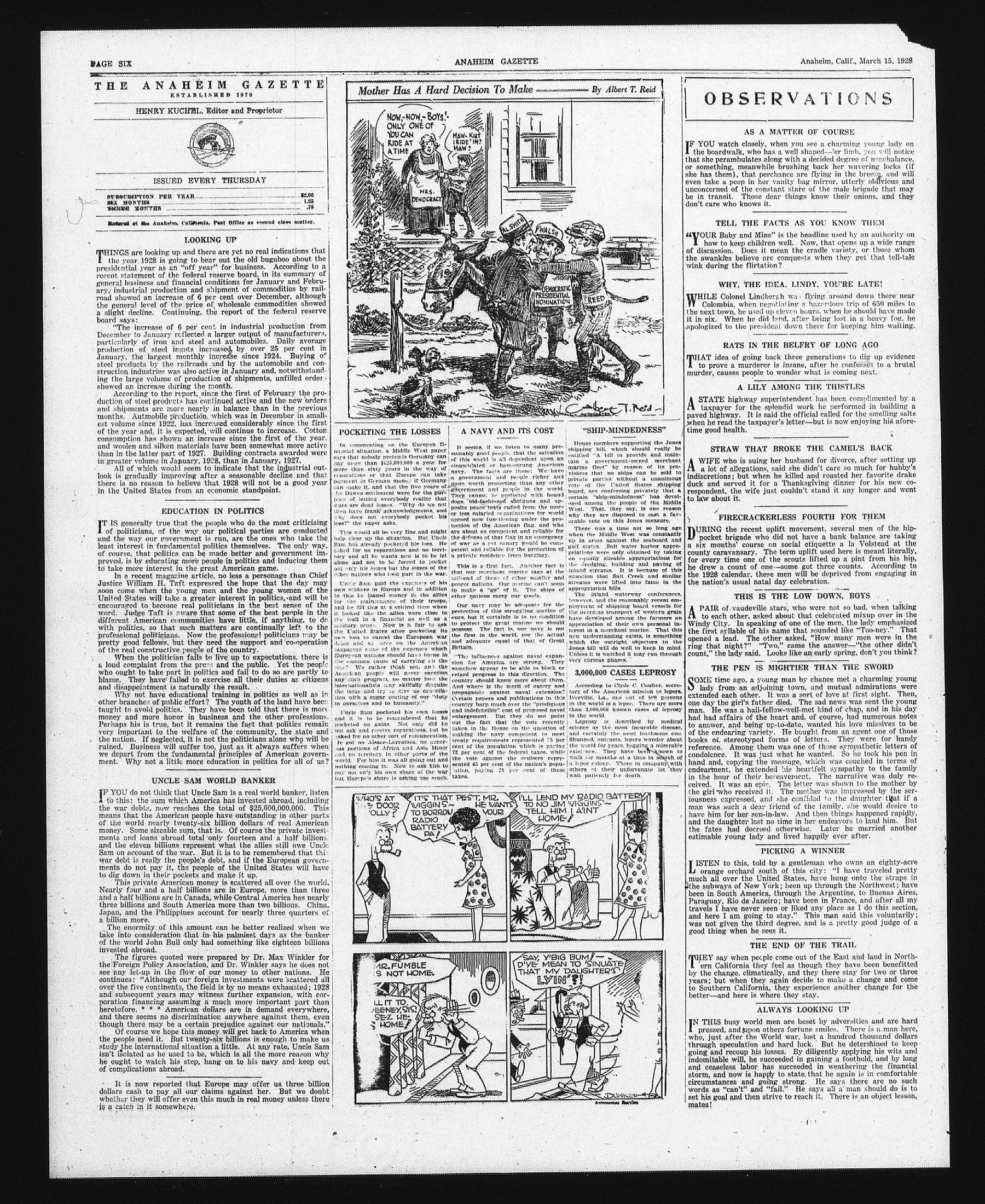
Searchable text
THE ANAHEIM GAZETTE
ESTABLISHED 1870
HENRY KUCHEL, Editor and Proprietor
ISSUED EVERY THURSDAY
SUBSCRIPTION PER YEAR $2.00
SEX MONTHS 1.25
THIRD MONTHS .75
Received at the Anaheim, California, Post Office as second class matter.
LOOKING UP
Things are looking up and there are yet no real indications that the year 1928 is going to bear out the old bugaboo about the presidential year as an "off year" for business. According to a recent statement of the federal reserve board, in its summary of general business and financial conditions for January and February, industrial production and shipment of commodities by railroad showed an increase of 6 per cent over December, although the general level of the price of wholesale commodities showed a slight decline. Continuing, the report of the federal reserve board says:
"The increase of 6 per cent in industrial production from December to January reflected a larger output of manufacturers, particularly of iron and steel and automobiles. Daily average production of steel ingots increased by over 25 per cent in January, the largest monthly increase since 1924. Buying of steel products by the railroads and by the automobile and construction industries was also active in January and, notwithstanding the large volume of production of shipments, unfilled orders showed an increase during the month.
According to the report, since the first of February the production of steel products has continued active and the new orders and shipments are more nearly in balance than in the previous months. Automobile production, which was in December in smallest volume since 1922, has increased considerably since the first of the year and, it is expected, will continue to increase. Cotton consumption has shown an increase since the first of the year, and woolen and silken materials have been somewhat more active."
January, the largest monthly increase since 1924. Buying of steel products by the railroads and by the automobile and construction industries was also active in January and, notwithstanding the large volume of production of shipments, unfilled orders showed an increase during the month.
According to the report, since the first of February the production of steel products has continued active and the new orders and shipments are more nearly in balance than in the previous months. Automobile production, which was in December in smallest volume since 1922, has increased considerably since the first of the year and, it is expected, will continue to increase. Cotton consumption has shown an increase since the first of the year, and woolen and silken materials have been somewhat more active than in the latter part of 1927. Building contracts awarded were in greater volume in January, 1928, than in January, 1927.
All of which would seem to indicate that the industrial outlook is gradually improving after a seasonable decline and that there is no reason to believe that 1928 will not be a good year in the United States from an economic standpoint.
EDUCATION IN POLITICS
It is generally true that the people who do the most criticising of politicians, of the way our political parties are conducted and the way our government is run, are the ones who take the least interest in fundamental politics themselves. The only way, of course, that politics can be made better and government improved, is by educating more people in politics and inducing them to take more interest in the great American game.
In a recent magazine article, no less a personage than Chief Justice William H. Taft expressed the hope that the day may soon come when the young men and the young women of the United States will take a greater interest in politics, and will be encouraged to become real politicians in the best sense of the word. Judge Taft is aware that some of the best people in the different American communities have little, if anything, to do with politics, so that such matters are continually left to the professional politicians. Now the profession! politicians may be pretty good fellows, but they need the support and co-operation of the real constructive people of the country.
When the politician fails to live up to expectations, there is a loud complaint from the press and the public. Yet the people who ought to take part in politics and fail to do so are partly to blame. They have failed to exercise all their duties as citizens and disappointment is naturally the result.
Why not have educational training in politics as well as in other branches of public effort? The youth of the land have been taught to avoid politics. They have been told that there is more money and more honor in business and the other professions. Perhaps his is true, but it remains the fact that politics remain very important to the welfare of the community, the state and the nation. If neglected, it is not the politicians alone who will be ruined. Business will suffer too, just as it always suffers when we depart from the fundamental principles of American government. Why not a little more education in politics for all of us?
UNCLE SAM WORLD BANKER
If YOU do not think that Uncle Sam is a real world banker, listen to this: the sum which America has invested abroad, including the war debts, now reaches the total of $25,600,000,000. This means that the American people have outstanding in other parts of the world nearly twenty-six billion dollars of real American money. Some sizeable sum, that is. Of course the private investments and loans abroad total only fourteen and a half billions, and the eleven billions represent what the allies still owe Uncle Sam.
UNCLE SAM WORLD BANKER
IF YOU do not think that Uncle Sam is a real world banker, listen to this: the sum which America has invested abroad, including the war debts, now reaches the total of $25,600,000,000. This means that the American people have outstanding in other parts of the world nearly twenty-six billion dollars of real American money. Some sizeable sum, that is. Of course the private investments and loans abroad total only fourteen and a half billions, and the eleven billions represent what the allies still owe Uncle Sam on account of the war. But it is to be remembered that this war debt is really the people's debt, and if the European governments do not pay it, the people of the United States will have to dig down in their pockets and make it up.
This private American money is scattered all over the world. Nearly four and a half billions are in Europe, more than three and a half billions are in Canada, while Central America has nearly three billions and South America more than two billions. China, Japan, and the Philippines account for nearly three quarters of a billion more.
The enormity of this amount can be better realized when we take into consideration that in his palmiest days as the banker of the world John Bull only had something like eighteen billions invested abroad.
The figures quoted were prepared by Dr. Max Winkler for the Foreign Policy Association, and Dr. Winkler says he does not see any let-up in the flow of our money to other nations. He continues: "Although our foreign investments were scattered all over the five continents, the field is by no means exhausted; 1928 and subsequent years may witness further expansion, with corporation financing assuming a much more important part than heretofore. * * * American dollars are in demand everywhere, and there seems no discrimination anywhere against them, even though there may be a certain prejudice against our nationals."
Of course we hope this money will get back to America when the people need it. But twenty-six billions is enough to make us study the international situation a little. At any rate, Uncle Sam isn't isolated as he used to be, which is all the more reason why he ought to watch his step, hang on to his navy and keep out of complications abroad.
It is now reported that Europe may offer us three billion dollars cash to pay all our claims against her. But we doubt whether they will offer even this much in real money unless there is a catch in it somewhere.
ANAHEIM GAZETTE
Mother Has A Hard Decision To Make By Albert T. Reid
NOW,-NOW,-BOYS! ONLY ONE OF YOU CAN RIDE AT A TIME
MAW-KUNT IRIDE'IM? MAW?
MRS. DEMOCRACY
AL-SMITH
WALSH
DEMOCRATIC PRESIDENTIAL NOMINATION
REED
POCKETING THE LOSSES
In commenting on the European flair of the war, it seems, if we listen to many pre-
A NAVY AND ITS COST
"It seems, if we listen to many pre-"
"SHIP-MINDEDNESS"
House members supporting the Jones shipping bill, which should really be
POCKETING THE LOSSES
In commenting on the European financial situation, a Middle West paper says that nobody pretends Germany can pay more than $25,000,000 a year for more than sixty years in the way of reparations or that Europe can take payment in German money if Germany can make it, and that the five years of the Dawes settlement were for the purpose of letting everybody realize that wars are dead losses. "Why do we not then have frank acknowledgments, and why does not everybody pocket his loss?" the paper asks.
This would all be very fine and might help clear up the situation. But Uncle Sam has already pocketed his loss. He asked for no reparations and no territory and all he wants now is to be left alone and not to be forced to pocket not only his losses but the losses of the other nations who took part in the war.
Uncle Sam paid the expenses of his own soldiers in Europe and in addition to this he loaned money to the allies for the maintenance of their troops, and he did this at a critical time when it looked like the allies were close to the wall in a financial as well as a military sense. Now is it fair to ask the United States after pocketing its own loss to cancel the European war debts and so force on the American taxpayers some of the expenses which European nations should have borne in the common cause of carrying on the war?
We rather think not, and the American people will never sanction any such program, no matter how the internationalists may skillfully disguise the issue and try to give us cancellation with a sugar coating of our "duty to ourselves and to humanity."
Uncle Sam pocketed his own losses and it is to be remembered that he pocketed no gains. Not only did he not ask and receive reparations, but he asked for no other sort of remuneration. He got no Alsace-Lorraine, no generous portions of Africa and Asia Minor and no territory in other parts of the world. For him it was all going out and nothing coming in. Now to ask him to pay not only his own share of the war but Europe's share is asking too much.
A NAVY AND ITS COST
It seems, if we listen to many presumably good people, that the salvation of this world is all dependent upon an emasculated or ham-strung American navy. The facts are these: We have a government and people richer and more worth protecting than any other government and people in the world. They cannot be protected with hound dogs, old-fashioned shotguns and opposite peace texts called from the more or less salaried organizations for world accord now functioning under the protection of the American flag, and who are about as competent and reliable for the defense of that flag in an emergency of war as a pet canary would be competent and reliable for the protection of a private residence from burglary.
This is a first fact. Another fact is that our merchant marine tags at the tail-end of those of either smaller and poorer nations. Our marine can't seem to make a "go" of it. The ships of other nations carry our goods.
Our navy may be adequate for the protection of this struggling marine of ours, but it certainly is in no condition to protect the great marine we should possess. The fact is, our navy is not the first in the world, nor the actual and adequate equal of that of Great Britain.
The influences against naval expansion for America are strong. They somehow appear to be able to block or retard progress in this direction. The country should know more about them. And where is the merit of outsey and propaganda against naval extension? Certain papers and publications in this country harp much over the "prodigious and indefensible" cost of proposed naval enlargement. But they do not point out the fact that the vote recently taken in the House on the question of making the navy competent to meet treaty requirements represented 55 per cent of the population which is paying 72 per cent of the federal taxes, while the vote against the cruisers represented 45 per cent of the nation's population, paying 28 per cent of these taxes.
"SHIP-MINDEDNESS"
House members supporting the Jones shipping bill, which should really be entitled "A bill to provide and maintain a government-owned merchant marine fleet" by reason of its provisions that no ships can be sold to private parties without a unanimous vote of the United States shipping board, are confessing privately that a certain "ship-mindedness" has developed among the people of the Middle West. That, they say, is one reason why they are disposed to cast a favorable vote on this Jones measure.
There was a time not so long ago when the Middle West was constantly up in arms against the seaboard and gulf states. Salt water harbor appropriations were only obtained by taking on equally sizeable appropriations for the dredging, building and paving of inland streams. It is because of this situation that Salt Creek and similar streams were lifted into fame in the appropriation bills.
The inland waterway conferences, however, and the reasonably recent employment of shipping board vessels for the overseas transport of western grain have developed among the farmers an appreciation of their personal interest in a merchant marine. That this new understanding exists, is something which the outright objectors to the Jones bill will do well to keep in mind. Unless it is watched it may run through very curious phases.
3,000,000 CASES LEPROSY
According to Clyde C. Coulter, secretary of the American mission to lepers Iverville, La., one out of 800 persons in the world is a leper. There are more than 3,000,000 known cases of leprosy in the world.
Leprosy is described by medical science as the most incurable disease, and certainly the most loathsome one Shunned, outcasts, lepers wander about the world for years, begging a miserable existence. They have been known to walk for months at a time in search of a leper colony. There in company with others of their unfortunate lot they wait patiently for death.
WHO'S AT THE DOOR 'OLLY?
IT'S THAT PEST, MR. WIGGINS~ TO BORROW RADIO BATTERY DA!
I'll LEND MY RADIO BATTERY TO NO JIM WIGGINS~ TELL HIM I AINT HOME!
MR. FUMBLE IS NOT HOME.
LL IT TO VEENEY, SIS SEZ HE HOME!
SAY, Y'BIG BUM! D'VEE MEAN TO 'SINUATE THAT MY DAUGHTER'S LYIN'?
OBSERVATIONS
AS A MATTER OF COURSE
IF YOU watch closely, when you see a charming young lady on the boardwalk, who has a well shaped—er limb, you will notice that she perambulates along with a decided degree of nonchalance, or something, meanwhile brushing back her wavering locks (if she has them), that perchance are flying in the breeze and will even take a peep in her vanity bag mirror, utterly oblivious and unconcerned of the constant stare of the male brigade that may be in transit. Those dear things know their onions, and they don't care who knows it.
TELL THE FACTS AS YOU KNOW THEM
"YOUR Baby and Mine" is the headline used by an authority on how to keep children well. Now, that opens up a wide range of discussion. Does it mean the cradle variety, or those whom the swankles believe are conquests when they get that tell-tale wink during the flirtation?
WHY, THE IDEA, LINDY, YOU'RE LATE!
WHILE Colonel Lindbergh was flying around down there near Colombia, when negotiating a hazardous trip of 650 miles to the next town, he used up eleven hours, when he should have made it in six. When he did land, after being lost in a heavy fog, he apologized to the president down there for keeping him waiting.
RATS IN THE BELFRY OF LONG AGO
THAT idea of going back three generations to dig up evidence to prove a murderer is insane, after he confesses to a brutal murder, causes people to wonder what is coming next.
A LILY AMONG THE THISTLES
A STATE highway superintendent has been complimented by a taxpayer for the splendid work he performed in building a paved highway. It is said the official called for the smelling salts when he read the taxpayer's letter—but is now enjoying his aforetime good health.
THAT idea of going back three generations to dig up evidence to prove a murderer is insane, after he confesses to a brutal murder, causes people to wonder what is coming next.
A LILY AMONG THE THISTLES
ASTATE highway superintendent has been complimented by a taxpayer for the splendid work he performed in building a paved highway. It is said the official called for the smelling salts when he read the taxpayer's letter—but is now enjoying his aforetime good health.
STRAW THAT BROKE THE CAMEL'S BACK
WIFE who is suing her husband for divorce, after setting up a lot of allegations, said she didn't care so much for hubby's indiscretions; but when he killed and roasted her favorite drake duck and served it for a Thanksgiving dinner for his new correspondent, the wife just couldn't stand it any longer and went to law about it.
FIRECRACKERLESS FOURTH FOR THEM
DURING the recent uplift movement, several men of the hip-pocket brigade who did not have a bank balance are taking a six months' course on social etiquette a la Volstead at the county caravansary. The term uplift used here is meant literally, for every time one of the scouts lifted up a pint from his hip, he drew a count of one—some got three counts. According to the 1928 calendar, these men will be deprived from engaging in the nation's usual natal day celebration.
THIS IS THE LOW DOWN, BOYS
PAIR of vaudeville stars, who were not so bad, when talking to each other, asked about that celebrated mixup over in the Windy City. In speaking of one of the men, the lady emphasized the first syllable of his name that sounded like "Too-ney." That opened a lead. The other asked, "How many men were in the ring that night?" "Two," came the answer—"the other didn't count," the lady said. Looks like an early spring, don't you think?
THE PEN IS MIGHTIER THAN THE SWORD
SOME time ago, a young man by chance met a charming young lady from an adjoining town, and mutual admirations were extended each other. It was a sort of love at first sight. Then, one day the girl's father died. The sad news was sent the young man. He was a hail-fellow-well-met kind of chap, and in his day had affairs of the heart and, of course, had numerous notes to answer, and being up-to-date, wanted his love missives to be of the endearing variety. He bought from an agent one of those books of stereotyped forms of letters. They were for handy reference. Among them was one of those sympathetic letters of condolence. It was just what he wanted. So he took his pen in hand and, copying the message, which was couched in terms of endearment, he extended his heartfelt sympathy to the family in the hour of their bereavement. The narrative was duly received. It was an epic. The letter was shown to the mother by the girl who received it. The mother was impressed by the seriousness expressed, and she confided to the daughter that if a man was such a dear friend of the family, she would desire to have him for her son-in-law. And then things happened rapidly, and the daughter lost no time in her endeavors to land him. But the fates had decreed otherwise. Later he married another estimable young lady and lived happily ever after.
PICKING A WINNER
PICKING A WINNER
LISTEN to this, told by a gentleman who owns an eighty-acre orange orchard south of this city: "I have traveled pretty much all over the United States, have hung onto the straps in the subways of New York; been up through the Northwest; have been in South America, through the Argentine, to Buenas Aires, Paraguay, Rio de Janeiro; have been in France, and after all my travels I have never seen or liked any place as I do this section, and here I am going to stay." This man said this voluntarily; was not given the third degree, and is a pretty good judge of a good thing when he sees it.
THE END OF THE TRAIL
THEY say when people come out of the East and land in Northern California they feel as though they have been benefitted by the change, climatically, and they there stay for two or three years; but when they again decide to make a change and come to Southern California, they experience another change for the better—and here is where they stay.
ALWAYS LOOKING UP
IN THIS busy world men are beset by adversities and are hard pressed, and upon others fortune smiles. There is a man here, who, just after the World war, lost a hundred thousand dollars through speculation and hard luck. But he determined to keep going and recoup his losses. By diligently applying his wits and indomitable will, he succeeded in gaining a foothold, and by long and ceaseless labor has succeeded in weathering the financial storm, and now is happy to state that he again is in comfortable circumstances and going strong. He says there are no such words as "can't" and "fail." He says all a man should do is to set his goal and then strive to reach it. There is an object lesson, mates!