anaheim-gazette 1928-01-05
Scanned page
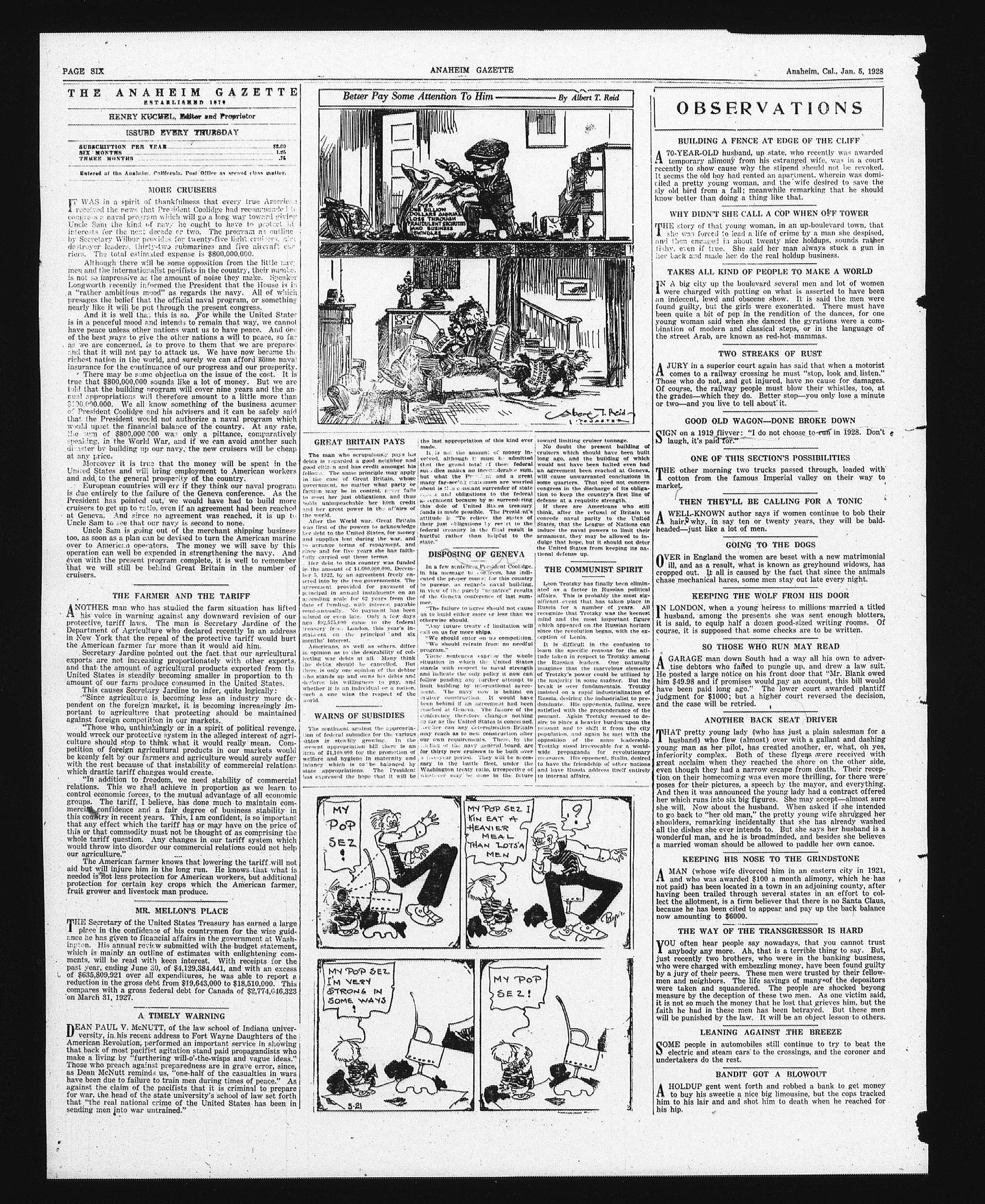
Searchable text
THE ANAHEIM GAZETTE
ESTABLISHED 1870
HENRY KUCHEL, Editor and Proprietor
ISSUED EVERY THURSDAY
SUBSCRIPTION PER YEAR $2.00
SIX MONTHS 1.95
THREE MONTHS .75
Entered at the Anaheim, California, Post Office as second class matter.
MORE CRUISERS
IT WAS in a spirit of thankfulness that every true American received the news that President Coolidge had recommended to congress a naval program which will go a long way toward giving Uncle Sam the kind of navy he ought to have to protect his interests for the next decade or two. The program as outlined by Secretary Wilbur provides for twenty-five light cruisers, also destroyer leaders, thirty-two submarines and five aircraft carriers. The total estimated expense is $800,000,000.
Although there will be some opposition from the little navy men and the internationalist pacifists in the country, their number is not so impressive as the amount of noise they make. Speaker Longworth recently informed the President that the House is in a "rather ambitious mood" as regards the navy. All of which presages the belief that the official naval program, or something nearly like it will be put through the present congress.
And it is well that this is so. For while the United States is in a peaceful mood and intends to remain that way, we cannot have peace unless other nations want us to have peace. And one of the best ways to give the other nations a will to peace, so far as we are concerned, is to prove to them that we are prepared and that it will not pay to attack us. We have now become the richest nation in the world, and surely we can afford some naval insurance for the continuance of our progress and our prosperity.
There may be some objection on the issue of the cost. It is true that $800,000,000 sounds like a lot of money. But we are told that the building program will cover nine years and the annual appropriations will therefore amount to a little more than $100,000,000. We all know something of the business acumen of President Coolidge and his advisers and it can be safely said that the President would not authorize a naval program which would upset the financial balance of the country. At any rate, the sum of $800,000,000 was only a pittance, comparatively speaking, in the World War, and if we can avoid another such disaster by building up our navy, the new cruisers will be cheap.
THE FARMER AND THE TARIFF
ANOTHER man who has studied the farm situation has lifted his voice in warning against any downward revision of our protective tariff laws. The man is Secretary Jardine of the Department of Agriculture who declared recently in an address in New York that the repeal of the protective tariff would hurt the American farmer far more than it would aid him.
Secretary Jardine pointed out the fact that our agricultural exports are not increasing proportionately with other exports, and that the amount of agricultural products exported from the United States is steadily becoming smaller in proportion to the amount of our farm produce consumed in the United States.
This causes Secretary Jardine to infer, quite logically:
"Since agriculture is becoming less an industry more dependent on the foreign market, it is becoming increasingly important to agriculture that protecting should be maintained against foreign competition in our markets."
"Those who, unthinkingly or in a spirit of political revenge, would wreck our protective system in the alleged interest of agriculture should stop to think what it would really mean. Competition of foreign agricultural products in our markets would be keenly felt by our farmers and agriculture would surely suffer with the rest because of that instability of commercial relations which drastic tariff changes would create.
In addition to freedom, we need stability of commercial relations. This we shall achieve in proportion as we learn to control economic forces, to the mutual advantage of all economic groups. The tariff, I believe, has done much to maintain commercial confidence and a fair degree of business stability in this country in recent years. This, I am confident, is so important that any effect which the tariff has or may have on the price of this or that commodity must not be thought of as comprising the whole tariff question. Any changes in our tariff system which would throw into disorder our commercial relations could not help..."
be keenly felt by our farmers and agriculture would surely suffer with the rest because of that instability of commercial relations which drastic tariff changes would create.
"In addition to freedom, we need stability of commercial relations. This we shall achieve in proportion as we learn to control economic forces, to the mutual advantage of all economic groups. The tariff, I believe, has done much to maintain commercial confidence and a fair degree of business stability in this country in recent years. This, I am confident, is so important that any effect which the tariff has or may have on the price of this or that commodity must not be thought of as comprising the whole tariff question. Any changes in our tariff system which would throw into disorder our commercial relations could not help our agriculture."
The American farmer knows that lowering the tariff will not aid but will injure him in the long run. He knows that what is needed is not less protection for American workers, but additional protection for certain key crops which the American farmer, fruit grower and livestock man produce.
MR. MELLON'S PLACE
THE Secretary of the United States Treasury has earned a large place in the confidence of his countrymen for the wise guidance he has given to financial affairs in the government at Washington. His annual review submitted with the budget statement, which is mainly an outline of estimates with enlightening comments, will be read with keen interest. With receipts for the past year, ending June 30, of $4,129,384,441, and with an excess of $635,809,921 over all expenditures, he was able to report a reduction in the gross debt from $19,643,000 to $18,510,000. This compares with a gross federal debt for Canada of $2,774,046,323 on March 31, 1927.
A TIMELY WARNING
DEAN PAUL V. McNUTT, of the law school of Indiana university, in his recent address to Fort Wayne Daughters of the American Revolution, performed an important service in showing that back of most pacifist agitation stand paid propagandists who make a living by "furthering will-o'-the-wisps and vague ideas." Those who preach against preparedness are in grave error, since, as Dean McNutt reminds us, "one-half of the casualties in wars have been due to failure to train men during times of peace." As against the claim of the pacifists that it is criminal to prepare for war, the head of the state university's school of law set forth that "the real national crime of the United States has been in sending men into war untrained."
ANAHEIM GAZETTE
Better Pay Some Attention To Him — By Albert T. Reid
GREAT BRITAIN PAYS
the last appropriation of this kind ever toward limiting cruiser tonnage.
No doubt the present building of
GREAT BRITAIN PAYS
The man who scrupulously pays his debts is regarded a good neighbor and good citizen and has credit amongst his fellows. The same principle may apply in the case of Great Britain, whose government, no matter what party or faction may be in control, never fails to meet her just obligations, and thus holds unimpeachable her high credit and her great power in the affairs of the world.
After the World war, Great Britain was first of the powers to acknowledge her debt to the United States, for money and supplies lent during the war, and to arrange terms of repayment, and since and for five years she has faithfully carried out those terms.
Her debt to this country was funded in the amount of $4,600,000,000. December 5, 1922, by an agreement freely entered into by the two governments. The agreement provided for payment of principal in annual instalments on an ascending scale for 62 years from the date of funding, with interest payable semi-annually. No payment has been missed or even late. Only a few days ago $22,575,000 came to the federal treasury from London, this year's instalment on the principal and six months' interest.
Americans, as well as others, differ in opinion as to the desirability of collecting war debts at all. Many think the debts should be cancelled. But there is only one opinion of the debtor who stands up and owns his debts and declares his willingness to pay, and whether it is an individual or a nation, such a one wins the respect of the world.
WARNS OF SUBSIDIES
The sentiment against the appropriation of federal subsidies for the various states is steadily growing. In the present appropriation bill there is an item of $1,100,000 for the promotion of welfare and hygiene in maternity and infancy which is to be balanced by state appropriations. The President has expressed the hope that it will be the last appropriation of this kind ever made.
It is not the amount of money involved, although it must be admitted that the grand total of these federal subsidies makes no considerable sum, but what the President and a great many far-seeking statesmen are worried about is this constant surrender of state funds and obligations to the federal government because by so surrendering this dole of United States treasury funds is made possible. The President's attitude is "To relieve the states of their just obligations by resort to the federal treasury in the final result is hurtful rather than helpful to the state."
DISPOSING OF GENEVA
In a few sentences President Coolidge, in his message to Congress, has indicated the proper course for this country to pursue, as regards naval building, in view of the purely "negative" results of the Geneva conference of last summer.
"The failure to agree should not cause us to build either more or less than we otherwise should."
"Any future treaty of limitation will call on us for more ships."
"We should enter on no competition."
"We should refrain from no needful program."
These sentences express the whole situation in which the United States stands with respect to naval strength and indicate the only policy it now can follow pending any further attempt to limit building by international agreement. The navy now is behind on cruiser construction. It would have been behind if an agreement had been reached at Geneva. The failure of the conference therefore changes nothing so far as the United States is concerned neither can any determination Britain may reach as to new construction after our own requirements. These, by the cutting of the naval general board, are for thirty new cruisers to be built over a five-year period. They will be necessary to the battle fleet, under the Washington treaty ratio, irrespective of whatever may be done in the future toward limiting cruiser tonnage.
No doubt the present building of cruisers which should have been built long ago, and the building of which would not have been halted even had an agreement been reached at Geneva, will cause unwarranted conclusions in some quarters. That need not concern congress in the discharge of its obligation to keep the country's first line of defense at a requisite strength.
If there are Americans who still think, after the refusal of Britain to concede naval parity to the United States, that the League of Nations can induce the naval powers to limit their armament, they may be allowed to indulge that hope, but it should not deter the United States from keeping its national defense up.
THE COMMUNIST SPIRIT
Leon Trotzky has finally been eliminated as a factor in Russian political affairs. This is probably the most significant event that has taken place in Russia for a number of years. All recognize that Trotzky was the keenest mind and the most important figure which appeared on the Russian horizon since the revolution began, with the exception of Lenin.
It is difficult in the confusion to learn the specific reasons for the attitude taken in respect to Trotzky among the Russian leaders. One naturally imagines that the marvelous elements of Trotzky's power could be utilized by the majority in some manner. But the break is over fundamentals. Trotzky insisted on a rapid industrialization of Russia, desiring the industrialist to predominate. His opponents, failing were satisfied with the preponderance of the peasant. Again Trotzky seemed to desire to place a heavier burden upon the peasant and to shift it from the city population, and again he met with the opposition of the same leadership. Trotzky stood irrevocable for a worldwide propaganda for revolutionary measures. His opponent, Stalin, desired to have the friendship of other nations and have Russia address itself entirely to internal affairs.
welfare and hygiene in maternity and intancy which is to be balanced by state appropriations. The President has expressed the hope that it will be a five-year period. They will be necessary to the battle fleet, under the Washington treaty ratio, irrespective of whatever may be done in the future measures. His opponent, Stalin, desired to have the friendship of other nations and have Russia address itself entirely to internal affairs.
MY POP SEZ!
MY POP SEZ I KIN EAT A HEAVIER MEAL THAN LOTS'A MEN
MY POP SEZ I'M VERY STRONG IN SOME WAYS!
MY POP SEZ!
OBSERVATIONS
BUILDING A FENCE AT EDGE OF THE CLIFF
A 70-YEAR-OLD husband, up state, who recently was awarded temporary alimony from his estranged wife, was in a court recently to show cause why the stipend should not be revoked. It seems the old boy had rented an apartment, wherein was domiciled a pretty young woman, and the wife desired to save the sly old bird from a fall; meanwhile remarking that he should know better than doing a thing like that.
WHY DIDN'T SHE CALL A COP WHEN OFF TOWER
The story of that young woman, in an up-boulevard town, that she was forced to lead a life of crime by a man she despised, and then engaged in about twenty nice holdups, sounds rather fishy, even if true. She said her man always stuck a gun in her back and made her do the real holdup business.
TAKES ALL KIND OF PEOPLE TO MAKE A WORLD
In a big city up the boulevard several men and lot of women were charged with putting on what is asserted to have been an indecent, lewd and obscene show. It is said the men were found guilty, but the girls were exonerated. There must have been quite a bit of pep in the rendition of the dances, for one young woman said when she danced the gyrations were a combination of modern and classical steps, or in the language of the street Arab, are known as red-hot mammas.
TWO STREAKS OF RUST
A JURY in a superior court again has said that when a motorist comes to a railway crossing he must "stop, look and listen." Those who do not, and get injured, have no cause for damages. Of course, the railway people must blow their whistles, too, at the grades—which they do. Better stop—you only lose a minute or two—and you live to tell about it.
GOOD OLD WAGON—DONE BROKE DOWN
SIGN on a 1919 flivver: "I do not choose to run in 1928. Don't laugh, it's paid for."
A JURY in a superior court again has said that when a motorist comes to a railway crossing he must "stop, look and listen." Those who do not, and get injured, have no cause for damages. Of course, the railway people must blow their whistles, too, at the grades—which they do. Better stop—you only lose a minute or two—and you live to tell about it.
GOOD OLD WAGON—DONE BROKE DOWN
SIGN on a 1919 flivver: "I do not choose to run in 1928. Don't laugh, it's paid for."
ONE OF THIS SECTION'S POSSIBILITIES
THE other morning two trucks passed through, loaded with cotton from the famous Imperial valley on their way to market.
THEN THEY'LL BE CALLING FOR A TONIC
A WELL-KNOWN author says if women continue to bob their hair why, in say ten or twenty years, they will be bald-headed—just like a lot of men.
GOING TO THE DOGS
OVER in England the women are beset with a new matrimonial ill, and as a result, what is known as greyhound widows, has cropped out. It all is caused by the fact that since the animals chase mechanical hares, some men stay out late every night.
KEEPING THE WOLF FROM HIS DOOR
IN LONDON, when a young heiress to millions married a titled husband, among the presents she was sent enough blotters, it is said, to equip half a dozen good-sized writing rooms. Of course, it is supposed that some checks are to be written.
SO THOSE WHO RUN MAY READ
A GARAGE man down South had a way all his own to advertise debtors who failed to pangle up, and drew a law suit. He posted a large notice on his front door that "Mr. Blank owed him $49.98 and if promises would pay an account, this bill would have been paid long ago." The lower court awarded plantiff judgment for $1000; but a higher court reversed the decision, and the case will be retried.
ANOTHER BACK SEAT DRIVER
THAT pretty young lady (who has just a plain salesman for a husband) who flew (almost) over with a gallant and dashing young man as her pilot, has created another, er, what, oh yes, inferiority complex. Both of these flyers were received with great acclaim when they reached the shore on the other side, even though they had a narrow escape from death. Their reception on their homecoming was even more thrilling, for there were poses for their pictures, a speech by the mayor, and everything. And then it was announced the young lady had a contract offered her which runs into six big figures. She may accept—almost sure she will. Now about the husband. When asked if she intended to go back to "her old man," the pretty young wife shrugged her shoulders, remarking incidentally that she has already washed all the dishes she ever intends to. But she says her husband is a wonderful man, and he is broadminded, and besides she believes a married woman should be allowed to paddle her own canoe.
KEEPING HIS NOSE TO THE GRINDSTONE
MAN (whose wife divorced him in an eastern city in 1921, and who was awarded $100 a month alimony, which he has not paid) has been located in a town in an adjoining county, after having been trailed through several states in an effort to collect the allotment, is a firm believer that there is no Santa Claus, because he has been cited to appear and pay up the back balance now amounting to $6000.
THE WAY OF THE TRANSGRESSOR IS HARD
YOU often hear people say nowadays, that you cannot trust anybody any more. Ah, that is a terrible thing to say. But, just recently two brothers, who were in the banking business, who were charged with embezzling money, have been found guilty by a jury of their peers. These men were trusted by their fellow-men and neighbors. The life savings of many of the depositors were taken and squandered. The people are shocked beyond measure by the deception of these two men. As one victim said, it is not so much the money that he lost that grieves him, but the faith he had in these men has been betrayed. But these men will be punished by the law. It will be an object lesson to others.
LEANING AGAINST THE BREEZE
SOME people in automobiles still continue to try to beat the electric and steam cars to the crossings, and the coroner and undertakers do the rest.
BANDIT GOT A BLOWOUT
A HOLDUP gent went forth and robbed a bank to get money to buy his sweetie a nice big limousine, but the cops tracked him to his lair and shot him to death when he reached for his hip.