anaheim-gazette 1927-12-08
Scanned page
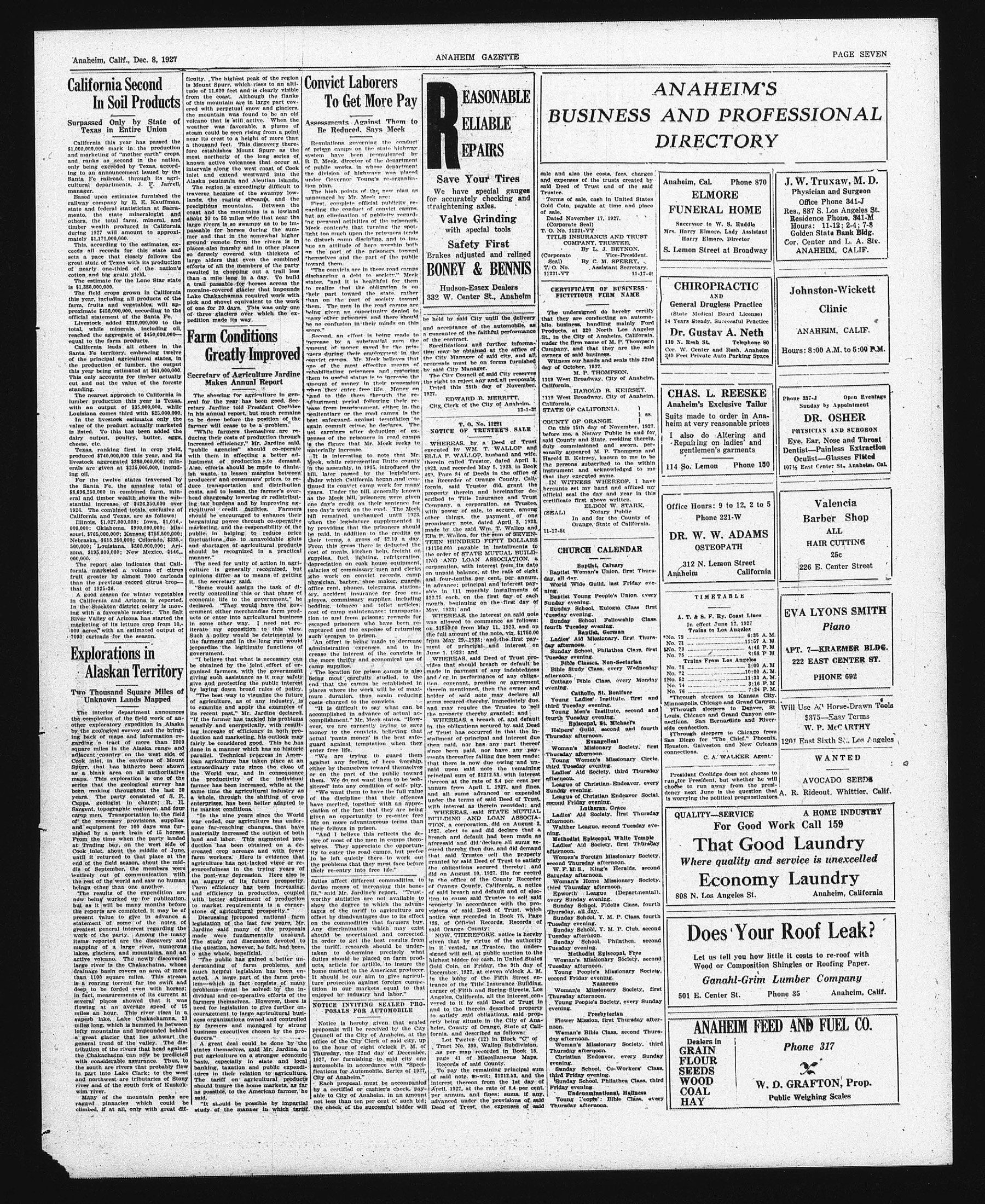
Searchable text
California Second In Soil Products
Surpassed Only by State of Texas in Entire Union
California this year has passed the $1,000,000,000 mark in the production and marketing of "mother earth" crops, and ranks as second in the nation, only being exceeded by Texas, according to an announcement issued by the Santa Fe railroad, through its agricultural departments, J. F. Jarrell, manager.
Based upon estimates furnished the railway company by E. E. Kauffman, state and federal statistician at Sacramento, the state mineralogist and others, the total farm, mineral, and timber wealth produced in California during 1927 will amount to approximately $1,171,000,000.
This, according to the estimates, exceeds all records for this state and sets a pace that closely follows the great state of Texas with its production of nearly one-third of the nation's cotton and big grain yield.
The estimate for the Lone Star state is $1,380,000,000.
The field crops grown in California this year, including all products of the farm, fruits and vegetables, will approximate $450,000,000, according to the official statement of the Santa Fe.
Livestock added $210,000,000 to the total, while minerals, including oil, reached the aggregate of $450,000,000—equal to the farm products.
California leads all others in the Santa Fe territory, embracing twelve of the principal agricultural states, in the production of lumber, the output this year being estimated at $61,000,000. This only accounts for timber actually cut and not the value of the forests standing.
The nearest approach to California in lumber production this year is Texas, with an output of $35,000,000, while Louisiana comes third with $25,000,000.
In the livestock estimates only the value of the product actually marketed is listed. To this has been added the dairy output, poultry, butter, eggs, cheese, etc.
Farm Conditions Greatly Improved
Secretary of Agriculture Jardine Makes Annual Report
The showing for agriculture in general for the year has been good. Secretary Jardine told President Coolidge in his annual report, but much remains to be done before the position of the farmer will cease to be a problem.
While farmers themselves are reducing their costs of production through increased efficiency," Mr. Jardine said. "Improvements should co-operate with the highest peak of the region is Mount Spurr, which rises to an altitude of 11,000 feet and is clearly visible from the coast. Although the flanks of this mountain are in large part covered with perpetual snow and glaciers, the mountain was found to be an old volcano that is still active. When the weather was favorable, a plume of steam could be seen rising from a point near its crest to a height of more than a thousand feet. This discovery therefore establishes Mount Spurr as the most northerly of the long series of known active volcanoes that occur at intervals along the west coast of Cook Inlet and extend westward into the Alaska peninsula and Aleutian islands.
The region is exceedingly difficult to traverse because of the swampy lowlands, the raging streams, and the precipitous mountains. Between the coast and the mountains is a lowland about 30 to 50 miles wide that near the large rivers is so swampy as to be impassable for horses during the summer and that in the somewhat higher ground remote from the rivers is in places also marshy and in other places so densely covered with thickets of large alders that even the combined efforts of all the members of the party resulted in chopping out a trail less than a mile long in a day. To build a trail passable for horses across the moraine-covered glacier that impounds Lake Chakachamna required work with pick and shovel equivalent to the work of one for 20 days. This was only one of three glaciers over which the expedition made its way.
Convict Labors To Get Measures Again Be Reduced.
Regulations govern prion camps on this system have been B. B. Meek, director of public works, in view of the division of highland under Governor Yoution plan.
The high points of announced by Mr. Meek.
First, complete offering but an elimination of ing personal activities Meck contends that light too much upon them to disturb camp dishew on an attitude of hone on the part of them themselves and put toward them.
"The convicts are in discharging a debt states," and it is he to realize that they part toward than on the part of them. The men in them being given an opportunity many other prisoners he no confusion in their score."
Second, an effort increase by a subtotal amount of money smuggled among their convict camps. Mr. Meek one of the most rehabilitating prisoners them to useful status amount of money in when they enter free land to tide them adjustment period for lease from imprisonment penitentiary or the rest best safeguard against again commit crime. Net earnings after expenses of the prison is the figure that Maternality increase.
Greatly Improved
Secretary of Agriculture Jardine Makes Annual Report
The showing for agriculture in general for the year has been good. Secretary Jardine told President Coolidge in his annual report, but much remains to be done before the position of the farmer will cease to be a problem.
While farmers themselves are reducing their costs of production through increased efficiency, Mr. Jardine said, "public agencies" should co-operate with them in effecting a better adjustment of production to demand. Also, efforts should be made to diminish waste, to lessen margins between producers' and consumers' prices, to reduce transportation and distribution costs, and to lessen the farmer's overhead charges by lowering or redistributing tax burdens and by improving agricultural credit facilities. Farmers should be encouraged to enhance their bargaining power through co-operative marketing, and the responsibility of the public in helping to reduce price fluctuations due to unavoidable gluts and shortages of agricultural products should be recognized in a practical manner."
The need for unity of action in agriculture is generally recognised, but opinions differ as to means of getting it, the secretary said.
Some would assign the task of directly controlling this or that phase of economic life to the government, he declared. They would have the government either merchandise farm products or enter into agricultural business in some other way. I need not reiterate my opposition to this view. Such a policy would be detrimental to the farmers and in the long run would jeopardize the legitimate functions of government.
"I believe that what is necessary can be obtained by the joint effort of organized farmers, with the government giving such assistance as it may safely give and protecting the public interest by laying down broad rules of policy." The best way to visualize the future of agriculture, as of any industry, is to examine and apply the examples of its recent past," Mr. Jardine declared.
If the farmer has tackled his problems sensibly and energetically, with resulting increase of efficiency in both production and marketing, his outlook may fairly be considered good. This he has done in a manner which has no historic parallel. Technical progress in American agriculture has taken place at an extraordinary rate since the close of the World war, and in consequence the productivity of the individual farmer has been increased, while at the same time the agricultural industry as a whole, through the shifting of crop enterprises, has been better adapted to its market conditions.
In the nine years since the World war ended, our agriculture has undergone far-reaching changes, that have materially increased the output of both land and labor. This augmented production has been obtained on a decreased average and with fewer conflicts during their convict camps. Mr. Jardine noted that most of the most rehabilitating prisoners them to useful status amount of money in when they enter free land and tide them off adjustment period for lease from imprisonment sentitary or the best safeguard against again commit crime, net earnings after expenses of the prison is the figure that Mr. materially increase.
It is interesting to Meek, while representing in the assembly, in 19 bill, later passed by under which California financed its convict care years. Under the bill as the Meek bill, prime one day's credit on two days' work on the bill remained unchanged when the legislature by providing that they be paid, in addition their terms, a gross cost of meals, kitchen supplies, fuel, light depreciation on cook salaries of commissars who work on convict physician, barber, office rent, phones, accident insurance ployes, commissary bedding, tobacco and cost of camp maintenance to and from prisons escaped prisoners we captured and the ex-escapes to pris.
An effort is being administration expense crease the interest more thrifty and camp supplies.
The location for prince being most careful end that the camps places where the womum duration, thus costs charged to them.
"It is difficult to accomplish in adveillance." Mr. Jardine ever, we are earnest money to the convict actual pants money guard against temp enter free life.
"We are trying against any feeling either by themselves or on the part of them. We do not want altered into any com-"
"We want them to have merited together citation of the fact given an opportunity life on more advanced their fellows in prize."
And I believe the size of most of the nouns. They appre
The results of the expenditure are now being worked up for publication, but as it will be many months before the reports are completed, it may be of present value to give in advance a statement of some of the notes of greatest general interest regarding the work of the party. Among the many items reported are the discovery and mapping of a large river, numerous lakes, glaciers, and mountains, and an active volcano. The newly discovered large river is the Chakachatna, whose drainage basin covers an area of more than 1100 square miles. This stream is a roaring torrent far too swift and deep to be forced even with horses; in fact, measurements of its current at several places showed that it was flowing at an average speed of 15 miles an hour. This river rises in a superb lake, Lake Chakachamna, 23 miles long, which is hemmed in between lofty mountains and impounded behind a great glacier that lies athwart the general trend of the valley. The distribution of the rivers that head against the Chakachatna can now be predicted with considerable assurance. Thus, to the south are rivers that probably flow in part into Lake Clark; to the west and northwest are tributaries of Stony river and of the south fork of Kuskokwim river.
Many of the mountain peaks are ragged pinnacles which could be climbed, if at all, only with great difficulty.
Technical progress in American agriculture has taken place at an extraordinary rate since the close of the World war, and in consequence the productivity of the individual farmer has been increased, while at the same time the agricultural industry as a whole, through the shifting of crop enterprises, has been better adapted to its market conditions.
"In the nine years since the World war ended, our agriculture has undergone far-reaching changes, that have materially increased the output of both land and labor. This augmented production has been obtained on a decreased crop acreage and with fewer farm workers. Here is evidence that agriculture has not lacked vigor or resourcefulness in the trying years of the post-war depression. Here also is an augury of its future prosperity. Farm efficiency has been increasing, and efficiency in production, coupled with better adjustment of production to market requirements is a cornerstone of agricultural prosperity."
Discussing proposed national farm legislation of the last few years, Mr. Jardine said many of the proposals made were fundamentally unsound. The study and discussion devoted to the question, however, he felt, had been o nthe whole, beneficial.
"The public has gained a better understanding of farm problems, and much helpful legislation has been enacted. A large part of the farm problem—which in fact consists of many problems—must be solved by the individual and co-operative efforts of the farmers themselves. However, there is need for legislation to give further encouragement to large agricultural business organizations owned and controlled by farmers and managed by strong business executives chosen by the producers."
A great deal could be done by the states themselves, said Mr. Jardine, to put agriculture on a stronger economic basis, especially in state and local banking, taxation and public expenditures in their relation to agriculture. The tariff on agricultural products should insure the home markets, as far as possible, to the American farmer, he said.
"It should be possible by impartial study of the manner in which tariff."
Convict Laborers To Get More Pay
Assessments Against Them to Be Reduced. Says Meek
Regulations governing the conduct of prison camps on the state highway system have been promulgated by B. B. Meek, director of the department of public works, in whose department the division of highways was placed under Governor Young's re-organization plan.
The high points of the new plan are announced by Mr. Meek are:
First, complete official publicity regarding the conduct of convict camps but an elimination of publicity regarding personal activities of the prisoners. Meek contends that turning the spotlight too much upon the prisoners tends to disturb camps discipline, and to imbue an attitude of hero worship both on the part of the prisoners toward themselves and the part of the public toward them.
"The convicts are in these road camps discharging a debt to society." Meek states, "and it is healthful for them to realize that the obligation is on their part toward the state, rather than on the part of society toward them. The men in the road camps are being given an opportunity denied to many other prisoners and there should be no confusion in their minds on this score."
Second, an effort is being made to increase by a substantial sum the amount of money saved by the prisoners during their employment in the convict camps. Mr. Meek believes that one of the most effective means of rehabilitation prisoners and restoring them to useful status is to increase the amount of money in their possession when they enter free life. Money on hand to tide them through the adjustment period following their release from imprisonment, either in the penitentiary or the road camps, is the best safeguard against temptation to again commit crime, he declares. The net earnings after deduction of expenses of the prisoners in road camps is the figure that Mr. Meek seeks to materialize.
REASONABLE RELIABLE REPAIRS
Save Your Tires
We have special gauges for accurately checking and straightening axles.
Valve Grinding with special tools
Safety First
Brakes adjusted and relined
BONEY & BENNIS
Hudson-Essex Dealers 332 W. Center St., Anaheim
be held by said City until the delivery and acceptance of the automobile, as a guarantee of the faithful performance of the contract.
Specifications and further information may be obtained at the office of the City Manager of said city, and all proposals must be on forms furnished by said City Manager.
The City Council of said City reserves the right to reject any and all proposals. Dated this 28th day of November, 1927.
EDWARD R. MERRITT,
City Clerk of the City of Anaheim.
12-1-3t
T. O. No. 11221
NOTICE OF TRUSTEE'S SALE
WHEREAS, by a Deed of Trust by WM. T. WALLOP and sale and also the costs, fees, charges and expenses of the trusts created by said Deed of Trust and of the said Trustee.
Terms of sale, cash in United States Gold Coin, payable at time and place of sale.
Dated November 17, 1927.
(Corporate Seal)
T. O. No. 11221-VT
TITLE INSURANCE AND TRUST COMPANY, TRUSTEE.
By L. J. BEYNON.
(Corporate Seal)
By C. M. SPERRY.
T. O. No.
Assistant Secretary.
11221-VT
11-17-4t
CERTIFICATE OF BUSINESS FICTITIOUS FIRM NAME
The undersigned do hereby certify that they are conducting an automobile business, handling mainly Ford Products, at $20 North Los Angeles St., in the City of Anaheim, California, under the firm name of M. P. Thompson Company, and that they are the sole owners of said business.
Witness our hands and seals this 22nd day of October, 1927.
M. P. THOMPSON,
1119 West Broadway, City of Anaheim, California.
HAROLD B. KEIRSEY,
1119 West Broadway, City of Anaheim, California.
STATE OF CALIFORNIA.
COUNTY OF ORANGE.
On this 15th day of November, 1927, before me, a Notary Public in and for said County and State, residing therein, duly commissioned and sworn, per-
It is interesting to note that Mr. Meek while representing Butte county in the assembly, in 1915, introduced the bill, later passed by the legislature under which California began and continued its convict camp work for many years. Under the bill, generally known as the Meek bill, prisoners were given one day's credit on their sentence for two days' work on the road. The Meek bill remained unchanged until 1923 when the legislature supplemented it by providing that the prisoners should be paid, in addition to the credits on their terms, a gross of $2.10 a day. From this gross there is deducted the cost of meals, kitchen help, freight on supplies, fuel, lighting, refrigeration, depreciation on cook house equipment, salaries of commissary men and clerks who work on convict records, camp physician, barber, shoe maker, guards, office rent, phones, telegrams, stationery, accident insurance for free employees, commissary supplies, including bedding, tobacco and toilet articles; cost of camp maintenance; transportation to and from prisons; rewards for escaped prisoners who have been captured and the expense of returning such escapes to prison.
An effort is being made to decrease administration expenses, and to increase the interest of the convicts in the more thrifty and economical use of camp supplies.
The location for prison camps is also being most carefully studied, to the end that the camps be established in places where the work will be of maximum duration, thus again reducing costs charged to the convicts.
"It is difficult to say what can be accomplished in advance of actual accomplishment." Mr. Meek states. However, we are earnestly trying to save money to the convicts, believing that actual pants money is the best safeguard against temptation when they enter free life.
"We are trying to guard them against any feeling of hero worship, either by themselves toward themselves or on the part of the public toward them. We do not want them to be 'sheltered' into any condition of self-pity."
"We want them to have the full value of the discipline that their offences have merited, together with an appreciation of the fact that they are being given an opportunity to re-enter free life on more advantageous terms than their fellows in prison.
"And I believe this reflects the desire of most of the men in camps themselves. They appreciate the opportunist nature during convict camps. Mr. Meek believes that one of the most effective means of rehabilitation prisoners and restoring them to useful status is to increase the amount of money in their possession when they enter free life. Money on hand to tide them through the adjustment period following their release from imprisonment, either in the penitentiary or the road camps, is the best safeguard against temptation to again commit crime, he declares. The net earnings after deduction of expenses of the prisoners in road camps is the figure that Mr. Meek seeks to materially increase.
It is interesting to note that Mr. Meek while representing Butte county in the assembly, in 1915, introduced the bill, later passed by the legislature under which California began and continued its convict camp work for many years. Under the bill, generally known as the Meek bill, prisoners were given one day's credit on their sentence for two days' work on the road. The Meek bill remained unchanged until 1923 when the legislature supplemented it by providing that the prisoners should be paid, in addition to the credits on their terms, a gross of $2.10 a day. From this gross there is deducted the cost of meals, kitchen help, freight on supplies, fuel, lighting, refrigeration, depreciation on cook house equipment, salaries of commissary men and clerks who work on convict records, camp physician, barber, shoe maker, guards, office rent, phones, telegrams, stationery, accident insurance for free employees, commissary supplies, including bedding, tobacco and toilet articles; cost of camp maintenance; transportation to and from prisons; rewards for escaped prisoners who have been captured and the expense of returning such escapes to prison.
An effort is being made to decrease administration expenses, and to increase the interest of the convicts in the more thrifty and economical use of camp supplies.
The location for prison camps is also being most carefully studied, to the end that the camps be established in places where the work will be of maximum duration, thus again reducing costs charged to the convicts.
"It is difficult to say what can be accomplished in advance of actual accomplishment." Mr. Meek states. However, we are earnestly trying to save money to the convicts, believing that actual pants money is the best safeguard against temptation when they enter free life.
"We are trying to guard them against any feeling of hero worship, either by themselves toward themselves or on the part of the public toward them. We do not want them to be 'sheltered' into any condition of self-pity."
"We want them to have the full value of the discipline that their offences have merited, together with an appreciation of the fact that they are being given an opportunity to re-enter free life on more advantageous terms than their fellows in prison.
"And I believe this reflects the desire of most of the men in camps themselves. They appreciate the opportunistic nature during convict camps. Mr. Meek believes that one of the most effective means of rehabilitation prisoners and restoring them to useful status is to increase the amount of money in their possession when they enter free life. Money on hand to tide them through the adjustment period following their release from imprisonment, either in the penitentiary or the road camps, is the best safeguard against temptation to again commit crime, he declares. The net earnings after deduction of expenses of the prisoners in road camps is the figure that Mr. Meek seeks to materially increase.
It is interesting to note that Mr. Meek while representing Butte county in the assembly, in 1915, introduced the bill, later passed by the legislature under which California began and continued its convict camp work for many years. Under the bill, generally known as the Meek bill, prisoners were given one day's credit on their sentence for two days' work on the road. The Meek bill remained unchanged until 1923 when the legislature supplemented it by providing that the prisoners should be paid, in addition to the credits on their terms, a gross of $2.10 a day. From this gross there is deducted the cost of meals, kitchen help, freight on supplies, fuel, lighting, refrigeration, depreciation on cook house equipment, salaries of commissary men and clerks who work on convict records, camp physician, barber, shoe maker, guards, office rent, phones, telegrams, stationery, accident insurance for free employees, commissary supplies, including bedding, tobacco and toilet articles; cost of camp maintenance; transportation to and from prisons; rewards for escaped prisoners who have been captured and the expense of returning such escapes to prison.
An effort is being made to decrease administration expenses, and to increase the interest of the convicts in the more thrifty and economical use of camp supplies.
The location for prison camps is also being most carefully studied, to the end that the camps be established in places where the work will be of maximum duration, thus again reducing costs charged to the convicts.
"It is difficult to say what can be accomplished in advance of actual accomplishment." Mr. Meek states. However, we are earnestly trying to save money to the convicts, believing that actual pants money is the best safeguard against temptation when they enter free life.
"We are trying to guard them against any feeling of hero worship, either by themselves toward themselves or on the part of the public toward them. We do not want them to be 'sheltered' into any condition of self-pity."
"We want them to have the full value of the discipline that their offences have merited, together with an appreciation of the fact that they are being given an opportunity to re-enter free life on more advantageous terms than their fellows in prison.
"And I believe this reflects the desire of most of the men in camps themselves. They appreciate the opportunistic nature during convict camps. Mr. Meek believes that one of the most effective means of rehabilitation prisoners and restoring them to useful status is to increase the amount of money in their possession when they enter free life. Money on hand to tide them through the adjustment period following their release from imprisonment, either in the penitentiary or the road camps, is the best safeguard against temptation to again commit crime, he declares. The net earnings after deduction of expenses of the prisoners in road camps is the figure that Mr. Meek seeks to materially increase.
It is interesting to note that Mr. Meek while representing Butte county in the assembly, in 1915,introducedthe bill,basedonwhichCaliforniabeganandcontinueditsconvictcampworkformanyyears.UnderwhichCaliforniabeganandcontinueditsconvictcampworkformanyyears.UnderwhichCaliforniabeganandcontinueditsconvictcampworkformanyyears.UnderwhichCaliforniabeganandcontinueditsconvictcampworkformanyyears.UnderwhichCaliforniabeganandcontinueditsconvictcampworkformanyyears.UnderwhichCaliforniabeganandcontinueditsconvictcampworkformanyyears.UnderwhichCaliforniabeganandcontinueditsconvictcampworkformanyyears.UnderwhichCaliforniabeganandcontinueditsconvictcampworkformanyyears.UnderwhichCaliforniabeganandcontinueditsconvictcampworkformanyyears.UnderwhichCaliforniabeganandcontinueditsconvictcampworkformanyyears.UnderwhichCaliforniabeganandcontinueditsconvictcampworkformanyyears.UnderwhichCaliforniabeganandcontinueditsconvictcampworkformanyyears.UnderwhichCaliforniabeganandcontinueditsconvictcampworkformanyyears.UnderwhichCaliforniabeganandcontinueditsconvictcampworkformanyyears.UnderwhichCaliforniabeganandcontinueditsconvictcampworkformanyyears.UnderwhichCaliforniabeganandcontinueditsconvictcampworkformanyyears.UnderwhichCaliforniabeganandcontinueditsconvictcampworkformanyyears.UnderwhichCaliforniabeganandcontinueditsconvictcampworkformanyyears.UnderwhichCaliforniabeganandcontinueditsconvictcampworkformanyyears.UnderwhichCaliforniabeganandcontinueditsconvictcampworkformanyyears.UnderwhichCaliforniabeganandcontinueditsconvictcampworkformanyyears.UnderwhichCaliforniabeganandcontinueditsconvictcampworkformanyyears.UnderwhichCaliforniabeganandcontinueditsconvictcampworkformanyyears.UnderwhichCaliforniabeganandcontinueditsconvictcampworkformanyyears.UnderwhichCaliforniabeganandcontinueditsconvictcampworkformanyyears.UnderwhichCaliforniabeganandcontinueditsconvictcampworkformanyyears.UnderwhichCaliforniabeganandcontinueditsconvictcampworkformanyyears.UnderwhichCaliforniabeganandcontinueditsconvictcampworkformanyyears.UnderwhichCaliforniabeganandcontinueditsconvictcampworkformanyyears.UnderwhichCaliforniabeganandcontinueditsconvictcampworkformanyyears.UnderwhichCaliforniabeganandcontinueditsconvictcampworkformanyyears.UnderwhichCaliforniabeganandcontinueditsconvictcampworkformanyyears.UnderwhichCaliforniabeganandcontinendeditsconvictcampworkformanyyears.UnderwhichCaliforniabeganandcontinendeditsconvictcampworkformanyyears.UnderwhichCaliforniabeganandcontinendeditsconvictcampworkformanyyears.UunderwhichCaliforniabeganandcontinendeditsconvictcampworkformanyyears.UunderwhichCaliforniabeganandcontinendeditsconvictcampworkformanyyears.UunderwhichCaliforniabeganandcontinendeditsconvictcampworkformanyyears.UunderwhichCaliforniabeganandcontinendeditisconvictcampworkformanyyears.UunderwhichCaliforniabeganandcontinendeditisconvictcampworkformanyyears.UunderwhichCaliforniabeganandcontinendeditisconvictcampworkformanyyears.UunderwhichCaliforniabeganandcontinendeditisconvictcampworkformanyyears.UunderwhichCaliforniabeganandcontinendeditisconvictcampworkformanyyears.UunderwhichCaliforniabeganandcontinendeditisconvictcampworkformanyyears.UunderwhichCaliforniabeganandcontinendeditisconvictcampworkformanyyears.UunderwhichCaliforniabeganandcontinendeditisconvictcampworkformanyyears.UunderwhichCaliforniabeganandcontinendeditisconvictcampworkformanyyears.UunderwhichCaliforniabeganandcontinendeditisconvictcampworkformanyyears.UunderwhichCaliforniabeganandcontinueditisconvictcampworkformanyyears.UunderwhichCaliforniabeganandcontinueditisconvictcampworkformanyyears.UunderwhichCaliforniabegan和continueditisconvictcampworkformanyyears.UunderwhichCaliforniabegan和continueditisconvictcampworkformanyyears.UunderwhichCaliforniabegen和continueditisconvictcampworkformanyyears.UunderwhichCaliforniabegen和continueditisconvictcampworkformanyyears.UunderwhichCaliforniabegen和continueditisconvictcampworkformanyyears.UunderwhichCaliforniabegen和continueditis convictcampworkformanyyears.UunderwhichCaliforniabegen和continueditis convict CampWorkForMaleUnion.firstThursday.day.all-day.WorldWideGuild.lastFridayevening.BaptistYoungPeople'sUnion.everySunday.evening.SundaySchool.FellowshipClass.fourthTuesday.evening.Baptist,GermanLadies'AidMissionary.firstThursdayafternoon.SundaySchool.PhilatheaClass.firstTuesdayevening.RibbleClasses,Non-SecretarianBibleStudyClass.everyWednesdayafternoon.CottageBibleClass.everyMondayevening.CatholicSt.BonifaceYouthAdmissionary.firstThursdayafternoon.BaptistWomen'sMissionaryCircle.firstTuesdayevening.Ladies'AidSociety.thirdTuesdayevening.Ladies'AidSociety.thirdTuesdayevening.Ladies'AidSociety.thirdTuesdayevening.Ladies'AidSociety.thirdTuesdayevening.Ladies'AidSociety.thirdTuesdayevening.Ladies'AidSociety.thirdTuesdayevening.Ladies'AidSociety.thirdTuesdayevening.Ladies'AidSociety.thirdTuesdayevening.Ladies'AidSociety.thirdTuesdayevening.Ladies'AidSociety.thirdTuesdayevening.Ladies'AidSociety.thirdTuesdayevening.Ladies'AidSociety.thirdTuesdayevening.Ladies'AidSociety.thirdTuesdayevening.Ladies'AidSociety.thirdTuesdayevening.Ladies'AidSociety.thirdTuesdayevening.Ladies'AidSociety.thirdTuesdayevening.Ladies'AidSociety.thirdTuesdayevening.Ladies'AidSociety.thirdTuesdayevening.Ladies'AidSociety.thirdTuesdayevening.Ladies'AidSociety.thirdTuesdayevening.Ladies'AidSociety.thirdTuesdayevening.Ladies'AidSociety.thirdTuesday evenning.Ladies'AidSociety.thirdTuesday evenning.Ladies'AidSociety.thirdT Tuesday evenning.Ladies'AidSociety.thirdT Tuesday evenning.Ladies'AidSociety.thirdT Tuesday evenning.Ladies'AidSociety.thirdT Tuesday evenning.Ladies'AidSociety.thirdT Tuesday evenning.Ladies'AidSociety.thirdT Tuesday evenning.Ladies'AidSociety.thirdT Tuesday evenning.Ladies'AidSociety.thirdT Tuesday evenning.Ladies'AidSociety.thirdT Tuesday evenning.Ladies'AidSociety.thirdT Tuesday evenning.Ladies'AidSociety.thirdT Tuesday evenning.Ladies'AidSociety.thirdT Tuesday evenning.Ladies'AidSociety.thirdT Tuesday evenning.Ladies'AidSociety.thirdT Tuesday evenning.Ladies'AidSociety.thirdT Tuesday evenning.Ladies'AidSociety.thirdT Tuesday evenning.Ladies'AidSociety.third T Tuesday evenning.Ladies'AidSociety.third T Tuesday evenning.Ladies'AidSociety.third T Tuesday evenning.Ladies'AidSociety.third T Tuesday evenning.Ladies'AidSociety.third T Tuesday evenning.Ladies'AidSociety.third T Tuesday evenning.Ladies'AidSociety.third T Tuesday evenning.Ladies'AidSociety.thirds T Tuesday evenning.Ladies'AidSociety.thirds T Tuesday evenning.Ladies'AidSociety.thirds T Tuesday evenning.Ladies'AidSociety.thirds T Tuesday evenning.Ladies'AidSociety.thirds T Tuesday evenning.Ladies'AidSociety.thirds T Tuesday evenning.Ladies'AidSociety.thirds T Tuesday evenning.Ladies'AidSociety.thirds T Tuesday evenning.Ladies'AidSociety.thirds T Tuesday evenning.Ladies'AidSociety.thirds T Tuesday evenning.Ladies'AidSociety.thirds T Tuesday evenning.Ladies'AidSociety.thirds T Tuesday evenning.Ladies'AidSociety.thirds T Tuesday evenning.Ladies'AidSociety.thirds T Tuesday evenning.Ladies'AidSociety.thirds T Tuesday evenning.Ladie'SaidMissionary.firstThursday.day.all-day.WorldWideGuild.lastFridayevening.BaptistYoungPeople'sUnion.secondThursday.day.all-day.WorldWideGuild.lastFridayevening.BaptistEpiscopal.st.Michael'SaidMissionary.firstThursday.day.all-day.WorldWideGuild.lastFridayevening.BaptistEpiscopal.st.Michael'SaidMissionary.firstThursday.day.all-day.WorldWideGuild.lastFridayevening.BaptistEpiscopal.st.Michael'SaidMissionary.firstThursday.day.all-day.WorldWideGuild.lastFridayevening.BaptistEpiscopal.st.Michael'SaidMissionary.firstThursday.day.all-day.WorldWideGuild.lastFridayevening.BaptistEpiscopal.st.Michael'SaidMissionary.firstThursday.day.all-day.WorldWideGuild.lastFridayevening.BaptistEpiscopal.st.Michael'SaidMissionary.firstThursday.day.all-day.WorldWideGuild.lastFridayevening.BaptistEpiscopal.st.Michael'SaidMissionary.firstThursday.day.all-day.WorldWideGuild.lastFridayevening.BaptistEpiscopal.st.Michael'SaidMissionary.firstThursday.day.all-day.WorldWideGuild.lastFridayevening.BaptistEpiscopal.st.Michael'SaidMissionary.firstThursday.day.all-day.WorldWideGuild.lastFridayevening.BaptistEpiscopal.st.Michael'SaidMissionary.firstThursday.day.all-day.WorldWideGuild.lastFridayevening.BaptistEpiscopal.st.Michael'SaidMissionary.firstThursday.day.all-day.WorldWideGuild.lastFridayevening.BaptistEpiscopal.st.Michael'SaidMissionary.firstThursday.day.all-day.WorldWideGuild.lastFridayevening.BaptistEpiscopal.st.Michael'SaidMissionary.firstThursday.day.all-day.WorldWideGuild.lastFridayevening.BaptistEpiscopal.st.Michael'SaidMissionary.firstThursday.day.all-day.WorldWideGuild.lastFridayevening.BaptistEpiscopal.st.Michael'SaidMissionary.firstThursday.day.all-day.WorldWideGuild.lastFridayevening.BaptistEpiscopal.st.Michael'SaidMissionary.firstThursday.day.all-day.WorldWideGuild.lastFridayevening.BaptistEpiscopal.st.Michael'SaidMissionary.firstThursday.day.all-day.WorldWideGuild.lastFridayevening.BaptistEpiscopal.st.Michael'SaidMissionary.firstThursday.day.all-day.WorldWideGuild.lastFridayevening.BaptistEpiscopal.st.Michael'SaidMissionary.firstThursday.day.all-day.WorldWideGuild.lastFridayevening.BaptistEpiscopal.st.Michael'SaidMissionary.firstThursday.day.all-day.WorldWideGuild.lastFridayevening.BaptistEpiscopal.st.Michael'SaidMissionary.firstThursday.day.all-day.WorldWideGuild.lastFridayevening.BaptistEpiscopal.st.Michael'SaidMissionary.firstThursday.day.all-day.WorldWideGuild.lastFridayevening.BaptistEpiscopal.st.Michael'SaidMissionary.firstThursday.day.all-day.WorldWideGuild.lastFridayevening.BaptistEpiscopal.st.Michael'SaidMissionary.firstThursday.day.all-day.WorldWideGuild.lastFridayevening.BaptistEpISCOPAL.st.Michael'SaidMissionary.firstThursday.day.all-day.WorldWideGuild.lastFridayevening.BaptistEpISCOPAL.st.Michael'SaidMissionary.firstThursday.day.all-day.WorldWideGuild.lastFractionally.FoundedInTheCouncil.ActionOnTheCouncil.InTheCouncil.InTheCouncil.InTheCouncil.InTheCouncil.InTheCouncil.InTheCouncil.InTheCouncil.InTheCouncil.InTheCouncil.InTheCouncil.InTheCouncil.InTheCouncil.InTheCouncil.InTheCouncil.InTheCouncil.InTheCouncil.InTheCouncil.InTheCouncil.InTheCouncil.InTheCouncil.InTheCouncil.InTheCouncil.InTheCouncil.InTheCouncil.InTheCouncil.InTheCouncil.InTheCouncil.InTheCouncil.InTheCouncil.InTheCouncil.InTheCouncil.InTheCouncil.InTheCouncil.InTheCouncil.InTheCouncil.InTheCouncil.InTheCouncil.InTheCouncil.InTheCouncil.InTheCouncil.InTheCouncil.InTheCouncil.InTheCouncil.IN THE CUNILIARY.ACTION ON THE CUNILIARY.ACTION ON THE CUNILIARY.ACTION ON THE CUNILIARY.ACTION ON THE CUNILIARY.ACTION ON THE CUNILIARY.ACTION ON THE CUNILIARY.ACTION ON THE CUNILIARY.ACTION ON THE CUNILIARY.ACTION ON THE CUNILIARY.ACTION ON THE CUNILIARY.ACTION ON THE CUNILIARY.ACTION ON THE CUNILIARY.ACTION ON THE CUNILIARY.ACTION ON THE CUNILIARY.ACTION ON THE CUNILIARY.ACTION ON THE CUNILIARY.ACTION ON THE CUNILIARY.ACTION ON THE CUNILIARY.ACTION ON THE CUNILIARY.ACTION ON THE CUNILIARY.ACTION ON THE CUNILIARY.ACTION ON THE CUNILIARY.ACTION ON THE CUNILIARY.ACTION ON THE CUNILIARY.ACTION ON THE CUNILIARY.ACTION ON THE CUNILIARY.ACTION ON THE CUNILIARY.ACTION ON THE CUNILIARY.ACTION ON THE CUNILIARY.ACTION ON THE CUNILIARY.ACTION ON THE CUNILIARY.ACTION ON THE CUNILIARY.ACTION ON THE CUNILIARY.ACTION ON THE CUNILIARY.ACTION ON THE CUNILIARY.ACTION ON THE CUNILIARY.ACTION ON THE CUNILIARY.ACTION ON THE CUNILIARY.ACTION ON THE CUNILIARY.ACTION ON THE CUNILIARY.ACTION ON THE CUNILIARY.ACTION ON THE CUNILIARY.ACTION ON THE CUNILIARY.ACTION ON THE CUNILIARY.ACTION ON THE CUNILIARY.ACTION ON THE CUNILIARY.ACTION ON THE CUNILIARY.ACTION ON THE CUNILIARY.ACTION ON THE CUNILIARY.ACTION ON THE CUNILIARY.ACTION ON THE CUNILIARY.ACTION ON THE CUNILIARY.ACTION ON THE CUNILIARY.ACTION ON THE CUNILIARY.ACTION ON THE CUNILIARY.ACTION ON THE CUNILIARY.ACTION ON THE CUNILIARY.ACTION ONTHE CUNILIARY.АСЫРЫЕ.АСЫРЫЕ.АСЫРЫЕ.АСЫРЫЕ.АСЫРЫЕ.АСЫРЫЕ.АСЫРЫЕ.АСЫРЫЕ.АСЫРЫЕ.АСЫРЫЕ.АСЫРЫЕ.АСЫРЫЕ.АСЫРЫЕ.АСЫРЫЕ.АСЫРЫЕ.АСЫРЫЕ.АСЫРЫЕ.АСЫРЫЕ.АСЫРЫЕ.АСЫРЫЕ.АСЫРЫЕ.АСЫРЫЕ.АСЫРЫЕ.АСЫРЫЕ.АСЫРЫЕ.АСЫРЫЕ.АСЫРЫЕ.АСЫРЫЕ.АСЫРЫЕ.АСЫРЫЕ.АСЫРЫЕ.АСЫРЫЕ.АСЫРІЇАСЫРІЇАСЫРІЇАСышріЇАсышріЇАсышріЇАсышріЇАсышріЇАсышріЇАсышріЇАсышріЇАсышріЇАсышріЇАсышріЇАсышріЇАсышріЇАс
"We are trying to guard them against any feeling of hero worship, either by themselves toward themselves or on the part of the public toward them. We do not want them to be 'subsidered' into any condition of self-pity.
"We want them to have the full value of the discipline that their offences have merited, together with an appreciation of the fact that they are being given an opportunity to re-enter free life on more advantageous terms than their fellows in prison.
"And I believe this reflects the desire of most of the men in camps themselves. They appreciate the opportunity to enter the road camps, but prefer to be left quietly there to work out the problems that they must face before their re-entry into free life."
duties affect different commodities, to devise means of increasing this benefit," said Mr. Jardine's report. "Trustworthy statistics are not available to show the degree to which the advantages of the tariff to agriculture are offset by disadvantages due to its effect on the commodities that farmers buy. Any discrimination which may exist should be ascertained and corrected. In order to get the best results from the tariff, research should be undertaken to determine precisely what duties should be placed on farm products, article for article, to insure the home market to the American producer. It should be our aim to give agriculture protection against foreign competition in our markets equal to that enjoyed by industry and labor."
NOTICE INVITING SEALED PROPOSALS FOR AUTOMOBILE
Notice is hereby given that scaled proposals will be received by the City Council of the City of Anaheim, at the office of the City Clerk of said city, up to the hour of eight o'clock P.M. of Thursday, the 22nd day of December, 1927, for furnishing to said city one automobile in accordance with "Specifications for Automobile, Series of 1927, City of Anaheim."
Each proposal must be accompanied by a certified or cashier's check, payable to City of Anaheim, in an amount not less than ten per cent of such bid; the check of the successful bidder will
Lot Twelve (12) in Block "C" of Tract No. 399, Wallop Subdivision, as per map recorded in Book 15, page 41 of Miscellaneous Maps, Records of said County.
To pay the remaining principal sum of said note, so-wit: $1212.53, and the interest thereon from the 1st day of April, 1927, at the rate of 8.4 per cent. per annum, and fines; sums, if any, advanced under the provisions of said Deed of Trust, the expenses of said
Young Women's Missionary Circle.
third Tuesday evening.
Ladies' Aid Society, third Thursday afternoon.
League of Christian Endeavor, every Sunday evening.
League of Christian Endeavor Social, second Friday evening.
Lutheran Grace
Ladies' Aid Society, first Thursday afternoon.
Walther League, second Tuesday evening.
Methodist Episcopal, White Temple
Ladies' Aid Society, first Thursday afternoon.
Women's Foreign Missionary Society, second Thursday afternoon.
W.F.M.S., King's Heralds, second Saturday afternoon.
Woman's Home Missionary Society, third Thursday afternoon.
Epworth League (Departmental).
every Sunday evening.
Sunday School, Fidelis Class, fourth Thursday, all day.
Sunday School, Y.M.P. Class, fourth Tuesday evening.
Sunday School, Y.M.P. Club, second Tuesday afternoon.
Sunday School, Philathea, second Tuesday evening.
Methodist Episcopal Free
Woman's Missionary Society, second Tuesday afternoon.
Young People's Missionary Society, second Friday evening.
Nazarene
Woman's Missionary Society, first Thursday afternoon.
Young People's Society, every Sunday evening.
Presbyterian
Flower Mission, first Thursday afternoon.
Woman's Bible Class, second Thursday afternoon.
Woman's Missionary Society, third Thursday afternoon.
Christian Endeavor, every Sunday evening.
Sunday School, Co-Workers' Class, third Friday evening.
Sunday School, Philathea Class, third Friday evening.
Undemnational Hallness
Young People's Bible Class, every Thursday afternoon.
ANAHEIM'S
ESS AND PROFESSIONAL
DIRECTORY
Anaheim, Cal. Phone 870
ELMORE
FUNERAL HOME
Successor to W. S. Huddle
Mrs. Harry Elmore, Lady Assistant
Harry Elmore, Director
S. Lemon Street at Broadway
J. W. Truxaw, M. D.
Physician and Surgeon
Office Phone 341-J
Res., 887 S. Los Angeles St.
Residence Phone, 341-M
Hours: 11-12; 2-4; 7-8
Golden State Bank Bldg.
Cor. Center and L. A. Ste.
ANAHEIM, CALIF.
CHIROPRACTIC
AND
General Drugless Practice
(State Medical Board License)
14 Years Steady, Successful Practice
Dr. Gustav A. Neth
110 N. Resh St. Telephone 80
Cor. W. Center and Resh, Anaheim
240 Feet Private Auto Parking Space
Johnston-Wickett
Clinic
ANAHEIM, CALIF.
Hours: 8:00 A.M. to 5:00 P.M.
CHAS. L. REESKE
Anaheim's Exclusive Tailor
Suits made to order in Anaheim at very reasonable prices
I also do Altering and Repairing on ladies' and gentlemen's garments
DR. OSHER
PHYSICIAN AND SURGEON
Eye, Ear, Nose and Throat
Dentist, Painless Extraction
CHAS. L. REESKE
Anaheim's Exclusive Tailor
Suits made to order in Anaheim at very reasonable prices
I also do Altering and Repairing on ladies' and gentlemen's garments
114 So. Lemon Phone 150
Phone 337-J Open Evenings
Sunday by Appointment
DR. OSHER
PHYSICIAN AND SURGEON
Eye, Ear, Nose and Throat
Dentist—Painless Extraction
Oculist—Glasses Fitted
107½ East Center St., Anaheim, Cal.
Office Hours: 9 to 12, 2 to 5
Phone 221-W
DR. W. W. ADAMS
OSTEOPATH
312 N. Lemon Street
Anaheim California
Valencia
Barber Shop
ALL
HAIR CUTTING
25c
226 E. Center Street
TIMETABLE
A. T. & S. F. Ry. Coast Lines
In effect June 12, 1927
Trains to Los Angeles
*No. 79 ... 6:35 A.M.
No. 71 ... 11:57 A.M.
No. 78 ... 4:46 P.M.
No. 75 ... 9:58 P.M.
Trains From Los Angeles
No. 78 ... 2:00 A.M.
No. 72 ... 10:00 A.M.
No. 52 ... 11:33 A.M.
No. 74 ... 3:16 P.M.
No. 76 ... 7:24 P.M.
*Through sleepers to Kansas City, Minneapolis, Chicago and Grand Canyon.
*Through sleepers to Denver, St Louis, Chicago and Grand Canyon connections, San Bernardino and River-side connection.
*Through sleepers to Chicago from San Diego for "The Chief." Phoenix, Houston, Galveston and New Orleans connections.
C. A. WALKER Agent.
Will Use All Horse-Drawn Tools
$375—Easy Terms
W. P. McCARTHY
1201 East Sixth St., Los Angeles
WANTED
AVOCADO SEEDS
A. R. Rideout, Whittier, Calif.
QUALITY—SERVICE
A HOME INDUSTRY
For Good Work Call 159
That Good Laundry
QUALITY—SERVICE A HOME INDUSTRY
For Good Work Call 159
That Good Laundry
Where quality and service is unexcelled
Economy Laundry
808 N. Los Angeles St. Anaheim, California
Does Your Roof Leak?
Let us tell you how little it costs to re-roof with
Wood or Composition Shingles or Roofing Paper.
Ganahl-Grim Lumber Company
501 E. Center St. Phone 35 Anaheim, Calif.
ANAHEIM FEED AND FUEL CO.
Dealers in
GRAIN
FLOUR
SEEDS
WOOD
COAL
HAY
Phone 317
W. D. GRAFTON, Prop.
Public Weighing Scales