anaheim-gazette 1927-12-01
Scanned page
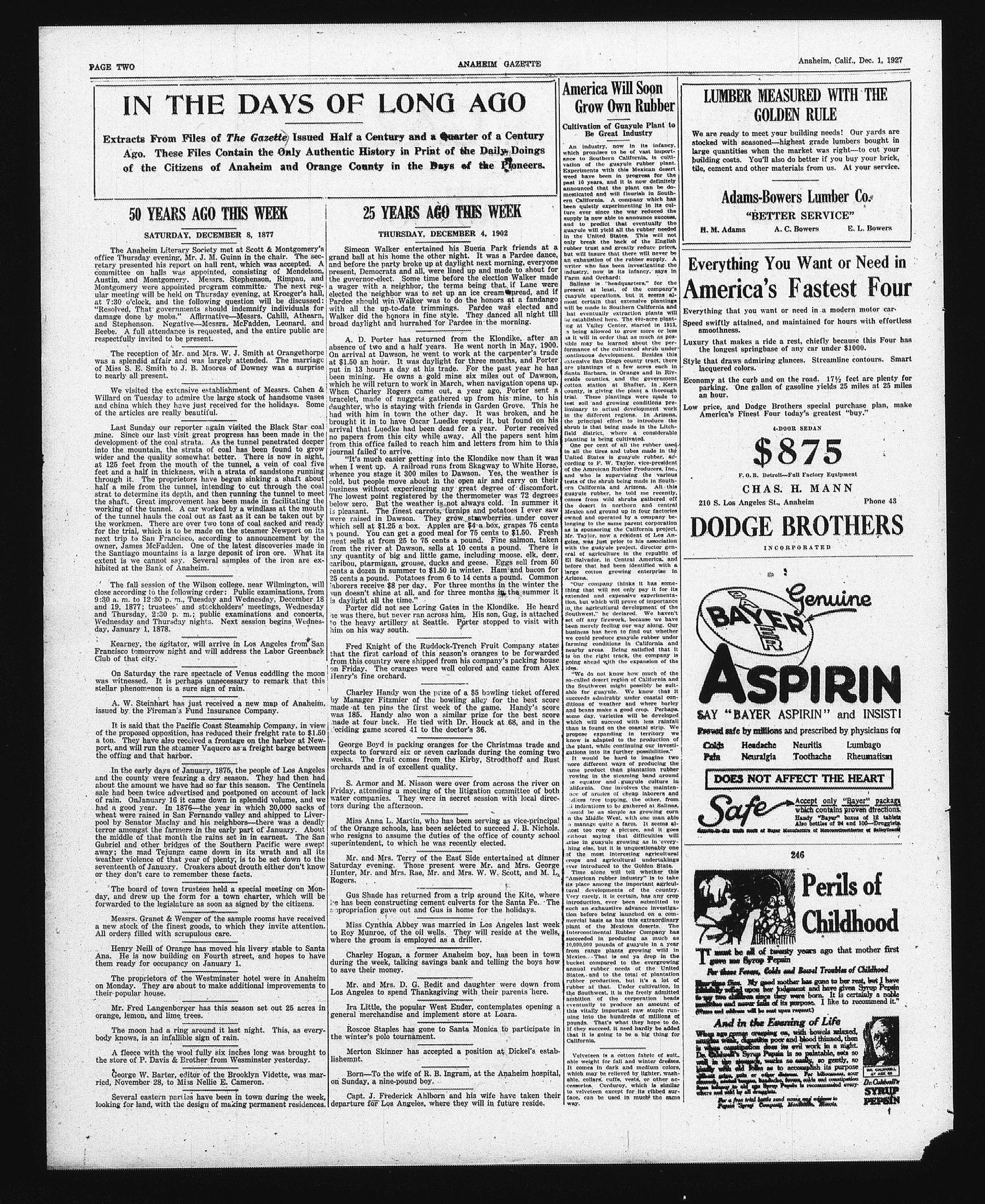
Searchable text
IN THE DAYS OF
Extracts From Files of The Gazette Issued Half a Century Ago. These Files Contain the Only Authentic History of the Citizens of Anaheim and Orange County.
50 YEARS AGO THIS WEEK
SATURDAY, DECEMBER 8, 1877
The Anaheim Literary Society met at Scott & Montgomery's office Thursday evening, Mr. J. M. Guinn in the chair. The secretary presented his report on hall rent, which was accepted. A committee on halls was appointed, consisting of Mendelson, Austin, and Montgomery. Messrs. Stephenson, Rimpau, and Montgomery were appointed program committe. The next regular meeting will be held on Thursday evening, at Kroeger's hall, at 7:30 o'clock, and the following question will be discussed: "Resolved, That governments should indemnify individuals for damage done by mobs." Affirmative—Messrs. Cahill, Athearn, and Stephenson. Negative—Messrs. McFadden, Leonard, and Beebe. A full attendance is requested, and the entire public are respectfully invited to be present.
The reception of Mr. and Mrs. W. J. Smith at Orangethorpe was a splendid affair and was largely attended. The marriage of Miss S. E. Smith to J. B. Moores of Downey was a surprise to nearly all present.
We visited the extensive establishment of Messrs. Cahen & Willard on Tuesday to admire the large stock of handsome vases and china which they have just received for the holidays. Some of the articles are really beautiful.
Last Sunday our reporter again visited the Black Star coal mine. Since our last visit great progress has been made in the development of the coal strata. As the tunnel penetrated deeper into the mountain, the strata of coal has been found to grow
The reception of Mr. and Mrs. W. J. Smith at Orangeshire was a splendid affair and was largely attended. The marriage of Miss S. E. Smith to J. B. Moores of Downey was a surprise to nearly all present.
We visited the extensive establishment of Messrs. Cahen & Willard on Tuesday to admire the large stock of handsome vases and china which they have just received for the holidays. Some of the articles are really beautiful.
Last Sunday our reporter again visited the Black Star coal mine. Since our last visit great progress has been made in the development of the coal strata. As the tunnel penetrated deeper into the mountain, the strata of coal has been found to grow wider and the quality somewhat better. There is now in sight, at 125 feet from the mouth of the tunnel, a vein of coal five feet and a half in thickness, with a strata of sandstone running through it. The proprietors have begun sinking a shaft about half a mile from the tunnel, intending to cut through the coal strat to determine its depth, and then running the tunnel to meet the shaft. Great improvement has been made in facilitating the working of the tunnel. A car worked by a windlass at the mouth of the tunnel hauls the coal out as fast as it can be taken out by the workmen. There are over two tons of coal sacked and ready for the trial, which is to be made on the steamer Newport on its next trip to San Francisco, according to announcement by the owner, James McFadden. One of the latest discoveries made in the Santiago mountains is a large deposit of iron ore. What its extent is we cannot say. Several samples of the iron are exhibited at the Bank of Anaheim.
The fall session of the Wilson college, near Wilmington, will close according to the following order: Public examinations, from 9:30 a.m. to 12:30 p.m., Tuesday and Wednesday, December 18 and 19, 1877; trustees' and stockholders' meetings, Wednesday and Thursday, 2:30 p.m.; public examinations and concerts, Wednesday and Thursday nights. Next session begins Wednesday, January 1, 1878.
Kearney, the agitator, will arrive in Los Angeles from San Francisco tomorrow night and will address the Labor Greenback Club of that city.
On Saturday the rare spectacle of Venus coddling the moon was witnessed. It is perhaps unnecessary to remark that this stellar phenomenon is a sure sign of rain.
A. W. Steinhart has just received a new map of Anaheim, issued by the Fireman's Fund Insurance Company.
It is said that the Pacific Coast Steamship Company, in view of the proposed opposition, has reduced their freight rate to $1.50 a ton. They have also received a frontage on the harbor at Newport, and will run the steamer Vaquero as a freight barge between the offing and that harbor.
In the early days of January, 1875, the people of Los Angeles and the county were fearing a dry season. They had then had about the amount we have had so far this season. The Centinela sale had been twice advertised and postponed on account of lack of rain. On January 16 it came down in splendid volume, and we had a good year. In 1876—the year in which 20,000 sacks of wheat were raised in San Fernando valley and shipped to Liverpool by Senator Maclay and his neighbors—there was a deadly terror amongst the farmers in the early part of January. About the middle of that month the rains set in in earnest. The San Gabriel and other bridges of the Southern Pacific were swept
In the early days of January, 1875, the people of Los Angeles and the county were fearing a dry season. They had then had about the amount we have had so far this season. The Centinela sale had been twice advertised and postponed on account of lack of rain. On January 16 it came down in splendid volume, and we had a good year. In 1876—the year in which 20,000 sacks of wheat were raised in San Fernando valley and shipped to Liverpool by Senator Maclay and his neighbors—there was a deadly terror amongst the farmers in the early part of January. About the middle of that month the rains set in in earnest. The San Gabriel and other bridges of the Southern Pacific were swept away; the mad Tejunga came down in its wrath and all its weather violence of that year of plenty, is to be set down to the seventeenth of January. Croakers about drouth either don't know or they don't care to remember these facts.
The board of town trustees held a special meeting on Monday, and drew up the form for a town charter, which will be forwarded to the legislature as soon as signed by the citizens.
Messrs. Granet & Wenger of the sample rooms have received a new stock of the finest goods, to which they invite attention. All orders filled with scrupulous care.
Henry Neill of Orange has moved his livery stable to Santa Ana. He is now building on Fourth street, and hopes to have them ready for occupancy on January 1.
The proprietors of the Westminster hotel were in Anaheim on Monday. They are about to make additional improvements to their popular house.
Mr. Fred Langenberger has this season set out 25 acres in orange, lemon, and lime trees.
The moon had a ring around it last night. This, as everybody knows, is an infallible sign of rain.
A fleece with the wool fully six inches long was brought to the store of P. Davis & Brother from Wesminster yesterday.
George W. Barter, editor of the Brooklyn Vidette, was married, November 28, to Miss Nellie E. Cameron.
Several eastern parties have been in town during the week, looking for land, with the design of making permanent residences.
DAYS OF LONG AGO
Issued Half a Century and a Quarter of a Century
Daily Authentic History in Print of the Daily Doings
and Orange County in the Days of the Ploneers.
25 YEARS AGO THIS WEEK
THURSDAY, DECEMBER 4, 1902
Simeon Walker entertained his Buena Park friends at a grand ball at his home the other night. It was a Pardee dance, and before the party broke up at daylight next morning, everyone present, Democrats and all, were lined up and made to shout for the governor-elect. Some time before the election Walker made a wager with a neighbor, the terms being that if Lane were elected the neighbor was to set up an ice cream spread, and if Pardee should win Walker was to do the honors at a fandango with all the up-to-date trimmings. Pardee was elected and Walker did the honors in fine style. They danced all night till broad daylight and hurrahed for Pardee in the morning.
A. D. Porter has returned from the Klondike, after an absence of two and a half years. He went north in May, 1900. On arrival at Dawson, he went to work at the carpenter's trade at $1.50 an hour. It was daylight for three months, and Porter put in 13 hours a day at his trade. For the past year he has been mining. He owns a gold mine six miles out of Dawson, which he will return to work in March, when navigation opens up. When Charley Rogers came out, a year ago, Porter sent a bracelet, made of nuggets gathered up from his mine, to his daughter, who is staying with friends in Garden Grove. This he had with him in town the other day. It was broken, and he brought it in to have Oscar Luedke repair it, but found on his arrival that Luedke had been dead for a year. Porter received no papers from this city while away. All the papers sent him from this office failed to reach him and letters from him to this America Will Soon Grow Own Rubber
Cultivation of Guayule Plant to Be Great Industry
An industry, now in its infancy, which promises to be of vast importance to Southern California, is cultivation of the guayule rubber plant. Experiments with this Mexican desert weed have been in progress for the past 10 years, and it is now definitely announced that the plant can be domesticated and will flourish in Southern California. A company which has been quietly experimenting in its culture ever since the war reduced the supply is now able to announce success, and to predict that eventually the guayule will yield all the rubber needed in the United States. This will not only break the back of the English rubber trust and greatly reduce prices, but will insure that there will never be an exhaustion of the rubber supply. A writer who has been investigating the industry, now in its infancy, says in Farm and Orchard:
Sallinas is "headquarters," for the present at least, of the company's guayule operations, but it seems almost certain that extensive plantings will be made in Southern California and that eventually extraction plants will be established here. The 400-acre planting at Valley Center, started in 1913, is being allowed to grow more or less as it will in order that as much as possible may be learned about the performance of the cultivated shrub under continuous development. Besides this extensive San Diego county tract, there are plantings of a few acres each in Santa Barbara, in Orange and in Riverside counties, and the government cotton station at Shafter, in Kern county, is giving the plant a thorough trial. These plantings were made to test soil and growing conditions preliminary to actual development work in the different regions. In Arizona, the principal effort to introduce the shrub is that being made in the Litchfield district, where a considerable planting is being cultivated.
One per cent of all the rubber used
On arrival at Dawson, he went to work at the carpenter's trade at $1.50 an hour. It was daylight for three months, and Porter put in 13 hours a day at his trade. For the past year he has been mining. He owns a gold mine six miles out of Dawson, which he will return to work in March, when navigation opens up. When Charley Rogers came out, a year ago, Porter sent a bracelet, made of nuggets gathered up from his mine, to his daughter, who is staying with friends in Garden Grove. This he had with him in town the other day. It was broken, and he brought it in to have Oscar Luedek repair it, but found on his arrival that Luedek had been dead for a year. Porter received no papers from this city while away. All the papers sent him from this office failed to reach him and letters from him to this journal failed to arrive.
"It's much easier getting into the Klondike now than it was when I went up. A railroad runs from Skagway to White Horse, whence you stage it 300 miles to Dawson. Yes, the weather is cold, but people move about in the open air and carry on their business without experiencing any great degree of discomfort. The lowest point registered by the thermometer was 72 degrees below zero. But the weather is not always cold. In summer it is pleasant. The finest carrots, turnips and potatoes I ever saw were raised in Dawson. They grow strawberries under cover which sell at $1.25 a box. Apples are $4 a box, grapes 75 cents a pound. You can get a good meal for 75 cents to $1.50. Fresh meat sells at from 25 to 75 cents a pound. Fine salmon, taken from the river at Dawson, sells at 10 cents a pound. There is any quantity of big and little game, including moose, elk, deer, caribou, ptarmigan, grouse, ducks and geese. Eggs sell from 50 cents a dozen in summer to $1.50 in winter. Ham and bacon for 25 cents a pound. Potatoes from 6 to 14 cents a pound. Common laborers receive $8 per day. For three months in the winter the sun doesn't shine at all, and for three months in the summer it is daylight all the time."
Porter did not see Loring Gates in the Klondike. He heard he was there, but never ran across him. His son, Gug, is attached to the heavy artillery at Seattle. Porter stopped to visit with him on his way south.
Fred Knight of the Ruddock-Trench Fruit Company states that the first carload of this season's oranges to be forwarded from this country were shipped from his company's packing house on Friday. The oranges were well colored and came from Alex Henry's fine orchard.
Charley Handy won the prize of a $5 bowling ticket offered by Manager Fitzmier of the bowling alley for the best score made at ten pins the first week of the game. Handy's score was 185. Handy also won a similar prize for the best score made at four back. He tied with Dr. Houck at 68, and in the deciding game scored 41 to the doctor's 36.
George Boyd is packing oranges for the Christmas trade and expects to forward six or seven carloads during the coming two weeks. The fruit comes from the Kirby, Strodthoff and Rustorchards and is of excellent quality.
S. Armor and M. Nisson were over from across the river on Friday, attending a meeting of the litigation committee of both water companies. They were in secret session with local directors during the afternoon.
Miss Anna L. Martin, who has been serving as vice-principal of the Orange schools, has been selected to succeed J. B. Nichols, who resigns to assume the duties of the office of county school superintendent, to which he was recently elected.
One per cent of all the rubber used in all the tires and tubes made in the United States is guayule rubber, according to F. W. Taylor, vice-president of the Amrelcan Rubber Producers, Inc., and who is supervising the various tests of the shrub being made in Southern California and Arizona. All this guayule rubber, he told me recently, comes from wild shrubs gathered off the desert in northern and central Mexico and ground up in four factories owned and operated by a company belonging to the same parent corporation as is sponsoring the California project. Mr. Taylor, now a resident of Los Angeles, was just prior to his association with the guayule project, director general of agriculture in the republic of El Salvador, in Central America, and before that had been identified with a large cotton growing enterprise in Arizona.
"Our company thinks it has something that will not only pay it for its extended and expensive experimentation, but which will prove of importance in the agricultural development of the Southwest," he declared. We haven't set off any firework, because we have been merely feeling our way along. Our business has been to find out whether we could produce guayule rubber under farming conditions in California and nearby areas. Being satisfied that it is on the right track, the company is going ahead with the expansion of the idea.
"We do not know how much of the so-called desert region of California and the Southwest might possibly be suitable for guayule. We know that it succeeds admirably under coastal conditions of weather and where barley and beans make a good crop. Perhaps some day, varieties will be developed which will succeed with less rainfall than is found on the coastal strip. We propose expanding in territory we know is adapted to the production of the plant, while continuing our investigations into its further possibilities."
It would be hard to imagine two more different ways of producing the same product than plantation rubberrowing in the steaming band around the equator and guayule culture in California. One involves the maintenance of aranes of cheap laborers and edibles tree tapping, the other, from indications to be gathered at Salinas, should be as simple as growing corn in the Middle West, with one man able to manage quite a farm. It seems almost too rosy a picture, and it goes without saying that difficulties will arise in guayule growing as in everything else, but it is unquestionably one
The fruit comes from the Kirby, Strodthoff and Rust orchards and is of excellent quality.
S. Armor and M. Nisson were over from across the river on Friday, attending a meeting of the litigation committee of both water companies. They were in secret session with local directors during the afternoon.
Miss Anna L. Martin, who has been serving as vice-principal of the Orange schools, has been selected to succeed J. B. Nichols. who resigns to assume the duties of the office of county school superintendent, to which he was recently elected.
Mr. and Mrs. Terry of the East Side entertained at dinner Saturday evening. Those present were Mr. and Mrs. George Hunter, Mr. and Mrs. Rae, Mr. and Mrs. W. W. Scott, and M. L. Rogers.
Gus Shade has returned from a trip around the Kite, where he has been constructing cement culverts for the Santa Fe. The appropriation gave out and Gus is home for the holidays.
Miss Cynthia Abbey was married in Los Angeles last week to Roy Munroe, of the oil wells. They will reside at the wells, where the groom is employed as a driller.
Charley Hogan, a former Anaheim boy, has been in town during the week, talking savings bank and telling the boys how to save their money.
Mr. and Mrs. D. G. Redit and daughter were down from Los Angeles to spend Thanksgiving with their parents here.
Ira Little, the popular West Ender, contemplates opening a general merchandise and implement store at Loara.
Roscoe Staples has gone to Santa Monica to participate in the winter's polo tournament.
Merton Skinner has accepted a position at Dickel's establishment.
Born—To the wife of R. B. Ingram, at the Anaheim hospital, on Sunday, a nine-pound boy.
Capt. J. Frederick Ahlborn and his wife have taken their departure for Los Angeles, where they will in future reside.
It would be hard to imagine two more different ways of producing the same product than plantation rubberrowing in the steaming band around the equator and guayule culture in California. One involves the maintenance of aranes of cheap laborers and endless tree tapping, the other, from indications to be gathered at Salinas, should be as simple as growing corn in the Middle West, with one man able to manage quite a farm. It seems almost too rosy a picture, and it goes without saying that difficulties will arise in guayule growing as in everything else, but it is unquestionably one of the most interesting agricultural crops and agricultural undertakings ever introduced to the Golden State.
Time alone will tell whether this "American rubber industry" is to take its place among the important agricultural developments of the country. Very rarely, it is certain, has any crop introduction ever been submitted to such an exhaustive advance investigation before being launched on a commercial basis as has this extraordinary plant of the Mexican deserts. The Intercontinental Rubber Company has succeeded in producing as much as 10,000,000 pounds of guayule in a year from range plants growing wild in Mexico... That is onl ya drop in the bucket compared to the evergrowing annual rubber needs of the United States, and to the total of plantation rubber production, but it's a lot of rubber at that. Under cultivation, in the Southwest, it is the freely admitted ambition of the corporation heads eventually to produce an amount of this vitally important raw staple running into the hundreds of millions of pounds. That's what they hope to do. If they succeed, it need hardly be added that it is going to be a big thing for California.
Velveteen is a cotton fabric of suitable weight for fall and winter dresses. It comes in dark and medium colors, which may be relieved by lighter, washable, collars, cuffs, vests, or other accessories. Corduroy, which is similar to velveteen except for its ribbed surface, can be used in much the same way.
LUMBER MEASURED WITH THE GOLDEN RULE
We are ready to meet your building needs! Our yards are stocked with seasoned—highest grade lumbers bought in large quantities when the market was right—to cut your building costs. You'll also do better if you buy your brick, tile, cement and other materials from us. At your service.
Adams-Bowers Lumber Co.
"BETTER SERVICE"
H. M. Adams A. C. Bowers E. L. Bowers
Everything You Want or Need in America's Fastest Four
Everything that you want or need in a modern motor car.
Speed swiftly attained, and maintained for hours with effortless smoothness.
Luxury that makes a ride a rest, chiefly because this Four has the longest springbase of any car under $1000.
Style that draws admiring glances. Streamline contours. Smart lacquered colors.
Economy at the curb and on the road. 17½ feet are plenty for parking. One gallon of gasoline yields 25 miles at 25 miles an hour.
Low price, and Dodge Brothers special purchase plan, make America's Finest Four today's greatest "buy."
4-DOOR SEEDAN
Style that draws admiring glances. Streamline contours. Smart lacquered colors.
Economy at the curb and on the road. 17½ feet are plenty for parking. One gallon of gasoline yields 25 miles at 25 miles an hour.
Low price, and Dodge Brothers special purchase plan, make America's Finest Four today's greatest "buy."
4-DOOR SEDAN
$875
F.O.B. Detroit—Full Factory Equipment
CHAS. H. MANN
210 S. Los Angeles St., Anaheim Phone 43
DODGE BROTHERS
INCORPORATED
Genuine
BAYER
ASPIRIN
SAY "BAYER ASPIRIN" and INSIST!
Prewed safe by millions and prescribed by physicians for
Colds Headache Neuritis Lumbago
Pain Neuralgia Toothache Rheumatism
DOES NOT AFFECT THE HEART
Safe
Accept only "Bayer" package which contains proven directions.
Handy "Bayer" boxes of 12 tablets Also bottles of 24 and 100—Druggists.
DOES NOT AFFECT THE HEART
Safe
Accept only "Bayer" package which contains proven directions.
Handy "Bayer" boxes of 12 tablets also bottles of 24 and 100—Druggists.
246
Perils of Childhood
I must be all of twenty years ago that mother first gave me Syrup Pepsin
For these Feats, Colds and Bowel Troubles of Childhood
My good mother has gone to her rest, but I have faithfully settled upon her judgment and have given Syrup Pepsin to my two children since they were born. It is certainly a noble invention and never fails of its purpose. I like to recommend it."
And in the Evening of Life
When age comes creeping on, with bowels relaxed, muscles weak, digestion poor and blood thinned, then constipation does its evil work in a night.
Dr. Caldwell's Syrup Pepsin is so palatable, sets so well in the stomach, works so easily, so gently, so mildly with old folks as to accomplish its purpose.
For biliousness, sour breath, small tongue, headache, fever, sore and constipation, heavy to old age Syrup Pepsin is recommended everywhere and will by all druggists.
For a free trial bottle send name and address to
Pepsin Syrup Company, Monmouth, Illinois.