anaheim-gazette 1927-11-24
Scanned page
Searchable text
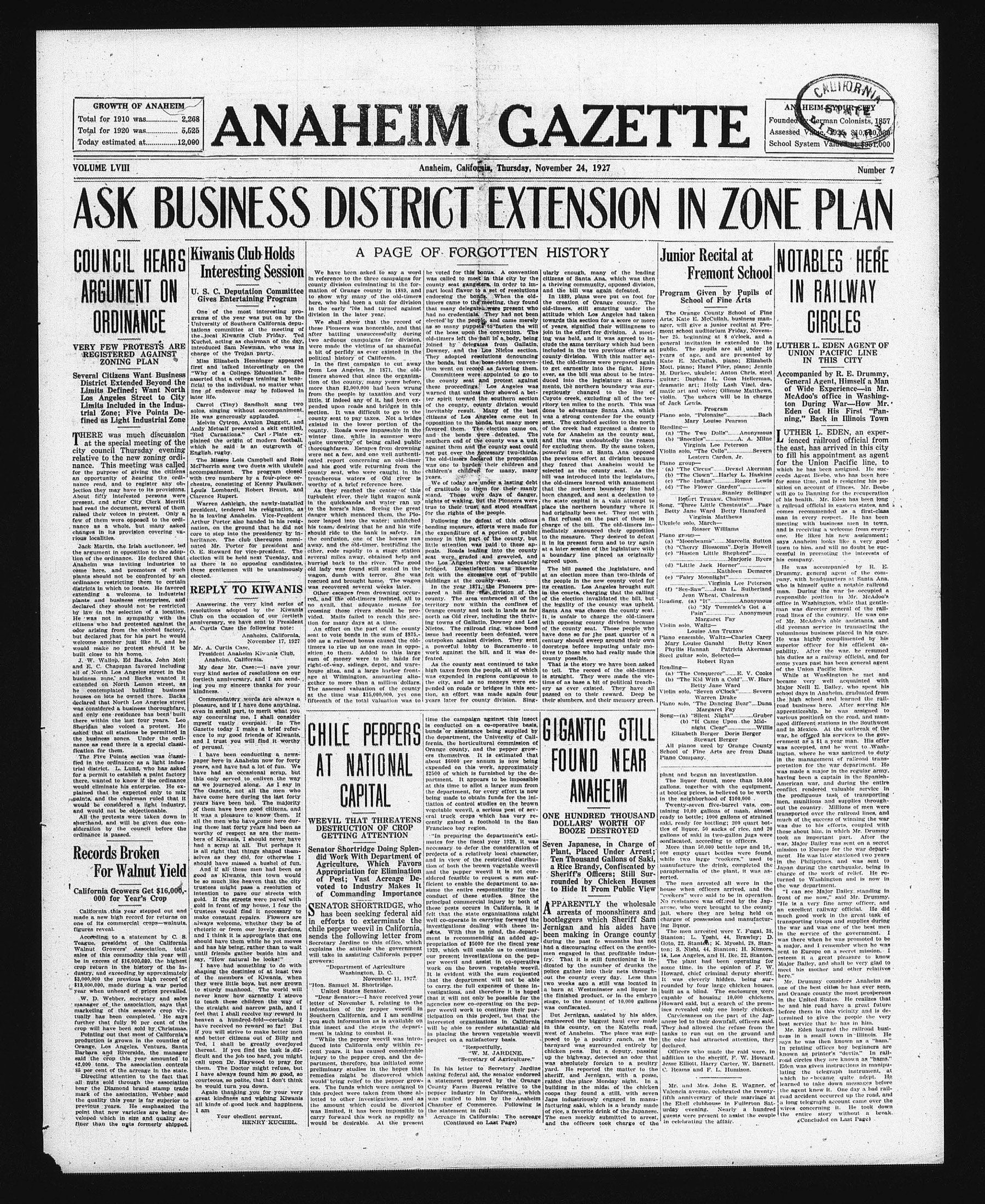
GROWTH OF ANAHEIM
Total for 1910 was... 2,268
Total for 1920 was... 5,525
Today estimated at... 12,000
VOLUME LVIII
ASK BUSINESS DISCUSSION
COUNCIL HEARS ARGUMENT ON ORDINANCE
VERY FEW PROTESTS ARE REGISTERED AGAINST ZONING PLAN
Several Citizens Want Business District Extended Beyond the Limits Defined; Want North Los Angeles Street to City Limits Included in the Industrial Zone; Five Points Defined as Light Industrial Zone
THERE was much discussion at the special meeting of the city council Thursday evening.
Kiwanis Club Holds Interesting Session
U. S. C. Deputation Committee Gives Entertaining Program
One of the most interesting programs of the year was put on by the University of Southern California deputations committee at the meeting of the local Kiwanis Club Friday. Ted Kuchel, acting as chairman of the day, introduced Sam Newman, who was in charge of the Trojan party.
Miss Elizabeth Henninger appeared first and talked interestingly on the "Why of a College Education." She asserted that a college training is beneficial to the individual, no matter what line of endeavor may be followed in later life.
Carrol (Tiny) Sandholt sang two solos, singing without accompaniment. He was generously applauded.
Melvin Cyrton, Avalon Daggett, and Andy Metcalf presented a skit entitled, "Red Carnations."
Carl Plate explained the origin of modern football, which he said is an outgrowth of
We have been asked in reference to the county divisionculmation of Orange county to show why many here, who had been in the early '70s had division in the later We shall show these Ploneers was last after battling unsuited two arduous campaigns were made the victim a bit of perfidy as one political history of In the first camp from Los Angeles, timers showed that situation of the county; more than $2,000,000 from the people by little, if indeed any are pended upon roads section. It was difficult county seat to pay to existed in the lower county. Roads were winter time, while quite unworthy of thoroughfares. Esca
THERE was much discussion at the special meeting of the city council Thursday evening relative to the new zoning ordinance. This meeting was called for the purpose of giving the citizens an opportunity of hearing the ordinance read, and to register any objection they may have to its provisions. About fifty interested persons were present, and after City Clerk Merritt had read the document, several of them raised their voices in protest. Only a few of them were opposed to the ordinance as a whole, but many asked changes in its provision covering various localities.
Jack Martin, the Irish auctioneer, led the argument in opposition to the adoption of the ordinance. He declared that Anaheim was inviting industries to come here, and promoters of such plants should not be confronted by an ordinance restricting them to certain districts in which to locate. He favored extending a welcome to industrial plants and business enterprises, and declared they should not be restricted by law in the selection of a location. He was not in sympathy with the citizens who had protested against the odor arising from the alcohol factory, but declared that for his part he would welcome another just like it, and he would make no protest should it be built close to his home.
J. W. Wallop, Ed Backs, John Molt and E. C. Chapman favored including all of North Los Angeles street in the business zone; and Backs wanted it extended on North Lemon street, as he contemplated building business houses on lots he owned there. Backs declared that North Los Angeles street was considered a business thoroughfare, and only one residence has been built there within the last four years. Leo Sheridan also voiced a protest. He asked that oil stations be permitted in the business zones. Under the ordinance as read there is a special classification for them.
The Five Points section was classified in the ordinance as a light industrial district. L. Lund, who has asked for a permit to establish a paint factory there, wanted to know if the ordinance would eliminate his enterprise. He explained that he expected only to mix paints, and the chairman ruled that it would be considered a light industry, and would not be objectionable.
All the protests were taken down in shorthand, and will be given due consideration by the council before the ordinance is passed.
Miss Elizabeth Henninger appeared first and talked interestingly on the "Why of a College Education." She asserted that a college training is beneficial to the individual, no matter what line of endeavor may be followed in later life.
Carrol (Tiny) Sandholt sang two solos, singing without accompaniment. He was generously applauded.
Melvin Cyrton, Avalon Daggett, and Andy Metcalf presented a skit entitled "Red Carnations." Carl Plate explained the origin of modern football, which he said is an outgrowth of English rugby.
The Misses Lois Campbell and Rose McPherrin sang two duets with ukulele accompaniment. The program closed with two numbers by a four-piece orchestra, consisting of Kenny Faulkner, Louis Lombardi, Robert Braun, and Clarence Rupert.
Warren Ashleigh, the newly-installed president, tendered his resignation, as he is leaving Anaheim. Vice-President Arthur Porter also handed in his resignation, on the ground that he did not core to stop into the presidency by inheritance. The club thereupon nominated Mr. Porter for president and O. E. Steward for vice-president. The election will be held next Tuesday, and as there is no opposing candidates, these gentlemen will be unanimously elected.
REPLY TO KIWANIS
Answering the very kind series of resolutions adopted by the Kiwanis Club on the occasion of our forty anniversary, we have sent to President A. Curtis Case the following note:
Anaheim, California,
November 17, 1927
Mr. A. Curtis Case.
President Anaheim Kiwanis Club,
Anaheim, California.
My dear Mr. Case:—I nave your very kind series of resolutions on our forty anniversary, and I am sending you my sincere thanks for your kindness.
Commendatory words are always a pleasure, and if I have done anything, even in small part, to merit what you say concerning me, I shall consider myself vastly overpaid. In The Gazette today I make a brief reference to my good friends of Kiwanis, and I trust you will find it worthy of perusal.
I have been conducting a newspaper here in Anaheim now for forty years, and have had a lot of fun. We have had an occasional scrap, but this only served to enliven the way as we journeyed along. As I say in The Gazette, not all the men who have come here during the last forty years have been bad. The majority of them have been good citizens, and it was a pleasure to know them. If all the men who have come here during these last forty years had been as worthy of respect as are the members of Kiwanis, I should never have had a scrap at all. But perhaps it is all right that things shaped them political history of America.
In the first campaign from Los Angeles, timers showed that a tion of the county; more than $2,000,000 from the people by little; if indeed any o pended upon roads or section. It was diffi culty seat to pay ta r existed in the lower county. Roads were winter time; while quite unworthy of th e thoroughfares. Esca were not a few, and cated report concern s and his good wife re county seat, who w ntreacherous waters worthy of a brief rea.
As they reached t turbulent river, their in the quicksands ar t to the horse's hips, danger which menne leaped into th e his team; desiring th e should ride to th e b eath confusion, one o away, and the old-thin other; rode rapidly t several miles away; hurried back to th e old lady was found wagon, dumb with rescued and brought was recovered sever al.
Other escapes from red., and the old-time no avail; that adde crossing those rivers vided. Mallis failed t ion for many days.
An effort on the peat seat to vote bonds in 000 as a railroad bond times to rise up as sition to them. Add sum of money were right-of-way, sidings house sites, and a lo age at Wilmington; gether to more than The assessed valuation at the time was $1 fifteenth of the total
The Five Points section was classified in the ordinance as a light industrial district. L. Lund, who has asked for a permit to establish a paint factory there, wanted to know if the ordinance would eliminate his enterprise. He explained that he expected only to mix paints, and the chairman ruled that it would be considered a light industry, and would not be objectionable.
All the protests were taken down in shorthand, and will be given due consideration by the council before the ordinance is passed.
Records Broken For Walnut Yield
California Growers Get $16,000,-000 for Year's Crop
California this year stepped out and made a new high record for returns on one of its commercial crops—walnuts, figures reveal.
According to a statement by C. S. Teague, president of the California Walnut Growers' Association, total sales of this commodity this year will be in excess of $16,000,000, the highest crop return in the history of the industry, and exceeding by approximately $3,000,000 the previous high record of $13,000,000, made during a war period year when unheard of prices prevailed.
W. D. Webber, secretary and sales manager of the association, says that marketing of this season's crop virtually has been completed. He says further that fully 90 per cent of the crop will have been sold by Christmas.
Pointing out that most of California's production is grown in the counties of Orange, Los Angeles, Ventura, Santa Barbara and Riverside, the manager said the crop this year amounted to 42,000 tons. The association controls 85 per cent of the acreage in the state.
Directing attention to the fact that all nuts sold through the association bear the Diamond brand stamp trade mark of the association, Webber said the quality this year is far superior to previous years. He emphasized the point that new varieties are being developed which in size and quality are finer than the nuts formerly shipped.
I have been conducting a newspaper here in Anaheim now for forty years, and have had a lot of fun. We have had an occasional scrap, but this only served to enliven the way as we journeyed along. As I say in The Gazette, not all the men who have come here during the last forty years have been bad. The majority of them have been good citizens, and it was a pleasure to know them. If all the men who have come here during these last forty years had been as worthy of respect as are the members of Kiwanis, I should never have had a scrap at all. But perhaps it is all right that things shaped themselves as they did, for otherwise I should have missed a bushel of fun.
And if all these men had been as good as Kiwanis, this town would be so much like heaven that the city trustees might pass a resolution of intention to pave our streets with gold. If the streets were paved with gold in front of my house, I fear the trustees would find it necessary to make constant repairs. Flowers are always welcome, whether they be of rhetoric or from our lovely gardens, and I think it is appropriate that one should have them while he yet moves and has his being, rather than to wait until friends gather beside him and say, "How natural he looks!"
I have had something to do with shaping the destinies of at least two of the members of Kiwanis, when they were little boys, but now grown to sturdy manhood. The world will never know how earnestly I strove to teach these children the way of the straight and narrow path, and I feel that I shall receive my reward in heaven a hundred-fold—certainly I have received no reward so far! But if you will strive to make better men and better citizens out of Billy and Ted, I shall be greatly overjoyed thereat. If you find the task is difficult and the job too hard, you might call upon Dr. Haywood to pray for them. The Doctor might refuse, but I have always found him so good, so courteous, so polite, that I don't think he would turn you down.
Again thank you for your very great kindness and wishing Kiwanis all kinds of good luck and happiness, I am
Your obedient servant,
HENRY KUCHEL.
A HEIM GAZETTE
Anaheim, California, Thursday, November 24, 1927
S DISTRICT EXTENSION IN
A PAGE OF FORGOTTEN HISTORY
We have been asked to say a word in reference to the three campaigns for county division culminating in the formation of Orange county in 1889, and to show why many of the old-timers here, who had been a unit for division in the early '70s had turned against division in the later year.
We shall show that the record of these Pioneers was honorable, and that after battling unsuccessfully during two arduous campaigns for division, were made the victims of as shameful a bit of perfidy as ever existed in the political history of California.
In the first campaign to cut away from Los Angeles, in 1871, the old-timers showed that since the organization of the county; many years before, more than $2,000,000 had been wring from the people by taxation and very little, if indeed any of it, had been expended upon roads and bridges in this section. It was difficult to go to the county seat to pay taxes. Not a bridge existed in the lower portion of the county. Roads were impassable in the winter time, while in summer were quite unworthy of being called public thoroughfares. Escapes from drowning be voted for this bonus. A convention was called to meet in this city by the county seat gangsters, in order to impart local flavor to a set of resolutions endorsing the bonds. When the old-timers came to the meeting, they found that many delegates were present who had no credentials. They had not been elected by the people, and came merely as so many puppets to fasten the will of the boss upon the convention. The old-timers left the hall in a body, being joined by delegates from Gallatin, Downey, and the Los Nietos section. They adopted resolutions denouncing the bonds, but the boss-ridden convention went on record as favoring them.
Committees were appointed to go to the county seat and protest against these proceedings. Los Angeles was warned that unless they showed a better spirit toward the southern section of the county, county division would inevitably result. Many of the best citizens of Los Angeles came out in opposition to the bonds, but many more favored them. The election came on, and the bonds were defeated. The southern end of the county was a unit against them and the county seat could regularly enough, many of the leading citizens of Santa Ana, which was then a thriving community, opposed division, and the bill was again defeated.
In 1889, plans were put on foot for the creation of Orange county. The old-timers, still smarting under the attitude which Los Angeles had taken towards this section for a score or more of years, signified their willingness to join in the effort for division. A meeting was held, and it was agreed to include the same territory which had been included in the two previous efforts at county-division. With this matter settled, the old-timers were prepared again to get earnestly into the fight. However, as the bill was about to be introduced into the legislature at Sacramento, the northern boundary was surreptiously changed to the line of Coyote creek, excluding all of the territory ten miles to the north. This was done to advantage Santa Ana, which was a strong contender for the county seat. The excluded section to the north of the creek had expressed a desire to vote for Anaheim as the county seat, and this was undoubtedly the reason for excluding them. By the same token,
Junior Fr
Program Scho
The Orang
Arts, Kate E.
ager, will give
mont school d
ber 25, begin
general invite
public. The
years of ag
Kate E. Mc
Mott, piano;
M. Durkee,
guitar; Dap
dramatic art;
music art and
violin. The
of Jack Lewi
Piano solo,
Mary
Reading—
(a) "The T
(b) "Sneeze"
Virgin
In the first campaign to cut away from Los Angeles, in 1871, the oldtimers showed that since the organization of the county; many years before, more than $2,000,000 had been wrung from the people by taxation and very little. If indeed any of it, had been expended upon roads and bridges in this section. It was difficult to go to the county seat to pay taxes. Not a bridge existed in the lower portion of the county. Roads were impassable in the winter time, while in summer were quite unworthy of being called public thoroughfares. Escapes from drowning were not a few, and one well authenticated report concerning an old-timer and his good wife returning from the county seat, who were caught in the treacherous waters of Old river is worthy of a brief reference here.
As they reached the center of this turbulent river, their light wagon sank in the quicksands and water ran up to the horse's hips. Seeing the great danger which menaced them, the Pioneer leaped into the water; unhitched his team, desiring that he and his wife should ride to the bank in safety. In the confusion, one of the horses ran away, and the old-timer, bestriding the other, rode rapidly to a stage station several miles away, obtained help and hurried back to the river. The good old lady was found still seated in the wagon, dumb with terror. She was rescued and brought home. The wagon was recovered several weeks later.
Other escapes from drowning occurred, and the old-timers insisted, all to no avail, that adequate means for crossing those rivers should be provided. Mails failed to reach this section for many days at a time.
An effort on the part of the county seat to vote bonds in the sum of $875,000 as a railroad bonus caused the old-timers rise up as one man in opposition to them. Added to this large sum of money were to be lands for right-of-way, sidings, depot, and warehouse sites, and a large harbor frontage at Wilmington, amounting altogether to more than a million dollars. The assessed valuation of the county at the time was $15,000,000, yet one fifteenth of the total valuation was to
CHILE PEPPERS AT NATIONAL CAPITAL
WEEVIL THAT THREATENS DESTRUCTION OF CROP GETTING ATTENTION
Senator Shortridge Doing Splenetime campaign against this insect is conducted on a co-operative basis, bunds or assistance being supplied by the department, the University of California, the horticultural commission of Orange county, and the pepper growers themselves. It is estimated that about $6000 per annum is now being expended on this work, approximately $2500 of which is furnished by the department. It appears to be impossible at this time to allot a larger sum from the department, for every effort is now being made to obtain funds for the initiation of control studies on the brown vegetable weevil, a serious pest of several truck crops which has very recently gained a foothold in the San Francisco bay region.
"In preparing the department's estimates for the fiscal year 1929, it was necessary to defer the consideration of
GIGANTIC STILL FOUND NEAR ANAHEIM
ONE HUNDRED THOUSAND DOLLARS' WORTH OF BOOZE DESTROYED
Seven Japanese, in Charge of Plant Placement Under Arrest
AT NATIONAL CAPITAL
WEEVIL THAT THREATENS DESTRUCTION OF CROP GETTING ATTENTION
Senator Shortridge Doing Splendid Work With Department of Agriculture, Which Favors Appropriation for Elimination of Pest; Vast Acreage Devoted to Industry Makes It of Commanding Importance
SENATOR SHORTRIDGE, who has been seeking federal aid in efforts to exterminate the chile pepper weevil in California, sends the following letter from Secretary Jardine to this office, which explains the attitude the government will take in assisting California pepper growers:
"Department of Agriculture
Washington, D. C.
November 11, 1927.
Hon. Samuel M. Shortridge,
United States Senator.
Dear Senator: I have received your letter of November 8, relating to the infestation of the pepper weevil in Southern California, and I am sending you such information as is available on this insect and the steps the department is taking to combat it.
While the pepper weevil was introduced into California only within recent years, it has caused considerable injury to the pepper crop, and the department, therefore, has initiated some preliminary studies in the hopes that remedies might be discovered which would bring relief to the pepper growers. The funds which were assigned to this project were taken from those allotted to other investigations, and as the amount which could be diverted was limited, it has been impossible to carry forward this work as rapidly as would be desirable. At the present
"It is evident with the sum requested that the department will not be able to carry the full expenses of these investigations, and therefore it is hoped that it will not only be possible for the agencies now co-operating on the pepper weevil work to continue their participation on this project, but that the interested organizations in California will be able to render substantial aid in placing the brown vegetable weevil project on a satisfactory basis.
"Respectfully,
W. M. JARDINE,
Secretary of Agriculture."
In his letter to Secretary Jardine asking federal aid, the senator endorsed a statement prepared by the Orange County Farm Bureau relative to the pepper industry in California, which was mailed to him by the Anaheim Chamber of Commerce. Following is the statement in full:
Acreage in California: The acreage (Continued on Last Page)
FOUND NEAR ANAHEIM
ONE HUNDRED THOUSAND DOLLARS' WORTH OF BOOZE DESTROYED
Seven Japanese, in Charge of Plant, Placed Under Arrest; Ten Thousand Gallons of Saki, a Rice Brandy, Confiscated by Sheriff's Officers; Still Surrounded by Chicken Houses to Hide It From Public View
APPARENTLY the wholesale arrests of moonshiners and bootleggers which Sheriff Sam Jernigan and his aides have been making in Orange county during the past few wmonths has not had a discouraging effect on the gentlemen engaged in that profitable industry. That it is still functioning is indicated by the number of drunks the police gather into their nets throughout the county every day. Less than two weeks ago a still was located in a barn at Westminster and liquor in the finished product, or in the embryo stage, to the amount of 10,000 gallons was confiscated.
But Jernigan, assisted by his aides, engineered the biggest haul ever made in this county, on the Katella road, west of Anaheim. The place was supposed to be a poultry ranch, as the barnyard was surrounded entirely by chicken pens. But a deputy, passing up the highway, detected an odor that was absolutely foreign to a poultry yard. He reported the matter to the sheriff, and Jernigan, with a posse, raided the place Monday night. In a building in the midst of the chicken coops they found a still, with seven Japs industriously engaged in manufacturing saki, which is a brandy made of rice, a favorite drink of the Japanese. The men weekly submitted to arrest, and the officers took charge of the
ETTE
ON IN ZONE PLAN
Junior Recital at Fremont School
Program Given by Pupils of School of Fine Arts
The Orange County School of Fine Arts, Kate E. McCullah, business manager, will give a junior recital at Fremont school auditorium Friday, November 25, beginning at 8 o'clock, and a general invitation is extended to the public. The pupils are all under 10 years of age, and are presented by Kate E. McCullah, piano; Elizabeth Mott, piano; Hazel Filer, plano; Jennie M. Durkee, ukulele; Anton Chris, steel guitar; Daphne L. Goss Hellerman, dramatic art; Holly Lash Visel, dramatic art and voice; Olivia Matthews, violin. The ushers will be in charge of Jack Lewis.
Program
Plano solo, "Polonaise"...Bach
Mary Louise Pearson
Reading—
(a) "The Two Dolls"...Anonymous
(b) "Sneezles"...A. A. Milne
Virginia Lee Peterson
NOTABLES HERE IN RAILWAY CIRCLES
LUTHER L. EDEN AGENT OF UNION PACIFIC LINE IN THIS CITY
Accompanied by R. E. Drummy, General Agent, Himself a Man of Wide Experience—in Mr. McAdoo's office in Washington During War—How Mr. Eden Got His First "Panning," Back in Illinois Town
LUTHER L. EDEN, an experienced railroad official from the east, has arrived in this city
plant and began an investigation.
The liquor found, more than 10,000 gallons, together with the equipment, at bootleg prices, is believed to be worth in the neighborhood of $100,000.
Twenty-seven five-barrel vats, containing 10,000 gallons of mash, almost ready to bottle; 1000 gallons of strained sask., ready for bottling; 200 quart bottles of liquor, 50 sacks of rice, and 20 gallons of salt in two-gallon jugs were confiscated, according to officers.
More than 50,000 bottle tops and 10,- years of age, and are presented by Kate E. McCullah, piano; Elizabeth Mott, piano; Hazel Filer, piano; Jennie M. Durkele, ukulele; Anton Chris, steel guitar; Daphne L. Goss Hellerman, dramatic art; Holly Lash Visel, dramatic art and voice; Oliviaae Matthews, violin. The ushers will be in charge of Jack Lewis.
Program
Piano solo, "Polonaise"...Bach
Mary Louise Pearson
Reading—
(a) "The Two Dolls"...Anonymous
(b) "Sneezes"...A. A. Milne
Virginia Lee Peterson
Violin solo, "The Cello"...Severn
Lestern Garden, Jr.
Piano group—
(a) "The Circus"...Drexel Akerman
(b) "The Clown"...Harley L. Haskins
(c) "The Indian"...Roger Lewis
(d) "The Flower Garden"...
Stanley Sellinger
Robert Truxaw, Chairman
Song, "Three Little Chestnuts"...Page
Betty Jane Ward Betty Hanaford
Virginia Matthews
Ukulele solo, March—Rosser Williams
Piano group—
(a) "Moonbeams"...Marcella Sutton
(b) "Cherry Blossoms"...Doris Howell
(e) "Hasten Little Shepherd"...
Marjorie Byers
(d) "Little Jack Horner"...
Kathleen Demaree
(e) "Fairy Moonlight"...
Virginia Lee Peterson
(f) "See-Saw"...Jean L. Sutherland
Jean Wheat, Chairman
Reading. (a) "It"...Anonymous
(b) "My Tummick's Got a Pain"...Anonymous
Margaret Fay
Violin solo, Waltz—Louise Ann Truxaw
Piano ensemble, Waltz—Charles Carey
Mary Louise Ganahl Betty Knox Phyllis Hannah Patricia Akerman Steel guitar solo, Selected—Robert Ryan
Reading—
(a) "The Conqueror"...E. V. Cooke
(b) "The Kid With a Cold"...W. Hare Betty Jane Ward
Violin solo, "Seven o'Clock"...Severn Warren Drake
Piano solo, "The Dancing Bear"...Dana Margaret Fay
Song—a) "Silent Night"...Gruber
(b) "If Came Upon the Midnight Clear"...Willis Elizabeth Berger Doris Berger Stewart Berger
All pianos used by Orange County School of Fine Arts are from Danz Piano Company.
Accompanied by R. E. Drummy,
General Agent, Himself a Man of Wide Experience—in Mr. McAdoo's office in Washington During War—How Mr. Eden Got His First "Panning," Back in Illinois Town
Luther L. EDEN, an experienced railroad official from the east, has arrived in this city to fill his appointment as agent for the Union Pacific line, to which he has been assigned. He succeeds Agent Beebe, who has been here for some time, and is resigning his position on account of illness. Mr. Beebe will go to Banning for the recuperation of his health. Mr. Eden has been long a railroad official in eastern states, and comes recommended as a first-class man in every respect. He has been meeting with business men in town, and is receiving a welcome from everyone. He likes his new assignment; says Anaheim looks like a very good town to him, and will no doubt be successful in promoting the interests of his company.
He was accompanied by R. E. Drummy, general agent of the company, with headquarters at Santa Ana, who is himself quite a notable railroad man. During the war he occupied a responsible position in Mr. McAdoo's office in Washington, while that gentleman was director general of the railroad lines of the country. He was one of Mr. McAdoo's able assistants, and did yeoman service in transacting the voluminous business placed in his care. He was highly complimented by his superior officer for his efficient capability. After the war, he resumed his duties as a railway official, and for some years past has been general agent of the Union Pacific lines.
While at Washington he met and became very well acquainted with Major Neill E. Bailey, who spent his school days in Anaheim, graduated from the high school and learned the railroad business here. After serving his apprenticeship, he was assigned to various positions on the road, and managed different stations in the Southwest and in Mexico. At the outbreak of the war, he offered his services to the government as a $1 a year man. His offer was accepted, and he went to Washington where he was assigned to duty in the management of railroad transportation for the war department. He was made a major in the regular army, having been a captain in the Spanish-American war, and during the entire conflict rendered valuable service in the prodigious task of transporting men, munitions and supplies throughout the country. Millions of men were transported over the railroad lines, and much of the success of winning the war was due to his efforts, coupled with those about him, in which Mr. Drummy took an important part. After the war, Major Bailey was sent on a secret mission to Europe for the war depart-
plant and began an investigation.
The liquor found, more than 10,000 gallons, together with the equipment, at bootleg prices, is believed to be worth in the neighborhood of $100,000.
Twenty-seven five-barrel vats, containing 10,000 gallons of mash, almost ready to bottle; 1000 gallons of strained saki, ready for bottling; 200 quart bottles of liquor, 50 sacks of rice, and 20 gallons of sail in two-gallon jugs were confiscated, according to officers.
More than 50,000 bottle tops and 10,000 empty quart bottles were found, while two large "cookies," used to manufacture the drink, completed the paraphernalia of the plant. It was asserted.
The men arrested all were in the house when officers arrived, and the "cookers" were said to be in operation. No resistance was offered by the Japanese, who were brought to the county jail, where they are being held on charges of possession and manufacturing liquor.
The men arrested were Y. Fugai, 38. Stanton; L. Yoshi, 44. Brawley; D. Goto, 22. Stanton; K. Myoshi, 28. Stanton; S. Nishi, 44. Stanton; H. Kimora, 18. Los Angeles, and H. Ike, 22. Stanton.
The plant had been operating for some time, in the opinion of F. W. Howard, chief criminal deputy sheriff. It was cleverly hidden, being surrounded by four large chicken houses, built as a blind. The enclosures were capable of housing 10,000 chickens. Howard said, but a search of the premises revealed only one lonely chicken.
Carelessness on the part of the Japanese led to their downfall, officers said. They had allowed the refuse from the tanks to run out on the ground and the odor had attracted attention, they declared.
Officers who made the raid were, in addition to the sheriff, F. W. Howard, Jesse Elliott, Harry Carter, W. Barnett, C. Reams and F. L. Humison.
Mr. and Mrs. John E. Wagner, of Valencia avenue, celebrated the twenty-fifth anniversary of their marriage at the Ebell clubhouse in Fullerton Saturday evening. Nearly a hundred guests were present to assist the couple in celebrating the affair.
in the management of railroad transportation for the war department. He was made a major in the regular army, having been a captain in the Spanish-American war, and during the entire conflict rendered valuable service in the prodigious task of transporting men, munitions and supplies throughout the country. Millions of men were transported over the railroad lines, and much of the success of winning the war was due to his efforts, coupled with those about him, in which Mr. Drummy took an important part. After the war, Major Bailey was sent on a secret mission to Europe for the war department. He was later stationed two years in the Philippines, and was sent to Japan during the earthquake, being in charge of the work of relief. He returned to Washington and is now in the war department.
"I can see Major Bailey standing in front of me now," said Mr. Drummy.
"He is a very fine army officer, and an excellent railway official. He did much good work in the great task of transporting troops and supplies during the war and was one of the best men in the service of the government. I was there when he was promoted to be a major, and I remember when he was sent to Europe on a secret mission. I esteem it a great pleasure to know Major Bailey, and shall be very glad to meet his mother and other relatives here."
Mr. Drummy considers Anaheim as one of the best cities he has ever seen, and Orange county is the most prosperous in the United States. He realizes that he and his road have a great future before them in this vicinity and is determined to give the people the very best service that he has in him.
Mr. Eden learned the railroad business in a small town in Illinois. He says he was then known as a "ham." In printing offices boy beginners are known as printer's "devils." In railroad circles they are known as "hams." Eden was given instructions in manipulating telegraph instrument, at which he became quite adept. He learned to take down messages before the agent knew it. One day a bad railroad accident occurred up the road, and a long telegraph account came over the wires concerning it. He took down the entire story without a break.
(Concluded on Last Page)