anaheim-gazette 1927-11-17
Scanned page
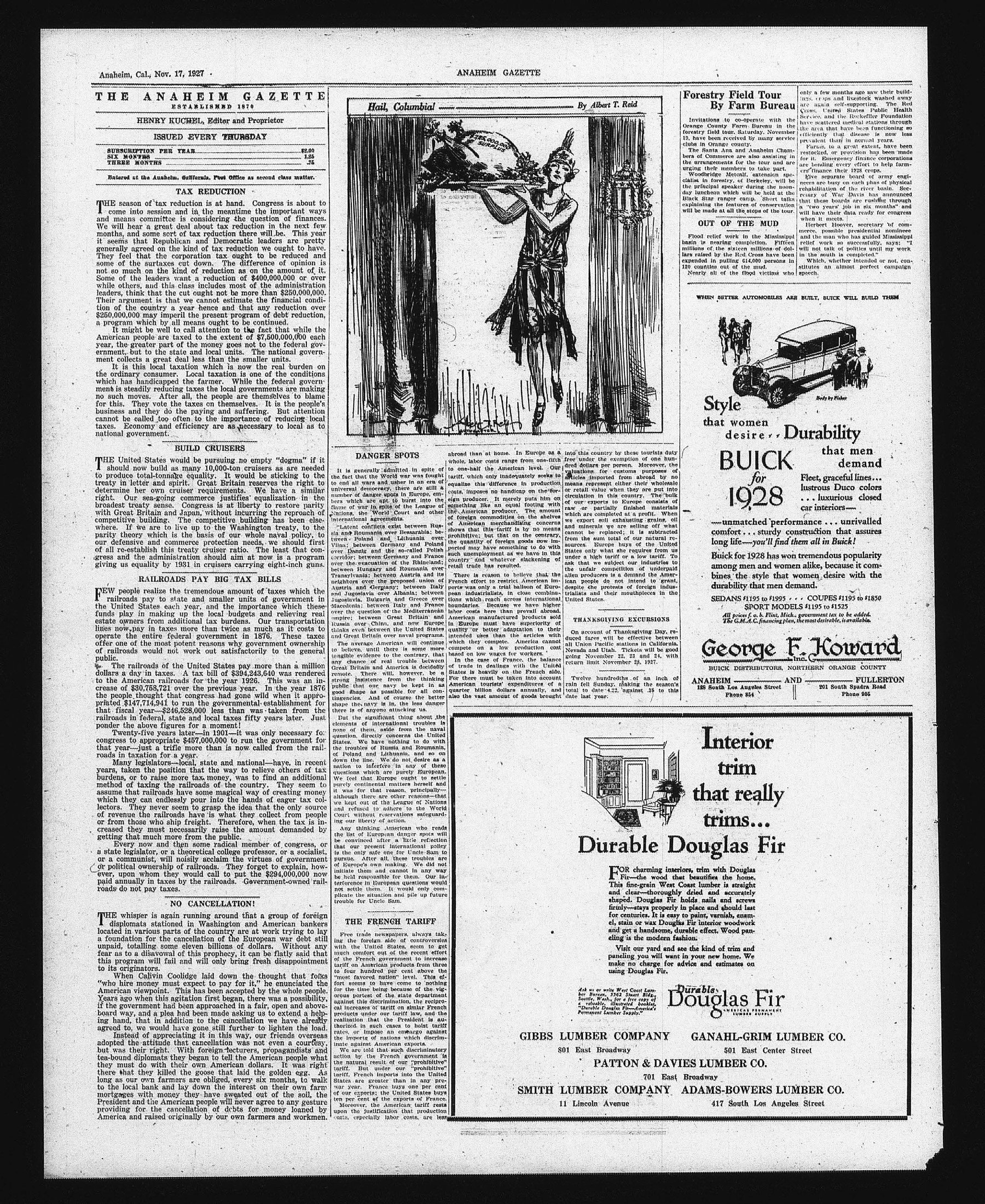
Searchable text
THE ANAHEIM GAZETTE
ESTABLISHED 1870
HENRY KUCHEL, Editor and Proprietor
ISSUED EVERY THURSDAY
SUBSCRIPTION PER YEAR ..... $2.00
SIX MONTHS ..... 1.25
THREE MONTHS ..... .75
Butered at the Anaheim, California, Post Office as second class matter.
TAX REDUCTION
The season of tax reduction is at hand. Congress is about to come into session and in the meantime the important ways and means committee is considering the question of finances. We will hear a great deal about tax reduction in the next few months, and some sort of tax reduction there will be. This year it seems that Republican and Democratic leaders are pretty generally agreed on the kind of tax reduction we ought to have. They feel that the corporation tax ought to be reduced and some of the surtaxes cut down. The difference of opinion is not so much on the kind of reduction as on the amount of it. Some of the leaders want a reduction of $400,000,000 or over while others, and this class includes most of the administration leaders, think that the cut ought not be more than $250,000,000. Their argument is that we cannot estimate the financial condition of the country a year hence and that any reduction over $250,000,000 may imperil the present program of debt reduction, a program which by all means ought to be continued.
It might be well to call attention to the fact that while the American people are taxed to the extent of $7,500,000,000 each year, the greater part of the money goes not to the federal government, but to the state and local units. The national government collects a great deal less than the smaller units.
It is this local taxation which is now the real burden on the ordinary consumer. Local taxation is one of the conditions which has handicapped the farmer. While the federal government is steadily reducing taxes the local governments are making no such moves. After all, the people are themselves to blame for this. They vote the taxes on themselves. It is the people's business and they do the paying and suffering. But attention cannot be called too often to the importance of reducing local taxes. Economy and efficiency are as necessary to local as to national government.
It is this local taxation which is now the real burden on the ordinary consumer. Local taxation is one of the conditions which has handicapped the farmer. While the federal government is steadily reducing taxes the local governments are making no such moves. After all, the people are themselves to blame for this. They vote the taxes on themselves. It is the people's business and they do the paying and suffering. But attention cannot be called too often to the importance of reducing local taxes. Economy and efficiency are as necessary to local as to national government.
BUILD CRUISERS
THE United States would be pursuing no empty "dogma" if it should now build as many 10,000-ton cruisers as are needed to produce total-tonnage equality. It would be sticking to the treaty in letter and spirit. Great Britain reserves the right to determine her own cruiser requirements. We have a similar right. Our sea-going commerce justifies equalization in the broadest treaty sense. Congress is at liberty to restore parity with Great Britain and Japan, without incurring the reproach of competitive building. The competitive building has been elsewhere. If we are to live up to the Washington treaty, to the parity theory which is the basis of our whole naval policy, to our defensive and commerce protection needs, we should first of all re-establish this treaty cruiser ratio. The least that congress and the administration should aim at now is a program giving us equality by 1931 in cruisers carrying eight-inch guns.
RAILROADS PAY BIG TAX BILLS
Few people realize the tremendous amount of taxes which the railroads pay to state and smaller units of government in the United States each year, and the importance which these funds play in making up the local budgets and relieving real estate owners from additional tax burdens. Our transportation lines now pay in taxes more than twice as much as it costs to operate the entire federal government in 1876. These taxes offer one of the most potent reasons why government ownership of railroads would not work out satisfactorily to the general public.
The railroads of the United States pay more than a million dollars a day in taxes. A tax bill of $394,243,640 was rendered to the American railroads for the year 1926. This was an increase of $30,758,721 over the previous year. In the year 1876 the people thought that congress had gone wild when it appropriated $147,714,941 to run the governmental establishment for that fiscal year—$246,528,000 less than was taken from the railroads in federal, state and local taxes fifty years later. Just ponder the above figures for a moment!
Twenty-five years later—in 1901—it was only necessary for congress to appropriate $457,000,000 to run the government for that year—just a trifle more than is now called from the railroads in taxation for a year.
Many legislators—local, state and national—have, in recent years, taken the position that the way to relieve others of tax burdens, or to raise more tax money, was to find an additional method of taxing the railroads of the country. They seem to assume that railroads have some magical way of creating money which they can endlessly pour into the hands of eager tax collectors. They never seem to grasp the idea that the only source of revenue the railroads have is what they collect from people or from those who ship freight. Therefore, when the tax is increased they must necessarily raise the amount demanded by getting that much more from the public.
Every now and then some radical member of congress, or a state legislator on a theoretical college professor or a specialist,
DA
Many legislators—local, state and national—have, in recent years, taken the position that the way to relieve others of tax burdens, or to raise more tax money, was to find an additional method of taxing the railroads of the country. They seem to assume that railroads have some magical way of creating money which they can endlessly pour into the hands of eager tax collectors. They never seem to grasp the idea that the only source of revenue the railroads have is what they collect from people or from those who ship freight. Therefore, when the tax is increased they must necessarily raise the amount demanded by getting that much more from the public.
Every now and then some radical member of congress, or a state legislator, or a theoretical college professor, or a socialist, or a communist, will noisily acclaim the virtues of government or political ownership of railroads. They forget to explain, however, upon whom they would call to put the $294,000,000 now paid annually in taxes by the railroads. Government-owned railroads do not pay taxes.
NO CANCELLATION!
The whisper is again running around that a group of foreign diplomats stationed in Washington and American bankers located in various parts of the country are at work trying to lay a foundation for the cancellation of the European war debt still unpaid, totalling some eleven billions of dollars. Without any fear as to a disavowal of this prophecy, it can be flatly said that this program will fail and will only bring fresh disappointment to its originators.
When Calivin Coolidge laid down the thought that folks "who hire money must expect to pay for it," he enunciated the American viewpoint. This has been accepted by the whole people. Years ago when this agitation first began, there was a possibility, if the government had been approached in a fair, open and above-board way, and a plea had been made asking us to extend a helping hand, that in addition to the cancellation we have already agreed to, we would have gone still further to lighten the load.
Instead of appreciating it in this way, our friends overseas adopted the attitude that cancellation was not even a courtesy, but was their right. With foreign lecturers, propagandists and tea-bound diplomats they began to tell the American people what they must do with their own American dollars. It was right there that they killed the goose that laid the golden egg. As long as our own farmers are obliged, every six months, to walk to the local bank and lay down the interest on their own farm mortgages with money they have sweated out of the soil, the President and the American people will never agree to any gesture providing for the cancellation of debts for money loaned by America and raised originally by our own farmers and workmen.
ANAHEIM GAZETTE
Hail, Columbial — By Albert T. Reid
DANGER SPOTS
It is generally admitted in spite of the fact that the World war was fought to end all wars and usher in an era of universal democracy, there are still a number of danger spots in Europe, embers which are apt to burst into the flame of war in spite of the League of Nations, the World Court and other international agreements.
Latent conflicts exist between Russia and Roumania over Bessarabia; between Poland and Lithuania over Vilna; between Germany and Poland over Danzig and the so-called Polish corridor; between Germany and France over the evacuation of the Rhineland; between Hungary and Roumania over Transylvania; between Austria and its neighbors over the proposed union of Austria and Germany; between Italy and Jugoslavia over Albania; between Jugoslavia, Bulgaria and Greece over Macedonia; between Italy and France over the question of the Mediterranean empire; between Great Britain and Russia over China, and now Europe thinks even between the United States and Great Britain over naval programs.
The average American will continue to believe, until there is some more tangible evidence to the contrary, that any chance of real trouble between Great Britain and America is decidedly remote. There will, however, be a strong insistence from the thinking public that our navy be kept in as good shape as possible for all contingencies. And of course the better shape the navy is in, the less danger there is of anyone attacking us.
But the significant thing about the elements of international troubles is none of them, aside from the naval question, directly concerns the United States. We have nothing to do with the troubles of Russia and Roumania, of Poland and Lithuania, and so on down the line. We do not desire as a nation to interfere in any of these questions which are purely European. We feel that Europe ought to settle purely continental matters herself and it was for that reason, principally—although there are other reasons—that we kept out of the League of Nations and refused to adhere to the World Court without reservations safeguarding our liberty of action.
Any thinking American who reads the list of European danger spots will be convinced after a little reflection that our present international policy abroad than at home. In Europe as a whole, labor costs range from one-fifth to one-half the American level. Our tariff, which only inadequately seeks to equalize this difference in production costs, imposes no handicap on the foreign producer. It merely puts him on something like an equal footing with the American producer. The amount of foreign commodities on the shelves of American merchandising concerns shows that this tariff is by no means prohibitive; but that on the contrary, the quantity of foreign goods now imported may have something to do with such unemployment as we have in this country and whatever slackening of retail trade has resulted.
There is reason to believe that the French effort to restrict American imports was only a trial balloon of European industrialists, in close combinations which reach across international boundaries. Because we have higher labor costs here than prevail abroad, American manufactured products in Europe must have superiority of quality or better adaptation to their intended uses than the articles with which they compete. America cannot compete on a low production cost based on low wages for workers.
In the case of France, the balance of trade in dealings with the United States is heavily on the French side. For there must be taken into account American tourists' expenditures of a quarter billion dollars annually, and also the vast amount of goods brought into this country by these tourists duty free under the exemption of one hundred dollars per person. Moreover, the valuations for customs purposes of vehicles imported from abroad by no means represent either their wholesale or retail value when they are put into circulation in this country. The bulk of our exports to Europe consists of raw or partially finished materials which are completed at a profit. When we export soil exhausting grains, oil and minerals we are selling off what cannot be replaced; it is subtracted from the sum total of our natural resources. Europe buys of the United States only what she requires from us under a high tariff or a low tariff. To ask that we subject our industries to the unfair competition of underpaid allen producers is a demand the American people do not intend to grant, despite the protests of foreign industrialists and their mouthpieces in the United States.
THANKSGIVING EXCURSIONS
On account of Thanksgiving Day, reduced fares will be effective between all Union Pacific stations in California, Nevada and Utah. Tickets will be good going November 22, 23 and 24, with return limit November 28, 1927.
Twelve hundredths of an inch of rain fell Sunday, making the season's total to date 4.22 against .35 to this date last year.
THE FRENCH TARIFF
Free trade newspapers, always taking the foreign side of controversies with the United States, seem to get much comfort out of the recent effort of the French government to increase tariff on American products from three to four hundred per cent above the "most favored nation" level. This effort seems to have come to nothing for the time being because of the vigorous porttest of the state department against this discrimination, the reciprocal increases of tariff on similar French products under our tariff law, and the realization that the President is authorized in such cases to hoist tariff rates, or impose an embargo against the import of nations which discriminate against American exports.
We are told that such discriminatory action by the French government is the natural result of our "prohibitive" tariff. But under our "prohibitive" tariff, French imports into the United States are greater than in any pre-war year. France buys one per cent of our exports; the United States buys ten per cent of the exports of France.
Moreover, the American tariff rests upon the justification that production costs, especially labor costs, are less
Forestry Field Tour
By Farm Bureau
Invitations to co-operate with the Orange County Farm Bureau in the forestry field tour. Saturday, November 10, have been received by many service clubs in Orange county.
The Santa Ana and Anaheim Chambers of Commerce are also assisting in the arrangements for the tour and are urging their members to take part.
Woodbridge Metcalf, extension specialist in forestry, of Berkeley, will be the principal speaker during the noon-day luncheon which will be held at the Black Star ranger camp. Short talks explaining the features of conservation will be made at all the stops of the tour.
OUT OF THE MUD
Flood relief work in the Mississippi basin is nearing completion. Fifteen millions of the sixteen millions of dollars raised by the Red Cross have been expended in pulling 614,000 persons in 120 counties out of the mud.
Nearly all of the flood victims who only a few months ago saw their buildings, crops and livestock washed away are again self-supporting. The Red Cross, United States Public Health Service, and the Rockefeller Foundation have scattered medical stations through the area that have been functioning so efficiently that disease is now less prevalent than in normal years.
Farms, to a great extent, have been restocked, or provision has been made for it. Emergency finance corporations are bending every effort to help farmers finance their 1928 crops.
Five separate board of army engineers are busy on each phase of physical rehabilitation of the river basin. Secretary of War Davis has announced that these boards are rushing through a "two years' job in six months" and will have their data ready for congress when it meets.
Herbert Hoover, secretary of commerce, possible presidential nominee and the man who has guided Mississippi relief work so successfully, says: "I will not talk of politics until my work in the south is completed."
Which, whether intended or not, constitutes an almost perfect campaign speech.
WHEN BETTER AUTOMOBILES ARE BUILT, BUICK WILL BUILD THEM
Style that women desire Durability
Style that women desire Durability
BUICK for 1928 that men demand
Fleet, graceful lines... lustrous Duco colors ... luxurious closed car interiors—
—unmatched performance ... unrivalled comfort ... sturdy construction that assures long life—you'll find them all in Buick!
Buick for 1928 has won tremendous popularity among men and women alike, because it combines the style that women desire with the durability that men demand.
SEDANS $1195 to $1995 COUPES $1195 to $1850 SPORT MODELS $1195 to $1525
All prices f. o. b. Flint, Mich., government tax to be added.
The G.M.A.C. financing plan, the most desirable, is available.
George F. Howard
BUICK DISTRIBUTORS, NORTHERN ORANGE COUNTY
ANAHEIM AND FULLERTON
128 South Los Angeles Street Phone 354
201 South Spadra Road Phone 905
Interior trim that really trims...
able Douglas Fir
trim that really trims...
Durable Douglas Fir
FOR charming interiors, trim with Douglas Fir—the wood that beautifies the home. This fine-grain West Coast lumber is straight and clear—thoroughly dried and accurately shaped. Douglas Fir holds nails and screws firmly—stays properly in place and should last centuries. It is easy to paint, varnish, enaminate or wax Douglas Fir interior woodwork and get a handsome, durable effect. Wood paning is the modern fashion.
Visit our yard and see the kind of trim and ceiling you will want in your new home. We take no charge for advice and estimates on using Douglas Fir.
Durable Douglas Fir
AMERICAS PERMANENT LUMBER SUPPLY
COMPANY GANAHL-GRIM LUMBER CO.
way 501 East Center Street
TON & DAVIES LUMBER CO.
701 East Broadway
COMPANY ADAMS-BOWERS LUMBER CO.
venue 417 South Los Angeles Street