anaheim-gazette 1927-10-06
Scanned page
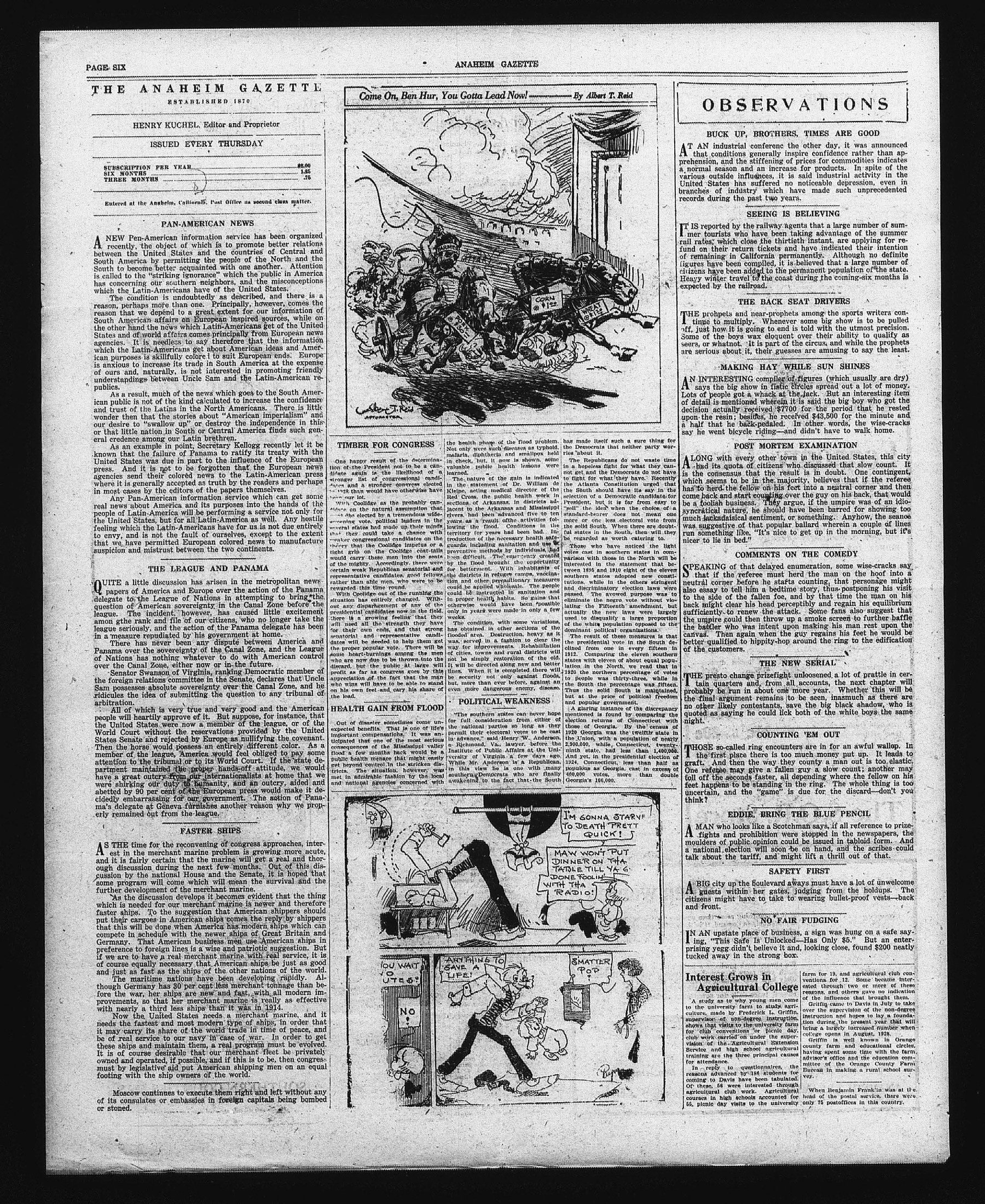
Searchable text
THE ANAHEIM GAZETTE
ESTABLISHED 1870
HENRY KUCHEL, Editor and Proprietor
ISSUED EVERY THURSDAY
SUBSCRIPTION PER YEAR.....$2.00
SIX MONTHS.....1.25
THREE MONTHS.....7.75
Entered at the Anaheim, California. Post Office as second class matter.
PAN-AMERICAN NEWS
A NEW Pen-American information service has been organized recently, the object of which is to promote better relations between the United States and the countries of Central and South America by permitting the people of the North and the South to become better acquainted with one another. Attention is called to the "striking ignorance" which the public in America has concerning our southern neighbors, and the misconceptions which the Latin-Americans have of the United States.
The condition is undoubtedly as described, and there is a reason, perhaps more than one. Principally, however, comes the reason that we depend to a great extent for our information of South American affairs on European inspired sources, while on the other hand the news which Latin-Americans get of the United States and of world affairs comes principally from European news agencies. It is needless to say therefore that the information which the Latin-Americans get about American ideas and American purposes is skillfully colorel to suit European ends. Europe is anxious to increase its trade in South America at the expense of ours and, naturally, is not interested in promoting friendly understandings between Uncle Sam and the Latin-American republics.
As a result, much of the news which goes to the South American public is not of the kind calculated to increase the confidence and trust of the Latins in the North Americans. There is little wonder then that the stories about "American imperialism" and our desire to "swallow up" or destroy the independence in this or that little nation in South or Central America finds such general credence among our Latin brethren.
As an example in point, Secretary Kellogg recently let it be
an purposes is skillfully colored to suit European ends. Europe is anxious to increase its trade in South America at the expense of ours and, naturally, is not interested in promoting friendly understandings between Uncle Sam and the Latin-American republics.
As a result, much of the news which goes to the South American public is not of the kind calculated to increase the confidence and trust of the Latins in the North Americans. There is little wonder then that the stories about "American imperialism" and our desire to "swallow up" or destroy the independence in this or that little nation in South or Central America finds such general credence among our Latin brethren.
As an example in point, Secretary Kellogg recently let it be known that the failure of Panama to ratify its treaty with the United States was due in part to the influence of the European press. And it is not to be forgotten that the European news agencies send their colored news to the Latin-American press where it is generally accepted as truth by the readers and perhaps in most cases by the editors of the papers themselves.
Any Pan-American information service which can get some real news about America and its purposes into the hands of the people of Latin-America will be performing a service not only for the United States, but for all Latin-America as well. Any hostile feeling which the Latin-Americans have for us is not due entirely to envy, and is not the fault of ourselves, except to the extent that we have permitted European colored news to manufacture suspicion and mistrust between the two continents.
THE LEAGUE AND PANAMA
QUITE a little discussion has arisen in the metropolitan newspapers of America and Europe over the action of the Panama delegate to the League of Nations in attempting to bring the question of American sovereignty in the Canal Zone before the league. The incident, however, has caused little excitement amon gthe rank and file of our citizens, who no longer take the league seriously, and the action of the Panama delegate has been in a measure repudiated by his government at home.
There has never been any dispute between America and Panama over the sovereignty of the Canal Zone, and the League of Nations has nothing whatever to do with American control over the Canal Zone, either now or in the future.
Senator Swanson of Virginia, ranking Democratic member of the foreign relations committee in the Senate, declares that Uncle Sam possesses absolute sovereignty over the Canal Zone, and he ridicules the idea of submitting the question to any tribunal of arbitration.
All of which is very true and very good and the American people will heartily approve of it. But suppose, for instance, that the United States were now a member of the league, or of the World Court without the reservations provided by the United States Senate and rejected by Europe as nullifying the covenant. Then the horse would possess an entirely different color. As a member of the league, America would feel obliged to pay some attention to the tribunal or to its World Court. If the state department maintained the proper hands-off attitude, we would have a great outcry from our internationalists at home that we were shirking our duty to humanity, and an outcry, aided and abetted by 90 per cent of the European press would make it decidedly embarrassing for our government. The action of Panama's delegate at Geneva furnishes another reason why we properly remained out from the league.
FASTER SHIPS
AS THE time for the reconvening of congress approaches, inter-
FASTER SHIPS
AS THE time for the reconvening of congress approaches, interest in the merchant marine problem is growing more acute, and it is fairly certain that the marine will get a real and thorough discussion during the next few months. Out of this discussion by the national House and the Senate, it is hoped that some program will come which will mean the survival and the further development of the merchant marine.
As the discussion develops it becomes evident that the thing which is needed for our merchant marine is newer and therefore faster ships. To the suggestion that American shippers should put their cargoes in American ships comes the reply by shippers that this will be done when America has modern ships which can compete in schedule with the newer ships of Great Britain and Germany. That American business men use American ships in preference to foreign lines is a wise and patriotic suggestion. But if we are to have a real merchant marine with real service, it is of course equally necessary that American ships be just as good and just as fast as the ships of the other nations of the world.
The maritime nations have been developing rapidly. Although Germany has 30 per cent less merchant tonnage than before the war, her ships are new and fast, with all modern improvements, so that her merchant marine is really as effective with nearly a third less ships than it was in 1914.
Now the United States needs a merchant marine, and it needs the fastest and most modern type of ships, in order that it may carry its share of the world trade in time of peace, and be of real service to our navy in case of war. In order to get these ships and maintain them, a real program must be evolved. It is of course desirable that our merchant fleet be privately owned and operated, if possible, and if this is to be, then congress must by legislative aid put American shipping men on an equal footing with the ship owners of the world.
Moscow continues to execute them right and left without any of its consulates or embassies in foreign capitals being bombed or stoned.
ANAHEIM GAZETTE
Come On, Ben Hur, You Gotta Lead Now!——By Albert T. Reid
TIMBER FOR CONGRESS
the health phase of the flood problem. has made itself such a sure thing for the Democrats that neither party wor-
TIMBER FOR CONGRESS
One happy result of the determination of the President not to be a candidate again is the likelihood of a stronger list of congressional candidates and a stronger congress elected in 1928 than would have otherwise have been our lot.
With Coolidge as the probably candidate on the natural assumption that he elected by a tremendous wide-opening vote, political leaders in the several states had made up their minds that they could take a chance with weaker congressional candidates on the theory that the Coolidge impetus or a tight grip on the Coolidge coat-tails would carry these men into the seats of the mighty. Accordingly, there were certain weak Republican senatorial and representative candidates, good fellows rather than able men, who were to be rewarded this time round.
With Coolidge out of the running the situation has entirely changed. Without any disparagement of any of the presidential candidates now in the field, there is a growing feeling that they will need all the strength they have for their own ends, and that strong senatorial and representative candidates will be needed to help them get the proper popular vote. There will be some heart-burnings among the men who are now due to be thrown into the discard, but the public at large will profit as far as congress goes by this appreciation of the fact that the man who wins will have to be able to stand on his own feet and carry his share of the load.
HEALTH GAIN FROM FLOOD
Out of disaster sometimes come unexpected benefits. That is one of life's important compensations. It was anticipated that one of the most serious consequences of the Mississippi valley flood a few months back would be a public health menace that might easily get beyond control in the stricken districts. The situation, however, was met in admirable fashion by the local and national agencies concerned with the health phase of the flood problem. Not only were such diseases as typhoid, malaria, diphtheria and smallpox held in check, but it now is shown, some valuable public health lessons were learned.
The nature of the gain is indicated in the statement of Dr. William de Kleine, acting medical director of the Red Cross, the public health work in sections of Arkansas, in districts adjacent to the Arkansas and Mississippi rivers, had been advanced five to ten years as a result of the activities following the flood. Conditions in the territory for years had been bad. Introduction of the necessary health safeguards, including sanitation and use of preventive methods by individuals, had been difficult. The emergency created by the flood brought the opportunity for betterment. With inhabitants of the districts in refuge camps, vaccination and other precautionary measures could be applied wholesale. The people could be instructed in sanitation and in proper health habits. So gains that otherwise would have been possible only in years were made in only a few weeks.
The condition, with some variations, has obtained in other sections of the flooded area. Destruction, heavy as it was, served in a fashion to clear the way for improvements. Rehabilitation of cities, towns and rural districts will not be simply restoration of the old. It will be directed along new and better lines. When it is completed there will be security not only against floods, but more than ever before, against an even more dangerous enemy, disease.
POLITICAL WEAKNESS
"The southern states can never hope for full consideration from either of the national parties so long as they permit their electoral votes to be cast in advance," said Henry W. Anderson, a Richmond, Va., lawyer, before the Institute of Public Affairs at the University of Virginia a few days ago. While Mr. Anderson is a Republican, in this view he is one with many southern Democrats who are finally awakening to the fact that—the South has made itself such a sure thing for the Democrats that neither party worries about it.
The Republicans do not waste time in a hopeless tight for what they cannot get and the Democrats do not have to fight for what they have. Recently the Atlanta Constitution urged that the South should have its say in the selection of a Democratic candidate for President, but it is far from easy to " sell" the idea when the choice of a standard-bearer does not mean one more or one less electoral vote from the solid South. When there are doubtful states in the South, then will they be regarded as worth catering to.
Those who have noticed the light votes cast in southern states in comparison with those in the North will be interested in the statement that between 1895 and 1810 eight of the eleven southern states adopted new constitutions while in the others stringent and discriminatory election laws were passed. The avowed purpose was to eliminate the negro vote without violating the Fifteenth amendment, but actually the new laws were largely used to disqualify a large proportion of the white population opposed to the dominant political organizations.
The result of these measures is that the presidential vote in the South declined from one in every fifteen in 1912. Comparing the eleven southern states with eleven of about equal population in the North, we read that in 1920 the northern percentage of votes to people was thirty-three, while in the South the percentage was fifteen. Thus the solid South is maintained, but at the price of political freedom and popular government.
A glaring instance of the discrepancy mentioned is found by comparing the election returns of Connecticut with those of Georgia. By the census of 1920 Georgia was the twelfth state in the Union, with a population of nearly 2,900,000; while Connecticut, twenty-ninth state, had less than 1,400,000. And yet, in the presidential election of 1924, Connecticut, less than half as populous as Georgia, cast in excess of 400,000 votes, more than double Georgia's 160,000.
public health menace that might easily get beyond control in the stricken districts. The situation, however, was met in admirable fashion by the local and national agencies concerned with the severity of Virginia's few days ago. While Mr. Anderson is a Republican, in this view he is one with many southern Democrats who are finally awakening to the fact that the South And yet, in the presidential election of 1924, Connecticut, less than half as populous as Georgia, cast in excess of 400,000 votes, more than double Georgia's 166,000.
I'm GONNA STARVE TO DEATH PRETTY QUICK!
MAW WON'T PUT DINNER ON THA TABLE TILL YA G DONE FOOLING WITH THA RADIO!
YOU WAIT TO UTEG?
NO!
ANYTHING TO SAVE A LIFE!
SMATTER POP?
OBSERVATIONS
BUCK UP, BROTHERS, TIMES ARE GOOD
AT AN industrial conference the other day, it was announced that conditions generally inspire confidence rather than apprehension, and the stiffening of prices for commodities indicates a normal season and an increase for products. In spite of the various outside influences, it is said industrial activity in the United States has suffered no noticeable depression, even in branches of industry which have made such unprecedented records during the past two years.
SEEING IS BELIEVING
IT IS reported by the railway agents that a large number of summer tourists who have been taking advantage of the summer rail rates, which close the thirtieth instant, are applying for refund on their return tickets and have indicated their intention of remaining in California permanently. Although no definite figures have been compiled, it is believed that a large number of citizens have been added to the permanent population of the state. Heavy winter travel to the coast during the coming-six months is expected by the railroad.
THE BACK SEAT DRIVERS
THE prohpets and near-prophets among the sports writers continue to multiply. Whenever some big show is to be pulled off, just how it is going to end is told with the utmost precision. Some of the boys wax eloquent over their ability to qualify as seers, or whatnot. It is part of the circus, and while the prophets are serious about it, their guesses are amusing to say the least.
MAKING HAY WHILE SUN SHINES
AN INTERESTING compiler of figures (which usually are dry) says the big show in fistic circles spread out a lot of money. Lots of people got a whack at the jack. But an interesting item of detail is mentioned wherein it is said the big boy who got the decision actually received $7700 for the period that he rested upon the resin; besides, he received $43,500 for the minute and a half that he back-pedaled. In other words, the wise-cracks say he went bicycle riding—and didn't have to walk home.
POST MORTEM EXAMINATION
MAKING HAY WHILE SUN SHINES
AN INTERESTING compiler of figures (which usually are dry) says the big show in fistic circles spread out a lot of money. Lots of people got a whack at the jack. But an interesting item of detail is mentioned wherein it is said the big boy who got the decision actually received $7700 for the period that he rested upon the resin; besides, he received $43,500 for the minute and a half that he back-pedaled. In other words, the wise-cracks say he went bicycle riding—and didn't have to walk home.
POST MORTEM EXAMINATION
ALONG with every other town in the United States, this city had its quota of citizens who discussed that slow count. It is the consensus that the result is in doubt. One contingent, which seems to be in the majority, believes that if the referee has to herd the fellow on his feet into a neutral corner and then come back and start counting over the guy on his back, that would be a foolish business. They argue, if the umpire was of an idiosyncratic nature, he should have been barred for showing too much lackadaisical sentiment, or something. Anyhow, the seanoe was suggestive of that popular ballard wherein a couple of lines run something like, "It's nice to get up in the morning, but it's nicer to lie in bed."
COMMENTS ON THE COMEDY
SPEAKING of that delayed enumeration, some wise-cracks say that if the referee must herd the man on the hoof into a neutral corner before he staffs counting, that personage might also essay to tell him a bedtime story, thus-postponing his visit to the side of the fallen foe, and by that time the man on his back might clear his head perceptibly and regain his equilibrium sufficiently to renew the attack. Some fans also suggest that the umpire could then throw up a smoke screen to further baffle the batfler who was intent upon making his man rest upon the canvas. Then again when the guy regains his feet he would be better qualified to hippity-hop around the ring to the edification of the customers.
THE NEW SERIAL
THE presto change prizefight unloosened a lot of prattle in certain quarters and, from all accounts, the next chapter will probably be run in about one more year. Whether this will be the final argument remains to be seen, inasmuch as there are no other likely contestants, save the big black shadow, who is quoted as saying he could lick both of the white boys the same night.
COUNTING 'EM OUT
THOSE so-called ring encounters are in for an awful wallop. In the first place there is too much money put up. It leads to graft. And then the way they county a man out is too elastic. One referee may give a fallen guy a slow count; another may toll off the seconds faster, all depending where the fellow on his feet happens to be standing in the ring. The whole thing is too uncertain, and the "game" is due for, the discard—don't you think?
EDDIE, BRING THE BLUE PENCIL
MAN who looks like a Scotchman says, if all reference to prize-fights and prohibition were stopped in the newspapers, the moulders of public opinion could be issued in tabloid form. And a national election will soon be on hand, and the scribes could
EDDIE, BRING THE BLUE PENCIL
MAN who looks like a Scotchman says, if all reference to prize-fights and prohibition were stopped in the newspapers, the moulders of public opinion could be issued in tabloid form. And a national election will soon be on hand, and the scribes could talk about the tariff, and might lift a thrill out of that.
SAFETY FIRST
BIG city up the boulevard always must have a lot of unwelcome guests within her gates, judging from the holdups. The citizens might have to take to wearing bullet-proof vests—back and front.
NO FAIR FUDGING
IN AN upstate place of business, a sign was hung on a safe saying, "This Safe Is Unlocked—Has Only $5." But an enterprising yegg didn't believe it and, looking close, found $200 neatly tucked away in the strong box.
Interest Grows in Agricultural College
A study as to why young men come to the university farm to study agriculture, made by Frederick L. Griffin, supervisor of non-degree instruction, shows that visits to the university farm for club conventions or picnic day, club work carried on under the supervision of the Agricultural Extension Service and high school agricultural training are the three principal causes for attendance.
In reply to questionnaires, the reasons advanced by 186 students for coming to Davis have been tabulated. Of these, 56 were interested through agricultural club work. Agricultural courses in high schools accounted for 55, picnic day visits to the university farm for 19, and agricultural club conventions for 12. Some became interested through two or more of these reasons, and others gave no indication of the influence that brought them.
Griffin came to Davis in July to take over the supervision of the non-degree instruction and hopes to lay a foundation during the present year that will bring a largely increased number when college opens in August, 1928.
Griffin is well known in Orange county farm and educational circles, having spent some time with the farm, advisor's office and the education committee of the Orange County Farm Bureau in making a rural school survey.
When Benjamin Franklin was at the head of the postal service, there were only 75 postoffices in this country.