anaheim-gazette 1927-08-18
Scanned page
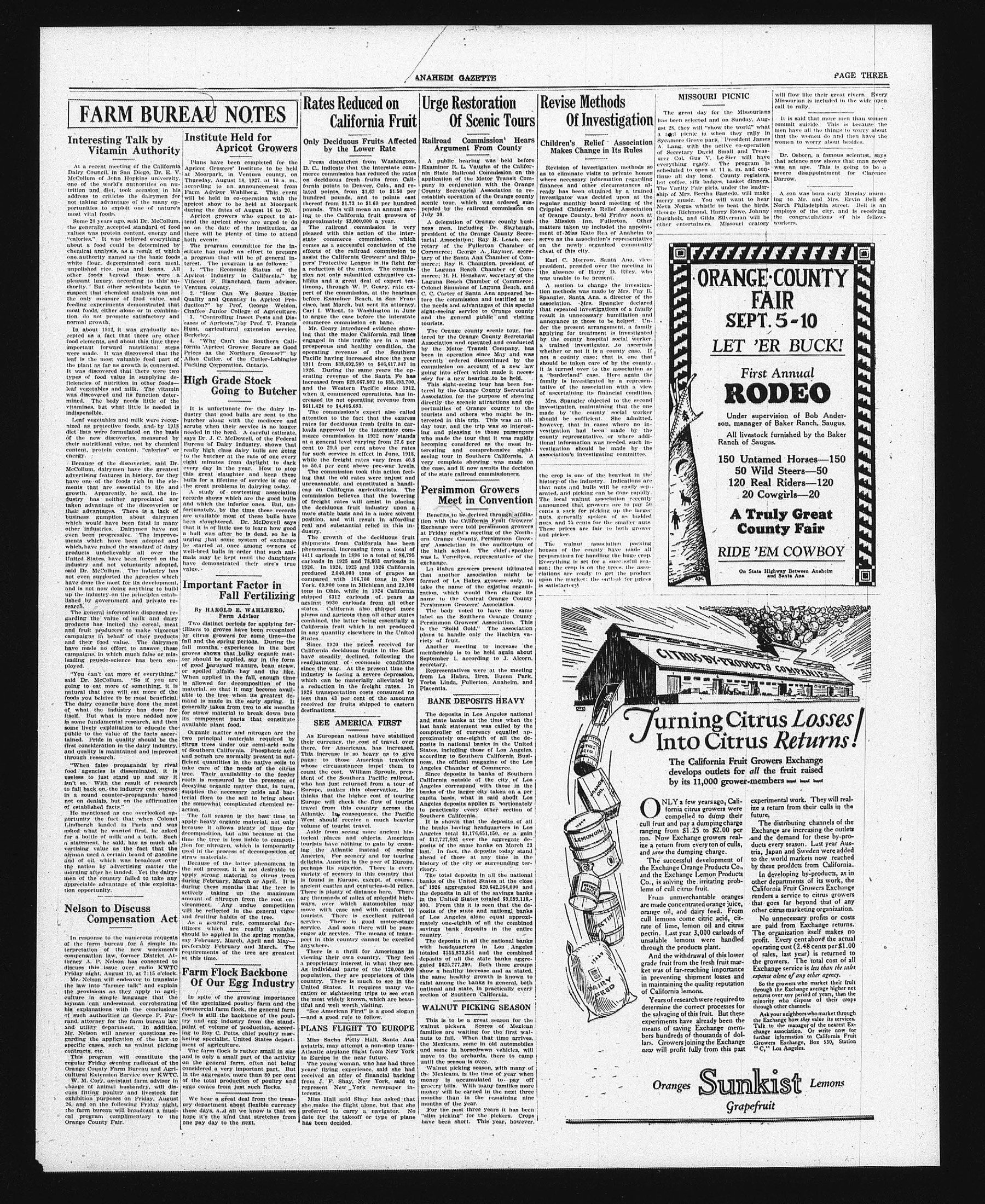
Searchable text
FARM BUREAU NOTES
Interesting Talk by Vitamin Authority
At a recent meeting of the California Dairy Council, in San Diego, Dr. E. V. McCollum of John Hopkins university, one of the world's authorities on nutrition and diet, took occasion in his address to criticise the dairymen for not taking advantage of the many opportunities to exploit one of nature's most vital foods.
Some 20 years ago, said Dr. McCollum, the generally accepted standard of food values was protein content, energy and "calories." It was believed everything about a food could be determined by chemical analysis, as a result of which one authority named as the basic foods white flour, degerminated corn meal, unpolished rice, peas and beans. All other foods beyond these were a pleasant luxury, according to this authority. But other scientists began to suspect that chemical analysis was not the only measure of food value, and feeding experiments demonstrated that most foods, either alone or in combination, do not promote satisfactory and normal growth.
In about 1912, it was gradually accepted as a fact that there are other food elements, and about this time three important forward nutritional steps were made. It was discovered that the leaf is the most valuable food part of the plant as far as growth is concerned. It was discovered that there were two types of food value in supplying deficiencies of nutrition in other foods—leaf vegetables and milk. The vitamin was discovered and its function determined. The body needs little of the vitamins, but what little is needed is indispensable.
Leaf vegetables and milk were recognized as protective foods, and by 1918 diet lists were formulated on the basis of the new discoveries, measured by their nutritional value, not by chemical content, protein content, "calories" on Institute Held for Apricot Growers
Plans have been completed for the Apricot Growers' Institute to be held at Moorpark, in Ventura county, on Thursday, August 18, 1927, at 10 a.m., according to an announcement from Farm Advisor Wahlberg. This event will be held in co-operation with the apricot show to be held at Moorpark during the dates of August 16 to 20.
Apricot growers who expect to attend the apricot show are urged to do so on the date of the institution, as there will be plenty of time to attend both events.
The program committee for the institute has made an effort to prepare a program that will be of general interest. The program is as follows:
1. "The Economic Status of the Apricot Industry in California," by Vincent F. Blanchard, farm advisor, Ventura county.
2. "How Can We Secure Better Quality and Quantity in Apricot Production?" by Prof. George Weldon, Chaffee Junior College of Agriculture.
3. "Controlling Insect Pests and Diseases of Apricots," by Prof. T. Francis Hunt, agricultural extension service, Berkeley.
4. "Why Can't the Southern California Apricot Grower Secure as Good Prices as the Northern Grower?" by Allan Cutler, of the Cutler-Lobingler Packing Corporation, Ontario.
High Grade Stock Going to Butcher
It is unfortunate for the dairy industry that good bulls are sent to the butcher along with the mediocre and scrubs when their service is no longer needed in the herd. A careful estimate, says Dr. J. C. McDowell, of the Federal Bureau of Dairy Industry, shows that nearly high quality butchered cattle account for deciduous free feeds approved by the mezzacotta commission in at a general level vary cent to 29.5 per cent.
Press dispatches from D. C., indicate that the mercury commission has on deciduous fresh for formula points to Denver lated points, from $11 hundred pounds, and thereof from $1.73 to $pounds. This will mean ing to the California approximately $3,000,000.
The railroad commissar pleased with this active state commerce comes as a successful effort of the railroad assist the California Grpers' Protective League a reduction of the rate sion not only submitted hilbits and a great deal timony, through W. P. pert of the commission before Examiner Bea cisco last March, but a Carl I. Wheat, to War to argue the case before commerce commission.
Mr. Geary introduced that the major Cal engaged in this traffic prosperous and health operating revenue of Pacific having increased 1911 from $38,692,580 1926. During the same erating revenue of the increased from $29,667,750 and the Western Pa when it commenced operations creased its net operation $611,424 to $4,405,683.
The commission's exention to the fact rates for deciduous free loads approved by the mezzacotta commission in at a general level vary cent to 29.5 per cent.
High Grade Stock Going to Butcher
It is unfortunate for the dairy industry that good bulls are sent to the butcher along with the mediocre and scrubs when their service is no longer needed in the herd. A careful estimate, says Dr. J. C. McDowell, of the Federal Bureau of Dairy Industry, shows that really high class dairy bulls are going to the butcher at the rate of one every eight minutes from daylight to dark every day in the year. How to stop this great slaughter and keep these bulls for a lifetime of service is one of the great problems in dairying today.
A study of cowtesting association records shows which are the good bulls and which the inferior ones. But, unfortunately, by the time these records are available most of these bulls have been slaughtered. Dr. McDowell says that it is of little use to learn how good a bull was after he was dead, so he is urging that some system of exchange be started at once among owners of well-bred bulls in order that such animals may be kept until the daughters have demonstrated their sire's true value.
Important Factor in Fall Fertilizing
By HAROLD E. WAHLBERG, Farm Advisor
Two distinct periods for applying fertilizers to groves have been recognized by citrus growers for some time—the fall and the spring periods. During the fall months, experience in the best groves shows that bulky organic matter should be applied, say in the form of good barnyard manure, bean straw, or spoiled alfalfa hay and the like. When applied in the fall, enough time is allowed for decomposition of the material, so that it may become available to the tree when its greatest demand is made in the early spring. It generally takes from two to six months for straw material to break down into its component parts that constitute available plant food.
Organic matter and nitrogen are the two principal materials required by citrus trees under our semi-arid soils of Southern California. Phosphoric acid and potash are normally present in sufficient quantities in the native soils to take care of the needs of the citrus tree. Their availability to the feeder roots is measured by the presence of decaying organic matter that, in turn, supplies the necessary acids and bacterial flora to the soil to bring about the somewhat complicated chemical reaction.
The fall season is the best time to apply heavy organic material, not only because it allows plenty of time for decomposition, but also because at the time the tree is less liable to competition for nitrogen, which is temporarily made up of nitrogen, which is temporarily made up of nitrogen, which is temporarily made up of nitrogen, which is temporarily made up of nitrogen, which is temporarily made up of nitrogen, which is temporarily made up of nitrogen, which is temporarily made up of nitrogen, which is temporarily made up of nitrogen, which is temporarily made up of nitrogen, which is temporarily made up of nitrogen, which is temporarily made up of nitrogen, which is temporarily made up of nitrogen, which is temporarily made up of nitrogen,
As European nations their currency, the cost there, for Americans. This increase is so high that whose circumstances count the cost. William ident of the Southern who has just returned Europe, makes this oo thinks that the higher Europe will check the travel from this country Atlantic. In consequence West should receive a volume of tourist travel Aside from seeing more tourical places and observing tourists nothing to ing the Atlantic ins
"When false propaganda by rival food agencies is disseminated, it is useless to just stand up and say it isn't so. With the result of research to fall back on, the industry can engage in a sound counter-propaganda based not on denials, but on the affirmation of established facts."
He mentioned as one overlooked opportunity the fact that when Colonel Lindbergh landed in Paris and was asked what he wanted first, he asked for a bottle of milk and a bath. Such a statement, he said, has as much advertising value as the fact that the airman used a certain brand of gasoline and of oil, which was broadcast over the nation by advertising matter the morning after he landed. Yet the dairymen of the country failed to take any appreciable advantage of this exploitation opportunity.
Nelson to Discuss Compensation Act
In response to the numerous requests of the farm bureau for a simple interpretation of the new workmen's compensation law, former District Attorney A. P. Nelson has consented to discuss this issue over radio KWTC Friday night. August 19, at 7:15 o'clock.
Mr. Nelson will endeavor to translate the law into "farmer talk" and explain the provisions as they apply to agriculture in simple language that the layman can understand, corroborating his explanations with the conclusions of such authorities as George P. Farrand, attorney for the farm bureau law and utility department. In addition, Mr. Nelson will answer questions regarding the application of the law to specific cases, such as walnut picking contracts, etc.
This program will constitute the regular Friday evening radiocast of the Orange County Farm Bureau and Agricultural Extension Service over KWTC.
W. M. Cory, assistant farm advisor in charge of animal husbandry, will discuss fitting poultry and livestock for exhibition purposes on Friday, August 26, and on the following Friday night, the farm bureau will broadcast a musical program complimentary to the Orange County Fair.
Farm Flock Backbone Of Our Egg Industry
In spite of the growing importance of the specialized poultry farm and the commercial farm flock, the general farm flock is still the backbone of the poultry and egg industry from the standpoint of volume of production, according to Roy C. Potts, chief poultry marketing specialist, United States department of agriculture.
The farm flock is rather small in size and is only a small part of the activity on the general farm, often not being considered a very important part. But in the aggregate, more than 80 per cent of the total production of poultry and eggs comes from just such flocks.
We hear a great deal from the treasury department about flexible currency these days, a.d all we know is that we hope it's the kind that stretches from one pay day to the next.
Miss Sacha Petty Haviatrixx, may attempt an Atlantic airplane flight to Europe in the near future. The young woman, who years' flying experience received an offer of ferry from J. F. Shay, New York represents New York terests.
Miss Hall said Shay she make the flight alone preferred to carry a date for the takeoff or has been decided.
Rates Reduced on California Fruit
Only Deciduous Fruits Affected by the Lower Rate
Press dispatches from Washington, D.C., indicate that the interstate commerce commission has reduced the rates on deciduous fresh fruits from California points to Denver, Colo., and related points, from $1.62 to $1.50 per hundred pounds, and to points east thereof from $1.73 to $1.60 per hundred pounds. This will mean an annual saving to the California fruit growers of approximately $3,000,000 a year.
The railroad commission is very pleased with this action of the interstate commerce commission, which comes as a successful conclusion of the efforts of the railroad commission to assist the California Growers' and Shippers' Protective League in its fight for a reduction of the rates. The commission not only submitted exhaustive exhibits and a great deal of expert testimony through W. P. Geary, rate expert of the commission, at the hearings before Examiner Beach, in San Francisco, last March, but sent its attorney, Carl I. Wheat, to Washington in June to argue the case before the interstate commerce commission en banc.
Mr. Geary introduced evidence showing that the major California rail lines engaged in this traffic are in a most prosperous and healthy condition, the operating revenue of the Southern Pacific having increased since the year 1911 from $38,692,580 to $46,617,047 in 1926. During the same years the operating revenue of the Santa Fe has increased from $29,667,802 to $55,493,700, and the Western Pacific since 1912, when it commenced operations, has increased its net operating revenue from $611,424 to $4,405,683.
The commission's expert also called attention to the fact that the express rates for deciduous fresh fruits in carloads approved by the interstate commerce commission in 1922 now stands at a general level varying from 27.6 per cent to 29.5 per cent above the rates
Urge Restoration Of Scenic Tours
Railroad Commission¹ Hears Argument From County
A public hearing was held before Examiner R. L. Vaughn of the California State Railroad Commission on the application of the Motor Transit Company in conjunction with the Orange County Secretarial Association to re-establish operation of the Orange county scenic tour, which was ordered suspended by the railroad commission on July 30.
A delegation of Orange county business men, including Dr. Skaybaugh, president of the Orange County Secretarial Association; Ray B. Leach, secretary of the Fullerton Chamber of Commerce; George A. Raymer, secretary of the Santa Ana Chamber of Commerce; Ray B. Champion, president of the Laguna Beach Chamber of Commerce; H. H. Henshaw, secretary of the Laguna Beach Chamber of Commerce; Colonel Simmons of Laguna Beach, and C. C. Carter of Santa Ana appeared before the commission and testified as to the needs and advantages of this special sight-seeing service to Orange county and the general public and visiting tourists.
The Orange county scenic tour, fostered by the Orange County Secretarial Association and operated and conducted by the Motor Transit Company, has been in operation since May and was recently ordered discontinued by the commission on account of a new law going into effect which made it necessary for a new hearing to be held.
This sight-seeing tour has been fostered by the Orange County Secretarial Association for the purpose of showing directly the scenic attractions and opportunities of Orange county to the tourists and others who might be interested in this trip. This was an all-day tour, and the trip was so interesting and pleasing to those passengers who made the tour that it was rapidly becoming considered as the most interesting and courteous sight.
Revise Methods Of Investigation
Children's Relief Association Makes Change In Its Rules
Revision of investigation methods so as to eliminate visits to private homes where necessary information regarding finances and other circumstances already has been obtained by a trained investigator was decided upon at the regular monthly board meeting of the Crippled Children's Relief Association of Orange County, held Friday noon at the Mission Inn. Fullerton. Other matters taken up included the appointment of Miss Kate Rea of Anahiem to serve as the association's representative on the newly organized community chest of this city.
Earl C. Morrow, Santa Ana, vice-president, presided over the meeting in the absence of Harry D. Riley, who was unable to be present.
A motion to change the investigation methods was made by Mrs. Fay R. Spangler, Santa Ana, a director of the association. Mrs. Spangler declared that repeated investigations of a family result in unnecessary humiliation and annoyance to those to be helped. Under the present arrangement, a family applying for treatment is investigated by the county hospital social worker. A trained investigator, to ascertain whether or not it is a county case. If not a county case; that is one that should be taken care of by the county. It is turned over to the association as a "borderland" case. Here again the family is investigated by a representative of the association with a view of ascertaining its financial condition.
Mrs. Spangler objected to the second investigation, maintaining that one made by 'the county social worker should be sufficient. She admitted, however, that in cases where no investigation had been made by the county representative, or where additional information was needed, such investigation should be made by the
Pacific having increased since the year 1911 from $38,692,580 to $46,617,047 in 1926. During the same years the operating revenue of the Santa Fe has increased from $29,678,802 to $55,493,700 and the Western Pacific since 1912, when it commenced operations, has increased its net operating revenue from $611,424 to $4,405,683.
The commission's expert also called attention to the fact that the express rates for deciduous fresh fruits in carloads approved by the interstate commerce commission in 1922 now stands at a general level varying from 27.6 per cent to 29.5 per cent above the rates for such service in effect in June, 1918, while the freight rates vary from 40.8 to 50.4 per cent above pre-war levels.
The commission took this action feeling that the old rates were unjust and unreasonable, and constituted a handicap on California agriculturists. The commission believes that the lowering of freight rates will assist in placing the deciduous fruit industry upon a more stable basis and in a more solvent position, and will result in affording real and substantial relief in this industry.
The growth of the deciduous fruit shipments from California has been phenomenal, increasing from a total of 4411 carloads in 1896 to a total of 86,795 carloads in 1925 and 78,803 carloads in 1926. In 1924, 1925 and 1926 California produced 2,040,000 tons of grapes as compared with 106,700 tons in New York, 60,900 tons in Michigan and 29,100 tons in Ohio, while in 1924 California shipped 6312 carloads of pears as against 9930 carloads from all other states. California also shipped more plums and apricots than all other states combined, the latter being essentially a California fruit which is not produced in any quantity elsewhere in the United States.
Since 1920 the prices received for California deciduous fruits in the East have steadily declined, following the readjustment of economic conditions since the war. At the present time the industry is facing a severe depression, which can be materially alleviated by a reduction in the freight rates. In 1926 transportation costs consumed no less than 43 per cent of the amounts received for fruits shipped to eastern destinations.
SEE AMERICA FIRST
As European nations have stabilized their currency, the cost of travel over there, for Americans, has increased. This increase is so heavy as to give pause to those American travelers whose circumstances impel them to count the cost. William Sproule, president of the Southern Pacific railroad, who has just returned from a tour of Europe, makes this observation. He thinks that the higher cost of touring Europe will check the flow of tourist travel from this country across the Atlantic. In consequence, the Pacific West should receive a much heavier volume of tourist travel.
Aside from seeing more ancient historical places and objects, American tourists have nothing to gain by crossing the Atlantic instead of seeing been in operation since May and was recently ordered discontinued by the commission on account of a new law going into effect which made it necessary for a new hearing to be held.
This sight-seeing tour has been fostered by the Orange County Secretarial Association for the purpose of showing directly the scenic attractions and opportunities of Orange county to the tourists and others who might be interested in this trip. This was an all-day tour, and the trip was so interesting and pleasing to those passengers who made the tour that it was rapidly becoming considered as the most interesting and comprehensive sightseeing tour in Southern California. A very complete showing was made on the case, and it now awaits the decision of the state railroad commissioners.
Persimmon Growers Meet in Convention
Benefits to be derived through affiliation with the California Fruit Growers' Exchange were told persimmon growers at Friday night's meeting of the Northern Orange County, Persimmon Growers' Association in the auditorium of the high school. The chief speaker was L. Vermilyea, representative of the exchange.
La Habra growers present intimated that another association might be formed of La Habra growers only, to take the name of the existing organization, which would then change its name to the Central Orange County Persimmon Growers' Association.
The body voted to have the same label as the Southern Orange County Persimmon Growers' Association. This is the "Solid Gold." The association plans to handle only the Hachiya variety of fruit.
Another meeting to increase membership is to be held again about September 1, according to J. Alcorn, secretary.
Representatives were at the meeting from La Habra, Brea, Buena Park, Yorba Linda, Fullerton, Anaheim, and Placentia.
BANK DEPOSITS HEAVY
The deposits in Los Angeles national and state banks at the time when the last bank statement was called by the comptroller of currency equalled approximately one-eighth of all the deposits in national banks in the United States, including those of Los Angeles, according to Southern California Business, the official magazine of the Los Angeles Chamber of Commerce.
Since deposits in banks of Southern California outside of the city of Los Angeles correspond with those in the banks of the larger city taken on a per capita basis, what is said about Los Angeles deposits applies proportionately to practically every other section of Southern California.
It is shown that the deposits of all the banks having headquarters in Los Angeles total $1,176,651,150, or a gain of $12,727,803 over the aggregate deposits of the same banks on March 23 last.
The walnut association packing houses of the county have made all preparations for handling the huge crop. Everything is set for a successful season; the crop is on the trees; the associations are ready to get the product upon the market; the outlook for prices is satisfactory.
ONLY a few California citrus developed by its 19th century growers.
Since deposits in banks of Southern California outside of the city of Los Angeles correspond with those in the banks of the larger city taken on a per capita basis, what is said about Los Angeles deposits applies proportionately to practically every other section of Southern California.
It is shown that the deposits of all the banks having headquarters in Los Angeles total $1,176,651,150, or a gain of $12,727,803 over the aggregate deposits of the same banks on March 23 last. In fact, the deposits today stand ahead of those at any time in the history of the city or surrounding territory.
The total deposits in all the national banks of the United States at the close of 1922 aggregated $20,642,164,000 and the deposits in all of the savings banks in the United States totaled $9,599,118,000. From this it is seen that the deposits of the state and national banks of Los Angeles alone equal approximately one-eighth of all the combined savings bank deposits in the entire country.
The deposits in all the national banks with headquarters in Los Angeles totaled $555,873,851 and the combined deposits of all the state banks aggregated $625,777,300. Both these groups show a healthy increase and as stated, the same healthy growth is known to exist among the banks in general, both national and state, in practically every section of Southern California.
WALNUT PICKING SEASON
This is to be a great season for the walnut pickers. Scores of Mexican families are waiting for the first walnuts to fall. When that time arrives, the Mexicans, some in old automobiles and some in horsedrawn vehicles, will move to the orchards, there to camp until the season is over.
Walnut picking season, with many of the Mexicans, is the time of year when money is accumulated to pay off grocery bills. With many families more money will be earned in the next three months than in the remaining nine months of the year.
For the past three years it has been "slim picking" for the pickers. Crops have been short. This year, however,
Oranges
MISSOURI PICNIC
The great day for the Missourians has been selected and on Sunday, August 28, they will "show the world" what a picnic is when they rally in Sycamore Grove park. President James A. Lang, with the active co-operation of Secretary David Small and Treasurer Col. Gus V. LeSier will have everything ready. The program is scheduled to open at 11 a.m. and continue all day long. County registers, hot coffee, silk badges, basket dinners. The Vanity Fair girls, under the leadership of Mrs. Bertha Bastedo, will make merry music. You will want to hear Neva Negus whistle to beat the birds. George Richmond, Harry Rowe, Johnny Buckholz, and Glida Silverman will be other entertainers. Missouri oratory will flow like their great rivers. Every Missourian is included in the wide open call to rally.
It is said that more men than women commit suicide. This is because the men have all the things to worry about that the women do and then have the women to worry about besides.
Dr. Osborn, a famous scientist, says that science now shows that man never was an ape. This is going to be a severe disappointment for Clarence Darrow.
A son was born early Monday morning to Mr. and Mrs. Ervin Bell of North Philadelphia street. Bell is an employee of the city, and is receiving the congratulations of his fellow-workers.
ORANGE COUNTY FAIR
SEPT. 5-10
LET 'ER BUCK!
First Annual RODEO
Under supervision of Bob Anderson, manager of Baker Ranch, Saugus.
All livestock furnished by the Baker Ranch of Saugus.
First Annual
RODEO
Under supervision of Bob Anderson, manager of Baker Ranch, Saugus.
All livestock furnished by the Baker Ranch of Saugus.
150 Untamed Horses—150
50 Wild Steers—50
120 Real Riders—120
20 Cowgirls—20
A Truly Great County Fair
RIDE 'EM COWBOY
On State Highway Between Anaheim and Santa Ana
Turning Citrus Losses!
Into Citrus Returns!
The California Fruit Growers Exchange develops outlets for all the fruit raised by its 11,000 grower-members
ONLY a few years ago, California citrus growers were compelled to dump their cull fruit and pay a dumping charge ranging from $1.25 to $2.00 per ton. Now Exchange growers realize a return from every ton of culls, experimental work. They will realize a return from their culls in the future.
The distributing channels of the Exchange are increasing the outlets and the demand for these by-products every season. Last year Aus-
The California Fruit Growers Exchange develops outlets for all the fruit raised by its 11,000 grower-members
ONLY a few years ago, California citrus growers were compelled to dump their cull fruit and pay a dumping charge ranging from $1.25 to $2.00 per ton. Now Exchange growers realize a return from every ton of culls, and save the dumping charge.
The successful development of the Exchange Orange Products Co., and the Exchange Lemon Products Co., is solving the irritating problems of cull citrus fruit.
From unmerchantable oranges are made concentrated orange juice, orange oil, and dairy feed. From cull lemons come citric acid, citrate of lime, lemon oil and citrus pectin. Last year 3,000 carloads of unsalable lemons were handled through the products plant.
And the withdrawal of this lower grade fruit from the fresh fruit market was of far-reaching importance in preventing shipment losses and in maintaining the quality reputation of California lemons.
Years of research were required to determine the correct processes for the salvaging of this fruit. But these experiments have already been the means of saving Exchange members hundreds of thousands of dollars. Growers joining the Exchange new will profit fully from this past experimental work. They will realize a return from their culls in the future.
The distributing channels of the Exchange are increasing the outlets and the demand for these by-products every season. Last year Austria, Japan and Sweden were added to the world markets now reached by these prodicts from California.
In developing by-products, as in other departments of its work, the California Fruit Growers Exchange renders a service to citrus growers that goes far beyond that of any other citrus marketing organization.
No unnecessary profits or costs are paid from Exchange returns. The organization itself makes no profit. Every cent above the actual operating cost (2.48 cents per $1.00 of sales, last year) is returned to the growers. The total cost of all Exchange service is less than the sales expense alone of any other agency.
So the growers who market their fruit through the Exchange average higher net returns over any period of years, than the minority who dispose of their crops through other channels.
Ask your neighbors who market through the Exchange how they value its services. Talk to the manager of the nearest Exchange association. Or write now for further information to California Fruit Growers Exchange, Box 530, Station "C," Los Angeles.
Oranges Sunkist Lemons Grapefruit