anaheim-gazette 1927-08-04
Scanned page
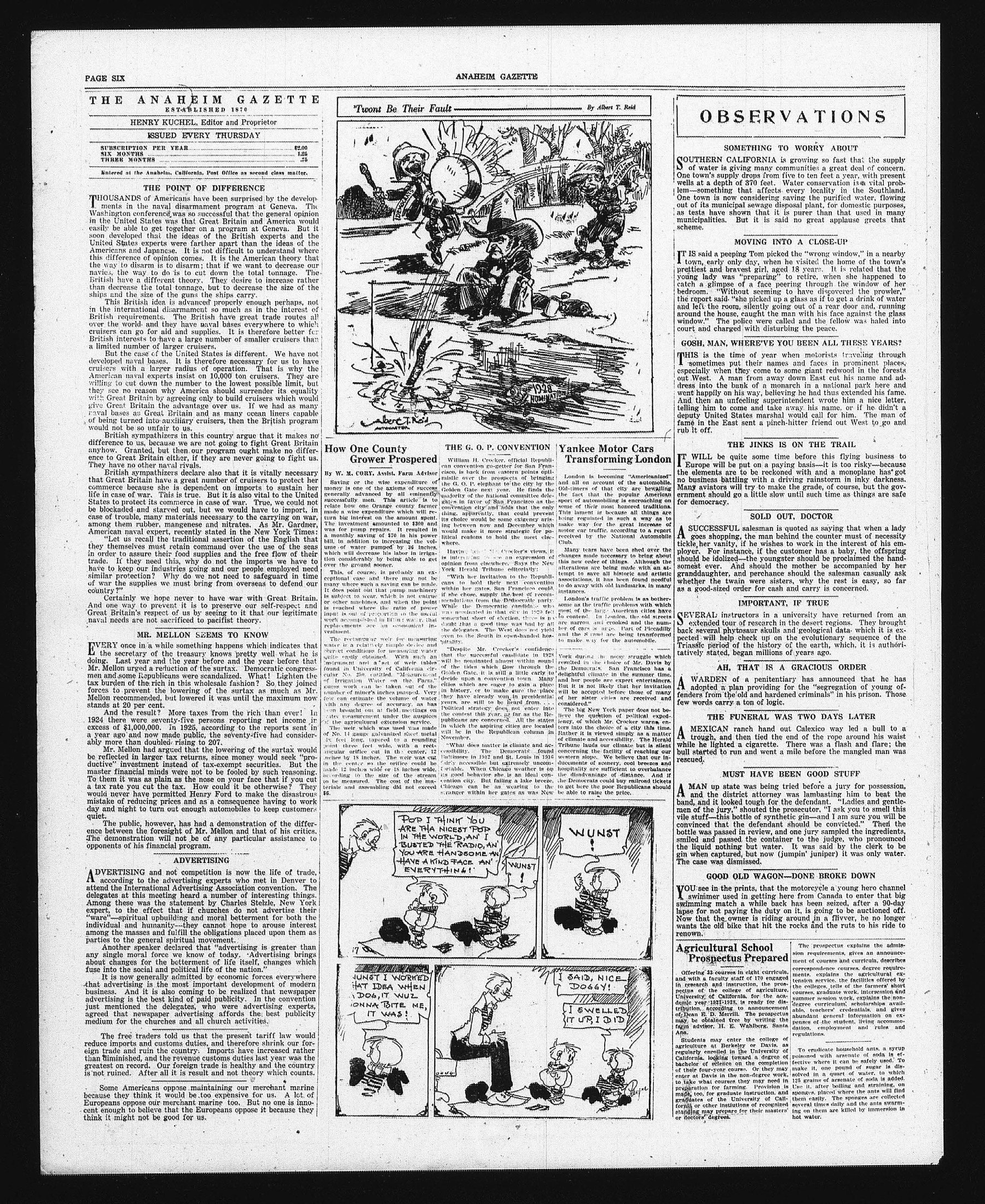
Searchable text
THE ANAHEIM GAZETTE
ESTABLISHED 1870
HENRY KUCHEL, Editor and Proprietor
ISSUED EVERY THURSDAY
SUBSCRIPTION PER YEAR $2.00
SIX MONTHS 1.25
THREE MONTHS .75
Entered at the Anaheim, California, Post Office as second class matter.
THE POINT OF DIFFERENCE
THOUSANDS of Americans have been surprised by the developments in the naval disarmament program at Geneva. The Washington conference was so successful that the general opinion in the United States was that Great Britain and America would easily be able to get together on a program at Geneva. But it soon developed that the ideas of the British experts and the United States experts were farther apart than the ideas of the Americans and Japanese. It is not difficult to understand where this difference of opinion comes. It is the American theory that the way to disarm is to disarm; that if we want to decrease our navies, the way to do is to cut down the total tonnage. The British have a different theory. They desire to increase rather than decrease the total tonnage, but to decrease the size of the ships and the size of the guns the ships carry.
This British idea is advanced properly enough perhaps, not in the international disarmament so much as in the interest of British requirements. The British have great trade routes all over the world and they have naval bases everywhere to which cruisers can go for aid and supplies. It is therefore better for British interests to have a large number of smaller cruisers than a limited number of larger cruisers.
But the case of the United States is different. We have not developed naval bases. It is therefore necessary for us to have cruisers with a larger radius of operation. That is why the American naval experts insist on 10,000 ton cruisers. They are willing to cut down the number to the lowest possible limit, but they see no reason why America should surrender its equality with Great Britain by agreeing only to build cruisers which would give Great Britain the advantage over us. If we had as many naval bases as Great Britain and as many ocean liners capable of being turned into auxiliary cruisers, then the British program would not be so unfair to us.
British sympathizers in this country argue that it makes no difference to us, because we are not going to fight Great Britain
But the case of the United States is different. We have not developed naval bases. It is therefore necessary for us to have cruisers with a larger radius of operation. That is why the American naval experts insist on 10,000 ton cruisers. They are willing to cut down the number to the lowest possible limit, but they see no reason why America should surrender its equality with Great Britain by agreeing only to build cruisers which would give Great Britain the advantage over us. If we had as many naval bases as Great Britain and as many ocean liners capable of being turned into auxiliary cruisers, then the British program would not be so unfair to us.
British sympathizers in this country argue that it makes no difference to us, because we are not going to fight Great Britain anyhow. Granted, but then our program ought make no difference to Great Britain either, if they are never going to fight us. They have no other naval rivals.
British sympathizers declare also that it is vitally necessary that Great Britain have a great number of cruisers to protect her commerce because she is dependent on imports to sustain her life in case of war. This is true. But it is also vital to the United States to protect its commerce in case of war. True, we could not be blockaded and starved out, but we would have to import, in case of trouble, many materials necessary to the carrying on war, among them rubber, manganese and nitrates. As Mr. Gardner, American naval expert, recently stated in the New York Times:
"Let us recall the traditional assertion of the English that they themselves must retain command over the use of the seas in order to assure their food supplies and the free flow of their trade. If they need this, why do not the imports we have to have to keep our industries going and our people employed need similar protection? Why do we not need to safeguard in time of war the supplies we must bring from overseas to defend our country?"
Certainly we hope never to have war with Great Britain. And one way to prevent it is to preserve our self-respect and Great Britain's respect of us by seeing to it that our legitimate naval needs are not sacrificed to pacifist theory.
MR. MELLON SEEMS TO KNOW
EVERY once in a while something happens which indicates that the secretary of the treasury knows pretty well what he is doing. Last year and the year before and the year before that Mr. Mellon urged a reduction of the surtax. Democratic congressmen and some Republicans were scandalized. What! Lighten the tax burden of the rich in this wholesale fashion? So they joined forces to prevent the lowering of the surtax as much as Mr. Mellon recommended, but lowered it was until the maximum now stands at 20 per cent.
And the result? More taxes from the rich than ever! In 1924 there were seventy-five persons reporting net income in excess of $1,000,000. In 1925, according to the reports sent in a year ago and now made public, the seventy-five had considerably more than doubled rising to 207.
Mr. Mellon had argued that the lowering of the surtax would be reflected in larger tax returns, since money would seek "productive" investment instead of tax-exempt securities. But the master financial minds were not to be fooled by such reasoning. To them it was as plain as the nose on your face that if you cut a tax rate you cut the tax. How could it be otherwise? They would never have permitted Henry Ford to make the disastrous mistake of reducing prices and as a consequence having to work day and night to turn out enough automobiles to keep customers quiet.
The public, however, has had a demonstration of the difference between the foresight of Mr. Mellon and that of his critics. The demonstration will not be of any particular assistance to opponents of his financial program.
be reflected in larger tax returns, since money would seek "productive" investment instead of tax-exempt securities. But the master financial minds were not to be fooled by such reasoning. To them it was as plain as the nose on your face that if you cut a tax rate you cut the tax. How could it be otherwise? They would never have permitted Henry Ford to make the disastrous mistake of reducing prices and as a consequence having to work day and night to turn out enough automobiles to keep customers quiet.
The public, however, has had a demonstration of the difference between the foresight of Mr. Mellon and that of his critics. The demonstration will not be of any particular assistance to opponents of his financial program.
ADVERTISING
Advertising and not competition is now the life of trade, according to the advertising experts who met in Denver to attend the International Advertising Association convention. The delegates at this meeting heard a number of interesting things. Among these was the statement by Charles Stelzle, New York expert, to the effect that if churches do not advertise their "ware"—spiritual upbuilding and moral betterment for both the individual and humanity—they cannot hope to arouse interest among the masses and fulfill the obligations placed upon them as parties to the general spiritual movement.
Another speaker declared that "advertising is greater than any single moral force we know of today." Advertising brings about changes for the betterment of life itself, changes which fuse into the social and political life of the nation."
It is now generally admitted by economic forces everywhere that advertising is the most important development of modern business. And it is also coming to be realized that newspaper advertising is the best kind of paid publicity. In the convention just mentioned the delegates, who were advertising experts, agreed that newspaper advertising affords the best publicity medium for the churches and all church activities.
The free traders told us that the present tariff law would reduce imports and customs duties, and therefore shrink our foreign trade and ruin the country. Imports have increased rather than diminished, and the revenue customs duties last year was the greatest on record. Our foreign trade is healthy and the country is not ruined. After all it is result and not theory which counts.
Some Americans oppose maintaining our merchant marine because they think it would be too expensive for us. A lot of Europeans oppose our merchant marine too. But no one is innocent enough to believe that the Europeans oppose it because they think it might not be good for us.
ANAHEIM GAZETTE
Twont Be Their Fault By Albert T. Reid
1928 NOMINATION
How One County THE G. O. P. CONVENTION Yankee Motor Cars
How One County Grower Prospered
By W. M. CORY, Assist. Farm Advisor
Saving or the wise expenditure of money is one of the axioms of success generally advanced by all eminently successfully men. This article is to relate how one Orange county farmer made a wise expenditure which will return big interest on the amount spent. The investment amounted to $300 and was for pump repairs. It resulted in a monthly saving of $70 in his power bill, in addition to increasing the volume of water pumped by 36 inches, which will decrease his labor in irrigation considerably by being able to get over the ground sooner.
This, of course, is probably an exceptional case and there may not be any where such a saving can be made. It does point out that pump machinery is subject to wear, which is not intrusive or other machines, and when the point is reached where the ratio of power input is out of proportion to the useful work accomplished in living water, that replacements are an economical investment.
The rectangular weir for measuring water is a relatively simple device and correct conditions for measuring water quite easily obtained. With such an instrument and a set of weir tables found in University of California circular No. 250, entitled "Measurement of Irrigation Water on the Farm," work can be taken out of the number of miner's inches pumped. Very few can estimate the volume of water with any degree of accuracy, as has been brought out at field meetings on water measurement under the auspices of the agricultural extension service.
The weir which was used was made of No. 14 gauge galvanized sheet metal is feet long, tapered to a rounding point three feet wide, with a rectangular orifice cut in the center, 12 inches by 18 inches. The weir was cut in the center so the orifice could be made 12 inches wid or 18 inches wide, according to the size of the stream to be measured. The cost of the materials and assembling did not exceed $6.
THE G. O. P. CONVENTION
William H. Crocker, official Republican convention go-getter for San Francisco, is back from eastern points optimistic over the prospects of bringing the G. O. P. elephant to the city by the Golden Gate next year. He finds the majority of the national committee delegates in favor of San Francisco as the convention city and adds that the only thing, apparently, that could prevent its choice would be some exigency arising between now and December which would make it more strategic for political reasons to hold the meet elsewhere.
Having heard Mr. Crocker's views, it is interesting to see an expression of opinion from elsewhere. Says the New York Herald Tribune editorially:
"With her invitation to the Republicans to hold their next convention within her gates, San Francisco could, if she chose, supply the best of recommendations from the Democratic party. While the Democratic candidate who was nominated in that city in 1920 felt somewhat short of election, there is no doubt that a good time was bid by all the delegates. The West does not yield even to the South in open-handed hospitality.
"Despite Mr. Crocker's confidence that the successful candidate in 1928 will be nominated almost within sound of the tides which flow through the Golden Gate, it is still a little early to decide upon a convention town. Many cities which are eager to gain a place in history, or to make sure the place they have already won in presidential years, are still to be heard from.
Political strategy does not enter into the contest this year, as far as the Republicans are concerned. All the states in which the aspiring cities are located will be in the Republican column in November.
"What does matter is climate and accessibility. The Democrats found Baltimore in 1912 and St. Louis in 1916 directly accessible but extremely uncomfortable. When Chicago weather is on its good behavior she is an ideal concession city. But falling a lake breeze, Chicago can be as wearing to the stranger within her gates as was New York.
Yankee Motor Cars Transforming London
London is becoming "Americanized" and all on account of the automobile. Old-timers of that city are bewailing the fact that the popular American sport of automobiling is encroaching on some of their most honored traditions. This lament is because all things are being regulated in such a way as to make way for the great increase of motor car traffic, according to a report received by the National Automobile Club.
Many tears have been shed over the changes made necessary to bring about this new order of things. Although the alterations are being made with an attempt to save all historic and artistic associations, it has been found needful to do away with old landmarks, in many instances.
London's traffic problem is as bothersome as the traffic problems with which most of the large American cities have to contend. In London, the old streets are narrow and crooked and the number of cars is large. Part of Piccadilly and the Strand are being transformed to make way for the automobile.
York during the noisy struggle which resulted in the choice of Mr. Davis by the Democrats. San Francisco has a delightful climate in the summer time, and her people are expert entertainers. But it is not likely that her invitation will be accepted before those of many of her slater cities are received and considered."
The big New York paper does not believe the question of political expediency, of which Mr. Crocker warns enters into the choice of a city this time. Rather it is viewed simply as a matter of climate and accessibility. The Herald Tribune lauds our climate but is silent concerning the facility of reaching our western slope. We believe that our inducements of scenery, cool breezes and hospitality are sufficient to overbalance the disadvantage of distance. And if the Democrats could buy railroad tickets to get here the poor Republicans should be able to raise the price.
"proBut the
reasoning.
you cut?
They
asastrous
to work
customers
POP I THINK YOU ARE THE NICEST POP IN THE WORLD, AN' I BUSTED THE RADIO, AN' YOU ARE HANDSOME AN' HAVE A KIND FACE AN' EVERYTHING!
WUNST!
WUNST!
I SAID, NICE DOGGY!
I SWELLED IT UP, I DID
Study agriculturegular,
California bachelor
of tholr
enter and to take
preparamade, to graduat
formula or standinor docto-
OBSERVATIONS
SOMETHING TO WORRY ABOUT
SOUTHERN CALIFORNIA is growing so fast that the supply of water is giving many communities a great deal of concern. One town's supply drops from five to ten feet a year, with present wells at a depth of 370 feet. Water conservation is a vital problem—something that affects every locality in the Southland. One town is now considering saving the purified water, flowing out of its municipal sewage disposal plant, for domestic purposes, as tests have shown that it is purer than that used in many municipalities. But it is said no great applause greets that scheme.
MOVING INTO A CLOSE-UP
IT IS said a peeping Tom picked the "wrong window," in a nearby town, early only day, when he visited the home of the town's prettiest and bravest girl, aged 18 years. It is related that the young lady was "preparing" to retire, when she happened to catch a glimpse of a face peering through the window of her bedroom. "Without seeming to have discovered the prowler," the report said. "she picked up a glass as if to get a drink of water and left the room, silently going out of a rear door and, running around the house, caught the man with his face against the glass window." The police were called and the fellow was haled into court and charged with disturbing the peace.
GOSH, MAN, WHERE'VE YOU BEEN ALL THESE YEARS?
THIS is the time of year when motorists traveling through sometimes put their names and faces in prominent places, especially when they come to some giant redwood in the forests out West. A man from away down East cut his name and address into the bank of a monarch in a national park here and went happily on his way, believing he had thus extended his fame. And then an unfeeling superintendent wrote him a nice letter, telling him to come and take away his name, or if he didn't a deputy United States marshal would call for him. The man of fame in the East sent a pinch-hitter friend out West to go and rub it off.
THE JINKS IS ON THE TRAIL
THIS is the time of year when motorists traveling through sometimes put their names and faces in prominent places, especially when they come to some giant redwood in the forests out West. A man from away down East cut his name and address into the bank of a monarch in a national park here and went happily on his way, believing he had thus extended his fame. And then an unfeeling superintendent wrote him a nice letter, telling him to come and take away his name, or if he didn't a deputy United States marshal would call for him. The man of fame in the East sent a pinch-hitter friend out West to go and rub it off.
THE JINKS IS ON THE TRAIL
IT WILL be quite some time before this flying business to Europe will be put on a paying basis—it is too risky—because the elements are to be reckoned with and a monoplane has got no business battling with a driving rainstorm in inky darkness. Many aviators will try to make the grade, of course, but the government should go a little slow until such time as things are safe for democracy.
SOLD OUT, DOCTOR
A SUCCESSFUL salesman is quoted as saying that when a lady goes shopping, the man behind the counter must of necessity tickle her vanity, if he wishes to work in the interest of his employer. For instance, if the customer has a baby, the offspring should be idolized—the youngster should be proclaimed the handsomest ever. And should the mother be accompanied by her granddaughter, and perchance should the salesman casually ask whether the twain were sisters, why the rest is easy, so far as a good-sized order for cash and carry is concerned.
IMPORTANT, IF TRUE
SEVERAL instructors in a university have returned from an extended tour of research in the desert regions. They brought back several phytosaur skulls and geological data which it is expected will help check up on the evolutionary sequence of the Triassic period of the history of the earth, which it is authoritatively stated, began millions of years ago.
AH, THAT IS A GRACIOUS ORDER
A WARDEN of a penitentiary has announced that he has adopted a plan providing for the "segregation of young offenders from the old and hardened criminals" in his prison. Those few words carry a ton of logic.
THE FUNERAL WAS TWO DAYS LATER
MEXICAN ranch hand out Calexico way led a bull to a trough, and then tied the end of the rope around his waist while he lighted a cigarette. There was a flash and flare; the bull started to run and went a mile before the mangled man was rescued.
MUST HAVE BEEN GOOD STUFF
MAN up state was being tried before a jury for possession, and the district attorney was lambasting him to beat the band, and it looked tough for the defendant. "Ladies and gentlemen of the jury," shouted the prosecutor, "I ask you to smell this vile stuff—this bottle of synthetic gin—and I am sure you will be convinced that the defendant should be convicted." Then the bottle was passed in review, and one jury sampled the ingredients, smiled and passed the container to the judge, who pronounced the liquid nothing but water. It was said by the clerk to be
MUST HAVE BEEN GOOD STUFF
MAN up state was being tried before a jury for possession,
and the district attorney was lambasting him to beat the
band, and it looked tough for the defendant. "Ladies and gentlemen of the jury," shouted the prosecutor, "I ask you to smell this
vile stuff—this bottle of synthetic gin—and I am sure you will be
convinced that the defendant should be convicted." Then the
bottle was passed in review, and one jury sampled the ingredients,
smiled and passed the container to the judge, who pronounced
the liquid nothing but water. It was said by the clerk to be
gin when captured, but now (jumpin' juniper) it was only water.
The case was dismissed.
GOOD OLD WAGON—DONE BROKE DOWN
YOU see in the prints, that the motorcycle a young hero channel
swimmer used in getting here from Canada to enter that big
swimming match a while back has been seized, after a 90-day
lapse for not paying the duty on it, is going to be auctioned off.
Now that the owner is riding around in a flivver, he no longer
wants the old bike that hit the rocks and the ruts to his ride to
renown.
Agricultural School Prospectus Prepared
Offering 33 courses in eight curricula,
and with a faculty staff of 170 engaged
in research and instruction, the prospectus of the college of agriculture,
University of California, for the academic year 1927-1928, is ready for distribution, according to announcement
of Dean E. D. Merrill. The prospectus
may be obtained free by writing the
farm advisor, H. E. Wahlberg, Santa Ana.
Students may enter the college of
agriculture at Berkeley or Davis, as
regularly enrolled in the University of
California, looking toward a degree of
bachelor of science on the completion
of their four-year course. Or they may
enter at Davis in the non-degree work,
to take what courses they may need in
preparation for farming. Provision is
made, too, for graduate instruction, and
graduates of the University of California or other institutions of recognized
standing may prepare for their masters'
or doctors' degrees.
The prospectus explains the admision requirements, gives an announcement
of courses and curricula, describes
correspondence courses, degree requirements, explains the agricultural extension service, the facilities offered by
the colleges, tells of the farmers' short
courses, graduate work, intersession and
summer session work, explains the nondegree curriculum; scholarships available, teachers' credentials, and gives
abundant general information on expenses of the student, living accommodation,
employment and rules and regulations.
To eradicate household ants, a syrup
poisoned with arsenate of soda is effective where it can be safely used. To
make it, one pound of sugar is dissolved in a quart of water, to which 125 grains of arsenate of soda is added. Use it after boiling and straining, on sponges placed where the ants will find them easily. The sponges are collected several times daily and the ants swarming on them are killed by immersion in hot water.