anaheim-gazette 1927-08-04
Scanned page
Searchable text
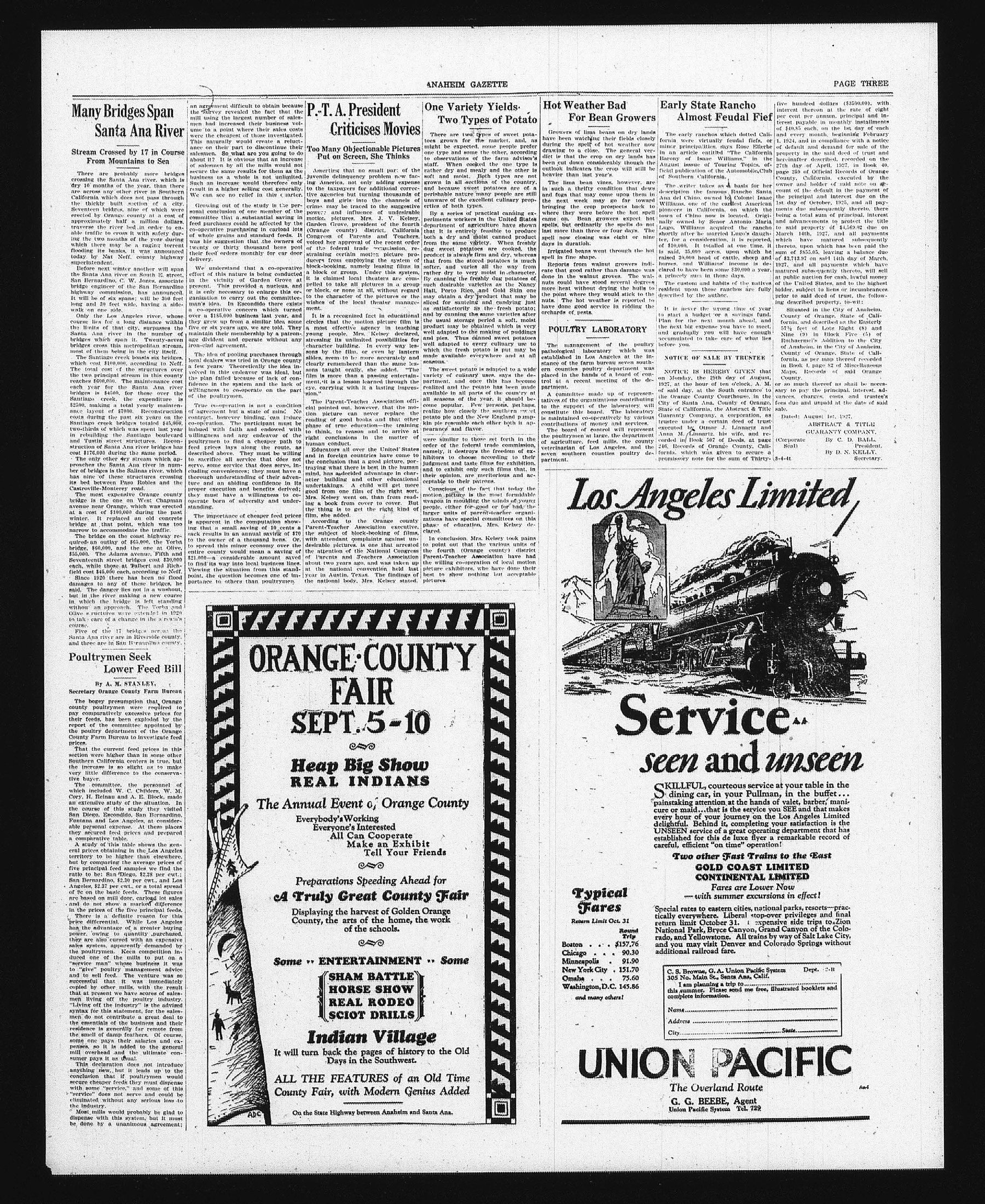
Many Bridges Span Santa Ana River
Stream Crossed by 17 in Course From Mountains to Sea
There are probably more bridges crossing the Santa Ana river, which is dry 10 months of the year, than there are across any other river in Southern California which does not pass through the thickly built section of a city. Seventeen bridges, nine of which were erected by Orange county at a cost of approximately half a million dollars, traverse the river bed in order to enable traffic to cross it with safety during the two months of the year during which there may be a raging torrent flooding its banks. It was announced today by Nat Neff, county highway superintendent.
Before next winter another will span the Santa Ana river on South E. street, San Bernardino, C. W. Jones, associate bridge engineer of the San Bernardino highway commission, has announced. It will be of six spans; will be 300 feet long and 30 feet wide, having a sidewalk on one side.
Only the Los Angeles river, whose course lies for a long distance within the limits of that city, surpasses the Santa Ana river in the number of bridges which span it. Twenty-seven bridges cross this metropolitan stream, most of them being in the city itself.
The Santiago creek boasts six bridges, which cost $100,000, according to Neff. The total cost of the structures over the two principal streams in this county reaches $600,000. The maintenance cost each year for the Santa Ana river bridges is $4500, for those over the Santiago creek, the expenditure is $2500, making a total yearly maintenance layout of $7000. Reconstruction costs during the past six years on the Santiago creek bridges totaled $45,000, two-thirds of which was spent last year in rebuilding the Santiago boulevard and Tustin street structures. Reconstruction of Santa Ana river bridges has an agreement difficult to obtain because the survey revealed the fact that the mill using the largest number of salesmen had increased their business volume to a point where their sales costs were the cheapest of those investigated. This naturally would create a reluctance on their part to discontinue their salesmen. So what are you going to do about it? It is obvious that an increase of salesmen by all the mills would not secure the same results for them as the business as a whole is not unlimited. Such an increase would therefore only result in a higher selling cost generally. We can see no relief in this quarter.
Growing out of the study is the personal conclusion of one member of the committee that a substantial saving in feed purchases could be affected by the co-operative purchasing in carload lots of whole grains and standard feeds. It was his suggestion that the owners of twenty or thirty thousand hens pool their feed orders monthly for car door delivery.
We understand that a co-operative effort of this nature is being conducted in the vicinity of Garden Grove at present. This provided a nucleus, and it is only necessary to enlarge this organization to carry out the committee-man's idea. In Escondido there exists a co-operative concern which turned over a $185,000 business last year, and they grew up from a similar idea some five or six years ago. we are told. They maintain their membership by a patronage dividend and operate without any iron-clad agreement.
The idea of pooling purchases through local dealers was tried in Orange county a few years. Theoretically the idea involved in this endeavor was ideal, but the plan failed because of lack of confidence in the system and the lack of willingness to co-operate on the part of the poultrymen.
True co-operation is not a condition of agreement but a state of mind. No contract, however binding, can induce co-operation. The participant must be imbued with faith and endowed with willingness and any endeavor of the poultrymen to find a cheaper path to feed prices lays along the route, as
P.-T. A. Precise Criticism
Asserting that no juvenile delinquency lying America, not only to the taxpayers forive agencies but turbine crime may be traced power and influence motion pictures. Mr Garden Grove presides (Orange county) d Congress of Parent voiced her approval of the federal trade straining certain movers from employing block-booking, namely a block or group. U it is claimed local t pelled to take all plo or block, or none at al to the character of th wishes of the local ment.
It is a recognized f circles that the motto a most effective ag young people, Mrs stressing its unlimite character building. I sons by the film, or slides, seem to be mo clearly remembered th sons taught orally, film is more than a ment, it is a lesson le eye, carrying with it sion."
The Parent-Teacherial pointed out, howtion picture can nu reading of good book phase of true educa to think, to reason right conclusions in human conduct. Educators all over
The Santiago creek boasts six bridges, which cost $100,000, according to Neff. The total cost of the structures over the two principal stream in this county reaches $600,000. The maintenance cost each year for the Santa Ana river bridges is $4500, for those over the Santiago creek, the expenditure is $2500, making a total yearly maintenance layout of $7000. Reconstruction costs during the past six years on the Santiago creek bridges totaled $45,000, two-thirds of which was spent last year in rebuilding the Santiago boulevard and Tustin street structures. Reconstruction of Santa Ana river bridges has cost $176,000 during the same period.
The only other dry stream which approaches the Santa Ana river in number of bridges is the Salinas river, which has nine of these structures crossing its bed between Paso Robles and the Castroville-Monterey road.
The most expensive Orange county bridge is the one on West Chapman avenue near Orange, which was erected at a cost of $100,000 during the past winter. It replaced an old concrete bridge at that point, which was too narrow to accommodate the traffic.
The bridge on the coast highway required an outlay of $65,000, the Yorba bridge, $60,000, and the one at Olive, $55,000. The Adams avenue, Fifth and Seventeenth street bridges cost $30,000 each, while those at Talbert and Richfield cost $45,000 each, according to Neff.
Since 1920 there has been no flood damages to any of these bridges, he said. The danger lies not in a washout, but in the river making a new course in which the bridge is left standing without an approach. The Yorba and Olive structures were extended in 1920 to take care of a change in the stream's course.
Five of the 17 bridges across the Santa Ana river are in Riverside county, and three are in San Bernardino county.
Poultrymen Seek Lower Feed Bill
By A. M. STANLEY,
Secretary Orange County Farm Bureau
The bogey presumption that Orange county poultrymen were required to pay comparatively excessive prices for their feeds, has been exploded by the report of the committee appointed by the poultry department of the Orange County Farm Bureau to investigate feed prices.
That the current feed prices in this section were higher than in some other Southern California centers is true, but the increase is so slight as to make very little difference to the conservative buyer.
The committee, the personnel of which included W. C. Childers, W. M. Cory, H. Reinau and A. E. Block, made an extensive study of the situation. In the course of this study they visited San Diego, Escondido, San Bernardino, Fontana and Los Angeles, at considerable personal expense. At these places they secured feed prices and prepared a comparative table.
A study of this table shows the general prices obtaining in the Los Angeles area.
The idea of pooling purchases through local dealers was tried in Orange county a few years. Theoretically the idea involved in this endeavor was ideal, but the plan failed because of lack of confidence in the system and the lack of willingness to co-operate on the part of the poultrymen.
True co-operation is not a condition of agreement but a state of mind. No contract, however binding, can induce co-operation. The participant must be imbued with faith and endowed with willingness and any endeavor of the poultrymen to find a cheaper path to feed prices lays along the route, as described above. They must be willing to sacrifice all service that does not serve, some service that does serve, including conveniences; they must have a thorough understanding of their adventure and an abiding confidence in its proper execution and benefits derived; they must have a willingness to cooperate born of adversity and understanding.
The importance of cheaper feed prices is apparent in the computation showing that a small saving of 10 cents a sack results in an annual saving of $70 to the owner of a thousand hens. Or, to spread this minor economy over the entire county would mean a saving of $21,000—a considerable amount saved to find its way into local business lines.
Viewing the situation from this standpoint, the question becomes one of importance to others than poultrymen.
According to the Parent-Teacher Association the subject of block-with attendant compliant desirable pictures is the attention of the N.O.F parents and Teachers about two years ago.at the national conference year in Austin,Texasthe national body.Mr.
ORANGE·FAST SEPT.
Heap Big REAL IN
The Annual Event
Everybody's Work
Everyone's Int
All Can Make
The committee, the personnel of which included W. C. Childers, W. M. Cory, H. Reinau and A. E. Block, made an extensive study of the situation. In the course of this study they visited San Diego, Escondido, San Bernardino, Fontana and Los Angeles, at considerable personal expense. At these places they secured feed prices and prepared a comparative table.
A study of this table shows the general prices obtaining in the Los Angeles territory to be higher than elsewhere, but by comparing the average prices of five principal feed samples we find the ratio to be: San Diego, $2.28 per cwt.; San Bernardino, $2.30 per cwt., and Los Angeles, $2.37 per cwt., or a total spread of 9c on the basic feeds. These figures are based on mill door, carload lot sales and do not show a marked difference in the prices of the five principal feeds.
There is a definite reason for this price differential. While Los Angeles has the advantage of a greater buying power, owing to quantity purchased, they are also cursed with an expensive sales system, apparently demanded by the poultrymen. Keen competition induced one of the mills to put on a "service man" whose business it was to "give" poultry management advice and to sell feed. The venture was so successful that it was immediately copied by other mills, with the result that at present we have scores of salesmen living off the poultry industry.
"Living off the industry" is the advised syntax for this statement, for the salesmen do not contribute a great deal to the essentials of the business and their residence is generally far remote from the smell of damp feathers. Of course, some one pays their salaries and expenses, so it is added to the general mill overhead and the ultimate consumer pays it as usual.
This declaration does not introduce anything new, but it leads up to the conclusion that if poultrymen would secure cheaper feeds they must dispense with some "service," and some of this "service" does not serve and could be eliminated without any serious loss to the industry.
Most mills would probably be glad to dispense with this system, but it must be done by a unanimous agreement;
ANAHEIM GAZETTE
P.-T. A. President Criticises Movies
Too Many Objectionable Pictures Put on Screen, She Thinks
Asserting that no small par: of the juvenile delinquency problem now facing America, not only adding expense to the taxpayers for additional corrective agencies but turning thousands of boys and girls into the channels of crime may be traced to the suggestive power, and influence of undesirable motors, pictures, Mrs. J. V. Kelsey, Garden Grove, president of the fourth (Orange county) district, California Congress of Parents and Teachers, voiced her approval of the recent order of the federal trade commission, restraining certain motions picture producers from employing the system of block-booking, namely leasing films in a block or group. Under this system, it is claimed local theaters are compelled to take all pictures in a group or block, or none at all, without regard to the character of the pictures or the wishes of the local theater management.
It is a recognized fact in educational circles that the motion picture film is a most effective agency in teaching young people, Mrs. Kelsey declared, stressing its unlimited possibilities for character building. In every way lessons by the film, or even by lantern slides, seem to be more accurately and clearly remembered than the same lessons taught orally, she added. "The film is more or less a passing entertainment; it is a lesson learned through the eye, carrying with it a lasting impression."
The Parent-Teacher Association official pointed out, however, that the motion picture can never replace the reading of good books and that other phase of true education—the training to think, to reason and to arrive at right conclusions in the matter of human conduct.
Educators all over the United States were similar to those set forth in the order of the federal trade commission,
One Variety Yields Two Types of Potato
There are two types of sweet potatoes grown for the market, and as might be expected, some people prefer one type and some the other, according to observations of the farm advisor's staff. When cooked the one type is rather dry and mealy and the other is soft and moist. Both types are not grown in all sections of the country, and because sweet potatoes are of a perishable nature many people are still unaware of the excellent culinary properties of both types.
By a series of practical canning experiments workers in the United States department of agriculture have shown that it is entirely feasible to produce both a dry and moist canned product from the same variety. When freshly dug sweet potatoes are cooked, the product is always firm and dry, whereas that from the stored potatoes is much softer, and varies all the way from rather dry to very moist in character. By canning the freshly dug potatoes of such desirable varieties as the Nancy Hall, Porto Rico, and Gold Skin one may obtain a dry product that may be sliced for sautéing and candying just as satisfactorily as the fresh potato; and by canning the same varieties after the usual storage period a soft, moist product may be obtained which is very well adapted to the making of puddings and pies. Thus darned sweet potatoes well adapted to such culinary use to which the fresh potato is put may be made available everywhere and at all seasons.
The sweet potato is adapted to a wide variety of culinary uses, says the department, and once this has become realized and the potato has been made available in all parts of the country at all seasons of the year, it should become popular. Few persons, perhaps, realize how closely the southern sweet potato pie and the New England pumpkin pie resemble each other both in appearance and flavor.
Hot Weather Bad For Bean Growers
Growers of lima beans on dry lands have been watching their fields closely during the spell of hot weather now drawing to a close. The general verdict is that the crop on dry lands has been cut down considerably though the outlook indicates the crop will still be heavier than last year's.
The lima bean vines, however, are in such a thrifty condition that dews and fogs that may come upon them in the next week may go far toward bringing the crop prospects back to where they were before the hot spell came on. Bean growers expect hot spells, but ordinarily the spells do not last more than three or four days. The spell now closing was eight or nine days in duration.
Irrigated beans went through the hot spell in fine shape.
Reports from walnut growers indicate that good rather than damage was done in the walnut groves. The walnuts could have stood several degrees more heat without drying the hulls to the point where they would stick to the nuts. The hot weather is reported to have done good service in ridding the orchards of pests.
POULTRY LABORATORY
The management of the poultry pathological laboratory which was established in Los Angeles at the instance of the farm bureau seven southern counties poultry department was placed in hands of a board of control at a recent meeting of the department.
A committee made up representatives of the organizations contributing to the support of the laboratory will constitute this board. The laboratory is maintained co-operatively by various contributions of money and services.
The board of control will represent the poultrymen at large, the department of agriculture, feed mills, the county veterinarian of Los Angeles, and the
Early Shrimp Alm
The early shrimp formia were minor principals in an article Barony of August issue issued publication of Southern.
The writer described Ana del Chino Williams, one pioneer in town of Chicago owned Lugo, William shortly after ten for a cost of $10,000. It is said 35,000 raised 30,000 horses, and clared to have a princely sum.
The resident upon description by it is never to start a Plan for the next big project and gradually accumulated before you.
NOTICE OF
NOTICE IS on Monday, 1927, at 11 o'clock a.m., at Orange City City of Santa Clara State of California Guaranty Co-owner trustee under executed by Anna M. Linn coded in Box 246. Records.
slides, seem to be more accurately and clearly remembered than the same lessons taught orally, she added. "The film is more than a passing entertainment; it is a lesson learned through the eye, carrying with it a lasting impression."
The Parent-Teacher Association official pointed out, however, that the motion picture can never replace the reading of good books and that other phase of true education—the training to think, to reason and to arrive at right conclusions in the matter of human conduct.
Educators all over the United States and in foreign countries have come to the conclusion that a good picture, portraying what there is best in the human mind, has decided advantage in character building and other educational undertakings. A child will get more good from one film of the right sort, Mrs. Kelsey went on, than from reading a book from cover to cover. But the thing is to get the right kind of film, she added.
According to the Orange county Parent-Teacher Association executive, the subject of block-booking of films, with attendant complaints against undesirable pictures, is one that arrested the attention of the National Congress of Parents and Teachers Association about two years ago, and was taken up at the national convention held last year in Austin, Texas. The findings of the national body, Mrs. Kelsey stated.
The sweet potato is adapted to a wide variety of culinary uses, says the department, and once this has become realized and the potato has been made available in all parts of the country at all seasons of the year, it should become popular. Few persons, perhaps, realize how closely the southern sweet potato pie and the New England pumpkin pie resemble each other both it appearance and flavor.
were similar to those set forth in the order of the federal trade commission, namely, it destroys the freedom of exhibitors to choose according to their judgment and taste films for exhibition, and to exhibit only such films that, in their opinion, are meritorious and acceptable to their patrons.
Conscious of the fact that today the motion picture is the most formidable weapon in moulding the minds of young people, either for good or for bad, the larger units of parent-teacher organizations have special committees on this phase of education, Mrs. Kelsey declared.
In conclusion, Mrs. Kelsey took pains to point out that the various units of the fourth (Orange county) district Parent-Teacher Association have had the willing co-operation of local motion picture exhibitors, who have done their best to show nothing but acceptable pictures.
established in Los Angeles at the instance of the farm bureau seven southern counties poultry department was placed in the hands of a board of control at a recent meeting of the department.
A committee made up of representatives of the organizations contributing to the support of the laboratory will constitute this board. The laboratory is maintained co-operatively by various contributions of money and services.
The board of control will represent the poultrymen at large, the department of agriculture, feed mills, the county veterinarian of Los Angeles, and the seven southern counties poultry department.
Los Angeles
Service seen
SKILLFUL dining painstaking cure or maid every hour delightful. UNSEEN established f careful, efficient
Heap Big Show
REAL INDIANS
Annual Event of Orange County
Everybody's Working
Everyone's Interested
All Can Cooperate
Make an Exhibit
Tell Your Friends
Preparations Speeding Ahead for
Truly Great County Fair
Displaying the harvest of Golden Orange County, the arts of the home, the work of the schools.
Entertainment Some
SHAM BATTLE
HORSE SHOW
REAL RODEO
SCIOT DRILLS
Indian Village
Will turn back the pages of history to the Old Days in the Southwest.
ALL THE FEATURES of an Old Time County Fair, with Modern Genius Added
On the State Highway between Anaheim and Santa Ana.
Early State Rancho Almost Feudal Fief
The early ranchos which dotted California were virtually feudal fiefs, or minor principalities, says Rose Ellerbe in an article entitled "The California Barony of Isaac Williams," in the August issue of Touring Topics, official publication of the Automobile Club of Southern California.
The writer takes as basis for her description the famous Rancho Santa Ana del Chino, owned by Colonel Isaea Williams, one of the earliest American pioneers in California, on which the town of Chino now is located. Originally owned by Senor Antonio Maria Lugo, Williams acquired the rancho shortly after he married Lugo's daughter, for a consideration, it is reported, of $10,000. It totalled at one time, it is said, 35,000 acres, upon which he raised 36,000 head of cattle, sheep and horses, and Williams' income is declared to have been some $30,000 a year, a princely sum in those days.
The custom and habits of the natives resident upon these ranchos are fully described by the author.
It is never the wrong time of year to start a budget or a savings fund. Plan for the next month ahead, and the next big expense you have to meet, and gradually you will have enough accumulated to take care of what lies before you.
NOTICE IS HEREBY GIVEN that on Monday, the 29th day of August, 1927, at the hour of ten o'clock, A.M. of said day, at the South entrance to the Orange County Courthouse, in the City of Santa Ana, County of Orange, State of California, the Abstract & Title Guaranty Company, a corporation, as trustee under a certain deed of trust executed by Otmar J. Linnartz and Anna M. Linnartz, his wife, and recorded in Book 507 of Deeds, at page 246. Records of Orange County, Calif., five hundred dollars ($3500.00), with interest thereon at the rate of eight per cent per annum, principal and interest payable in monthly installments of $40.85 each, on the 1st day of each and every month, beginning February 1, 1924, and in compliance with a notice of default and demand for sale of the property in the said deed of trust and hercinafter described, recorded on the 27th day of April, 1927, in Book 40, page 259 of Official Records of Orange County, California, executed by the owner and holder of said note on account of the default in the payment of the principal and interest due on the 1st day of October, 1925, and all payments due subsequently thereto, there being a total sum of principal, interest and advancements to protect the title to said property of $4,569.02 due on March 14th, 1927, and all payments which have matured subsequently thereto, upon which has been paid the sum of $855.05, leaving a balance due of $3,713.97 on said 14th day of March, 1927, and all payments which have matured subsequently thereto, will sell at public auction for cash, lawful money of the United States, and to the highest bidder, subject to liens or incumbences prior to said deed of trust, the following described property, to-wit:
Situated in the City of Anaheim, County of Orange, State of California, and described as the Easterly 57½ feet of Lots Eight (8) and Nine (9) in Block Five (5) of Rothaermel's Addition to the City of Anaheim, in the City of Anaheim, County of Orange, State of California, as per map thereof recorded in Book 4, page 82 of Miscellaneous Maps. Records of said Orange County,
or so much thereof as shall be necessary to pay the principal interest advances charges costs and trustees fees due and unpaid at the date of said sale.
Dated: August 1st, 1927.
ABSTRACT & TITLE
GUARANTY COMPANY.
(Corporate By C. D. BALL,
Seal)
President.
NOTICE IS HEREBY GIVEN that on Monday, the 29th day of August, 1927, at the hour of ten o'clock, A. M. of said day, at the South entrance to the Orange County Courthouse, in the City of Santa Ana, County of Orange, State of California, the Abstract & Title Guaranty Company, a corporation, as trustee under a certain deed of trust executed by Otmar J. Linnartz and Anna M. Linnartz, his wife, and recorded in Book 507 of Deeds, at page 246, Records of Orange County, California, which was given to secure a promissory note for the sum of Thirty-
Service seen and unseen
SKILLFUL, courteous service at your table in the dining car, in your Pullman, in the buffet... painstaking attention at the hands of valet, barber, manicure or maid...that is the service you SEE and that makes every hour of your journey on the Los Angeles Limited delightful. Behind it, completing your satisfaction is the UNSEEN service of a great operating department that has established for this de luxe flyer a remarkable record of careful, efficient "on time" operation!
SKILLFUL, courteous service at your table in the dining car, in your Pullman, in the buffet... painstaking attention at the hands of valet, barber, manicure or maid... that is the service you SEE and that makes every hour of your journey on the Los Angeles Limited delightful. Behind it, completing your satisfaction is the UNSEEN service of a great operating department that has established for this de luxe flyer a remarkable record of careful, efficient "on time" operation!
Two other Fast Trains to the East
GOLD COAST LIMITED
CONTINENTAL LIMITED
Fares are Lower Now
— with summer excursions in effect!
Special rates to eastern cities, national parks, resorts—practically everywhere. Liberal stop-over privileges and final return limit October 31. Expensive side trips to Zion National Park, Bryce Canyon, Grand Canyon of the Colorado, and Yellowstone. All trains by way of Salt Lake City, and you may visit Denver and Colorado Springs without additional railroad fare.
C. S. Browne, G. A. Union Pacific System
305 No. Main St., Santa Ana, Calif.
I am planning a trip to... this summer. Please send me free, illustrated booklets and complete information.
Name.....
Address.....
City.....State...
UNION PACIFIC
The Overland Route
G. G. BEEBE, Agent
Union Pacific System Tel. 729