anaheim-gazette 1927-06-09
Scanned page
Searchable text
THE ANAHEIM GAZETTE
ESTABLISHED 1876
HENRY KUCHEL, Editor and Proprietor
ISSUED EVERY THURSDAY
SUBSCRIPTION PER YEAR $2.00
SIX MONTHS 1.50
THREE MONTHS 4.75
Entered at the Anaheim, California, Post Office as second class matter.
THE SUMMER WHITE HOUSE
PRESIDENT COOLIDGE will not lack opportunities to study
the farm problem in the vacation home which he has selected,
and judging from past experiences he will not fail to profit by it.
In the four states, South Dakota, Montana, Wyoming and
Nebraska, there are over 300,000 farmers and 50,000,000 acres of
tillable land. In four other nearby states, North Dakota, Iowa,
Kansas and Minnesota, there are 650,000 farmers and 90,000,000
acres of crop-producing land. Furthermore, the Black Hills territory is the real playground of this enormous farming population.
The lack of frills of fine linen, silver and cut-glass in the summer vacationings of these people will not disturb the President,
and it will be most surprising if he does not establish his contact with them during the time of his stay.
He is going to a land where people rise with the dawn and work their living out of the soil. There are very few surtaxes paid by the people who in their holidays tramp and fish and hunt in this territory. The granite may be a little softer than that with which he is familiar in his native state of Vermont, but he will find the aspirations, ideals and characteristics of these people similar to those of his neighbors in the Green Mountain state.
The immediate result of the President's visit will be the spending within the state of a quite considerable sum of money by visitors who otherwise would have journeyed to other points. In addition, however, before the season is over, this playground will have been advertised to such an extent by reason of Mr. Coolidge's visit that it will have a boom which will last for years to come.
OUR BALANCED SYSTEM
OWEN HOWARD OWEN, an Englishman, writing recently in the London Spectator, as a former resident of the United States mentioned the common habit of making comparisons of trade conditions and other economic problems in the two countries. Mr. Owen declared that there is really no analogy between the two countries in these respects and explains the difference
OUR RALANCED SYSTEM
OWEN HOWARD OWEN, an Englishman, writing recently in the London Spectator, as a former resident of the United States mentioned the common habit of making comparisons of trade conditions and other economic problems in the two countries. Mr. Owen declared that there is really no analogy between the two countries in these respects and explains the difference as follows:
"The United States of America is a vast continent (self-supporting) with a comparatively small population, while 'industrialism' is not paramount as is the case in Great Britain, where out of a population of 44,000,000 in an area smaller than New York state, only about one and a quarter millions are engaged in agriculture. The United States also possesses a vast home market, plus a foreign market which at present absorbs all surplus products and is enjoying the prosperity Great Britain experienced between 1840 and 1890, when manufacturing for the rest of the world.
"Great Britain's existing depression is due to the rise of other nations (notably the United States and Japan) who compete with her in neutral markets, while neglect of 'agriculture' while concentrating on 'industrialism' has led to a serious depopulation in the rural areas and consequent congestion in the urban districts."
There is some interesting truth in what Mr. Owen has to say. American prosperity is due in a great measure to the fact that this is a vast self-supporting country. We farm, we manufacture, and we carry on trade. Consistent efforts have always been made to build up our manufacturing and agriculture on the sound theory that to remain a prosperous, independent nation we must have both. The correctness of this theory is abundantly demonstrated in the present situation of the country. It has been this theory which has actuated the protectionists in encouraging our industry. In the early days it was deemed advisable that we have factories so that we could build our own means of defense. Later, when the country grew rapidly, it was deemed wise to keep the great home market for our own producers, both in the mill and on the farm.
And our American idea has worked well. The American market is the greatest in the world. The workmen get the highest wages and so provide the greatest agricultural market in the world. And the assurance of the great home market has made it possible for us to compete in the world market, although the home market is of course many times more important to us.
England neglected agriculture and went in for manufacture and trade. Now she has lost out in farming and finds herself closely pressed in her specialty—manufacture and world trade. British ingenuity will doubtless solve this problem for England just as it has solved worse problems, but it is safe to say our theory has proved best—for America at least.
In recent years our agriculture has not kept stride with our manufacturing, but there are indications that the tide is turning. America needs a sound farming, as well as a sound manufacturing industry, and this will be maintained.
RUSSIA'S TRADE
A YEAR or two ago the friends of Soviet Russia were holding out to us the tempting bait of Russian trade as a reward for recognizing the Red government in the former realm of the czar. We did not take the bait, but Great Britain did.
just as it has solved worse problems, but it is safe to say our theory has proved best—for America at least.
In recent years our agriculture has not kept stride with our manufacturing, but there are indications that the tide is turning. America needs a sound farming, as well as a sound manufacturing industry, and this will be maintained.
RUSSIA'S TRADE
A YEAR or two ago the friends of Soviet Russia were holding out to us the tempting bait of Russian trade as a reward for recognizing the Red government in the former realm of the czar. We did not take the bait, but Great Britain did. The recent experiences of John Bull have proved that there was one time at least when American diplomacy was more astute than that of the famed British variety.
Now that American recognition of Red Russia seems further off than it has been for some time, it might be well to inquire just what this tempting Russian foreign trade is worth anyhow.
In the days before the World war the Russian trade was a little less than three and a half per cent of the total world trade. Now, according to German experts who have studied Russian conditions, the Russian trade in its peak year of sovietism has been but three-tenths of one per cent of the trade of the world. During this same peak year, Russian trade with Great Britain formed but three and four-tenths per cent of the total British world trade. And John Bull let himself in for a lot of worries to get that three and four-tenths per cent.
AMERICA AND JAPAN
WHILE there was criticism at first from some sources over the United States government's unwillingness to employ force against the Chinese at Hankow, it is now conceded in diplomatic circles that the government's policy prevented war. Japan stood as a valiant ally of America in the Chinese policy the Washington government has pursued, and this support has been a powerful factor in its success.
The American policy, staunchly supported by the Japanese government, is working dut satisfactorily. There is now no responsible, representative government in China with which the powers can deal, but if and when the time comes that there is one, the American government and other powers can be ready to treat with it and negotiate treaties that will satisfactorily iron out present disputes.
America is entirely willing to give China an opportunity to get on its feet. By adhering to its present policy it is doing just that and doing it in a peaceful, friendly manner.
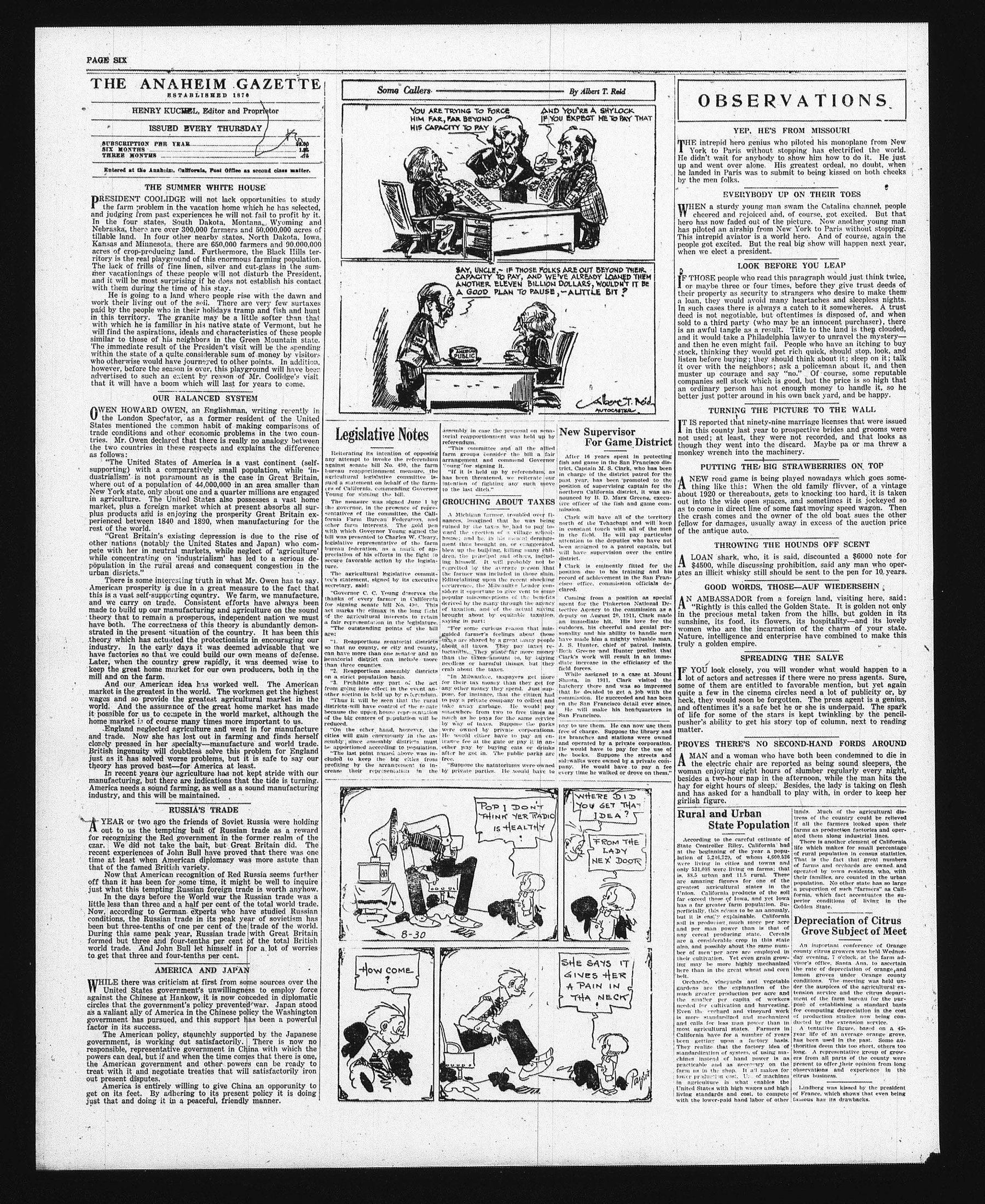
Some Callers By Albert T. Reid
YOU ARE TRYING TO FORCE HIM FAR, FAR BEYOND HIS CAPACITY TO PAY
AND YOU'RE A SHYLOCK IF YOU EXPECT ME TO PAY THAT
SAY, UNCLE, IF THOSE FOLKS ARE OUT BEYOND THEIR CAPACITY TO PAY, AND WE'VE ALREADY LOANED THEM ANOTHER ELEVEN BILLION DOLLARS, WOULDN'T IT BE A GOOD PLAN TO PAUSE, -ALITTLE BIT?
Legislative Notes
assembly in case the proposal on senatorial reapportionment was held up by referendum.
New Supervisor For Game District
Legislative Notes
Reiterating its intention of opposing any attempt to invoke the referendum against senate bill No. 490, the farm bureau reapportionment measure, the agricultural legislative committee issued a statement on behalf of the farmers of California, commending Governor Young for signing the bill.
The measure was signed June 1 by the governor, in the presence of representatives of the committee, the California Farm Bureau Federation, and other farm interests. The gold pen with which Governor Young signed the bill was presented to Charles W. Cleary, legislative representative of the farm bureau federation, as a mark of appreciation of his efforts in the fight to secure favorable action by the legislature.
The agricultural legislative committee's statement, signed by its executive secretary, said:
"Governor C. C. Young deserves the thanks of every farmer in California for signing senate bill No. 490. This act marks the climax in the long fight of the agricultural interests to retain a fair representation in the legislature.
"The outstanding points of the bill are:
1. Reapportions senatorial districts so that no county, or city and county, can have more than one senator and no senatorial district can include more than three counties.
2. Reapportions assembly districts on a strict population basis.
3. Prevents any part of the act from going into effect in the event another section is held up by referendum.
Thus it will be seen that the rural districts will have control of the Senate because the upper house representation of the big centers of population will be reduced.
On the other hand, however, the cities will gain enormously in the assembly since assembly districts must be apportioned according to population.
The last point named above was included to keep the big cities from profiting by the arrangement to increase their representation in the assembly in case the proposal on senatorial reapportionment was held up by referendum.
This committee and all the allied farm groups consider the bill a fair arrangement and commend Governor Young for signing it.
If it is held up by referendum, as has been threatened, we reiterate our intention of fighting any such move to the last ditch."
GROUCHING ABOUT TAXES
A Michigan farmer, troubled over finances, imagined that he was being ruined by the taxes he had to pay toward the erection of a village schoolhouse; and he, in his mental derangement thus brought on, or exaggerated, blew up the building, killing many children, the principal and others, including himself. It will probably not be regretted by the average person that the farmer was included in those slain. Editorializing upon the recent shocking occurrence, the Milwaukee Leader considers it opportunity to give vent to some popular misconceptions of the benefits derived by the many through the agency of taxation, and of the actual saving brought about by equitable taxation, saying in part:
"For some curious reason that misguided farmer's feelings about those taxes are shared by a great many people about all taxes. They pay taxes reluctantly. They waste far more money than the taxes amount to, by buying needless or harmful things, but they crab about the taxes.
In Milwaukee, taxpayers get more for their tax money than they get for any other money they spend. Just suppose, for instance, that the citizen had to pay a private company to collect and take away garbage. He would pay somewhere from two to five times as much as he pays for the same service by way of taxes. Suppose the parks were owned by private corporations. He would either have to pay an entrance fee at the gate or pay it in another way by buying cats or drinks after he got in. The public parks are free.
Suppose the natatoriums were owned by private parties. He would have to pay to use them. He can now use them free of charge. Suppose the library and its branches and stations were owned and operated by a private corporation. He would have to pay for the use of the books. Suppose the streets and sidewalks were owned by a private company. He would have to pay a fee every time he walked or drove on them."
New Supervisor For Game District
After 16 years spent in protecting fish and game in the San Francisco district, Captain M. S. Clark, who has been in charge of the district patrol for the past year, has been promoted to the position of supervising captain for the northern California district, it was announced by B. D. Marx Greene, executive officer of the fish and game commission.
Clark will have all of the territory north of the Teehachapi and will keep in constant touch with all of the men in the field. He will pay particular attention to the deputies who have not been assigned to a patrol captain, but will have supervision over the entire district.
Clark is eminently fitted for the position due to his training and his record of achievement in the San Francisco office, commission officials declared.
Coming from a position as special agent for the Pinkerton National Detective Agency to the commission as a deputy on August 20, 1911, Clark made an immediate hit. His love for the outdoors, his cheerful and genial personality and his ability to handle men have made him a mighty valuable man. J. S. Hunter, chief of patrol, insists. Both Greene and Hunter predict that Clark's work will result in an immediate increase in the efficiency of the field forces.
While assigned to a case at Mount Shasta, in 1911, Clark visited the hatchery there and was so impressed that he decided to get a job with the commission. He succeeded and has been on the San Francisco detail ever since. He will make his headquarters in San Francisco.
pay to use them. He can now use them free of charge. Suppose the library and its branches and stations were owned and operated by a private corporation. He would have to pay for the use of the books. Suppose the streets and sidewalks were owned by a private company. He would have to pay a fee every time he walked or drove on them."
say our
turning.
acturing
with our
holding
reward
of the
world. The
was one
state than
further
inquire
anyhow.
he was a
old trade.
Russian
ism has
the world.
Britain
British
worries
over the
oy force
polomatic
stood
washington
powerful
japanese
now no
which the
e is one,
ready to
illy iron
unity to
is doing
POP I DON'T THINK YER RADIO IS HEALTHY
WHERE DID YOU GET THAT IDEA?
FROM THE LADY NEX DOOR
HOW COME?
SHE SAYS IT GIVES HER A PAIN IN THA NECK
Paigntz
OBSERVATIONS
YEP, HE'S FROM MISSOURI
THE intrepid hero genius who piloted his monoplane from New York to Paris without stopping has electrified the world. He didn't wait for anybody to show him how to do it. He just up and went over alone. His greatest ordeal, no doubt, when he landed in Paris was to submit to being kissed on both cheeks by the men folks.
EVERYBODY UP ON THEIR TOES
WHEN a sturdy young man swam the Catalina channel, people cheered and rejoiced and, of course, got excited. But that hero has now faded out of the picture. Now another young man has piloted an airship from New York to Paris without stopping. This intrepid aviator is a world hero. And of course, again the people got excited. But the real big show will happen next year, when we elect a president.
LOOK BEFORE YOU LEAP
IF THOSE people who read this paragraph would just think twice, or maybe three or four times, before they give trust deeds of their property as security to strangers who desire to make them a loan, they would avoid many heartaches and sleepless nights. In such cases there is always a catch to it somewheres. A trust deed is not negotiable, but oftentimes is disposed of, and when sold to a third party (who may be an innocent purchaser), there is an awful tangle as a result. Title to the land is then clouded, and it would take a Philadelphia lawyer to unravel the mystery—and then he even might fail. People who have an itching to buy stock, thinking they would get rich quick, should stop, look, and listen before buying; they should think about it; sleep on it; talk it over with the neighbors; ask a policeman about it, and then muster up courage and say "no." Of course, some reputable companies sell stock which is good, but the price is so high that an ordinary person has not enough money to handle it, so he better just potter around in his own back yard, and be happy.
TURNING THE PICTURE TO THE WALL
IT IS reported that ninety-nine marriage licenses that were issued in this county last year to prospective brides and grooms were not used; at least, they were not recorded, and that looks as though they went into the discard. Maybe pa or ma threw a
TURNING THE PICTURE TO THE WALL
IT IS reported that ninety-nine marriage licenses that were issued in this county last year to prospective brides and grooms were not used; at least, they were not recorded, and that looks as though they went into the discard. Maybe pa or ma threw a monkey wrench into the machinery.
PUTTING THE BIG STRAWBERRIES ON TOP
A NEW road game is being played nowadays which goes something like this: When the old family flivver, of a vintage about 1920 or thereabouts, gets to knocking too hard, it is taken out into the wide open spaces, and sometimes it is jockeyed so as to come in direct line of some fast moving speed wagon. Then the crash comes and the owner of the old boat sues the other fellow for damages, usually away in excess of the auction price of the antique auto.
THROWING THE HOUNDS OFF SCENT
A LOAN shark, who, it is said, discounted a $6000 note for $4500, while discussing prohibition, said any man who operates an illicit whisky still should be sent to the pen for 10 years.
GOOD WORDS, THOSE—AUF WIEDERSEHN
AN AMBASSADOR from a foreign land, visiting here, said: "Rightly is this called the Golden State. It is golden not only in the precious metal taken from the hills, but golden in its sunshine, its food, its flowers, its hospitality—and its lovely women who are the incarnation of the charm of your state. Nature, intelligence and enterprise have combined to make this truly a golden empire.
SPREADING THE SALVE
IF YOU look closely, you will wonder what would happen to a lot of actors and actresses if there were no press agents. Sure, some of them are entitled to favorable mention, but yet again quite a few in the cinema circles need a lot of publicity or, by heck, they would soon be forgotten. The press agent is a genius, and oftentimes it's a safe bet he or she is underpaid. The spark of life for some of the stars is kept twinkling by the pencil-pusher's ability to get his story top of column, next to reading matter.
PROVES THERE'S NO SECOND-HAND FORDS AROUND
MAN and a woman who have both been condemned to die in the electric chair are reported as being sound sleepers, the woman enjoying eight hours of slumber regularly every night, besides a two-hour nap in the afternoon, while the man hits the hay for eight hours of sleep. Besides, the lady is taking on flesh and has asked for a handball to play with, in order to keep her girlish figure.
Rural and Urban State Population
According to the careful estimate of State Controller Riley, California had lands. Much of the agricultural distress of the country could be relieved if all the farmers looked upon their farms as production factories and operated them along industrial lines.
There is another element of California life which makes for small percentage
Rural and Urban State Population
According to the careful estimate of State Controller Riley, California had at the beginning of the year a population of 5,246,729, of whom 4,600,526 were living in cities and towns and only 531,008 were living on farms; that is, 88.5 urban and 11.5 rural. These are amazing figures for one of the greatest agricultural states in the Union. California products of the soil far exceed those of Iowa, and yet Iowa has a far greater farm population. Superficially, this seems to be an anomaly, but it is easily explainable. California soil is producing much more per acre and per man power than is that of any cereal producing state. Cereals are a considerable crop in this state also, and possibly about the same number of men per acre are employed in their cultivation. Yet even grain growing may be more highly mechanized here than in the great wheat and corn belt.
Orchards, vineyards and vegetable gardens are the explanation of the much greater production per acre and the smaller per capita of workers needed for cultivation and harvesting. Even the orchard and vineyard work is more standardized and mechanized and calls for less man power than in most agricultural states. Farmers in California have for a number of years been getting upon a factory basis. They realize that the factory idea of standardization of system, of using machines instead of hand power is as practicable and as necessary on the farm as in the shop. It all makes for lower production cost. Use of machines in agriculture is what enables the United States with high wages and high living standards and cost, to compete with the lower-paid hand labor of other lands. Much of the agricultural distress of the country could be relieved if all the farmers looked upon their farms as production factories and operated them along industrial lines.
There is another element of California life which makes for small percentage of rural population in census statistics. That is the fact that great numbers of farms and orchards are owned and operated by town residents, who, with their families, are counted in the urban population. No other state has so large a proportion of such "farmers" as California, which fact accentuates the superior conditions of living in the Golden State.
Depreciation of Citrus Grove Subject of Meet
An important conference of Orange county citrus growers was held Wednesday evening, 7 o'clock, at the farm advisor's office, Santa Ana, to ascertain the rate of depreciation of orange and lemon groves under Orange county conditions. The meeting was held under the auspices of the agricultural extension service and the citrus department of the farm bureau for the purpose of establishing a standard basis for computing depreciation in the cost of production studies now being conducted by the extension service.
A tentative figure, based on a 45-year life of an average orange grove, has been used in the past. Some authorities deem this too short, others too long. A representative group of growers from all parts of the county were present to offer their opinion from long observations and experience in the citrus business.
Lindberg was kissed by the president of France, which shows that even being famous has its drawbacks.