anaheim-gazette 1927-05-26
Scanned page
Searchable text
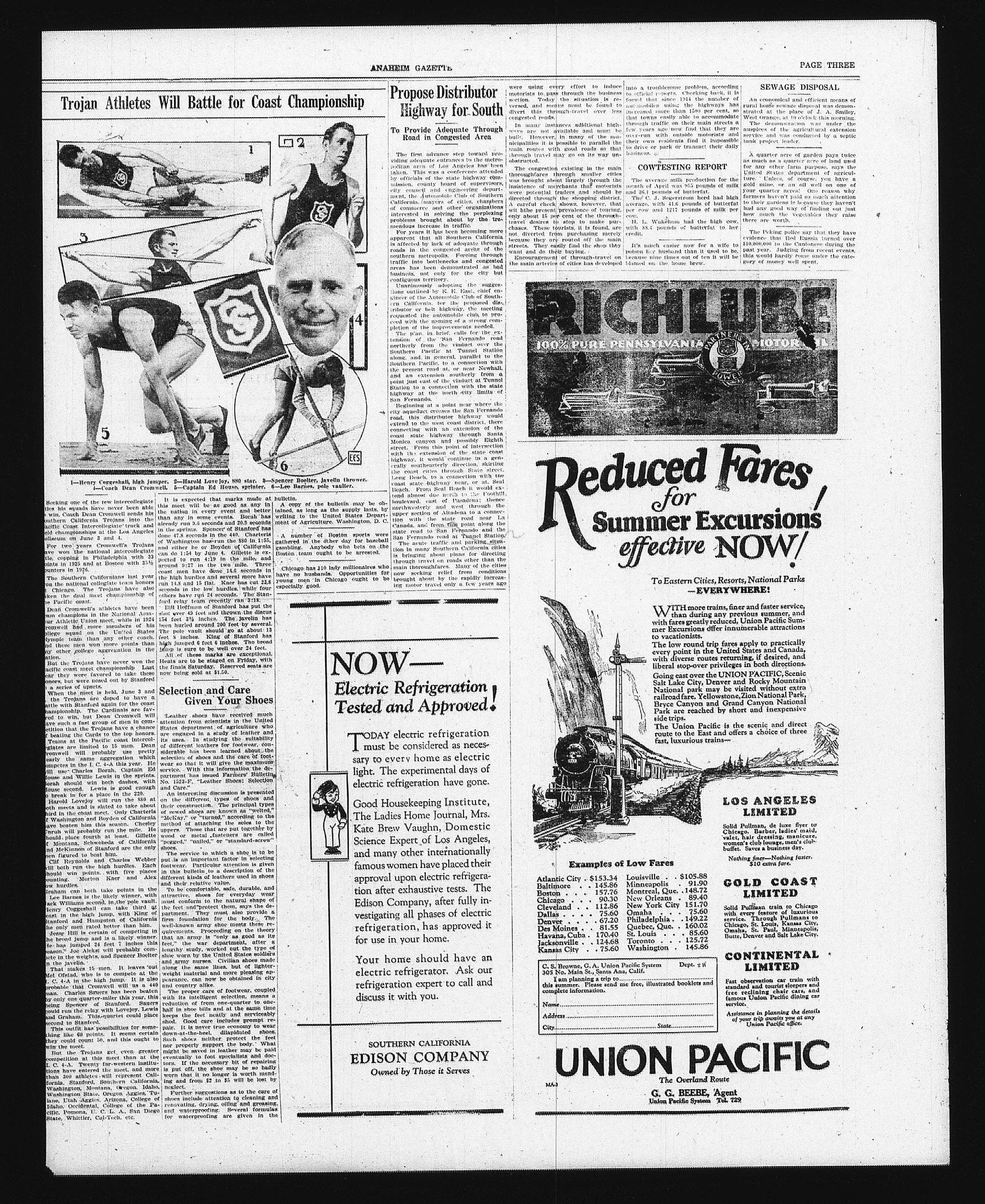
Trojan Athletes Will Battle for Coast Championship
Seeking one of the few intercollegiate titles his squads have never been able to win, Coach Dean Cromwell sends his southern California Trojans into the Pacific Coast Intercollegiate track and field championships at the Los Angeles coliseum on June 3 and 4.
For two years Cromwell's Trojans have won the national intercollegiate title, copping in Philadelphia with 33 points in 1925 and at Boston with 35½ pointers in 1926.
The Southern Californians last year won the national collegiate team honors at Chicago. The Trojans have also taken the dual meet championship of the Pacific coast.
Dean Cromwell's athletes have been team champions in the National Amateur Athletic Union meet, while in 1924 Cromwell had more members of his college squad on the United States Olympic team than any other coach, and these men won more points than any other college aggregation in the nation.
But the Trojans have never won the Pacific coast meet championship. Last year they were favored to take these honors, but were nosed out by Stanford in a series of upsets.
When the meet is held, June 3 and 4, the Trojans are doped to have a battle with Stanford again for the coast championship. The Cardinals are favored to win, but Dean Cromwell will have such a fast group of men in competition that the Trojans have a chance of beating the Cards to the top honors.
Teams at the Pacific coast intercollegates are limited to 15 men. Dean Cromwell will probably use pretty early the same aggregation which competes in the I. C. 4-A this year. He will use Charles Borah, Captain Ed House and Willie Lewis in the sprints. Borah should win both dashes, with house second. Lewis is good enough to break in for a place in the 220.
Harold Lovejoy will run the 880 at both meets and is slated to take about third in the coast meet. Only Charteris of Washington and Boyden of California have beaten him this season. Chessley Inruh will probably run the mile. He should place fourth at least. Gillette of Montana, Schwobeda of California and McKinnon of Stanford are the only
It is expected that marks made at this meet will be as good as any in the nation in every event and better than any in some events. Borah has already run 9.6 seconds and 20.9 seconds in the sprints. Spencer of Stanford has done 47.8 seconds in the 440. Charteris of Washington has run the 880 in 1:55, and either he or Boyden of California can do 1:54 by June 4. Gillette is expected to run 4:19 in the mile, and around 9:27 in the two mile. Three coast men have done 14.6 seconds in the high hurdles and several more have run 14.8 and 15 flat. Kaer has cut 23.8 seconds in the low hurdles, while four others have run 24 seconds. The Stanford relay team recently ran 3:18.
Dill Hoffman of Stanford has put the shot over 49 feet and thrown the discus 154 feet 3½ inches. The javelin has been hurled around 200 feet by several. The pole vault should go at about 13 feet 8 inches. King of Stanford has high jumped 6 feet 6 inches. The broad jump is sure to be well over 24 feet.
All of these marks are exceptional. Heats are to be staged on Friday, with the finals Saturday. Reserved seats are now being sold at $1.50.
Selection and Care Given Your Shoes
Leather shoes have received much attention from scientists in the United States department of agriculture who are engaged in a study of leather and its uses. In studying the suitability of different leathers for footwear, considerable has been learned about the selection of shoes and the care of footwear so that it will give the maximum service. With this information the department has issued Farmers' Bulletin No. 1523-F, "Leather Shoes; Selection and Care."
An interesting discussion is presented on the different types of shoes and their construction. The principal types of sewed shoes are known as "welted," "McKay," or "turned," according to the method of attaching the soles to the uppers. Those that are put together by wood or metal fasteners are called "pegged," "nailed," or "standard-screw" shoes.
early the same aggregation which competes in the I. C. 4-A this year. He will use Charles Borah, Captain Ed Mouse and Willie Lewis in the sprints. Korah should win both dashes, with mouse second. Lewis is good enough to break in for a place in the 220.
Harold Lovejoy will run the 880 at both meets and is slated to take about third in the coast meet. Only Charteris of Washington and Boyden of California have beaten him this season. Chesley Unruh will probably run the mile. He should place fourth at least. Gillette of Montana, Schwobeda of California and McKinnon of Stanford are the only men figured to beat him.
Clif Reynolds and Charles Webber will both run the high hurdles. Each should win points, with five places counting. Morton Kaer and Alex Low hurdles.
Braham can both take points in the Lee Barnes is the likely winner, with Jack Williams second, in the pole vault. Henry Coggeshall can take third at least in the high jump, with King of Stanford and Hampston of California the only men rated better than him.
Jesse Hill is certain of competing in the broad jump and is a likely winner. He has jumped 24 feet 7 inches this season. Joe Aleksi will probably compete in the weights, and Spencer Boelter in the javelin.
That makes 15-men. It leaves out Mel Ofstad, who is to compete at the I. C. 4-A in the high jump. It is also probable that Cromwell will us a 440 man. Charles Sauers has been beaten by only one quarter-miler this year, this being Spencer of Stanford. Sauers could run the relay with Lovejoy, Lewis and Graham. This-quartet could place second to Stanford.
This outfit has possibilities for something like 60 points. It seems certain they could count 50, and this ought to win the meet.
But the Trojans get even greater competition at this meet than at the I. C. 4-A. Twenty far-western institutions have entered the meet, and more than 300 athletes will represent California, Stanford, Southern California, Washington, Montana, Oregon, Idaho, Washington State, Oregon Aggies, Tulane, Utah Aggies, Arizona, College of Idaho, Occidental, College of the Pacific, Pomona, U. C. L. A., San Diego State, Whittier, Cal-Tech, etc.
An interesting discussion is presented on the different types of shoes and their construction. The principal types of sewed shoes are known as "welted," "McKay," or "turned," according to the method of attaching the soles to the uppers. Those that are put together by wood or metal fasteners are called "pegged," "nailed," or "standard-screw" shoes.
The service to which a shoe is to be put is an important factor in selecting footwear. Particular attention is given in this bulletin to a description of the different kinds of leathers used in shoes and their relative value.
To be comfortable, safe, durable, and attractive, shoes for everyday wear must conform to the natural shape of the feet and protect them, says the department. They must also provide a firm foundation for the body. The well-known army shoe meets these requirements. Proceeding on the theory that an army is "only as good as its feet," the war department, after a lengthy study, worked out the type of shoe worn by the United States soldiers and army nurses. Civilian shoes made along the same lines, but of lighter-weight material and more pleasing appearance, can now be obtained in city and country alike.
The proper care of footwear, coupled with its intelligent selection, means a reduction of from one-quarter to one-half in shoe bills and at the same time keeps the feet neatly and serviceably shod. Good care includes prompt repair. It is never true economy to wear down-at-the-heel, dillapidated shoes. Such shoes neither protect the feet nor properly support the body. What might be saved in leather may be paid eventually to foot specialists and doctors. If the necessary bit of repairing is put off, the shoe may be so badly worn that it no longer is worth mending and from $2 to $5 will be lost by neglect.
Further suggestions as to the care of shoes include attention to cleaning and renovating, drying, oiling and greasing, and waterproofing. Several formulas for waterproofing are given in the
Propose Distributor Highway for South
To Provide Adequate Through Road in Congested Area
The first advance step toward providing adequate entrances to the metropolitan area of Los Angeles has been taken. This was a conference attended by officials of the state highway commission, county board of supervisors, city council and engineering department, the Automobile Club of Southern California, mayors of cities, chambers of commerce and other organizations interested in solving the perplexing problems brought about by the tremendous increase in traffic.
For years it has been becoming more apparent that all Southern California is affected by lack of adequate through roads in the congested areas of the southern metropolis. Forcing through traffic into bottlenecks and congested areas has been demonstrated as bad business, not only for the city but contiguous territory.
Unanimously adopting the suggestions outlined by E. E. East, chief engineer of the Automobile Club of Southern California, for the proposed distributor or belt highway, the meeting requested the automobile club, to proceed with the naming of a strong completion of the improvements needed.
The plan, in brief, calls for the extension of the San Fernando road nertherly from the vialuct over the Southern Pacific at Tunnel Station along, and, in general, parallel to the Southern Pacific, to a connection with the present road at, or near Newhall, and an extension southerly from a point just east of the vialuct at Tunnel Station to a connection with the state highway at the north city limits of San Fernando.
Beginning at a point near where the city aqueduct crosses the San Fernando road, this distributor highway would extend to the west coast district, there connecting with an extension of the coast state highway through Santa Monica canyon and possibly Eighth street. From this point of intersection were using every effort to induce motorists to pass through the business section. Today the situation is reversed, and means must be found to divert this through-travel over less congested roads.
In many instances additional highways are not available and must be built. However, in many of the municipalities it is possible to parallel the main routes with good roads so that through travel may go on its way unobstructed.
The congestion existing in the main thoroughfares through smaller cities was brought about largely through the insistence of merchants that motorists were potential traders and should be directed through the shopping district. A careful check shows, however, that wit hthe present prevalence of touring, only about 15 per cent of the through-travel desires to stop to make purchases. These tourists, it is found, are not diverted from purchasing merely because they are routed off the main streets. They easily find the shop they want and do their buying.
Encouragement of through-travel on the main arteries of cities has developed into a troublesome problem to official reports. Check found that since 1914 automobiles using the increased more than 150 that towns easily able to through traffic on their few years ago now find over-run with outside their own residents fining to drive or park or trans-business.
COWTESTING
The average milk procmonth of April was 955 and 36.1 pounds of butter.
The C. J. Segerstrom average, with 41.6 pounds per cow and 1217 pound cow.
H. L. Wakeham had with 88.4 pounds of bui credit.
It's much easier now poison her husband than because nine times out of blamed on the home bro
NOW—Electric Refrigeration Tested and Approved!
TODAY electric refrigeration must be considered as necessary to every home as electric light. The experimental days of electric refrigeration have gone.
Good Housekeeping Institute,
The Ladies Home Journal, Mrs. Kate Brew Vaughn, Domestic Science Expert of Los Angeles,
Good Housekeeping Institute,
The Ladies Home Journal, Mrs.
Kate Brew Vaughn, Domestic Science Expert of Los Angeles,
and many other internationally famous women have placed their approval upon electric refrigeration after exhaustive tests. The Edison Company, after fully investigating all phases of electric refrigeration, has approved it for use in your home.
Your home should have an electric refrigerator. Ask our refrigeration expert to call and discuss it with you.
SOUTHERN CALIFORNIA
EDISON COMPANY
Owned by Those it Serves
Examples of Low Fares
Atlantic City . $153.34 Louisville . $105
Baltimore . 145.86 Minneapolis . 91
Boston . 157.76 Montreal, Que. 148
Chicago . 90.30 New Orleans . 89
Cleveland . 112.86 New York City 151
Dallas . 75.60 Omaha . 75
Denver . 67.20 Philadelphia . 149
Des Moines . 81.55 Quebec, Que. 160
Havana, Cuba . 170.40 St. Louis . 85
Jacksonville . 124.68 Toronto . 125
Kansas City . 75.60 Washington . 145
C. S. Browne, G. A. Union Pacific System Dept.
305 No. Main St., Santa Ana, Calif.
I am planning a trip to...
this summer. Please send me free, illustrated booklet complete information.
Name.....
Address.....
City.....State.......
into a troublesome problem, according to official reports. Checking back, it is found that since 1914 the number of automobiles using the highways has increased more than 1500 per cent, so that towns easily able to accommodate through traffic on their main streets a few years ago now find that they are over-run with outside motorists and their own residents find it impossible to drive or park or transact their daily business.
COWTESTING REPORT
The average milk production for the month of April was 855 pounds of milk and 36.1 pounds of butterfat.
The C. J. Segerstrom herd had high average, with 41.6 pounds of butterfat per cow and 1217 pounds of milk per cow.
H. L. Wakeham had the high cow, with 88.4 pounds of butterfat to her credit.
It's much easier now for a wife to poison her husband than it used to be, because nine times out of ten it will be blamed on the home brew.
SEWAGE DISPOSAL
An economical and efficient means of rural home sewage disposal was demonstrated at the place of J. A. Smiley, West Orange, at 10 o'clock this morning.
The demonstration was under the auspices of the agricultural extension service and was conducted by a septic tank project leader.
A quarter acre of garden pays twice as much as a quarter acre of land used for any other farm purpose, says the United States department of agriculture. Unless, of course, you have a gold mine, or an oil well on one of your quarter acres! One reason why farmers haven't paid so much attention to their gardens is because they haven't had any good way of finding out just how much the vegetables they raise there are worth.
The Peking police say that they have evidence that Red Russia turned over $10,000,000 to the Cantonese during the past year. Judging from recent events, this would hardly come under the category of money well spent.
Reduced Fares for Summer Excursions effective NOW!
To Eastern Cities, Resorts, National Parks
—EVERYWHERE!
With more trains, finer and faster service, than during any previous summer, and with fares greatly reduced, Union Pacific Summer Excursions offer innumerable attractions to vacationists.
The low round trip fares apply to practically every point in the United States and Canada, with diverse routes returning, if desired, and liberal stop-over privileges in both directions.
Going east over the UNION PACIFIC, Scenic Salt Lake City, Denver and Rocky Mountain National park may be visited without extra railroad fare. Yellowstone, Zion National Park, Bryce Canyon and Grand Canyon National Park are reached by short and inexpensive side trips.
The Union Pacific is the scenic and direct route to the East and offers a choice of three fast, luxurious trains—
LOS ANGELES LIMITED
Solid Pullman, de luxe flyer to Chicago. Barber, ladies' maid, valet, hair dressing, manicure, women's club lounge, men's club buffet. Saves a business day.
LOS ANGELES
LIMITED
Solid Pullman, de luxe flyer to Chicago. Barber, ladies' maid, valet, hair dressing, manicure, women's club lounge, men's club buffet. Saves a business day.
Nothing finer—Nothing faster. $10 extra fare.
GOLD COAST
LIMITED
Solid Pullman train to Chicago with every feature of luxurious service. Through Pullmans to Chicago, St. Louis, Kansas City, Omaha, St. Paul, Minneapolis, Butte, Denver and Salt Lake City.
CONTINENTAL
LIMITED
Fast observation car train with standard and tourist sleepers and free reclining chair cars, and famous Union Pacific dining car service.
Assistance in planning the details of your trip awaits you at any Union Pacific office.
ON PACIFIC
The Overland Route
G. G. BEEBE, Agent
Union Pacific System Tel. 729