anaheim-gazette 1927-05-05
Scanned page
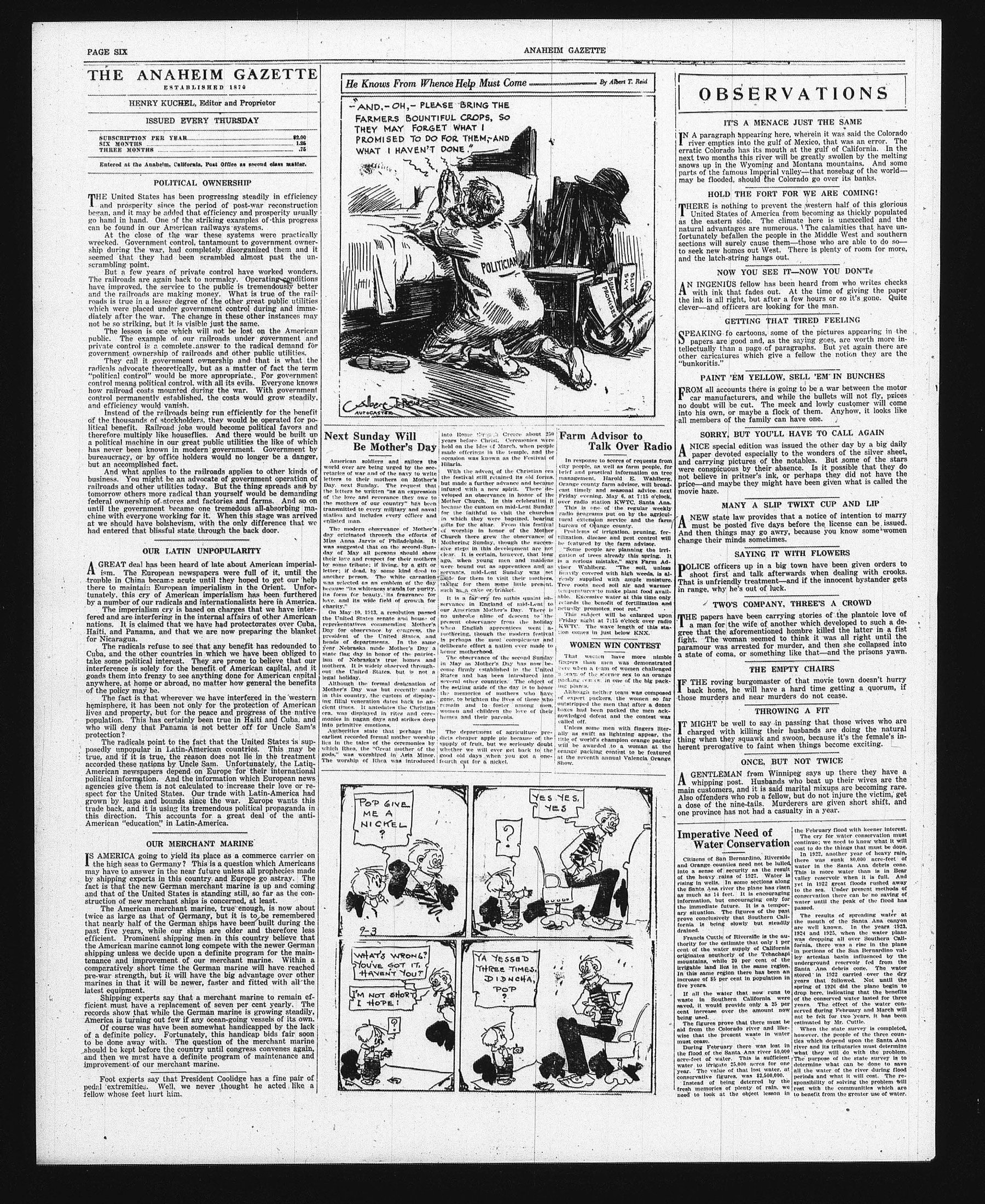
Searchable text
THE ANAHEIM GAZETTE
ESTABLISHED 1870
HENRY KUCHEL, Editor and Proprietor
ISSUED EVERY THURSDAY
SUBSCRIPTION PER YEAR ..... $2.00
SIX MONTHS ..... 1.95
THREE MONTHS ..... .75
Entered at the Anaheim, California, Post Office as second class matter.
POLITICAL OWNERSHIP
The United States has been progressing steadily in efficiency and prosperity since the period of post-war reconstruction began, and it may be added that efficiency and prosperity usually go hand in hand. One of the striking examples of this progress can be found in our American railways systems.
At the close of the war these systems were practically wrecked. Government control, tantamount to government ownership during the war, had completely disorganized them and it seemed that they had been scrambled almost past the unscrambling point.
But a few years of private control have worked wonders. The railroads are again back to normalcy. Operating conditions have improved, the service to the public is tremendously better and the railroads are making money. What is true of the railroads is true in a lesser degree of the other great public utilities which were placed under government control during and immediately after the war. The change in these other instances may not be so striking, but it is visible just the same.
The lesson is one which will not be lost on the American public. The example of our railroads under government and private control is a complete answer to the radical demand for government ownership of railroads and other public utilities.
They call it government ownership and that is what the radicals advocate theoretically, but as a matter of fact the term "political control" would be more appropriate. For government control means political control, with all its evils. Everyone knows how railroad costs mounted during the war. With government control permanently established, the costs would grow steadily, and efficiency would vanish.
Instead of the railroads being run efficiently for the benefit of the thousands of stockholders, they would be operated for political benefit. Railroad jobs would become political favors and therefore multiply like houseflies. And there would be built up a political machine in our great public utilities the like of which has never been known in modern government.
They call it government ownership and that is what the radicals advocate theoretically, but as a matter of fact the term "political control" would be more appropriate. For government control means political control, with all its evils. Everyone knows how railroad costs mounted during the war. With government control permanently established, the costs would grow steadily, and efficiency would vanish.
Instead of the railroads being run efficiently for the benefit of the thousands of stockholders, they would be operated for political benefit. Railroad jobs would become political favors and therefore multiply like houseflies. And there would be built up a political machine in our great public utilities the like of which has never been known in modern government. Government by bureaucracy, or by office holders would no longer be a danger, but an accomplished fact.
And what applies to the railroads applies to other kinds of business. You might be an advocate of government operation of railroads and other utilities today. But the thing spreads and by tomorrow others more radical than yourself would be demanding federal ownership of stores and factories and farms. And so on until the government became one tremedous all-absorbing machine with everyone working for it. When this stage was arrived at we should have bolshevism, with the only difference that we had entered that blissful state through the back door.
OUR LATIN UNPOPULARITY
AGREAT deal has been heard of late about American imperialism. The European newspapers were full of it, until the trouble in China became acute until they hoped to get our help there to maintain European imperialism in the Orient. Unfortunately, this cry of American imperialism has been furthered by a number of our radicals and internationalists here in America.
The imperialism cry is based on charges that we have interfered and are interfering in the internal affairs of other American nations. It is claimed that we have had protectorates over Cuba, Haiti, and Panama, and that we are now preparing the blanket for Nicaragua.
The radicals refuse to see that any benefit has redounded to Cuba, and the other countries in which we have been obliged to take some political interest. They are prone to believe that our interference is solely for the benefit of American capital, and it goads them into frenzy to see anything done for American capital anywhere, at home or abroad, no matter how general the benefits of the policy may be.
The fact is that wherever we have interfered in the western hemisphere, it has been not only for the protection of American lives and property, but for the peace and progress of the native population. This has certainly been true in Haiti and Cuba, and who will deny that Panama is not better off for Uncle Sam's protection?
The radicals point to the fact that the United States is supposedly unpopular in Latin-American countries. This may be true, and if it is true, the reason does not lie in the treatment accorded these nations by Uncle Sam. Unfortunately, the Latin-American newspapers depend on Europe for their international political information. And the information which European news agencies give them is not calculated to increase their love or respect for the United States. Our trade with Latin-America had grown by leaps and bounds since the war. Europe wants this trade back, and it is using its tremendous political propaganda in this direction. This accounts for a great deal of the anti-American "education" in Latin-America.
OUR MERCHANT MARINE
OUR MERCHANT MARINE
IS AMERICA going to yield its place as a commerce carrier on the high seas to Germany? This is a question which Americans may have to answer in the near future unless all prophecies made by shipping experts in this country and Europe go astray. The fact is that the new German merchant marine is up and coming and that of the United States is standing still, so far as the construction of new merchant ships is concerned, at least.
The American merchant marine, true enough, is now about twice as large as that of Germany, but it is to be remembered that nearly half of the German ships have been built during the past five years, while our ships are older and therefore less efficient. Prominent shipping men in this country believe that the American marine cannot long compete with the newer German shipping unless we decide upon a definite program for the maintenance and improvement of our merchant marine. Within a comparatively short time the German marine will have reached pre-war strength, but it will have the big advantage over other marines in that it will be newer, faster and fitted with all the latest equipment.
Shipping experts say that a merchant marine to remain efficient must have a replacement of seven per cent yearly. The records show that while the German marine is growing steadily, America is turning out few if any ocean-going vessels of its own.
Of course was have been somewhat handicapped by the lack of a definite policy. Fortunately, this handicap bids fair soon to be done away with. The question of the merchant marine should be kept before the country until congress convenes again, and then we must have a definite program of maintenance and improvement of our merchant marine.
Foot experts say that President Coolidge has a fine pair of pedal extremities. Well, we never thought he acted like a fellow whose feet hurt him.
He Knows From Whence Help Must Come By Albert T. Reid
"AND, - OH, - PLEASE BRING THE FARMERS BOUNTIFUL CROPS, SO THEY MAY FORGET WHAT I PROMISED TO DO FOR THEM, AND WHAT I HAVEN'T DONE."
Next Sunday Will Be Mother's Day
Farm Advisor to Talk Over Radio
Next Sunday Will Be Mother's Day
American soldiers and sailors the world over are being urged by the secretaries of war and of the navy to write letters to their mothers on Mother's Day, next Sunday. The request that the letters be written "as an expression of the love and reverence they owe to the mothers of our country" has been transmitted to every military and naval station and includes every officer and enlisted man.
The modern observance of Mother's day originated through the efforts of Miss Anna Jarvis of Philadelphia. It was suggested that on the second Sunday of May all persons should show their love and respect for their mothers by some tribute; if living, by a gift or letter; if dead, by some kind deed to another person. The white carnation was selected as an emblem of the day because "its whiteness stands for purity, its form for beauty, its fragrance for love, and its wide field of growth for charity."
On May 10, 1913, a resolution passed the United States senate and houses of representatives commending Mother's Day for observance by congress, the president of the United States, and heads of departments. In the same year Nebraska made Mother's Day a state flag day in honor of the patriotism of Nebraska's true homes and mothers. It is widely observed throughout the United States, but is not a legal holiday.
Although the formal designation of Mother's Day was but recently made in this country, the custom of displaying filial veneration dates back to ancient times. It antedates the Christian era, was displayed in rites and ceremonies in pagan days and strikes deep into primitive emotions.
Authorities state that perhaps the earliest recorded formal mother worship lies in the tales of the ceremonies by which Rhea, "Great mother of the gods," was worshipped in Asia Minor. The worship of Rhea was introduced into Rome during Greece about 250 years before Christ. Ceremonies were held on the Ides of March, when people made offerings in the temple, and the occasion was known as the Festival of Hilaria.
With the advent of the Christian era the festival still retained its old forms, but made a further advance and became infused with a new spirit. There developed an observance in honor of the Mother Church. In this celebration it became the custom on mid-Lent Sunday for the faithful to visit the churches in which they were baptized, bearing gifts for the altar. From this festival of worship in honor of the Mother Church there grew the observance of Mothering Sunday, though the successive steps in this development are not clear. It is certain, however, that long ago, when young men and maidens were bound out as apprentices and as servants, mid-Lent Sunday was set aside for them to visit their mothers, taking for them some little present, such as a cake or trinket.
It is a far cry fro mthis quaint observance in England of mid-Lent to our American Mother's Day. There is no unbroke nine of descent to present observance from the holiday when English apprentices went a-mothering, though the modern festival is perhaps the most conspicuous and deliberate effort a nation ever made to honor motherhood.
The observance of the second Sunday in May as Mother's Day has now become firmly established in the United States and has been introduced into several other countries. The object of the setting aside of the day is to honor the memories of mothers who have gone, to brighten the lives of those who remain and to foster among men, women and children the love of their homes and their parents.
The department of agriculture predicts cheaper apple pie because of the supply of fruit, but we seriously doubt whether we will ever get back to the good old days when you got one-fourth cut for a nickel.
Farm Advisor to Talk Over Radio
In response to scores of requests from city people, as well as farm people, for brief and practical information on tree management, Harold E. Wahlberg, Orange county farm advisor, will broadcast timely and seasonal advice next Friday evening, May 6, at 7:15 o'clock, over radio station KWTC, Santa Ana.
This is one of the regular weekly radio programs put on by the agricultural extension service and the farm bureau of Orange county.
Problems of irrigation, pruning, fertilization, disease and pest control will be featured by the farm advisor.
"Some people are planning the irrigation of trees already this spring. It is a serious mistake," says Farm Advisor Wahlberg.
"The soil, unless heavily covered with high weeds, is already supplied with ample moisture. Tree roots need soil air and warmer temperatures to make plant food available. Excessive water at this time only retards the benefit of fertilization and actually promotes root rot."
This subject will be enlarged upon Friday night at 7:15 o'clock over radio KWTC. The wave length of this station comes in just below KNX.
WOMEN WIN CONTEST
That women have more nimble fingers than men was demonstrated here when a team of women challenged a team of stern sex to an orange packing contest in one of the big packing plants.
Although neither team was composed of expert packers, the women so far outstripped the men that after a dozen boxes had been packed the men acknowledged defeat and the contest was called off.
Unless some men with fingers literally as swift as lightning appear, the title of world's champion orange packer will be awarded to a woman at the orange packing contest to be featured at the seventh annual Valencia Orange Show.
POP GIVE ME A NICKEL?
YES YES, YES
WHAT'S WRONG? YOU'VE GOT IT, HAVENT YOU?
I'M NOT SHORT I HOPE!
YA YESSED THREE TIMES, DIDNCHA, POP?
OBSERVATIONS
IT'S A MENACE JUST THE SAME
IN A paragraph appearing here, wherein it was said the Colorado river empties into the gulf of Mexico, that was an error. The erratic Colorado has its mouth at the gulf of California. In the next two months this river will be greatly swollen by the melting snows up in the Wyoming and Montana mountains. And some parts of the famous Imperial valley—that nosebag of the world—may be flooded, should the Colorado go over its banks.
HOLD THE FORT FOR WE ARE COMING!
THERE is nothing to prevent the western half of this glorious United States of America from becoming as thickly populated as the eastern side. The climate here is unexcelled and the natural advantages are numerous. The calamities that have unfortunately befallen the people in the Middle West and southern sections will surely cause them—those who are able to do so—to seek new homes out West. There is plenty of room for more, and the latch-string hangs out.
NOW YOU SEE IT—NOW YOU DON'T
AN INGENIUS fellow has been heard from who writes checks with ink that fades out. At the time of giving the paper the ink is all right, but after a few hours or so it's gone. Quite clever—and officers are looking for the man.
GETTING THAT TIRED FEELING
SPEAKING fo cartoons, some of the pictures appearing in the papers are good and, as the saying goes, are worth more intellectually than a page of paragraphs. But yet again there are other caricatures which give a fellow the notion they are the "bunkoritis."
PAINT 'EM YELLOW, SELL 'EM IN BUNCHES
FROM all accounts there is going to be a war between the motor car manufacturers, and while the bullets will not fly, prices no doubt will be cut. The meek and lowly customer will come into his own, or maybe a flock of them. Anyhow, it looks like all members of the family can have one.
SORRY, BUT YOU'LL HAVE TO CALL AGAIN
A NICE special edition was issued the other day by a big daily
PAINT 'EM YELLOW, SELL 'EM IN BUNCHES
FROM all accounts there is going to be a war between the motor car manufacturers, and while the bullets will not fly, prices no doubt will be cut. The meek and lowly customer will come into his own, or maybe a flock of them. Anyhow, it looks like all members of the family can have one.
SORRY, BUT YOU'LL HAVE TO CALL AGAIN
NICE special edition was issued the other day by a big daily paper devoted especially to the wonders of the silver sheet, and carrying pictures of the notables. But some of the stars were conspicuous by their absence. Is it possible that they do not believe in pritner's ink, or perhaps they did not have the price—and maybe they might have been given what is called the movie haze.
MANY A SLIP TWIXT CUP AND LIP
NEW state law provides that a notice of intention to marry must be posted five days before the license can be issued. And then things may go awry, because you know some women change their minds sometimes.
SAYING IT WITH FLOWERS
POLICE officers up in a big town have been given orders to shoot first and talk afterwards when dealing with crooks. That is unfriendly treatment—and if the innocent bystander gets in range, why he's out of luck.
TWO'S COMPANY, THREE'S A CROWD
THE papers have been carrying stories of the plantioic love of a man for the wife of another which developed to such a degree that the aforementioned hombre killed the latter in a fist fight. The woman seemed to think it was all right until the paramour was arrested for murder, and then she collapsed into a state of coma, or something like that—and the prisons yawn.
THE EMPTY CHAIRS
IF THE roving burgomaster of that movie town doesn't hurry back home, he will have a hard time getting a quorum, if those murders and near murders do not cease.
THROWING A FIT
IT MIGHT be well to say in passing that those wives who are charged with killing their husbands are doing the natural thing when they squawk and swoon, because it's the female's inherent prerogative to faint when things become exciting.
ONCE, BUT NOT TWICE
GENTLEMAN from Winnipeg says up there they have a whipping post. Husbands who beat up their wives are the main customers, and it is said marital mixups are becoming rare. Also offenders who rob a fellow, but do not injure the victim, get a dose of the nine-tails. Murderers are given short shift, and one province has not had a casualty in a year.
Imperative Need of Water Conservation
the February flood with keener interest.
The cry for water conservation must continue; we need to know what it will cost to do the things that must be done.
ONCE, BUT NOT TWICE
AGENTLEMAN from Winnipeg says up there they have a whipping post. Husbands who beat up their wives are the main customers, and it is said marital mixups are becoming rare. Also offenders who rob a fellow, but do not injure the victim, get a dose of the nine-tails. Murderers are given short shift, and one province has not had a casualty in a year.
Imperative Need of Water Conservation
Citizens of San Bernardino, Riverside and Orange counties need not be lulled into a sense of security as the result of the heavy rains of 1927. Water is rising in wells. In some sections along the Santa Ana river the plane has risen as much as 14 feet. It is encouraging information, but encouraging only for the immediate future. It is a temporary situation. The figures of the past prove conclusively that Southern California is being slowly but steadily drained.
Francis Cuttle of Riverside is the authority for the estimate that only 1 percent of the water supply of California originates southerly of the Tehachapi mountains, while 20 per cent of the irrigable land lies in the same region. In this same region there has been an increase of 55 per cent in population in five years.
If all the water that now runs to waste in Southern California were saved, it would provide only a 25 per cent increase over the amount now being used.
The figures prove that there must be aid from the Colorado river and likewise that the present waste in water must cease.
During February there was lost in the flood of the Santa Ana river 50,000 acre-feet of water. This is sufficient water to irrigate 25,000 acres for one year. The value of that lost water, at conservative figures, was $2,500,000.
Instead of being deterred by the fresh memories of plenty of rain, we need to look at the object lesson in the February flood with keener interest.
The cry for water conservation must continue; we need to know what it will cost to do the things that must be done.
In 1922, another year of heavy rain, there was sunk 80,000 acre-feet of water in the Santa Ana debris cone. This is more water than is in Bear valley reservoir when it is full. And yet in 1922 great floods rushed away to the sea. Under present methods of conservation there can be no saving of water until the peak of the flood has passed.
The results of spreading water at the mouth of the Santa Ana canyon are well known. In the years 1923, 1924 and 1925, when the water plane was dropping all over Southern California, there was a rise in the plane in portions of the San Bernardino valley artesian basin influenced by the underground reservoir fed from the Santa Ana debris cone. The water stored in 1922 carried over the dry years that followed. Not until the spring of 1926 did the plane begin to drop here, indicating that the benefits of the conserved water lasted for three years. The effect of the water conserved during February and March will not be felt for two years, it has been estimated by Mr. Cuttle.
When the state survey is completed, however, the people of the three counties which depend upon the Santa Ana river and its tributaries must determine what they will do with the problem. The purpose of the state survey is to determine what can be done to save all the water of the river during flood periods and what it will cost. The responsibility of solving the problem will rest with the communities which are to benefit from the greater use of water.