anaheim-gazette 1927-04-07
Scanned page
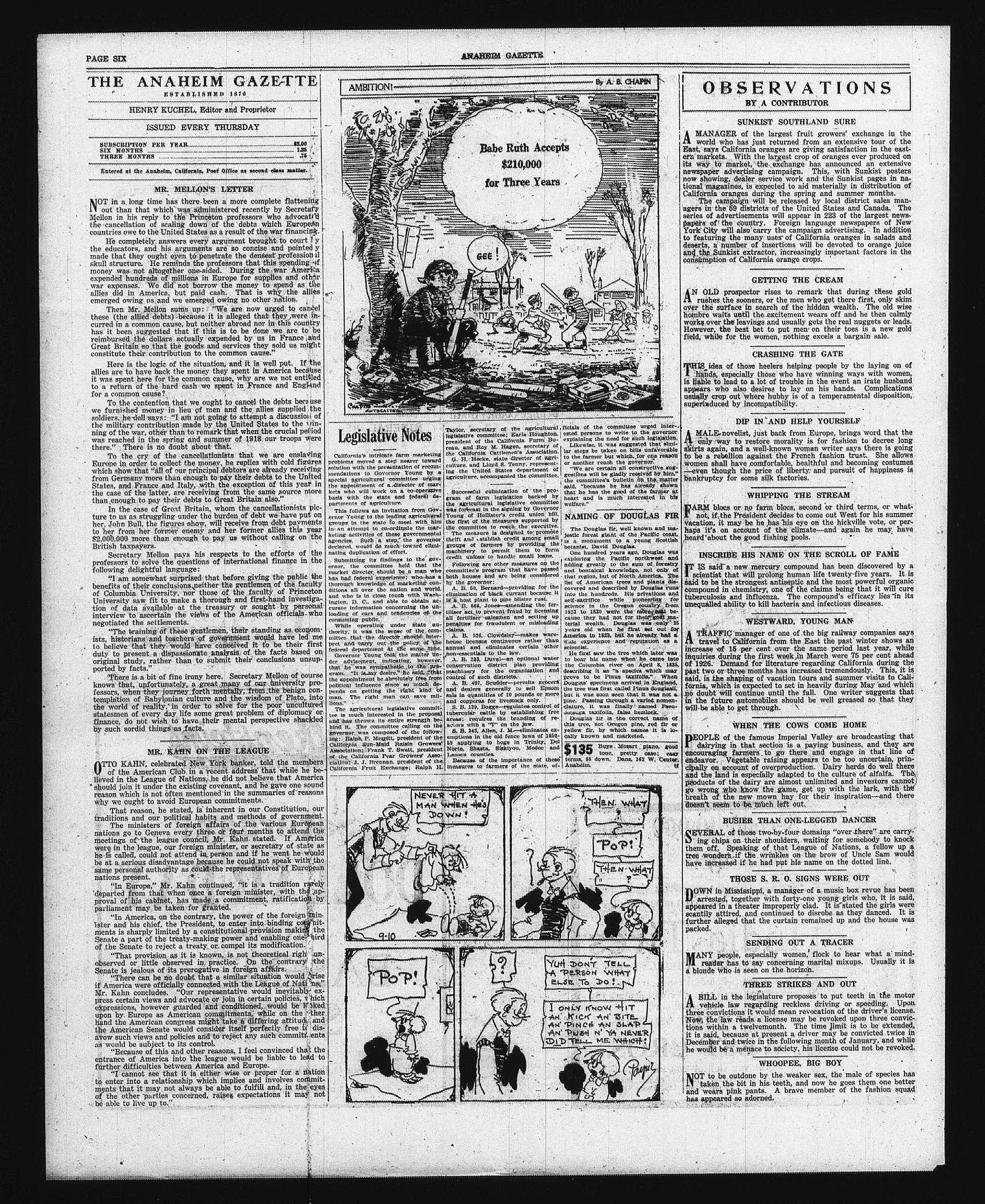
Searchable text
THE ANAHEIM GAZETTE
ESTABLISHED 1870
HENRY KUCHEL, Editor and Proprietor
ISSUED EVERY THURSDAY
SUBSCRIPTION PER YEAR.....$2.00
SIX MONTHS.....1.25
THREE MONTHS......75
Entered at the Anaheim, California, Post Office as second class matter.
MR. MELLON'S LETTER
NOT in a long time has there been a more complete flattening out than that which was administered recently by Secretary Mellon in his reply to the Princeton professors who advocated the cancellation of scaling down of the debts which European countries owe to the United States as a result of the war financing.
He completely answers every argument brought to court by the educators, and his arguments are so concise and pointedly made that they ought even to penetrate the densest professional skull structure. He reminds the professors that this spending of money was not altogether one-sided. During the war America expended hundreds of millions in Europe for supplies and other war expenses. We did not borrow the money to spend as the allies did in America, but paid cash. That is why the allies emerged owing us and we emerged owing no other nation.
Then Mr. Mellon sums up: "We are now urged to cancel these (the allied debts) because it is alleged that they were incurred in a common cause, but neither abroad nor in this country has it been suggested that if this is to be done we are to be reimbursed the dollars actually expended by us in France and Great Britain so that the goods and services they sold us might constitute their contribution to the common cause."
Here is the logic of the situation, and it is well put. If the allies are to have back the money they spent in America because it was spent here for the common cause, why are we not entitled to a return of the hard cash we spent in France and England for a common cause?
To the contention that we ought to cancel the debts because we furnished money in lieu of men and the allies supplied the soldiers, he-dell says: "I am not going to attempt a discussion of the military contribution made by the United States to the winning of the war, other than to remark that when the crucial period was reached in the spring and summer of 1918 our troops were there." There is no doubt about that.
Here is the logic of the situation, and it is well put. If the allies are to have back the money they spent in America because it was spent here for the common cause, why are we not entitled to a return of the hard cash we spent in France and England for a common cause?
To the contention that we ought to cancel the debts because we furnished money in lieu of men and the allies supplied the soldiers, he dell says: "I am not going to attempt a discussion of the military contribution made by the United States to the winning of the war, other than to remark that when the crucial period was reached in the spring and summer of 1918 our troops were there." There is no doubt about that.
To the cry of the cancellationists that we are enslaving Europe in order to collect the money, he replies with cold figures which show that "all of our principal debtors are already receiving from Germany more than enough to pay their debts to the United States, and France and Italy, with the exception of this year in the case of the latter, are receiving from the same source more than enough to pay their debts to Great Britain also."
In the case of Great Britain, whom the cancellationists picture to us as struggling under the burden of debt we have put on her, John Bull, the figures show, will receive from debt payments to her from her former enemy and her former allies this year $2,000,000 more than enough to pay us without calling on the British taxpayers.
Secretary Mellon pays his respects to the efforts of the professors to solve the questions of international finance in the following delightful language:
"I am somewhat surprised that before giving the public the benefits of their conclusions neither the gentlemen of the faculty of Columbia University nor those of the faculty of Princeton University saw fit to make a thorough and first-hand investigation of data available at the treasury or sought by personal interview to ascertain the views of the American officials who negotiated the settlements.
"The training of these gentlemen, their standing as economists, historians and teachers of government would have led me to believe that they would have conceived it to be their first duty to present a dispassionate analysis of the facts based on original study, rather than to submit their conclusions unsupported by facts."
There is a bit of fine irony here. Secretary Mellon of course knows that, unfortunately, a great many of our university professors, when they journey forth mentally, from the benign contemplation of Babylonian culture and the wisdom of Plato, into the world of reality, in order to solve for the poor uncultured statesmen of every day life some great problem of diplomacy or finance, do not wish to have their mental perspective shackled by such sordid things as facts.
MR. KAHN ON THE LEAGUE
OTTO KAHN, celebrated New York banker, told the members of the American Club in a recent address that while he believed in the League of Nations, he did not believe that America should join it under the existing covenant, and he gave one sound reason which is not often mentioned in the summaries of reasons why we ought to avoid European commitments.
That reason, he stated, is inherent in our Constitution, our traditions and our political habits and methods of government.
The ministers of foreign affairs of the various European nations go to Geneva every three or four months to attend the meetings of the league council, Mr. Kahn stated. If America were in the league, our foreign minister, or secretary of state as
OTTO KAHN, celebrated New York banker, told the members of the American Club in a recent address that while he believed in the League of Nations, he did not believe that America should join it under the existing covenant, and he gave one sound reason which is not often mentioned in the summaries of reasons why we ought to avoid European commitments.
That reason, he stated, is inherent in our Constitution, our traditions and our political habits and methods of government.
The ministers of foreign affairs of the various European nations go to Geneva every three or four months to attend the meetings of the league council, Mr. Kahn stated. If America were in the league, our foreign minister, or secretary of state as he is called, could not attend in person and if he went he would be at a serious disadvantage because he could not speak with the same personal authority as could the representatives of European nations present.
"In Europe," Mr. Kahn continued, "it is a tradition rarely departed from that when once a foreign minister, with the approval of his cabinet, has made a commitment, ratification by parliament may be taken for granted.
"In America, on the contrary, the power of the foreign minister and his chief, the President, to enter into binding commitments is sharply limited by a constitutional provision making the Senate a part of the treaty-making power and enabling one-third of the Senate to reject a treaty or compel its modification.
"That provision as it is known, is not theoretical right unobserved or little observed in practice. On the contrary, the Senate is jealous of its prerogative in foreign affairs.
"There can be no doubt that a similar situation would arise if America were officially connected with the League of Nations," Mr. Kahn concludes. "Our representative would inevitably express certain views and advocate or join in certain policies, which expressions, however guarded and conditioned, would be looked upon by Europe as American commitments, while on the other hand the American congress might take a differing attitude and the American Senate would consider itself perfectly free to disavow such views and policies and to reject any such commitments as would be subject to its control.
"Because of this and other reasons, I feel convinced that the entrance of America into the league would be liable to lead to further difficulties between America and Europe.
"I cannot see that it is either wise or proper for a nation to enter into a relationship which implies and involves commitments that it may not always be able to fulfill and, in the eyes of the other parties concerned, raises expectations it may not be able to live up to."
ANAHEIM GAZETTE
AMBITION! By A. B. CHAPIN
Babe Ruth Accepts
$210,000
for Three Years
GEE!
Legislative Notes
Taylor, secretary of the agricultural
legislative committee; Earle Houghton,
president of the California Farm Bureau, and Roy M. Hagen, secretary of
Legislative Notes
California's intricate farm marketing problems moved a step nearer toward solution with the presentation of recommendations to Governor Young by a special agricultural committee urging the appointment of a director of markets who will work on a co-operative basis with the state and federal departments of agriculture.
This follows an invitation from Governor Young to the leading agricultural groups in the state to meet with him in an attempt to co-ordinate the marketing activities of these governmental agencies. Such a step, the governor declared, would do much toward eliminating duplication of effort.
Submitting its findings to the governor, the committee held that the market director should be a man who has had federal experience; who has a thorough knowledge of marketing conditions all over the nation and world, and who is in close touch with Washington, D.C., and able to obtain accurate information concerning the unloading of cars and tendencies of the consuming public.
While operating under state authority, it was the sense of the committee that the director should interpret and carry out the policy of the federal department at the same time.
Governor Young took the matter under advisement, indicating, however, that he was sympathetic to the program. "It is my desire," he said, "that the appointment be absolutely free from political influence since so much depends on getting the right kind of man. The right man can save millions."
The agricultural legislative committee is much interested in the proposal and has thrown its entire strength behind it. The committee calling on the governor, was composed of the following: Ralph P. Megritt, president of the California Sun-Maid Raisin Growers' Association; Frank T. Swett, president of the California Pear Growers' Association; J. J. Brennan, president of the California Fruit Exchange; Ralph H.
Taylor, secretary of the agricultural legislative committee; Earle Houghton, president of the California Farm Bureau, and Roy M. Hagen, secretary of the California Cattlemen's Association.
G. H. Hecke, state director of agriculture, and Lloyd S. Tenny, representing the United States department of agriculture, accompanied the committee.
Successful culmination of the program of farm legislation backed by the agricultural legislative committee was forecast in the signing by Governor Young of Hollister's credit union bill, the first of the measures supported by the committee to reach the executive.
The measure is designed to promote thrift and establish credit among small groups of farmers by providing the machinery to permit them to form credit unions to handle small loans.
Following are other measures on the committee's program that have passed both houses and are being considered by the governor:
A. B. 50, Bernard—providing for the elimination of black currant because it is a host plant to pine blister rust.
A. B. 666, Jones—amending the fertilizer act to prevent fraud by licensing all fertilizer salesmen and setting up penalties for fraudulent or misleading claims.
A. B. 926, Clowdsley—makes warehouse licenses continuous rather than annual and eliminates certain other non-essentials to the law.
A. B. 233, Duval—an optional water conservation district plan providing machinery for the organization and control of such districts.
A. B. 407, Scudder—permits grocers and dealers generally to sell Epsom salts in quantities of 10 pounds or more and copperas for livestock only.
S. B. 129, Boggs—regulates control of tubercular cattle by establishing free areas; requires the branding of reactors with a "T" on the jaw.
S. B. 242, Allen, J. M.—eliminates exemptions in the old fence laws of 1850-59 applying to hogs in Trinity, Del Norte, Shasta, Siaklyou, Modoc and Lassen counties.
Because of the importance of these measures to farmers of the state, officials of the committee urged interested persons to write to the governor explaining the need for such legislation.
Likewise, it was suggested that similar steps be taken on bills unfavorable to the farmer but which, for one reason or another reach the governor.
"We are certain all constructive suggestions will be gladly received by him," the committee's bulletin on the matter said, "because he has already shown that he has the good of the farmer at heart and is much interested in his welfare."
NAMING OF DOUGLAS FIR
The Douglas fir, well known and majestic forest giant of the Pacific coast, is a monument to a young Scottish botanist, David Douglas.
One hundred years ago, Douglas was exploring the Pacific northwest and adding greatly to the sum of forestry and bontalical knowledge, not only of region, but of North America. The list of American trees and plants discovered and described by Douglas runs into the hundreds. His privations and self-sacrifice while pioneering for science in the Oregon country from 1823 to 1830 were the more real because they had not for their goal material wealth. Douglas was only 25 years old when he first set out for America in 1823, but he already had a wide experience and reputation as a scientist.
He first saw the tree which later was to bear his name when he came into the Columbia river on April 8, 1825, describing it as "a species which may prove to be Pinus taxifolia." When Douglas' specimens arrived in England, the tree was first called Pinus douglasii, but it was soon seen that it was not a pine. Passing through a varied nomenclature, it was finally named Pseudo-tuga taxifolia, false hemlock.
Douglas fir is the correct name of this tree, not Oregon pine, red fir or yellow fir, by which names it is locally known and marketed.
$135 Buys Mozart plano, good tone, pretty case; easy terms,$5 down. Danz, 162 W. Center, Anaheim.
NEVER HIT A MAN WHEN HE DOWN!
THEN WHAT?
POP!
THEN WHAT?
POP!
YUH DON'T TELL A PERSON WHAT ELSE TO DO!
I ONLY KNOW HIT AN' KICK AN' BITE AN' PINCH AN SLAP AN' PUSH N' YA NEVER DID TELL ME WHICH!
OBSERVATIONS
BY A CONTRIBUTOR
SUNKIST SOUTHLAND SURE
MANAGER of the largest fruit growers' exchange in the world who has just returned from an extensive tour of the East, says California oranges are giving satisfaction in the eastern markets. With the largest crop of oranges ever produced on its way to market, the exchange has announced an extensive newspaper advertising campaign. This, with Sunkist posters now showing, dealer service work and the Sunkist pages in national magazines, is expected to aid materially in distribution of California oranges during the spring and summer months.
The campaign will be released by local district sales managers in the 59 districts of the United States and Canada. The series of advertisements will appear in 223 of the largest newspapers of the country. Foreign language newspapers of New York City will also carry the campaign advertising. In addition to featuring the many uses of California oranges in salads and deserts, a number of insertions will be devoted to orange juice and the Sunkist extractor, increasingly important factors in the consumption of California orange crops.
GETTING THE CREAM
AN OLD prospector rises to remark that during these gold rushes the sooners, or the men who get there first, only skim over the surface in search of the hidden wealth. The old wise hombre waits until the excitement wears off and he then calmly works over the leavings and usually gets the real nuggets or leads. However, the best bet to put men on their toes is a new gold field, while for the women, nothing excels a bargain sale.
CRASHING THE GATE
THIS idea of those heelers helping people by the laying on of hands, especially those who have winning ways with women, is liable to lead to a lot of trouble in the event an irate husband appears who also desires to lay on his hands. Complications usually crop out where hubby is of a temperamental disposition, superinduced by incompatibility.
DIP IN AND HELP YOURSELF
MALE novelist, just back from Europe, brings word that the only way to restore morality is for fashion to decree long skirts again, and a well-known woman writer says there is going
THIS idea of those heelers helping people by the laying on of hands, especially those who have winning ways with women, is liable to lead to a lot of trouble in the event an irate husband appears who also desires to lay on his hands. Complications usually crop out where hubby is of a temperamental disposition, superinduced by incompatibility.
DIP IN AND HELP YOURSELF
MALE novelist, just back from Europe, brings word that the only way to restore morality is for fashion to decree long skirts again, and a well-known woman writer says there is going to be a rebellion against the French fashion trust. She allows women shall have comfortable, healthful and becoming costumes—even though the price of liberty: and pursuit of happiness is bankruptcy for some silk factories.
WHIPPING THE STREAM
FARM blocs or no farm blocs, second or third terms, or what not, if the President decides to come out West for his summer vacation, it may be he has his eye on the hickville vote, or perhaps it's on account of the climate—and again he may have heard about the good fishing pools.
INSCRIBE HIS NAME ON THE SCROLL OF FAME
IT IS said a new mercury compound has been discovered by a scientist that will prolong human life twenty-five years. It is said to be the strongest antiseptic and the most powerful organic compound in chemistry, one of the claims being that it will cure tuberculosis and influenza. The compound's efficacy lies in its unequalled ability to kill bacteria and infectious diseases.
WESTWARD, YOUNG MAN
ATRAFFIC manager of one of the big railway companies says travel to California from the East the past winter shows an increase of 15 per cent over the same period last year, while inquiries during the first week in March were 75 per cent ahead of 1926. Demand for literature regarding California during the past two or three months has increased tremendously. This, it is said, is the shaping of vacation tours and summer visits to California, which is expected to set in heavily during May and which no doubt will continue until the fall. One writer suggests that in the future automobiles should be well greased so that they will be able to get through.
WHEN THE COWS COME HOME
PEOPLE of the famous Imperial Valley are broadcasting that dairying in that section is a paying business, and they are encouraging farmers to go there and engage in that line of endeavor. Vegetable raising appears to be too uncertain, principally on account of overproduction. Dairy herds do well there and the land is especially adapted to the culture of alfalfa. The products of the dairy are almost unlimited and investors cannot go wrong who know the game, get up with the lark, with the breath of the new mown hay for their inspiration—and there doesn't seem to be much left out.
BUSIER THAN ONE-LEGGED DANCER
SEVERAL of those two-by-four domains "over there" are carrying chips on their shoulders, waiting for somebody to knock them off. Speaking of that League of Nations, a fellow up a
BUSIER THAN ONE-LEGGED DANCER
SEVERAL of those two-by-four domains "over there" are carrying chips on their shoulders, waiting for somebody to knock them off. Speaking of that League of Nations, a fellow up a tree wonders if the wrinkles on the brow of Uncle Sam would have increased if he had put his name on the dotted line.
THOSE S. R. O. SIGNS WERE OUT
DOWN in Mississippi, a manager of a music box revue has been arrested, together with forty-one young girls who, it is said, appeared in a theater improperly clad. It is stated the girls were scantily attired, and continued to disrobe as they danced. It is further alleged that the curtain remained up and the house was packed.
SENDING OUT A TRACER
MANY people, especially women, flock to hear what a mind reader has to say concerning marital mixups. Usually it is a blonde who is seen on the horizon.
THREE STRIKES AND OUT
A BILL in the legislature proposes to put teeth in the motor vehicle law regarding reckless driving or speeding. Upon three convictions it would mean revocation of the driver's license. Now, the law reads a license may be revoked upon three convictions within a twelvemonth. The time limit is to be extended, it is said, because at present a driver may be convicted twice in December and twice in the following month of January, and while he would be a menace to society, his license could not be revoked.
WHOOPEE, BIG BOY
NOT to be outdone by the weaker sex, the male of species has taken the bit in his teeth, and now he goes them one better and wears pink pants. A brave member of the fashion squad has appeared so adorned.