anaheim-gazette 1927-03-24
Scanned page
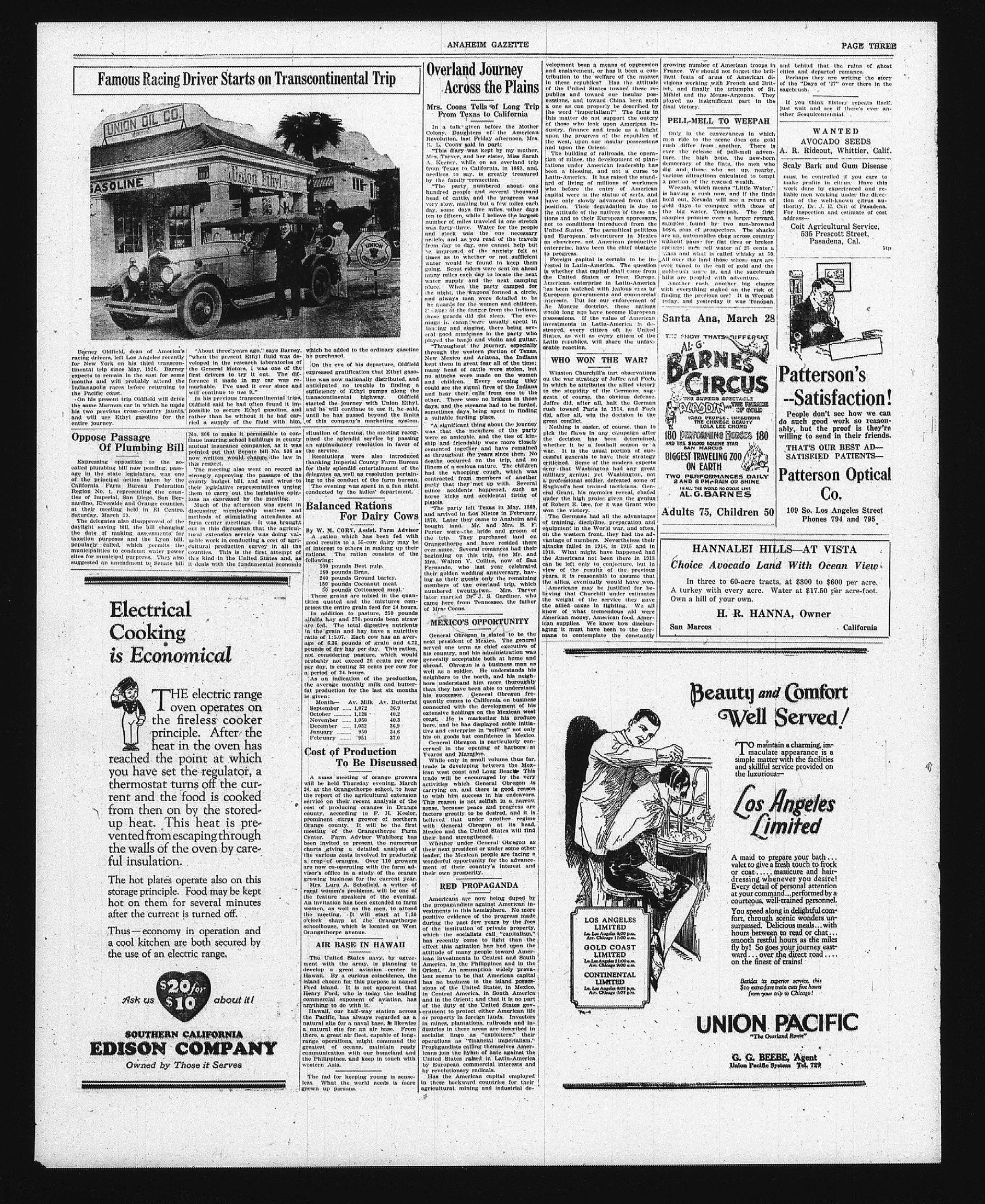
Searchable text
Famous Racing Driver Starts on Transcontinental
Barney Oldfield, dean of America's racing drivers, left Los Angeles recently for New York on his third transcontinental trip since May, 1926. Barney expects to remain in the east for some months and will probably attend the Indianapolis races before returning to the Pacific coast.
On his present trip Oldfield will drive the same Marmon car in which he made his two previous cross-country jaunts, and will use Ethyl gasoline for the entire journey.
"About three years ago," says Barney. "when the present Ethyl fluid was developed in the research laboratories of the General Motors, I was one of the first drivers to try it out. The difference it made in my car was remarkable. I've used it ever since and will continue to use it."
In his previous transcontinental trips, Oldfield said he had often found it impossible to secure Ethyl gasoline, and rather than be without it he had carried a supply of the fluid with him,
which he added to the he purchased.
On the eve of his expressed gratification line was now national anticipated no trouble sufficiency of Ethyl transcontinental high started the journey and he will continue until he has passed of this company's m
Oppose Passage Of Plumbing Bill
No. 806 to make it permissible to continue insuring school buildings in county mutual insurance companies, as it was situation of farming, tized the splendid so an applaudatory reso
racing drivers, left Los Angeles recently for New York on his third transcontinental trip since May, 1926. Barney expects to remain in the east for some months and will probably attend the Indianapolis races before returning to the Pacific coast.
On his present trip Oldfield will drive the same Marmon car in which he made his two previous cross-country jaunts, and will use Ethyl gasoline for the entire journey.
Oppose Passage Of Plumbing Bill
Expressing opposition to the so-called plumbing bill now pending, passage in the state legislature, was one of the principal action taken by the California Farm Bureau Federation Region No. 1, representing the counties of Imperial, San Diego, San Bernardino, Riverside and Orange counties, at their meeting held in El Centro, Saturday, March 19.
The delegates also disapproved of the daylight saving bill, the bill changing the date of making assessments for taxation purposes and the Lyon bill, popularly called, which permits the municipalities to condemn water power sites for municipal purposes. They also suggested an amendment to Senate bill
No. 806 to make it permissible to continue insuring school buildings in county mutual insurance companies, as it was pointed out that Senate bill No. 806 as now written would change the law in this respect.
The meeting also went on record as strongly approving the passage of the county budget bill, and sent wires to their legislative representatives urging them to carry out the legislative opinions as expressed by the meeting.
Much of the afternoon was spent in discussing membership matters and methods of stimulating attendance at farm center meetings. It was brought out in this discussion that the agricultural extension service was doing valuable work in conducting a cost of agricultural production survey in all the counties. This is the first attempt of this kind in the United States and, as it deals with the fundamental economic situation of farming, it nized the splendid effort an applaudatory resource the service.
Resolutions were thanked Imperial County for their splendid endeavors; well as raising to the conduct of the evening was spared conducted by the ladies.
Balanced Rating For D
By W. M. CORY, Assoc.
A ration which has good results to a 55-0 interest to others in rations. The ration following:
100 pounds Beetle
160 pounds Bran
240 pounds Grouse
150 pounds Cocoa
50 pounds Cottone
These grains are many titles quoted and they prises the entire grain.
In addition to past alfalfa hay and 270 per cent fed. The total dry in the grain and hay ratio of 1:5.07. Each age of 6.36 pounds of pounds of dry hay per not considering pasture probably not exceed 1 per day, is costing 33 cents a period of 24 hours.
As an indication of the average monthly fat production for the given:
Month—Av. Mil
September ... 1,072
October ... 1,128
November ... 1,060
December ... 1,032
January ... 950
February ... 951
Cost of Producing To Be
A mass meeting of will be held Thursday 24, at the Orangethorp report of the agriculture cost of producing or county, according to prominent citrus grove Orange county. It will meet of the Orangethorp Farm Advice been invited to presen charts giving a detriment of farming, to nize the splendid effort an applaudatory resource the service.
Electrical Cooking is Economical
THE electric range oven operates on the fireless cooker principle. After the heat in the oven has reached the point at which you have set the regulator, a thermostat turns off the current and the food is cooked from then on by the stored-up heat. This heat is prevented from escaping through the walls of the oven by care-
reached the point at which you have set the regulator, a thermostat turns off the current and the food is cooked from then on by the stored-up heat. This heat is prevented from escaping through the walls of the oven by careful insulation.
The hot plates operate also on this storage principle. Food may be kept hot on them for several minutes after the current is turned off.
Thus—economy in operation and a cool kitchen are both secured by the use of an electric range.
$20 for $10 about it!
SOUTHERN CALIFORNIA
EDISON COMPANY
Owned by Those it Serves
Overland Journey Across the Plains
Mrs. Coons Tells of Long Trip From Texas to California
In a talk given before the Mother Colony, Daughters of the American Revolution, last Friday afternoon, Mrs. N. L. Coons said in part:
"This diary was kept by my mother, Mrs. Tarver, and her sister, Miss Sarah A. Keener, while on an overland trip from Texas to California, in 1869, and, needless to say, is greatly treasured by the family connection.
"The party numbered about one hundred people and several thousand head of cattle, and the progress was very slow, making but a few miles each day, some days five miles, other days ten to fifteen, while I believe the largest number of miles traveled in one stretch was forty-three. Water for the people and stock was the one necessary article, and as you read of the travels from day to day, one cannot help but be impressed of the anxiety felt at times as to whether or not sufficient water would be found to keep them going. Scout riders were sent on ahead many miles each day to locate the next water supply and the next camping place. When the party camped for the night, the wagons formed a circle, and always men were detailed to be he guards for the women and children. Because of the danger from the Indians, these guards did not sleep. The evening it camped were usually spent in lancing and singing, there being several good musicians in the party who played the banjo and violin and guitar.
"Throughout the journey, especially through the western portion of Texas, New Mexico and Arizona, the Indians kept them in great fear all of the time; many head of cattle were stolen, but no attacks were made on the women and children. Every evening they could see the signal fires of the Indians and hear their calls from one to the other. There were no bridges in those days, and the streams had to be forded sometimes days, being spent in finding a suitable fording place.
"A significant thing about the journey was that the members of the party were so amicable, and the ties of kinship and friendship were more closely cemented together and have remained development been a means of oppression and enslavement, or has it been a contribution to the welfare of the masses in these republics? Has the attitude of the United States toward these republics and toward our insular possessions, and toward China been such a one as can properly be described by the word "imperialism?" The facts in this matter do not support the outcry of those who look upon American industry, finance and trade as a blight upon the progress of the republics of the west, upon our insular possessions and upon the Orient.
The building of railroads, the operation of mines, the development of plantations under American leadership has been a blessing, and not a curse to Latin-America. It has raised the standard of living of millions of workmen who before the entry of American capital were in the status of serfs, and have only slowly advanced from that position. Their degradation is due to the attitude of the natives of these nations and to their European oppressors, not to conditions introduced from the United States. The parasitical politics and European adventurers in Mexico as elsewhere, not American productive enterprise, have been the chief obstacle to progress.
Foreign capital is certain to be invested in Latin-America. The question is whether that capital shall come from the United States or from Europe. American enterprise in Latin-America has been watched with jealous eyes by European governments and commercial interests. But for our enforcement of the Monroe doctrine, these nations would long ago have become European possessions. If the value of American investments in Latin-America is destroyed, every citizen oft he United States, as well as every citizen of the Latin republics, will share the unfavorable reaction."
WHO WON THE WAR?
Winston Churchill's tart observations on the war strategy of Joffre and Foch, in which he attributes the allied victory to the stupidity of the Germans, suggests, of course, the obvious defense. Joffre did, after all, halt the German rush toward Paris in 1914, and Foch did, after all, win the decision in the great conflict.
Nothing is easier, of course, than to pick the flaws in any campaign after the decision has been determined, whether it be a football season or a growing numb
On the eve of his departure, Oldfield expressed gratification that Ethyl gasoline was now nationally distributed, and anticipated no trouble in finding a sufficiency of Ethyl pumps along the transcontinental highway. Oldfield started the journey with Union Ethyl, and he will continue to use it, he said, until he has passed beyond the limits of this company's marketing system.
Resolutions were also introduced thanking Imperial County Farm Bureau for their splendid entertainment of the delegates as well as resolution pertaining to the conduct of the farm bureau. The evening was spent in a fun night conducted by the ladies' department.
Balanced Rations For Dairy Cows
By W. M. CORY, Assist. Farm Advisor
A ration which has been fed with good results to a 55-cow dairy may be of interest to others in making up their rations. The ration consists of the following:
100 pounds Beet pulp.
160 pounds Bran.
240 pounds Ground barley.
150 pounds Cocoanut meal.
50 pounds Cottonseed meal.
These grains are mixed in the quantities quoted and the mixtures comprise the entire grain feed for 24 hours.
In addition to pasture, 250 pounds alfalfa hay and 270 pounds bean straw are fed. The total digestive nutrients in the grain and hay have a nutritive ratio of 1:5.07. Each cow has an average of 6.36 pounds of grain and 4.72 pounds of dry hay per day. This ration, not considering pasture, which would probably not exceed 20 cents per cow per day, is costing 33 cents per cow for a period of 24 hours.
As an indication of the production, the average monthly milk and butter-fat production for the last six months is given:
Month— Av. Milk Av. Butterfat
September ... 1,072 36.9
October ... 1,128 40.2
November ... 1,060 40.3
December ... 1,032 36.9
January ... 950 34.6
February ... 951 37.0
Cost of Production To Be Discussed
A mass meeting of orange growers will be held Thursday evening, March 24, at the Orangethorpe school, to hear the report of the agricultural extension service on their recent analysis of the cost of producing oranges in Orange county, according to F. H. Keelor, prominent citrus grower of northern Orange county. It will be the first meeting of the Orangethorpe Farm Center. Farm Advisor Wahlberg has been invited to present the numerous charts giving a detailed analysis of New Mexico and Arizona, the Indians kept them in great fear all of the time; many head of cattle were stolen, but no attacks were made on the women and children. Every evening they could see the signal fires of the Indians and hear their calls from one to the other. There were no bridges in those days, and the streams had to be forded sometimes days, being spent in finding a suitable fording place.
"A significant thing about the journey was that the members of the party were so amicable, and the ties of kinship and friendship were more closely cemented together and have remained so throughout the years since then. No deaths occurred on the trip, and no illness of a serious nature. The children had the whooping cough, which was contracted from members of another party that they met up with. Several minor accidents happened, such as horse kicks and accidental firing of pistols.
"The party left Texas in May, 1869, and arrived in Los Nietos in February, 1870. Later they came to Anaheim and bought land. Mr. and Mrs. B. F. Porter were—the bride and groom of the trip. They purchased land on Orangethorpe and have resided there ever since. Several romances had their beginning on this trip, one Mr. and Mrs. Walton V. Collins, now of San Fernando, who last year celebrated their golden wedding anniversary, having as their guests only the remaining members of the overland trip, which numbered twenty-two... Mrs. Tarver later married Dr. J. S. Gardiner, who came here from Tennessee, the father of Mrs. Coons.
MEXICO'S OPPORTUNITY
General Obregon is slated to be the next president of Mexico. The general served one term as chief executive of his country, and his administration was generally acceptable both at home and abroad. Obregon is a business man as well as a soldier. He understands his neighbors to the north, and his neighbors understand him more thoroughly than they have been able to understand his successor. General Obregon frequently comes to California on business connected with the development of his extensive holdings on the Mexican west coast. He is marketing his produce here, and he has displayed noble initiative and enterprise in "selling" not only his on goods but confidence in Mexico.
General Obregon is particularly concerned in the opening of harbors at Yvaros and Mazatlan.
While only in small volume thus far, trade is developing between the Mexican west coast and Long Beach. This trade will be encouraged by the very activities which General Obregon is carrying on, and there is good reason to wish him success in his endeavors. This reason is not selfish in a narrow sense, because peace and progress are factors greatly to be desired, and it is believed that under another regime with General Obregon at its head, Mexico and the United States will find their bond strengthened.
Whether under General Obregon as their next president or under some other WHO WON THE WAR?
Winston Churchill's tart observations on the war strategy of Joffre and Foch, in which he attributes the allied victory to the stupidity of the Germans, suggests, of course, the obvious defense Joffre did, after all, halt the German rush toward Paris in 1914, and Foch did, after all, win the decision in the great conflict.
Nothing is easier, of course, than to pick the flaws in any campaign after the decision has been determined, whether it be a football season or a war. It is the usual portion of successful generals to have their strategy criticized. Some of the modern experts deny that Washington had any great military genius; yet Washington, not a professional soldier, defeated some of England's best trained tacticians. General Grant, his memoirs reveal, chafed under the high praise given the genius of Robert E. Lee; for it was Grant who won the victory.
The Germans had all the advantages of training, discipline, preparation and equipment in the World war, and often, on the western front, they had the advantage of numbers. Nevertheless their attacks failed in 1914, in 1915 and in 1918. What might have happened had the Americans not been there in 1918 can be left only to conjecture, but in view of the results of the previous years, it is reasonable to assume that the allies eventually would have won.
Americans may be justified for believing that Churchill under estimates the weight of the service they gave the allied cause in fighting. We all know of what tremendous aid were American money, American food, American supplies. We know how discouraging it must have been to the Germans to contemplate the constantly
To Be Discussed
A mass meeting of orange growers will be held Thursday evening, March 24, at the Orangethorpe school, to hear the report of the agricultural extension service on their recent analysis of the cost of producing oranges in Orange county, according to F. H. Keelor, prominent citrus grower of northern Orange county. It will be the first meeting of the Orangethorpe Farm Center. Farm Advisor Wahlberg has been invited to present the numerous charts giving a detailed analysis of the various costs involved in producing a crop of oranges. Over 110 growers are now co-operating with the farm advisor's office in a study of the orange growing business for the current year.
Mrs. Lura A. Schofield, a writer of rural women's problems, will be one of the feature speakers of the evening. An invitation has been extended to farm women, as well as the men, to attend the meeting. It will start at 7:30 o'clock sharp at the Orangethorpe schoolhouse, which is located on West Orangethorpe avenue.
AIR BASE IN HAWAII
The United States navy, by agreement with the army, is planning to develop a great aviation center in Hawaii. By a curious coincidence, the island chosen for this purpose is named Ford Island. It is not apparent that Henry Ford, who is today the leading commercial exponent of aviation, has anything to do with it.
Hawaii, our half-way station across the Pacific, has always regarded as a natural site for a naval base, likewise a natural site for an air base. From there, a great air fleet, capable of long-range operations, might command the greatest of oceans, maintain ready communication with our homeland and the Philippines, and keep in touch with western Asia.
The fad for keeping young is senseless. What the world needs is more grown up persons.
While only in small volume thus far, trade is developing between the Mexican west coast and Long Beach. This trade will be encouraged by the very activities which General Obregon is carrying on, and there is good reason to wish him success in his endeavors. This reason is not selfish in a narrow sense, because peace and progress are factors greatly to be desired, and it is believed that under another regime with General Obregon at its head, Mexico and the United States will find their bond strengthened.
Whether under General Obregon as their next president or under some other leader, the Mexican people are facing a wonderful opportunity for the advancement of their country's interest and their own prosperity.
RED PROPAGANDA
Americans are now being duped by the propagandists against American investments in this hemisphere. No more positive evidence of the progress made during the past few years by the foes of the institution of private property, which the socialists call "capitalism," has recently come to light than the effect this agitation has had upon the attitude of many people toward American investments in Central and South America, in the Philippines and in the Orient. An assumption widely prevalent seems to be that American capital has no business in the island possessions of the United States, in Mexico, in Central America, in South America and in the Orient; and that it is no part of the duty of the United States government to protect either American life or property in foreign lands. Investors in mines, plantations, railroads and industries in these areas are described in socialist lingo as "exploiters," their operations as "financial imperialism." Propagandists calling themselves Americans join the hymn of hate against the United States raised in Latin-America by European commercial interests and by revolutionary radicals.
Has the American capital employed in these backward countries for their agricultural, mining and industrial de-
of oppression it has been a continent of the masses
the attitude
ward these reinsular possions inna been such
described by
The facts in
port the outcry
American inside as a blight
the republics of
war possessions
dids, the operament of planleadership has
at a curse to
used the standness of workmen
of American
s of serfs, and
ced from that
action is due to
of these naman oppressors,
ced from the
critical politicos
ars in Mexico
can productive
chief obstacle
main to be intain to be intained. The question
all come from
from Europe.
latin-America
valious eyes by
and commercial
enforcement of
these nations
some European
America is dentire he United
citizen of the
the unfav-
growing number of American troops in France. We should not forget the brilliant feats of arms of American divisions working with French and British, and finally the triumphs of St. Mihiel and the Meuse-Argonne. They played no insignificant part in the final victory.
PELL-MELL TO WEEPAH
Only in the conveyances in which men ride to the scene does one gold rush differ from another. There is ever the release of pell-mell adventure, the high hope, the new-born democracy of the flats, the men who dig and those who set up nearby, various attractions calculated to tempt a portion of the rescued wealth.
Weepah, which means "Little Water," is having a rush now, and if the finds hold out, Nevada will see a return of gold days to compare with those of the big water. Tonopah. The first samples promise even a larger reward, samples found by two sun-browned boys, sons of prospectors. The shacks are up, automobiles chug across country without pause for flat tires or broken springs; men sell water at 25 cents a glass and what is called whisky at 50. All over the land those whose ears are ever tuned to the call of gold and the gold-tush move in, and the sagebrush hills are peopled with adventure.
Another rush, another big chance with everything staked on the risk of finding the precious ore! It is Weepah today, and yesterday it was Tonopah.
Santa Ana, March 28
THE SHOW THAT'S DIFFERENT
AL G.
BARNES CIRCUS
THE SUPER SOUTACHE
THE PARADE OF GOLD
1050 PEOPLE. INCLUDING THE CHINESE BEAUTY LOLA LEE CHONG
180 PERFORMING HORSES 180 AND THE $14000 EQUINE STAR SAN MARCUS
and behind that the ruins of ghost cities and departed romance.
Perhaps they are writing the story of the "Days of '27" over there in the sagebrush.
If you think history repeats itself, just wait and see if there's ever another Sesquicentennial.
WANTED
AVOCADO SEEDS
A. R. Rideout, Whittier, Calif.
Scaly Bark and Gum Disease must be controlled if you care to make profits in citrus. Have this work done by experienced and reliable men working under the direction of the well-known citrus authority, Dr. J. E. Coit of Pasadena. For inspection and estimate of cost address—Coit Agricultural Service,
535 Prescott Street,
Pasadena, Cal.
Patterson's --Satisfaction!
People don't see how we can do such good work so reasonably, but the proof is they're willing to send in their friends.
THAT'S OUR BEST AD—
BARNES CIRCUS
THE SUPERIOR SPECTACLE
MAGDIN AND THE PARADE OF GOLD
1080 PEOPLE, INCLUDING
THE CHINESE BEAUTY
LOLA LEE CHONG
180 PERFORMING HORSES 180
AND THE $16,000 EQUINE STAR
SAN MARCUS
BIGGEST TRAVELING ZOO ON EARTH
TWO PERFORMANCES DAILY
2 AND 8 PM-RAIN OR SHINE
IN ALL THE WORLD NO CIRCUS LIKE
AL.G.BARNES
Adults 75, Children 50
Patterson's --Satisfaction!
People don't see how we can do such good work so reasonably, but the proof is they're willing to send in their friends.
THAT'S OUR BEST AD—SATISFIED PATIENTS—
Patterson Optical Co.
109 So. Los Angeles Street
Phones 794 and 795
HANNALEI HILLS—AT VISTA
Choice Avocado Land With Ocean View
In three to 60-acre tracts, at $300 to $600 per acre.
A turkey with every acre. Water at $17.50 per acre-foot.
Own a hill of your own.
H. R. HANNA, Owner
San Marcos California
Beauty and Comfort Well Served!
To maintain a charming, immaculate appearance is a simple matter with the facilities and skillful service provided on the luxurious—
Los Angeles Limited
simple matter with the facilities and skillful service provided on the luxurious—
Los Angeles Limited
A maid to prepare your bath... valet to give a fresh touch to frock or coat... manicure and hair-dressing whenever you desire! Every detail of personal attention at your command... performed by a courteous, well-trained personnel.
You speed along in delightful comfort, through scenic wonders unsurpassed. Delicious meals... with hours between to read or chat... smooth restful hours as the miles fly by! So goes your journey eastward... over the direct road... on the finest of trains!
Besides its superior service, this $10 extra-fare train cuts five hours from your trip to Chicago!
UNION PACIFIC
"The Overland Route"
G. G. BEEBE, Agent
Union Pacific System Tel. 729