anaheim-gazette 1927-02-17
Scanned page
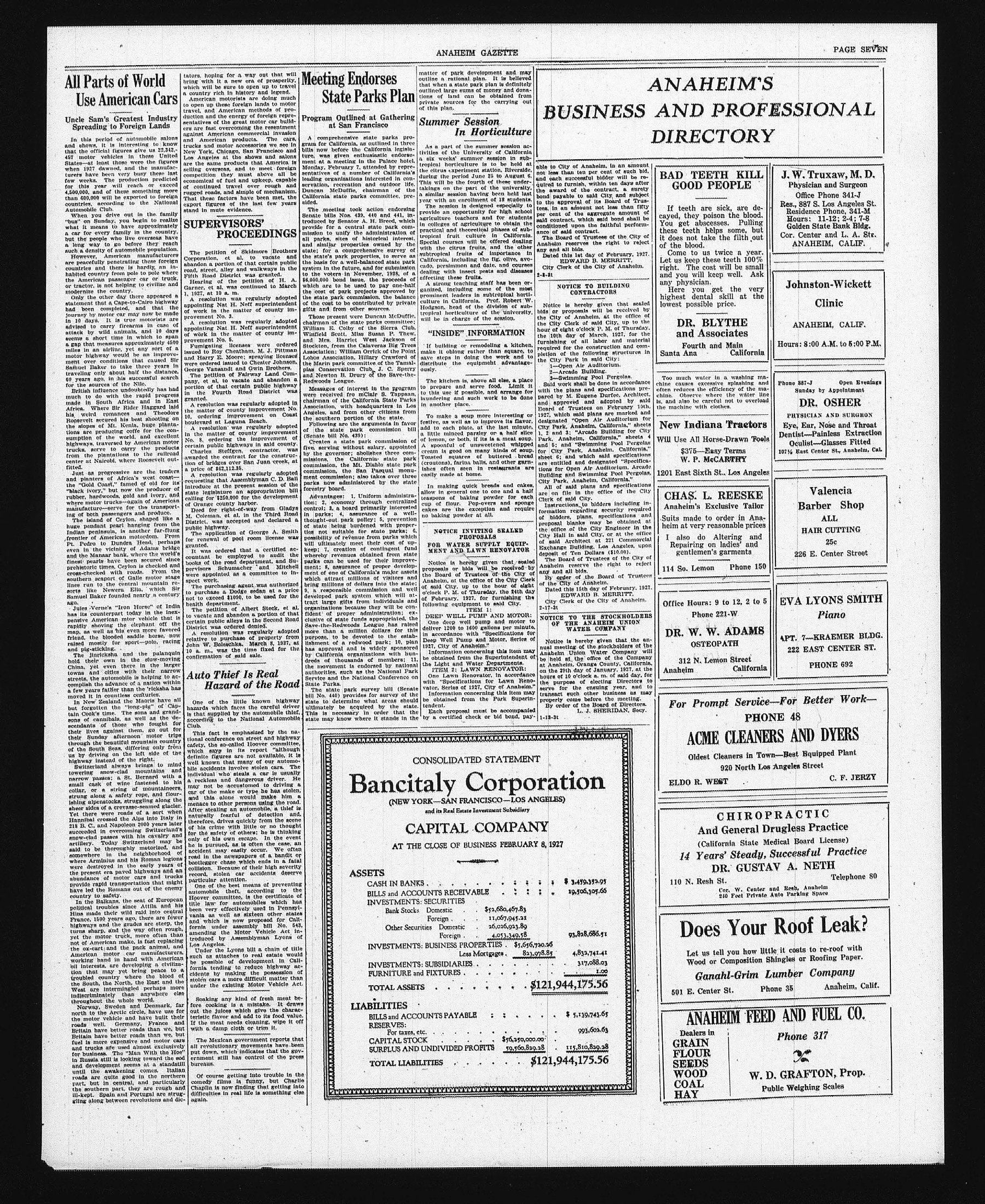
Searchable text
All Parts of World Use American Cars
Uncle Sam's Greatest Industry Spreading to Foreign Lands
In this period of automobile salons and shows, it is interesting to know that the official figures give us 22,342,457 motor vehicles in these United States—at least those were the figures when 1927 dawned, and the manufacturers have been very busy these last few weeks. The production predicted for this year will reach or exceed 4,500,000, and of these something more than 600,000 will be exported to foreign countries, according to the National Automobile Club.
When you drive out in the family "bus" on Sunday, you begin to realize what it means to have approximately a car for every family in the country, but the people who live overseas have a long way to go before they reach such a density of automobile population.
However, American manufacturers are peacefully penetrating these foreign countries and there is hardly an inhabited country from pole to pole where the American passenger car or truck, or tractor, is not helping to civilize and modernize the country.
Only the other day there appeared a statement that a Cape-to-Cairo highway had been completed, and that the journey by motor car may now be made in 10 days. It is true motorists are advised to carry firearms in case of attack by wild animals, and 10 days seems a short time in which to span a gap that measures approximately 4500 miles in an airline, yet any sort of a motor highway would be an improvement over conditions that caused Sir Safrudd Baker to take three years in traveling only about half the distance, 60 years ago, in his successful search for the sources of the Nile.
British influence undoubtedly has had much to do with the rapid progress made in South Africa and in East Africa. Where Sir Rider Haggard laid his weird romances and Theodore Roosevelt secured his best shooting on the slopes of Mt. Kenya, huge plantations are producing coffee for the consumption of the world, and excellent highways, traversed by American motor trucks, serve to carry the products tators, hoping for a way out that will bring with it a new era of prosperity, which will be sure to open up to travel a country rich in history and legend.
American motorists are doing much to open up these foreign lands to motor travel, and American methods of production and the energy of foreign representatives of the great motor car builders are fast overcoming the resentment against American commercial invasion and American products. The cars, trucks and motor accessories we see in New York, Chicago, San Francisco and Los Angeles at the shows and salons are the same products that America is selling overseas, and to meet foreign competition they must above all be economical of fuel and upkeep, capable of continued travel over rough and rugged roads, and simple of mechanism. That these factors have been met, the export figures of the last few years stand in mute evidence.
SUPERVISORS' PROCEEDINGS
The petition of Skidmore Brothers Corporation, et al., to vacate and abandon a portion of that certain public road, street, alley and walkways in the Fifth Road District was granted.
Hearing of the petition of H. A. Garner, et al., was continued to March 1, 1927, at 10 a.m.
A resolution was regularly adopted appointing Nat H. Neff superintendent of work in the matter of county improvement No. 3.
A resolution was regularly adopted appointing Nat H. Neff superintendent of work in the matter of county improvement No. 5.
Fumigating licenses were ordered issued to Roy Cheatham, M. J. Pittman and Harry E. Moore; spraying licenses were ordered issued to Chester Johnson, George Vansandt and Gwin Brothers.
The petition of Fairway Land Company, et al., to vacate and abandon a portion of that certain public highway in the Fourth Road District was granted.
A resolution was regularly adopted in the matter of county improvement No. 10, ordering improvement on Coast boulevard at Laguna Beach.
A resolution was regularly adopted in the matter of county improvement No. 8, ordering the improvement of certain public highways in said county.
Meeting Endorsement at San Francisco
A comprehensive program for California, as bills now before the Court, was given entitlement at a meeting in Monday, February 7, at sentiments of a number leading organizations in servation, recreation and Duncan McDuffie, chicago California state parks sided.
The meeting took place at Senate bills Nos. 439, produced by Senator A. provide for a central mission to unify the all parks, sites of high and similar properties state; for a comprehension the state's park proper the basis for a well-balanced system in the future; and to the voters in November $6,000,000 bond issue, which are to be used to cost of park project the state park commissary of the cost to be contrived gifts and from otherThose present were D. chairman of the state p William E. Colby of Winfield Scott, Miss and Mrs. Harriet W Stockton, from the Californi Association; William O. Lobos Association; Hill the Marin park committee plus Conservation Club and Newton B. Drury Redwoods League.
Messages of interest were received fro mC chairman of the California Association, with head Angeles, and from other southern portionsFollowing are the articles of the state park (Senate bill No. 439):Creates a state pari five serving without
British influence undoubtedly has had much to do with the rapid progress made in South Africa and in East Africa. Where Sir Rider Haggard laid his weird romances and Theodore Roosevelt secured his best shooting on the slopes of Mt. Kenla, huge plantations are producing coffee for the consumption of the world, and excellent highways, traversed by American motor trucks, serve to carry the products from the plantations to the railroad center at Nairobi, where Roosevelt outfitted.
Just as progressive are the traders and planters of Africa's west coast—the "Gold Coast," famed of old for its "black ivory," but now the producer of rubber, hardwoods, gold and ivory, and where motor trucks—again of American manufacture—serve for the transporting of both passengers and produce.
The island of Ceylon, shaped like a huge pendant pearl hanging from the Indian peninsula, is another far-flung frontier of American motordom. From Pt. Pedro to Dundra Head, perhaps even in the vicinity of Adams bridge and the Manaar bank, where the world's finest pearls have been secured since prehistoric times. Ceylon is checked and cross-checked with roads. From the southern seaport of Galle motor stage lines run to the central mountain resorts like Newera Elia, which Sir Samuel Baker founded nearly a century ago.
Jules Verne's "Iron Horse" of India has its counterpart today in the inexpensive American motor vehicle that is rapidly showing the elephant off the map, as well as his even more favored friend, the blooded saddle horse, now raised mostly for sport—polo, racing and pig-stickling.
The jinricksha and the palanquin hold their own in the slow-moving China, yet even there in the larger towns and cities with their narrow streets, the automobile is helping to accomplish the advance of a nation within a few years fatter than the ricksha has moved it in countless centuries.
In New Zealand the Maoris have all but forgotten the "long-pig" of Captain Cook's time. The sons and grandsons of cannibals, as well as the descendants of those who fought for their lives against them, go out for their Sunday afternoon motor trips through the beautiful mountain country of the South Seas, differing only from us by driving on the left side of the highway instead of the right.
Switzerland always brings to mind towering snow-clad mountains and narrow passes; a St. Bernard with a small cask of wine fastened to his collar, or a string of mountaineers, strung along a safety rope, and flourishing alpenstocks, struggling along the sheer sides of a crevasse-seamed glacier. Yet there were roads of a sort when Hannibal crossed the Alps into Italy in 218 B.C., and Napoleon 2000 years later succeeded in overcoming Switzerland's snow-clad passes with his cavalry and artillery. Today Switzerland may be said to be thoroughly motorized, and motor highway would be an improvement over conditions that caused Sir Samuel Baker to take three years in traveling only about half the distance, 60 years ago, in his successful search for the sources of the Nile.
British influence undoubtedly has had much to do with the rapid progress made in South Africa and in East Africa. Where Sir Rider Haggard laid his weird romances and Theodore Roosevelt secured his best shooting on the slopes of Mt. Kenla, huge plantations are producing coffee for the consumption of the world, and excellent highways, traversed by American motor trucks, serve to carry the products from the plantations to the railroad center at Nairobi, where Roosevelt outfitted.
Just as progressive are the traders and planters of Africa's west coast—the "Gold Coast," famed of old for its "black ivory," but now the producer of rubber, hardwoods, gold and ivory, and where motor trucks—again of American manufacture—serve for the transporting of both passengers and produce.
The island of Ceylon, shaped like a huge pendant pearl hanging from the Indian peninsula, is another far-flung frontier of American motordom. From Pt. Pedro to Dundra Head, perhaps even in the vicinity of Adams bridge and the Manaar bank, where the world's finest pearls have been secured since prehistoric times. Ceylon is checked and cross-checked with roads. From the southern seaport of Galle motor stage lines run to the central mountain resorts like Newera Elia, which Sir Samuel Baker founded nearly a century ago.
Jules Verne's "Iron Horse" of India has its counterpart today in the inexpensive American motor vehicle that is rapidly showing the elephant off the map, as well as his even more favored friend, the blooded saddle horse, now raised mostly for sport—polo, racing and pig-stickling.
The jinricksha and the palanquin hold their own in the slow-moving China, yet even there in the larger towns and cities with their narrow streets, the automobile is helping to accomplish the advance of a nation within a few years fatter than the ricksha has moved it in countless centuries.
In New Zealand the Maoris have all but forgotten the "long-pig" of Captain Cook's time. The sons and grand-sons of cannibals, as well as the descendants of those who fought for their lives against them, go out for their Sunday afternoon motor trips through the beautiful mountain country of the South Seas, differing only from us by driving on the left side of the highway instead of the right.
Switzerland always brings to mind towering snow-clad mountains and narrow passes; a St. Bernard with a small cask of wine fastened to his collar, or a string of mountaineers, strung along a safety rope, and flourishing alpenstocks, struggling along the sheer sides of a crevasse-seamed glacier. Yet there were roads of a sort when Hannibal crossed into Italy in 218 B.C., and Napoleon 2000 years later succeeded in overcoming Switzerland's snow-clad passes with his cavalry and artillery. Today Switzerland may be said to be thoroughly motorized, and motor highway would be an improvement over conditions that caused Sir Samuel Baker to take three years in traveling only about half the distance, 60 years ago, in his successful search for the sources of the Nile.
British influence undoubtedly has had much to do with the rapid progress made in South Africa and in East Africa. Where Sir Rider Haggard laid his weird romances and Theodore Roosevelt secured his best shooting on the slopes of Mt. Kenla, huge plantations are producing coffee for the consumption of the world, and excellent highways, traversed by American motor trucks, serve to carry the products from the plantations to the railroad center at Nairobi, where Roosevelt outfitted.
The island of Ceylon, shaped like a huge pendant pearl hanging from the Indian peninsula, is another far-flung frontier of American motordom. From Pt. Pedro to Dundra Head, perhaps even in the vicinity of Adams bridge and the Manaar bank, where the world's finest pearls have been secured since prehistoric times. Ceylon is checked and cross-checked with roads. From the southern seaport of Galle motor stage lines run to the central mountain resorts like Newera Elia, which Sir Samuel Baker founded nearly a century ago.
Jules Verne's "Iron Horse" of India has its counterpart today in the inexpensive American motor vehicle that is rapidly showing the elephant off the map, as well as his even more favored friend, the blooded saddle horse, now raised mostly for sport—polo, racing and pig-stickling.
The jinricksha and the palanquin hold their own in the slow-moving China, yet even there in the larger towns and cities with their narrow streets, the automobile is helping to accomplish the advance of a nation within a few years fatter than the ricksha has moved it in countless centuries.
In New Zealand the Maoris have all but forgotten the "long-pig" of Captain Cook's time. The sons and grand-sons of cannibals, as well as the descendants of those who fought for their lives against them, go out for their Sunday afternoon motor trips through the beautiful mountain country of the South Seas, differing only from us by driving on the left side of the highway instead of the right.
Switzerland always brings to mind towering snow-clad mountains and narrow passes; a St. Bernard with a small cask of wine fastened to his collar, or a string of mountaineers, strung along a safety rope, and flourishing alpenstocks, struggling along the sheer sides of a crevasse-seamed glacier. Yet there were roads of a sort when Hannibal crossed into Italy in 218 B.C., and Napoleon 2000 years later succeeded in overcoming Switzerland's snow-clad passes with his cavalry and artillery. Today Switzerland may be said to be thoroughly motorized, and motor highway would be an improvement over conditions that caused Sir Samuel Baker to take three years in traveling only about half the distance, 60 years ago, in his successful search for the sources of the Nile.
British influence undoubtedly has had much to do with the rapid progress made in South Africa and in East Africa. Where Sir Rider Haggard laid his weird romances and Theodore Roosevelt secured his best shooting on the slopes of Mt. Kenla, huge plantations are producing coffee for the consumption of the world, and excellent highways, traversed by American motor trucks, serve to carry the products from the plantations to the railroad center at Nairobi, where Roosevelt outfitted.
The island of Ceylon, shaped like a huge pendant pearl hanging from the Indian peninsula, is another far-flung frontier of American motordom. From Pt. Pedro to Dundra Head, perhaps even in the vicinity of Adams bridge and the Manaar bank, where the world's finest pearls have been secured since prehistoric times. Ceylon is checked and cross-checked with roads. From the southern seaport of Galle motor stage lines run to the central mountain resorts like Newera Elia, which Sir Samuel Baker founded nearly a century ago.
Jules Verne's "Iron Horse" of India has its counterpart today in the inexpensive American motor vehicle that is rapidly showing the elephant off the map, as well as his even more favored friend, the blooded saddle horse, now raised mostly for sport—polo, racing and pig-stickling.
The jinricksha and the palanquin hold their own in the slow-moving China, yet even there in the larger towns and cities with their narrow streets, the automobile is helping to accomplish the advance of a nation within a few years fatter than the ricksha has moved it in countless centuries.
In New Zealandthe Maoris have all but forgottenthe "long-pig"ofCaptainCook'stime.Thesonandgrandsonsofcannibals.aswellasthedescendantsofthosewhogoughtfortheirlivesagainstthem.gooutfortheirsundayafternoonmotriptripsthroughthebewildmountaincountryoftheSouthSeas,differingonlyfromusbydrivingonthelftsideofthehighwayinsteadoftheright.
Switzerlandalwaysbringsto mind塔ering雪-城mountainsandnarrowpasses:aSt.Bernardwithasmallcaskofwinefastenedtohiscollar.orasmallstringofmountainmeets.strungalonga Safetyrope,andflourishingalpenstocksstrugglingalongsheer sidesofacrevasse-seamedglacier.Yettherewerereoadsofa sortwhenHannibalcrossedtheAlpsintoItalyin218B.C.,andNapoleon2000yearslater succeededinovercomingSwitzerland'snow-城mountainsandnarrowpasses:aSt.Bernardwithasmallcaskofwinefastenedtohiscollar.orasmallstringofmountainmeets.strungalonga Safetyrope,andflourishingalpenstocksstrugglingalongsheer sidesofacrevasseur-seamedglacier.Yettherewerereoadsofa sortwhenHannibalcrossedtheAlpsintoItalyin218B.C.,andNapoleon2000yearslater succeededinovercomingSwitzerland'snow-城mountainsandnarrowpasses:aSt.Bernardwithasmallcaskofwinefastenedtohiscollar.orasmallstringofmountainmeets.strugglingalongsheer sidesofacrevasseur-seamedglacier.Yettherewerereoadsofa sortwhenHannibalcrossedtheAlpsintoItalyin218B.C.,andNapoleon2000yearslater succeededinovercomingSwitzerland'snow-城mountainsandnarrowpasses:aSt.Bernardwithasmallcaskofwinefastenedtohiscollar.orasmallstringofmountainmeets.strugglingalongsheer sidesofacrevasseur-seamedglacier.Yettherewerereoadsofa sortwhenHannibalcrossedtheAlpsintoItalyin218B.C.,andNapoleon2000yearslater succeededinovercomingSwitzerland'snow-城mountainsandnarrowpasses:aSt.Bernardwithasmallcaskofwinefastenedtohiscollar.orasmallstringofmountainmeets.strugglingalongsheer sidesofacrevasseur-seamedglacier.Yettherewerereoadsofa sortwhenHannibalcrossedtheAlpsintoItalyin218B.C.,andNapoleon2000yearslater succeededinovercomingSwitzerland'snow-城mountains和narrowpasses:aSt.Bernardwithasmallcaskofwinefastenedtohiscollar.orasmallstringofmountainmeets.strugglingalongsheer sidesofacrevasseur-seemedglacier.Yettherewerereoadsofa sortwhenHannibalcrossedtheAlpsintoItalyin218B.C.,andNapoleon2000yearslater succeededinovercomingSwitzerland'snow-城mountains和narrowpasses:aSt.Bernardwithasmallcaskofwinefastenedtohiscollar.orasmallstringofmountainmeets.strugglingalongsheer sidesofacrevasseur-seemedglacier.Yettherewerereoadsofa sortwhenHannibalcrossedtheAlpsintoItalyin218B.C.,andNapoleon2000yearslater succeededinovercomingSwitzerland'snow-城mountains和narrowpasses:aSt.Bernardwithasmallcaskofwinefastenedtohiscollar.orasmallstringofmountainmeets.strugglingalongsheer sidesofacrevasseur-seemedglacier.Yettherewerereoadsofa sortwhenHannibalcrossedtheAlpsintoItalyin218B.C.,andNapoleon2000yearslater succeededinovercomingSwitzerland'snow-城mountains和narrowpasses:aSt.Bernardwithasmallcaskofwinefastenedtohiscollar.orasmallstringofmountainmeets.strugglingalongsheer sidesofacrevasseur-seemedglacier.YettherewerereoadsOfa sortwhenHannibalcrossedtheAlpsintoItalyin218B.C.,andNapoleon2000yearslater succeededinovercomingSwitzerland'snow-城mountains和narrowpasses:aSt.Bernardwithasmallcaskofwinefastenedtohiscollar.orasmallstringofmountainmeets.strugglingalongsheer sidesofacrevasseur-seemedglacier.YettherewerereoadsOfa sortwhenHannibalcrossedtheAlpsintoItalyin218B.C.,andNapoleon2000yearslater succeededinovercomingSwitzerland'snow-城mountains和narrowpasses:aSt.Bernardwithasmallcaskofwinefastenedtohiscollar.orasmallstringofmountainmeets.strugglingalongsheer sidesofacrevasseur-seemedglacier.YettherewerereoadsOfa sortwhenHannibalcrossedtheAlpsintoItalyin218B.C.,andNapoleon2000yearslater succeededinovercomingSwitzerland'snow-城mountains和narrowpasses:aSt.Bernardwithasmallcaskofwinefastenedtohiscollar.orasmallstringofmountainmeets.strugglingalongsheer sidesofacrevasseur-seemedglacier.YettherewerereoadsOfa sortwhenHannibalcrossedtheAlpsintoItalyin218B.C.,andNapoleon2000yearslater succeededinovercomingSwitzerland'snow-城 Mountains和narrowpasses:aSt.Bernardwithasmallcaskofwinefastenedtohiscollar.orasmallstringofmountainmeets.strugglingalongsheer sides-ofacrevasseur-seemedglacier.YettherewerereoadsOfa sortwhenHannibalcrossedtheAlpsintoItalyin218B.C.,andNapoleon2000yearslater succeededinovercomingSwitzerland'snow-城 Mountains和narrowpasses:aSt.Bernardwithasmallcaskofwinefastenedtohiscollar.orasmallstringofmountainmeets.strugglingalongsheer sides-ofacrevasseur-seemedglacier.YettherewerereoadsOfa sortwhenHannibalcrossedtheAlpsintoItalyin218B.C.,andNapoleon2000yearslater succeededinovercomingSwitzerland'snow-城 Mountains和narrowpasses:aSt.Bernardwithasmallcaskofwinefastenedtohiscollar.orasmallstringofmountainmeets.strugglingalongsheer sides-ofacrevasseur-seemedglacier.YettherewerereoadsOfa sortwhenHannibalcrossedtheAlpsintoItalyin218B.C.,andNapoleon2000yearslater succeededinovercomingSwitzerland'Snow-城Mountains和narrowpasses:aSt.Bernardwithasmallcaskofwinefastenedtohiscollar.orasmallstringofmountainmeets.strugglingalongsheer sides-ofacrevasseur-seemedglacier.YettherewerereoadsOfa sortwhenHannibalcrossedtheAlpsintoItalyin218B.C.,andNapoleon2000yearslater succeededinovercomingSwitzerland'Snow-城Mountains和narrowpasses:aSt.Bernardwithasmallcaskofwinefastenedtohiscollar.orasmallstringofmountainmeets.strugglingalongsheer sides-ofacrevasseur-seemedglacier.YettherewerereoadsOfa sortwhenHannibalcrossedtheAlpsintoItalyin218B.C.,andNapoleon2000yearslater succeededinovercomingSwitzerland'Snow-城Mountains和narrowpasses:aSt.Bernardwithasmallcaskofwinefastenedtohiscollar.orasmallstringofmountainmeets.strugglingalongsheer sides-ofacrevasseur-seemedglacier.YettherewerereoadsOfa sortwhenHannibalcrossedtheAlpsintoItalyin218B.C.,andNapoleon2000yearslater succeededinovercomingSwitzerland'Snow-城Mountains和narrowpasses:aSt.Bernardwithasmallcaskofwinefastenedtohiscollar.orasmallstringofmountainmeets.strugglingalongsheer sides-ofacrevasseur-seemedglacier.YettherewerereoadsOfa sortwhenHannibalcrossedtheAlpsintoItalyin218B.C.,andNapoleon2000yearslater succeededinovercomingSwitzerland'Snow-城Mountains和narrowpasses:aSt.BernardwithasmallcaskOFwinefastenedtohiscollar.orasmallstringofmountainmeets.strugglingalongsheer sides-ofacrevasseur-seemedglacier.YettherewerereoadsOfa sortwhenHannibalcrossedtheAlpsintoItalyin218B.C.,andNapoleon2000yearslater succeededinovercomingSwitzerland'Snow-城Mountains和narrowpasses:aSt.BernardwithasmallcaskOFwinefastenedtoHiscollar.orasmallstring OfMountainMeets.StrugglingALONGSTREET
Lobster Is Real Hazard Of The Road
One ofthe little known highway hazards which facedthe careful driver is that supplied bythe automobiles thrief,
which says in its report "although definite figures are not available,it will not be accustomed to drivinga car of type he has stolen,and this alone would make him a menace to other persons usingthe road.After stealing an automobile,a thief is naturally fearful of detection and,
therefore,drives quickly fromthe scene.ofhis crime with little or no thought forthe safetyofforshe will be thinkingonlyofforshe will be thinkingonlyofforshe will be thinkingonlyofforshe will be thinkingonlyofforshe will be thinkingonlyofforshe will be thinkingonlyofforshe will be thinkingonlyofforshe will be thinkingonlyofforshe will be thinkingonlyofforshe will be thinkingonlyofforshe will be thinkingonlyofforshe will be thinkingonlyofforshe will be thinkingonlyofforshe will be thinkingonlyofforshe will be thinkingonlyofforshe will be thinkingonlyofforshe will be thinkingonlyofforshe will be thinkingonlyofforshe will be thinkingonlyofforshe will be thinkingonlyofforshe will be thinkingonlyofforshe will be thinkingonlyofforshe will be thinkingonlyofforshe will be thinkingonlyofforshe will be thinkingonlyofforshe will be thinkingonlyofforshe will be thinkingonlyofforshe will be thinkingonlyofforshe will be thinkingonlyofforshe will be thinkingonlyofforshe will be thinkingonlyofforshe will be thinkingonlyofforshe will be thinkingonlyofforshe will be thinkingonlyofforshe will be thinkingonlyofforshe will be thinkingonlyofforshe will be thinkingonlyoffORSHE WILL BE THINKING ONLYOFFORSHE WILL BE THINKING ONLYOFFORSHE WILL BE THINKING ONLYOFFORSHE WILL BE THINKING ONLYOFFORSHE WILL BE THINKING ONLYOFFORSHE WILL BE THINKING ONLYOFFORSHE WILL BE THINKING ONLYOFFORSHE WILL BE THINKING ONLYOFFORSHE WILL BE THINKING ONLYOFFORSHE WILL BE THINKING ONLYOFFORSHE WILL BE THINKING ONLYOFFORSHE WILL BE THINKING ONLYOFFORSHE WILL BE THINKING ONLYOFFORSHE WILL BE THINKING ONLYOFFORSHE WILL BE THINKING ONLYOFFORSHE WILL BE THINKING ONLYOFFORSHE WILL BE THINKING ONLYOFFORSHE WILL BE THINKING ONLYOFFORSHE WILL BE THINKING ONLYOFFORSHE WILL BE THINKINGONLYOFFORSHE WILL BE THINKING ONLYOFFORSHE WILL BE THINKING ONLYOFFORSHE WILL BE THINKING ONLYOFFORSHE WILL BE THINKING ONLYOFFORSHE WILL BE THINKING ONLYOFFORSHE WILL BE THINKING ONLYOFFORSHE WILL BE THINKING ONLYOFFORSHE WILL BE THINKING ONLYOFFORSHE WILL BE THINKING ONLYOFFORSHE WILL BE THINKING ONLYOFFORSHE WILL BE THINKING ONLYOFFORSHE WILL BE THINKINGONLYOFFORSHE WILL BE THINKINGONLYOFFORSHE WILL BE THINKINGONLYOFFORSHE WILL BE THINKINGONLYOFFORSHE WILL BE THINKINGONLYOFFORSHE WILL BE THINKINGONLYOFFORSHE WILL BE THINKINGONLYOFFORSHE WILL BE THINKINGONLYOFFORSHE WILL BE THINKINGONLYOFFORSHE WILL BE THINKINGONLYOFFORSHE WILLBE THINKINGONLYOFFORSHEWILLEBETHICKSKAISNOTEXISTEDINTHEMARKETSCANEWHEREWASGOVERNINGBYTHEMARKETSCANEWHEREWASGOVERNINGBYTHEMARKETSCANEWHEREWASGOVERNINGBYTHEMARKETSCANEWHEREWASGOVERNINGBYTHEMARKETSCANEWHEREWASGOVERNINGBYTHEMARKETSCANEWHEREWASGOVERNINGBYTHEMARKETSCANEWHEREWASGOVERNINGBYTHEMARKETSCANEWHEREWASGOVERNINGBYTHEMARKETSCANEWHEREWASGOVERNINGBYTHEMARKETSCANEWHEREWASGOVERNINGBYTHEMARKETSCANEWHEREWASGOVERNINGBYTHEMARKETSCANEWHEREWASGOVERNINGBYTHEMARKETSCANEWHEREWASGOVERNINGBYTHEMARKETSCANEWHEREWASGOVERNINGBYTHEMARKETSCANEWHEREWASGOVERNINGBYTHEMARKETSCANEWHEREWASGOVERNINGBYTHEMARKETSCANEWHEREWASGOVERNINGBYTHEMARKETSCANEWHEREWASGOVERNINGBYTHEMARKETSCANEWHEREWASGOVERNINGBYTHEMARKETSCANEWHEREWASGOVERNINGBYTHEMARKETSCANEWHEREWASGOVERNINGBYTHEMARKETSCANEWHEREWASGOVERNINGBYTHEMARKETSCANEWHEREWASGOVERNINGBYTHEMARKETSCANEWHEREWASGOVERNINGBYTHEMARKETSCANEWHEREWASGOVERNINGBYTHEMARKETSCANEWHEREWASGOVERNINGBYTHEMARKETSCANEWHEREWASGOVERNINGBYTHEMARKETSCANEWHEREWASGOVERNINGBYTHEMARKETSCANEWHEREWASGOVERNINGBYTHEMARKETSCANEWHEREWASGOVERNINGBYTHEMARKETSCANEWHEREWASGOVERNINGBYTHEMARKETSCANEWHEREWASGOVERNINGBYTHEMARKETSCANEWHEREWASGOVERNINGBYTHEMARKETSCANEWHEREWASGOVERNINGBYTHEMARKETSCANE
Switzerland always brings to mind towering snow-clad mountains and narrow passes; a St. Bernard with a small cask of wine fastened to his collar, or a string of mountainers, strung along a safety rope, and flourishing alpenstocks, struggling along the sheer sides of a crevassed-seamed glacier. Yet there were roads of a sort when Hannibal crossed the Alps into Italy in 218 B.C., and Napoleon 2000 years later succeeded in overcoming Switzerland's snow-clad passes with his cavalry and artillery. Today Switzerland may be said to be thoroughly motorized, and somewhere in the neighborhood of where Arminius and his Roman legions were destroyed in the early years of the present era paved highways and an abundance of motor cars and trucks provide rapid transportation that might have led the Romans out of the enemy country to safety.
In the Balkans, the seat of European political troubles since Attila and his Hins made their wild raid into central France, 1500 years ago, there are fewer highways and the grades are steep, the turns sharp, and the way often rough, yet the motor truck, more often than not of American make, is fast replacing the ox-cart and the pack animal, and American motor car manufacturers, working hand in hand with American oil interests, are developing a civilization that may yet bring peace to a troubled country where the blood of the South, the North, the East and the West are intermingled perhaps more indiscriminately than anywhere else throughout the whole world.
Norway, Sweden and Denmark, far north to the Arctic circle, have use for the motor vehicle and have built their roads well. Germany, France and Britain have better roads than we, but Britain have better roads than we, but fuel is more expensive and motor cars and trucks are used almost exclusively for business. The "Man With the Hoe" in Russia still is looking toward the sod and development seems at a standstill until the awakening comes. Italian roads are quite good in the northern part, but in central, and particularly the southern part, they are rough and ill-kept. Spain and Portugal are struggling along between revolutions and dic-
definite figures are not available. It is well known that many of our automobile accidents involve stolen cars. The individual who steals a car is usually a reckless and dangerous driver. He may not be accustomed to driving a car of the make or type he has stolen, and this alone would make him a menace to other persons using the road. After stealing an automobile, a thief is naturally fearful of detection and, therefore, drives quickly from the scene of his crime with little or no thought for the safety of others; he is thinking only of his own escape. In the event he is pursued, as is often the case, an accident may easily occur. We often read in the newspapers of a bandit or bootlegger chase which ends in a fatal collision. Because of their high severity record, stolen car accidents deserve particular attention.
One of the best means of preventing automobile theft, according to the Hoover committee, is the certificate of title law for automobiles which has been very effectively used in Pennsylvania as well as sixteen other states and which is now proposed for California under assembly bill No. 543, amending the Motor Vehicle Act introduced by Assemblyman Lyons of Los Angeles.
Under the Lyons bill a chain of title such as attaches to real estate would be possible of development in California tending to reduce highway accidents by making the possession of stolen cars a more difficult matter than under the existing Motor Vehicle Act.
Soaking any kind of fresh meat before cooking is a mistake. It draws out the juices which give the characteristic flavor and add to its food value. If the meat needs cleaning, wipe it off with a damp cloth or trim it.
The Mexican government reports that all revolutionary movements have been put down, which indicates that the government still has control of the press bureaus.
Of course getting into trouble in the comedy films is funny, but Charlie Chaplin is now finding that getting into difficulties in real life is something else again.
Meeting Endorses State Parks Plan
Program Outlined at Gathering at San Francisco
A comprehensive state parks program for California, as outlined in three bills now before the California legislature, was given enthusiastic endorsement at a meeting in the Palace hotel. Monday, February 7, attended by representatives of a number of California's leading organizations interested in conservation, recreation and outdoor life. Duncan McDuffie, chairman of the California state parks committee, presided.
The meeting took action endorsing Senate bills Nos. 439, 440 and 441, introduced by Senator A. H. Breed, which provide for a central state park commission to unify the administration of all parks, sites of historical interest, and similar properties owned by the state; for a comprehensive survey of the state's park properties, to serve as the basis for a well-balanced state park system in the future, and for submission to the voters in November, 1928, of a $6,000,000 bond issue, the proceeds of which are to be used to pay one-half the cost of park projects approved by the state park commission, the balance of the cost to be contributed by private gifts and from other sources.
Those present were Duncan McDuffie, chairman of the state parks committee; William E. Colby of the Sierra Club; Winfield Scott, Miss Susan P. Thew, and Mrs. Harriet West Jackson of Stockton, from the Calaveras Big Trees Association; William Orrick of the Point Lobos Association; Hillary Crawford of the Marin park committee of the Tamalplas Conservation Club; J. C. Sperry and Newton B. Drury of the Save-the-Redwoods League.
Messages of interest in the program were received from mClair S. Tappan, chairman of the California State Parks Association, with headquarters in Los Angeles, and from other citizens from the southern portion of the state.
Following are the arguments in favor of the state park commission bill (Senate bill No. 439):
Creates a state park commission of five, serving without salary, appointed matter of park development and may outline a rational plan. It is believed that when a state park plan is definitely outlined large sums of money and donations of land can be obtained from private sources for the carrying out of this plan.
Summer Session In Horticulture
As a part of the summer session activities of the University of California a six weeks' summer session in subtropical horticulture is to be held at the citrus experiment station, Riverside, during the period June 25 to August 6. This will be the fourth of these undertakings on the part of the university, a similar session having been held last year with an enrollment of 18 students.
The session is designed especially to provide an opportunity for high school agriculture teachers and for students in colleges of agriculture to obtain the practical and theoretical phases of subtropical fruit culture in California. Special courses will be offered dealing with the citrus fruits, and the other subtropical fruits of importance in California, including the fig, olive, avocade, persimmon and date, and courses dealing with insect pests and diseases affecting these fruits.
A strong teaching staff has been organized, including some of the most prominent leaders in subtropical horticulture in California. Prof. Robert W. Hodgson, head of the division of subtropical horticulture of the university, will be in charge of the session.
"INSIDE" INFORMATION
If building or remodeling a kitchen, make it oblong rather than square, to save steps in doing the work and to distribute the equipment advantageously.
The kitchen is, above all else, a place to prepare and serve food. Limit it to this use if possible, and arrange for laundering and such work to be done in another place.
To make a soup more interesting or festive, as well as to improve its flavor, add to each plate, at the last minute, a little minced parsley or a half slice of lemon, or both. If its is a meat soup. A spoonful of unsweetened whipped able to City of Anaheim, in an amount not less than ten per cent of such bid, and each successful bidder will be required to furnish, within ten days after the award of the contract, a surety bond payable to said City and subject to the approval of its Board of Trustees, in an amount not less than fifty per cent of the aggregate amount of said contract, which said bond shall be conditioned upon the faithful performance of said contract.
The Board of Trustees of the City of Anaheim reserves the right to reject any and all bids.
Dated this 1st day of February, 1927.
EDWARD B. MERRITT.
City Clerk of the City of Anaheim.
2-2-3t
NOTICE TO BUILDING CONTRACTORS
Notice is hereby given that sealed bids or proposals will be received by the City of Anaheim, at the office of the City Clerk of said City, up to the hour of eight o'clock P.M. of Thursday, the 10th day of March, 1927, for the furnishing of all labor and material required for the construction and completion of the following structures in the City Park in said City:
1-Open Air Auditorium.
2-Arcade Building.
3-Swimming Pool Pergolas.
Said work shall be done in accordance with the plans and specifications prepared by M. Eugene Durfee, Architect, and approved and adopted by said Board of Trustees on February 10th, 1927, which said plans are marked and designated "Open Air Auditorium for City Park, Anaheim, California," sheets 1, 2 and 3; "Arcade Building for City Park, Anaheim, California," sheets 4 and 5; and "Swimming Pool Pergolas."
Lobos Association, Hillary Crawford of the Marin park committee of the Tamaplas Conservation Club, J. C. Sperry and Newton B. Drury of the Save-the-Redwoods League.
Messages of interest in the program were received from mClair S. Tappaan, chairman of the California State Parks Association, with headquarters in Los Angeles, and from other citizens from the southern portion of the state.
Following are the arguments in favor of the state park commission bill (Senate bill No. 439):
Creates a state park commission of five, serving without salary, appointed by the governor; abolishes three commissions, the California state park commission, the Mt. Diablo state park commission, the San Pasquall monument commission; also takes over three parks now administered by the state forestry board.
Advantages: 1. Uniform administration; 2. Economy through centralized control; 3. A board primarily interested in parks; 4. assurance of a well-thought-out park policy; 5. prevention of state being burdened with properties not suitable for state parks; 6. possibility of revenue from parks which will ultimately meet their cost of upkeep; 7. creation of contingent fund whereby revenues obtained from state parks can be used for their improvement; 8. assurance of proper development of one of California's major assets which attract millions of visitors and bring millions of dollars into the state; 9. a responsible commission and well-developed park system which will attract large gifts from individuals and organizations because they will be confident of proper administration; exclusive of state funds appropriated, the Save-the-Redwoods League has raised more than a million dollars for this purpose, to be devoted to the establishment of a redwood park; 10. plan has approval and is widely sponsored by California organizations with hundreds of thousands of members; 11. the movement is endorsed by national authorities, such as the National Park Service and the National Conference on State Parks.
The state park survey bill (Senate bill No. 440) provides for survey of the state to determine what areas should ultimately be acquired by the state. This is necessary in order that the state may know where it stands in the save steps in doing the work and to distribute the equipment advantageously.
The kitchen is, above all else, a place to prepare and serve food. Limit it to this use if possible, and arrange for laundering and such work to be done in another place.
To make a soup more interesting or festive, as well as to improve its flavor, add to each plate, at the last minute, a little minced parsley or a half slice of lemon, or both. If its is a meat soup. A spoonful of unsweetened whipped cream is good on many kinds of soup. Toasted squares of buttered bread (croutons), farina balls, and other garnishes often seen in restaurants are easily made at home.
In making quick breads and cakes, allow in general one to one and a half teaspoons of baking powder for each cup of flour. Pop-overs and sponge cakes are the exception and require no baking powder at all.
NOTICE INVITING SEALED PROPOSALS FOR WATER SUPPLY EQUIPMENT AND LAWN RENOVATOR
Notice is hereby given that sealed proposals or bids will be received by the Board of Trustees of the City of Anaheim, at the office of the City Clerk of said City, up to the hour of eight o'clock P.M. of Thursday, the 24th day of February, 1927, for furnishing the following equipment to said City.
ITEM 1:
DEEP WELL PUMP AND MOTOR:
One deep well pump and motor to deliver 1200 to 1600 gallons per minute, in accordance with "Specifications for Deep Well Pump and Motor, Series of 1927, City of Anaheim."
Information concerning this item may be obtained from the Superintendent of the Light and Water Departments.
ITEM 2: LAWN RENOVATOR:
One Lawn Renovator, in accordance with "Specifications for Lawn Renovator, Series of 1927, City of Anaheim."
Information concerning this item may be obtained from the Park Superintendent.
Each proposal must be accompanied by a certified check or bid bond, payable to the following structure:
the City Park in said City:
1—Open Air Auditorium.
2—Arcade Building.
3—Swimming Pool Pergolas.
Said work shall be done in accordance with the plans and specifications prepared by M. Eugene Duree, Architect, and approved and adopted by said Board of Trustees on February 10th, 1927, which said plans are marked and designated "Open Air Auditorium for City Park, Anaheim, California," sheets 1, 2 and 3; "Arcade Building for City Park, Anaheim, California," sheets 4 and 5; and "Swimming Pool Pergolas for City Park, Anaheim, California." sheet 6; and which said specifications are entitled and designated "Specifications for Open Air Auditorium, Arcade Building and Swimming Pool Pergolas, City Park, Anaheim, California."
All of said plans and specifications are on file in the office of the City Clerk of said City.
Instructions to bidders including information regarding security required of bidders, plans, specifications and proposal blanks may be obtained at the office of the City Engineer In The City Hall in said City, or at the office of said Architect at 221 Commercial Exchange Building, Los Angeles, upon deposit of Ten Dollars ($10.00).
The Board of Trustees of the City of Anaheim reserve the right to reject any and all bids.
By order of the Board of Trustees of the City of Anaheim.
Dated this 15th day of February, 1927.
EDWARD B. MERRITT.
City Clerk of the City of Anaheim.
2-17-3t
NOTICE TO THE STOCKHOLDERS OF THE ANAHEIM UNION WATER COMPANY
Notice is hereby given that annual meeting of the stockholders of the Anaheim Union Water Company will be held at the office of the Company at Anaheim, Orange County, California, on the 29th day of January, 1927, at the hours of 10 o'clock a.m. of said day, for the purpose of electing Directors to serve for the ensuing year, and to transact such other business as may properly come before the meeting.
By order of the Board of Directors.
L. J. SHERIDAN, Secy.
1-13-3t
CONSOLIDATED STATEMENT
Bancitaly Corporation
(NEW YORK—SAN FRANCISCO—LOS ANGELES)
and its Real Estate Investment Subsidiary
CAPITAL COMPANY
AT THE CLOSE OF BUSINESS FEBRUARY 8, 1927
ASSETS
CASH IN BANKS . . . $3,459,352.95
BILLS and ACCOUNTS RECEIVABLE . . . 19,506,305.66
INVESTMENTS: SECURITIES
Bank Stocks Domestic $52,680,467.83
Foreign 11,067,945.21
Other Securities Domestic 26,026,923.89
Foreign 4,053,349.58 93,828,686.51
INVESTMENTS: BUSINESS PROPERTIES $5,656,720.26
Less Mortgages 823,978.85 4,832,741.41
INVESTMENTS: SUBSIDIARIES 317,088.03
FURNITURE and FIXTURES 1.00
TOTAL ASSETS $121,944,175.56
LIABILITIES
BILLS and ACCOUNTS PAYABLE . . . $5,139,743.65
RESERVES:
For taxes, etc. 993,602.63
CAPITAL STOCK $56,250,000.00
SURPLUS AND UNDIVIDED PROFITS 59,560,829.28 115,810,829.28
TOTAL LIABILITIES $121,944,175.56
ANAHEIM'S
ESS AND PROFESSIONAL
DIRECTORY
BAD TEETH KILL GOOD PEOPLE
If teeth are sick, are decayed, they poison the blood. You get abscesses. Pulling these teeth helps some, but it does not take the filth out of the blood.
Come to us twice a year. Let us keep these teeth 100% right. The cost will be small and you will keep well. Ask any physician.
Here you get the very highest dental skill at the lowest possible price.
DR. BLYTHE
and Associates
Fourth and Main
Santa Ana California
J. W. Truxaw, M. D.
Physician and Surgeon
Office Phone 341-J
Res., 887 S. Los Angeles St.
Residence Phone, 341-M
Hours: 11-12; 2-4; 7-8
Golden State Bank Bldg.
Cor. Center and L. A. Str.
ANAHEIM, CALIF.
Johnston-Wickett
Clinic
ANAHEIM, CALIF.
Hours: 8:00 A.M. to 5:00 P.M.
Too much water in a washing machine causes excessive splashing and often reduces the efficiency of the machine. Observe where the water line is, and also be careful not to overload the machine with clothes.
New Indiana Tractors
Will Use All Horse-Drawn Tools
DR. OSHER
PHYSICIAN AND SURGEON
Eye, Ear, Nose and Throat
Dentist—Painless Extraction
Oculist—Glasses Fitted
Too much water in a washing machine causes excessive splashing and often reduces the efficiency of the machine. Observe where the water line is, and also be careful not to overload the machine with clothes.
New Indiana Tractors
Will Use All Horse-Drawn Tools
$375—Easy Terms
W. P. McCARTHY
1201 East Sixth St., Los Angeles
CHAS. L. REESKE
Anaheim's Exclusive Tailor
Suits made to order in Anaheim at very reasonable prices
I also do Altering and Repairing on ladies' and gentlemen's garments
114 So. Lemon Phone 150
Office Hours: 9 to 12, 2 to 5
Phone 221-W
DR. W. W. ADAMS
OSTEOPATH
312 N. Lemon Street
Anaheim California
EVA LYONS SMITH
Piano
APT. 7—KRAEMER BLDG.
222 EAST CENTER ST.
PHONE 692
For Prompt Service—For Better Work—
PHONE 48
ACME CLEANERS AND DYERS
Oldest Cleaners in Town—Best Equipped Plant
920 North Los Angeles Street
ELDO R. WEST C. F. JERZY
CHIROPRACTIC
And General Drugless Practice
(California State Medical Board License)
Oldest Cleaners in Town—Best Equipped Plants
920 North Los Angeles Street
ELDO R. WEST C. F. JERZY
CHIROPRACTIC
And General Drugless Practice
(California State Medical Board License)
14 Years' Steady, Successful Practice
DR. GUSTAV A. NETH
110 N. Resh St. Telephone 80
Cor. W. Center and Resh, Anaheim
240 Feet Private Auto Parking Space
Does Your Roof Leak?
Let us tell you how little it costs to re-roof with
Wood or Composition Shingles or Roofing Paper.
Ganahl-Grim Lumber Company
501 E. Center St. Phone 35 Anaheim, Calif.
ANAHEIM FEED AND FUEL CO.
Dealers in
GRAIN
FLOUR
SEEDS
WOOD
COAL
HAY
Phone 317
W. D. GRAFTON, Prop.
Public Weighing Scales