anaheim-gazette 1927-02-03
Scanned page
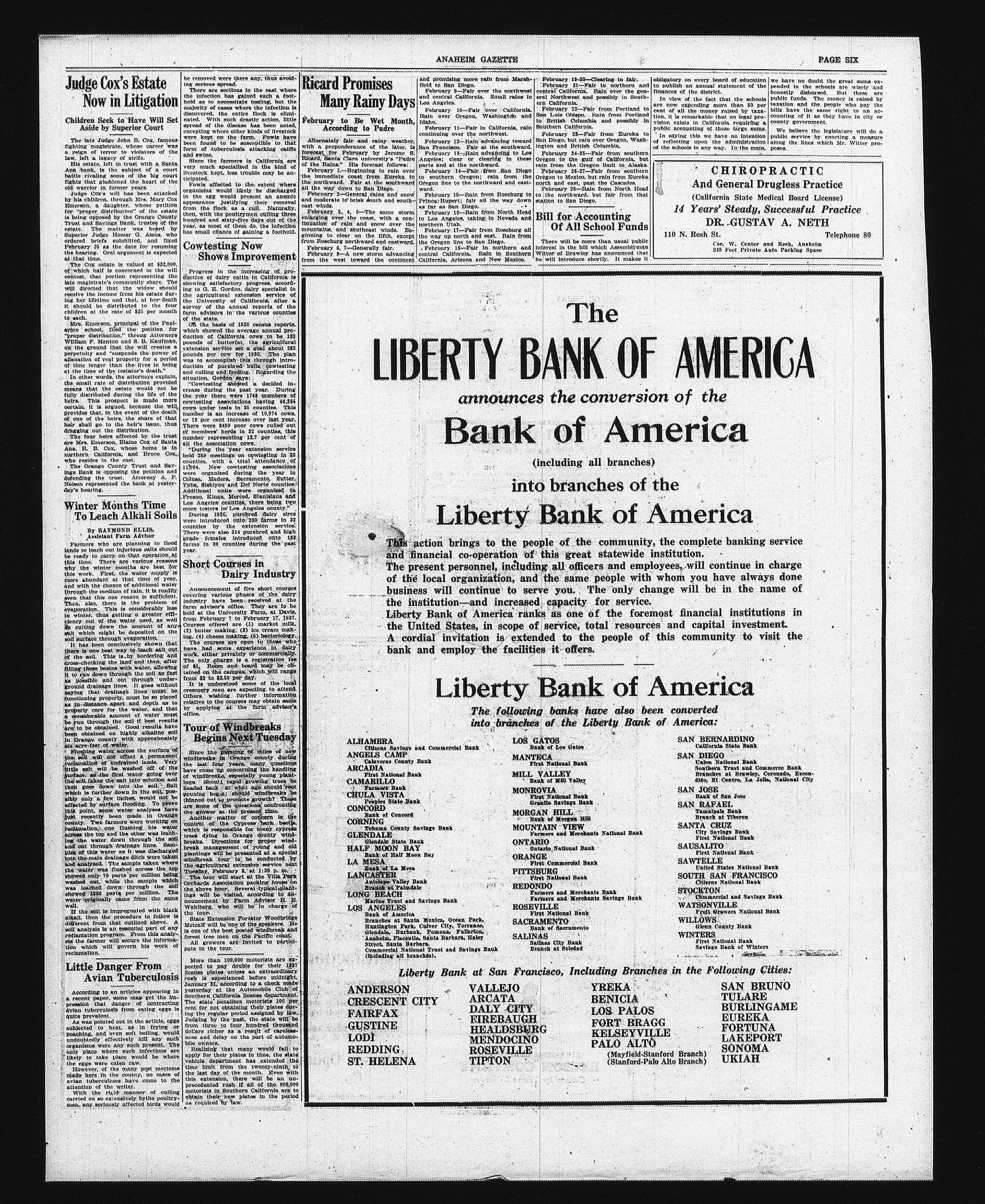
Searchable text
Judge Cox's Estate Now in Litigation
Children Seek to Have Will Set Aside by Superior Court
The late Judge John B. Cox, famous fighting magistrate, whose career was a reign of terror to violators of the law, left a legacy of strife.
His estate, left in trust with a Santa Ana bank, is the subject of a court battle rivaling some of the big court fights that gladdened the heart of the old warrior in former years.
Judge Cox's will has been attacked by his children, through Mrs. Mary Cox Emerson, a daughter, whose petition for "proper distribution" of the estate is being opposed by the Orange County Trust and Savings Bank, trustee of the estate. The matter was heard by Superior Judge Homer G. Ames, who ordered briefs submitted, and fixed February 25 as the date for resuming the hearing. Oral argument is expected at that time.
The Cox estate is valued at $32,000, of which half is concerned in the will contest, that portion representing the late magistrate's community share. The will directed that the widow should receive the income from his estate during her lifetime and that, at her death it should be distributed to the four children at the rate of $25 per month to each.
Mrs. Emerson, principal of the Paulino school, filed the petition for "proper distribution," through Attorneys William F. Menton and S. B. Kaufman, on the ground that the will creates a perpetuity and "suspends the power of alienation of real property for a period of time longer than the lives in being at the time of the testator's death."
In other words, the attorneys explain, the small rate of distribution provided means that the estate would not be fully distributed during the life of the heirs. This prospect is made more certain, it is argued, because the will provides that, in the event of the death of one of the heirs, the share of that heir shall go to the heir's issue, thus dragging out the distribution.
The four heirs affected by the trust are Mrs. Emerson, Blaine Cox of Santa Ana, R. B. Cox, whose home is in be removed were there any, thus avoiding serious spread.
There are sections in the east where the infection has gained such a foothold as to necessitate testing, but the majority of cases where the infection is discovered, the entire flock is eliminated. With such drastic action, little spread of the disease has been noted, excepting where other kinds of livestock were kept on the farm. Fowls have been found to be susceptible to that form of tuberculosis attacking cattle and swine.
Since the farmers in California are very much specialized in the kind of livestock kept, less trouble may be anticipated.
Fowls affected to the extent where organisms would likely be discharged in the egg would present an anemic appearance justifying their removal from the flock as a cull. Naturally, then, with the poultrymen culling three hundred and sixty-five days out of the year, as most of them do, the infection has small chance of gaining a foofold.
Cowtesting Now Shows Improvement
Progress in the increasing production of dairy cattle in California is showing satisfactory progress, according to G. E. Gordon, dairy specialist in the agricultural extension service of the University of California, after a survey of the annual reports of the farm advisors in various counties of the state.
On the basis of 1920 census reports, which showed the average annual production of California cows to be 182 pounds of butterfat, the agricultural extension service set a goal about 265 pounds per cow for 1930. The plan was to accomplish this through introduction of purebred bulls, cowtesting and culling and feeding. Regarding the situation, Gordon says:
"Cowtesting showed a decided increase during the past year. During the year there were 1748 members of cowtesting associations having 66,364 cows under tests in 35 counties. This number is an increase of 10,974 cows, or 19 per cent increase over last year. There were 8490 poor cows culled out of members' herds in 32 counties, this number representing 12.7 per cent of all the association cows."
Winter Months Time To Leach Alkali Soils
By RAYMOND ELLIS,
Assistant Farm Advisor
Farmers who are planning to flood lands to leach out injurious salts should be ready to carry on that operation at this time. There are various reasons why the winter months are best for this work. First, the water supply is more abundant at that time of year, and with the chance of additional water through the medium of rain, it is readily seen that this one reason is sufficient. Then, also, there is the problem of evaporation. This is considerably less in winter, thus getting a greater efficiency out of the water used, as well as cutting down the amount of any salt which might be deposited on the soil surface through evaporation.
It has been conclusively shown that there is one best way to leach salt out of the soil. This is by bordering and cross-checking the land and then, after filling these basins with water, allowing it to run down through the soil as fast as possible and out through underground drainage lines. It goes without saying that drainage lines must be functioning properly, must be so placed as to distance apart and depth as to properly care for the water, and that a considerable amount of water must be run through the soil if best results are to be obtained. Good results have been obtained on highly alkaline soil in Orange county with approximately six acre-feet of water.
Flushing water across the surface of the soil will not affect a permanent reclamation of undrained lands. Very little salt will be washed off of the surface, as the first water going over the soil takes the salt into solution and then goes down into the soil. Salt which is further down in the soil, possibly only a few inches, would not be affected by surface flooding. To prove this point, some water analyses have just recently been made in Orange county. Two farmers were working on reclamation, one flushing his water across the top and the other was leaching the water down through the soil and out through drainage lines. Sam-
the soil will not effect a permanent reclamation of undrained lands. Very little salt will be washed off of the surface, as the first water going over the soil takes the salt into solution and then goes down into the soil. Salt which is further down in the soil, possibly only a few inches, would not be affected by surface flooding. To prove this point, some water analyses have just recently been made in Orange county. Two farmers were working on reclamation, one flushing his water across the top and the other was leaching the water down through the soil and out through drainage lines. Samples of this water as it was discharged into the main drainage ditch were taken and analyzed. The sample taken where the water was flushed across the top showed only 70 parts per million being washed out, while the sample which was leached down through the soil showed 1220 parts per million. The water originally came from the same well.
If the soil is impregnated with black alkali, then the procedure to follow is different from that outlined above. A soil analysis is an essential part of any reclamation program. From this analysis the farmer will secure the information which will govern his work of reclamation.
Little Danger From Avian Tuberculosis
According to an articles appearing in a recent paper, some may get the impression that danger of contracting avian tuberculosis from eating eggs is quite prevalent.
As was pointed out in the article, eggs subjected to heat, as in frying or poaching, and even soft boiling, would undoubtedly effectively kill any such organisms were any such present. The only place where such infections are likely to take place would be where the eggs were eaten raw.
However, of the many post mortems made here in the county, no cases of avian tuberculoses have come to the attention of the writer.
With the rigid manner of culling carried on so extensively by the poultry men, any seriously affected birds would more than 100,000 motorists are expected to pay double for their 1927 license plates unless an extraordinary rush is experienced before midnight, January 31, according to a check made yesterday at the Automobile Club of Southern California license department. The state penalizes motorists 100 percent for not obtaining their plates during the regular period assigned by law. Judging by the past, the state will be from three to four hundred thousand dollars richer as a result of carelessness and delay on the part of automobile owners.
Realizing that many would fail to apply for their plates in time, the state vehicle department has extended the time limit from the twenty-ninth to the last day of the month. Even with this extension, there will be an unprecedented rush if all of the 800,000 motorists in Southern California are to obtain their new plates in the period as required by law.
Ricard Promises Many Rainy Days
February to Be Wet Month, According to Padre
Alternately fair and rainy weather, with a preponderance of the later, is forecast for February by Jerome S. Ricard, Santa Clara university's "Padre of the Rains." His forecast follows:
February 1—Beginning to rain over the immediate coast from Eureka to the northward. Fair at the southward all the way down to San Diego.
February 2—General rains and snow and moderate to brisk south and southeast winds.
February 3, 4, 5—The same storm enlarging over the coast, with a continuation of rain and snow over the mountains, and southeast winds. Beginning to clear on the fifth, except from Roseburg northward and eastward.
February 6, 7—Generally fair.
February 8—A new storm advancing from the west toward the continent and promising more rain from Marshfield to San Diego.
February 9—Fair over the northwest and central California. Small rains in Los Angeles.
February 10—Fair over California. Rain over Oregon, Washington and Idaho.
February 11—Fair in California, rain continuing over the northwest.
February 12—Rain advancing toward San Francisco. Fair at the southward.
February 13—Rain advancing to Los Angeles; clear or clearing in these parts and at the northward.
February 14—Fair from San Diego to southern Oregon; rain from the Oregon line to the northward and eastward.
February 15—Rain from Roseburg to Prince Rupert; fair all the way down as far as San Diego.
February 16—Rain from North Head to Los Angeles, taking in Nevada and northern Utah.
February 17—Fair from Roseburg all the way up north and east. Rain from the Oregon line to San Diego.
February 18—Fair in northern and central California. Rain in Southern California, Arizona and New Mexico.
February 19-20—Clearing to fair.
February 21—Fair in northern and central California. Rain over the general Northwest and possibly in Southern California.
February 22—Fair from Portland to San Luis Obispo. Rain from Portland to British Columbia and possibly in Southern California.
February 23—Fair from Eureka to San Diego, but rain over Oregon, Washington and British Columbia.
February 24-25—Fair from southern Oregon to the gulf of California, but rain from the Oregon limit to Alaska.
February 26-27—Fair from southern Oregon to Mexico, but rain from Eureka north and east, past the Cascades.
February 28—Rain from North Head to the northward, but fair from that station to San Diego.
Bill for Accounting Of All School Funds
There will be more than usual public interest in the bill which Assemblyman Witter of Brawley has announced that he will introduce shortly. It makes it obligatory on enrolment to publish an annual finances of the school.
The LIBERTY BANK OF A announces the conversion of Bank of America
LIBERTY BANK OF AMERICA
announces the conversion of
Bank of America
(including all branches)
into branches of the
Liberty Bank of Am
This action brings to the people of the community, the comand financial co-operation of this great statewide institution.
The present personnel, including all officers and employees, wiof the local organization, and the same people with whom y
business will continue to serve you. The only change will
the institution—and increased capacity for service.
Liberty Bank of America ranks as one of the foremost finathe United States, in scope of service, total resources and c
A cordial invitation is extended to the people of this conbank and employ the facilities it offers.
LIBERTY BANK OF AMERICA
The following banks have also been converinto branches of the Liberty Bank of Amer
ALHAMBRA
Clifton Savings and Commercial Bank
ANGELS CAMP
Calaveras County Bank
ARCADIA
First National Bank
CAMARILLO
Farmers Bank
CHULA VISTA
Peoples State Bank
CONCORD
Bank of Concord
CORNING
Tehama County Savings Bank
GLENDALE
Glendale State Bank
HALF MOON BAY
LOS GATOS
Bank of Los Gatos
MANTECA
First National Bank
MILL VALLEY
Bank of Mill Valley
MONROVIA
First National Bank
Granite Savings Bank
MORGAN HILL
Bank of Morgan Hill
MOUNTAIN VIEW
Farmers and Merchants National Bank
ONTARIO
Ontario National Bank
ANGELS CAMP
Calaveras County Bank
ARCADIA
First National Bank
CAMARILLO
Farmers Bank
CHULA VISTA
Peoples State Bank
CONCORD
Bank of Concord
CORNING
Tehama County Savings Bank
GLENDALE
Glendale State Bank
HALF MOON BAY
Bank of Half Moon Bay
LA MESA
Bank of La Mesa
LANCASTER
Antelope Valley Bank
Branch at Palmdale
LONG BEACH
Marine Trust and Savings Bank
LOS ANGELES
Bank of America
Branches at Santa Monica, Ocean Park,
Huntington Park, Culver City, Torrance,
Glendale, Burbank, Pomona, Fullerton,
Anahiem, Placentia, Santa Barbara, Haley
Street, Santa Barbara.
Commercial National Trust and Savings Bank
(including all branches).
MANTECA
First National Bank
MILL VALLEY
Bank of Mill Valley
MONROVIA
First National Bank
Granite Savings Bank
MORGAN HILL
Bank of Morgan Hill
MOUNTAIN VIEW
Farmers and Merchants National Bank
ONTARIO
Ontario National Bank
ORANGE
First Commercial Bank
PITTSBURG
First National Bank
REDONDO
Farmers and Merchants Bank
Farmers and Merchants Savings Bank
ROSEVILLE
First National Bank
SACRAMENTO
Bank of Sacramento
SALINAS
Salinas City Bank
Branch at Soledad
Liberty Bank at San Francisco, Including Branches in the
ANDERSON
CRESCENT CITY
FAIRFAX
GUSTINE
LODÍ
REDDING
ST. HELENA
VALLEJO
ARCATA
DALY CITY
FIREBAUGH
HEALDSBURG
MENDOCINO
ROSEVILLE
TIPTON
YREKA
BENICIA
LOS PALOS
FORT BRAGG
KELSEYVILLE
PALO ALTO
(Mayfield-Stanford Branch)
(Stanford-Palo Alto Branch)
obligatory on every board of education to publish an annual statement of the finances of the district.
In view of the fact that the schools are now expending more than 50 per cent of all the money raised by taxation, it is remarkable that no legal provision exists in California requiring a public accounting of these large sums.
In saying this we have no intention of reflecting upon the administration of the schools in any way. In the main, we have no doubt the great sums expended in the schools are wisely and honestly disbursed. But these are public funds. The money is raised by taxation and the people who pay the bills have the same right to an accounting of it as they have in city or county government.
We believe the legislature will do a public service by enacting a measure along the lines which Mr. Witter proposes.
CHIROPRACTIC
And General Drugless Practice
(California State Medical Board License)
14 Years' Steady, Successful Practice
DR. GUSTAV A. NETH
110 N. Resh St. Telephone 80
Cor. W. Center and Resh, Anaheim
210 Feet Private Auto Parking Space
OF AMERICA
version of the
America
(branches)
s of the
of America
community, the complete banking service
wide institution.
and employees, will continue in charge
with whom you have always done
only change will be in the name of
service.
the foremost financial institutions in
resources and capital investment.
people of this community to visit the
OF America
also been converted
to Bank of America:
SAN BERNARDINO
California State Bank
SAN DIEGO
Union National Bank
Southern Trust and Commerce Bank
Branches at Brawley, Coronado, Escondido, El Centro, La Jolla, National City
SAN JOSE
Bank of San Jose
SAN RAFAEL
Tamalpals Bank
Branch at Tiberon
SANTA CRUZ
City Savings Bank
First National Bank
SAUSALITO
SAN DIEGO
Union National Bank
Southern Trust and Commerce Bank
Branches at Brawley, Coronado, Escondido, El Centro, La Jolla, National City
SAN JOSE
Bank of San Jose
SAN RAFAEL
Tamalpals Bank
Branch at Tiberon
SANTA CRUZ
City Savings Bank
First National Bank
SAUSALITO
First National Bank
SAWTELLE
United States National Bank
SOUTH SAN FRANCISCO
Citizens National Bank
STOCKTON
Commercial and Savings Bank
WATSONVILLE
Fruit Growers National Bank
WILLOWS
Glenn County Bank
WINTERS
First National Bank
Savings Bank of Winters
Branches in the Following Cities:
AKA SAN BRUNO
ICIA TULARE
PALOS BURLINGAME
BRAGG EUREKA
SEYVILLE FORTUNA
ALTÓ LAKEPORT
Bayfield-Stanford Branch) SONOMA
Stanford-Palo Alto Branch) UKIAH