anaheim-gazette 1927-02-03
Scanned page
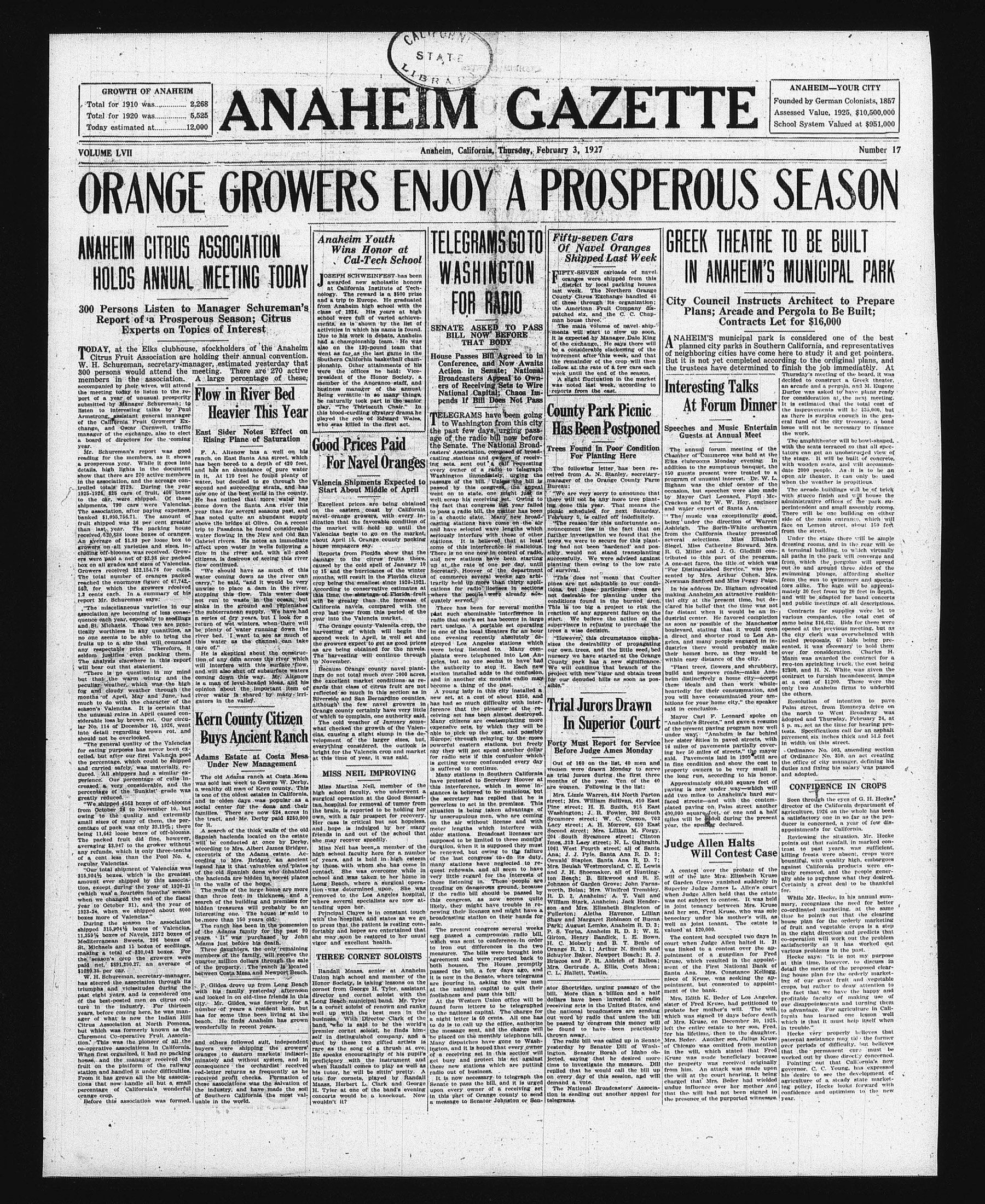
Searchable text
GROWTH OF ANAHEIM
Total for 1910 was... 2,268
Total for 1920 was... 5,525
Today estimated at...12,000
VOLUME LVII
ORANGE GROWERS
ANAHEIM CITRUS ASSOCIATION
HOLDS ANNUAL MEETING TODAY
300 Persons Listen to Manager Schureman's Report of a Prosperous Season; Citrus Experts on Topics of Interest
TODAY, at the Elks clubhouse, stockholders of the Anaheim Citrus Fruit Association are holding their annual convention. W. H. Schureman, secretary-manager, estimated yesterday that 300 persons would attend the meeting. There are 270 active members in the association. A large percentage of these; accompanied by their wives, will attend the meeting today to listen to the report of a year of unusual prosperity submitted by Manager Schureman; to listen to interesting talks by Paul Armstrong, assistant general manager of the California Fruit Growers' Exchange, and Oscar Cornwell, traffic manager of the exchange, also to elect a board of directors for the coming year.
Flow in River Bed
Heavier This Year
East Sider Notes Effect on Rising Plane of Saturation
Citrus Fruit Association are holding their annual convention. W. H. Schureman, secretary-manager, estimated yesterday that 300 persons would attend the meeting. There are 270 active members in the association. A large percentage of these; accompanied by their wives, will attend the meeting today to listen to the report of a year of unusual prosperity submitted by Manager Schureman; to listen to interesting talks by Paul Armstrong, assistant general manager of the California Fruit Growers' Exchange, and Oscar Cornwell, traffic manager of the exchange, also to elect a board of directors for the coming year.
Mr. Schureman's report was good reading for the members, as it shows a prosperous year. While it goes into details, high lights in the document show that there are 270 active members in the association, and the acreage controlled totals 2729. During the year 1925-1926, $25 cars of fruit, 400 boxes to the car, were shipped. Of these shipments, 790 cars were Valenclas. The association, after paying expenses, banked $1,095,756.71. The amount of fruit shipped was 36 per cent greater than last year. The packing house received 520,828 loose boxes of oranges. An average of $1.89 per loose box to growers on all varieties and sizes, including off-blooms, was received. Growers were paid a net of $2.98 per packed box on all grades and sizes of Valenclas. Growers received $22,154.76 for culls. The total number of oranges packed reached the enormous figure of 67,742,563, for which the growers received 1.3 cents each. In a summary of his report Mr. Schureman says:
"The miscellaneous varieties in our association are becoming of less consequence each year, especially to seedlings and St. Michaels. Those two are practically worthless in any quantities, as no one seems to be able to bring the fruits up to a size that will command any respectable price. Therefore, it seldom justifies even packing them. The analysis elsewhere in this report will bear out that statement.
"There is no question in my mind but that the warm winter and the peculiar weather, which was the high fog and cloudy weather through the months of April, May and June, had much to do with the character of the season's Valenclas. It is certain that the unusual rains in April caused considerable loss by brown rot. Our circular No. 114 of December 10, 1926, went into detail regarding brown rot, and should not be overlooked.
"The general quality of the Valenclas for eating purposes has never been excelled, but after our first Valencla pool the percentage, which could be shipped and carried safely, was materially reduced. All shippers had a similar experience. Our percentage of culls increased a very considerable, and the percentage of the 'Sunkist' grade was greatly reduced.
"We shipped 4563 boxes of off-blooms from October 26 to November 10, but owing to the quality and extremely small sizes of many of them, the percentage of pack was only 39.19%; there being 11,642 loose boxes of off-blooms. The packed fruit did fine, however, averaging 3.947 to the grower without compensation."
Flow in River Bed Heavier This Year
East Sider Notes Effect on Rising Plane of Saturation
F. A. Altenow has a well on his ranch, on East Santa Ana street, which has been bored to a depth of 420 feet, and has an abundance of pure water in it. At 110 feet he found plenty of water, but decided to go through the second and succeeding strata, and has now one of the best wells in the county. He has noticed that more water has come down the Santa Ana river this year than for several seasons past, and has noted quite an abundant supply above the bridge at Olive. On a recent trip to Pasadena he found considerable water flowing in the New and Old San Gabriel rivers. He notes an immediate affect upon water in wells following a flow in the river and, with all good citizens, is desirous of seeing this river flow continued.
"We should have as much of this water coming down as the river can carry," he said, "and it would be very unwise to place a dam in the river, stopping this flow. This water does not run to waste in the ocean, but sinks in the ground and replenishes the subterranean supply. We have had a series of dry years, but I look for a return of wet winters, when there will be plenty of water running down the river bed. I want to see as much of this water as the channel can take care of."
He is skeptical about the construction of any dam across the river which will interfere with this surface flow, and will also shut off subsurface waters coming down this way. Mr. Altenow is a man of level-headed ideas, and his opinion about the important item of river water is shared by many irrigators in the valley.
Kern County Citizen Buys Ancient Ranch
Adams Estate at Costa Mesa Under New Management
The old Adams ranch at Costa Mesa was sold last week to George W. Derby, a wealthy oil man of Kern county. This is one of the oldest estates in California, and in olden days was popular as a social center for the dons and their families. There are now 524 acres in the tract, and Mr. Derby paid $250,000 for it.
A search of the thick walls of the old Sapnish hancenda located on the estate will be conducted at once by Derby, according to Mrs. Albert James Bridger.
Good Price For Naval
Valencia Shipment Start About Miles
Excellent prices on the eastern coast navel-orange grown dication that far from the market will Valencias begin to about April 15. Or house managers say.
Reports from Flood damage to the cold tide 15 and the hurricane months, will result in crop being the smallest According to conservation this time, will be greater than California navels, crop last year from year into the Valencian county harvesting of what second week in April the growers expect as are being obtained The harvesting will to November.
Because Orangeings do not total mills the excellent markards class of reflected so much Riverside and San although the few Orange county certs of which complains.
The cold weather what checked the glas causing a slight development of everything consider bright for the Valencian at this time of year.
MISS NEIL
Miss Martina Nigh high school faculty surgical operation at tan hospital for renal brain is reported own, with a fair price Her case is critical and hope is inducing friends in and out she may recover miss Miss Neil has been
Adams Estate at Costa Mesa Under New Management
The old Adams ranch at Costa Mesa was sold last week to George W. Derby, a wealthy oil man of Kern county. This is one of the oldest estates in California, and in older days was popular as a social center for the dons and their families. There are now 524 acres in the tract, and Mr. Derby paid $250,000 for it.
A search of the thick walls of the old Saphnia haclenda located on the estate will be conducted at once by Derby, according to Mrs. Albert James Bridger, executive of the Adams estate. According to Mrs. Bridger, an ancient legend has it that valuables and plates of the old Spanish dons who inhabited the haclenda are hidden in secret places in the walls of the home.
The walls of the large home are more than three feet in thickness, and a search of the building and premises for hidden treasures will probably be an interesting one. The house is said to be more than 150 years old.
The ranch has been in the possession of the Adams family for the past 90 years. It was purchased by John Adams just before his death.
Three daughters, the only remaining members of the family, will receive the quarter million dollars through the sale of the property. The ranch is located between Costa Mesa and Newport Beach.
P. Glidea drove up from Long Beach with his family yesterday afternoon and looked in on old-time friends in this city. Mr. Glidea, was formerly for a number of years a resident here, but has for some time been living at the beach. He finds Anaheim has grown wonderfully in recent years.
and others followed suit, independent buyers were shipping the growers' oranges to eastern markets indiscriminately and without system, and in consequence the orchardist received red-letter returns as frequently as he received profit checks. Formation of these associations was the salvation of the industry, and have made the soil of Southern California the most valuable in the world.
MISS NEIL
Miss Martina N., high school faculty, surgical operation at tan hospital for remission brain, is reported own, with a fair price. Her case is critical and hope is in friends in out she may recover sp.
Miss Neil has been high school faculty of years, and is by those with whom contact. She was school and was taken Long Beach, where tion was determined removed to the La where several special tending upon her.
Principal Clayes with the hospital, to press that the pa fortably and hopes she may soon be re vigor and excellent.
THREE CORN
Randall Maass, Union high school Honor Society, is the corner from George director and corner Long Beach muncipal is a cornet soloist o well up with the business. With D band, who is said premier cornet soli self in distinguishe duet by these two rare as the song o He speaks encouraged proficiency with t when Randall comes his tutor, he will b trio for cornets, Maass, Herbert L., H. Tyler at one of concerts would be wouldn't it?
Anaheim, California, Thursday, February 3, 1927
WERS ENJOY A PROSPER
Anaheim Youth
Wins Honor at
Cal-Tech School
JOSEPH SCHWEINFEST has been awarded new scholastic honors at California Institute of Technology. The reward is a $500 prize and a trip to Europe. He graduated from Anaheim high school with the class of 1924. His years at high school were full of varied achievements, as is shown by the list of activities in which his name is found. Due to his work in debate, Anaheim had a championship team. He was also on the 130-pound team that went as far, as the last game in the Southern California basketball championship. Other attainments of his were the offices he held: Vice-president of the Honor Society, a member of the Anoranco staff, and business manager of the annual. Being versatile in so many things, he naturally took part in the senior play, "The Thirteenth Chair." In this blood-curdling nystagmus drama he played the role of Edward Wales, who was killed in the first act.
TELEGRAMS GOTO WASHINGTON FOR RADIO
SENATE ASKED TO PASS BILL NOW BEFORE THAT BODY
House Passes Bill Agreed to in Conference, and Now Awaits Action in Senate; National Broadcasters Appeal to Owners of Receiving Sets to Wire National Capital; Chaos Impends If Bill Does Not Pass
TELEGRAMS have been going to Washington from this city the past few days, urging passage of the radio bill now before the Senate. The National Broad-
Fifty-seven Cars Of Navel Oranges Shipped Last Week
FIFTY-SEVEN carloads of navel oranges were shipped from this district by local packing houses last week. The Northern Orange County Citrus Exchange handled 48 of these through its organization; the American Fruit Company dispatched six, and the C. C. Chapman house three.
The main volume of navel shipments will start to slow up soon, it is expected by Manager, Dale King of the exchange. He says there will be a considerable slackening of the movement after this week, and that the remainder of the crop will then follow at the rate of a few cars each week until the end of the season.
A slight fluctuation in the market was noted last week, according to reports from the east.
County Park Picnic Has Been Postponed
Trees Found in Poor Condition
Good Prices Paid For Navel Oranges
Valencia Shipments Expected to Start About Middle of April
Excellent prices are being obtained on the eastern coast by California navel-orange growers, with every indication that the favorable condition of the market will hold up until the Valencias begin to go on the market, about April 15. Orange county packing house managers say.
Reports from Florida show that the damage to the citrus fruits there caused by the cold spell of January 10 to 15 and the hurricanes of the winter months, will result in the Florida citrus crop being the smallest since 1920-1921. According to conservative estimates at this time, the shortage of Florida fruit will be greater than the increase of California navels, compared with the crop last year from this period of the year into the Valencia market.
The Orange county valencia-crop, the harvesting of which will begin the second week in April, is well set and the growers expect to get as good prices as are being obtained for the navels. The harvesting will continue through to November.
Because Orange county navel plantings do not total much over 2000 acres, the excellent market conditions as regards that class of citrus fruit are not reflected so much in this section as in Riverside and San Bernardino counties, although the few navel growers in Orange county certainly have very little of which to complain, one authority said.
The cold weather of January somewhat checked the growth of the Valencias, causing a slight slump in the development of the larger sizes, but everything considered, the outlook is bright for the Valencia crop and market at this time of year, it was said.
MISS NEIL IMPROVING
Miss Martina Neil, member of the high school faculty, who underwent a surgical operation at the Good Samaritan hospital for removal of tumor from the brain, is reported to be holding her own, with a fair prospect for recovery. Her case is critical but not hopeless, and hope is indulged by her many friends in and out of the school that she may recover speedily.
Miss Neil has been a member of the House Passes Bill Agreed to in Conference, and Now Awaits Action in Senate; National Broadcasters Appeal to Owners of Receiving Sets to Wire National Capital; Chaos Impends If Bill Does Not Pass TELEGRAMS have been going to Washington from this city past few days, urging passage of the radio bill now before the Senate. The National Broadcasters Association, composed of broadcast stations and owners of receiving sets, sent out a call requesting every owner of a radio to telegraph Washington immediately, urging the passage of the bill. Unless the bill is passed by this congress, the appeal went on to state, one might just as well scrap his receiving set. Owing to the fact that congress last year failed to pass a radio bill, the matter has been in a chaotic state. Many new broadcast stations have come on the air and have selected wave lengths which seriously interfere with those of other stations. It is believed that at least some of this interference is malicious. There is no one now in control of radio, and new stations have been starting up at the rate of one per day, until Secretary Hoover of the department of commerce several weeks ago arbitrarily held up more than thirty applications for radio licenses in sections where the people were already adequately served.
There has been for several months past such abominable interference in radio that one's set has become in large part useless. A portable set operating in one of the local treaters for an hour one evening recently absolutely destroyed Los Angeles stations which were being listened to. Many complaints were telephoned into Los Angeles, but no one seems to have had the authority to stop it. Each new station installed adds to the confusion, and in another six months radio may become a thing of the past.
A young lady in this city installed a new set, at a cost of about $350, and has had so much difficulty with interference that the pleasure of the receiving set has been almost destroyed. Many citizens are contemplating more expensive sets, by which they will be able to pick up the east, and possibly Europe, through relaying by the more powerful eastern stations, but freely say they will not spend another dollar for radio sets if this confusion which is getting worse confounded every day is suffered to continue.
Many stations in Southern California have protested to Secretary Hoover at this interference, which in some instances is believed to be malicious, but the secretary has replied that he is powerless to act in the premises. This situation is being taken advantage of by unscrupulous men, who are coming on the air without license and with meter lengths which interfere with older stations. Broadcast licenses are supposed to be limited to three months' duration, when it is supposed they must move on their fellows.
County Park Picnic Has Been Postponed
Trees Found in Poor Condition For Planting Here
The following letter has been received from A. N. Stanley, secretary-manager of the Orange County Farm Bureau:
"We are very sorry to announce that there will not be any more tree planting done this year. That means the picnic scheduled for next Saturday, February 5, is called off indefinitely."
"The reason for this unfortunate announcement lies in the fact that on further investigation we found that the trees we were to secure for this planting had not been 'hardened' and possibly would not stand transplanting successfully. We were advised against planting them owing to the low rate of survival."
"This does not mean that Coulter pines are not adaptable to our conditions, but these particular trees are not desirable for planting under the conditions found in the burned area. This is too big a project to risk the reaction of any apparent failure on the start. We believe the action of the supervisors in refusing to purchase the trees a wise decision."
"However, this circumstance emphasizes the desirability of propagating our own trees, and the little seed bed nursery we have started at the Orange County park has a new significance. We will continue that branch of the project with new vigor and obtain trees for our denuded hills as soon as possible."
Trial Jurors Drawn In Superior Court
Forty Must Report for Service Before Judge Ames Monday
Out of 160 on the list, 40 men and women were drawn Monday to serve as trial jurors during the first three months of the year. Ten of the 40 are women. Following is the list:
Mrs. Lizzie Warren, 814 North Parton street; Mrs. William Sullivan, 410 East Pine street; H. E. Smith, 915 East Washington; J. R. Fowler, 302 South Sycamore street; W. C. Corson, 703 Lacy street; A. H. Morrow, 610 East Second street; Mrs. Lillian M. Forker, 204 South Sycamore street; Clinton Imes, 213 Lacy street; N. L. Galbraith, 1061 West Fourth street; all of Santa Judge
MISS NEIL IMPROVING
Miss Martina Neil, member of the high school faculty, who underwent a surgical operation at the Good Samaritan hospital for removal of tumor from the brain, is reported to be holding her own, with a fair prospect for recovery. Her case is critical but not hopeless, and hope is indulged by her many friends in and out of the school that she may recover speedily.
Miss Neil has been a member of the high school faculty here for a number of years, and is held in high esteem by those, with whom she has come in contact. She was overcome while in school and was taken to her home in Long Beach, where a surgical operation was determined upon. She was removed to the Los Angeles hospital, where several specialists are now attending upon her.
Principal Clayes is in constant touch with the hospital, and states as we go to press that the patient is resting comfortably and hopes are entertained that she may soon be restored to her usual vigor and excellent health.
THREE CORNET SOLOISTS
Randall Maass, senior at Anaheim Union high school and member of the Honor Society, is taking lessons on the cornet from George H. Tyler, assistant director and cornet soloist with the Long Beach municipal band. Mr. Tyler is a cornet soloist of renown and ranks well up with the best men in the business. With Director Clark of the band, who is said to be the world's premier cornet soloist, he finds himself in distinguished company, and a duet by these two gifted artists is rare as the song of a thrush at eve. He speaks encouragingly of his pupil's proficiency with the instrument and when Randall comes to play as well as his tutor, he will be sittin' pretty. A trio for cornets, played by Randall Maass, Herbert L. Clark and George H. Tyler at one of the band's evening concerts would be a knockout. Now wouldn't it?
Many stations in Southern California have protested to Secretary Hoover at this interference, which in some instances is believed to be malicious, but the secretary has replied that he is powerless to act in the premises. This situation is being taken advantage of by unscrupulous men, who are coming on the air without license and with meter lengths which interfere with older stations. Broadcast licenses are supposed to be limited to three months' duration, when it is supposed they must be renewed, but owing to the failure of the last congress to do its duty, many stations have neglected to request renewals, and all seem to have very little regard for the interests of those listening in. These people are treading on dangerous ground, because if the radio bill should be passed by this congress, as now seems quite likely, they might have trouble in renewing their licenses and might have a broadcast station on their hands for sale.
The present congress several weeks ago passed a compromise radio bill, which was sent to conference. In order to iron out differences in the two measures. The bills were brought into agreement and were reported back to both houses. The House promptly passed the bill, a few days ago, and it is now in the Senate, where telegrams are pouring in, asking the wise men at the national capital to quit their foolishness and pass this bill!
At the Western Union office will be found form letters to be telegraphed to the national capital. The charge for a night letter is 60 cents. All one has to do is to call up the office, authorize the message sent, and the charge will be placed on the monthly telephone bill. Many dispatches have gone to Washington, and it is hoped that every owner of a receiving set in this section will get busy and protect his set against these new stations which are putting radio out of business.
It is now necessary to telegraph the Senate to pass the bill, and it is urged upon every owner of a receiving set in this part of Orange county to send a message to Senator Johnston or Senator Shortridge, urging passage of the bill. More than a billion and a half dollars have been invested. Radio receiving sets in the United States, and the national broadcasters are sending out word by radio that unless the bill be passed by congress this money will be found to have been practically thrown away.
The radio bill was called up in Senate yesterday by Senator Dill of Washington. Senator Borah of Idaho objected, saying that he desired more time to investigate the measure. Dill replied that he would call the bill up on every day of this session, and will demand a vote.
The National Broadcasters' Association is sending out another appeal for telegrams.
L Mrs. Lizzie Warren, 814 North Parton street; Mrs. William Sullivan, 410 East Pine street; H. E. Smith, 915 East Washington; J. R. Fowler, 302 South Sycamore street; W. C. Corson, 703 Lacy street; A. H. Morrow, 610 East Second street; Mrs. Lillian M. Forgy, 204 South Sycamore street; Clinton Imes, 213 Lacy street; N. L. Galbraith, 1061 West Fourth street; all of Santa Ana; J. J. Pyle, Santa Ana R. D. 3; Oswald Staples, Santa Ana R. D. 7; Beaulah Westmorland, C. E. Lewis and J. H. Shoemaker, all of Huntington Beach; B. Silkwood and R. E. Johnson of Garden Grove; John Farnsworth, Bolsa; Mrs. Winifred Trembley, R. D. 2, Anaheim; A. T. Vail and William Stark, Anaheim; Jack Henderson and Mrs. Elizabeth Singleton of Fullerton; Aletha Havenor, Lillian Shaw and Margaret Robinson of Buena Park; August Lemke, Anaheim R. D. 3; P. S. Yorba, Anaheim R. D. 3; W.E Girton, Henry Bandick, I. E.Bown, H.C.Moberly and B.T.Beale of Orange R.D.1; Arthur N.Smith and Schuyler Baker, Newport Beach; R.J.Briscoe and F.R.Aldrich of Balboa; Mrs.Gertrude A.Ellis,Costa Mesa; C.L.Hallett,Tustin.
A contender will win of Garden Juvenile Superior Jurge when Judge was not suited in Joint tenure and her son beneclary well as joy valued at $5.
The contender court when was linked punishment Kruse, whencement of Santa Anna niece of Kpointment of Mrs.Edit sister of Fry probate here which was of Mrs.Kruse entitlement for his life.
Mrs.Beder of Chicago in the will Kruse was proper from him, the will at charged undue influence that the wille present said.
Pave in fine condition property over the long term.
Approximately paving is made two mason faced streets plated pavement 400,000 squares miles will be year,the se
ANAHEIM—YOUR CITY
Founded by German Colonists, 1857
Assessed Value, 1925, $10,500,000
School System Valued at $951,000
Number 17
SPEROUS SEASON
GREEK THEATRE TO BE BUILT IN ANAHEIM’S MUNIGIPAL PARK
City Council Instructs Architect to Prepare Plans; Arcade and Pergola to Be Built; Contracts Let for $16,000
ANAHEIM’S municipal park is considered one of the best planned city parks in Southern California, and representatives of neighboring cities have come here to study it and get pointers. But it is not yet completed according to the ordiginal plans, and the trustees have determined to finish the job immediately. At Thursday’s meeting of the board, it was decided to construct a Greek theater, an arcade and a pergola, and M. Eugene Durfee was asked to have plans ready for consideration at the next meeting. It is estimated that the total cost of the improvements will be $35,000, but as there is surplus enough in the general fund of the city treasury, a bond issue will not be necessary to finance the work.
Interesting Talks
At Forum Dinner
Speeches and Music Entertain Guests at Annual Meet
The amphitheater will be bowl-shaped, with the seats terraced so that all spec-
Interesting Talks At Forum Dinner
Speeches and Music Entertain Guests at Annual Meet
The annual forum meeting of the Chamber of Commerce was held at the Elks clubrooms Monday evening. In addition to the sumptuous banquet, the 150 guests present were treated to a program of unusual interest. Dr. W. L. Bigham was the chief orator of the occasion, but speeches were also made by Mayor Carl Leonard, Floyd McCracken and by W. W. Hoy, engineer and water expert of Santa Ana.
The music was exceptionally good, being under the direction of Warren Ashleigh. The Sorin-White orchestra from the California theater presented several selections. Miss Elizabeth Siegel, Miss Catherine Steward, Mrs. R. G. Miller and J. G. Gledhill contributed to this part of the program. A one-act farce, the title of which was "For Distinguished Service," was presented by Mrs. Arthur Cohen, Mrs. Newman Sanford and Miss Peggy Paige.
In his address Dr. Bigham advocated making Anaheim an attractive residential city at the present time, but declared his belief that the time was not far distant when it would be an industrial center. He favored completion as soon as possible of the Manchester boulevard, stating that it would open a direct and shorter road to Los Angeles, and many people engaged in industries there would probably make their homes here, as they would be within easy distance of the city.
"Plant trees, flowers and shrubbery, build and improve roads—make Anaheim distinctively a home city—accept these ideals and then work wholeheartedly for their consummation, and you will have consummated your ambitions for your home city," the speaker said in conclusion.
Mayor Carl F. Leonard spoke on "Anaheim's Streets," and gave a resume of the present paving program now well under way: "Anaheim is far behind her sister cities in paved streets, with 16 miles of pavements partially covering her 50 miles of streets," the mayor said. Pavements laid in 1909 still are in fine condition and show the cost to property owners to be very small in the long run, according to his honor.
Approximately 400,000 square feet of paving is now under way—which will add two miles to Anaheim's hard surfaced streets—and with the contemplated paving on Palm street another 400,000 square feet, or one and a half miles will be added during the present year, the speaker declared.
Thursday's meeting of the board, it was decided to construct a Greek theater, an arcade and a pergola, and M. Eugene Durfee was asked to have plans ready for consideration at the next meeting. It is estimated that the total cost of the improvements will be $35,000, but as there is surplus enough in the general fund of the city treasury, a bond issue will not be necessary to finance the work.
The amphitheater will be bowl-shaped, with the seats terraced so that all spectators can get an unobstructed view of the stage. It will be built of concrete, with wooden seats, and will accommodate 2000 people. As it is to be an open air theater, it can only be used when the weather is propitious.
The arcade buildings will be of brick with stucco finish and will house the administrative offices of the park superintendent and small assembly rooms. There will be one building on either side of the main entrance, which will face on Lemon street, about 150 feet from the street.
Under the stage there will be ample dressing rooms, and in the rear will be a terminal building, to which virtually all paths in the park will converge and from which the pergolas will spread out to and around three sides of the swimming plunge, affording shelter from the sun to swimmers and spectators alike. The sage will be approximately 30 feet front by 20 feet in depth, and will be adapted for band concerts and public meetings of all descriptions.
Contracts for supplies were let to various companies, the total cost of same being $16,432. Bids for these were opened at the previous meeting, but as the city clerk was overwhelmed with sealed proposals, 67 bids being presented, it was necessary to hold them over for consideration. Charles H. Mann was awarded the contract for a two-ton sprinkling truck, the cost being $2300, and H. N. White was given the contract to furnish incandescent lamps at a cost of $1200. These were the only two Anaheim firms to underbid the others.
Resolution of intention to pave Palm street, from Romneya drive on the north to West Broadway was adopted and Thursday, February 24, at S.p.m., set as the time for hearing protests. Specifications call for an asphalt pavement six inches thick and 51.5 feet in width on this street.
Ordinance No. 503, amending section of Ordinance No. 350, an act creating the office of city manager, defining his duties and fixing his salary was passed and adopted.
CONFIDENCE IN CROPS
Seen through the eyes of G. H. Hecke, director of the California department of agriculture, 1926 on the whole has been a satisfactory one in so far as the producer is concerned, a year of few disappointments for California.
Reviewing the situation, Mr. Hecke points out that rainfall, in marked contrast to past years, was sufficient.
Judge Allen Halts Will Contest Case
A contest over the probate of the will of the late Mrs. Elizabeth Kruse of Garden Grove vanished suddenly in Superior Judge James L. Allen's court when Judge Allen held that the estate was not subject to contest. It was held in joint tenancy between Mrs. Kruse and her son, Fred Kruse, who was sole beneficiary under his mother's will, as well as joint tenant. The estate is valued at $20,000.
The contest had occupied two days in court when Judge Allen halted it. It was linked to a contest over the appointment of a guardian for Fred Kruse, which resulted in the appointment of the First National Bank of Santa Ana. Mrs. Constance Kellogg, niece of Kruse, was seeking the appointment, but consented to appointment of the bank.
Mrs. Edith K. Beder of Los Angeles, sister of Fred Kruse, had petitioned to probate her mother's will. The will, which was signed 10 days before death of Mrs. Kruse, on December 30, 1925, left the entire estate to her son, Fred, for his lifetime, then to the daughter, Mrs. Beder. Another son, Julius Kruse of Chicago was omitted from mention in the will, which stated that Fred Kruse was made beneficiary because the property was received originally from him. An attack was made upon the will at the court hearing, it being charged that Mrs. Beder had wielded undue influence over her mother and that the will had not been signed in the presence of the purported witnesses.
CONFIDENCE IN CROPS
Seen through the eyes of G. H. Hecke, director of the California department of agriculture, 1926 on the whole has been a satisfactory one in so far as the producer is concerned, a year of few disappointments for California.
Reviewing the situation, Mr. Hecke points out that rainfall, in marked contrast to past years, was sufficient, killing frosts were absent, crops were bountiful, with quality high, embargoes against California products were entirely removed, and the people generally able to purchase what they desired. Certainly a great deal to be thankful for.
While Mr. Hecke, in his annual summary, recognizes the need for better co-ordinated marketing, at the same time he points out that the clearing house plan for the orderly marketing of fruit and vegetable crops is a step in the right direction and predicts that co-operation will work out the problem satisfactorily as it has worked out various problems in the past.
Hecke says: "It is not my purpose at this time, however, to discuss in detail the merits of the proposed clearing house plan for the orderly marketing of our great fruit and vegetable crops, but rather to draw attention to the fact that we have the happy and profitable faculty of making use of our disappointments and turning them to advantage. For agriculture in California has learned one lesson well which is that it must help itself when in trouble."
Hecke very properly believes that paternal assistance may tie the farmer over periods of difficulty, but believes that the permanent cure must be worked out by those directly concerned.
Pointing out that California's new governor, C. C. Young, has expressed his desire to see the development of agriculture of a steady state marketing policy, Hecke looks forward with confidence and optimism to the new year.