anaheim-gazette 1927-01-13
Scanned page
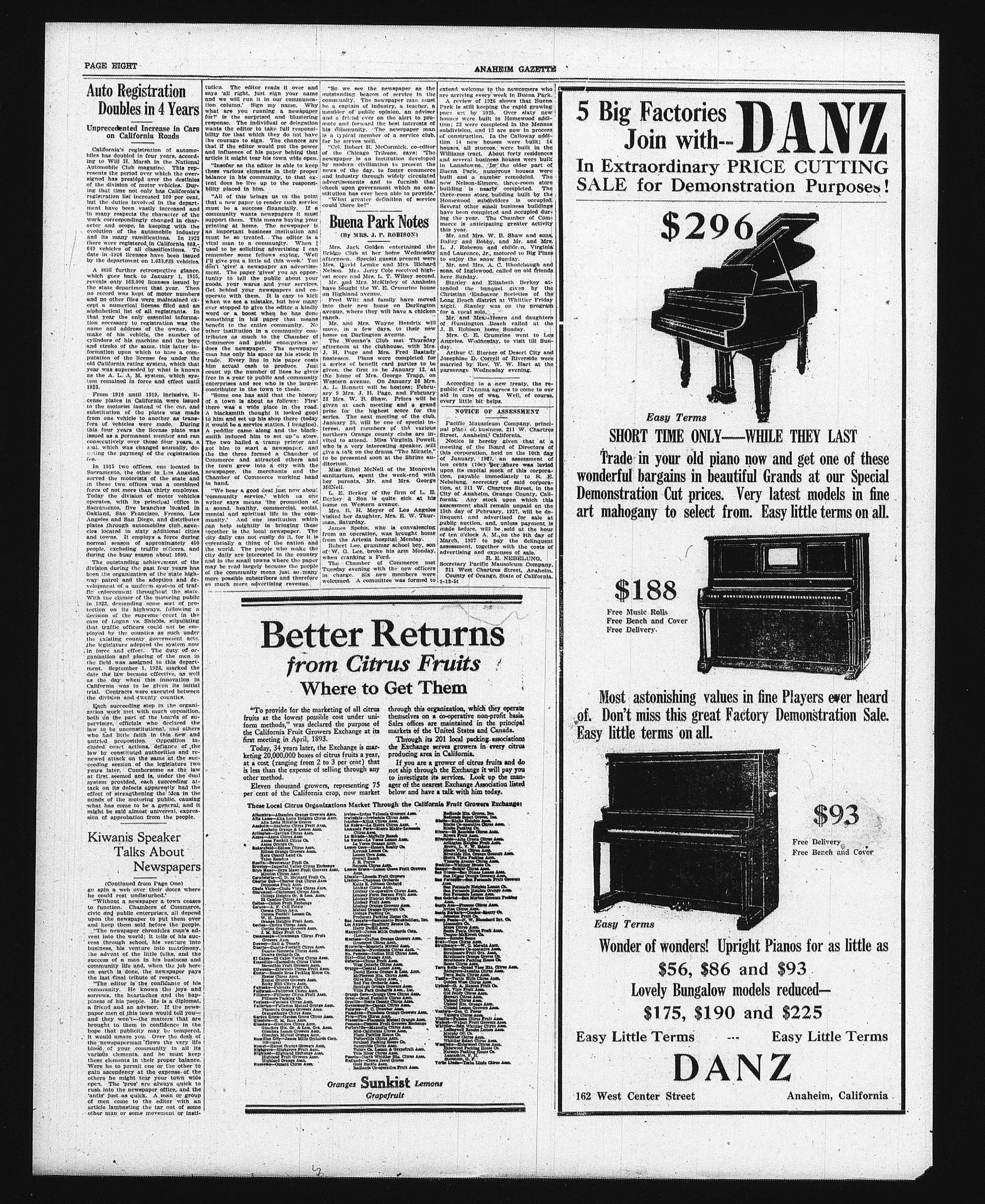
Searchable text
Auto Registration Doubles in 4 Years
Unprecedented Increase in Cars on California Roads
California's registration of automobiles has doubled in four years, according to Will H. Marsh in the National Automobile Club magazine. This represents the period over which the oversigned has presided over the destinies of the division of motor vehicles. During that time not only has California's registration list increased 100 per cent, but the duties involved in the department have been vastly increased and in many respects the character of the work correspondingly changed in character and scope, in keeping with the evolution of the automobile industry and its many ramifications. In 1922 there were registered in California 858,649 vehicles of all classifications. To date in 1926 licenses have been issued by the department on 1,633,638 vehicles.
A still further retrospective glance, which goes back to January 1, 1915, reveals only 163,000 licenses issued by the state department that year. Then no record was kept of motor numbers and no other files were maintained except a numerical license filed and an alphabetical list of all registrants. In that year the only essential information necessary to registration was the name and address of the owner, the make of his vehicle, the number of cylinders of his machine and the bore and stroke of the same, this latter information upon which to base a computation of the license fee under the old California rating system, which that year was superseded by what is known as the A. L. A. M. system, which system remained in force and effect until 1923.
From 1916 until 1919, inclusive, license plates in California were issued to the motorist instead of the car, and substitution of the plates was made from one vehicle to another as transfers of vehicles were made. During this four years the license plate was issued as a permanent number and ran consecutively over those four years, a seal, which was changed annually, detention. The editor reads it over and says 'all right, just sign your name and we will run it in our communication column.' Sign my name. Why what are you running a newspaper for? is the surprised and blustering response. The individual or delegation wants the editor to take full responsibility for that which they do not have the courage to sign. The chances are that if the editor would put the power and influence of his paper behind that article it might tear his town wide open.
"Insofar as the editor is able to keep these various elements in their proper balance in his community, to that extent does he live up to the responsibility placed in him.
'All of this brings us to the point that a new paper to render such service must be a success financially. If a community wants newspapers it must support them. This means buying your printing at home. The newspaper is an important business institution and must be so treated. The editor is a vital man to a community. When I used to be soliciting advertising I can remember some fellows saying, 'Well I'll give you a little ad this week.' You don't 'give' a newspaper an advertisement. The paper 'gives' you an opportunity to tell the public about your goods, your wares and your services. Get behind your newspapers and cooperate with them. It is easy to kick when we see a mistake, but how many ever stopped to give the editor a kindly word or a boost when he has done something in his paper that means benefit to the entire community. No other institution in a community contributes as much to the Chamber of Commerce and public enterprises as does the newspaper. The newspaper man has only his space as his stock in trade. Every line in his paper costs him actual cash to produce. Just count up the number of lines he gives free in a year to public and community enterprises and see who is the largest contributor in the town to these.
'Some one has said that the history of a town is about as follows: First there was a wide place in the road. A blacksmith thought it looked good to him and set up his shop there (today it would be a service station). I imagine). A peddler came along and the blacksmith induced him to set up a store. The two hailed a tramp printer and got him to start a newspaper, and'
"So we see outstanding best community. That be a captain of moulder of pub and a friend even move and forward his Community. It is a typical men for he serves well."
"Col. Robert B of the Chicago newspaper is at by modern civil news of the day and industry the advertisements check upon government situation has ever."
"What greater could there be?"
From 1916 until 1919, inclusive, license plates in California were issued to the motorist instead of the car, and substitution of the plates was made from one vehicle to another as transfers of vehicles were made. During this four years the license plate was issued as a permanent number and ran consecutively over those four years, a seal, which was changed annually, denoting the payment of the registration fee.
In 1915 two offices, one located in Sacramento, the other in Los Angeles, served the motorists of the state and in these two offices was a combined force of not more than thirty employees. Today the division of motor vehicles operates, with its principal office in Sacramento, five branches located in Oakland, San Francisco, Fresno, Los Angeles and San Diego, and distributes plates through automobiles club agencies located in sixty additional cities and towns. It employs a force during normal season of approximately 450 people, excluding traffic officers, and during the busy season about 1000.
The outstanding achievement of the division during the past four years has been the organization of the state highway patrol and the adoption and development of a uniform system of traffic enforcement throughout the state. With the clamor of the motoring public in 1923, demanding some sort of protection on its highways, following a decision of the supreme court in the case of Logan va. Shields, stipulating that traffic officers could not be employed by the counties as such under the existing county government acts, the legislature adopted the system now in force and effect. The duty of organization and placing of the men in the field was assigned to this department. September 1, 1923, marked the date the law became effective, as well as the day when this innovation in California was to be given its initial trial. Contracts were executed between the division and twenty counties.
Each succeeding step in the organization work met with much opposition, both on the part of the boards of supervisors, officials who declared the law to be unconstitutional, and others who had little faith in this new and untried proposition. Opposition included court actions, defiance of the law by constituted authorities and renewed attack on the same at the succeeding session of the legislature two years later. Cumbersome as the law at first seemed and is, under the dual system provided, each succeeding attack on its defects apparently had the effect of strengthening the idea in the minds of the motoring public, causing what has come to be a general, and it might be said almost universal, expression of approbation from the people.
Kiwanis Speaker
Tells About
Better from City Where t
"To provide for the marketing of all citrus fruits at the lowest possible cost under form methods," was declared the purpose of the California Fruit Growers Exchange a first meeting in April, 1893.
Today, 34 years later, the Exchange is making 20,000,000 boxes of citrus fruits a year at a cost (ranging from 2 to 3 per cent) is less than the expense of selling through other method.
Eleven thousand growers, representing per cent of the California crop, now make
Kiwanis Speaker Talks About Newspapers
(Continued from Page One)
go spin a web over their doors where he could rest undisturbed.
"Without a newspaper a town ceases to function. Chambers of Commerce, civic and public enterprises, all depend upon the newspaper to put them over and keep them sold before the people.
"The newspaper chronicles man's advent into the world; it tells of his success through school, his venture into business, his venture into matrimony, the advent of the little folks, and the success of a man in his business and community life and, when the job here on earth is done, the newspaper pays the last final tribute of respect.
"The editor is the confidante of his community. He knows the joys and sorrows, the heartaches and the happiness of his people. He is a diplomat, a friend and an advisor. If the newspaper men of this town would tell you—and they won't—the matters that are brought to them in confidence in the hope that publicity may be tempered, it would amaze you. Over the desk of the newspaperman flows the very life blood of your community in all its various elements, and he must keep these elements in their proper balance. Were he to permit one or the other to gain ascendency at the expense of the others he might tear your town wide open. The 'pros' are always quick to rush into the newspaper office, and the 'antis' just as quick. A man or group of men come to the editor with an article lambasting the tar out of some other man or some movement or insti-
ANAHEIM GAZETTE
"So we see the newspaper as the outstanding beacon of service in the community. The newspaper man must be a captain of industry, a teacher, a moulder of public opinion, an adviser and a friend ever on the alert to promote and forward the best interests of his Community. The newspaper man is a typical member of a service club, for he serves well.
"Col. Robert R. McCormick, co-editor of the Chicago Tribune, says: The newspaper is an institution developed by modern civilization to present the news of the day, to foster commerce and industry through widely circulated advertisements and to furnish that check upon government which no constitution has ever been able to provide."
"What greater definition of service could there be?"
Buena Park Notes
(By MRS. J. P. ROBISON)
Mrs. Jack Golden entertained the Bridge Club at her home Wednesday afternoon. Special guests present were Mrs. David Lemke and Mrs. Richard Nelson. Mrs. Jerry Cole received highest score and Mrs. L. T. Wilsey second. Mr. and Mrs. McKinley of Anaheim have bought the W. E. Crumrine house on Highland avenue. Fred Witt and family have moved into their new home on Darlington avenue, where they will have a chicken ranch.
Mr. and Mrs. Wayne Hendrix will move, in a few days, to their new home on Darlington avenue.
The Woman's Club met Thursday afternoon at the clubhouse, with Mrs. J. H. Page and Mrs. Fred Bastady hostesses. Plans were completed for a series of benefit card parties to be given, the first to be January 12, at the home of Mrs. George Trapp, on Western avenue. On January 26 Mrs. A. L. Bennett will be hostess; February 9 Mrs. J. H. Page, and February 23 Mrs. W. B. Shaw. Prizes will be given at each meeting and a grand prize for the highest score for the series. The next meeting of the club, January 20, will be one of special interest, and members of the various northern Orange county clubs are invited to attend. Miss Virginia Powell, who is a very interesting speaker, will extend welcome to the newcomers who are arriving every week in Buena Park.
A review of 1925 shows that Buena Park is still keeping the rapid growing pace set by 1925. Over sixty new houses were built in Homewood addition; 22 were completed in the Mennes subdivision, and 13 are now in process of construction. In the Calloway addition 14 new houses were built; 14 houses, all stucco, were built in the Williams tract. About forty residences and several business houses were built in Lansdowne. In the older part of Buena Park, numerous houses were built and a number remodeled. The new Nelson-Elmore, three-room store building is nearly completed. The three-room store building built by the Homewood subdividers is occupied. Several other small business buildings have been completed and occupied during the year. The Chamber of Commerce is anticipating greater activity this year.
Mr. and Mrs. W. B. Shaw and sons, Bailey and Bobby, and Mr. and Mrs. L. J. Robeson and children, Virginia and Laurence, Jr., motored to Big Pines to enjoy the snow Sunday.
Mr. and Mrs. A. C. Rhodebaugh and sons, of Inglewood, called on old friends here Sunday.
Stanley and Elizabeth Berkey attended the banquet given by the Christian Endeavor Societies of the Long Beach district at Whittier Friday night. Stanley was on the program for a vocal solo.
Mr. and Mrs.-Hearn and daughters of Huntington Beach called at the J. B. Robison home Sunday.
Mrs. C. E. Crumrine went to Los Angeles, Wednesday, to visit till Sunday.
Arthur C. Sterner of Desert City and Josephine D. Correll of Riverside were married by Rev. W. W. Hart at the parsonage Wednesday evening.
According to a new treaty, the republic of Panama agrees to come to our aid in case of war. Well, of course, every little bit helps.
NOTICE OF ASSESSMENT
Pacific Mausoleum Company, principal place of business, 211 W. Chartres Street, Anaheim, California.
Notice is hereby given that at a meeting of the Board of Directors of
Now about as one motion of the social, the common which using these paper. The t. for it is nation and make the country the paper the people so many therefore revenue.
Plans were completed for a series of benefit card parties to be given the first to be January 12, at the home of Mrs. George Trapp, on Western avenue. On January 26 Mrs. A. L. Bennett will be hostess; February 9 Mrs. J. H. Page, and February 23 Mrs. W. B. Shaw. Prizes will be given at each meeting and a grand prize for the highest score for the series. The next meeting of the club, January 20, will be one of special interest, and members of the various northern Orange county clubs are invited to attend. Miss Virginia Powell, who is a very interesting speaker, will give a talk on the drama "The Miracle," to be presented soon at the Shrine auditorium.
Miss Ethel McNeil of the Monrovia sanitarium, spent the week-end with her parents, Mr. and Mrs. George McNeil.
L. E. Berkey of the firm of L. E. Berkey & Son is quite sick at his home on Western avenue.
Mrs. R. H. Meyer of Los Angeles visited her daughter, Mrs. E. W. Thurman, Saturday.
James Spohn, who is convalescing from an operation, was brought home from the Artesia hospital Monday.
Robert Lee, grammar school boy, son of W. G. Lee, broke his arm Monday, when cranking a Ford.
The Chamber of Commerce met Tuesday evening with the new officers in charge. Six new members were welcomed. A committee was formed to through this organization, which they operate themselves on a co-operative non-profit basis. Sales offices are maintained in the principal markets of the United States and Canada.
Through its 201 local packing associations the Exchange serves growers in every citrus producing area in California.
If you are a grower of citrus fruits and do not ship through the Exchange it will pay you to investigate its services. Look up the manager of the nearest Exchange Association listed below and have a talk with him today.
Citrus Organizations Market Through the California Fruit Growers Exchange:
Josephine D. Correll of Riverside were married by Rev. W. W. Hart at the parsonage Wednesday evening.
According to a new treaty, the republic of Panama agrees to come to our aid in case of war. Well, of course, every little bit helps.
NOTICE OF ASSESSMENT
Pacific Mausoleum Company, principal place of business, 211 W. Chartres Street, Anaheim, California.
Notice is hereby given that at a meeting of the Board of Directors of this corporation, held on the 10th day of January, 1927, an assessment of ten cents (10c) per share was levied upon its capital stock of this corporation, payable immediately to R. E. Nebelung, secretary of said corporation, at 211 W. Chartres Street, in the City of Anaheim, Orange County, California.
Any stock upon which this assessment shall remain unpaid on the 15th day of February, 1927, will be delinquent and advertised for sale at public auction, and, unless payment is made before, will be sold at the hour of ten o'clock A.M., on the 8th day of March, 1927 to pay the delinquent assessment, together with the costs of advertising and expenses of sale.
R. E. NEBELUNG,
Secretary Pacific Mausoleum Company,
211 West Chartres Street, Anaheim.
County of Orange, State of California.
1-13-5t
$188
Free Music Rolls
Free Bench and Cover
Free Delivery.
Most astonishing of. Don't miss this g
Easy little terms on
If you are a grower of citrus fruits and do not ship through the Exchange it will pay you to investigate its services. Look up the manager of the nearest Exchange Association listed below and have a talk with him today.
Oranges Sunkist Lemons Grapefruit
Easy Terms
Wonder of wonder
$56,
Lovely Bung
$175,
Easy Little Terms
162 West Center Street
Big Factories Join with-- DANZ
extraordinary PRICE CUTTING
E for Demonstration Purposes!
$296
Easy Terms
HORT TIME ONLY—WHILE THEY LAST
Easy Terms
SHORT TIME ONLY—WHILE THEY LAST
made in your old piano now and get one of these
fewful bargains in beautiful Grands at our Special
stration Cut prices. Very latest models in fine
hogany to select from. Easy little terms on all.
$188
Free Music Rolls
Free Bench and Cover
Free Delivery.
Most astonishing values in fine Players ever heard
don’t miss this great Factory Demonstration Sale.
Little terms on all.
$93
Free Delivery
$93
Free Delivery
Free Bench and Cover
Wonder of wonders! Upright Pianos for as little as
$56, $86 and $93
Lovely Bungalow models reduced—
$175, $190 and $225
Little Terms --- Easy Little Terms
DANZ
t Center Street Anaheim, California