anaheim-gazette 1927-01-13
Scanned page
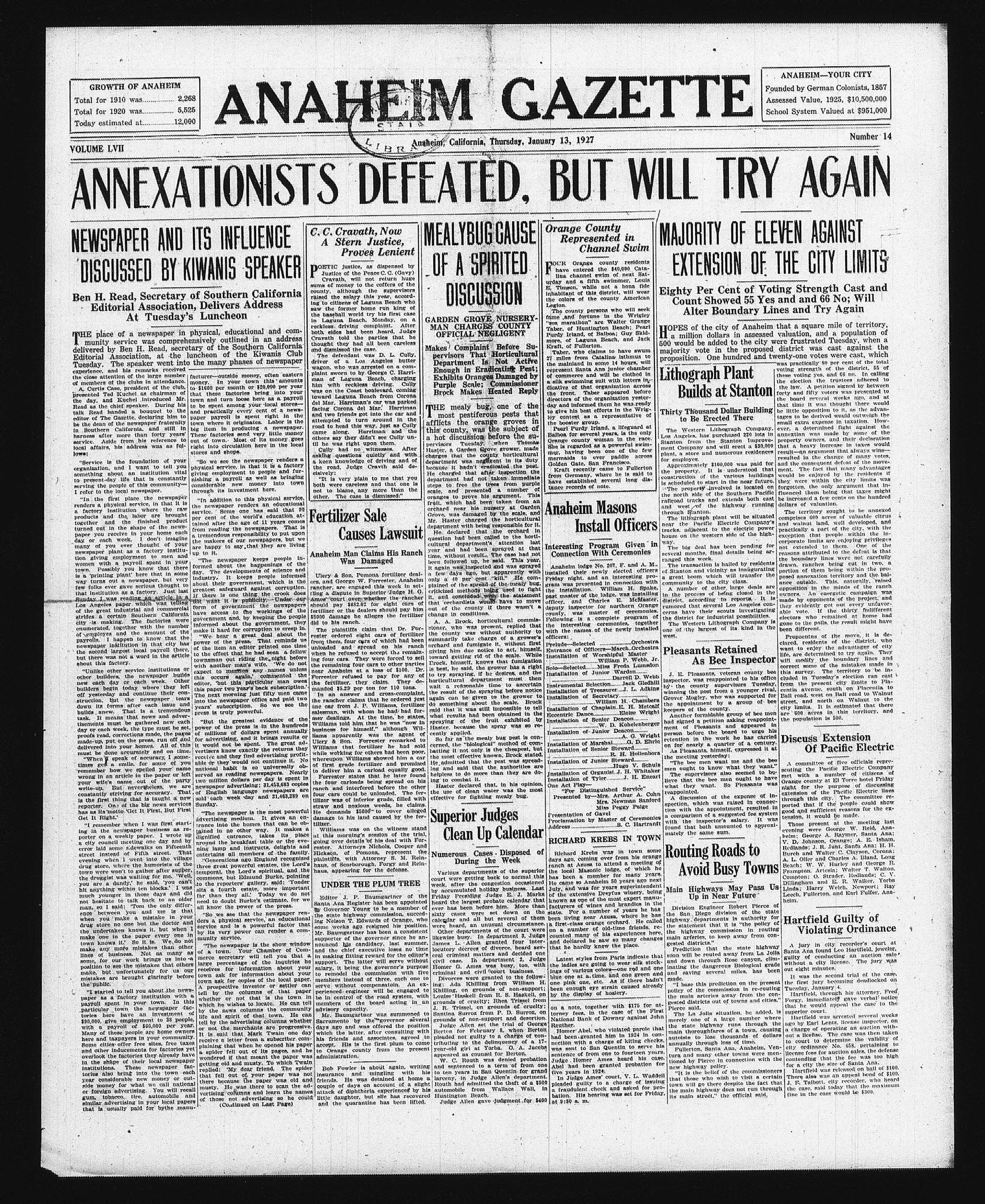
Searchable text
GROWTH OF ANAHEIM
Total for 1910 was... 2,268
Total for 1920 was... 5,525
Today estimated at... 12,000
VOLUME LVII
ANNEXATIONISTS D
NEWSPAPER AND ITS INFLUENCE
DISCUSSED BY KIWANIS SPEAKER
Ben H. Read, Secretary of Southern California
Editorial Association, Delivers Address
At Tuesday’s Luncheon
THE place of a newspaper in physical, educational and community service was comprehensively outlined in an address
delivered by Ben H. Read, secretary of the Southern California
Editorial Association, at the luncheon of the Kiwanis Club
Tuesday. The speaker went into the many phases of newspaper
experience, and his remarks received
the close attention of the large number
of members of the clubs in attendance.
A. Curtis Case, president of the club,
presented Ted Kuchel as chairman of
the day, and Kuchel introduced Mr.
Read as the chief speaker. During his
talk Read handed a bouquet to the
editor of The Gazette, declaring him to
be the dean of the newspaper fraternity
in Southern California, and still in
harness after more than forty years’
service. Aside from his reference to
local affairs, his address was as folfacturer—outside money, often eastern
money. In your town this amounts
to $1600 per month or $20,000 per year
that these factories bring into your
town and turn loose here as a payroll
to be spent among your local stores—
and practically every cent of a newspaper payroll is spent right in the
town where it originates. Labor is the
big item in producing a newspaper.
These factories send very little money
out of town. Most of its money goes
right into circulation here in the local
"Service is the foundation of your organization, and I want to tell you something about an institution vital to present-day life that is constantly serving the people of this community—I refer to the local newspaper.
In the first place the newspaper renders a physical service, in that it is a factory institution where the raw products and the labor are brought together and the finished product turned out in the shape of the newspaper you receive in your home each day or each week. I don't imagine many of you ever thought of your newspaper plant as a factory institution giving employment to men and women with a payroll spent in your town. Possibly you know that there is a 'printing plant' here that in some way turns out a newspaper, but very few folks ever gave serious thought to that institution as a factory. Just last Sunday I was reading an article in a Los Angeles paper which was telling of the great industrial and commercial strides a certain Southern California city is making. The factories were enumerated, together with the number of employees and the amount of the payrolls. I happen to know that the newspaper institution in that city has the second largest local payroll there, but there was not a word in the article about this factory.
Unlike other service institutions or other builders, the newspaper builds new each day or each week. Other builders begin today where they left off yesterday and continue their construction, but the newspaper tears down its forms after each issue and builds anew. That is a tremendous task. It means that news and advertisements must be gathered new each day or each week, the type must be set, proofs read, corrections made, the pages made-up put on the press, run off and delivered into your homes. All of this must be done accurately and on time.
When I speak of accuracy, I sometimes get a smile, for some of you remember how we spelled your name wrong in an article in the paper or left your wife's name out of the party write-up. But nevertheless, we are constantly striving for accuracy. That is the first thing that is taught a new reporter. One of the big news services has as its motto 'Get It First, But First Get It Right.'
"I remember when I was first starting in the newspaper business as reporter on a weekly paper. I wrote up a city council meeting one day and by error laid some sidewalks on Fifteenth facturer—outside money, often eastern money. In your town this amounts to $1600 per month or $20,000 per year that these factories bring into your town and turn loose here as a payroll to be spent among your local stores—and practically every cent of a newspaper payroll is spent right in the town where it originates. Labor is the big item in producing a newspaper. These factories send very little money out of town. Most of its money goes right into circulation here in the local stores and shops.
"So we see the newspaper renders a physical service, in that it is a factory giving employment to people and furnishing a payroll as well as bringing considerable new money into town through its investment here.
In addition to this physical service, the newspaper renders an educational service. Some one has said that 90 per cent of the world's education attained after the age of 11 years comes from reading the newspapers. That is a tremendous responsibility to put upon the makers of our newspapers, but we are happy to say that they are living up to it.
The newspaper keeps people informed about the happenings of the day. The developments of science and industry. It keeps people informed about their government, which is the greatest safeguard against corruption. If there is one thing the crook does not want it is publicity. Under our form of government the newspapers have access to the workings of the government and, by keeping the people informed about the government, they make it hard for corruption to creep in.
We hear a great deal about the power of the press. That reminds us of the item an editor printed one time to effect that he had seen a fellow townman out riding the night before with another man's wife. We do not expect to mention any names unless this occurs again," commented the editor, "but this particular man owes this paper two year's back subscription." The next morning just fifty men came into the newspaper office and paid two years' subscription. So we see the press is truly powerful.
But the greatest evidence of the power of the press is in the hundreds of millions of dollars spent annually for advertising, and it brings results or it would not be spent. The great advertisers know exactly the returns they receive and they find advertising profitable or they would not continue it. No national habit is so universally observed as reading newspapers. Nearly two million dollars per day is spent in newspaper advertising; 31,453,683 copies of English language newspapers are sold each week day and 21,463,289 on Sunday.
"The newspaper is the most powerful advertising medium. It gives an entrance into the homes that can be obtained in no other way. It makes a dignified entrance, takes its place around the breakfast table or the evening lamp and instructs, delights and tills."
The defendant wakes up by a plaint sworn to by a man with recklessness on the Coast bending Laguna Beach del Mar. Harriman facing Corona del Mar and two friends got attempted to turn road to head this way came along. Harriots say they did til he was right up.
Cully had no asking questions of a keen knowledge of the road, Judge cisely:
"It is very plain both were careless not to blame any other. The case lays."
Fertilizer Supply Causes
Anaheim Man Club Was Day
Ulery & Son, Pommers, and George W., rancher, are engaged tilling a dispute in San Amos court over two fertilizers or the deal $5000 damage he had did to his ranch.
The plaintiffs clerestored eight from them four cars unloaded and sprenged when he refused to ing four cars. They remained four near Anaheim at a Forrester refused to the fertilizer, they manded $5.29 per tine.
In an answer to the rancher claims one car from J.P. Salesman, with whom mer dealings. At Williams told him his business for himself llamas apparently Ulery & Son. For Williams that ferry while working for ores whereupon William of first grade fertile to deliver him a car.
Forrester states that four carloads ranch and interfere four cars could be tiller was of inferior straw and noxious He demands $5000 damage to his land miller.
Williams was on at this morning's going over details wrester. Attorneys
"When I speak of accuracy, I sometimes get a smile, for some of you remember how we spelled your name wrong in an article in the paper or left your wife's name out of the party write-up. But nevertheless, we are constantly striving for accuracy. That is the first thing that is taught a new reporter. One of the big news services has as its motto 'Get It First, But First Get It Right.'
"I remember when I was first starting in the newspaper business as reporter on a weekly paper. I wrote up a city council meeting one day and by error laid some sidewalks on Fifteenth street instead of Fifth street. That evening when I went into the village drug store, where the humorists of the town were won't to gather after supper, the druggist was waiting for me. 'Well, you are a dandy,' he said, 'you can't hit anything within ten blocks.' I was much younger in those days and did not hesitate to talk back to an older man, so I said: 'Tom the only difference between you and me is that when you make a mistake in your drug store no one but the doctor and the undertaken knows it, but when I make one in the paper every one in town knows it.' So it is. We do not make any more mistakes than other lines of business. Not as many as some, for our work brings us into a position to see the mistakes that others make, but unfortunately for us our mistakes are brought glaringly before the public.
"I started to tell you about the newspaper as a factory institution with a payroll spent in your town. In this particular town the newspaper factories here have an investment of $90,000, give employment to 38 people, with a payroll of $60,000 per year. Many of these people are home owners here and taxpayers in your community. Some cities offer free sites, free taxes and other inducements for factories yet overlook the factories they already have in the shape of their local newspaper institutions. These newspaper factories also bring into the town each year considerable new money for what we call national or foreign advertising. You will recall gum, tobacco, tire, automobile and similar advertising in your local papers that is usually paid for bythe manu-"
"The newspaper is the most powerful advertising medium. It gives an entrance into the homes that can be obtained in no other way. It makes a dignified entrance, takes its place around the breakfast table or the evening lamp and instructs, delights and entertains all members of the family.
"Generations ago England recognized three great powerful estates, the Lord's temporal, the Lord's spiritual, and the commons, but Edmund Burke, pointing to the reporters' gallery, said: 'Yonder sits a fourth estate, more important far than they all.' Today we do not need to doubt Burke's estimate, for we all know the power of the press.
"So we see that the newspaper renders a physical service, an educational service and is a powerful factor that by its very power can render a community service.
"The newspaper is the show window of a town. Your Chamber of Commerce secretary will tell you that a large percentage of the inquiries he receives for information about your town ask for information about your town ask for copies of the local paper. A prospective investor or settler can tell by the columns of that paper whether or not that is the town in which he wishes to locate. He can tell by the advertising columns whether or not the merchants are progressive. It is said that Mark Twain one day receive a letter from a subscriber complaining that when he opened his paper a spider fell out of its pages, and he wondered if that meant the paper was getting old and musty. To which Twain replied: 'My dear friend. The spider that fell out of your paper was not there because the paper was old and musty. He was there to scan the advertising columns and learn the names of those not advertising so he could receive and they find advertising profitable or they would not continue it. No national habit is so universally observed as reading newspapers. Nearly two million dollars per day is spent in newspaper advertising; 31,453,683 copies of English language newspapers are sold each week day and 21,463,239 on Sunday.
"The newspaper is the most powerful advertising medium. It gives an entrance into the homes that can be obtained in no other way. It makes a dignified entrance, takes its place around the breakfast table or the evening lamp and instructs, delights and entertains all members of the family.
"Generations ago England recognized three great powerful estates, the Lord's temporal, the Lord's spiritual, and the commons, but Edmund Burke, pointing to the reporters' gallery, said: 'Yonder sits a fourth estate, more important far than they all.' Today we do not need to doubt Burke's estimate, for we all know the power of the press."
"So we see that the newspaper renders a physical service, an educational service and is a powerful factor that by its very power can render a community service.
"The newspaper is the show window of a town. Your Chamber of Commerce secretary will tell you that a large percentage of the inquiries he receives for information about your town ask for information about your town ask for copies of the local paper. A prospective investor or settler can tell by the columns of that paper whether or not that is the town in which he wishes to locate. He can tell by the advertising columns whether or not the merchants are progressive. It is said that Mark Twain one day receive a letter from a subscriber complaining that when he opened his paper a spider fell out of its pages, and he wondered if that meant the paper was getting old and musty. To which Twain replied: 'My dear friend. The spider that fell out of your paper was not there because the paper was old and musty. He was there to scan the advertising columns and learn the names of those not advertising so he could receive and they find advertising profitable or they would not continue it. No national habit is so universally observed as reading newspapers. Nearly two million dollars per day is spent in newspaper advertising; 31,453,683 copies of English language newspapers are sold each week day and 21,463,239 on Sunday."
"The newspaper is the most powerful advertising medium. It gives an entrance into the homes that can be obtained in no other way. It makes a dignified entrance, takes its place around the breakfast table or the evening lamp and instructs, delights and entertains all members of the family.
"Generations ago England recognized three great powerful estates, the Lord's temporal, the Lord's spiritual, and the commons, but Edmund Burke, pointing to the reporters' gallery, said: 'Yonder sits a fourth estate, more important far than they all.' Today we do not need to doubt Burke's estimate, for we all know the power of the press."
AHEIM GAZETTE
Anaheim, California, Thursday, January 13, 1927
STS DEFEATED, BUT WILL
C. C. Cravath, Now A Stern Justice, Proves Lenient
POETIC Justice, as dispensed by Justice of the Peace C. C. (Gavy) Cravath, will not return huge sums of money to the coffers of the county, although the supervisors raised the salary this year, according to citizens of Laguna Beach who saw the former home run king of the baseball world try his first case in Laguna Beach, Monday, on a reckless driving complaint. After both sides had been heard, Judge Cravath told the parties that he thought they had all been careless and dismissed the case.
The defendant was D. L. Cully, driver of a Los Angeles butter wagon, who was arrested on a complaint sworn to by George C. Harriman of Laguna Beach, charging him with reckless driving. Cully was on the Coast boulevard, coming toward Laguna Beach from Corona del Mar. Harriman's car was parked facing Corona del Mar, Harriman and two friends got into the car and attempted to turn around in the road to head this way. Just as Cully came along. Harriman and the others say they didn't see Cully until he was right upon them.
MEALYBUG CAUSE OF A SPIRITED DISCUSSION
GARDEN GROVE NURSERY-MAN CHARGES COUNTY OFFICIAL NEGLIGENT
Makes Complaint Before Supervisors That Horticultural Department Is Not Active Enough in Eradicating Pest; Exhibits Oranges Damaged by Purple Scale; Commissioner Brock Makes Heated Reply
THE mealy bug, one of the most pestiferous pests that afflicts the orange groves in this county, was the subject of a hot discussion before the supervisors Tuesday, when Thomas Hatcher, a Garden Grove grower made Orange County Represented in Channel Swim
FOUR Orange county residents have entered the $40,000 Catalina channel swim of next Saturday and a fifth swimmer, Louis E. Timson, while not a bona fide inhabitant of this district, will wear the colors of the county American Legion.
The county persons who will seek fame and fortune in the Wrigley "sea marathon" are Walter Grange Taber, of Huntington Beach; Pearl Purdy Ireland, of Balboa; Guy Skidmore, of Laguna Beach, and Jack Kraft, of Fullerton.
Taber, who claims to have swum 27 miles from Catalina isthmus to the mainland in some 14 hours, will represent Santa Ana Junior chamber of commerce and will be clothed in a silk swimming suit with letters indicative of that organization across the front. Taber appeared before directors of the organization yesterday and informed them he was ready to give his best efforts in the Wrigley contest as a representative of the booster group.
Pearl Purdy Ireland, a lifeguard at Balboa for several years, is the only Orange county woman in the race. She is regarded as a powerful swim-
Fertilizer Sale Causes Lawsuit
Anaheim Man Claims His Ranch Was Damaged
Ulery & Son, Pomona fertilizer dealers, and George W. Forrester, Anaheim rancher, are engaged this week in settling a dispute in Superior Judge H. G. Amos' court over whether the rancher should pay $682.02 for eight cars of fertilizer or the dealers should pay him $5000 damage he alleges the fertilizer did to his ranch.
The plaintiffs claim that Dr. Forrester ordered eight cars of fertilizer from them, four cars of which had been unloaded and spread on his ranch when he refused to accept the remaining four cars. They were forced to sell the remaining four cars to other parties near Anaheim at a loss of $100. Dr. Forrester refused to pay for any of the fertilizer, they claim. They demanded $5.29 per ton for 110 tons.
In an answer and cross-complaint, the rancher claims that he ordered just one car from J. P. Williams, fertilizer salesman, with whom he had had former dealings. At the time, he states, Williams told him that he was "now in business for himself," although Williams apparently was the agent of Ulery & Son. Forrester remarked to Williams that fertilizer he had sold while working for others had been poor, whereupon Williams showed him a car of first grade fertilizer and promised to deliver him a carload equally good. Forrester states that he later found the four carloads being spread on his ranch and interfered before the other four cars could be unloaded. The fertilizer was of inferior grade, filled with straw and noxious weeds, he claims. He demands $5000 to cover alleged damage to his land caused by the fertilizer.
Williams was on the witness stand at this morning's session of the trial, going over details of his deal with Forrester. Attorneys Nichols, Cooper and pervisors That Horticultural Department Is Not Active Enough in Eradicating Pest; Exhibits Oranges Damaged by Purple Scale; Commissioner Brock Makes Heated Reply
THE mealy bug, one of the most pestiferous pests that afflicts the orange groves in this county, was the subject of a hot discussion before the supervisors Tuesday, when Thomas Hasler, a Garden Grove grower, made charges that the county horticultural department was negligent in its duty because it hadn't eradicated the pest. He charged that after inspection the department had not taken immediate steps to free the trees from purple scale, and presented a number of oranges to prove his argument. This fruit, which had been taken from an orchard near his nursery at Garden Grove, was damaged by the scale, and Mr. Haster charged the horticultural department with being responsible for it.
He declared that the orchard in question had been called to the horticultural department's attention last year and had been sprayed at that time, without result. The case had not been followed up, he said. This year, it again was inspected and was sprayed a few days ago, but apparently with only a 40 percent "kill." He complained of the spread of the mealy bug, criticized methods being used to fight it, and concluded with the statement that orchardists would have to move out of the county if there wasn't a change in conditions.
A. A. Brock, horticultural commissioner, who was present, replied that the county was without authority to summarily take charge of a grower's orchard and fumigate it, without first giving him due notice to act, himself. Brock, himself, knows that fumigation is best, he said, the grower has a right to try spraying, if he desires, and the horticultural department must then wait a reasonable time to ascertain the result of the spraying before notice again can be given to the grower to do something about the scale. Brock said that it was still impossible to tell what results had been obtained in the spraying of the fruit exhibited by Haster, because the spray was so recently applied.
So far as the mealy bug pest is concerned, the "biological" method of combatting it not only is the cheapest, but the most effective known. Brock stated. He admitted that the pest was spreading and said that the authorities are helpless to do more than they are doing to combat it.
Haster declared that, in his opinion, the use of clean water was the most effective for fighting mealy bug.
Superior Judges Clean Up Calendar
J. E. Pleasan Inspector, wily by the winning Mogrover Appointment Keepers of Cervellus
RICHARD KREBS IN TOWN
whereupon Williams showed him a car of first grade fertilizer and promised to deliver him a carload equally good. Forrester states that he later found the four carloads being spread on his ranch and interfered before the other four cars could be unloaded. The fertilizer was of inferior grade, filled with straw and noxious weeds, he claims. He demands $5000 to cover alleged damage to his land caused by the fertilizer.
Williams was on the witness stand at this morning's session of the trial, going over details of his deal with Forrester. Attorneys Nichols, Cooper and Hickson, of Pomona, represent the plaintiffs, with Attorney S. M. Reinhaus, of Scarborough, Forgery and Reinhaus, appearing for the defense.
UNDER THE PLUM TREE
Editor J. P. Baumgartner of the Santa Ana Register has been appointed Governor Young to be a member of the state highway commission, succeeding Nelson T. Edwards of Orange, who some weeks ago resigned his position. Mr. Baumgartner has been a consistent supporter of the governor since he announced his candidacy, last summer, and the chief executive loses no time in making fitting reward for the editor's support. The latter will serve without salary, it being the governor's purpose to remodel the commission with five members instead of three, each one to serve without compensatoim. An experienced engineer will be engaged to be in control of the road system, with members of the board acting in an advisory capacity.
Mr. Baumgartner was summoned to Sacramento by the governor several days ago and was offered the position which the latter, after consulting with his friends and associates, agreed to accept. His is the first plum to come to Orange county from the present administration.
Bob Fowler is about again, writing insurance and mingling with his friends. He was detained at home a couple of days on account of a slight attack of diphtheria experiences by his little daughter, but she has recovered and the quarantine has been lifted.
Superior Judges Clean Up Calendar
Numerous Cases Disposed Of During the Week
Various departments of the superior court were getting back to normal this week, after the congestion occasioned by accumulated holiday business. Last Friday Presiding Judge E. J. Marks heard the largest probate calendar that ever has been before him. More than sixty cases were set down on the calendar and all but several of them were heard, an unusual circumstance. Other departments of the court were likewise busy. In department 3, Judge James L. Allen granted four interlocutory decrees of divorce, heard several criminal matters and decided one civil case. In department 2, Judge Homer G. Ames was busy, too, with criminal and civil court business.
Divorces were granted to the following: Ada Khilling from William H. Khilling, on grounds of non-support; Louise Haskell from R. S. Haskell, on grounds of cruelty; Rhea Trissel from J. R. Trissel, on grounds of cruelty; Santina Surroz from P. D. Surroz, on grounds of non-support and desertion.
Judge Allen set the trial of George Berton for February 8, when Berton pleaded not guilty to a charge of contributing to the delinquency of a 17-year-old girl at Yorba. O. A. Jacobs appeared as counsel for Berton.
W. C. Routh was denied probation and sentenced to a term of from one to ten years in San Quentin for grand larceny, in Judge Allen's department. Routh had admitted the theft of a $500 automobile from Wallace Wall, in Huntington Beach.
Judge Allen gave Judgment for $400
Installation of Junior Steward
Hugo V. Schulz
Installation of Organist J. H. Whitaker
Installation of Tyler
J. H. Enearl
One Act Play—
"For Distinguished Service"
Presented by—Mrs. Arthur A. Cohn
Mrs. Newman Sanford
Miss Peggy Palge
Presentation of Gavel
Proclamation by Master of Ceremonies
Address
S. C. Hartranft
RICHARD KREBS IN TOWN
Richard Krebs was in town some days ago, coming over from his orange ranch at Azusa to attend a meeting of the local Masonic lodge, of which he has been a member for many years. He came to Anaheim 50 years ago next July, and was for years superintendent of the extensive Dreyfus winery, being known as one of the most expert manufacturers of wines and brandles in the state. For a number of years he has been living near Azusa, where he has a first-class orange orchard. He called on a number of old-time friends, recounted many of his experiences here, and declared he saw so many changes that he hardly knew the place.
Latest styles from Paris indicate that the ladies are going to wear silk stockings of various colors—one red and one blue one at a time, and one green and one pink one, etc. As if there hadn't been enough eye strain caused already by the display of hosiery.
On a note, together with $175 for attorney fees, in the case of the First National Bank of Downey against John Reuther.
Homer Abel, who violated parole that had been granted him in 1924 in connection with a charge of kiting checks, was sent to San Quentin to serve his sentence of from one to fourteen years.
Judge Homer Ames heard his case. Abel had been granted probation for five years in 1924.
In Judge Ames' court, V. L. Waddell pleaded guilty to a charge of issuing a fraudulent check and asked for probation. His hearing was set for Friday, at 9:30 a.m.
ETTE
ANAHEIM—YOUR CITY
Founded by German Colonists, 1857
Assessed Value, 1925, $10,500,000
School System Valued at $951,000
Number 14
WILL TRY AGAIN
MAJORITY OF ELEVEN AGAINST EXTENSION OF THE CITY LIMITS
Eighty Per Cent of Voting Strength Cast and Count Showed 55 Yes and 66 No; Will Alter Boundary Lines and Try Again
HOPES of the city of Anaheim that a square mile of territory, a million dollars in assessed valuation, and a population of 500 would be added to the city were frustrated Tuesday, when a majority vote in the proposed district was cast against the proposition. One hundred and twenty-one votes were cast, which was practically 80 per cent of the total voting strength of the district, 55 of these voting yes, and 66 no. In calling the election the trustees adhered to the law. A petition signed by between forty and fifty voters was presented to the board several weeks ago, and at that time it was thought there would be little opposition to it, as the advantages to be derived would outweigh the small extra expense in taxation. However, a determined fight against the annexian was made by some of the property owners, and their declaration that a heavy increase in taxes would
Lithograph Plant Builds at Stanton
Thirty Thousand Dollar Building to Be Erected There
The Western Lithograph Company, Los Angeles, has purchased 220 lots in Stanton from the Stanton Improvement Company and will erect a $30,000 plant, a store and numerous residences for employees.
Approximately $100,000 was paid for the property. It is understood that construction of the various buildings is scheduled to start in the near future.
The property involved is located on the north side of the Southern Pacific railroad tracks and extends both east and west of the highway running through Stanton.
The lithograph plant will be situated near the Pacific Electric Company's tracks, adjacent to the electric power house on the western side of the highway.
The big deal has been pending for several months, final details being arranged this week.
The transaction is hailed by residents of Stanton and vicinity as inaugurating a great boom which will transfer the community to the city class.
A number of other large deals are in the process of being closed in the district, according to reports. It is rumored that several Los Angeles concerns have their scouts investigating the district for industrial possibilities.
The Western Lithograph Company is one of the largest of its kind in the west.
Pleasants Retained As Bee Inspector
J. E. Pleasants, veteran county bee inspector, was reappointed to his office by the county supervisors Tuesday, winning the post from a younger rival, Grover Mogley, who was supported for the appointment by a group of bee keepers of the county.
Another formidable group of bee men had signed a petition asking reappointment of Pleasants and appeared in person before the board to urge his retention in the work he has carried on for nearly a quarter of a century.
As Pleasants, himself, expressed it at the meeting yesterday:
"The bee men want me and the bee men ought to know what they want."
The supervisors also seemed to believe that the bee men ought to have what they want. So Pleasants was reappointed.
A discussion of the expense of inspection, which was raised in connection with the appointment, resulted in a comparison of a suggested fee system with the inspector's salary. It was found that both amounted to approximately the same sum.
Routing Roads to
The territory sought to be annexed comprises 600 acres of valuable citrus and walnut land, well developed, and practically a part of the city, with the exception that people within the corporate limits are enjoying privileges not extended to them. One of the reasons attributed to the defeat is that the boundary lines were not carefully drawn, ranches being cut in two, a portion of them being within the proposed annexation territory and the balance outside. This, naturally, raised opposition in the minds of the ranch owners. An energetic campaign was made by opponents of the project, and they evidently got out every unfavorable vote. If the thirty fadifferent electors who remained at home had gone to the polls, the result might have been different.
Proponents of the move, it is declared, residents of the district, who want to enjoy the advantages of city life, are determined to try again. They will modify the boundary lines and correct some of the mistakes made in this survey. The territory to be included in Tuesday's election ran east from the present city limits to Placentia avenue, south on Placentia to Ball road, west on Ball road to Walnut street, and north on Walnut to the city limits. It is estimated that there are 600 acres in this territory, and the population is 500.
Discuss Extension Of Pacific Electric
A committee of five officials representing the Pacific Electric Company met with a number of citizens of Orange county at El Torre hotel Friday night for the purpose of discussing extension of the Pacific Electric lines through this city. The committee reported that if the people could show good and sufficient reasons for the extension, it would be made.
Those present at the meeting last evening were George W. Reid, Anaheim; George A. Rayner, Santa Ana; V. D. Johnson, Orange; A. E. Isham, Redlands; J. R. Junt, Santa Ana; H. H.
Routing Roads to Avoid Busy Towns
Main Highways May Pass Us Up in Near Future
Division Engineer Robert Pierce of the San Diego division of the state highway departments is authority for the statement that it is "the policy of the highway commission in routing main arteries, to keep away from congested districts."
Prediction that the state highway soon will be routed away from La Jolla and down through Rose canyon, eliminating the dangerous Biological grade and saving several miles, has been made.
"I base this prediction on the present policy of the commission in re-routing the main arteries away from the congested districts out of towns and cities," Pierce said.
The La Jolla situation, he added, is merely one of a large number where the state highway runs through the main thoroughfares of a town, causing autoists to lose thousands of dollars annually through loss of time.
Fullerton, Santa Ana, Anaheim, Ventura and many other towns were mentioned by Pierce in connection with the new highway policy.
"It is the belief of the commissioners that those who wish to visit a certain town will go there despite the fact that the main highway does not run through its main street," the official said,
A committee of five officials representing the Pacific Electric Company met with a number of citizens of Orange county at El Torre hotel Friday night for the purpose of discussing extension of the Pacific Electric lines through this city. The committee reported that if the people could show good and sufficient reasons for the extension, it would be made.
Those present at the meeting last evening were George W. Reid, Anaheim; George A. Raymer, Santa Ana; V. D. Johnson, Orange; A. E. Isham, Redlands; J. R. Junt, Santa Ana; H. H. Burch and Walter C. Clayson, Corona; A. L. Ollier and Charles A. Bland, Long Beach; W. W. Hurley and George R. Frampton, Artesia; Walter T. Walton, Compton; O. Strader, Redlands; C. V. Dillingham and E. R. Walker, Yorba Linda; Harry Welch, Newport; Ray Leech, Fullerton, and Earl Fulfer, Anaheim.
Hartfield Guilty of Violating Ordinance
A jury in city recorder's court at Santa Ana found Leo Hartfield, jeweler, guilty of conducting an auction sale without a city license. The jury was out eight minutes.
It was the second trial of the case, the first jury becoming deadlocked on Tuesday, January 4.
Hartfield, through his attorney, Fred Forgy, immediately gave verbal notice that he would appeal the case to the superior court.
Hartfield was arrested several weeks ago by Earl Lentz, license inspector, on a charge of operating an auction without a license. The case was then taken to court to determine the validity of city ordinance No. 658, pertaining to license fees for auction sales, the defense contending that the fee was too high for a city size of Santa Ana.
Hartfield was released on bail of $100. There also was an appeal bond of $100. J. F. Talbott, city recorder, who heard the case, said today that the maximum fine in the case would be $300.