anaheim-gazette 1926-09-23
Scanned page
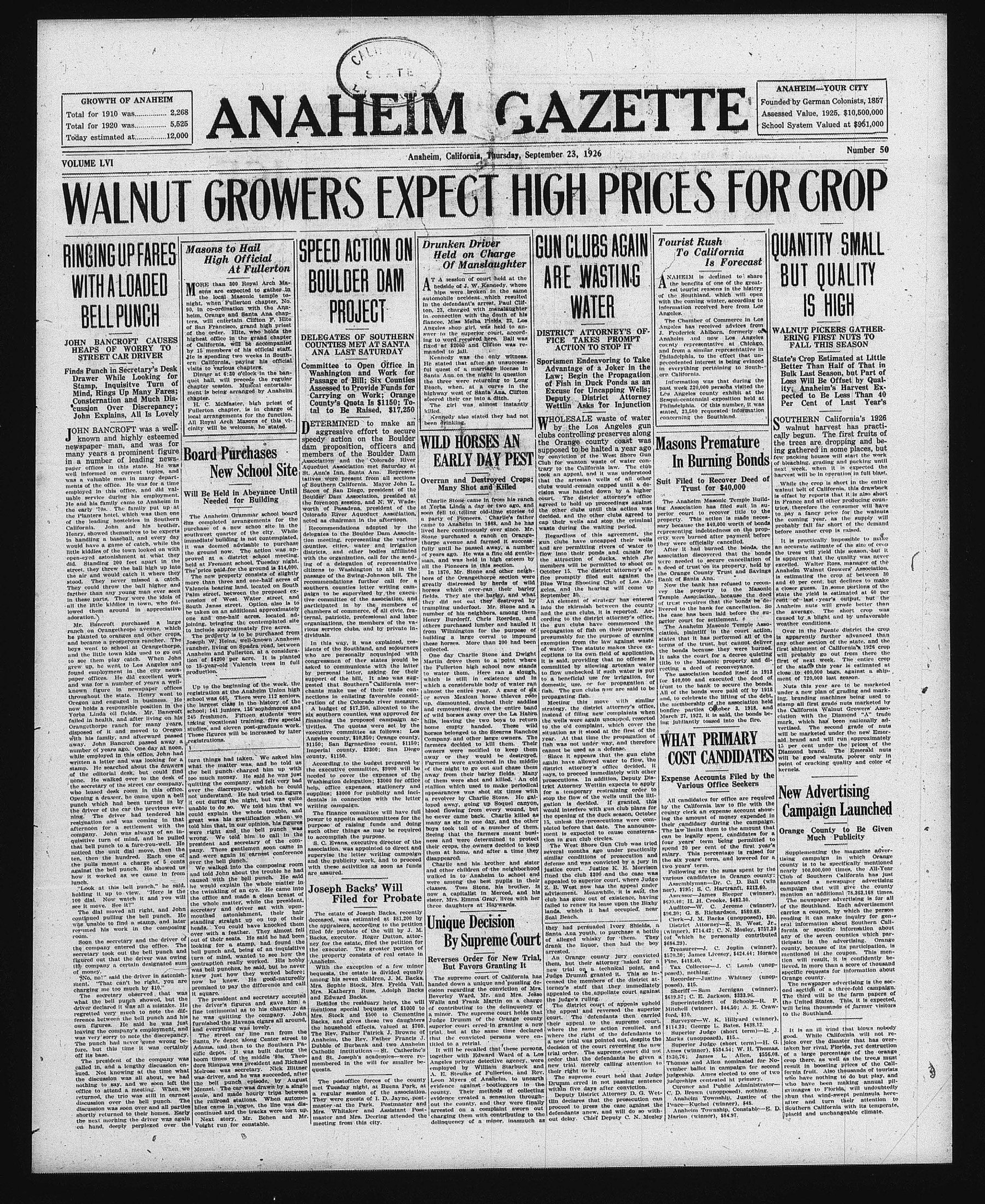
Searchable text
GROWTH OF ANAHEIM
Total for 1910 was..... 2,268
Total for 1920 was..... 5,525
Today estimated at.....12,000
VOLUME LVI
WALNUT GROWERS
RINGING UP FARES
WITH A LOADED
BELL PUNCH
JOHN BANCROFT CAUSES
HEAPS OF WORRY TO
STREET CAR DRIVER
Finds Punch in Secretary’s Desk
Drawer While Looking for
Stamp, Inquisitive Turn of
Mind, Rings Up Many Fares;
Consternation and Much Discussion Over Discrepancy;
John Explains, All Is Lovely
JOHN BANCROFT was a well-known and highly esteemed newspaper man, and was for
Masons to Hail
High Official
At Fullerton
More than 300 Royal Arch Masons are expected to gather in the local Masonic temple tonight, when Fullerton chapter, No. 90, in co-ordination with the Anaheim, Orange and Santa Ana chapters, will entertain Clifton F. Hite of San Francisco, grand high priest of the order. Hite, who holds the highest office in the grand chapter of California, will be accompanied by 15 members of his official staff. He is spending two weeks in Southern California, paying his official visits to various chapters.
Dinner at 6:30 o’clock in the banquet hall, will precede the regular chapter session. Musical entertainment is being arranged by Anaheim chapter.
H. C. McMaster, high priest of Fullerton chapter, is in charge of local arrangements for the function. All Royal Arch Masons of this vicinity will be welcome, he stated.
SPEED ACT
BOULDER
PROJE
DELEGATES OF COUNTIES MET
ANA LAST SA
Committee to Open Washington and Passage of Bill; Assessed to Provide Carrying on W County’s Quota tal to Be Raid
DETERMINED aggressive effect speedy action on dam proposition,
STREET CAR DRIVER
Finds Punch in Secretary’s Desk Drawer While Looking for Stamp, Inquisitive Turn of Mind, Rings Up Many Fares; Consternation and Much Discussion Over Discrepancy; John Explains, All Is Lovely
JOHN BANCROFT was a well-known and highly esteemed newspaper man, and was for many years a prominent figure in a number of leading newspaper offices in this state. He was well informed on current topics, and was a valuable man in many departments of the office. He was for a time employed in this office, and did valuable service during his employment. He and his family came to Anaheim in the early '70s. The family put up at the Planters hotel, which was then one of the leading hostelries in Southern California. John and his brother, Henry, showed themselves to be experts in handling a baseball, and every day would have a game of catch, while the little kiddies of the town looked on with open-eyed astonishment at what they did. Standing 200 feet apart in the street, they threw the ball high up into the air and would catch it where they stood. They never missed a catch. They could throw the ball higher and farther than any young man ever seen in these parts. They were the idols of all the little kiddies in town, who followed them around in appreciative adoration.
Mr. Bancroft purchased a large ranch on Orangethrove avenue, which he planted to oranges and other crops, and became a prosperous rancher. The boys went to school at Orangethroe, and the little town kids used to go out to see them play catch. When John grew up, he went to Los Angeles and found employment in the city newspaper offices. He did excellent work and was for a number of years a well-known figure in newspaper offices throughout the state. Henry went to Oregon and engaged in business. He now holds a responsible position in the Yorba Linda oil fields. Mr. Bancroft failed in health, and after living on his Orangethroe ranch for many years, disposed of it and moved to Oregon with his family, and afterward passed away. John Bancroft passed away a number of years ago. One day at noon, while employed in this office, John had written a letter and was looking for a stamp. He searched about the drawers of the editorial desk, but could find none. He walked over to the desk of the secretary of the street car company, who leased desk room in this office. Opening a drawer, he came upon a bell punch which had been turned in by the driver of the car the previous evening. The driver had tendered his resignation and was coming in that afternoon for a settlement with the company. John was always of an inquisitive turn of mind, and he pulled that bell punch to a fare-you-well. He did not spend two weeks in Southern California, paying his official visits to various chapters.
Dinner at 6:30 o’clock in the banquet hall, will precede the regular chapter session. Musical entertainment is being arranged by Anaheim chapter.
H. C. McMaster, high priest of Fullerton chapter, is in charge of local arrangements for the function. All Royal Arch Masons of this vicinity will be welcome, he stated.
Board Purchases New School Site
Will Be Held in Abeyance Until Needed for Building
The Anaheim Grammar school board has completed arrangements for the purchase of a new schoo site in the southwest quarter of the city. While immediate building is not contemplated, it was deemed advisable to purchase the ground now. The action was approved at a district school meeting, held at Freemont school, Tuesday night. The price paid for the ground is $14,000.
The new property consists of slightly more than three and one-half acres of Valencia bearing land, located on South Palm street, between the proposed extension of West Water street and South Jansss street. Option also is to be taken on an additional approximately one and one-half acres, located joining, bringing the contemplated site to include approximately five acres.
The property is to be purchased from Joseph W. Heinz, well-known Anaheim rancher, living on Spadra road, between Anaheim and Fullerton, at a consideration of $4200 per acre. It is planted to 15-year-old Valencia trees in full production.
Up to the beginning of the week, the registration at the Anaheim Union high school was 665. There were 112 seniors, the largest class in the history of the school; 141 juniors, 136 sophomores and 245 freshmen. Fifteen students were taking vocational training, five special studies, and eleven post-graduate work. These figures will be increased by later registrations.
Return things had taken. We asked him what the matter was, and he told us the bell punch charged him up with too much money. He said he was just quitting the company, and felt very bad over the discrepancy, which he could not understand. He had tried to figure it out during the night, but was quite unable to do so. We told him that we could explain the whole trouble, and great was his gratification when he told him that, in our opinion, his figures were right and the bell punch was wrong. We told him to call in the president and secretary of the company. These gentlemen soon came in
Committee to Open Washington and Passage of Bill; Assessed to Provide Carrying on W County’s Quota tal to Be Raid
DETERMINED aggressive effort speedy action on dam proposition members of the Association and the Aqueduct Association St. Ann’s Inn, Santa tatives were present f Southern California Bacon of San Diego, Boulder Dam Association the foremost session, a worth of Pasadena, Colorado River Aqueduct acted as chairman in Recommendations delegates to the Boulder station meeting, represent counties, cities, water districts, and other with the organization, ing of a delegation citizens to Washington passage of the Swing-recommendations fur southern counties lett palign to be supervised committee of the participated in by chambers of commerce ternal patriotic profere organizations,the merious service clubs,and dividuals.
In this way, it was identes of the Southlan who are personally congressmen of those asked to communicate by personal letter support of the bill,gested that Southern chants make use of nections in enlisting creation of the Colorado A budget of $17,250 six southern counties financing the proposal titles.The quotas executive committee Angeles county,$10,351$150;San Bgnard Imperial county,$2150;
According to the executive committee needed to cover Washington delegation help,office expenses supplies;$3000 for p dentals in connection writing campaign.
The finance committee power to appoint sub purpose of raising such other things are to accomplish the pu S.C.Evans.executive association.was appl
while employed in this office, he wrote a letter and was looking for a stamp. He searched about the drawers of the editorial desk, but could find none. He walked over to the desk of the secretary of the street car company, who leased desk room in this office. Opening a drawer, he came upon a bell punch which had been turned in by the driver of the car the previous evening. The driver had tendered his resignation and was coming in that afternoon for a settlement with the company. John was always of an inquisitive turn of mind, and he pulled that bell punch to a fare-you-well. He noticed the unit dial move, then the ten, then the hundred. Each one of the pulls meant a charge of 5 cents against the bell punch. He showed us how it worked as we came in from lunch.
"Look at this bell punch," he said, holding it up to view. "Here is the 100 dial. Now watch it and you will see it move. See it?"
The dial moved all right, and John continued pulling the bell punch. He was unable to find a stamp, and later returned his work in the composing room.
Soon the secretary and the driver of the company entered the office. The secretary took out the bell punch and figured out that the driver was owing the company a certain designated sum of money.
"No, no!" said the driver in astonishment. "That can't be right, you are charging me too much by $10."
The secretary observed that was what the bell punch showed, but the driver declared it was all a mistake. He regretted very much to note the difference between the bell punch and his own figures. He said he was just leaving the company's employment, and was very sorry to note the discrepancy. The punch had never gone wrong before, but this time it was certainly off its base.
The president of the company was called in, and a lengthy discussion ensued. Not knowing at the time what the discussion was all about, we had nothing to say, and we soon left the office to attend a meeting. When we returned, the trio was still in earnest discussion over the bell punch. The discussion was soon over and all parties shortly returned to their homes. Early the next morning the driver was again on hand, deeply perplexed over the turn things had taken. We asked him what the matter was, and he told us the bell punch charged him up with too much money. He said he was just quitting the company, and felt very bad over the discrepancy, which he could not understand. He had tried to figure it out during the night, but was quite unable to do so. We told him that we could explain the whole trouble, and great was his gratification when he told him that, in our opinion, his figures were right and the bell punch was wrong. We told him to call in the president and secretary of the company. These gentlemen soon came in and were again in earnest conference over the bell punch.
We walked into the composing room and told John about the trouble he had caused with the bell punch. He said he would explain the whole matter in the twinkling of an eye. He came into the office and made a clean breast of the whole matter, while the president, secretary and driver sat with open-mouthed astonishment, their hair standing straight up on top of their heads. You could have knocked them over with a feather. They almost fell out of their seats. He said he had been looking for a stamp, had found the bell punch and, being of an inquisitive turn of mind, wanted to see how the contraption really worked. His hobby was bell punches, he said, but he never knew just how they worked before; now he knew. He good-naturedly promised to pay the difference and call it square.
The president and secretary accepted the driver's figures and gave him a fine testimonial as to his character as he was quitting the company. John furnished the Havana cigars all around, and everything was lovely.
The street car line ran from Santa Fe depot along Center street to Adams, and then to the Southern Pacific depot. It was built during the boom times of the middle '80s. Theodore Rimpau was president and Richard Melrose was secretary. Nick Bittner was driver, and he was succeeded, after the bell punch episode, by August Menzel. The car was drawn by a single mule, and made hourly trips between the railroad stations. When automobiles came in vogue, the line was discontinued and the tracks were torn up.
Next story, Mr. Bohen and Mr. Voight run for constable.
The estate of Joseph deceased, was estimating the appraisals, according to Backs, executor. Reyn for the estate, filed for Backs, executor. The property consisted Anaheim.
With the exception bequests, the estate among his seven children Mrs. Sophie Stock, Mrs. Katheryn Ruiz and Edward Backs.
Besides the results mentioned special behalf Mrs. Stock and $Backs, and gives ther household effect The Rev. Father Papa Anaheim, the Rev. Dubble of Burbank Catholic institution and St. Joseph's are members in the quests.
The postoffice met Tuesday night at a regular session at master at the Park Mrs. Whitaker and master and Mrs. Loe meeting from this
AHEIM GAZETTE
Anaheim, California, Thursday, September 23, 1926
WERS EXPECT HIGH PRICES
SPEED ACTION ON BOULDER DAM PROJECT
DELEGATES OF SOUTHERN COUNTIES MET AT SANTA ANA LAST SATURDAY
Committee to Open Office in Washington and Work for Passage of Bill; Six Counties Assessed to Provide Funds for Carrying on Work; Orange County’s Quota Is $1150; Total to Be Raised, $17,250
DETERMINED to make an aggressive effort to secure speedy action on the Boulder dam proposition, officers and
Drunken Driver
Held on Charge
Of Manslaughter
At a session of court held at the bedside of J. W. Kennedy, whose hips were broken in the same automobile accident, which resulted in the defendant's arrest, Paul Clifton, 23, charged with manslaughter in connection with the death of his fiancee, Miss Melba Fields, 22, Los Angeles shop girl, was held to answer to the superior court, according to word received here. Ball was fixed at $2000 and Clifton was reminded to Jail.
Kennedy was the only witness. He stated that after an unsuccessful quest of a marriage license in Santa Ana on the night in question the three were returning to Long Beach, when, at a curve in the highway west of Santa Ana, Clifton steered their car into a ditch.
The girl was almost instantly killed.
Kennedy also stated they had not been drinking.
GUN CLUBS AGAIN ARE WASTING WATER
DISTRICT ATTORNEY’S OFFICE TAKES PROMPT ACTION TO STOP IT
Sportism Endeavoring to Take Advantage of a Joker in the Law; Begin the Propagation of Fish in Duck Ponds as an Excuse for Uncapping Wells; Deputy District Attorney Wettlin Asks for Injunction
WHOLESALE waste of water by the Los Angeles gun clubs controlling preserves along the Orange county coast was supposed to be halted a year ago
Tourist To O
ANAHEIM the benefit of the South with the com information r Angeles.
The Chamber Angeles has J. Frederick Anaheim an county repre and from a s Philadelphia, preceded it in everything orn California.
Information past week 220 Los Angeles Sexqui-center Philadelphia stated, 23,500 concerning t
WILD HORSES AN
Committee to Open Office in Washington and Work for Passage of Bill; Six Counties Assessed to Provide Funds for Carrying on Work; Orange County’s Quota Is $1150; Total to Be Raised, $17,250
DETERMINED to make an aggressive effort to secure speedy action on the Boulder dam proposition, officers and members of the Boulder Dam Association and the Colorado River Aqueduct Association met Saturday at St. Ann’s Inn, Santa Ana. Representatives were present from all sections of Southern California. Mayor John L. Bacon of San Diego, president of the Boulder Dam Association, presided at the forenoon session, and N. W. Wadsworth of Pasadena, president of the Colorado River Aqueduct Association, acted as chairman in the afternoon.
Recommendations adopted by the delegates to the Boulder Dam Association meeting, representing the various counties, cities, water and irrigation districts, and other bodies affiliated with the organization, call for the sending of a delegation of representative citizens to Washington to aid in the passage of the Swing-Johnson bill. The recommendations further call for a southern counties letter writing campaign to be supervised by the executive committee of the association, and participated in by the members of chambers of commerce, of all civic, fraternal, patriotic, professional and labor organizations, the members of the various service clubs, and by private individuals.
In this way, it was explained, residents of the Southland, and sojourners who are personally acquainted with congressmen of their states would be asked to communicate with the latter by personal letter, asking for their support of the bill. It also was suggested that Southern California merchants make use of their trade connections in enlisting favorable consideration of the Colorado river measure.
A budget of $17,250, allocated to the six southern counties, was approved for financing the proposed campaign activities. The quotas were set by the executive committee as follows: Los Angeles county, $10,350; Orange county, $1150; San Bgnardino count, $1150; Imperial county, $2300; San Diego county, $1150.
According to the budget prepared by the executive committee, $9000 will be needed to cover the expenses of the Washington delegation; $3000 for office help, office expenses, stationery and supplies; $3000 for publicity and incidentals in connection with the letter writing campaign.
The finance committee will have full power to appoint subcommittees for the purpose of raising funds and doing such other things as may be required to accomplish the purpose.
S. C. Evans, executive director of the association, was appointed to direct and Kennedy was the only witness. He stated that after an unsuccessful quest of a marriage license in Santa Ana on the night in question the three were returning to Long Beach, when, at a curve in the highway west of Santa Ana, Clifton steered their car into a ditch. The girl was almost instantly killed.
Kennedy also stated they had not been drinking.
WILD HORSES AN EARLY DAY PEST
Overran and Destroyed Crops; Many Shot and Killed
Charlie Stone came in from his ranch at Yorba Linda a day or two ago, and soon fell to telling old-time stories to a party of Pioneers. Charlie’s father came to Anahiem in 1868, and he has lived here continuously ever since. Mr. Stone purchased a ranch on Orange thorpe avenue and farmed it successfully until he passed away, a number of years ago. He was a fine old gentleman, and was held in high esteem by all the Pioneers in this section.
In 1870, Mr. Stone and other neighbors of the Orangenthorpe section were greatly distressed by herds of wild horses which over-ran their barley fields. They ate the barley, and what they did not eat they destroyed by trampling underfoot. Mr. Stone and a number of his neighbors, among them Henry Burdorf, Chris Roerden, and others purchased lumber and hauled it from Wilmington for the purpose of building a large corral to impound these horses. More than 200 had been collected.
One day Charlie Stone and Dwight Martin drove them to a point where the Fullerton high school now stands to water them. Here ran a slough, which is still in existence and in which a considerable body of water ran almost the entire year. A gang of six or seven Mexican horse thieves rode up, dismounted, clinched their saddles and remounting, drove the entire band of wild horses away over the La Habra hills, leaving the two boys to return home empty handed. These wild horses belonged to the Stearns Ranch Company and other large owners. The farmers decided to kill them. Their owners were notified to keep them away or they would be destroyed. Farmers were awakened in the middle of the night to go out and chase them away from their barley fields. Many of them were shot and killed. An old stallion which used to make periodical appearances was shot six times with a revolver by Charlie Stone. He galloped away, going up Soquel canyon, blood flowing from every wound, but he never came back. Charlie killed as many as six in one day, and the other boys took toll of a number of them. Seeing that the farmers meant business and were determined to protect their crops, the owners decided to keep them away or they would be destroyed.
Sportismen Endeavoring to Take Advantage of a Joker in the Law; Begin the Propagation of Fish in Duck Ponds as an Excuse for Uncapping Wells; Deputy District Attorney Wettlin Asks for Injunction
WHOLESALE waste of water by the Los Angeles gun clubs controlling preserves along the Orange county coast was supposed to be halted a year ago by conviction of the West Shore Gun Club for wanton waste of water contrary to the California law. The club took an appeal, and it was understood that the artesian wells of all other clubs would remain capped until a decision was handed down by a higher court. The district attorney’s office agreed to hold up proceedings against the other clubs until this action was decided, and the other clubs agreed to cap their wells and stop the criminal waste during the waiting period.
Regardless of this agreement, the gun clubs have uncapped their wells and are permitting rivers of water to flow into their ponds and canals for the attraction of ducks, which the members will be permitted to shoot on October 15. The district attorney’s office promptly filed suit against the Blue Wing Shooting Club of Los Angeles, and the hearing will come up September 30.
An element of strategy has entered into the skirmish between the county and the gun clubs. It is reported. According to the district attorney’s office, the gun clubs have commenced the propagation of fish on their preserves, presumably for the purpose of earning exemption from the law against waste of water. The statute makes three exceptions to its own field of application, it is said, providing that no offense is committed by allowing artesian water to flow unchecked if such water is put to a beneficial use for irrigation, for domestic use, or for propagation of fish. The gun clubs now are said to be propagating fish.
Meeting this move with similar strategy, the district attorney’s office instead of filling new complaints when the wells were again uncapped, resorted to the old complaint, which covered the situation as it stood at the first of the year. At that time the propagation of fish was not under way, and therefore cannot be used as a defense.
Since it appears that the gun clubs again have allowed water to flow, the district attorney’s office decided, it says, to proceed immediately with other prosecutions. In addition, Deputy District Attorney Wettlin expects to apply for a temporary restraining order to stop the flow of the wells until the litigation is decided. If granted, this would interfere with gun club plans for the opening of the duck season, October 15, unless the prosecution were completed before that date. The announcement is expected to cause consternation in gun club circles.
The West Shore Gun Club was tried several months ago under practically no pressure.
The Anaheiling Association per court property. This sary because it represents iterty were bury they were off.
After it has association dame were needed due deed of trust the Orange C Bank of San Francisco.
Now he bvey the pre Temple Assoc for trustiver led tothe case hase perior court
The Anaheiling claitionplain states that it terms ofthe bonds heIt asks she c title to therecting a dee
The associsfor $40,000g trusttoAllofthebeandtocelethemembersbonfirepartMarch27.JustilubillantWHATCOST
Expense A Various
All candidates bythe Californi county clerk ingthe amo their candidat The law limit can be legal four years’spend 20
According to the budget prepared by the executive committee, $9000 will be needed to cover the expenses of the Washington delegation; $3000 for office help, office expenses, stationery and supplies; $3000 for publicity and incidentals in connection with the letter writing campaign.
The finance committee will have full power to appoint subcommittees for the purpose of raising funds and doing such other things as may be required to accomplish the purpose.
S. C. Evans, executive director of the association, was appointed to direct and supervise the letter writing campaign and the publicity work, and to proceed with these activities as soon as funds are assured.
Joseph Backs' Will Filed for Probate
The estate of Joseph Backs, recently deceased, was estimated at $81,200 by the appraisers, according to the petition filed for probate of the will by J. M. Backs, executor. Roger Dutton, attorney for the estate, filed the petition for the executor. The greater portion of the property consists of real estate in Anaheim.
With the exception of a few minor bequests, the estate is divided equally among his seven children, J. M. Backs, Mrs. Sophie Stock, Mrs. Freida Vall, Mrs. Katheryn Russ, Adolph Backs and Edward Backs.
Besides the residuary heirs, the will mentions special bequests of $1000 to Mrs. Stock and $500 to Clementine Backs, and gives these two daughters the household effects, valued at $700. The Rev. Father Patrick J. Browne of Anaheim, the Rev. Father Francis J. Dubble of Burbank and two Anaheim Catholic institutions—St. Catherine and St. Joseph's academies—were remembered in the will for smaller bequests.
The postoffice forces of the county met Tuesday night, at Buena Park, at a regular session of the association. They were guests of I. D., Jayne, postmaster at the Park. Postmaster and Mrs. Whitaker and Assistant Postmaster and Mrs. Deering attended the meeting from this city.
Unique Decision By Supreme Court
Reverses Order for New Trial, But Favors Granting It
The supreme court of California has handed down a unique and puzzling decision regarding the conviction of Mrs. Beaverley Ward, Mr. and Mrs. Jeese Walls and Frank Martin on a charge contributing to the delinquency of a minor. The supreme court holds that Judge Drumm of the Orange county superior court erred in granting a new trial, but at the same time declared that the convicted persons were entitled to a retrial.
It will be recalled that these persons, together with Edward Ward of a Los Angeles private detective agency, were employed by William Starbuck and A. E. Steulke of Fullerton, and Rev. Leon Myers of Anaheim, to unearth evidence against bootleggers in the county. Their methods of collecting evidence created a sensation throughout the county, and they were finally arrested on a complaint sworn out charging them with contributing to the delinquency of a minor, inasmuch as away or they would be destroyed. Farmers were awakened in the middle of the night to go out and chase them away from their barley fields. Many of them were shot and killed. An old stallion which used to make periodical appearances was shot six times with a revolver by Charlie Stone. He galloped away, going up Soquel canyon, blood flowing from every wound, but he never came back. Charlie killed as many as six in one day, and the other boys took toll of a number of them. Seeing that the farmers meant business and were determined to protect their crops, the owners decided to keep them at home, and after a time they disappeared.
Charlie and his brother and sister and other children of the neighborhood walked in to Anaheim to school and were among the best pupils in their classes. Tom Stone, his brother, is now a capitalist in Merced, and his sister, Mrs. Emma Gray, lives with her three daughters at Haywards.
The West Shore Gun Club was tried several months ago under practically similar conditions of prosecution and defense and was convicted by a jury in justice court. Justice K. E. Morrison fined the club $300 and the case was appealed to superior court, where Judge Z. B. West now has the appeal under advisement. Meanwhile, it is said, the club has gone out of existence, having failed to renew its lease upon the Bixby lands, which it had occupied, near Seal Beach.
They had persuaded Ivory Shields, a Santa Ana youth, to purchase a bottle of alleged whisky for them. They drank the liquor, then had the boy arrested.
An Orange county jury convicted them, but their attorney asked for a new trial on a technical point, and Judge Drumm granted it. This so incensed the members of the district attorney's staff that they immediately appealed to the appellate court against the judge's ruling.
The district court of appeals upheld the appeal and reversed the superior court. The defendants then carried their appeal to the supreme court, where the same action resulted, and where the right of the defendants to a new trial was pointed out, despite the decision of the court reversing the new trial order. The supreme court did not order that the defendants be given a new trial merely calling attention to their right to it.
The supreme court held that Judge Drumm erred in not passing sentence within five days after conviction.
Deputy District Attorney D. G. Wettlin declares that the prosecution can proceed to press the case against the defendants anew, and will do so without delay. Chief Deputy C. N. Mozley
COST
Expense A Various
All candidates by the California county clerk ing the amo their candidacy.
The law limit can be legal four years' spend 20 per salary. This thirx six years' two years' tail Following various cancels Assembly ner). $795; Ascensor-$690.40; H.; Auditor-$96.30; G.; Clerk-J.; District A (winner). $76 (of which $684.29).
Treasurer $570.30; Jan Fine.$418.4 Tax Coll posed), not Recorder posed), $155 Sheriff — $619.57; C.
Superintendent Mitchell (w ford,$10.
Surveyor $114.23; Go Superior Marks (un Superior Ames (wim $830.76; Thomas an member b judgeship; judgeships Coroner C.D.Brow Anaheim Peace—Ku Anaheim Marlon (w
ANAHEIM—YOUR CITY
Founded by German Colonists, 1857
Assessed Value, 1925, $10,500,000
School System Valued at $961,000
Number 50
PRICES FOR CROP
Tourist Rush
To California
Is Forecast
ANAHEIM is destined to share the benefits of one of the greatest tourist reasons in the history of the Southland, which will open with the coming winter, according to information received here from Los Angeles.
The Chamber of Commerce in Los Angeles has received advises from J. Frederick Ahlborn, formerly of Anaheim and now Los Angeles county representative at Chicago, and from a similar representative in Philadelphia, to the effect that unprecedented interest is being evinced in everything pertaining to Southern California.
Information was that during the past week 220,000 persons visited the Los Angeles county exhibit at the Sesqui-centennial exposition held at Philadelphia. Of this number, it was stated, 23,500 requested information concerning the Southland.
QUANTITY SMALL BUT QUALITY IS HIGH
WALNUT PICKERS GATHERING FIRST NUTS TO FALL THIS SEASON
State's Crop Estimated at Little Better Than Half of That in Bulk Last Season, but Part of Loss Will Be Offset by Quality; Anaheim's Harvest Expected to Be Less Than 40 Per Cent of Last Year's
SOUTHERN California's 1926 walnut harvest has practically begun. The first fruits of the trees are dropping and being gathered in some places, but
Masons Premature In Burning Bonds
Suit Filed to Recover Deed of Trust for $40,000
The Anaheim Masonic Temple Building Association has filed suit in superior court to recover title to the property. This action is made necessary because the $40,000 worth of bonds representing indebtedness on the property were burned after payment before they were officially cancelled.
After it had burned the bonds, the association discovered that the bonds were needed to secure cancellation of a deed of trust on its property, held by the Orange County Trust and Savings Bank of Santa Ana.
Now the bank has refused to reconvey the property to the Masonic Temple Association, because the deed of trust requires that the bonds be delivered to the bank for cancellation. So the case has been laid before the superior court for settlement.
The Anaheim Masonic Temple Association, plaintiff in the court action, states that it has performed all of the terms of the trust, but cannot deliver the bonds because they were burned. It asks the court for a decree quieting title to the Masonic property and directing a deed of reconveyance.
The association bonded itself in 1913 for $40,000 and executed the deed of trust to the bank to secure the bonds. All of the bonds were paid off by 1918, and, to celebrate the lifting of the debt, the membership of the association held bonfire parties October 3, 1918, and March 27, 1922. It is said, the bonds being jubilantly tossed into the fire.
WHAT PRIMARY COST CANDIDATES
Expense Accounts Filed by the Various Office Seekers
All candidates for office are required by the California law to file with the county clerk an expense account showing the amount of money expended in their candidacy during the campaign. The law limits them to the amount that can be legally spent, candidates for a four years' term being permitted to spend 20 per cent of the first year's income.
State's Crop Estimated at Little Better Than Half of That in Bulk Last Season, but Part of Loss Will Be Offset by Quality; Anaheim's Harvest Expected to Be Less Than 40 Per Cent of Last Year's SOUTHERN California's 1926 walnut harvest has practically begun. The first fruits of the trees are dropping and being gathered in some places, but few packing houses will start the work of bleaching, grading and packing until next week, when it is expected the harvest will be in operation in full blast.
While the crop is short in the entire walnut belt of California, this drawback is offset by reports that it is also short in France and all other producing countries, therefore the consumer will have to pay a fancy price for the walnuts the coming year, as the supply will probably fall far short of the demand before another crop is raised.
It is practically impossible to make an accurate estimate of the size of crop the trees will yield this season, but it is apparent that the quality was never excelled. Walter Ross, manager of the Anaheim Walnut Growers' Association, is estimating the crop at between 30 and 40 per cent, but declines to make a closer guess. In some portions of the state the yield is estimated at 60 per cent of last year's output, but the Anaheim nuts will grade better than the average. The short crop was caused by a blight and by unfavorable weather conditions.
Over in the Puente district the crop is apparently farther advanced than any other section of the state, and the first shipment of California's 1926 crop will probably go out from there the first of next week. The entire crop of the state this year is estimated at close to 400,000 bags, against a shipment of 720,000 last season.
Nuts this year are to be marketed under a new plan of grading and marking, branding machines being used to stamp all first grade nuts marketed by the California Walnut Growers' Association with the Diamond "A" trade mark, which has been nationally advertised. The second grade of nuts will be marketed under the new Emerald brand and will run approximately 15 per cent under the prices of the Diamond brand. The Emerald nuts will be good walnuts, poorer only in point of cracking quality and color of kernels.
New Advertising Campaign Launched
Orange County to Be Given Much Publicity
Expense Accounts Filed by the Various Office Seekers
All candidates for office are required by the California law to file with the county clerk an expense account showing the amount of money expended in their candidacy during the campaign. The law limits them to the amount that can be legally spent, candidates for a four years' term being permitted to spend 20 per cent of the first year's salary. This percentage is raised for the six years' term, and lowered for a two years' term.
Following are the sums spent by the various candidates in Orange county: Assemblyman—Dr. C. D. Ball (winner), $795; S. C. Hartranft, $212.60. Assessor—James Sleeper (winner), $699.40; H. H. Crooke, $482.30. Auditor—W. C. Jerome (winner), $96.30; G. S. Richardson, $580.68. Clerk—J. M. Backs (unopposed), $30. District Attorney—Z. B. West, Jr. (winner), $714.42; C. N. Mozley, $757.29 (of which he personally contributed $684.29).
Treasurer—J. C. Joplin (winner), $570.30; James Livesey, $424.44; Horace Fine, $418.40.
Tax Collector—J. C. Lamb (unopposed), nothing.
Recorder—Justine Whitney (unopposed), $15.
Sheriff—Sam Jernigan (winner), $619.57; C. E. Jackson, $333.96.
Superintendent of Schools—R. P. Mitchell (winner), $44.50; A. E. Crawford, $10.
Surveyor—W. K. Hillyard (winner), $114.23; George L. Bates, $438.12.
Superior Judge (short term)—E. J. Marks (unopposed), $15.
Superior Judge (short term)—H. G. Ames (winner), $534.54; W. H. Thomas, $830.76; James L. Allen, $556.08.
Thomas and Allen nominated for November ballot in campaign for second judgeship. Ames elected to one of two judgeships contested at primary.
Coroner and Public Administrator—C. D. Brown (unopposed), nothing.
Anaheim Township, Justice of the Peace—Kuchel (winner), $48.
Anaheim Township, Constable—E. D. Marlon (winner), $84.97.
New Advertising Campaign Launched
Orange County to Be Given Much Publicity
Supplementing the magazine advertising campaign in which Orange county is to be specifically mentioned nearly 100,000,000 times, the All-Year Club of Southern California has just announced a newspaper advertising campaign that will give the county mention an additional 78,363,168 times.
The newspaper advertising is for all of the Southland. Each advertisement carries a coupon, by which the person reading it can make inquiry for general information about Southern California or specific information about any of the seven counties which participate in the advertising. Orange county, because of its participation, is mentioned in the coupon. This mention will result, it is confidently believed, in more than a score of thousand specific requests for information about Orange county.
The newspaper advertising is the second section of a three-fold campaign. The third will be the farm papers of the United States. This, it is expected, will bring thousands of farmer visitors to the Southland.
It is an ill wind that blows nobody good. While California will not rejoice over the disaster that has overtaken her rival, Florida, yet destruction of a large percentage of the orange crop there, as well as the trees, must result in boosting prices of the California fruit. Also thousands of tourists who have nothing to do but play, and who have been making annual pilgrimages to Florida, will undoubtedly shun that wind-swept peninsula hereafter and turn their attention to Southern California with its temperate, placid and unchangeable climate.