anaheim-gazette 1926-09-09
Scanned page
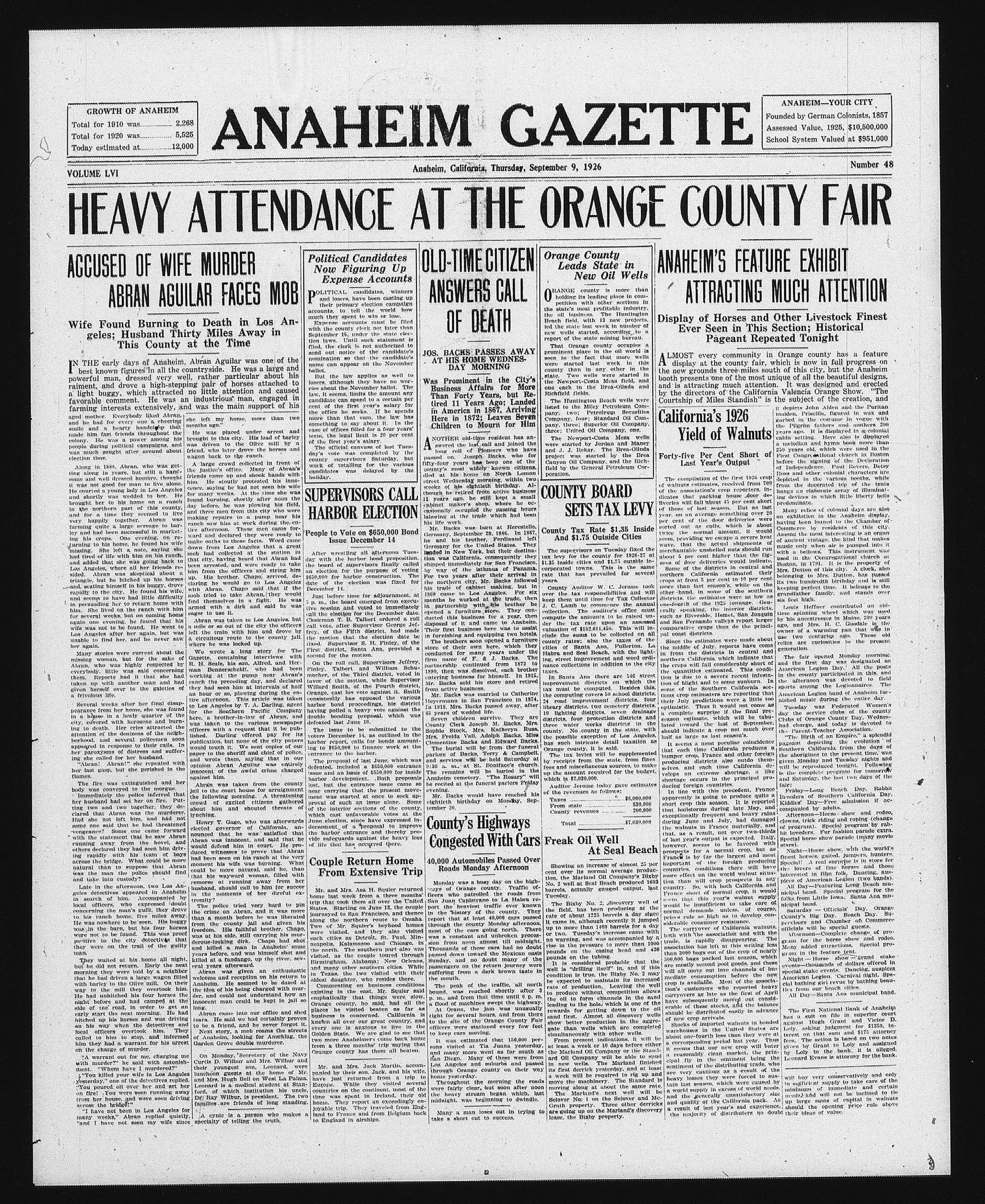
Searchable text
GROWTH OF ANAHEIM
Total for 1910 was... 2,268
Total for 1920 was... 5,525
Today estimated at...12,000
VOLUME LVI
HEAVY ATTENDANCE
ACCUSED OF WIFE MURDER
ABRAN AGUILAR FACES MOB
Wife Found Burning to Death in Los Angeles; Husband Thirty Miles Away in This County at the Time
IN THE early days of Anaheim, Abran Aguilar was one of the best known figures in all the countryside. He was a large and powerful man, dressed very well, rather particular about his raiment, and drove a high-stepping pair of horses attached to a light buggy, which attracted no little attention and caused favorable comment. He was an industrious man, engaged in farming interests extensively, and was the main support of his aged mother. Everybody liked Abran, and he had for every one a cheering smile and a hearty handelsp that made him fast friends throughout the colony. He was a power among his people during political campaigns, and she left my home, more than two months ago."
He was placed under arrest and brought to this city. His load of barley was driven to the Olive mill by a later driver.
IN THE early days of Anaheim, Abran Aguilar was one of the best known figures in all the countryside. He was a large and powerful man, dressed very well, rather particular about his raiment, and drove a high-stepping pair of horses attached to a light buggy, which attracted no little attention and caused favorable comment. He was an industrious man, engaged in farming interests extensively, and was the main support of his aged mother. Everybody liked Abran, and he had for every one a cheerful smile and a hearty handshake that made him fast friends throughout the colony. He was a power among his people during political campaigns, and was much sought after around election time.
Along in 1888, Abran, who was getting along in years, but still a handsome and well dressed hombre, thought it was not good for man to live alone. He courted a young lady in Los Angeles and shortly was wedded to her. He brought her to his home on a ranch in the northern part of this county, and for a time they seemed to live very happily together. Abran was farming quite a large acreage to barley and had been successful in marketing his crops. One evening, on returning to his home, he found his wife missing. She left a note, saying she had tired of life with him on his ranch, and added that she was going back to Los Angeles, where all her friends resided. Abran was skeptical about a triangle, but he hitched up his horses and seated himself in his buggy, drove rapidly to the city. He found his wife, and seems to have had little difficulty in persuading her to return home with him. She lived on the ranch with him for several weeks, but on coming home again one evening, he found that his wife was not to be found. He went to Los Angeles after her again, but was unable to find her, and he never saw her again.
Many stories were current about the missing woman, but for the sake of Abran, who was highly respected by everybody, little was said concerning them. Reports had it that she had taken up with another man and had given herself over to the galeties of a frivolous life.
Several weeks after her final disappearance from her home, she was found in a house in a lowly quarter of the city, covered with kerosene and burning to death. Her cries attracted the attention of the denizens of the neighborhood, and several policemen soon appeared in response to their calls. In her paroxysms of distress and suffering she called for her husband.
"Abran! Abran!" she repeated with her last gasp, but she perished in the flames.
The fire was extinguished and her body was conveyed to the morgue.
Immediately the police inferred that her husband had set her on fire. Putting two and two together, they declared that Abran was the murderer. Had she not left him, and had not some one said that he had threatened vengeance? Some one came forward with the statement that he saw Abran running away from the hovel, and others declared they had seen him drive she left my home, more than two months ago."
He was placed under arrest and brought to this city. His load of barley was driven to the Olive mill by a friend, who later drove the horses and wagon back to the ranch.
A large crowd collected in front of the justice's office. Many of Abran's friends came up and shook hands with him. He stoutly protested his innocence, saying he had not seen his wife for many weeks. At the time she was found burning, shortly after noon the day before, he was plowing his field, and three men from this city who were making repairs to a pump near his ranch saw him at work during the entire afternoon. These men came forward and declared they were ready to make oaths to these facts. Word came down from Los Angeles that a great mob had collected at the station in that city, having heard that Abran had been arrested, and were ready to take him from the officers and string him up. His brother, Chapo, arrived, declaring he would go to Los Angeles with Abran. Chapo said that if the mob tried to take Abran, they would find themselves in a fight. He was armed with a dirk and said he was eager to use it.
Abran was taken to Los Angeles, but a mile or so out of the city the officers left the train with him and drove by a circuitous route to the county jail. where he was locked up.
We wrote a long story for The Gazette, containing interviews with R. H. Seale, his son, Alfred, and Herman Bennerscheldt, who had been working at the pump near Abran's ranch the preceding day, and declared they had seen him at intervals of half an hour or so, plowing during the entire afternoon. This article was taken to Los Angeles by T. A. Darling, agent for the Southern Pacific Company here, a brother-in-law of Abran, and was taken to the various newspaper officers with a request that it be published. Darling offered pay for its publication, but none of the city papers would touch it. We sent copies of our paper to the sheriff and chief of police, and wrote them, saying that in our opinion Abran Aguilar was entirely innocent of the awful crime charged against him.
Abran was taken from the county jail to the court house for arraignment the following morning. A threatening crowd of excited citizens gathered about him and shouted threats of lynching.
Henry T. Gage, who was afterwards elected governor of California, announced that he was satisfied that Abran was innocent, and said that he would defend him in court. He proposed last week for his nomination so that name can appear on ballot.
But the law applauds losses although they relate about the November law; it seems limits candidate can spend cent of the first year on the office he seeks; more than that something to say about case of offices filled term; the legal limit of the first year's salary.
The official canvass day's vote was correct; county supervisors work of totalling five candidates was done holiday.
SUPERVISOR
HARBOR E
People to Vote on Issue Decree
After wrestling all day with the harbor board of supervision for election for the P $650,000 for harbor date of December 14.
Just before time for 5 p.m., the board emailed session and vote call the election for Chairman T. B. Talbey call vote after Superfrey, of the Fifth district motion that fixed Supervisor S. First district; Santa Fe second for the motion.
On the roll call, Su Finley, Talbert and macher, of the Third flavor of the motion; Willard Smith, of the Orange; cast his vote consistently has oppose harbor bond process having polled a heavy double bonding prop defeated last June 10.
The issue to be voted December 14 harbor report; calls ing to $650,000 to fi n entrance to the harbor.
The proposal of last defeated; included an issue and an issue of harbor development lost; but the entrant near carrying that moment was started at proval of such an hour of the interior section which cast unfavorable June election; since dorserse of a bire harbor entrance vide safeguards against life that has occu
"Abran! Abran!" she repeated with her last gasp, but she perished in the flames.
The fire was extinguished and her body was conveyed to the morgue.
Immediately the police inferred that her husband had set her on fire. Putting two and two together, they declared that Abran was the murderer. Had she not left him, and had not some one said that he had threatened vengeance? Some one came forward with the statement that he saw Abran running away from the hovel, and others declared they had seen him driving rapidly with his team of bays across the bridge. What could be more natural than to suppose that Abran was the man the police should find and take into custody?
Late in the afternoon, two Los Angeles detectives appeared in Anaheim in search of him. Accompanied by local officers, who expressed doubt concerning the man's guilt, they drove to his ranch home, five miles away. He was nowhere to be seen. His buggy was in the barn, but his four horses were not to be found. This was proof positive to the city detectives that they were on the trail of the guilty man.
They waited at his home all night, but he did not return. Early the next morning they were told by a neighbor that he had driven a large wagon filled with barley to the Olive mill. On their way to the mill they overtook him. He had unhitched his four horses the night before and had camped at the side of the road, in order to get an early start the next morning. He had hitched up his horses and was driving on his way when the detectives and local officers overtook him. They called to him to stop, and informed him they had a warrant for his arrest on the charge of murder.
"A warrant out for me, charging me with murder?" he said with astonishment. "Whom have I murdered?"
"You killed your wife in Los Angeles yesterday," one of the detectives replied. "You poured oil over her and set her on fire! You were seen running away from her house, and were seen driving across the bridge!"
"I have not been in Los Angeles for many weeks," Abran replied quietly, "and I have not seen my wife since and wrote them, saying that in our opinion Abran Aguilar was entirely innocent of the awful crime charged against him.
Abran was taken from the county jail to the court house for arraignment the following morning. A threatening crowd of excited citizens gathered about him and shouted threats of lynching.
Henry T. Gage, who was afterwards elected governor of California, announced that he was satisfied that Abran was innocent, and said that he would defend him in court. He produced witnesses to prove that Abran had been seen on his ranch at the very moment his wife was burning. What could be more natural, said he, than that his wayward woman, filled with remorse at running away from her husband, should call to him for succor in the moments of her direful extremity?
The police tried very hard to pin the crime on Abran, and it was more than a month before he was liberated from the county jail and given his freedom. His faithful brother, Chapo, was at his side, still carrying his murders-looking dirk. Chapo had shot and killed a man in Anaheim some years before, and was himself shot and killed at a fandango, up the river, several years afterward.
Abran was given an enthusiastic welcome and reception on his return to Anaheim. He seemed to be dazed at the idea of his being charged with murder, and could not understand how an innocent man could be kept in jail so long.
Abran came into our office and shed tears. He said we had certainly proven to be a friend, and he never forgot it.
Next story, a mob roams the streets of Anaheim, looking for Anschlag, the Garden Grove double murderer.
On Monday,'Secretary of the Navy Curtis D. Wilbur and Mrs. Wilbur and their youngest son, Leonard, were luncheon guests at the home of Mr. and Mrs. Hugh Bell on West La Palma. Leonard is a medical student at Stanford, of which institution his uncle, Dr. Ray Wilbur, is president. The two families are friends of long standing.
A cynic is a person who makes a specialty of telling the truth.
The proposal of last defeated, included an issue and an issue of harbor development lost, but the entrant near carrying that ment was started at proval of such an In of the interior section which cast unfavor June election, since dorsement of a brew the harbor entrance vide safeguards against life that has occured
Couple Return From Ext
Mr. and Mrs. Asa home last week from trip that took them States. Starting on journey to San Fran along the northern Two of Mr. Squier were visited, and such cities as Det neapolis, Kalamazoo the north. The souls visited, as the cour Birmingham, Alabar and many other souls in Texas, the two oldest daughter, whi Commenting on existing in the east emphatically that Orange county, hot places he visited business is concern known all over our every one is anxia Golden State. We two more Anahelme from a three month Orange county has
Mr. and Mrs. Ja panled by their son have just returned Europe. While countries on the time was spent in home. They report joyable trip. They land to France and to England in airs
AHEIM GAZETTE
Anaheim, California, Thursday, September 9, 1926
DANCE AT THE ORANGE CITY
Political Candidates Now Figuring Up Expense Accounts
POLITICAL candidates, winners and losers, have been casting up their primary election campaign accounts, to tell the world how much they spent to win or lose.
Expense accounts must be filed with the county clerk not later than September 15, under the state election laws. Until such statement is filed, the clerk is not authorized to send out notice of the candidate's nomination so that the candidate's name can appear on the November ballot.
But the law applies as well to losers, although they have no worries about the November ballot. The law, it seems, limits the amount any candidate can spend to a certain per cent of the first year's salary for the office he seeks. If he spends more than that sum, the law has something to say about it. In the case of offices filled for a four years' term, the legal limit is 20 per cent of the first year's salary.
The official canvass of last Tuesday
OLD-TIME CITIZEN ANSWERS CALL OF DEATH
JOS. BACKS PASSES AWAY AT HIS HOME WEDNESDAY MORNING
Was Prominent in the City’s Business Affairs for More Than Forty Years, but Retired 11 Years Ago; Landed in America in 1867, Arriving Here in 1872; Leaves Seven Children to Mourn for Him
NOTHER old-time resident has answered the last call and joined the Orange County Leads State in New Oil Wells
ORANGE county is more than holding its leading place in competition with other sections in the state's most profitable industry, the oil business. The Huntington Beach field, with 13 new projects, led the state last week in number of new wells started, according to a report of the state mining bureau.
That Orange county occupies a prominent place in the oil world is seen in the fact that more wells were started last week in this county than in any other in the state. Two wells were started in the Newport-Costa Mesa field, and one each in the Brea-Oilinda and Richfield fields.
The Huntington Beach wells were listed to the Miley Petroleum Company, two; Petroleum Securities Company, four; Standard Oil Company, three; Superior Oil Company, three; United Oil Company, one.
The Newport-Costa Mesa wells were started by Jordan and Maney
SUPERVISORS CALL HARBOR ELECTION
People to Vote on $650,000 Bond Issue December 14
After wrestling all afternoon Tuesday with the harbor bond proposition, the board of supervisors finally called an election for the purpose of voting $650,000 for harbor construction. The date of the election was fixed for December 14.
Just before time for adjournment, at 5 p.m., the board emerged from executive session and voted to immediately call the election for the December date. Chairman T. B. Talbert ordered a roll call vote, after Supervisor George Jeffrey, of the Fifth district, had made the motion that the election date be fixed. Supervisor S. H. Finley, of the First district, Santa Ana, provided a second for the motion.
On the roll call, Supervisors Jeffrey, Finley, Talbert and William Schumacher, of the Third district, voted in favor of the motion, while Supervisor Willard Smith, of the Fourth district, Orange, cast his vote against it. Smith consistently has opposed the various harbor bond proceedings, his district having polled a heavy vote against the double bonding proposal, which was defeated last June 10.
The issue to be submitted to the voters December 14, as outlined in the harbor report, calls for bonds amounting to $650,000 to finance work at the entrance to the harbor.
The proposal of last June, which was defeated, included a $650,000 entrance issue and an issue of $550,000 for inside harbor development. Both proposals lost, but the entrance issue came so near carrying that the present movement was started at once to seek approval of such an issue alone. Some of the interior sections of the county, which cast unfavorable votes at the Juno election, since have expressed endorsement of a proposal to improve the harbor entrance and thereby provide safeguards against the heavy loss of life that has occurred there.
Was Prominent in the City’s Business Affairs for More Than Forty Years, but Retired 11 Years Ago; Landed in America in 1867, Arriving Here in 1872; Leaves Seven Children to Mourn for Him
Another old-time resident has answered the last call and joined the long roll of Pioneers who have passed on. Joseph Backs, who for fifty-four years has been one of the county's most widely known citizens, died at his home on North Lemon street Wednesday morning, within two weeks of his eightieth birthday. Although he retired from active business 11 years ago, he still kept a small cabinet maker's shop, where he occasionally occupied the passing hours laboring at the trade which had been his life work.
Mr. Backs was born at Herestelle, Germany, September 20, 1846. In 1867, he and his brother, Ferdinand left Germany for the United States. They landed in New York, but their destination was California, consequently they shipped immediately for San Francisco by way of the Isthmus of Panama. For two years after their arrival in the northern city, Mr. Backs followed his trade of cabinet making, but in 1869 came to Los Angeles. For six months he worked at the trade, then in partnership with his brother he opened a furniture store. They conducted this business for a year, then disposed of it and came to Anaheim. Their first business here was to assist in furnishing and equipping two hotels.
The brothers soon opened a furniture store of their own here, which they conducted for many years under the firm name of F. & J. Backs. The partnership continued from 1872 to 1890, then was dissolved, each brother entering business for himself. In 1915, Mr. Backs sold his store and retired from active business.
Mr. Backs was married to Catherine Heyermann in San Francisco in 1874. In 1918, Mrs. Backs passed away after 45 years of wedded life.
Seven children survive. They are County Clerk Joseph M. Backs, Mrs. Sophie Stock, Mrs. Katheryn Russ, Mrs. Freida Vall, Adolph Backs, Miss Clementine Backs and Edward Backs.
The burial will be from the funeral parlors of Backs, Terry & Campbell, and services will be held Saturday at 9:30 a.m., at St. Boniface's church. The remains will be buried in the Anaheim cemetery. "The Rosary" will be recited at the funeral parlors Friday evening.
Mr. Backs would have reached his eighteenth birthday on Monday, September 20.
County’s Highways Congested With Cars
Taxes $6,000,000
From state $830,000
County revenues $200,000
Freak Oil Well At Seal Beach
ALMOST display the new grotto present and is attray by the direct Courtship
Forty-five Last
The compilations of walnut cases of associates dictate that fiveries will fill those of five per cent of all sorted out twice the seem, providable wave that merchantable about 5 per cent of doors.
Some of the northern Carpets at more than other hand districts. The one-fourth or easily speak such as River and San Ferry comparative pal coastal disasters.
Since the end of the middle order in from the northern Carpets with the quantitation is due to tion of blight some of these fiveries crop their July pro optimistic.
A complete season extended toward should indicate half as large.
It seems that each thumper crops producing dales and velops an shortage occuring forecry.
In line we apparently lied short crop that halloween exceptionally during June that as a last year however s
The proposal of last June, which was defeated, included a $650,000 entrance issue and an issue of $550,000 for inside harbor development. Both proposals lost, but the entrance issue came so near carrying that the present movement was started at once to seek approval of such an issue alone. Some of the interior sections of the county, which cast unfavorable votes at the June election, since have expressed endorsement of a proposal to improve the harbor entrance and thereby provide safeguards against the heavy loss of life that has occurred there.
Couple Return Home From Extensive Trip
Mr. and Mrs. Asa H. Squler returned home last week from a three months' trip that took them all over the United States. Starting on June 13, the couple journeyed to San Francisco, and thence along the northern route to Omaha. Two of Mr. Squler's boyhood homes were visited, and they also visited such cities as Detroit, St. Paul, Minneapolis, Kalamazoo and Chicago, in the north. The southern part was visited, as the couple toured through Birmingham, Alabama; New Orleans, and many other southern cities. While in Texas, the two visited with their oldest daughter, who resides there.
Commenting on business conditions existing in the east, Mr. Squler said emphatically that things were slow. Orange county, he said, had all the places he visited beaten as far as business is concerned. California is known all over our great country, and every one is anxious to live in the Golden State. We are glad to see that two more Anahelmer's come back home from a three months' trip saying that Orange county has them all beaten.
Mr. and Mrs. Jack Martin, accompanied by their son, Jack, and his wife, have just returned from a trip to Europe. While they visited several countries on the continent, most of the time was spent in Ireland, their old home. They report an exceedingly enjoyable trip. They traveled from England to France and from Belgium back to England in airships.
County's Highways Congested With Cars
40,000 Automobiles Passed Over Roads Monday Afternoon
Monday was a busy day on the highways of Orange county. Traffic officers who patrolled the roads from San Juan Capistrano to La Habra reported that at least 40,000 cars passed through the county Monday afternoon, most of the cars going north. There was a constant and unbroken procession from noon almost till midnight. Thousands of these cars had no doubt passed down toward the Mexican oasis Sunday, and no doubt many of the passengers on the return journey were suffering from a dark brown taste in the mouth.
The peak of the traffic, all north bound, was reached shortly after 3 p.m., and from that time until 6 p.m. a flood of machines swept the highway.
At Orana, the jam was unusually tight for several hours, and from there to the site of the Orange County Fair officers were stationed every few feet to keep cars moving.
It was estimated that 150,000 persons visited at Tia Juana yesterday, and many more went as far south as San Diego. Many of these were from Los Angeles and suburbs and passed through Orange county on their way home yesterday.
Throughout the morning the roads were fairly clear, but soon after noon the heavy stream began which, last midnight, was beginning to dwindle.
Many a man loses out in trying to take a short cut to success.
Freak Oil Well At Seal Beach
Showing an increase of almost 25 per cent over its normal average production, the Marland Oil Company's Bixby No. 2 well at Seal Beach produced 1603 barrels, actually gauged output, last Tuesday.
The Bixby No. 2 discovery well of the field, has been producing at the rate of about 1225 barrels a day since it came in, although recently it jumped up to more than 1400 barrels for a day or two. Tuesday's increase came with no warning, and was accompanied by a rise in the pressure to more than 1000 pounds on the casing head and 430 pounds on the tubing.
It is considered probable that the well is "drilling itself" in, and if this condition is true, the Bixby No. 2 may be expected to maintain its increased rate of production. Leaving the well to produce without competition allows the oil to form channels in the sand leading to the hole, which is one of the rewards for getting down to the oil sand first. Almost all discovery wells show better production in the aggregate than wells which are completed simultaneously with other wells.
From present indications, it will be at least a week or 10 days before either the Marland Oil Company or the Standard Oil Company will be able to spud in new wells. The Marland finished its first derrick yesterday, and at least a week will be required to rig up and move the machinery. The Standard is moving along at about the same rate.
The Marland's next well will be Selover No: 1 on the Selover and McGrath property. Three other derricks are going up on the Marland's discovery lease, the Bixby property.
ANAHEIM—YOUR CITY
Founded by German Colonists, 1857
Assessed Value, 1925, $10,500,000
School System Valued at $951,000
Number 48
ANGE COUNTY FAIR
ANAHEIM’S FEATURE EXHIBIT
ATTRACTING MUCH ATTENTION
Display of Horses and Other Livestock Finest
Ever Seen in This Section; Historical
Pageant Repeated Tonight
ALMOST every community in Orange county has a feature
display at the county fair, which is now in full progress on
the new grounds three miles south of this city, but the Anaheim
booth presents one of the most unique of all the beautiful designs,
and is attracting much attention. It was designed and erected
by the directors of the California Valencia Orange Show. “The
Courtship of Miles Standish” is the subject of the creation, and
California’s 1926
Yield of Walnuts
California’s 1926 Yield of Walnuts
Forty-five Per Cent Short of Last Year's Output
The compilation of the first 1926 crop of walnuts estimates, received from 700 of the association's crop reporters, indicates that packing house door deliveries will fall about 45 per cent short of those of last season. But as last year, on an average something over 20 per cent of the door deliveries were sorted out as culls, which is about twice the normal amount, it would seem, providing we escape a severe heat wave, that the actual shipments of merchantable unshelled nuts should run about 5 per cent higher than the figures of door deliveries would indicate.
Some of the districts in central and northern California estimated their crops at from 5 per cent to 10 per cent more than last season's, while on the other hand, in some of the southern districts, the estimates were as low as one-fourth of the 1925 tonage. Generally speaking, the interior districts, such as Riverside, Hemet, San Joaquin and San Fernando valleys report larger comparative crops than do the principal coast districts.
Since the estimates were made about the middle of July, reports have come in from the districts in central and northern California which indicate that the crops will fall considerably short of the quantities estimated. This condition is due to a severe recent infestation of blight and to some sunburn. In some of the Southern California sections crop estimators are reporting that their July predictions were a little too optimistic. Thus it would not come as a complete surprise if the final pre-season estimate, which will be tabulated toward the last of September, should indicate a crop not much over half as large as last season's.
It seems a most peculiar coincidence that each time California produces a bumper crop, France and other foreign producing districts also outdo themselves, and each time California develops an extreme shortage, a like shortage occurs in the principal producing foreign countries.
In line with this precedent, France apparently is going to produce quite a short crop this season. It is reported that hailstorms during late May, and exceptionally frequent and heavy rains during June and July, had damaged the walnuts in France materially, and that, as a result, not over two-thirds of last year's output is expected. Italy, however, seems to be favored with prospects for a normal corn, but as it depicts John Alden and the Puritan malden, Priscilla, figured in wax and garbed in the costume in vogue with the Pilgrim fathers and mothers 300 years ago. It is displayed in a colonial cabin setting. Here also is displayed a melodian and hymn book more than 250 years old, which were used in the First Congregational church in Boston before the signing of the Declaration of Independence. Paul Revere, Betsey Ross and other colonial characters are depleted in the various booths, while from the decorated top of the tents hangs an elaborate array of illuminating devices in which little liberty bells predominate.
Many relies of colonial days are also on exhibition in the Anaheim display, having been loaned to the Chamber of Commerce by residents of this city. Among the most interesting is an organ of ancient vintage, the kind that makes music only when air is pumped into it with a bellows. This instrument was used in the Congregational church at Boston, in 1791. It is the property of Mrs. Dutton of this city. A clock, also belonging to Mrs. Dutton, has passed its two hundredth birthday and is still keeping perfect time. It belongs to the grandfather family, and stands over six feet high.
Louis Heffner contributed an old-time spinning wheel which was used by his ancestresses in Maine, 200 years ago, and Mrs. H. C. Goodale is the owner of a warming pan that was in use two centuries ago. These old relies are curiosities to the present generation.
The fair opened Monday morning, and the first day was designated as American Legion Day. All the posts in the county participated in this, and the afternoon was devoted to field sports among the Legionnaires. The American Legion band of Anaheim furnished music during the entire day.
Tuesday was Federated Women's day the service clubs of the county Clubs of Orange County Day, Wednesdays charge, and today is devoted to the Parent-Teacher Association.
"The Birth of an Empire," a splendid pageant depicting the evolution of Southern California from the days of the aborigines to the present time, was given Monday and Tuesday nights and will be reproduced tonight. Following is the complete program for tomorrow and Saturday, the last two days of the fair:
Friday—Long Beach Day. Rabbit Breeders of Southern California Day. Kiddies' Day—Free admission if accompanied by adults.
Afternoon—Horse show and rodeo, trick riding and roping (change of program). Special program by rabbit breeders. Fur fashion parade extra. Special horse show parade (many movie stars).
Night—Horse show, with world's
almost 25 per average produce company's Bixby produced 1603 output, last recovery well of producing at the falls a day since recently it jumped barrels for a day case came with companied by a more than 1000 head and 430 stable that the rain, and if this Bixby No. 2 may its increased having the well competition allows in the sand which is one of the down to the oil discovery wells in the aggreave completed over wells.讼ions, it will be days before either by or the Standee able to spud warland finished day, and at least to rig up and The Standard is the same rate. well will be colower and Mc other derricks land's discovery well.
In line with this precedent, France apparently is going to produce quite a short crop this season. It is reported that hailstorms during late May, and exceptionally frequent and heavy rains during June and July, had damaged the walnuts in France materially, and that, as a result, not over two-thirds of last year's output is expected. Italy, however, seems to be favored with prospects for a normal crop, but as France is by far the largest and most important of the foreign producing countries, conditions there will have more effect on the world walnut situation than will crop prospects in any country. So, with both California and France short of normal crop, it would seem that this year's walnut supply would be insufficient to take care of normal demands unless, of course, prices rule so high as to develop considerable consumer resistance.
The carryover of California walnuts, both with the association and with the trade, is rapidly disappearing. The association has left at this writing less than 3000 bags out of the crop of nearly 500,000 bags packed last season, which are mostly second pool goods, and these will all move out into channels of immediate consumption before the new crop is available. Most of the association's customers who reported heavy carryovers as late as the first of April have subsequently moved out considerable of these stocks, and the balance should be distributed easily in advance of new crop arrivals.
Stocks of imported walnuts in bonded warehouses in the United States are about one-fourth less than they were at a corresponding period last year. Thus it seems that our new crop will enter a reasonably clean market, the principal fly in the ointment being the sentiment of the distributing trade, who are very cautious as a result of the heavy losses they were forced to sustain last season, which were caused by a world supply in excess of world needs, and the generally unsatisfactory size and quality of the California pack. As a result of last year's sad experience, the majority of distributers no doubt
the doorknobs to the Monday and Tuesday nights and will be reproduced tonight. Following is the complete program for tomorrow and Saturday, the last two days of the fair:
Friday—Long Beach Day, Rabbit Breeders of Southern California Day, Kiddies' Day—Free admission if accompanied by adults.
Afternoon—Horse show and rodeo, clowns, trick riding and roping (change of program). Special program by rabbit breeders. Fur fashion parade extra. Special horse show parade (many movie stars).
Night—Horse show, with the world's finest horses, gaited, jumper, hunters. Special! A real surprise is in store for the lovers of fine horses and those interested in film folk. Dancing, auspices of American Legion (two bands).
All Day—Featuring Long Beach municipal band. Special program for the folks from Little Iowa. Santa Ana municipal band.
Saturday — Officials' Day, Orange County's Big Day, Beach Day. Supervisors and Chamber of Commerce officials will be special guests.
Afternoon—Complete change of program for the horse show and rodeo. Many added attractions. Special program in the feature tent.
Night—Horse show—grand stake events—thousands of dollars offered in special stake events. Dancing, auspices American Legion. Carnival night. Special bathing girl revue by bathing beauties from our beach cities.
All Day—Santa Ana municipal band.
The First National Bank of Anaheim has a suit on file in superior court against Hugh Grant and Victor D. Loly, asking judgment for $1350, interest on that sum and $175 attorney fees. The action is based on two notes given by Grant to Loly and assigned by Loly to the bank. It is alleged Leonard Evans is attorney for the bank.
will buy very conservatively and only in sufficient supply to take care of the minimum of immediate and certain needs—and will not be inclined to tie up large sums of capital in walnuts should the opening price rule above their ideas of value.