anaheim-gazette 1926-08-05
Scanned page
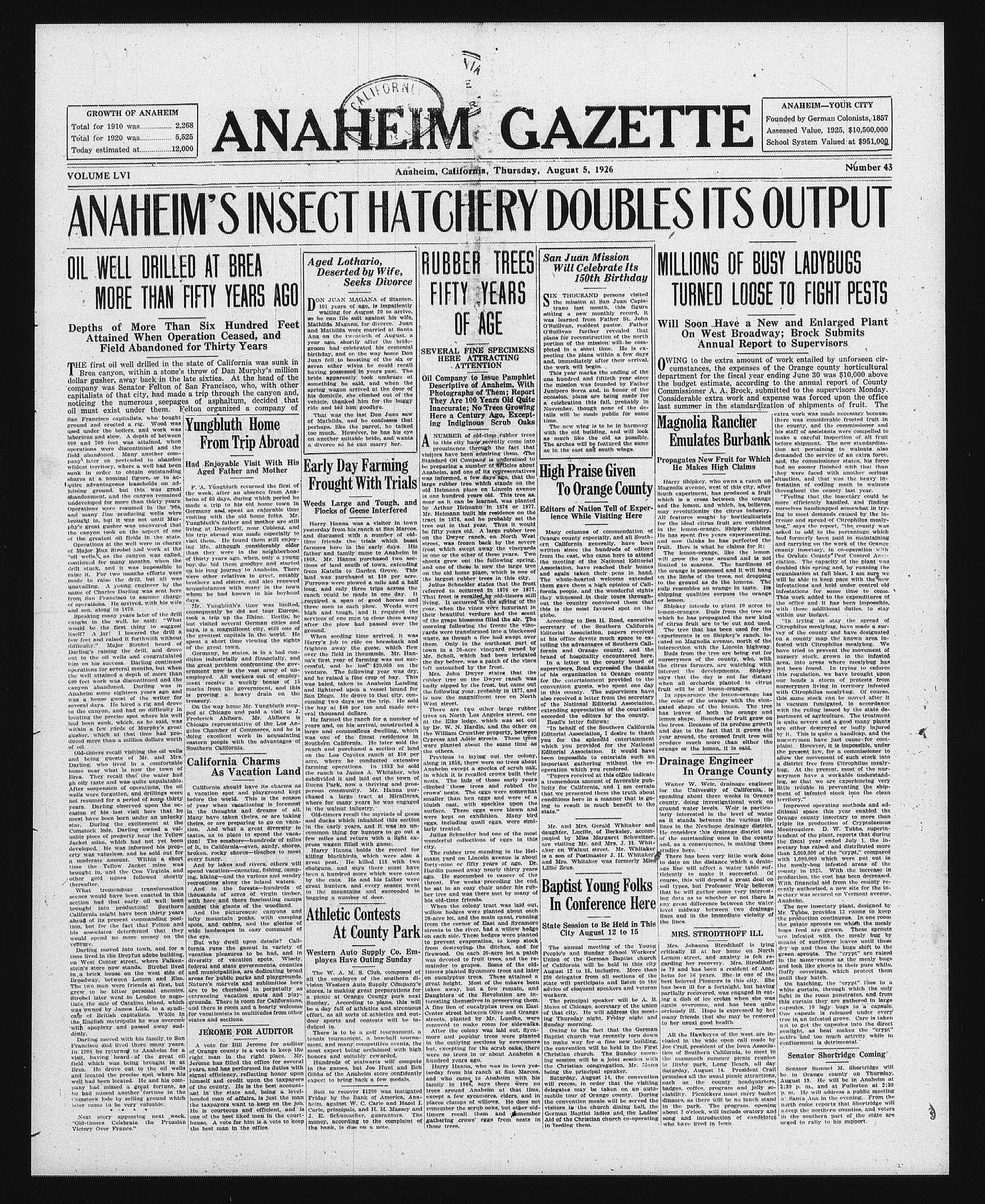
Searchable text
GROWTH OF ANAHEIM
Total for 1910 was... 2,268
Total for 1920 was... 5,525
Today estimated at...12,000
VOLUME LVI
ANAHEIM’S INSECT
OIL WELL DRILLED AT BREA
MORE THAN FIFTY YEARS AGO
Depths of More Than Six Hundred Feet
Attained When Operation Ceased, and
Field Abandoned for Thirty Years
THE first oil well drilled in the state of California was sunk in Brea canyon, within a stone’s throw of Dan Murphy’s million dollar gusher, away back in the late sixties. At the head of the company was Senator Felton of San Francisco, who, with other capitalists of that city, had made a trip through the canyon and, noticing the numerous seepages of asphaltum, decided that oil must exist under them. Felton organized a company of San Francisco capitalists, who bought ground and erected a rig. Wood was used under the boilers, and work was laborious and slow. A depth of between 600 and 700 feet was attained, when operations were discontinued and the
Aged Lothar
Deserted by
Seeks
DON JUAN MAGA
101 years of age
waiting for August
so he can file suit against Mathilda Magana, for and Mathilda were mute Ana on the twentieth year ago, shortly after groom had celebrated birthday, and on the Juan fell to boasting seven other wives having possessed in her bride apparently too something he said, spring wagon arrived his domicile, she climbed vehicle, thanked him ride and bid him good That was the last of Mathilda, and he perhaps, like the pay too much. However, on another guitable divorce so he can
THE first oil well drilled in the state of California was sunk in Brea canyon, within a stone's throw of Dan Murphy's million dollar gusher, away back in the late sixties. At the head of the company was Senator Felton of San Francisco, who, with other capitalists of that city, had made a trip through the canyon and, noticing the numerous seepages of asphaltum, decided that oil must exist under them. Felton organized a company of San Francisco capitalists, who bought ground and erected a rig. Wood was used under the boilers, and work was laborious and slow. A depth of between 600 and 700 feet was attained, when operations were discontinued and the field abandoned. Many another company later on pretended to abandon wildcat territory, where a well had been sunk in order to obtain outstanding shares at a nominal figure, or to acquire advantageous leaseholds adjoining ground, but this was great abandonment, and the canyon remained undeveloped for more than thirty years. Operations were resumed in the '90s, and many fine producing wells were brought in, but it was not until Murphy's great gusher was uncovered that the canyon took on the aspect of one of the greatest oil fields in the state.
Operations at the well were in charge of Major Max Strobel and work at the "oil wells," as the canyon was called, continued for many months, when the drill stuck, and it was impossible to raise it. For two months efforts were made to raise the drill, but all was unavailing. A young engineer by the name of Charles Darling was sent here from San Francisco to assume charge of operations. He arrived, with his wife and son, along in 1870.
Speaking many years later of the drill caught in the well, he said: "What would be the first thing to suggest itself? A jar! I lowered the drill a few feet and raised it forthwith without difficulty." Major Strobel heard of Darling's raising the drill, and drove out to the oil wells and congratulated him on his success. Darling continued operations for several months, but when the well attained a depth of more than 600 feet work was discontinued and the canyon abandoned. Darling was in Anaheim some eighteen years ago and was a house guest of the writer for several days. He hired a rig and drove to the canyon, and had no difficulty in locating the precise spot where his well had been sunk, which, as he said, was within a few yards of Murphy's great gusher, which at that time had produced more than a million dollars worth of oil.
Old-timers recall visiting the oil wells and being guests of Mr. and Mrs. Darling, who lived in a comfortable home near what is now the town of Brea. They recall that the water had an oily taste and was quite unpalatable. After suspension of operations, the oil wells were forgotten, and drilling were not resumed for a period of some thirty years. Darling observed upon the occasion of his last visit here that he must have been born under an unlucky star. During the excitement at the Cornstock lode, Darling owned a valuable piece of property near the Yellow Jacket mine, which had not yet been developed. He was informed his prop-
Yungbluth Home From Trip Abroad
Had Enjoyable Visit With His Aged Father and Mother
F. A. Yungbluth returned the first of the week, after an absence from Anaheim of 60 days, during which period he made a trip to his old home town in Germany and spent an enjoyable time visiting with the old home folks. Mr. Yungbluth's father and mother are still living at Deardorff, near Coblenz, and his trip abroad was made especially to visit them. He found them still enjoying life, although considerably older than they were in the neighborhood of thirty years ago, when only a young boy she bid them goodbye and started on his long journey to Anaheim. There were other relatives to greet, notably brothers and sisters, and also renewed acquaintances with many in the town whom he had known in his boyhood days.
Mr. Yungbluth's time was limited, consequently he did not tour Europe, took a trip up the Rhine. Berlin, he but visited several German cities and says, is a magnificent city, still one of the greatest capitals in the world. He spent a short time viewing the sights of the great town.
Germany, he states, is in a bad condition industrially and financially, and the great problem confronting the government now is the vast army of unemployed. All workers out of employment receive a weekly bonus of 15 marks from the government, and this is proving a heavy drain on the treasury.
On the way home Mr. Yungbluth stopped at Chicago and paid a visit to J. Frederick Ahlborn. Mr. Ahlborn is Chicago representative of the Los Angeles Chamber of Commerce, and he is doing excellent work in acquiring eastern people with the advantages of Southern California.
California Charms As Vacation Land
California should have its charms as a vacation spot and playground kept before the world. This is the season of year when vacationing is foremost in the thoughts and dreams of all. Many have taken theirs, or are taking theirs, or are preparing to go on vacation. And what a great diversity in tastes, as to place to spend the vacation! The seashore—hundreds of miles of it, in California—even sandy, shores,
Harry Hanna was yesterday from his ranch and discussed with all time friends the tri farmers here in the father and family camp in 1868. Mr. Hanna pursues land south of Katella to Gareland was purchased Furrows were plowed long, and only three ranch could be made required a span of three men to each plot high and tough, and services of one man to after the plow had ground.
When seeding time Harry's job to ride off frighten away the grass over the field in thoula's first year of farm cessful, and he lost venture. The followin- and he raised a fine cow was baled, taken to Aalderen upon an San Diego. He drove summing two days on a hay at $40 per ton eral thousand dollars.
He farmed the ranch years and, on his arrivel large and commodious was one of the finest Southern California ranch and purchased on the Los Coyotes acre, where he com-farming operations; the ranch to James subdivided it and laid Buena Park, now a terperous community; chased a large trac-where for many years in the walnut industry.
Old-timers recall that ducks which inhabit in the early years, a common thing for few miles and return press wagon filled with Harry Hanna hold-
and being guests of Mr. and Mrs. Darling, who lived in a comfortable home near what is now the town of Brea. They recall that the water had an oily taste and was quite unpalatable. After suspension of operations, the oil wells were forgotten, and drillings were not resumed for a period of some thirty years. Darling observed upon the occasion of his last visit here that he must have been born under an unlucky star. During the excitement at the Comstock lode, Darling owned a valuable piece of property near the Yellow Jacket mine, which had not yet been developed. He was informed his property was valueless, and he sold out for a moderate amount. Within a short time the Yellow Jacket mine was brought in, and the Con Virginia and other gold mines followed shortly thereafter.
What tremendous transformation scenes would have been enacted in this section had that early oil well been brought into production! Southern California might have been thirty years ahead of its present commanding position, but for the fact that Felton and his associates determined that they would spend no more money on the venture.
Darling moved into town, and for a time lived in the Dreyfus adobe building, on West Center street, where Falkenstein's store now stands. Strobel lived in a brick house on the west side of Broadway, between Lemon and Elm. The two men were friends at first, but grew to be bitter personal enemies. Strobel later went to London to negotiate the sale of Catalina island, which was owned by James Lick, to a syndicate of British capitalists. While in the English metropolis he was overcame with apoplexy and passed away suddenly.
Darling moved with his family to San Francisco and lived there many years. In 1908 he returned to Anaheim for a visit, having heard of the great oil field which was being brought in at Brea. He drove out to the oil wells and located the precise spot where his well had been located. He and his company had missed a great fortune, as he had missed another fortune in the Comstock lode by selling ground which later came to be very valuable.
Next story appearing next week, "Old-timers Celebrate the Prussian Victory Over France."
California should have its charms as a vacation spot and playground kept before the world. This is the season of year when vacationing is foremost in the thoughts and dreams of all. Many have taken theirs, or are taking theirs, or are preparing to go on vacation. And what a great diversity in tastes, as to place to spend the vacation! The seashore—hundreds of miles of it, in California—even, sandy, shores, broken, rocky shores—leaches to meet every fancy.
And by lakes and rivers, others will spend vacation—a caoning, fishing, camping, hiking—and the various and sundry recreations along the inland waters.
And in the forests—hundreds of thousands of acres of virgin timber, with here and there fascinating camps amidst the giants of the woodland.
And the picturesque canyons and lofty mountain peaks, with camping spots, and cabins, and the glories of wide landscapes in easy command of the eye.
But why dwell upon details? California runs the gamut in variety of vacation pleasures to be had, and in diversity of vacation spots. Wisely federal and state governments, counties and municipalities, are dedicating broad areas for public parks and playgrounds. Nature's marvels and sublimities here are to be cherished in perpetuity as entrancing vacation spots and playgrounds. There is room for Californians, and there is room and a hearty welcome for vacationists in multitudes from other states and sections.
JEROME FOR AUDITOR
A vote for Bill Jerome for auditor of Orange county is a vote to keep the right man in the right place. Mr. Jerome has filled the office for several years, and has performed its duties with signal efficiency, reflecting honor upon himself and credit upon the taxpayers of the county. He is the best accountant in the state and, being a level-headed man of affairs, is just the man the taxpayers want to keep on the job. He is courteous and efficient, and is one of the best liked men in the courthouse. A vote for him is a vote to keep the best man in the office.
Athletic Coat At Court
Western Auto Service Have Out
The W. A. M. S. all the employees of vision Western Auto stores, is making great a picnic at Orange Sunday. According to a day full of athletic effort, as all sorts of door sports and conduited in.
There is to be a tennis tournament, ample and many com-monest expert being admired honors and suitably expected to bring back.
Suit to recover $1 Friday by the Bank helm against W. C. Carle, principals, and J. E. Schumacher, money, according to the bank, is due on
AHEIM GAZETTE
Anaheim, California, Thursday, August 5, 1926
SECT HATCHERY DOUBLES
Aged Lothario,
Deserted by Wife,
Seeks Divorce
DON JUAN MAGANA of Stanton,
101 years of age, is impatiently waiting for August 20 to arrive,
so he can file suit against his wife,
Mathilda Magana, for divorce.
Juan and Mathilda were married at Santa Ana on the twentieth of August, a year ago, shortly after the bridegroom had celebrated his centennial birthday, and on the way home Don Juan fell to boasting of the six or seven other wives he could recall having possessed in years past. The bride apparently took umbrage at something he said, and when the spring wagon arrived at the door of his domicile, she climbed out of the vehicle, thanked him for the buggy ride and bid him goodbye.
That was the last Don Juan saw of Mathilda, and he confesses that perhaps, like the parrot, he talked too much. However, he has his eye on another suitable bride, and wants a divorce so he can marry her.
RUBBER TREES FIFTY YEARS OF AGE
SEVERAL FINE SPECIMENS HERE ATTRACTING ATTENTION
Oil Company to Issue Pamphlet Descriptive of Anaheim, With Photographs of Them; Report They Are 100 Years Old Quite Inaccurate; No Trees Growing Here a Century Ago, Excepting Indiginous Scrub Oaks
NUMBER of old-time rubber trees in this city have recently come into prominence through the fact that
San Juan Mission Will Celebrate Its 150th Birthday
SIX THOUSAND persons visited the mission at San Juan Capistrano last month, this figure setting a new monthly record. It was learned from Father St. John O'Sullivan, resident pastor. Father O'Sullivan further revealed that plans for reconstruction of the north portion of the mission will be completed in a short time. He is expecting the plans within a few days and, immediately after their arrival, the work will begin.
This year marks the ending of the one hundred and fiftieth year since the mission was founded by Father Junlipero Serra and, in honor of the occasion, plans are being made for a celebration this fall, probably in November, though none of the details will be made public for some time.
The new wing is to be in harmony with the old building, and will look as much like the old as possible. The arches will be featured the same in the port and south wings.
Early Day Farming Frought With Trials
Weeds Large and Tough, and Flocks of Geese Interfered
Harry Hanna was a visitor in town yesterday from his ranch at San Marcos, and discussed with a number of old-time friends the trials which beset farmers here in the early days. His father and family came to Anaheim in 1868. Mr. Hanna purchased two sections of land south of town, extending from Katella to Garden Grove. This land was purchased at $10 per acre. Furrows were plowed a mile and a half long, and only three trips across the ranch could be made in one day. It required a span of good horses and three men to each plow. Weeds were high and tough, and it required the services of one man to clear them away after the plow had passed over the ground.
When seeding time arrived, it was Harry's job to ride on horseback and frighten away the geese, which flew over the field in thousands. Mr. Hana's first year of farming was not successful, and he lost $20,000 on the venture. The following year was dry, and he raised a fine crop of hay. This was baled, taken to Anaheim Landing and lightened upon a vessel bound for San Diego. He drove to that city, consuming two days on the trip. He sold the hay at $40 per ton and made several thousand dollars.
He farmed the ranch for a number of years and, on his arrival, constructed a large and commodious dwelling, which was one of the finest residences in Southern California. He later sold the ranch and purchased a section of land on the Los Coyotes ranch at $50 per acre, where he conducted extensive farming operations. In 1883 he sold the ranch to James A. Whitaker, who subdivided it and laid out the town of Buena Park, now a thriving and prosperous community. Mr. Hanna purchased a large tract at Miraflores, where for many years he was engaged in the walnut industry.
Old-timers recall the myriads of geese and ducks which inhabited this section in the early years, and it was no uncommon thing for hunters to go out a few miles and return with a light express wagon filled with game.
Harry Hanna holds the record for
HERE ATTRACTING ATTENTION
Oil Company to Issue Pamphlet Descriptive of Anaheim, With Photographs of Them; Report They Are 100 Years Old Quite Inaccurate; No Trees Growing Here a Century Ago, Excepting Indiginous Scrub Oaks
A NUMBER of old-time rubber trees in this city have recently come into prominence through the fact that visitors have been admiring them. The Standard Oil Company is understood to be preparing a number of articles about Anaheim, and one of its representatives was informed, a few days ago, that the large rubber tree which stands on the old Helmann place on Lincoln avenue is one hundred years old. This tree as near as it can be learned, was planted by Arthur Helmann in 1876 or 1877. Mr. Helmann built his residence on the tract in 1876, and he probably set the tree out in that year. Thus it would be fifty years old. A large rubber tree on the Dwyer ranch, on North West street, was frozen back by the severe frost which swept away the vineyards in one or other of these years. Two shoots grew out the following spring, and one of these is now the large tree on the old home place, which is one of the largest rubber trees in this city.
Julius Schneider states that the frost referred to occurred in 1876 or 1877. That frost is recalled by old-timers still living. It occurred in the spring of the year, when the vines were luxuriant in their beautiful verdure and the scent of the grape blossoms filled the air. The morning following the freeze the vineyards were transformed into a blackened waste, as though a fire had swept over them. Only in the northeast part of town in a 20-acre vineyard owned by Mr. Scholl, which had been irrigated the day before, was a patch of the vines left untouched by the frost.
Mrs. John Dwyer states that the rubber tree on the Dwyer ranch was badly nipped by the frost, but came out the following year, probably in 1877, and is now the magnificent tree on North West street.
There are two other large rubber trees on North Los Angeles street, one at the Elks lodge, which was set out by Dr. W. N. Hardin, and the other on William Crowther property, between Cypress and Adelaide streets. These trees were planted about the same time as the others.
Previous to laying out the colony along in 1858, there were no trees about Anaheim except a species of scrub oak in which it is recalled crowns built their nests. The lads of those early years climbed these trees and robbed the crowns' nests. The eggs were somewhat smaller than hen eggs and were of a bluish cast, with speckles upon the surface. These eggs were blown and were kept on exhibition. Many bird eggs, including quail eggs, were similarly treated.
Julius Schneider had one of the most wonderful collections of eggs in this city.
Many columns of commendation of Orange county especially, and all Southern California generally, have been written since the hundreds of editors from the east, who came here to attend the meeting of the National Editorial Association, have reached their homes and again taken their pens in hand. The whole-hearted welcome extended them gave them a high opinion of California people, and the wonderful sights they witnessed in their tours throughout the country convinced them that this is the most favored spot on the globe.
According to Ben H. Read, executive secretary of the Southern California Editorial Association, papers received at his office devote much space to extolling the advantages of Southern California and Orange county, and the brand of hospitality encountered here.
In a letter to the county board of supervisors, Read expressed the thanks of his organization to Orange county for the entertainment provided to the convention guests, who spent one day in this county. The supervisors have also received a letter from the secretary of the National Editorial Association, extending appreciation of the courtesies accorded by the county.
Read's letter follows:
"In behalf of the Southern California Editorial Association, I desire to thank you for the splendid entertainment which you provided for the National Editorial Association. It would have been impossible to entertain such an important gathering without the cooperation which you rendered."
Papers received at this office indicate a tremendous amount of favorable publicity for California, and I am certain that we presented them the truth about conditions here in a manner that is going to result in much benefit to the state."
Mr. and Mrs. Gerald Whitaker and daughter, Lucille, of Berkeley, accompanied by Miss Margaret Schweitzer, are visiting Mr. and Mrs. J. H. Whitaker on Walnut street. Mr. Whitaker is to be in harmony with the old building, and will look as much like the old as possible. The arches will be featured the same as in the east and south wings.
High Praise Given To Orange County
Editors of Nation Tell of Experience While Visiting Here
Many columns of commendation of Orange county especially, and all Southern California generally, have been written since the hundreds of editors from the east, who came here to attend the meeting of the National Editorial Association, have reached their homes and again taken their pens in hand. The whole-hearted welcome extended them gave them a high opinion of California people, and the wonderful sights they witnessed in their tours throughout the country convinced them that this is the most favored spot on the globe.
According to Ben H. Read, executive secretary of the Southern California Editorial Association, papers received at his office devote much space to extolling the advantages of Southern California and Orange county, and the brand of hospitality encountered here.
In a letter to the county board of supervisors, Read expressed the thanks of his organization to Orange county for the entertainment provided to the convention guests, who spent one day in this county. The supervisors have also received a letter from the secretary of the National Editorial Association, extending appreciation of the courtesies accorded by the county.
Read's letter follows:
"In behalf of the Southern California Editorial Association, I desire to thank you for the splendid entertainment which you provided for the National Editorial Association. It would have been impossible to entertain such an important gathering without the cooperation which you rendered."
Mr. and Mrs. Gerald Whitaker and daughter, Lucille, of Berkeley, accompanied by Miss Margaret Schweitzer, are visiting Mr. and Mrs. J. H. Whitaker on Walnut street. Mr. Whitaker is to be in harmony with the old building, and will look as much like the old as possible. The arches will be featured the same as in the east and south wings.
Shipping into lemon-orange which he has citrus fruit.
The tree experiments cured on Maggie intersection with Buds from nurserymen on citrus fruit will be interesting.
In appearance color of grapes has leaves o lemon shape.
The trees. Bee due to year around produce much orange or lemon juice.
Drainage In
Walter W., tor for Umpqua spending abound county; doing ground water larvae interest as it stands lines in He considers department department budget Commission Considerable last summer
Athletic Contests At County Park
Western Auto Supply Co. Employes Have Outing Sunday
The W. A. M. S. Club, composed of all the employees of the southern division Western Auto Supply Company's stores, is making great preparations for a picnic at Orange County park next Sunday. According to plans, this will be a day full of athletics and strenuous effort, as all sorts of athletics and outdoor sports and contests will be indulged in.
There is to be a golf tournament, a tennis tournament, a baseball tournament, and many competitive events, the most expert being acclaimed with high honors and suitably rewarded.
Hundreds of stalwarts will compete in the games, but Joe Hunt and Bob Gibbs of the Anaheim store confidently expect to bring back a few medals.
Suit to recover $1200 was instigated Friday by the Bank of America, Anaheim, against W. C. Carle and Hazel I. Carle, principals, and H. M. Massey and J. E. Schumacher, guarantors. The money, according to the complaint of the bank, is due on a note.
Previous to laying out the colony, along in 1858, there were no trees about Anaheim except a species of scrub oak, in which it is recalled crowds built their nests. The lads of those early years climbed these trees and robbed the crow's nests. The eggs were somewhat smaller than hen eggs and were of a bluish cast, with speckles upon the surface. These eggs were blown and were kept on exhibition. Many bird eggs, including quail eggs, were similarly treated.
Julius Schnelder had one of the most wonderful collections of eggs in this city.
The rubber tree standing in the Helmann yard on Lincoln avenue is about forty-nine or fifty years of age. Dr. Hardin passed away nearly thirty years ago. He succumbed to cancer of the throat. For weeks preceding the end he sat in an easy chair under his rubber tree and was there met by many of his old-time friends.
When the colony tract was laid out, willow hedges were planted about each 20-acre lot, and the main canal, running from the corner of East and Sycamore streets to the river, had a willow hedge on each side. These hedges were planted to prevent evaporation, to keep stock from destroying the ditches, and for firewood. On each 20-acre lot a patch was devoted to fruit trees, and the remainder to grapes. Some of the oldtimers planted Sycamore trees and later on eucalyptus trees. These attained a great height. Most of the mhave been taken away, but a few remain, and Daughters of the Revolution are interesting themselves in preserving them. A fine len of eucalyptus trees on East Center street between Olive and Orange streets, planted by Mr. Luedke, were removed to make room for sidewalks.
After the colony was laid out, Sycamore and popular trees were planted in the outlying sections by newcomers but, excepting for the scrub oaks, there were no trees in or about Anaheim a hundred years ago.
Harry Hanna, who was in town yesterday from his ranch at San Marcos, and who came to Anaheim with his family in 1868, says there were no trees around Anaheim at that time, except a few sycamores, elders, and in places clumps of willows. He does not remember the scrub oaks, but other old-timers recall them and remember gathering crows' eggs from nests in those trees.
Mr. and Mrs. Gerald Whitaker and daughter, Lucille, of Berkeley, accompanied by Miss Margaret Schweitzer, are visiting Mr. and Mrs. J. H. Whitaker on Walnut street. Mr. Whitaker is a son of Postmaster J. H. Whitaker and Mrs. Whitaker was formerly Miss Lillie Zeus.
Baptist Young Folks In Conference Here
State Session to Be Held in This City August 12 to 15
The annual meeting of the Young People's and Sunday School Workers' Union of the German Baptist church of California will be held in this city August 12 to 15, inclusive. More than 200 delegates from all sections of the state will participate and listen to the advice of eloquent speakers and veteran workers.
The principal speaker will be A. B. Mann of Chicago, secretary of the union of that city. He will address the meeting Thursday night. Friday night and Sunday morning.
Owing to the fact that the German Baptist church was recently torn down to make way for a fine new building, the convention will be held in the First Christian church. The Sunday morning session will be a joint session with the Christian congregation, Mr. Mann being the principal speaker.
Saturday, August 14, the convention will recess, in order that the visiting delegates may be taken on an automobile tour of Orange county. During the convention meals will be served the visitors in the church dining hall, the German Baptist ladies and the Ladies' Aid of the Christian church co-operating in feeding them.
Mrs. John critically ill Lemon street gardening here is 79 and has him for 56 best beloved has been ill partially receiving a dish or again overcook seriously ill many friend to her usual all the Hs included in the Joe Crull praction of South mamma in Bixby park Saturday. A promises all such as badges, coffeeability. Pic dinners, as is in the pari about 2 o'clock song and who have l
ETTE
ANAHEIM—YOUR CITY
Founded by German Colonists, 1857
Assessed Value, 1925, $10,500,000
School System Valued at $951,000
Number 43
BLES ITS OUTPUT
MILLIONS OF BUSY LADYBUGS
TURNED LOOSE TO FIGHT PESTS
Will Soon Have a New and Enlarged Plant
On West Broadway; Brock Submits
Annual Report to Supervisors
OWING to the extra amount of work entailed by unforseen circumstances, the expenses of the Orange county horticultural department for the fiscal year ending June 30 was $10,000 above the budget estimate, according to the annual report of County Commissioner A. A. Brock, submitted to the supervisors Monday. Considerable extra work and expense was forced upon the office last summer in the standardization of shipments of fruit. The
Magnolia Rancher
Emulates Burbank
extra work was made necessary because there was considerable frosted fruit in the county, and the commissioner and his staff of assistants were compelled to make a careful inspection of all fruit before shipment. The new standardiza-
OWING to the extra amount of work entailed by unforeseen circumstances, the expenses of the Orange county horticultural department for the fiscal year ending June 30 was $10,000 above the budget estimate, according to the annual report of County Commissioner A. A. Brock, submitted to the supervisors Monday. Considerable extra work and expense was forced upon the office last summer in the standardization of shipments of fruit. The extra work was made necessary because there was considerable frosted fruit in the county, and the commissioner and his staff of assistants were compelled to make a careful inspection of all fruit before shipment. The new standardization act pertaining to walnuts also demanded the service of an extra force, and, the commissioner states, his force had no sooner finished with that than they were faced with another serious situation, and that was the heavy infestation of codling moth in walnuts throughout the county last year.
"Feeling that the insectary could be more efficiently handled, and finding ourselves handicapped somewhat in trying to meet demands caused by the increase and spread-of Citrophilus mealybug," says the report, "the county was asked to add to the percentage which had formerly been paid in maintaining and carrying on the work of the Orange county insectary, in co-operation with the Orange County Pest Control Association. The capacity of the plant was doubled this spring and, by running the organization at full blast, I am sure we will be able to keep pace with the new infestations and hold under control old infestations for some time to come. This work added to the expenditures of the office and it has been impossible, with these additional duties, to stay within our budget.
"In trying to stay the spread of Citrophilus mealybug, have made a survey of the county and have designated on a county map the known area infested with Citrophilus mealybug. We have tried to prevent the movement of nurserymen of the county, who, with the citrus farmers, are watching with interest the developments. Shipkey says that the day is not far distant when all orchards planted to citrus fruit will be of lemon-oranges.
In appearance the lemon-orange has the color of the orange with the elongated shape of the lemon. The tree has leaves of both the orange and lemon shape. Bunches of fruit grow on the trees. Because of its profuse growth and due to the fact that it grows the year around, the crossed fruit tree will produce much more than either the orange or the lemon, it is said.
Drainage Engineer In Orange County
Walter W. Weir, drainage engineer for the University of California, is spending about three weeks in Orange county, doing investigational work on ground water levels. Weir is particularly interested in the level of water as it stands between the various tile lines in the Newhope drainage district. He considers this drainage district one of the outstanding ones in the county and, as a consequence, is making these studies here."
Magnolia Rancher Emulates Burbank
Propagates New Fruit for Which He Makes High Claims
Harry Shipkey, who owns a ranch on Magnolia avenue, west of this city, after much experiment, has produced a fruit which is a cross between the orange and the lemon, and which, he believes, may revolutionize the citrus industry. All features sought by horticulturists for the ideal citrus fruit are combined in the lemon-orange. Shipkey claims. He has spent five years experimenting, and now thinks he has perfected the fruit. Here is what he claims for it:
The lemon-orange, like the lemon will grow the year around and is not limited to seasons. The hardiness of the orange is possessed and it will hang on the limbs of the trees, not dropping to the ground as do the lemons. The pulp resembles an orange in taste. Its shipping qualities surpass the orange or lemon.
Shipkey intends to plant 10 acres to lemon-oranges. Buds from the tree on which he has propagated the new kind of citrus fruit are to be cut and used.
The tree that has been used for the experiments is on Shipkey's ranch, located on Magnolia avenue, north of the intersection with the Lincoln highway.
Buds from the tree are being cut for nurserymen of the county, who, with the citrus farmers, are watching with interest the developments. Shipkey says that the day is not far distant when all orchards planted to citrus fruit will be of lemon-oranges.
In appearance the lemon-orange has the color of the orange with the elongated shape of the lemon. The tree has leaves of both the orange and lemon shape. Bunches of fruit grow on the trees. Because of its profuse growth and due to the fact that it grows the year around, the crossed fruit tree will produce much more than either the orange or the lemon, it is said.
Drainage Engineer In Orange County
Walter W. Weir, drainage engineer for the University of California, is spending about three weeks in Orange county, doing investigational work on ground water levels. Weir is particularly interested in the level of water as it stands between the various tile lines in the Newhope drainage district. He considers this drainage district one of the outstanding ones in the county and, as a consequence, is making these studies here.
There was considerable frosted fruit in the county, and the commissioner and his staff of assistants were compelled to make a careful inspection of all fruit before shipment. The new standardization act pertaining to walnuts also demanded the service of an extra force, and, the commissioner states, his force had no sooner finished with that than they were faced with another serious situation, and that was the heavy infestation of codling moth in walnuts throughout the county last year.
"Feeling that the insectary could be more efficiently handled, and finding ourselves handicapped somewhat in trying to meet demands caused by the increase and spread-of Citrophilus mealybug," says the report, "the county was asked to add to the percentage which had formerly been paid in maintaining and carrying on the work of the Orange county insectary, in co-operation with the Orange County Pest Control Association. The capacity of the plant was doubled this spring and, by running the organization at full blast, I am sure we will be able to keep pace with the new infestations and hold under control old infestations for some time to come. This work added to the expenditures of the office and it has been impossible, with these additional duties, to stay within our budget.
"In trying to stay the spread of Citrophilus mealybug, have made a survey of the county and have designated on a county map the known area infested with Citrophilus mealybug. We have tried to prevent the movement of nurserymen of the county, who, with the citrus farmers, are watching with interest the developments. Shipkey says that the day is not far distant when all orchards planted to citrus fruit will be of lemon-oranges.
In appearance the lemon-orange has the color of the orange with the elongated shape of the lemon. The tree has leaves of both the orange and lemon shape. Bunches of fruit grow on the trees. Because of its profuse growth and due to the fact that it grows the year around, the crossed fruit tree will produce much more than either the orange or the lemon, it is said."
Drainage Engineer In Orange County
Walter W. Weir, drainage engineer for the University of California, is spending about three weeks in Orange county, doing investigational work on ground water levels. Weir is particularly interested in the level of water as it stands between the various tile lines in the Newhope drainage district. He considers this drainage district one of the outstanding ones in the county and, as a consequence, is making these studies here.
There has been very little work done to date on the distance which a drainage line will affect a water table sufficiently to make it successful. Of course, this will depend a great deal on soil types, but Professor Weir believes that he will gather some very interesting data as to whether or not there is any great difference between the water level midway between two drainage lines and in the immediate vicinity of the lines.
MRS. STRODTHOFF ILL
Mrs. Johanna Strodthoff is lying critically ill at her home on North Lemon street, and anxiety is felt regarding her recovery. Mrs. Strodthoff is 79 and has been a resident of Anaheim for 56 years. She is one of the best beloved Ploneers in this city. She has been ill for a fortnight, but having partially recovered, was engaged in eating a dish of ice cream when she was again overcome, and has been quite seriously ill. Hope is expressed by her many friends that she may be restored to her usual good health.
All the Hawkeyes of the west are included in the wide open call made by Joe Crall, president of the Iowa Association of Southern California, to meet in the mammoth summer picnic reunion in Bixby park, Long Beach, all day Saturday, August 14. President Crall promises all the usual picnic attractions, such as the county headquarters, badges, coffee program and jolly sociability. Ploneers must carry basket dinners, as there will be no lunch stand in the park. The program, opening about 2 o'clock, will include oratory and song and introduction of candidates who have lived in Iowa.
Improved operating methods and additional space this year enabled the Orange county insectary to more than triple its production of Cryptolaemus Montrouziere. D. W. Tubbs, superintendent of the plant, reports that during the fiscal year ended July 1, the insectary has raised and distributed more than 3,000,000 of the "crypt," compared with 1,000,000 which were put out in the mealy-bug infested areas of the county in 1925. With the increase in production, the cost has been decreased. With financial aid from the county recently authorized, a new site for the insectary was secured on Vermont avenue, Anaheim.
The new insectary plant, designed by Mr. Tubbs, provides 12 rooms to keep the production continuous. In one room the potato sprouts on which the mealy bugs feed are grown. These sprouts are infested with the mealy bug by means of sunflower leaves until these dry up and then the bugs shift to the green sprouts. The "crypt" are raised in the same rooms as the mealy bugs and look like ghosts in their pure white, fluffy coverings, which protect them until they hatch.
On hatching, the "crypt" flies to a white curtain, through which the only light in the room penetrates, and from this curtain they are gathered in large capsules. 10 lady bugs to a capsule. One capsule is released under every tree in an infested grove. Care is taken not to get the capsules into the direct sunlight, as heat makes the "crypt" active and too much activity while in confinement is detrimental.
Senator Shortridge Coming
Senator Samuel M. Shortridge will be in Orange county on Thursday, August 19. He will be in Anaheim at 3:30 p.m., and at Fullerton at 2:30 p.m. He will address a public meeting at Santa Ana in the evening. From the north come reports that Shortridge will sweep the northern counties, and voters in the southern part of the state are urged to rally to his support.