anaheim-gazette 1926-07-22
Scanned page
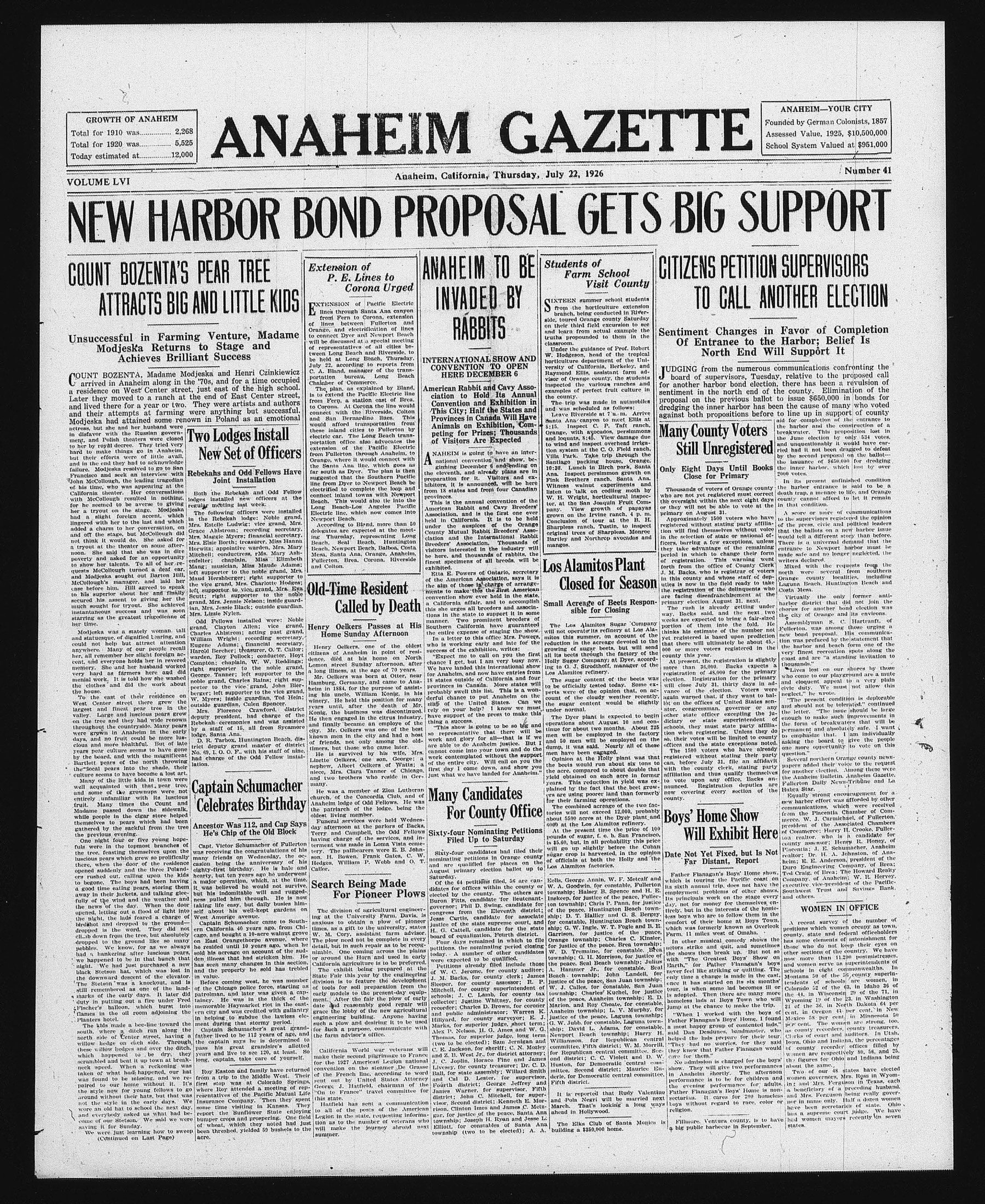
Searchable text
GROWTH OF ANAHEIM
Total for 1910 was... 2,268
Total for 1920 was... 5,525
Today estimated at...12,000
VOLUME LVI
NEW HARBOR BOND
COUNT BOZENTA'S PEAR TREE
ATTRACTS BIG AND LITTLE KIDS
Unsuccessful in Farming Venture, Madame Modjeska Returns to Stage and Achieves Brilliant Success
COUNT BOZENTA, Madame Modjeska and Henri Czinkiewicz arrived in Anaheim along in the '70s, and for a time occupied a residence on West Center street, just east of the high school. Later they moved to a ranch at the end of East Center street, and lived there for a year or two. They were artists and authors and their attempts at farming were anything but successful. Modjeska had attained some renown in Poland as an emotional actress, but she and her husband were in disfavor with the Russian government, and Polish theaters were closed to her by royal decree. They tried very
Achieves Brilliant Success
COUNT BOZENTA, Madame Modjeska and Henri Czinkiewicz arrived in Anaheim along in the '70s, and for a time occupied a residence on West Center street, just east of the high school. Later they moved to a ranch at the end of East Center street, and lived there for a year or two. They were artists and authors and their attempts at farming were anything but successful. Modjeska had attained some renown in Poland as an emotional actress, but she and her husband were in disfavor with the Russian government, and Polish theaters were closed to her by royal decree. They tried very hard to make things go in Anaheim, but their efforts were of little avail, and in the end they had to acknowledge failure. Modjeska resolved to go to San Francisco and seek an interview with John McCollough, the leading tragedian of his time, who was appearing at the California theater. Her conversations with McCollough resulted in nothing, for he seemed to be averse to giving her a tryout on the stage. Modjeska had a slight foreign accent, which lingered with her to the last and which added a charm to her conversation, on and off the stage, but McCollough did not think it would do. She asked for a tryout at the theater on some afternoon. She said that she was in dire poverty and asked for an opportunity to show her talents. To all of her requests McCollough turned a deaf ear, and Modjeska sought out Barton Hill, McCollough's manager, and laid her case before him. Hill agreed to speak to his superior about her and finally secured his assent to giving her the much sought for tryout. She achieved instantaneous success and was soon starring as the greatest tragedienne of her time.
Modjeska was a stately woman, tall and statuesque, of dignified bearing, and could not help but attract attention anywhere. Many of our people recall her, all remember her slight foreign accent, and everyone holds her in revered memory. She and her husband worked very hard as farmers here and did menial work. It is told how she washed the clothes and did the work about the house.
To the east of their residence on West Center street there grew the largest and finest pear tree in the valley. Large and luscious pears grew on the tree and they had wide renown throughout the countryside. Many pears were grown in Anaheim in the early days, and no fruit could be more luscious and more healthful. But of late years pear culture seems to have gone by the board, and with the magnificent Bartlett pears of the north throwing the local pears into the shade, their culture seems to have become a lost art.
Many of the little kids in town were well acquainted with that, pear tree, and some of the grownups were not entirely unfamiliar with its luscious fruit. Many times the Count and Madame passed down the sidewalk, while people in the cigar store helped themselves to pears which had been gathered by the sackful from the tree the previous evening.
One night four or five young hopefuls were in the topmost branches of the actress, but she and her husband were in disfavor with the Russian government, and Polish theaters were closed to her by royal decree. They tried very hard to make things go in Anaheim, but their efforts were of little avail, and in the end they had to acknowledge failure. Modjeska resolved to go to San Francisco and seek an interview with John McCollough, the leading tragedian of his time, who was appearing at the California theater. Her conversations with McCollough resulted in nothing, for he seemed to be averse to giving her a tryout on the stage. Modjeska had a slight foreign accent, which lingered with her to the last and which added a charm to her conversation, on and off the stage, but McCollough did not think it would do. She asked for a tryout at the theater on some afternoon. She said that she was in dire poverty and asked for an opportunity to show her talents. To all of her requests McCollough turned a deaf ear, and Modjeska sought out Barton Hill, McCollough's manager, and laid her case before him. Hill agreed to speak to his superior about her and finally secured his assent to giving her the much sought for tryout. She achieved instantaneous success and was soon starring as the greatest tragedienne of her time.
Modjeska was a stately woman, tall and statuesque, of dignified bearing, and could not help but attract attention anywhere. Many of our people recall her, all remember her slight foreign accent, and everyone holds her in revered memory. She and her husband worked very hard as farmers here and did menial work. It is told how she washed the clothes and did the work about the house.
To the east of their residence on West Center street there grew the largest and finest pear tree in the valley. Large and luscious pears grew on the tree and they had wide renown throughout the countryside. Many pears were grown in Anaheim in the early days, and no fruit could be more luscious and more healthful. But of late years pear culture seems to have gone by the board, and with the magnificent Bartlett pears of the north throwing the local pears into the shade, their culture seems to have become a lost art.
Many of the little kids in town were well acquainted with that, pear tree, and some of the grownups were not entirely unfamiliar with its luscious fruit. Many times the Count and Madame passed down the sidewalk, while people in the cigar store helped themselves to pears which had been gathered by the sackful from the tree the previous evening.
One night four or five young hopefuls were in the topmost branches of the actress, but she and her husband were in disfavor with the Russian government, and Polish theaters were closed to her by royal decree. They tried very hard to make things go in Anaheim, but their efforts were of little avail, and in the end they had to acknowledge failure. Modjeska resolved to go to San Francisco and seek an interview with John McCollough, the leading tragedian of his time, who was appearing at the California theater. Her conversations with McCollough resulted in nothing, for he seemed to be averse to giving her a tryout on the stage. Modjeska had a slight foreign accent, which lingered with her to the last and which added a charm to her conversation, on and off the stage, but McCollough did not think it would do. She asked for a tryout at the theater on some afternoon. She said that she was in dire poverty and asked for an opportunity to show her talents. To all of her requests McCollough turned a deaf ear, and Modjeska sought out Barton Hill, McCollough's manager, and laid her case before him. Hill agreed to speak to his superior about her and finally secured his assent to giving her the much sought for tryout. She achieved instantaneous success and was soon starring as the greatest tragedienne of her time.
Modjeska was a stately woman, tall and statuesque, of dignified bearing, and could not help but attract attention anywhere. Many of our people recall her, all remember her slight foreign accent, and everyone holds her in revered memory. She and her husband worked very hard as farmers here and did menial work. It is told how she washed the clothes and did the work about the house.
To the east of their residence on West Center street there grew the largest and finest pear tree in the valley. Large and luscious pears grew on the tree and they had wide renown throughout the countryside. Many pears were grown in Anaheim in the early days, and no fruit could be more luscious and more healthful. But of late years pear culture seems to have gone by the board, and with the magnificent Bartlett pears of the north throwing the local pears into the shade, their culture seems to have become a lost art.
Many of the little kids in town were well acquainted with that, pear tree, and some of the grownups were not entirely unfamiliar with its luscious fruit. Many times the Count and Madame passed down the sidewalk, while people in the cigar store helped themselves to pears which had been gathered by the sackful from the tree the previous evening.
One night four or five young hopefuls were in the topmost branches of the actress, but she和her husband were in disfavor withthe Russian government,and Polishtheaterswereclosedtoherbyroyaldecrease.ThefollowingofficerswereinstalledintheRebekahlodge:Noblegrand,mrs.EstelleLudwig;vicegrand,mrs.GraceAhlstrom;recordingsecretary,mrs.MaggleMyers;financialsecretary,mrs.ElsieBorth;treasurer,MissHannaHorwitz;appointivewarden,mrs.MaryMitchell;conductress,rMs.MaryAshenfelter;chaplain,MissElizabethMang;musician,MissMaudeAdams;leftsupportertothenoblegrand,mrs.MaudHershberger;rightsupportertothevicegrand,mrs.EyaScutt;rightsupportertothenoblegrand,mrs.Jenniele Nelson;insideguardian,mrs.JessieBlack;outsideguardian,mrs.LizzieNylen.
Odd Fellows installed were: Noblegrand,Clapton Allen; vicegrandCharlesAhlstrom;actingpastgrandWilliamWright;recordingsecretary,HaroldBercher;treasurer.O.T.Callor;warden,RoyPollock;conductor,HoyCompton;chaplain.W.W.Reddings;rightsupportertothenoblegrand,CherylRains;rightsupportertothevicegrand,johnBierberger;leftsupportertothevicegrand W.Myers;insideguardian,TedHein;outsideguardian,CulenSpencer.
Mrs.FlorenceCrawford,district deputy president,hadchargeoftheRebekahceremoniesandwasassistedbya staffof15.allfromSycamorelodge,SantaAna.
D.R.Tarbox,HuntingtonBeach,district deputy grandmasterofdistrictNo.69.I.O.O.F.,withhis staffof nine,hadchargeoftheOddFellowinstallation.
CaptainSchumacherCelebratesBirthday
AncestorWas112,andCapSaysHe'SChipoftheOldBlock
Capt.VictorSchumacherOfFullerton
The plan.asexplisitistoextendthePacifromFerg,astatioCorona.AtCoronconnectwiththeHanSanBernardlinwouldaffordtransmittheinlandcitieselectriccar.TheLoportationofficealsoextensionofthefromFullertonthOrangewhereitwowedtheSantaAnalinefarasDyer,suggestedthatthelinefromDyertoNelectrifiedtocomplementinlandtownBeachThiswouldLongBeach-LosElectricline,theNewportBeach.
AccordingtoBler delegatesareexpectingThursday,reregionalBeach.SealBeach.NewportBeachMesa,SantaAna,Cullerton.Brea,Cullerton.
Old-TimeRCalled
HenryOelkersHomeSunday
HenryOelkers,cousitizensofAnaheimdence,diedathisLemon街Sundayalongillness.attherimin1884.forthinkingihuncle.Willwinery.HewheldthisyearsuntilafterKonig,thebusinessHethenengagedinandfinallybecamecityMr.Oelkerswomenmeninthecowoffriends.notonlytimersbutthosewhohissurvivedLizetteOelkers.onnephew AlbertOelkerpiece,Mrs.ClaraTandtwobrotherswemany.
Hewasmemberschurch.ofTheCondeAnnaheimlodgeofOneworldlivingmemberFuneralservicesdayafternoonAtTerryandCampher havingchargeofthetermentwasmadeilternothem
Captain Schumacher Celebrates Birthday
Ancestor Was 112, and Cap Says He's Chip of the Old Block
Capt. Victor Schumacher of Fullerton was receiving the congratulations of his many friends on Wednesday, the occasion being the anniversary of his eighty-first birthday. He is hale and hearty, but ten years ago he underwent a major operation, which, at the time, it was believed he would not survive, but his indomitable will and ruggedness pulled him through. He is now taking life easy, but daily bushes himself about his well-kept gardens on West Amerige avenue.
Captain Schumacher came to Southern California 40 years ago, from Chicago, and bought a 10-acre walnut grove on East Orangethorne avenue, where he resided until 10 years ago, when he sold his acreage on account of the sudden illness that had stricken him. He has seen many changes in this section, and the property he sold has trebled in value.
Before coming west, he was member of the Chicago police force, starting as patrolman, and later was given a captaincy. He was in the thick of the memorable Haymarket riot in the eastern city and was credited with gallantry in helping to subdue the lawless element during that stormy period.
Captain Schumacher's great grandfather lived to be 112 years of age, and the captain says he is determined to pass his great grandsire's allotted years and live to see 120, at least. So long, captain, take care of yourself.
Roy Easton and family have returned from a trip to the Middle West. Their first stop was at Colorado Springs, where Roy attended a meeting of representatives of the Pacific Mutual Life Insurance Company. Then they spent some time visiting in Kansas. They report the Sunflower State enjoying bumper crops and prospering. One field of wheat, which they noted had just been threshed, yielded 59 bushels to the acre.
Search Behind For Pie
The division of an anxious to obtain times, as a gift to W. M. Cory, assists the plow need not be detail, but in such rarityizable. One common or around the Horse California agriculture.
The exhibit behind State Fair this year division is to feast of tools for soil early models to the ment. After the date and reasonably grace the lobby of engineering building such a plow and dwarf for such a purpose the farm advisor's.
California Works make their second for the 1927 American convention on the of the French line sent out by Uncle George J. Hatfield "On to France" to this state.
Hatfield has sent all of the post Legion in the station as to the number will make the jum
AHEIM GAZETTE
Anaheim, California, Thursday, July 22, 1926
BOND PROPOSAL GETS BACK
Extension of
P. E. Lines to
Corona Urged
EXTENSION of Pacific Electric lines through Santa Ana canyon from Fern to Corona, extension of lines between Fullerton and Orange, and electrification of lines to connect Dyer and Newport Beach will be discussed at a special meeting of representatives of all cities between Long Beach and Riverside, to be held at Long Beach, Thursday, July 22, according to reports from C. A. Bland, manager of the transportation bureau, Long Beach Chamber of Commerce.
The plan, as explained by Bland, is to extend the Pacific Electric line from Fern, a station east of Brea, to Corona. At Corona the line would connect with the Riverside, Colton and San Bernardino lines. This would afford transportation from these inland cities to Fullerton by electric car. The Long Beach transportation office also advocates the extension of the Pacific Electric
ANAHEIM TO BE INVADED BY RABBITS
INTERNATIONAL SHOW AND CONVENTION TO OPEN HERE DECEMBER 6
American Rabbit and Cavy Association to Hold Its Annual Convention and Exhibition in This City; Half the States and Provinces in Canada Will Have Animals on Exhibition, Competing for Prizes; Thousands of Visitors Are Expected
Students of Farm School Visit County
SIXTEEN summer school students from the horticulture extension branch, being conducted in Riverside, toured Orange county Saturday on their third field excursion to see and learn from actual example the truths propounded to them in the classroom.
Under the guidance of Prof. Robert W. Hodgeson, head of the tropical horticulture department of the University of California, Berkeley, and Raymond Ellis, assistant farm advisor of Orange county, the students inspected the various ranches and examples of perfect fruit culture in the county.
The trip was made in automobiles and was scheduled as follows:
Leave Riverside at 7 a.m. Arrive Santa Ana canyon to meet Ellis at 8:15. Inspect C. P. Taft ranch, Orange, with avocados, persimmons and loquats, 8:46. View damage due to wind and inspect overhead irrigation system at the C.O. Field ranch
Old-Time Resident Called by Death
Henry Oelkers Passes at His Home Sunday Afternoon
Henry Oelkers, one of the oldest citizens of Anaheim in point of residence, died at his home on North Lemon street Sunday afternoon, after a long illness, at the age of 70 years.
Mr. Oelkers was born at Otter, near Hamburg, Germany, and came to Anaheim in 1884, for the purpose of assisting his uncle, William Konig, in his winery. He held this position for many years until, after the death of Mr. Konig, the business was discontinued. He then engaged in the citrus industry, and finally became an employee of the city. Mr. Oelkers was one of the best known men in the city and had a host of friends, not only among the old-timers, but those who came later.
He is survived by his wife, Mrs. Lizette Oelkers, one son, George; a nephew, Albert Oelkers of Watts; a niece, Mrs. Clara Tanner of Chicago, and two brothers who reside in Germany.
He was a member of Zion Lutheran church, of the Concordia Club, and of Anaheim lodge of Odd Fellows. He was the patriarch of the lodge, being the oldest living member.
Funeral services were held Wednesday afternoon at the parlors of Backs, Terry and Campbell, the Odd Fellows having charge of the services, and interment was made in Loma Vista cemetery.
INTERNATIONAL SHOW AND CONVENTION TO OPEN HERE DECEMBER 6
American Rabbit and Cavy Association to Hold Its Annual Convention and Exhibition in This City; Half the States and Provinces in Canada Will Have Animals on Exhibition, Competing for Prizes; Thousands of Visitors Are Expected
ANAHEIM is going to have an international convention and show, beginning December 6 and ending on the eleventh, and already plans are in preparation for it. Visitors and exhibitors, it is announced, will be here from 18 states and from four Canadian provinces.
This is the annual convention of the American Rabbit and Cavy Breeders' Association, and is the first one ever held in California. It is to be held under the auspices of the Orange County Mutual Rabbit Breeders' Association and the International Rabbit Breeders' Association. Thousands of visitors interested in the industry will be here, and thousands of rabbits, the finest specimens of all breeds, will be exhibited.
Etta E. Powers of Ontario, secretary of the American Association, says it is the aim of those in charge of arrangements to make this the first American convention show ever held in the state, a California affair, and to accomplish this she urges all breeders and associations in the state to support it in some manner. Two prominent breeders of Southern California have guaranteed the entire expense of staging the show.
In a letter to this office Mrs. Powers, who is working early and late for the success of the exhibition, writes:
"Expect me to call on you the first chance I get, but I am very busy now. We have landed this international show for Anaheim, and now have entries from 18 states outside of California and four provinces in Canada. More states will probably swell this list. This is a wonderful chance to put Anaheim on the map of the United States. Can we rely on your help? I know we must have support of the press to make this thing a success."
This show is going to be so big and so representative that there will be work and glory for all—that is if we are able to do Anaheim justice. But I cannot come into your town and do the work contemplated without the support of the entire city. Will call on you the first day I come down, and show you just what we have landed for Anaheim."
Many Candidates For County Office
Sixty-four Nominating Petitions Filed Up to Saturday
W. Hodgeson, head of the tropical horticulture department of the University of California, Berkeley, and Raymond Ellis, assistant farm advisor of Orange county, the students inspected the various ranches and examples of perfect fruit culture in the county.
The trip was made in automobiles and was scheduled as follows:
Leave Riverside at 7 a.m. Arrive Santa Ana canyon to meet Ellis at 8:15. Inspect C. P. Taft ranch, Orange, with avocados, persimmons and loquats; 8:45. View damage due to wind and inspect overhead irrigation system at the C. O. Field ranch, Villa Park. Take trip through the Santiago packing house, Orange; 10:30. Lunch in Birch park, Santa Ana. Inspect persimmon growth on Fink Brothers ranch, Santa Ana. Witness walnut experiments and listen to talk on codling moth by W. H. Wright, horticultural inspector, at the San Joaquin Fruit Company. View growth of papayas grown on the Irvine ranch, 4 p.m. Conclusion of tour at the B. H. Sharpless ranch, Tustin, to inspect original trees of Sharpless, Monroe Bartley and Northrop avocados and mangos.
Los Alamitos Plant Closed for Season
Small Acreage of Beets Responsible for Closing
The Los Alamitos Sugar Company will not operate its refinery at Los Alamitos this summer, on account of the reduction in the acreage devoted to the growing of sugar beets, but will send all its beets through the factory of the Holly Sugar Company; at Dyer, according to G. J. Stroodthoff, manager of the Los Alamitos refinery.
The sugar content of the beets was to be officially tested today. Some experts were of the opinion that, on account of the cloudy weather recently, the sugar content would be slightly under normal.
The Dyer plant is expected to begin operations about August 10 and continue for about two months. About 225 men will be employed in the factory and 50 men will be employed on the dump, it was said. Nearly all of these men have been engaged.
Opinion at the Holly plant was that the beets would run about six tons to the acre, compared to about double that yield obtained on each acre in former years. This reduction in yield was explained by the fact that the beet growers are using poorer land than formerly for their farming operations.
The combined acreage of the two factories will not exceed 12,000, probably about 5500 acres at the Dyer plant and 6000 at the Los Alamitos refinery.
At the present time the price of 100 pounds of sugar, f. o. b., San Francisco, is $5.60, but in all probability this price will go up slightly before the Cuban
Search Being Made For Pioneer Plows
The division of agricultural engineering at the University Farm, Davis, is anxious to obtain a plow of pioneer times, as a gift to the university, states W. M. Cory, assistant farm advisor. The plow need not be complete in every detail, but in such repair as to be recognizable. One coming across the plains or around the Horn and used in early California agriculture is to be preferred.
The exhibit being prepared at the State Fair this year by the engineering division is to feature the development of tools for soil preparation from the early models to the present-day equipment. After the fair the plow of early date and reasonably good repair will grace the lobby of the new agricultural engineering building. Anyone having such a plow and desiring it to be used for such a purpose, communicate with the farm advisor's office.
California World war veterans will make their second pilgrimage to France for the 1927 American Legion national convention on the steamer De Grasse of the French line, according to word sent out by United States Attorney George J. Hatfield, chairman of the "On to France" travel committee for this state.
Hatfield has sent a communication to all of the posts of the American Legion in the state, requesting information as to the number of veterans who will make the journey abroad next summer.
Many Candidates For County Office
Sixty-four Nominating Petitions Filed Up to Saturday
Sixty-four candidates had filed their nominating petitions in Orange county and are qualified for places on the August primary election ballot up to Saturday.
Of the 64 petitions filed, 56 are candidates for offices within the county or elected by the county. The others are Buron Fits, candidate for lieutenant governor; Phil D. Swing, candidate for congress from the Eleventh district; Jesse Curtis, candidate for associate justice of the state supreme court, and H. G. Cattell, candidate for the state board of equalization. Fourth district.
Four days remained in which file petitions, the nominating period closing today. A number of other candidates were expected to be qualified.
Petitions already filed include those of W. C. Jerome, for county auditor; J. M. Backs, for county clerk; James Sleeper, for county assessor; R. P. Mitchell, for county superintendent of schools; J. C. Lamb, for county tax collector; Justine Whitney, for county recorder; Charles D. Brown, for coroner and public administrator; Warren K. Hillyard, for county surveyor; E. J. Marks, for superior judge, short term; Alex P. Nelson, H. G. Ames and W. G. Thomas, for superior judge, long term (two to be elected); Sam Njerman and C. E. Jackson, for sheriff; C. N. Mozley and Z. B. West Jr., for district attorney; J. C. Joplin, Horace Fine and James Livesey, for county treasurer; Dr. C. D. Ball, for state assembly; Willard Smith and Cal D. Lester, for supervisor, Fourth district; George Jeffrey and James Warner, for supervisor, Fifth district; John C. Mitchell, for supervisor, Second district; Kenneth E. Morrison, Clinton Ims and James C. Metzgar, for justice of the peace, Santa Ana township; Joseph H. Ryan and Jesse L. Elliott, for constables of Santa Ana township (two to be elected); A. A.
Opinion at the Holly plant was that the beets would run about six tons to the acre, compared to about double that yield obtained on each acre in former years. This reduction in yield was explained by the fact that the beet growers are using poorer land than formerly for their farming operations.
The combined acreage of the two factories will not exceed 12,000 probably about 5500 acres at the Dyer plant and 6000 at the Los Alamitos refinery.
At the present time the price of 100 pounds of sugar, f. o. b. San Francisco, is $5.60, but in all probability this price will go up slightly before the Cuban sugar crop is harvested, in the opinion of officials at both the Holly and the Los Alamitos factories.
Eells, George Annin, W. F. Metcalf and W. A. Goodwin, for constable, Fullerton township; Halsey B. Spence and H. E. Inskeep, for justice of the peace, Fullerton township; Chris P. Pann, for justice of the peace, Huntington Beach township; D. T. Hallley and G. S. Bergey, for constable, Huntington Beach township; G. W. Ingle, T. Fogle and B. E. Garrison, for justice of the peace, Orange township; Charles C. Kinsler, for justice of the peace, Brea township; W. D. Tremaine, for constable, Brea township; G. H. Morrison, for justice of the peace, Seal Beach township; Julius A. Hammer Jr., for constable, Seal beach township; John Landell, for justice of the peace, San Juan township; W.J. Calles, for constable, San Juan township; Charles Kuchel, for justice of the peace, Anaheim township; E.D.Marlon, and Roy Choate, for constable, Anaheim township; L.V.Murphy, for justice of the peace, Laguna township; G.W.Jubb, for constable, Laguna township; David L.Adams, for constable Newport Beach township; Harry H.Williamson, for Republican central committee, Fifth district; W.M.Morrill, for Republican central committee, Second district; C.C.Violett and D.W.Huston, for Democratic central committee, Second district; Maurice Enderle, for Democratic central committee,Fifth district.
It is reported that Rudy Valentino and Pola Negri will be married next March. That's looking a long ways ahead in Hollywood.
The Elks Club of Santa Monica is building a $350,000 home.
Father F which is its sixth man employment Its principal day not tirely but less boys we comfort which Farm 11 mile In other actors stirs shows with "The Earth," for never feel only time it has tour is adopted homeless jump at肘 No adm show Thin in Anahe perform the event Father Fliess sectarian boys with religion.
Fillmore q big pub
ETTE
ANAHEIM—YOUR CITY
Founded by German Colonists, 1857
Assessed Value, 1925, $10,500,000
School System Valued at $951,000
Number 41
TS BIG SUPPORT
CITIZENS PETITION SUPERVISORS
TO CALL ANOTHER ELECTION
Sentiment Changes in Favor of Completion Of Entrance to the Harbor; Belief Is North End Will Support It
JUDGING from the numerous communications confronting the board of supervisors, Tuesday, relative to the proposed call for another harbor bond election, there has been a revulsion of sentiment in the north end of the county. Elimination of the proposal on the previous ballot to issue $650,000 in bonds for dredging the inner harbor has been the cause of many who voted against both propositions before to line up in support of county aid for completion of the entrance to the harbor and the construction of a breakwater. This proposition lost in the June election by only 534 votes, and unquestionably it would have carved it out not been dragged to defeat.
JUDGING from the numerous communications confronting the board of supervisors, Tuesday, relative to the proposed call for another harbor bond election, there has been a revulsion of sentiment in the north end of the county. Elimination of the proposal on the previous ballot to issue $650,000 in bonds for dredging the inner harbor has been the cause of many who voted against both propositions before to line up in support of county aid for completion of the entrance to the harbor and the construction of a breakwater. This proposition lost in the June election by only 534 votes, and unquestionably it would have carried had it not been dragged to defeat by the second proposal on the ballot—the issuance of $650,000 for dredging the inner harbor, which lost by over 2000 votes.
In its present unfinished condition the harbor entrance is said to be a death trap, a menace to life, and Orange county cannot afford to let it remain in that condition.
A score or more of communications to the supervisors registered the opinion of the press, civic and political leaders that the ballots on a new harbor issue would tell a different story than before. There is a universal demand that the entrance to Newport harbor must be made safe and no longer neglected, the writers declared.
Mixed with the requests from the north were several from southern Orange county localities, including Laguna Beach, Huntington Beach and Costa Mesa.
Virtually the only former anti-harbor district that did not join the chorus for another bond election was the city of Orange and its environs.
Assemblyman S. C. Hartranft, of Fullerton, was among those urging a new bond proposal. His communication was prefaced by the statement that the harbor and beach form one of the very finest recreation spots along the coast and are "a standing invitation to thousands."
Lives lost on our shores by those who come to our playground are a mute and eloquent appeal to a very plain civile duty. We must not allow this neglect," he wrote.
"The present condition is deplorable and should not be tolerated." continued the letter. "The issue should be large enough to make such improvements in the form of breakwaters that will be permanent and absolutely safe. I want to emphasize that I am individually asking the board to give the people one more opportunity to vote on this question."
Several northern Orange county newspapers added their voice to the request for another election. Among these were the Anaheim Bulletin, Anaheim Gazette, Fullerton Daily News-Tribune and La Habra Star.
Equally strong encouragement for a new harbor effort was afforded by other communications, which were received from the Placentia Chamber of Commerce, W. J. Carmichael, of Fullerton, president of the Associated Chambers of Commerce; Harry H. Crooke, Fullerton realtor, who is a candidate for county assessor; Henry R. Honey, of Placentia; J. E. Schumacher, Anaheim
Boys' Home Show Will Exhibit Here
Date Not Yet Fixed, but Is Not Far Distant, Report
Father Flanagan's Boys' Home show,
which is touring the Pacific coast on its sixth annual trip, does not have the employment problems of other shows.
Its principals work on the stage every day, not for money for themselves entirely, but in the interests of the homeless boys who are to follow them in the comfort of their home at Boys Town, which was formerly known as Overlook Farm, 11 miles west of Omaha.
In other musical comedy shows the actors strike and quit, and sometimes the shows then break up. But not so with "The Greatest Boys' Show on Earth," for Father Flanagan's boys never feel like striking or quitting. The only time a change is made in the cast, once it has started on its six months' tour, is when some lad becomes ill or is adopted. Then there are many more homeless lads at Boys Town who jump at the chance to make the trip.
"When I worked with the boys of Father Flanagan's Home, I found a most happy group of contented lads," said Dan Desdunes, bandmaster, who helped the lads prepare for their tour. "They had no worries, for they said they knew that Father Flanagan would care for them."
No admission is charged for the boys' show. They will give two performances in Anaheim shortly. The afternoon performance is to be for children and the evening performance for adults. Father Flanagan's Boys' Home is nonsectarian. It cares for 200 homeless boys without regard to race, color or religion.
Fillmore, Ventura county, is to have a big public barbecue in September.
Several northern Orange county newspapers added their voice to the request for another election. Among these were the Anaheim Bulletin, Anaheim Gazette, Fullerton Daily News-Tribune and La Habra Star.
Equally strong encouragement for a new harbor effort was afforded by other communications, which were received from the Placentia Chamber of Commerce, W. J. Carmichael, of Fullerton, president of the Associated Chambers of Commerce; Harry H. Crooke, Fullerton realtor, who is a candidate for county assessor; Henry R. Honey, of Placentia; J. E. Schumacher, Anaheim realtor; Dr. H. A. Johnston, of Anaheim; E. E. Anderson, president of the Duro Engineering Company, of Brea; Ted Craig, of Brea; The Howard Realty Company, of Anaheim; W. R. Hervey, executive vice-president of the Pacific-Southwest Trust and Savings Bank, and others.
WOMEN IN OFFICE
A recent survey of the number of positions which women occupy as town, county, state and federal officeholders has some elements of astonishment for those who do not keep their eyes on other sections of the country. We have now more than 11,200 postmistresses and women serve as superintendents of schools in eight commonwealths. In Montana 50 of the 56 county superintendents of schools are women, in Colorado 52 of the 63, in Idaho 36 of the 44, in Wisconsin 29 of the 71, in Wyoming 19 of the 23, in Washington 21 of the 36, in North Dakota 64 per cent, in Oregon 41 per cent, in New Mexico 58 per cent, in Minnesota 50 per cent. The women are strong, too, as county recorders, county treasurers, Clerks of court and auditors. In Utah Iowa Ohio and Indiana, the percentages of county recorder offices filled by women are respectively 80, 56, and 25, the figures for Ohio and Indiana being about the same.
Two of our 48 states have elected women governors, Mrs. Ross in Wyoming and Mrs. Ferguson in Texas, each a beneficiary of a preceding husband, and Mrs. Ferguson being really governor in name only. Half a dozen women have been secretaries of state. Ohio has a supreme court judge. We have had women mayors recently in seven states.