anaheim-gazette 1926-07-01
Scanned page
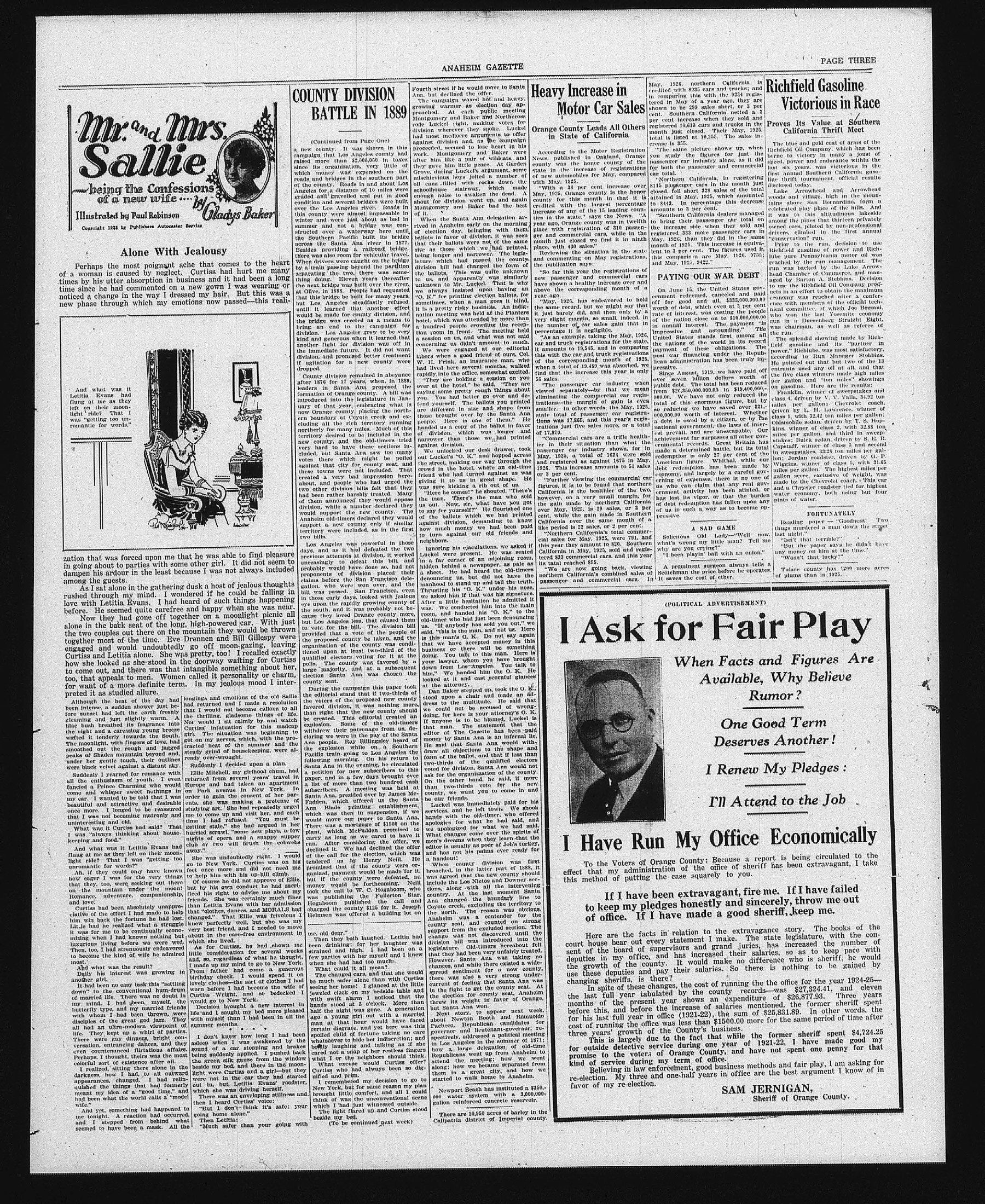
Searchable text
Mr. and Mrs. Sallie
being the Confessions of a new wife... by Gladys Baker
Illustrated by Paul Robinson
Copyright 1928 by Publishers Autocaster Service
Alone With Jealousy
Perhaps the most poignant ache that comes to the heart of a woman is caused by neglect. Curtiss had hurt me many times by his utter absorption in business and it had been a long time since he had commented on a new gown I was wearing or noticed a change in the way I dressed my hair. But this was a new phase through which my emotions now passed—this reali-
And what was it Letitia Evans had flung at me as they left on their moonlight ride? That I was "getting too unromantic for words."
And what was it Letitia Evans had flung at me as they left on their moonlight ride? That I was "getting too unromantic for words."
zation that was forced upon me that he was able to find pleasure in going about to parties with some other girl. It did not seem to dampen his ardour in the least because I was not always included among the guests.
As I sat alone in the gathering dusk a host of jealous thoughts rushed through my mind. I wondered if he could be falling in love with Letitia Evans. I had heard of such things happening before. He seemed quite carefree and happy when she was near.
Now they had gone off together on a moonlight picnic all alone in the back seat of the long, high-powered car. With just the two couples out there on the mountain they would be thrown together most of the time. Eve Drennen and Bill Gillespy were engaged and would undoubtedly go off moon-gazing, leaving Curtiss and Letitia alone. She was pretty, too! I recalled exactly how she looked as she stood in the doorway waiting for Curtiss to come out, and there was that intangible something about her, too, that appeals to men. Women called it personality or charm, for want of a more definite term. In my jealous mood I interpreted it as studied allure.
Although the heat of the day had been intense, a sudden shower just before sunset had left the earth freshly gleaming and just slightly warm. A lilac bush breathed its fragrance into the night and a caressing young breeze wafted it tenderly towards the South. The moonlight, with fingers of love, had smoothed out the rough and jagged peaks of Shades mountain beyond and, under her gentle touch, their outlines were black velvet against a distant sky.
Suddenly I yearned for romance with all the enthusiasm of youth. I even fancied a Prince Charming who would come and whisper sweet nothings in my ear. I wanted to be told that I was beautiful and attractive and desirable once more. I longed to be reassured that I was not becoming matronly and uninteresting and old.
What was it Curtiss had said? That I was "always thinking about housekeeping and food."
And what was it Letitia Evans had longings and emotions of the old Sallie had returned and I made a resolution that I would not become callous to all the thrilling, gladsome things of life. Nor would I sit calmly by and watch Curtiss' infatuation for this madcap girl. The situation was beginning to get on my nerves, which, with the protracted heat of the summer and the steady grind of housekeeping, were already over-wrought.
Suddenly I decided upon a plan.
Ellie Mitchell, my girlhood chum, had returned from several years' travel in Europe and had taken an apartment on Park avenue in New York. In order to gain the consent of her parents, she was making a pretense of studying art. She had repeatedly urged me to come up and visit her, and each time I had refused. "You must be getting stale," she had argued in her hurried scrawl, "some new plays, a few nights of opera and a snappy supper club or two will brush the cobwebs away."
Suddenly I yearned for romance with all the enthusiasm of youth. I even fancied a Prince Charming who would come and whisper sweet nothings in my ear. I wanted to be told that I was beautiful and attractive and desirable once more. I longed to be reassured that I was not becoming matronly and uninteresting and old.
What was it Curtiss had said? That I was "always thinking about housekeeping and food."
And what was it Letitia Evans had flung at me as they left on their moonlight ride? That I was "getting too unromantic for words?"
Ah, if they could only have known how eager I was for the very things that they, too, were seeking out there on the mountain under the moon! Romance, adventure, companionship, and love.
Curtiss had been absolutely unappreciative of the effort I had made to help him win back the fortune he had lost. Litie had he realized what a struggle it was for me to be continually economizing when I had known nothing but luxurious living before we were wed. Then, too, I had strenuously endeavored to become the kind of wife he admired most.
Ahd what was the result?
Daily his interest was growing in another girl.
It had been no easy task this "settling down" to the conventional hum-drum of married life. There was no doubt in my mind, I had been, myself, the butterfly type, and my married friends with whom I had been thrown, were disciples of the great god jazz. They all had an ultra-modern viewpoint of life. They kept up a whirl of parties. There were gay dinners, bright conversation, entrancing dances, and they even countenanced filtratious affairs. Perhaps, I thought, theirs was the most colorful sort of existence after all.
I realized, slitting there alone in the darkness, how I had, to all outward appearances, changed. I had relinquished the things that had formerly meant my idea of a "good time," and had been what the world calls a "model wife."
And yet, something had happened to me tonight. A reaction had occurred, and I stepped from behind what seemed to have been a mask. All the Suddenly I decided upon a plan.
Ellie Mitchell, my girlhood chum, had returned from several years' travel in Europe and had taken an apartment on Park avenue in New York. In order to gain the consent of her parents, she was making a pretense of studying art. She had repeatedly urged me to come up and visit her, and each time I had refused. "You must be getting stale," she had argued in her hurried scrawl, "some new plays, a few nights of opera and a snappy supper club or two will brush the cobwebs away."
She was undoubtedly right. I would go to New York. Curtiss was on his feet once more and did not need me to help him with his up-hill climb.
Of course he did not approve of Ellie, but by his own conduct he had sacrificed his right to advise me about my friends. She was certainly much finer than Letitia Evans with her admission that "clothes, dances, and MORALS had changed." That Ellie was frivolous I knew perfectly well, but she was my very best friend, and I needed to move about in the care-free environment in which she lived.
As for Curtiss, he had shown me little consideration for several weeks and, so, regardless of what he thought, I made up my mind to go to New York. From father had come a generous birthday check. I would spend it on lovely clothes—the sort of clothes I had worn before I had become the wife of Curtiss Wright, and so bedecked I would go to New York.
Decision brought a new interest in life and I sought my bed more pleased with myself than I had been in all the summer months.
I don't know how long I had been asleep when I was awakened by the sound of a car stopping and brakes being suddenly applied. I pushed back the green silk gauze from the window beside my bed, and there in the moonlight were Curtiss and a girl—but they were not in the car they had started out in, but Letitia Evans' roadster, which she was driving herself.
There was an enveloping stillness and then I heard Curtiss' voice:
"But I don't think it's safe; your going home alone."
Then Letitia:
"Much safer than your going with
me, old dear."
Then they both had been drinking; for he strained and high, few parties with her when she had tasted what could not be much safer alone seeing her home!
Jewelled clock on my hands stood at 3 o'clock the night was ago a young girl of man at that hour certain disgrace, and spoiled child of forty whatsoever to hide boltly laughing and cared not a snap of what I or the neighbor.
What excuse was Curtiss who had nified and prim.
I remembered me New York, but for a brought little comfort of what was the which I had just seen The light shone beside my bed.
(To be continued)
COUNTY DIVISION BATTLE IN 1889
(Continued from Page One)
a new county. It was shown in this campaign that Los Angeles county had raised more than $2,000,000 in taxes since its organization, very little of which money was expended on the roads and bridges in the southern part of the county. Roads in and about Los Angeles for a distance of 10 miles were graded and gravelled and put in good condition and several bridges were built over the Los Angeles river. Routes in this county were almost impassable in winter and were just about as bad in summer and not a bridge was constructed over a waterway here until the Southern Pacific built its bridge across the Santa Ana river in 1877. Bealdes providing a railroad bridge there was also room for vehicular travel. When drivers were caught on the bridge by a train passing beyond the partition separating the two, there was something doing. Eleven years thereafter the next bridge was built over the river at Olive, in 1888. People had requested that this bridge be built for many years, but Los Angeles steadfastly refused, until it learned that another effort would be made for county division, and the bridge was erected as a means to bring an end to the campaign for division. Los Angeles grew to be very kind and generous when it learned that another fight for division was off in the immediate future. It did not want division, and promised better treatment if agitation for a new county were dropped.
County division remained in abeyance after 1876 for 17 years, when, in 1889, leaders in Santa Ana proposed the formation of Orange county. A bill was introduced into the legislature in January of that year, embracing what is now Orange county placing the northern boundary at Coyote creek and excluding all the rich territory running northerly for many miles. Much of this territory desired to be included in the new county, and the old-timers tried very hard to have these sections in Fourth street if he would move to Santa Ana, but declined the offer.
The campaign waxed hot and heavy, growing warmer as election day approached. At each public meeting Montgomery and Baker and Northcross rode Luckel right, making votes for division wherever they spoke. Luckel had most mediocre arguments to offer against division and, as the campaign proceeded, seemed to lose heart in his work. Montgomery and Baker were after him like a pair of wildcats, and they gave him little peace. At Garden Grove, during Luckel's argument, some mischievous boys jolted a number of oil cans filled with rocks down the schoolhouse stairway, which made enough noise to awaken the dead. A shout for division went up, and again Montgomery and Baker had the best of it.
When the Santa Ana delegation arrived in Anaheim early on the morning of election day, bringing with them ballots in favor of division, it was seen that their ballots were not of the same size as those which we had printed, being longer and narrower. The legislature which had passed the county-division bill had changed the form of the ballots. This was quite unknown to us, and apparently was similar to known to Mr. Luckel. That is why we always insisted upon having an "O. K." for printing election ballots, for sometimes, when a man goes it blind, it is a pretty risky business. An indignation meeting was held at the Planters hotel, which was attended by more than a hundred people crowding the reception room in front. The meeting held a session on us, and what was not said concerning our didn't amount to much.
We were engaged at our editorial labors when a good friend of ours, Col. W. H. Frink, an insurance man, who lived here several months, walked rapidly into the office, somewhat excited.
"They are holding a session on you over at the hotel," he said. "They are saying some pretty rough things about you. You had better go over and defend yourself. The ballots you printed are different in size and shape from those brought over by the Santa Ana people. Here is one of them." He handed us a copy of the ballot in favor of division, which was longer and narrower than those we had printed against division.
Heavy Increase in Motor Car Sales
Orange County Leads All Others in State of California
According to the Motor Registration News, published in Oakland, Orange county was the honor county of the state in the increase of registrations of new automobiles for May, compared with May 1925.
With a 38 per cent increase over May, 1925, Orange county is the honor county for this month in that it is credited with the largest percentage increase of any of the 15 leading counties in the state," says the News.
"A year ago, Orange county was in twelfth place with registration of 310 passenger and commercial cars, while in the month just closed we find it in ninth place, with 430 sales."
Reviewing the situation in the state and commenting on May registrations, the publication says:
"So far this year the registrations of new passenger and commercial cars have shown a healthy increase over and above the corresponding month of a year ago.
May, 1926, has endeavored to hold the same record, but we might say that it just barely did, and then only by a very slight margin, so small, indeed, in the number of car sales gain that in percentage it is negligible.
As an example, taking the May, 1926 car and truck registrations for the state, it amounts to 19,545, and in comparing this with the car and truck registrations of the corresponding month of 1925 when a total of 19,489 was absorbed, we find that the increase this year is only 56 sales.
The passenger car industry when viewed separately—by that we mean eliminating the commercial car registrations—the margin of gain is even smaller. In other words, May 1925 state total of passenger car registrations was 17,865, and this year's registrations just five sales more, or a total of 17,870.
Commercial cars are a trifle healthier in their situation than what in their industry shows, for in May 1926 no credit was given with 833 percent in comparing theretoed in May 1925 shown to be 299 cents. Southern New York per cent increase registered 10,610 month just close total is listed at crease is 355.
The same plan you study the passenger car industry for both the pass car total.
Northern California 8115 passenger car closed; fell short attained in May to 8443. In payment amounts to 3 per cent.
Southern California to bring their increase side registered 333 month May 1926, than month of 1925 lent to 3 per cent this comparison and May 1925.
PAYING C
On June 15, errant redemption off for good worth of debt, rate of interest of the nation on annuity interest impressive and United States of America payment of post war financial lican administrative pressure.
Since August over seven public debt. From $26,350,000.00. We have total of this ee so reducing nooooooooooooooooooooooooooooooooooooooooooooooooooooooooooooooooooooooooooooooooooooooooooooooooooooooooooooooooooooooooooooooo
County division remained in abeyance after 1876 for 17 years, when, in 1889, leaders in Santa Ana proposed the formation of Orange county. A bill was introduced into the legislature in January of that year, embracing what is now Orange county, placing the northern boundary at Coyote creek and excluding all the rich territory running northerly for many miles. Much of this territory desired to be included in the new county, and the old-timers tried very hard to have these sections included, but Santa Ana saw too many votes there which might be polled against that city for county seat, and these towns were not included. That created a very bad impression hereabout, and people who had urged the two other division bills felt that they had been rather harshly treated. Many of them announced they would oppose division, while a number declared they would support the new county. The Anaheim old-timers declared they would support a new county only if similar territory were included, as in the first two bills.
Los Angeles was powerful in those days, and as it had defeated the two previous attempts at division, it worked unceasingly to defeat this bill, and probably would have done so, had not proponents of division placed their claims before the San Francisco delegation, who were won over, and the bill was passed. San Francisco, even in those early days, looked with jealous eye upon the rapidly growing county of the south, and it was probably not because they loved Orange county more, but Los Angeles less, that caused them to vote for the bill. The division bill provided that a vote of the people of the proposed county be taken, and the organization of the county was conditioned upon at least two-third of the qualified electors voting for it at the polls. The county was favored by a large majority, and at a subsequent election Santa Ana was chosen the county seat.
During the campaign this paper took the editorial stand that if two-thirds of the voters of the proposed new county favored division, it was nothing more than right that the new county should be created. This editorial created an explosion. Some of the old-timers withdrew their patronage from us, declaring we were in the pay of the Santa Ana people. Ray Billingsley heard of the explosion while on a Southern Pacific train going to Los Angeles the following morning. On his return to Santa Ana in the evening, he circulated a petition for new subscribers to this paper, and in a few days brought over a list of more than two hundred cash subscribers. A meeting was held at Santa Ana, presided over by James McFadden, which offered us the Santa Ana Blade printing establishment, which was then in suspension, if we would move our paper to Santa Ana. There was a mortgage of $1500 on the plant, which McFadden promised to carry as long as we cared to have it run. After considering the offer, we declined it. We had declined the offer labors when a good friend of ours, Col. W. H. Frink, an insurance man, who lived here several months, walked rapidly into the office, somewhat excited.
They are holding a session on you over at the hotel," he said. "They are saying some pretty rough things about you. You had better go over and defend yourself. The ballots you printed are different in size and shape from those brought over by the Santa Ana people. Here is one of them." He handed us a copy of the ballot in favor of division, which was longer and narrower than those we had printed against division.
We unlocked our desk drawer, took out Luckel's "O. K." and hopped across the street, making our way through the crowd in the hotel, where an old-time friend who had turned against us was giving it to us in great shape. He was sure kicking a rib out of us.
"Here he comes!" he shouted. "There's the man. There's the man who sold us out. Now, sir, what have you got to say for yourself?" He flourished one of the ballots which we had printed against division, demanding to know how much money we had been paid to turn against our old friends and neighbors.
Ignoring his ejaculations, we asked if Luckel were present. He was seated in a far corner of an adjoining room, hidden behind a newspaper, as pale as a sheet. He had heard the old-timers denouncing us, but did not have the manhood to stand up and tell the truth. Thrusting his "O. K." under his nose, we asked him if that was his signature. After a little hesitation he admitted it was. We conducted him into the main room, and handed his "O. K." to the old-timer who had just been denounced us. "If anybody has sold you out," we said, "this is the man. And not us. Here is this man's O. K. Do not say again that we have accepted money in this business or there will be something doing. You talk to this man. Here is your lawyer, whom you have brought down from Los Angeles. You talk to him."
We handed him the O. K. He looked at it and cast scornful glances at the attorney.
Dan Baker stepped up, took the O. K., stood upon a chair and made an address to the multitude. He said that we could not be accused of wrongdoing, for here is your attorney's O. K. If anyone is to be blamed, Luckel is that man.
The statement that the editor of The Gazette has been paid money by Santa Ana is an infernal lie. He said that Santa Ana would withdraw all objections to the shape and form of the ballot, and that if less than two-thirds of the qualified electors voted for division, Santa Ana would not ask for the organization of the county. On the other hand, he said, if more than two-thirds vote for the new county, we want you to come in and be our friends.
Luckel was immediately paid for his services, and he left town. We shook hands with the old-timer, who offered apologies for what he had said, and we apologized for what we had said. What changes come over the spirits of men's dreams when they learn-that the editor is usually as poor as Job's turkey,
Since August over seven billion public debt, THP from $26,350,000.000. We had total of this oil so reducing ww000,000 wortw000 national governr est prevail,and achievement farnernental rece made a determ redemption is American figure debt redemptive economy,and cerning of exp esis who can ocnrment activity has lost its vw000 debt redemptio us in such pressive.
A prominent Scotchman tha It saves the e
(POLITICAL)
I Have Run My
me, old dear."
Then they both laughed. Letitia had been drinking; for her laughter was strained and high. I had been on a few parties with her myself and I knew when she had had too much.
What could it all mean?
The changed cars, and that she would be much safer alone than with Curtiss seeing her home! I glanced at the little jeweled clock on my bedside table and with swift alarm I noticed that the hands stood at 3 o'clock. More than half the night was gone. A generation ago a young girl out with a married man at that hour would have faced certain disgrace, and yet here was this spolied child of fortune taking no care whatsoever to hide her indiscretion; and bodily laughing and talking as if she cared not a snap of her restless fingers what I or the neighbors should think.
What excuse would Curtiss offer? Curtiss who had always been so dignified and prim.
I remembered my decision to go to New York, but for some reason my plan brought little comfort, and all I could think of was the unconventional scene which I had just witnessed outside. The light flared up and Curtiss stood beside my bed.
(To be continued next week)
Newport Beach has instituted a $350,-000 water system with a 3,000,000-gallon reinforced concrete reservoir.
There are 10,950 acres of barley in the Callpatria district of Imperial county.
I Have Run My Way
To the Voters of Orange County effect that my administration of this method of putting the case so here are the facts in relation court house bear out every statement sent of the board of supervisors and deputies in my office, and has in the growth of the county. It will use these deputies and pay their s changing sheriffs, is there?
In spite of these changes, the last full year tabulated by the months of the present year show before this, and before the increase for his last full year in office (1921 cost of running the office was less than three years' growth of the County.
This is largely due to the fact for outside detective service during promise to the voters of Orange kind of service during my term Believing in law enforcement, re-election. My three and one-half favor of my re-election.
May, 1926, northern California is credited with 8935 cars and trucks; and in comparing this with the 9234 registered in May of a year ago, they are shown to be 299 sales short, or 3 per cent. Southern California netted a 3 per cent increase when they sold and registered 10,610 cars and trucks in the month just closed. Their May, 1925, total is listed at 10,255. The sales increase is 355.
"The same picture shows up, when you study the figures for just the passenger car industry alone, as it did for both the passenger and commercial car total."
"Northern California, in registering 8115 passenger cars in the month just closed, fell short 328 sales of the total attained in May, 1925, which amounted to 8443. In percentage this decrease amounts to 3 per cent.
"Southern California dealers managed to bring their passenger car total on the increase side when they sold and registered 333 more passenger cars in May, 1926, than they did in the same month of 1925. This increase is equivalent to 3 per cent. The figures used in this comparison are May, 1926, 9755; and May, 1925, 9422."
PAYING OUR WAR DEBT
On June 15, the United States government redeemed, canceled and paid off for good and all, $333,000,000.00 worth of debt, which even at 3 per cent rate of interest, was costing the people of the nation close on to $10,000,000.00 in annual interest. The payment "is impressive and astounding." The United States stands first among all the nations of the world in its record payment of these obligations. The post war financing under the Republican administration has been truly impressive.
Since August, 1919, we have paid off over seven billion dollars worth of public debt. The total has been reduced from $26,350,000,000.00 to $19,400,000,-000.00. We have not only reduced the total of this enormous figure, but by so reducing we have saved over $21,-000,000.00 worth of interest. Whether a debt is owed by a citizen, or by the national government, the laws of interest prevail, and are unescapable. Our achievement far surpasses all other governmental records. Great Britain has determined battle but its total
Richfield Gasoline Victorious in Race
Proves Its Value at Southern California Thrift Meet
The blue and gold coat of arms of the Richfield Oil Company, which has been borne to victory in many a joust of speed, power and endurance within the last six years, was victorious in the first annual Southern California gasoline thrift tournament, official results disclosed today.
Lake Arrowhead and Arrowhead woods and village, high in the mountains above San Bernardino, form a celebrated play place of the hills. And it was to this altitudinous lakeside among the pines that thirteen privately owned cars, piloted by non-professional drivers, climbed in the first annual "conservation" run.
Prior to the run, decision to use Richfield gasoline of power and Richlube pure Pennsylvania motor oil was reached by the run management. The run was backed by the Lake Arrowhead Chamber of Commerce, and managed by Barton A. Stebbins. Decision to use the Richfield Oil Company products in an effort to obtain the maximum economy was reached after a conference with members of the official technical committee, of which Joe Bozzani, who won the last Yosemite economy run in a Duesenberg Straight Eight, was chairman, as well as referee of the run.
The splendid showing made by Itichfield gasoline and its "partner in power," Richlube, was most satisfactory, according to Run Manager Stebbins. He pointed out that but two of the 13 entrants used any oil at all, and that the five class winners made high miles per gallon and "ton miles" showings on gasoline. Here are the results:
Franklin, winner of sweepstakes and class 4, driven by V. V. Valla, 34.92 ton miles per gallon; Chevrolet coach, driven by L. H. Lawrence, winner of class 1, with 32.42 ton miles per gallon; Oldsmobile sedan, driven by T. S. Hopkins, winner of class 2, with 32.88 ton miles per gallon; and third in sweepstakes; Buick sedan, driven by S. E. R. Capstaff, winner of class 3 and second
post war financing under the Republican administration has been truly impressive.
Since August, 1919, we have paid off over seven billion dollars worth of public debt. The total has been reduced from $26,350,000,000.00 to $19,400,000,-000.00. We have not only reduced the total of this enormous figure, but by so reducing we have saved over $21,-000,000.00 worth of interest. Whether a debt is owed by a citizen, or by the national government, the laws of interest prevail, and are unescapable. Our achievement far surpasses all other governmental records. Great Britain has made a determined battle, but its total redemption is only 27 per cent of the American figure. Whithal, while our debt redemption has been made by economy, and largely by a careful governing of expenses, there is no one of us who can claim that any real government activity has been stinted, or has lost its vigor, or that the burden of debt redemption has fallen upon any of us in such a way as to become oppressive.
A SAD GAME
Solicitous Old Lady—"Well now, what's wrong my little man? Tell me why are you crying?"
"I been playin' ball with an onlon."
A prominent surgeon always tells a Scotchman the price before he operates. It saves the cost of ether.
FORTUNATELY
Reading paper — "Goodness! Two thugs murdered a man down the street last night."
"Isn't that terrible?"
"But the paper says he didn't have any money on him at the time."
"Wasn't that lucky?"
Tulare county has 1200 more acres of plums than in 1925.
(POLITICAL ADVERTISEMENT)
Sk for Fair Play
When Facts and Figures Are Available, Why Believe Rumor?
One Good Term Deserves Another!
I Renew My Pledges:
I'll Attend to the Job
I Renew My Pledges:
I'll Attend to the Job
He Run My Office Economically
Roters of Orange County: Because a report is being circulated to the city administration of the office of sheriff has been extravagant, I take off putting the case squarely to you.
I have been extravagant, fire me. If I have failed to my pledges honestly and sincerely, throw me out of the county. If I have made a good sheriff, keep me.
In the facts in relation to the extravagance story. The books of the year out every statement I make. The state legislature, with the board of supervisors and grand juries, has increased the number of my office, and has increased their salaries, so as to keep pace with the county. It would make no difference who is sheriff, he would duties and pay their salaries. So there is nothing to be gained by sheriffs, is there?
Of these changes, the cost of running the office for the year 1924-25—in year tabulated by the county records—was $27,324.41, and eleven present year shows an expenditure of $26,877.93. Three years and before the increase of salaries mentioned, the former sheriff spent all year in office (1921-22), the sum of $25,831.89. In other words, the age the office was less than $1500.00 more for the same period of time after growth of the County's business.
Largely due to the fact that while the former sheriff spent $4,724.25 detective service during one year of 1921-22. I have made good my voters of Orange County, and have not spent one penny for that service during my term of office.
In law enforcement, good business methods and fair play, I am asking for My three and one-half years in office are the best argument I know of in re-election.
SAM JERNIGAN,
Sheriff of Orange County.