anaheim-gazette 1926-06-10
Scanned page
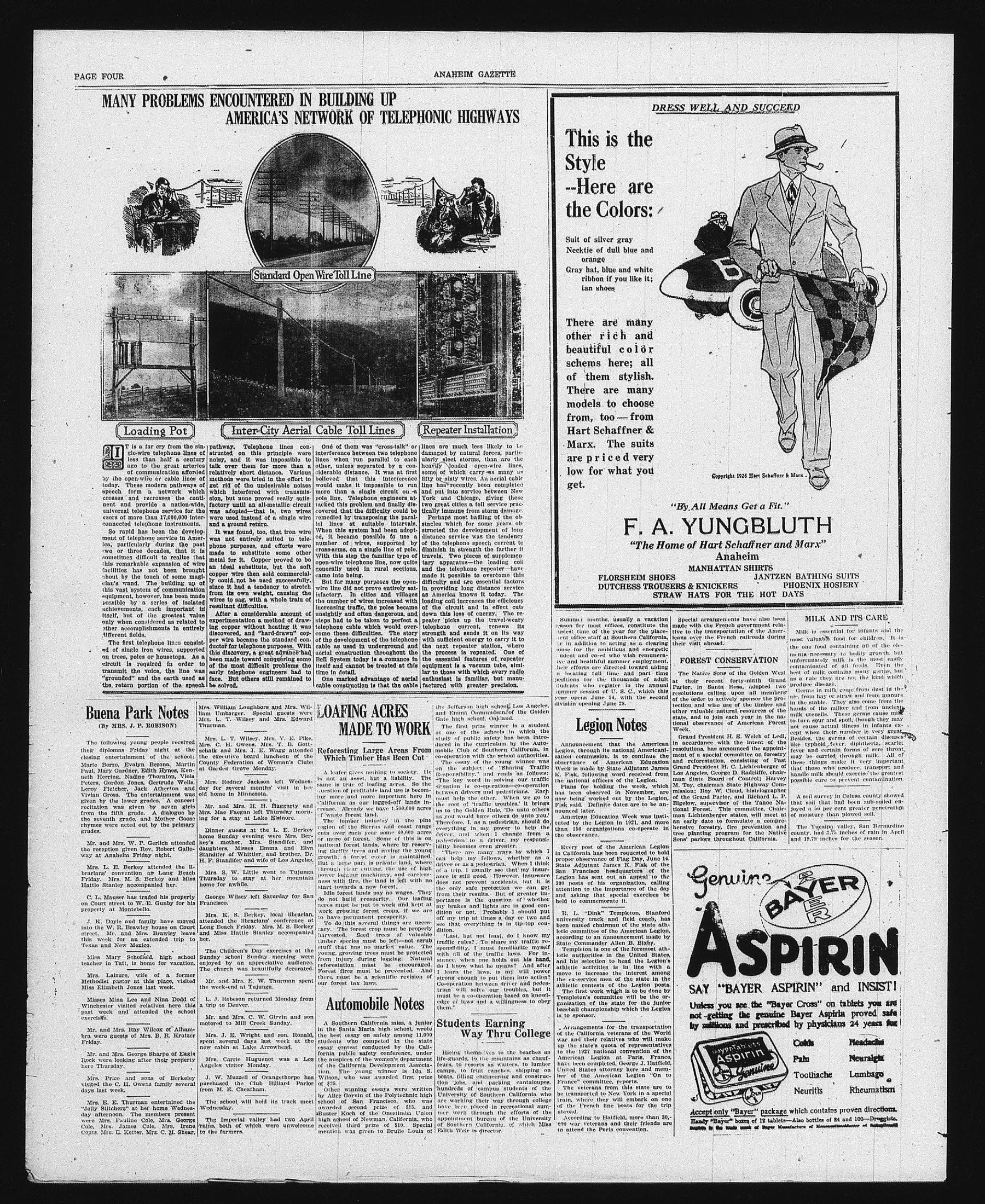
Searchable text
PAGE FOUR
MANY PROBLEMS ENCOUNTERED IN BUILDING AMERICA'S NETWORK OF
Standard Open Wire Toll Line
Loading Pot
Inter-City Aerial Cable Toll
Loading Pot
Inter-City Aerial Cable Tollway
It is a far cry from the single-wire telephone lines of less than half a century ago to the great arteries of communication afforded by the open-wire or cable lines of today. These modern pathways of speech form a network which crosses and recrosses the continent and provide a nation-wide universal telephone service for the users of more than 17,000,000 interconnected telephone instruments.
So rapid has been the development of telephone service in America, particularly during the past two or three decades, that it is sometimes difficult to realize that this remarkable expansion of wire facilities has not been brought about by the touch of some magician's wand. The building up of this vast system of communication equipment, however, has been made possible by a series of isolated achievements, each important in itself, but of the greatest value only when considered as related to other accomplishments in entirely different fields.
The first telephone lines consisted of single iron wires, supported on trees, poles or housetops. As a circuit is required in order to transmit the voice, the line was "grounded" and the earth used as the return portion of the speech pathway. Telephone lines constructed on this principle were noisy, and it was impossible to talk over them for more than a relatively short distance. Various methods were tried in the effort to get rid of the undesirable noises which interfered with transmission, but none proved really satisfactory until an all-metalic circuit was adopted—that is, two wires were used instead of a single wire and a ground return.
It was found, too, that iron wire was not entirely suited to telephone purposes, and efforts were made to substitute some other metal for it. Copper proved to be an ideal substitute, but the soft copper wire then sold commercially could not be used successfully, since it had a tendency to stretch from its own weight, causing the wires to sag, with a whole train of resultant difficulties.
After a considerable amount of experimentation a method of drawing copper without heating it was discovered, and "hard-drawn" copper wire became the standard conductor for telephone purposes. With this discovery, a great advance had been made toward conquering some of the most difficult problems the early telephone engineers had to face. But others still remained to be solved.
Buena Park Notes
(By MRS. J. P. ROBISON)
The following young people received their diplomas Friday night at the closing entertainment of the school: Marie Borzo, Evalyn Bezona, Martin Paul, Mary Gardner, Edith Hynes, Kenneth Herring, Nadine Thornton, Viola Peters, Gordon Jones, Gertrude Wells, Leroy Fletcher, Jack Atherton and Vivian Gross. The entertainment was given by the lower grades. A concert recitation was given by seven girls from the fifth grade. A dialogue by the seventh grade, and Mother Goose rhymes were acted out by the primary grades.
Mr. and Mrs. W. P. Gerilch attended the reception given Rev. Robert Gallo-Mrs. William Loughbors and Mrs. William Umbarger. Special guests were Mrs. L. T. Wilsey and Mrs. Edward Thurman.
Mrs. L. T. Wilsey, Mrs. V. E. Pike, Mrs. C. H. Owens, Mrs. T. B. Gottschalk and Mrs. J. E. Wagg attended the executive board luncheon of the County Federation of Woman's Clubs at Garden Grove Monday.
Mrs. Rodney Jackson left Wednesday for several months' visit in her old home in Minnesota.
Mr. and Mrs. H. H. Haggarty and Mrs. Mae Faegan left Thursday morning for a stay at Lake Elsinore.
Dinner guests at the L. E. Berkey home Sunday evening were Mrs. Berkey's mother, Mrs. Standiffer, and daughters, Misses Emma and Elva
LOAFING MADDER
Reforesting Law Which Timber
A leafer gives rise not an asset; same is true of questioning profit more and more California as our crease. Already we of waste forest land.
The lumber in region of the Slovak cuts over each yard or more of forest national forest lands
closing entertainment of the school: Marie Borzo, Evalyn Bezona, Martin Paul, Mary Gardner, Edith Hynes, Kenneth Herring, Nadine Thornton, Viola Peters, Gordon Jones, Gertrude Wells, Leroy Fletcher, Jack Atherton and Vivian Gross. The entertainment was given by the lower grades. A concert recitation was given by seven girls from the fifth grade. A dialogue by the seventh grade, and Mother Goose rhymes were acted out by the primary grades.
Mr. and Mrs. W. P. Gerilch attended the reception given Rev. Robert Galloway at Anaheim Friday night.
Mrs. L. E. Berkey attended the librarians' convention as Long Beach Friday. Mrs. M. S. Berkey and Miss Hattie Stanley accompanied her.
C. L. Mauser has traded his property on Court street to W. E. Gunby for his property at Montebello.
J. K. Doyle and family have moved into the W. R. Brawley house on Court street, Mr. and Mrs. Brawley leave this week for an extended trip to Texas and New Mexico.
Miss Mary Schoffeld, high school teacher in Taft, is home for vacation.
Mrs. Laizure, wife of a former Methodist pastor at this place, visited Miss Elizabeth Jones last week.
Misses Mina Lee and Nina Dodd of Winchester visited relatives here this past week and attended the school exercises.
Mr. and Mrs. Ray Wilcox of Alhambra were guests of Mrs. B. R. Kratzer Friday.
Mr. and Mrs. George Sharpe of Eagle Rock were looking after their property here Thursday.
Mrs. Price and sons of Berkeley visited the C. H. Owens family several days last week.
Mrs. E. E. Thurman entertained the "Jolly Stitchers" at her home Wednesday afternoon. The members present were Mrs. Pauline Cole, Mrs. George Cole, Mrs. James Cole, Mrs. Irene Coutts, Mrs. E. Ketter, Mrs. C. M. Shear,
the executive board luncheon of the County Federation of Woman's Clubs at Garden Grove Monday.
Mrs. Rodney Jackson left Wednesday for several months' visit in her old home in Minnesota.
Mr. and Mrs. H. Haggarty and Mrs. Mae Faegan left Thursday morning for a stay at Lake Elsinore.
Dinner guests at the L. E. Berkey home Sunday evening were Mrs. Berkey's mother, Mrs. Standifer, and daughters, Misses Emma and Elva Standifer of Whittier, and brother, Dr. H. F. Standifer and wife of Los Angeles.
Mrs. S. W. Little went to Tujunga Thursday to stay at her mountain home for awhile.
George Wilsey left Saturday for San Francisco.
Mrs. K. S. Berkey, local librarian, attended the librarians' conference at Long Beach Friday. Mrs. M. S. Berkey and Miss Hattie Stanley accompanied her.
The Children's Day exercises at the Sunday school Sunday morning were enjoyed by an appreciative audience. The church was beautifully decorated.
Mr. and Mrs. E. W. Thurman spent the week-end at Tujunga.
L. J. Robeson returned Monday from a trip to Denver.
Mr. and Mrs. C. W. Girvin and son motored to Mill Creek Sunday.
Mrs. J. E. Wright and son, Ronald, spent several days last week at the new cabin at Lake Arrowhead.
Mrs. Carrie Huguenot was a Los Angeles visitor Monday.
J. W. Muzzell of Orangethorpe has purchased the Club Billiard Parlor from M. E. Cheatham.
The school will hold its track meet Wednesday.
The Imperial valley had two April trains, both of which were unwelcome to the farmers.
A leafer gives rise not an asset; same is true of question of profiting more and more California as our crease.Already wilt of waste forest land.The lumber in region of the Slovak cuts over each year or more of forest national forest lands thrifty trees growth.a forestBut a large part through clear cut power logging makes with fire.the start towards a ridgeforest landdo not build prairiesmust be put work growing forto have permanentsTo do this several years.The forest harvested.Seed timber species must be stuff that has no young.growing from injury durereforestation mustForest fires mustthere must be aour forest tax law
D IN BUILDING UP
NETWORK OF TELEPHONIC HIGHWAYS
Open Wire Toll Line
Material Cable Toll Lines Repeater Installation
DRESS W
This is the Style
--Here are the Colors:
Suit of silver gray
Necktie of dull blue and orange
Gray hat, blue and white ribbon if you like it;
tan shoes
There are many other rich and beautiful color schemes here; all of them stylish.
There are many models to choose from, too—from Hart Schaffner & Marx. The suits
Material Cable Toll Lines
Repeater Installation
One of them was "cross-talk" or interference between two telephone lines when run parallel to each other, unless separated by a considerable distance. It was at first believed that this interference would make it impossible to run more than a single circuit on a pole line. Telephone engineers attacked this problem and finally discovered that the difficulty could be remedied by transposing the parallel lines at suitable intervals. When this system had been adopted, it became possible to use a number of wires, supported by cross-arms, on a single line of pole. With this step the familiar type of open-wire telephone line, now quite generally used in rural sections, came into being.
But for many purposes the open-wire line did not prove entirely satisfactory. In cities and villages the number of wires increased with increasing traffic, the poles became unsightly and often dangerous, and steps had to be taken to perfect a telephone cable which would overcome these difficulties. The story of the development of the telephone cable as used in underground and aerial construction throughout the Bell System today is a romance itself and cannot be treated at this time in detail.
One marked advantage of aerial cable construction is that the cables are much less likely to damage by natural forces, particularly sheet storms, than are the heavily loaded open-wire lines, some of which carry as many as fifty or sixty wires. An aerial cable line has recently been completed and put into service between New York and Chicago, giving these two great cities a toll service practically immune from storm damage.
Perhaps most baffling of the obstacles which for some years obstructed the development of long-distance service was the tendency of the telephone speech current to diminish in strength the farther it travels. Two pieces of supplementary apparatus—the loading coil and the telephone repeater—have made it possible to overcome this difficulty and are essential factors in providing long distance service as America knows it today. The loading coil increases the efficiency of the circuit and in effect cuts down this loss of energy. The repeater picks up the travel-weary telephone current, renews its strength and sends it on its way with sufficient energy to carry it to the next repeater station, where the process is repeated. One of the essential features of repeater equipment is a vacuum tube, similar to those with which every radio enthusiast is familiar, but manufactured with greater precision.
LOAFING ACRES MADE TO WORK
Reforesting Large Areas From Which Timber Has Been Cut
A leafer gives nothing to society. He is not an asset, but a liability. The same is true of leafing acres. So the question of profitable land use is becoming more and more important here in California as our logged-off lands increase. Already we have 1,500,000 acres of waste forest land.
The lumber industry in the pine region of the Sierra and coast range cuts over each year some 60,000 acres or more of forest. Some of this is on national forest lands, where by reserving thriftier trees and saving the young the Jefferson high school, Los Angeles, and Emma Ommundson of the Golden Gate high school, Oakland.
The first prize winner is a student at one of the schools in which the study of public safety has been introduced in the curriculum by the Automobile Club of Southern California, in cooperation with the school authorities.
The essay of the young winner was on the subject of "Sharing Traffic Responsibility," and reads as follows: "The key word in solving our traffic situation is co-operation—co-operation must help the other. When we go to the root of 'traffic troubles,' it brings us to the Golden Rule: 'Do unto others as you would have others do unto you.' Therefore, I, as a pedestrian, should do everything in my power to help the driver, and when I change from a pedestrian to a driver, my responsibility becomes even greater.
Schems here; all of them stylish. There are many models to choose from, too—from Hart Schaffner & Marx. The suits are priced very low for what you get.
"By A. Y.
F.A.Y.
"The Home of"
FLORSHEIM SHOES
DUTCHESS TROUSERS &
STRAW HA
Summer months, usually a vacation season for most offices, constitute the easiest time of the year for the placement office staff at Southern California, or in addition to acting as a clearing house for the ambitious and energetic student and co-ed who wish remunerative and healthful summer employment, their efforts are directed toward adding in locating full time and part time positions for the thousands of adult students who register in the annual summer session of U. S. C., which this year opens June 14, with the second division opening June 28.
Legion Notes
Announcement that the American Legion, through its national Americanization commission, is to continue the observance of American Education Week made by State Adjutant James K. Fisk, following word received from the national officers of the Legion.
Plans for holding the week, which has been observed in November, are now being worked out by the Legion, Fisk said. Definite dates are to be announced later.
American Education Week was instituted by the Legion in 1921, and more than 150 organizations co-operate in the observance.
Every post of the American Legion
Which Timber Has Been Cut
A leafer gives nothing to society. He is not an asset, but a liability. The same is true of loafing acres. So the question of profitable land use is becoming more and more important here in California as our logged-off lands increase. Already we have 1,500,000 acres of waste forest land.
The lumber industry in the pine region of the Sierra and coast range cuts over each year some 60,000 acres or more of forest. Some of this is on national forest lands, where by reserving thrifty trees and saving the young growth, a forest cover is maintained. But a large part is private land, where through clear cutting, the use of high power logging machinery, and carelessness with fire, the land is left with no start towards a new forest.
Idle forest lands pay no wages. They do not build prosperity. Our loafing nests must be put to work and kept at work growing forest crops, if we are to have permanent prosperity.
To do this several things are necessary. The forest crop must be properly harvested. Seed trees of valuable timber species must be left—not scrub stuff that has no market value. The young, growing trees must be protected from injury during logging. Natural reforestation must be encouraged. Forest fires must be prevented. And there must be a scientific revision of our forest tax laws.
Automobile Notes
A Southern California miss, a junior in the Santa Maria high school, wrote the best essay on safety among 11,000 students who competed in the state essay contest conducted by the California public safety conference, under the auspices of the women's department of the California Development Association. The young winner is Ida S. Wilson, who was awarded first prize of $25.
Other winning essays were written by Alice Garvin of the Polytechnic high school of San Francisco, who was awarded second prize of $15, and Buster Koch of the Onestimba Union high school of Newman, California, who received third prize of $10. Special mention was given to Brulle Louis of
Students Earning Way Thru College
Hieing themselves to the beaches as life-guards, to the mountains as chauffeurs, to resorts as waiters, to lumber camps, to fruit ranches, shipping on boats, filling engineering and construction jobs, and packing cantaloupes, hundreds of campus students of the University of Southern California who are working their way through college have been placed in recreational summer work through the efforts of the appointment bureau of the University of Southern California, of which Miss Edith Weir is director.
Arrangements for the transportation of the California veterans of the World war and their relatives who will make up the state's quota of representatives to the 1927 national convention of the American Legion at Paris, France, have been completed, George J. Hatfield, United States attorney here and member of the American Legion "On to France" committee, reports.
The veterans from this state are to be transported to New York in a special train, where they will embark on one of the French line boats for the trip abroad.
According to Hatfield, more than 30,000 war veterans and their friends are to attend the Parts convention.
DRESS WELL AND SUCCEED
the
are
lors:
gray
blue and
and white
you like it;
many
h and
color
ere; all
stylish.
many
choose
from
ffner &
ne suits
"By All Means Get a Fit."
F. A. YUNGBLUTH
"The Home of Hart Schaffner and Marx"
Anaheim
MANHATTAN SHIRTS
JANTZEN BATHING SUITS
CHESS TROUSERS & KNICKERS
PHOENIX HOSIERY
STRAW HATS FOR THE HOT DAYS
Special arrangements have also been made with the French government relative to the transportation of the Americans over the French railroads during their visit abroad.
FOREST CONSERVATION
The Native Sons of the Golden West at their recent forty-ninth Grand Parlor, in Santa Rosa, adopted two resolutions calling upon all members of the order to actively sponsor the protection and wise use of the timber and other valuable natural resources of the state, and to join each year in the national observance of American Forest Week.
Grand President H. E. Welch of Lodi, in accordance with the intent of the resolutions, has announced the appointment of a special committee on forestry and reforestation, consisting of Past Grand President H. C. Lichtenberger of Los Angeles, George D. Radcliffe, chairman State Board of Control; Harvey M. Toy, chairman State Highway Commission; Roy W. Cloud, histrographer of the Grand Parlor, and Richard L. P. Bigelow, supervisor of the Tahoe National Forest. This committee, Chairman Lichtenberger states, will meet at an early date to formulate a comprehensive forestry, fire prevention and tree planting program for the Native Sons' parlors throughout California.
MILK AND ITS CARE
Milk is essential for infants and the most valuable food for children. It is the one food containing all of the elements necessary to bodily growth, but unfortunately milk is the most easily contaminated of all foods. Even the best of milk contains many germs, but as a rule they are not the kind which produce disease.
Germs in milk come from dust in the air, from hay or straw and from manure in the stable. They also come from the hands of the milker and from unclean milk utensils. These germs cause milk to turn sour and spoil, though they may not cause actual illness in infants except when their number is very great. Besides, the germs of certain diseases like typhoid fever, diphtheria, scarlet fever and certain forms of sore throat may be carried through milk. All of these things make it very important that those who produce, transport and handle milk should exercise the greatest possible care to prevent contamination.
A soil survey in Colusa county showed that soil that had been sub-soiled enjoyed a 50 per cent greater penetration of moisture than plowed soil.
The Yucaipa valley, San Bernardino county, had 7.75 inches of rain in April and 19.79 inches for the season.
Genuine BAYER ASPIRIN
SAY "BAYER ASPIRIN" and INSIST!
Unless you see the "Bayer Cross" on tablets you are not getting the genuine Bayer Aspirin proved safe by millions and prescribed by physicians 24 years for
Cotts Headache
Pain Neuralgia
Toothache Lumbago
Neuritis Rheumatism
Accept only "Bayer" package which contains proven directions.
Handy "Bayer" boxes of 12 tablets—Also bottles of 24 and 100—Druggists.