anaheim-gazette 1926-04-08
Scanned page
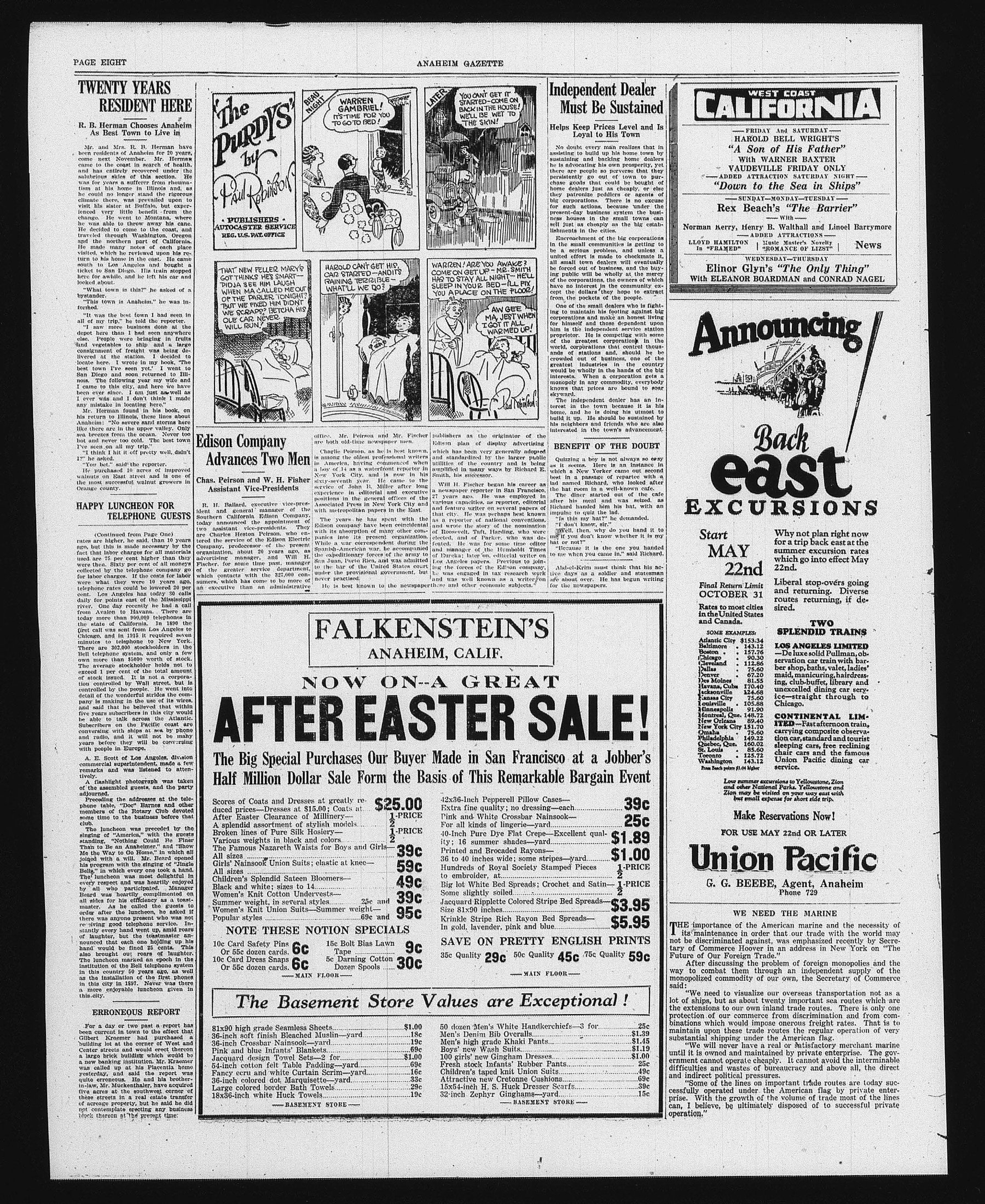
Searchable text
TWENTY YEARS RESIDENT HERE
R. B. Herman Chooses Anaheim As Best Town to Live in
Mr. and Mrs. R. B. Herman have been residents of Anaheim for 20 years, come next November. Mr. Herman came to the coast in search of health, and has entirely recovered under the salubrious skies of this section. He was for years a sufferer from rheumatism at his home in Illinois and, as he could no longer stand the rigorous climate there, was prevailed upon to visit his sister at Buffalo, but experienced very little benefit from the change. He went to Montana, where he was able to throw away his cane. He decided to come to the coast, and traveled through Washington, Oregon and the northern part of California. He made many notes of each place visited, which he reviewed upon his return to his home in the east. He came south to Los Angeles and bought a ticket to San Diego. His train stopped here for awhile, and he left his car and looked about.
"What town is this?" he asked of a bystander.
"This town is Anaheim," he was informed.
"It was the best town I had seen in all of my trip," he told the reporter.
"I saw more business done at the depot here than I had seen anywhere else. People were bringing in fruits and vegetables to ship and a large consignment of freight was being delivered at the station. I decided to locate here. I wrote in my book, 'The best town I've seen yet.' I went to San Diego and soon returned to Illinois. The following year my wife and I came to this city, and here we have been ever since. I am just as well as I ever was and I don't think I made any mistake in locating here."
Mr. Herman found in his book, on his return to Illinois, these lines about Anaheim: "No severe sand storms here like there are in the upper valley. Only sea breezes from the ocean. Never too hot and never too cold. The best town I've seen on all my trip."
livered at the station. I decided to locate here. I wrote in my book, "The best town I've seen yet." I went to San Diego and soon returned to Illinois. The following year my wife and I came to this city, and here we have been ever since. I am just as well as I ever was and I don't think I made any mistake in locating here."
Mr. Herman found in his book, on his return to Illinois, these lines about Anaheim: "No severe sand storms here like there are in the upper valley. Only sea breezes from the ocean. Never too hot and never too cold. The best town I've seen on all my trip."
"I think I hit it off pretty well, didn't it?" he asked.
"You bet," said the reporter.
He purchased 10 acres of improved walnuts on East street and is one of the most successful walnut growers in Orange county.
HAPPY LUNCHEON FOR TELEPHONE GUESTS
(Continued from Page One) rates are higher, he said, than 10 years ago, but this is made necessary by the fact that labor charges for all materials used are 75 per cent higher than they were then. Sixty per cent of all money collected by the telephone company go for labor charges. If the costs for labor were what they were 10 years ago, telephone rates could be lowered 20 per cent. Los Angeles has today 30 calls daily for points east of the Mississippi river. One day recently he had a call from Avalon to Havana. There are today more than 900,000 telephones in the state of California. In 1890 the first call was sent from Los Angeles to Chicago, and in 1915 it required seven minutes to telephone to New York. There are 302,000 stockholders in the Bell telephone system, and only a few own more than $5000 worth of stock. The average stockholder holds not to exceed 1 per cent of the total amount of stock issued. It is not a corporation controlled by Wall street, but is controlled by the people. He went into detail of the wonderful strides the company is making in the use of its wires, and said that he believed that within five years subscribers in this city would be able to talk across the Atlantic. Subscribers on the Pacific coast are conversing with ships at sea by phone and radio, and it will not be mahya years before they will be conversing with people in Europe.
A. E. Scott of Los Angeles, division commercial superintendent, made a few remarks and was listened to attentively.
A flashlight photograph was taken of the assembled guests, and the party adjourned.
Preceding the addresses at the telephone table, "Doc" Barnes and other members of the Rotary Club devoted some time to the business before that club.
The luncheon was preceded by the singing of "America," with the guests standing, "Nothing Could Be Finer Than To Be an Anahelmer," and "Show livered at the station. I decided to locate here. I wrote in my book, 'The best town I've seen yet.' I went to San Diego and soon returned to Illinois. The following year my wife and I came to this city, and here we have been ever since. I am just as well as I ever was and I don't think I made any mistake in locating here."
Mr. Herman found in his book, on his return to Illinois, these lines about Anaheim: "No severe sand storms here like there are in the upper valley. Only sea breezes from the ocean. Never too hot and never too cold. The best town I've seen on all my trip."
"I think I hit it off pretty well, didn't it?" he asked.
"You bot," said the reporter.
He purchased 10 acres of improved walnuts on East street and is one of the most successful walnut growers in Orange county.
HAPPY LUNCHEON FOR TELEPHONE GUESTS
(Continued from Page One) rates are higher, he said, than 10 years ago, but this is made necessary by the fact that labor charges for all materials used are 75 per cent higher than they were then. Sixty per cent of all money collected by the telephone company go for labor charges. If the costs for labor were what they were 10 years ago, telephone rates could be lowered 20 per cent. Los Angeles has today 30 calls daily for points east of the Mississippi river. One day recently he had a call from Avalon to Havana. There are today more than 900,000 telephones in the state of California. In 1890 the first call was sent from Los Angeles to Chicago, and in 1915 it required seven minutes to telephone to New York. There are 302,000 stockholders in the Bell telephone system, and only a few own more than $5000 worth of stock. The average stockholder holds not to exceed 1 per cent of the total amount of stock issued. It is not a corporation controlled by Wall street, but is controlled by the people. He went into detail of the wonderful strides the company is making in the use of its wires, and said that he believed that within five years subscribers in this city would be able to talk across the Atlantic. Subscribers on the Pacific coast are conversing with ships at sea by phone and radio, and it will not be mahya years before they will be conversing with people in Europe.
A. E. Scott of Los Angeles, division commercial superintendent, made a few remarks and was listened to attentively.
A flashlight photograph was taken of the assembled guests, and the party adjourned.
Preceding the addresses at the telephone table, "Doc" Barnes and other members of the Rotary Club devoted some time to the business before that club.
The luncheon was preceded by the singing of "America," with the guests standing, "Nothing Could Be Finer Than To Be an Anahelmer," and "Show livered at the station. I decided to locate here. I wrote in my book, 'The best town I've seen yet.' I went to San Diego and soon returned to Illinois. The following year my wife and I came to this city, and here we have been ever since. I am just as well as I ever was and I don't think I made any mistake in locating here."
Mr. Herman found in his book, on his return to Illinois, these lines about Anaheim: "No severe sand storms here like there are in the upper valley. Only sea breezes from the ocean. Never too hot and never too cold. The best town I've seen on all my trip."
"I think I hit it off pretty well, didn't it?" he asked.
"You bot," said the reporter.
He purchased 10 acres of improved walnuts on East street and is one of the most successful walnut growers in Orange county.
HAPPY LUNCHEON FOR TELEPHONE GUESTS
(Continued from Page One) rates are higher, he said, than 10 years ago, but this is made necessary by the fact that labor charges for all materials used are 75 per cent higher than they were then. Sixty per cent of all money collected by the telephone company go for labor charges. If the costs for labor were what they were 10 years ago, telephone rates could be lowered 20 per cent. Los Angeles has today 30 calls daily for points east of the Mississippi river. One day recently he had a call from Avalon to Havana. There are today more than 900,000 telephones in the state of California. In 1890 the first call was sent from Los Angeles to Chicago, and in 1915 it required seven minutes to telephone to New York. There are 302,000 stockholders in the Bell telephone system, and only a few own more than $5000 worth of stock. The average stockholder holds not to exceed 1 per cent of the total amount of stock issued. It is not a corporation controlled by Wall street, but is controlled by the people. He went into detail of the wonderful strides the company is making in the use of its wires, and said that he believed that within five years subscribers in this city would be able to talk across the Atlantic. Subscribers on the Pacific coast are conversing with ships at sea by phone and radio, and it will not be mahya years before they will be conversing with people in Europe.
A. E. Scott of Los Angeles, division commercial superintendent, made a few remarks and was listened to attentively.
A flashlight photograph was taken of the assembled guests, and the party adjourned.
Preceding the addresses at the telephone table, "Doc" Barnes and other members of the Rotary Club devoted some time to the business before that club.
The luncheon was preceded by the singing of "America," with the guests standing, "Nothing Could Be Finer Than To Be an Anahelmer," and "Show livered at the station. I decided to locate here. I wrote in my book, 'The best town I've seen yet.' I went to San Diego and soon returned to Illinois. The following year my wife and I came to this city, and here we have been ever since. I am just as well as I ever was and I don't think I made any mistake in locating here."
Mr. Herman found in his book, on his return to Illinois, these lines about Anaheim: "No severe sand storms here like there are in the upper valley. Only sea breezes from the ocean. Never too hot and never too cold. The best town I've seen on all my trip."
"I think I hit it off pretty well, didn't it?" he asked.
"You bot," said the reporter.
He purchased 10 acres of improved walnuts on East street and is one of the most successful walnut growers in Orange county.
HAPPY LUNCHEON FOR TELEPHONE GUESTS
(Continued from Page One) rates are higher, he said, than 10 years ago, but this is made necessary by the fact that labor charges for all materials used are 75 per cent higher than they were then. Sixty per cent of all money collected by the telephone company go for labor charges. If the costs for labor were what they were 10 years ago, telephone rates could be lowered 20 per cent. Los Angeles has today 30 calls daily for points east of the Mississippi river. One day recently he had a call from Avalon to Havana. There are today more than 900,000 telephones in the state of California. In 1890 the first call was sent from Los Angeles to Chicago, and in 1915 it required seven minutes to telephone to New York. There are 302,000 stockholders in the Bell telephone system, and only a few own more than $5000 worth of stock. The average stockholder holds not to exceed 1 per cent of the total amount of stock issued. It is not a corporation controlled by Wall street, but is controlled by the people. He went into detail of the wonderful strides the company is making in the use of its wires, and said that he believed that within five years subscribers in this city would be able to talk across the Atlantic. Subscribers on the Pacific coast are conversing with ships at sea by phone and radio, and it will not be mahya years before they will be conversing with people in Europe.
A. E. Scott of Los Angeles, division commercial superintendent, made a few remarks and was listened to attentively.
A flashlight photograph was taken of the assembled guests, and the party adjourned.
Preceding the addresses at the telephone table, "Doc" Barnes and other members of the Rotary Club devoted some time to the business before that club.
The luncheon was preceded by the singing of "America," with the guests standing, "Nothing Could Be Finer Than To Be an Anahelmer," and "Show livered at the station. I decided to locate here. I wrote in my book, 'The best town I've seen yet.' I went to San Diego and soon returned to Illinois. The following year my wife and I came to this city, and here we have been ever since. I am just as well as I ever was and I don't think I made any mistake in locating here."
Mr. Herman found in his book, on his return to Illinois, these lines about Anaheim: "No severe sand storms here like there are in the upper valley. Only sea breezes from the ocean. Never too hot and never too cold. The best town I've seen on all my trip."
"I think I hit it off pretty well, didn't it?" he asked.
"You bot," said the reporter.
He purchased 10 acres of improved walnuts on East street and is one of the most successful walnut growers in Orange county.
HAPPY LUNCHEON FOR TELEPHONE GUESTS
(Continued from Page One) rates are higher, he said, than 10 years ago, but this is made necessary by the fact that labor charges for all materials used are 75 per cent higher than they were then. Sixty per cent of all money collected by the telephone company go for labor charges. If the costs for labor were what they were 10 years ago, telephone rates could be lowered 20 per cent. Los Angeles has today 30 calls daily for points east of the Mississippi river. One day recently he had a call from Avalon to Havana. There are today more than 900,000 telephones in the state of California. In 1890 the first call was sent from Los Angeles to Chicago, and in 1915 it required seven minutes to telephone to New York. There are 302,000 stockholders in the Bell telephone system, and only a few own more than $5000 worth of stock. The average stockholder holds not to exceed 1 per cent of the total amount of stock issued. It is not a corporation controlled by Wall street, but is controlled by the people. He went into detail of the wonderful strides the company is making in the use of its wires, and said that he believed that within five years subscribers in this city would be able to talk across the Atlantic. Subscribers on the Pacific coast are conversing with ships at sea by phone and radio, and it will not be mahya years before they will be conversing with people in Europe.
A. E. Scott of Los Angeles, division commercial superintendent, made a few remarks and was listened to attentively.
A flashlight photograph was taken of the assembled guests, and the party adjourned.
Preceding the addresses at the telephone table, "Doc" Barnes and other members of the Rotary Club devoted some time to the business before that club.
The luncheon was preceded by the singing of "America," with the guests standing, "Nothing Could Be Finer Than To Be an Anahelmer," and "Show livered at the station. I decided to locate here. I wrote in my book, 'The best town I've seen yet.' I went to San Diego and soon returned to Illinois. The following year my wife和I came to this city,and here we have been ever since.I am just as well as I ever was and I don't think I made any mistake in locating here."
A. E. Scott of Los Angeles, division commercial superintendent, made a few remarks and was listened to attentively.
A flashlight photograph was taken of the assembled guests, and the party adjourned.
Preceding the addresses at the telephone table, "Doc" Barnes and other members of the Rotary Club devoted some time to the business before that club.
The luncheon was preceded by the singing of "America," with the guests standing, "Nothing Could Be Finer Than to Be an Anahelmer," and "Show Me the Way to Go Home," in which all joined with a will. Mr. Beard opened his program with the singing of "Jingle Bells," in which every one took a hand. The luncheon was most delightful in every respect and was heartily enjoyed by all who participated. Manager Beard was heartily complimented on all sides for his efficiency as a toastmaster. As he called the guests to order after the luncheon, he asked if there was anyone present who was not receiving good telephone service. Instantly every hand went up, amid roars of laughter, but the toastmaster announced that each one holding up his hand would be fined 25 cents. This also brought out roars of laughter. The luncheon marked an epoch in the institution of the Bell telephone system in this country 50 years ago, as well as the installation of the first phones in this city in 1897. Never was there a more enjoyable luncheon given in this city.
ERRONEOUS REPORT
For a day or two past a report has been current in town to the effect that Gilbert Kraemer had purchased a building lot at the corner of West and Center streets and would erect thereon a large brick building which would be a new banking institution. Mr. Kraemer was called up at his Placentia home yesterday, and said the report was quite erroneous. He and his brother-in-law, Mr. Muckenthaler, have acquired five acres at the southwest corner of these streets in a real estate transfer of acreage property, but he said he did not contemplate erecting any business block thereon at the present time.
ANAHEIM GAZETTE
Independent Dealer Must Be Sustained
Helps Keep Prices Level and Is Loyal to His Town
No doubt every man realizes that in assisting to build up his home town by sustaining and backing home dealers he is advocating his own prosperity, yet there are people so perverse that they persistently go out of town to purchase goods that could be bought of home dealers just as cheaply, or else they patronize peddlers or agents of big corporations. There is no excuse for such actions, because under the present-day business system the business houses in the small towns can sell just as cheaply as the big establishments in the cities.
Encroachment of the big corporations in the small communities is getting to be a serious problem, and unless a united effort is made to checkmate it, all small town dealers will eventually be forced out of business, and the buying public will be wholly at the mercy of the corporations, the owners of which have no interest in the community except the dollars they hope to extract from, the pockets of the people.
One of the small dealers who is fighting to maintain his footing against big corporations and make an honest living for himself and those dependent upon him is the independent service station proprietor. He is competing with some of the greatest corporations in the world, corporations that control thousands of stations and, should he be crowded out of business, one of the greatest industries in the country would be wholly in the hands of the big interests. When a corporation gets a monopoly in any commodity, everybody knows that prices are bound to soar skyward.
The independent dealer has an interest in the town because it is his home, and he is doing his utmost to build it up. He should be sustained by his neighbors and friends who are also interested in the town's advancement.
BENEFIT OF THE DOUBT
MEN
Fisher
nts
office. Mr. Peirson and Mr. Fischer are both old-time newspaper men.
Charlie Peirson, as he is best known, is among the oldest professional writers in America, having commenced when a boy of 14 as a waterfront reporter in New York City, and is now in his sixty-seventh year. He came to the service of John B. Miller after long experience in editorial and executive positions in the general offices of the Associated Press in New York City and with metropolitan papers in the East.
The years he has spent with the Edison company have been coincidental with its absorption of many other companies into its present organization. While a war correspondent during the Spanish-American war, he accompanied the expeditionary forces of the army to San Juan, Porto Riena, and was admitted to the bar of the United States court under the provisional government, but never practised.
He is best known to the newspaper publishers as the originator of the Edison plan of display advertising which has been very generally adopted and standardized by the larger public utilities of the country and is being amplified in many ways by Richard E. Smith, his successor.
Will H. Fischer began his career as a newspaper reporter in San Francisco, 27 years ago. He was employed in various capacities, as reporter, editorial and feature writer on several papers of that city. He was perhaps best known as a reporter of national conventions, and wrote the story of the nomination of Roosevelt, Taft, Harding, who were elected, and of Parker, who was defeated. He was for some time editor and manager of the Humboldt Times of Eureka; later on, editorial writer on Los Angeles papers. Previous to joining the forces of the Edison company, he was engaged in tax research work and was well known as a writer on these and other economic subjects.
BENEFIT OF THE DOUBT
Quizzing a boy is not always so easy as it seems. Here is an instance in which a New Yorker came out second best in a passage of repartee with a lad named Richard, who looked after the hat room in a well-known cafe.
The diner started out of the cafe after his meal and was seized, as Richard handed him his hat, with an impulse to quiz the lad.
"Is this my hat?" he demanded.
"I don't know, sir."
"Well, then, why do you hand it to me if you don't know whether it is my hat or not?"
"Because it is the one you handed to me when you came in," said Richard.
Abd-al-Krim must think that his active days as a soldier and statesman are about over. He has begun writing for the newspapers.
FALKENSTEIN'S
ANAHEIM, CALIF.
NOW ON--A GREAT
TER EASTER SALE!
Total Purchases Our Buyer Made in San Francisco at a Jobber's Dollar Sale Form the Basis of This Remarkable Bargain Event
Dresses at greatly reats at $15.00; Coats at
price of Millinery—
1-PRICE
of stylish models.
2
Silk Hosiery—
1-PRICE
back and colors.
2
Waists for Boys and Girls—39c
42x36-Inch Pepperell Pillow Cases—
Extra fine quality; no dressing—each.
39c
Pink and White Crossbar Nainsook—
For all kinds of lingerie—yard.
25c
40-Inch Pure Dye Flat Crepe—Excellent quality; 16 summer shades—yard.
$1.89
Printed and Brocaded Rayons—
$1.99
REAL Purchases Our Buyer Made in San Francisco at a Jobber's Dollar Sale Form the Basis of This Remarkable Bargain Event
Dresses at greatly reduced prices at $15.00; Coats at $25.00
Price of Millinery— ½-PRICE
Tot of stylish models— ½
Silk Hosiery— ½-PRICE
Black and colors— ½
Waists for Boys and Girls— 39c
Suits; elastic at knee— 59c
Estate Bloomers— 49c
Sizes to 14— 39c
Undervests— 39c
Several styles— 25c and 95c
Suits— Summer weight— 69c and
BASE NOTION SPECIALS
6c 15c Bolt Bias Lawn Tape 9c
6c 5c Darning Cotton Dozen Spools 30c
SAVE ON PRETTY ENGLISH PRINTS
35c Quality 29c 50c Quality 45c 75c Quality 59c
Basement Store Values are Exceptional!
Fanless Sheets...$1.00
Reached Muslin—yard...18c
Musook—yard...19c
'Blankets...69c
Vel Sets—2 for...$1.00
Table Padding—yard...69c
Curtain Scrim—yard...16c
Marquisette—yard...33c
Bath Towels...29c
Rock Towels...19c
50 dozen Men's White Handkerchiefs—3 for...25c
Men's Denim Bib Overalls...$1.39
Men's high grade Khaki Pants...$1.45
Boys' new Wash Suits...$1.19
100 girls' new Gingham Dresses...$1.00
Fresh stock Infants' Rubber Pants...25c
Children's taped knit Union Suits...49c
Attractive new Cretonne Cushions...69c
15x54-inch H. S. Huck Dresser Scarfs...39c
32-inch Zephyr Ginghams—yard...15c
BASEMENT STORE —
WEST COAST
CALIFORNIA
FRIDAY AND SATURDAY
HAROLD BELL WRIGHT'S
"A Son of His Father"
With WARNER BAXTER
VAUDEVILLE FRIDAY ONLY
ADDED ATTRACTION SATURDAY NIGHT
"Down to the Sea in Ships"
SUNDAY—MONDAY—TUESDAY
Rex Beach's "The Barrier"
With
Norman Kerry, Henry B. Walthall and Linoel Barrymore
ADDED ATTRACTIONS
LLOYD HAMILTON | Music Master's Novelty
In "FRAMED" | ROMANCE OF LIZST"
News
WEDNESDAY—THURSDAY
Elinor Glyn's "The Only Thing"
With ELEANOR BOARDMAN and CONRAD NAGEL
Announcing
Back
Back east
EXCURSIONS
Start
MAY
22nd
Final Return Limit
OCTOBER 31
Rates to most cities in the United States and Canada.
SOME EXAMPLES:
Atlantic City $153.34
Baltimore 143.12
Boston 157.76
Chicago 90.30
Cleveland 112.86
Dallas 75.60
Denver 67.20
Des Moines 81.55
Lavana, Cuba 170.40
Jacksonville 124.68
Pansas City 75.60
Louisville 105.88
Minneapolis 91.90
Montreal, Que. 148.72
New Orleans 89.40
New York City 151.70
Omaha 75.60
Philadelphia 149.22
Quebec, Que. 160.02
St. Louis 85.60
Toronto 125.72
Washington 143.12
From Beach points $1.04 higher
Why not plan right now for a trip back east at the summer excursion rates which go into effect May 22nd.
Liberal stop-overs going and returning. Diverse routes returning, if desired.
TWO SPLENDID TRAINS
LOS ANGELES LIMITED—Deluxe solid Pullman, observation car train with barber shop, baths, valet, ladies' maid, manicuring, hairdressing, club-buffet, library and unexcelled dining car service—straight through to Chicago.
CONTINENTAL LIMITED—Fast afternoon train, carrying composite observation car, standard and tourist sleeping cars, free reclining chair cars and the famous Union Pacific dining car service.
Low summer excursions to Yellowstone, Zion and other National Parks. Yellowstone and Zion may be visited on your way east with but small expense for short side trip.
Make Reservations Now!
FOR USE MAY 22ND OR LATER
Low summer excursions to Yellowstone, Zion and other National Parks. Yellowstone and Zion may be visited on your way east with but small expense for short side trip.
Make Reservations Now!
FOR USE MAY 22nd OR LATER
Union Pacific
G. G. BEEBE, Agent, Anaheim
Phone 729
WE NEED THE MARINE
The importance of the American marine and the necessity of its maintenance in order that our trade with the world may not be discriminated against, was emphasized recently by Secretary of Commerce Hoover in an address in New York on "The Future of Our Foreign Trade."
After discussing the problem of foreign monopolies and the way to combat them through an independent supply of the monopolized commodity of our own, the Secretary of Commerce said:
"We need to visualize our overseas transportation not as a lot of ships, but as about twenty important sea routes which are the extensions to our own inland trade routes. There is only one protection of our commerce from discrimination and from combinations which would impose onerous freight rates. That is to maintain upon these trade routes the regular operation of very substantial shipping under the American flag.
"We will never have a real or satisfactory merchant marine until it is owned and maintained by private enterprise. The government cannot operate cheaply. It cannot avoid the interminable difficulties and wastes of bureaucracy and above all, the direct and indirect political pressures.
"Some of the lines on important trade routes are today successfully operated under the American flag by private enterprise. With the growth of the volume of trade most of the lines can, I believe, be ultimately disposed of to successful private operation."